Sample Category Title
Gold Dips to Six-Month Low, US Economic Numbers Mixed
Gold has posted losses in the Tuesday session. In North American trade, the spot price for one ounce of gold is $1266.59 down 0.39% on the day. On the release front, the Richmond Manufacturing Index improved to 20 points, above the estimate of 15 points. This marked a 3-month high. As well, CB Consumer Confidence dropped to 126.4, shy of the estimate of 127.6 points. On Wednesday, the focus will be on durable goods orders.
There is widespread concern among central bankers that recent protectionist moves could hamper global growth and financial stability. This was the message on Sunday from the Bank of International Settlements (BIS), which acts as an umbrella group for some 60 central banks. The BIS also warned that the escalating trade war could have negative side effects on the currency markets. At the same time, the BIS expressed support for the Federal Reserve raising interest rates gradually and for the ECB heading towards normalization as it winds up its massive asset program.
The escalating trade war between the U.S and China has spooked investors and sent global equity markets sharply lower. Although gold, a safe-haven asset, usually benefits from geopolitical crises, such has not been the case this time around. Instead, this latest round of trade battle rhetoric has boosted the U.S. dollar, which continues to gain ground against a basket of currencies. In essence, investors and traders have been betting on the greenback rather than on gold. On Thursday, gold dropped to $1261, as it recorded a new low for 2018.
USD Index Trading Towards 93.15 Support
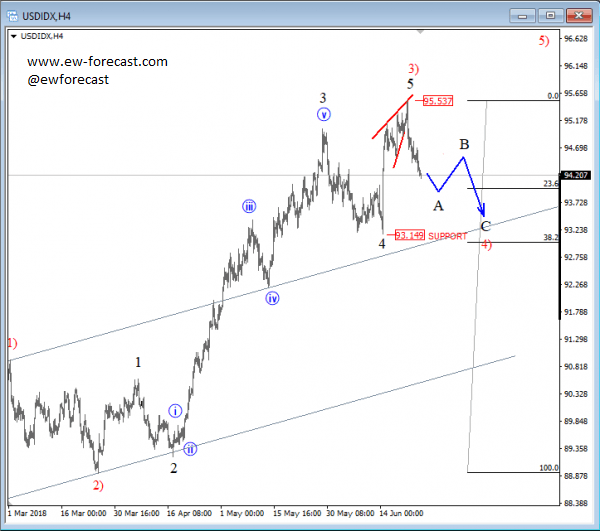
Nice and clear five waves on USD index from March lows are an indication that higher degree wave 3) is finished and a new corrective retracement can be underway. We are talking about wave 4) that can be already in play with its first leg A taking price lower. Support for the whole correction can be found near the 93.15 area where Fibonacci support ratios and the upper channel line sit.
USDJPY – Recovery on Fading Trade Fears Struggles at 110
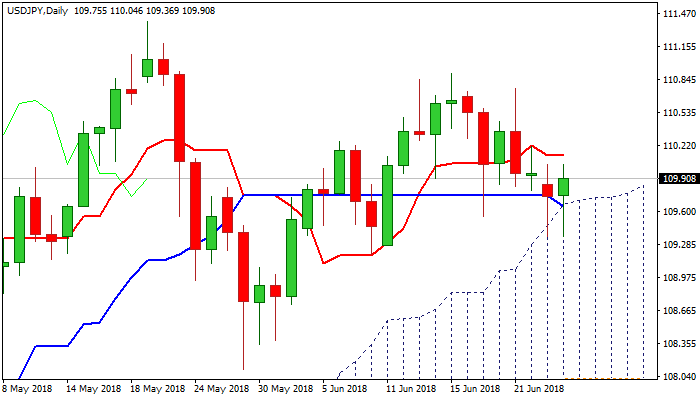
The pair moved higher as dollar strengthened on fading trade war fears and signaling repeated failure to clearly break into daily cloud.
Tuesday’s action is on track to leave the second consecutive daily candle with long tail and this time bullish, which signals rejection at strong support zone, provided by top of thick daily cloud and reinforced by rising 55SMA..
On the other side, recovery struggles at psychological 110.00 barrier which proves to be strong resistance.
The pair so far holds in the range identical to the previous day and looks for catalyst to emerge from current congestion and generate fresh direction signal.
Daily techs show prevailing bearish tone as momentum remains negative and MA’s are in bearish configuration, which keeps the downside vulnerable., but directionless mode could extend while the price holds between current boundaries.
Bearish scenario requires penetration into daily cloud and clear break below 55SMA (109.39) to shift focus lower and expose key near-term support at 108.11 (29 May low).
Conversely, sustained break above 110.00 would expose strong barrier at 110.20 (converged 200/10SMA’s) and signal further advance on break higher.
Res: 110.04; 110.20; 110.75; 110.90
Sup: 109.66; 109.39; 109.17; 108.77
Pound Still Sensitive to Brexit Talks
This week, the British Pound is looking rather weak. Investors’ attention is focused on the GDP numbers over the first quarter 2018 to be published by the United Kingdom on Friday and although investors aren’t expecting any surprises, they are trying to avoid any risks. Apart from this, the European Union Economic Summit will take place at the end of this week and the UK promised to announce its updated vision of the Brexit procedure there.
Official Brexit talks between the European Union and the United Kingdom have been going on for a year now as they started on June 19th 2017. Over this period of time, the parties have been completed the first stage of negotiations, which was mostly about legislative and law matters. They have also discussed the amount of fees and penalties to be paid by the United Kingdom for wrecking agreements. Several times, the talks were put on hold due to some serious conflicts and tensions. On paper, the negotiations will have to be completed by December this year, but there are some reasons to assume that they may linger on for a bit longer.
All this time, the Pound has been extremely “sensitive” to changes in investors’ sentiment, who were following the Brexit talks. No one expected the negotiations to be easy: there were no such cases in Europe before, that’s why the procedure may really take much time and be very complicated.
Investors, manufacturers, and businesses themselves can’t decide on how to deal with the Brexit procedure and future outlooks. The latest news said that BMW, a German multinational company that currently produces luxury automobiles and motorcycles, may decide to close its facilities, which are located in the UK, if the negotiations take much time and the company suffers losses. It’s not the first news that due to the Brexit the British economy may lose a lot of jobs offered by foreign companies. Earlier, the same was announced by Airbus. If manufacturers really decide to abandon the United Kingdom, it will extremely hurt the British economy and the Pound.
However, right now there are no reasons to expect an “exodus” of business structures from the UK. The Bank of England is doing its best to stabilize the country’s monetary system; consumer demand is high and stable and the companies and enterprises have no problems with capital.
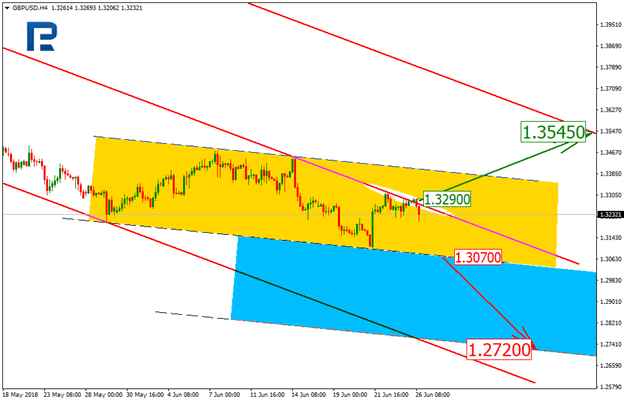
From the technical point of view, the H4 chart shows both mid-term and short-term downtrends. However, when analyzing these different downtrends, one may assume that the dominating tendency may change soon. This is mostly because the price is testing the resistance line of the major downtrend. If the price breaks the resistance line at 1.3290, it may continue trading towards the upside projected channel. The target of this possible new uptrend may be at 1.3545. Still, there might be another scenario, according to which the pair may rebound from the resistance level and start forming a new impulse to the downside with the target at 1.3070, which is the short-term support line. If this line is broken as well, the instrument may move towards the downside projected channel and its support level at 1.2720.
Japanese Yen Ticks Higher as Inflation Meets Expectations
The Japanese yen is unchanged in the Tuesday session. In the North American trade, USD/JPY is trading at 109.95, up 0.16% on the day. In Japan, the focus is on inflation data. The Services Producer Price Index edged up to 1.0%, matching the forecast. The Bank of Japan Core CPI, the bank’s preferred inflation index, dipped to 0.5%, shy of the estimate of 0.6%. In the U.S, CB Consumer Confidence dropped to 126.4, shy of the estimate of 127.6 points. On Wednesday, the U.S releases durable goods orders and Japan will publish retail sales.
BoJ policymakers appear in no hurry to make any changes to monetary policy. This was underscored in the summary of opinions of the June policy meeting, which was published on Monday. The summary, which precedes the minutes, indicated that policymakers urged the bank to ‘patiently continue’ its massive easing program. At the same time, some board members expressed concern that the program had undesirable side effects, such as ultra-low rates hurting the profitability of banks. At the June meeting, the bank maintained monetary policy but lowered its inflation forecast. With inflation mired below the BoJ’s target of just under 2 percent, the BoJ is widely expected to continue with its easing scheme well into 2019.
With global trade tensions worsening by the week, central bankers have sounded the alarm that global growth and financial stability is at risk. This was the message on Sunday from the Bank of International Settlements (BIS), which acts as an umbrella group for some 60 central banks. The BIS also warned that the escalating trade war could have negative side effects on the currency markets. With regard to Japan, the BIS warned that Japanese banks were vulnerable to funding shocks, since the banks have doubled their borrowing and lending in dollars since 2007, but do not have adequate dollar deposits to cover these loans. At the same time, analysts have noted that these are high-quality loans and in a pinch, the banks can always rely on the Bank of Japan for any dollar shortfalls.
ECB de Guindos: Risks stem from increased protectionism, oil prices and debt
ECB Vice President Luis de Guindos said Eurozone is on track for solid and broad-based growth. And there is increasing confidence for on inflation. But he also warned that "downside risks to the outlook stem from the threat of increased protectionism, rising oil prices and its impact on inflation and global growth, as well as very elevated levels of global debt."
Meanwhile, the relatively muted reactions on ECB's June policy meeting suggested that the policy stance is appropriate. He also emphasized that "monetary policy will be firmly guided by the outlook for price stability and our stance will evolve in a data-dependent and time-consistent manner."
Sunset Market Commentary
Markets:
Global core bond trading was rather uneventful today. Volumes traded remain very low. The overnight improvement in risk sentiment resulted in a weaker opening for the Bund, but the selling pressure soon evaporated, making way for a cautious upward bias. Moves in both the Bund and the US note future were technically insignificant. The EMU eco calendar was empty. ECB Hansson warned about rather big potential consequences stemming from the risk of a trade war. The German yield curve bull flattens slightly at the time of writing with yields 0.2 bps (2-yr) to 1 bp (30-yr) lower. US yields decline by 0.5 bps (30-yr) to 1.5 bps (5-yr). Italian BTP’s continue to underperform on intra-EMU bond markets following this weekend’s local election gains for Salvini’s Lega party and their centre-right coalition partners. The 10-yr yield spread vs Germany adds 9 bps. Spanish and Portuguese spreads widen by 4 bps. The Kingdom of Spain successfully launched a new 10-yr Obligacion via syndication (€7bn Jul2028). The bond was priced to yield MS +55 bps, compared MS + 57 bps guidance.
USD/JPY tested yesterday’s lows during Asian dealings in the 109.40 area. Yesterday’s risk aversion didn’t continue, which was sufficient to put a short term floor under the currency pair. EUR/USD made a lacklustre attempt to stay north of 1.17. The dollar’s general good performance today pulled the single currency back towards 1.1660.
Sterling lost ground today, especially against the dollar of course. GBP/USD dropped from 1.3290 to 1.3250 currently. EUR/GBP reversed initial weakness with EUR/GBP back around 0.8810. The move occurred during the appointment hearing of Jonathan Haskel, who’ll replace BoE McCafferty in August. Haskel said “the first risk involved in raising interest rates would be if this is done too quickly, disturbing investment and borrowing plans by more than would have been expected”. He agrees with the broad direction of travel set out by the MPC. Haskel’s inaugural comments suggest that the hawkish wing of the BoE will lose one vote (McCafferty), potentially bringing the tally back to 7-2. At last week’s BoE meeting, the central bank was split 6-3 on whether or not to hike the policy rates. The dovish wing conquered.
News Headlines:
The Shanghai Composite stock index has tumbled a little more than 20% from its 2018 high entering a bear market. Both domestic (deleveraging reduces the liquidity available) as external (trade war) factors are threatening growth and prompted a significant market sell-off.
In the first half of this year, investment in Britain’s car industry has halved relative to the same period last year. The country’s motor industry lobby blames Brexit-uncertainty about the UK’s future relationship with Europe and urges PM May to keep the UK in the EU’s customs union.
EU trade commissioner Cecilia Malmstrom warns of the consequences for US companies and consumers from a tit-for-that trade war after Harley-Davidson’s decision to move some production out of the US. She added the EU was still rolling out its response to Trump’s trade tariffs. Provisional safeguard measures to shield the EU from a surge of steel and aluminium imports due to the US restrictions ought to be in place by mid-July.
In the US, Conference Board consumer confidence edged down a little (from a revised 128.8 to 126.4) but remains lofty. On the producer side, the Richmond Fed Manufacturing Index climbed from 16.0 to 20.0.
US consumer confidence dropped to 126.4, not foresee the economy gaining much momentum in the months ahead
Conference Board US consumer confidence dropped to 126.4 in Jun, down from 128.8 and missed expectation of 127.6.
Quote from the release by Lynn Franco, Director of Economic Indicators at The Conference Board:
"Consumer confidence declined in June after improving in May,"
"Consumers' assessment of present-day conditions was relatively unchanged, suggesting that the level of economic growth remains strong.
While expectations remain high by historical standards, the modest curtailment in optimism suggests that consumers do not foresee the economy gaining much momentum in the months ahead."
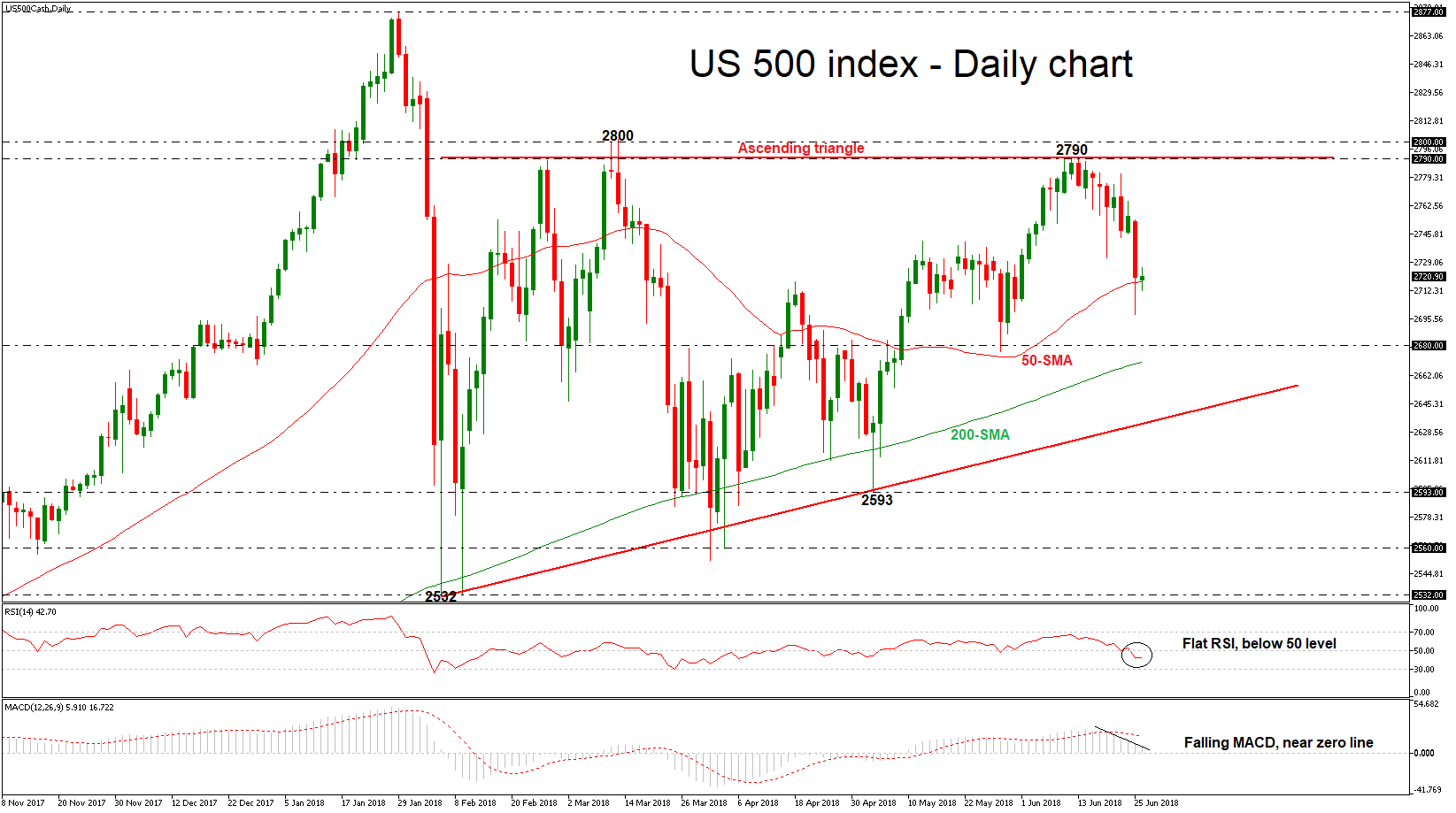
US 500 Index Retreats after Red Day; Develops in Ascending Triangle in Long Term
The US 500 index recorded a strong bearish day on Monday, losing more than 1% from its performance but remained above the 50-day simple moving average (SMA). However, the index is trading within an ascending triangle started on February 6, but there is no change in the longer timeframe from the latest movement.
Momentum indicators in the daily chart though are currently supporting that the negative momentum is likely to strengthen in the short-term. Specifically, the RSI is flattening below 50 and the MACD continues the falling momentum below its red trigger line.
Should the price decisively close below the 50-SMA, bears could extend the downward movement towards the 2680 region, which has been a major support in the past. Further decreases below this level, could then target the area around the 200-SMA, near 2669.8 at the time of writing. In case of a slip below this line, the next barrier to watch is the uptrend line, currently near 2650.
On the flip side, an advance could meet the 2790 resistance level, taken from the peak on June 12. Slightly above this zone, the price could retest the March 13 high of 2800.
Overall, in the bigger picture, the index remains below the key level of 2790, which is acting as the upper boundary of the ascending triangle, indicating that the price needs stronger momentum for continuing the upward rally.
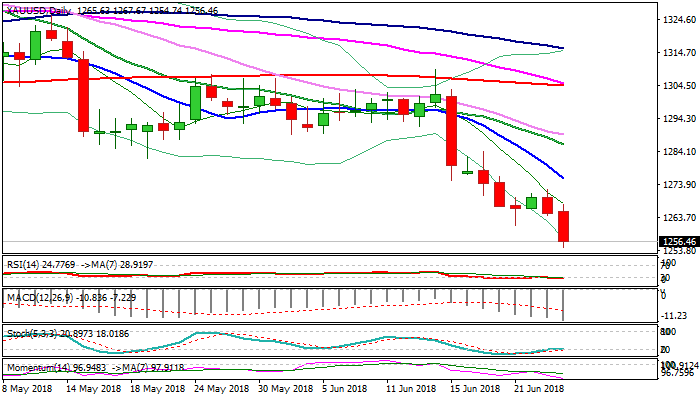
XAUUSD outlook: Bears Could Extend Towards Key Support at $1236; Falling 10SMA to Cap Upticks
Spot Gold holds firmly in red for the second straight day as the greenback regained traction but showed no benefits from safe haven demand on risk aversion, sparked by fears of deeper trade conflict.
The yellow metal hit new over six-month low at $1255 on Tuesday, pressuring string support at $1252 (weekly cloud base), break of which would open way towards key med-term support at $1236 (12 Dec 2017 trough).
Momentum and RSI continue to trend lower, deeply in negative territory, with bearish setup of daily MA’s, completing negative technical outlook.
Bears could take a breather before resuming higher as slow stochastic is attempting to reverse from oversold territory, but consolidation is likely to be limited.
Falling 10SMA ($1275) is expected to cap extended upticks and keep bearish structure intact.
Res: 1261; 1267; 1272; 1275
Sup: 1255; 1250; 1243; 1236