Sample Category Title
Forex Analysis: GBPAUD
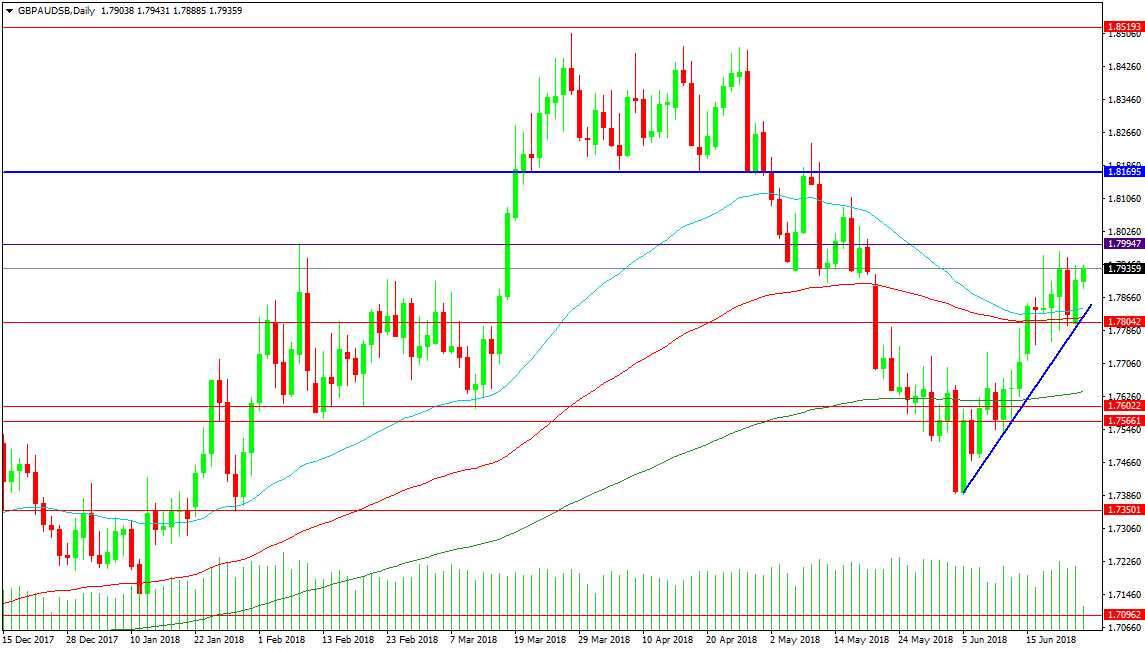
The GBPAUD pair has retraced part of the selloff from May and is approaching resistance ahead of 1.80000 while leaning on the rising supporting trend line from the June lows. The 1.79947 level halted the advance in February and is a key level for this pair. Resistance overhead comes in at 1.81695 which provided support for price through April and can be a solid area until price breaks above and potentially converts it to support. The high for 2018 comes in at 1.85062 with previous resistance just above at 1.85193 the target for the next leg higher.
Support for the pair comes at the combination of the 50 DMA at 1.78390 and the 100 DMA and rising trend line at 1.78178. The 1.78000 level is also supportive and this block of levels can see strong buying. However a break under the area can force buyers to close positions and can result in a drive to the 200 DMA at 1.76367 or the 1.76000 level itself. This level has seen consolidation in the recent past with dips to the June low at 1.73900 being bought. The 2018 low is found at 1.70962.
DAX Dips To 2-Week Low As Trade Row Spooks Investors
The DAX index has started the trading week with sharp losses. In the Monday session, the DAX is at 12,309, up 0.32% on the day. There are no German or eurozone events on the schedule.
It continues to be a rough June for the DAX, which has slipped 2.8 percent. European equity markets remain under pressure, as investors cast a nervous eye on the escalating trade tariff between the U.S and its major trading partners. On Friday, the EU slapped retaliatory tariffs of some 25% on $3.3 billion of U.S goods. This move was in response to U.S tariffs on EU steel and aluminum imports. However, President Trump has more cards up his sleeves and has threatened to impose 20% tariffs on EU vehicles. This threat has sent automobile stocks on the DAX sharply lower on Monday. Daimler is down 2.29% and BMW has fallen 1.49%. On Thursday, Daimler said that trade tensions would affect its sales. BMW exports cars from the U.S to China and Europe, so the trade battles could have a negative impact on the company’s revenues. Later this week, the U.S Treasury Department is expected to announce restrictions on Chinese investment in the U.S, as part of the government’s efforts to curtail alleged intellectual property theft by the Chinese. This would mark a significant escalation of the trade battle with China, and a strong Chinese response could shake up the fragile global stock markets.
Major central bankers have expressed alarm at the recent protectionist moves, and the Bank of International Settlements (BIS), an umbrella group for 60 central banks, weighed in on the crisis on Sunday. The BIS said that a global trading war is putting growth and financial stability at risk, and also warned that this could have negative side effects on the currency markets. At the same time, the BIS expressed support for the Federal Reserve raising interest rates gradually and for the ECB heading towards normalization as it winds up its massive asset program.
EUR/USD – Lack Of Data Leaves Euro Treading Water
EUR/USD has edged lower in the Tuesday session, after posting modest gains on Monday. Currently, the pair is trading at 1.1675, down 0.24% on the day. It’s a quiet day on the release front, with no eurozone events. In the U.S, the key event is CB Consumer Confidence, which is expected to drop to 127.6 points. On Wednesday, the U.S releases durable goods reports.
The euro continues to have a quiet week, but trade tensions continue to simmer between the U.S and its trading partners. Although the headlines have been dominated by the trade between the U.S and China, the European Union has also been drawn into the frey. On Friday, the EU slapped 25% tariffs on $3.3 billion of U.S goods. This move was in response to U.S tariffs on EU steel and aluminum imports. However, President Trump has more cards up his sleeves and has threatened to impose 20% tariffs on EU vehicles. Such a move could take a toll on German auto giants Daimler and BMW and could sour investors on the euro. The EU has enough on its plate without a trade war with the U.S, and has launched a complaint over the U.S tariffs with the World Trade Organization. Still, the EU has not shied away from retaliatory moves, with EU Commission President Jean-Claude Juncker saying that the EU’s response would be “clear but measured”. The U.S Treasury Department is expected to announce restrictions on Chinese investment in the U.S, as part of the government’s efforts to curtail alleged intellectual property theft by the Chinese. This would mark a significant escalation of the trade battle with China, and a strong Chinese response could shake up the currency markets.
There is widespread concern that recent protectionist moves could hamper global growth and financial stability. This was the message on Sunday from the Bank of International Settlements (BIS), which acts as an umbrella group for some 60 central banks. The BIS also warned that the esclating trade war could have negative side effects on the currency markets. At the same time, the BIS expressed support for the Federal Reserve raising interest rates gradually and for the ECB heading towards normalization as it winds up its massive asset program.
BoE Haskel agrees with MPC’s broad direction of travel
New BoE MPC member Jonathan Haskel testifies in the parliament today. On interest rates he said that "at this stage, I would merely say that given current conditions and current economic data, I agree with the broad direction of travel (of the BoE's current guidance)."
But he pointed out that "ultimately, long run consumer demand depends on how much (perceived long run) incomes grow and how much is saved or spent." And, "in recent years savings rates seem to have declined and thus consumption has been stronger than was expected. I would expect that savings rates would fall assuming the outlook for wages and productivity remains subdued." Therefore, he predicted that " outlook for consumer spending in the UK is that it will be similarly subdued."
On Brexit, Haskel said "what all of this hangs on is the extent to which we can re-negotiate advantageous supply trade relationships, trade and services and all of those kinds of things." And, "If they can be negotiated and we can be in a good place, then the economy can keep on growing. If we're in a bad place, then I think most people will agree there may at least be a temporary lull."
Haskel's term will start in September. That is, after the highly anticipated August BoE MPC meeting, when a rate hike is on the table.
Harley Gang Backfires On Trump
USA President Donald Trump's careless trade policy is backfiring. Protective duties have unintended consequences: motorcycle-maker and Americana-bastion Harley-Davidson said in a regulatory filing that Trump tariffs will displace its production of its European- bound motorcycles to the European Union. Harley estimates that Trump tariffs on steel and aluminium would add an addition $2,200 to the cost of each bike sold in Europe. This, after the EU said on Friday it will hang EUR 2.8 billion of tolls on US imports including bourbon whiskey, jeans and motorcycles.
Harley's stock fell sharply, down more than 5% at one point. However, it's difficult to tell if the move was purely about tariffs or general weakness at the company. Since the start of 2018 plant closures and subsequent layoffs of some 800 workers have been impossible to miss – despite Republican lawmakers claiming Harley benefits from Trumps trade and tax policy.
Trump misses that only 20% of world's trade is conducted with the USA and partners. The other 80% is transacted between non-US nations. Shifting production to the EU not only avoids US trade wars, but gives access to other markets without trade barriers. If trade relations with China, the EU and NAFTA spiral out of control, the US will be isolated. This policy shift from taxes to tariffs is unsettling markets. In the current environment (plus expectations for the European Central Bank), we see long Euro as the idea position.
Pot is good for you – says FDA
The USA's Food and Drug Administration has approved America's first cannabis-based drug, Epidiolex, for use against epilepsy. Tested on 2,000 patients since 2007, the medicine will be available for patients with severe Lennox-Gastaut or Dravet epilepsy in a few months. Similar approvals are in progress at the European Medicines Agency with deadlines of Q1 2019. Epidiolex's maker, GW-Pharmaceuticals, is also waiting on approval of its multiple sclerosis treatment, Sativex, which is in phase 3 testing by the FDA and already commercialized in 30 countries worldwide.
This news highlights the growth potential of the cannabis industry. It continues to achieve key milestones, thus strengthening investment opportunities in the long-run. As GW Pharmaceuticals' CEO Justin Gover says: “We now remove ourselves from being a special case and meet the standard criteria for prescription medications.” The healthcare sector finally recognises cannabis as a legitimate medicine.
Forex Technical Analysis: EUR/USD, USD/JPY, GBP/USD
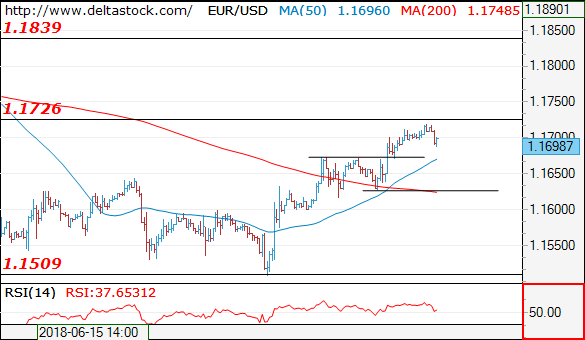
EUR/USD
Current level - 1.1698
The rise peaked below 1.1730 and the intraday outlook is already negative, for a slide towards 1.1600 area. Initial support lies at 1.1670, followed by the crucial 1.1625.
| Resistance | Support | ||
| intraday | intraweek | intraday | intraweek |
| 1.1730 | 1.1730 | 1.1670 | 1.1510 |
| 1.1830 | 1.1830 | 1.1600 | 1.1300 |
 USD/JPY
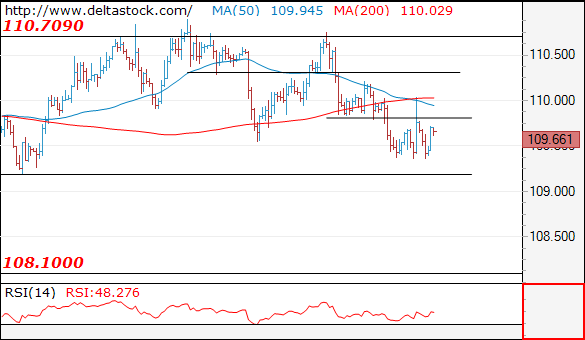
Current level - 109.66
The downtrend from 110.80 is still underway, aiming at 109.20, en route to 108.60. Initial hurdle lies at 109.80.
| Resistance | Support | ||
| intraday | intraweek | intraday | intraweek |
| 109.80 | 111.40 | 109.20 | 107.80 |
| 110.80 | 114.40 | 108.60 | 106.70 |
GBP/USD
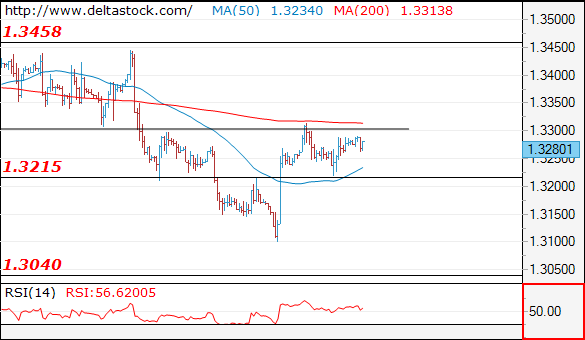
Current level - 1.3280
The intraday bias is neutral, with a risk of another slide towards 1.3215 support area, before advancing towards 1.3350.
| Resistance | Support | ||
| intraday | intraweek | intraday | intraweek |
| 1.3310 | 1.3618 | 1.3215 | 1.3040 |
| 1.3460 | 1.3990 | 1.3100 | 1.3040 |
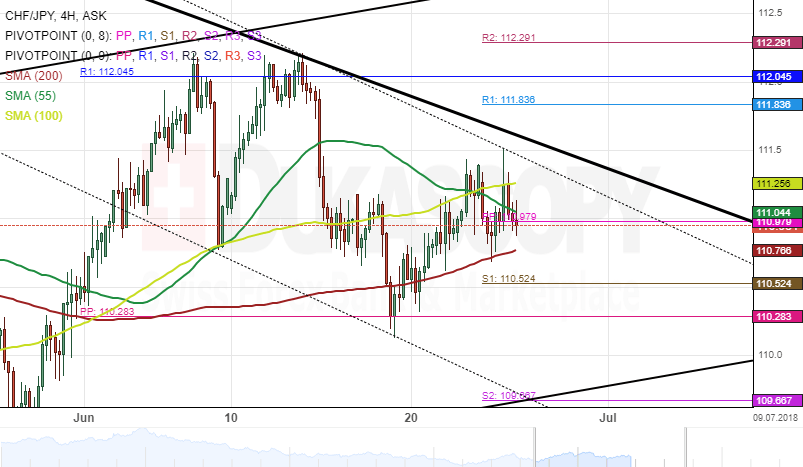
CHF/JPY 4H Chart: Reveals New Pattern
The Swiss Franc has appreciated significantly against the Japanese Yen since the beginning of May. The surge began after the exchange rate hit the weekly support level at 108.64.
However, during the past few weeks, the currency pair has formed a new junior descending pattern which is driving the pair lower as can be observed on the chart. At the time of this analysis, the rate stranded between SMAs.
Everything being equal, the CHF/JPY currency exchange rate is likely to maintain the newly formed junior descending channel during the following week until it reaches the lower boundary of a secondary pattern.
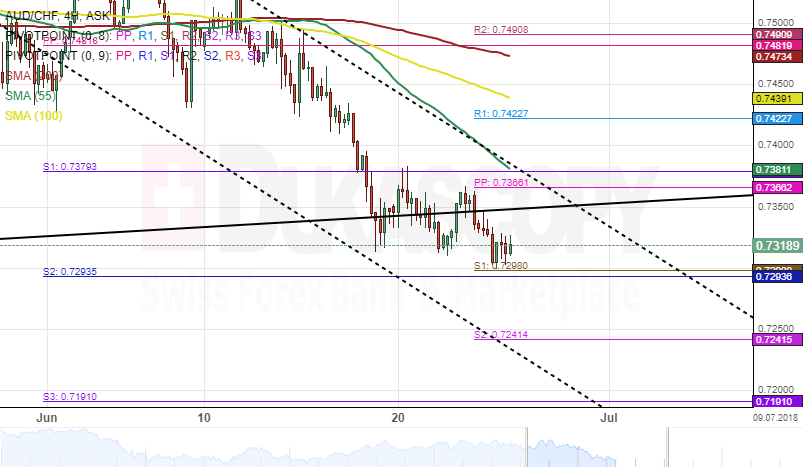
AUD/CHF 4H Chart: Bearish Sentiment
Following up on last week analysis for the AUD/CHF currency pair. Bears have continued their dominance in the market and drove the exchange rate lower towards a support cluster set by the weekly and the monthly pivot points near the 0.7293 mark.
Given that a breakout had occurred through the bottom border of an uptrend line, the rate could be set for a long-term decline. Moreover, the 55-hour simple moving average has guided the pair lower.
Technical indicators flash bearish sentiment; therefore, bears are likely to grow stronger within the next trading sessions.
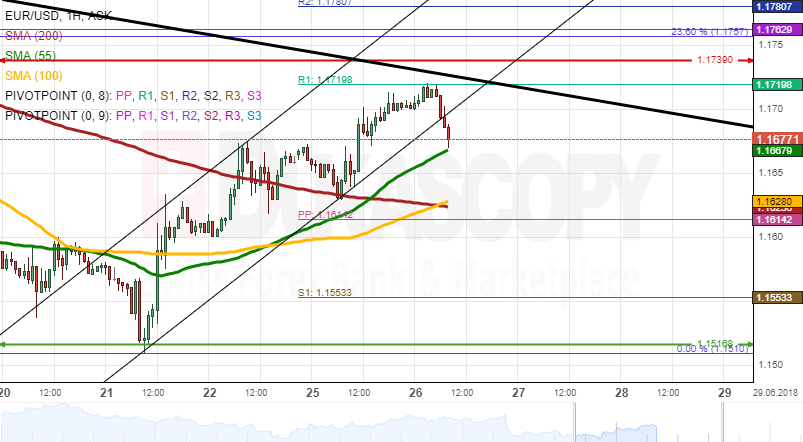
EURUSD Analysis: Unlikely To Surpass Resistance
The common European currency continues to strengthen against its American counterpart in a short-term ascending channel.
The pair managed to accelerate from the 200-hour SMA on Monday, and it was trading at the 1.1720 mark early today. This 1.1740/50 range coincides with the weekly R1, the upper boundary of a four-month channel down, a historically strong support/resistance level and the 200-period (4H) SMA.
The Euro has returned to the overbought territory, and technical indicators flash strong bearish signals. Thus, the 1.1750 area is expected to be a point of reversal that should pressure the rate lower down to the 55-, 100– and 200-hour SMAs near 1.1630.
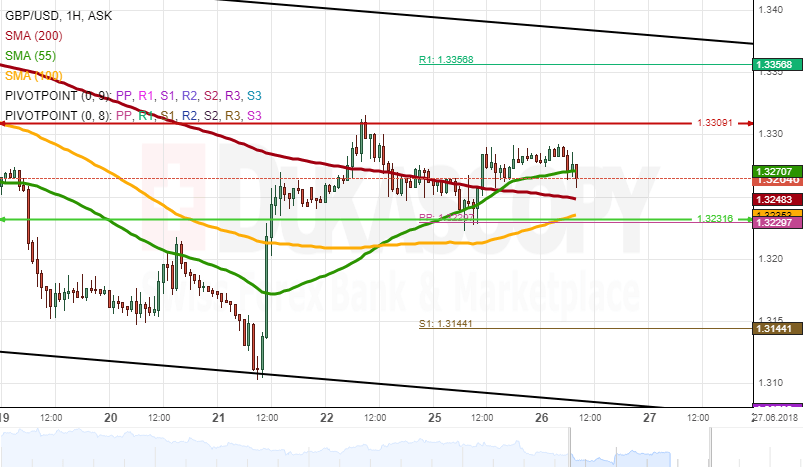
GBPUSD Analysis: Continues Ranging
GBP/USD has not left the 1.3215/1.3310 range for three consecutive sessions. This has been mainly due to the 55– and 200-hour moving averages which have pressured the Pound from both directions.
The former has guided the pair for the last trading session; thus, it might continue doing so today, as well. However, traders should consider the 100-period (4H) SMA which is strengthening the upper range boundary.
In case this resistance is breached, the pair should target the 200-period SMA, the weekly R1 and the upper boundary of a two-month descending channel near 1.3350.
Conversely, a failure to move above 1.3310 is likely to result in the Sterling remaining in the above range and continuing to trade sideways, as the 1.3215 level is showing some strong support.