

Sample Category Title
XAUUSD Intraday Analysis
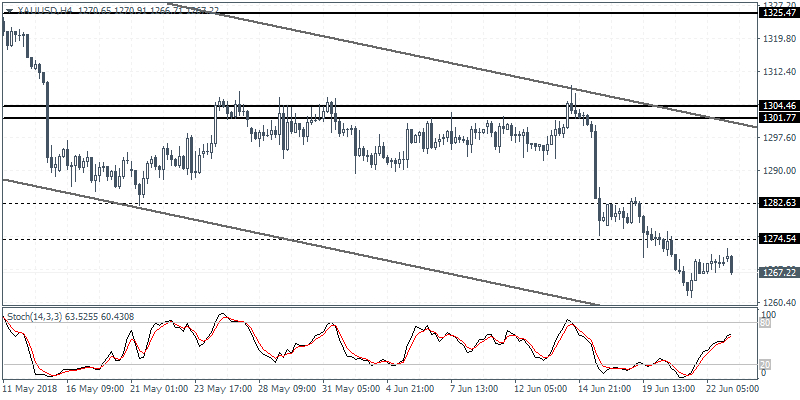
XAUUSD (1267.22): Gold prices are seen easing their declines with price action on the daily chart closing with a doji pattern on Thursday and a follow through with some bullish gains on Friday. This pattern potentially indicates some upside momentum in price action. Gold prices will now have to test the resistance level at 1274 region in order to post any further gains. The downside is likely to be limited for the moment. A breakout from 1274 could keep price action under pressure within the 1282 and 1274 price levels.
USDJPY Intraday Analysis
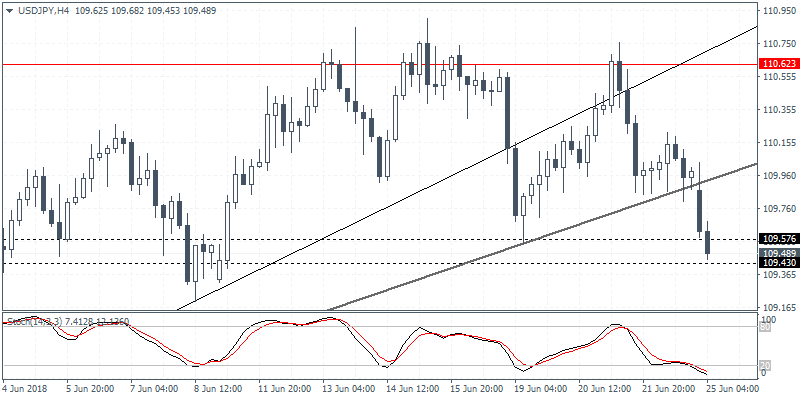
USDJPY (109.48): The USDJPY currency pair was seen testing the dynamic support of the major rising trend line. While this could offer some upside support in the near term, we expect that the momentum has eased a bit. The USDJPY could potentially turn higher but form a lower high. To the downside, a breakout from the rising trend line could trigger a decline to the support level at 109.57 - 109.43 region. Establishing support at this level could keep the currency pair supported in the near term.
German Ifo dropped to 101.8, fell markedly in trade
German Ifo business climate dropped to 101.8 in June, down from 102.3, slightly higher than expectation of 101.7. Current assessment dropped to 105.1, down from 106.1 and missed expectation of 105.6. Expectations gauge was unchanged at 98.6, meeting consensus.
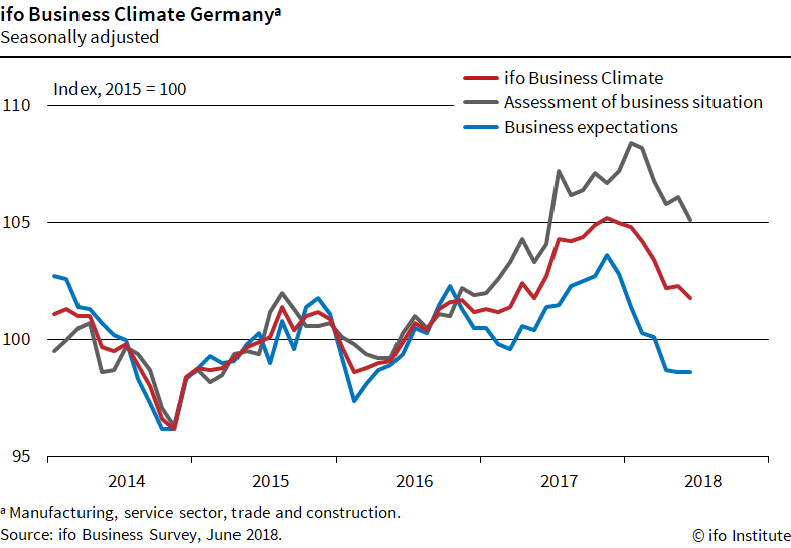
Ifo President Clemens Fuest noted in the release that companies were less satisfied with their current business situation while business expectations remained slightly optimistic. Nonetheless, "the tailwind enjoyed by the German economy is calming down."
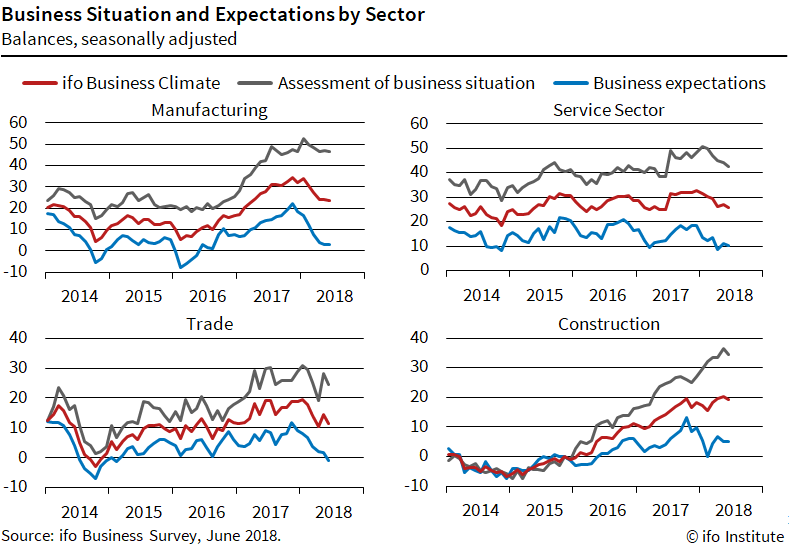
He also pointed out that the index "fell markedly in trade". "Companies downwardly revised their very good assessments of the current business situation. Their business outlook turned slightly pessimistic for the first time since February 2015. Indicators dropped far more sharply in retailing than in wholesaling."
EURUSD Intraday Analysis
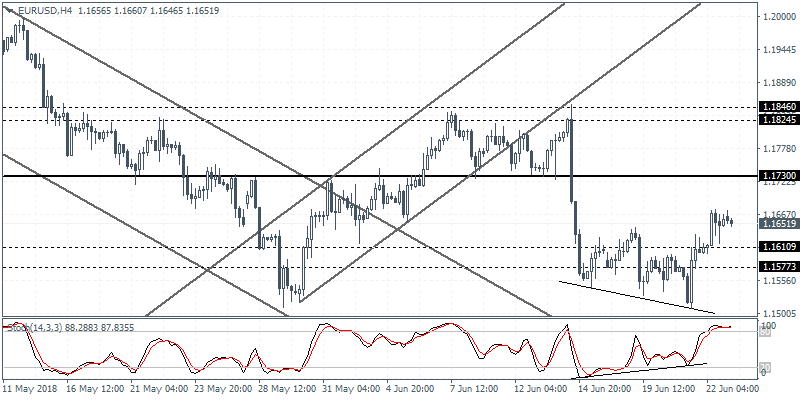
EURUSD (1.1651): The EURUSD currency pair managed to turn bullish on Friday following through from Thursday's gains. Price action posted a rebound off the support level near 1.1539 level with the bullish divergence being validated on the 4-hour chart. To the upside, we now expect the currency pair to test the resistance level at 1.1730 and the EURUSD could potentially turn into a sideways range within these levels. A breakout above 1.1730 could trigger further gains toward the 1.1824 - 1.1846 level of resistance. To the downside, the declines are limited as long as the support at 1.1610 is not breached.
OPEC Agrees To Hike Oil Production
Economic data on Friday was mixed but the U.S. dollar was seen giving up some of the gains made from earlier in the week. Japan's national core CPI data showed a 0.7% increase on the year, unchanged from the month before.
In the Eurozone, the preliminary manufacturing and services PMI data showed a somewhat mixed picture. While the manufacturing PMI for the Eurozone eased to 55.0, services sector surged ahead with the index rising to 55.0 up from 53.8 in the previous month.
OPEC leaders were seen reaching an agreement to raise production by an additional one million barrels per day. Crude oil prices surged on the news.
In the U.S. trading session, data from Canada dominated the headlines. Canada's inflation increased just 0.1% on the month putting the annual inflation rate to 2.2%, which was unchanged from the month before. Retail sales however disappoint,compared to the previous month, raising doubts on whether the BoC could hike rates in July.
Looking ahead, the economic calendar for the day is quiet. The German Ifo business climate data is expected to be released. Forecasts show that business expectations might have eased to 101.9. In the U.S. trading session, new home sales data is expected to show a modest increase to 665k on the month, up from 662k registered the month before.
GBPUSD Outook: Risk Aversion And Brexit Concerns Weigh On Cable
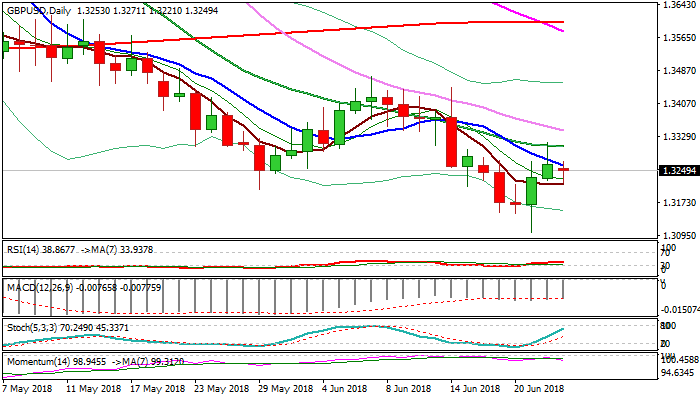
Cable trades within narrow range on Monday, holding between 10SMA (1.3260) and 5SMA (1.3215) after recovery action was capped by 20SMA on Friday (1.3308) and subsequent pullback marked strong rejection here.
Risk aversion on escalation of trade conflict between US and China weighs on cable, along with deepening row between UK government and business leaders over Brexit.
Near-term risk remains skewed lower as daily techs are overall bearish and see risk of retesting key supports at 1.3101 (21 June low) and 1.3073 (weekly 100SMA).
Close below 5SMA pivot is needed to confirm bearish scenario, while lift and close above 20SMA would sideline bearish threats and open way for extension of recovery leg from 1.3101. Break above 1.3330 (Fibo 61.8% of 1.3472/1.3101) is needed to confirm reversal.
Res: 1.3261, 1.3305, 1.3330, 1.3343
Sup: 1.3218, 1.3146, 1.3101, 1.3073
EUR/CHF Daily Outlook
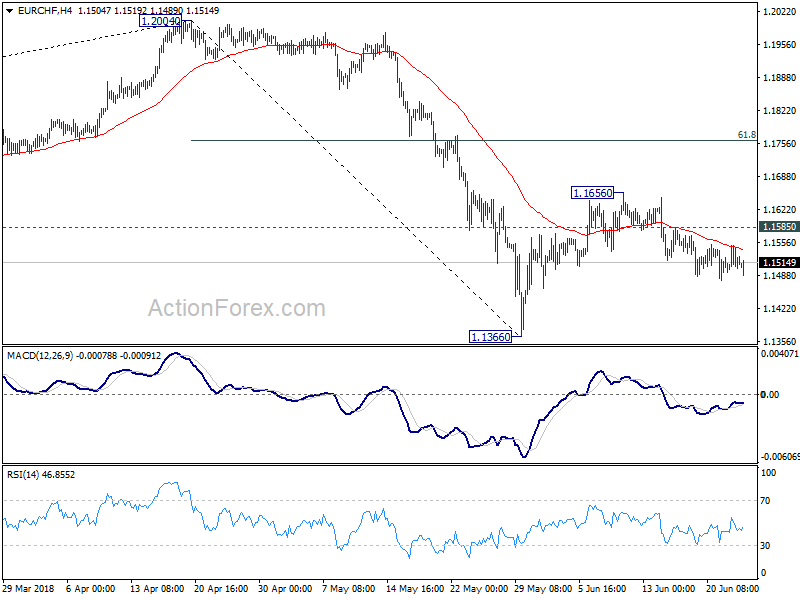
Daily Pivots: (S1) 1.1490; (P) 1.1521; (R1) 1.1545; More....
With 1.1585 minor resistance intact, deeper fall is expected in EUR/CHF to 1.1366 low. Break there will resume the corrective fall from 1.2004. On the upside, though, above 1.1585 will likely extend the rebound from 1.1366 through 1.1656. But in that case, upside should be limited by 61.8% retracement of 1.2004 to 1.1366 at 1.1760.
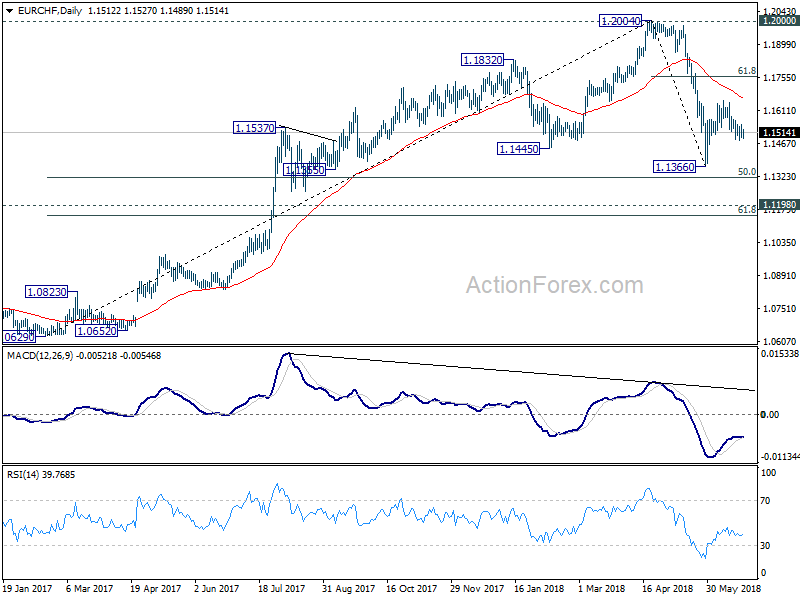
In the bigger picture, current development suggests solid rejection by prior SNB imposed floor at 1.2000. Considering bearish divergence condition in daily and weekly MACD, 1.2004 should be a medium term top. And price action from 1.2004 is correcting the up trend from 1.0629. Such correction is expected to extend for a while and therefore, we're not anticipating a break of 1.2004 in near term. Another decline cannot be ruled out yet. But in that case, strong support should be seen at 1.1198 (2016 high), 61.8% retracement of 1.0629 to 1.2004 at 1.1154 to contain downside.
EURUSD – 20SMA Caps Recovery For Now, German Ifo Data In Focus
The Euro stands at the back foot in early European trading on Monday, ahead of release of German Ifo business climate data for June.
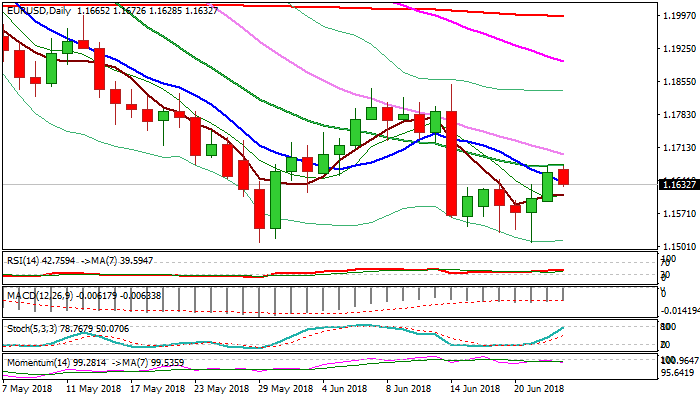
Two-day recovery off last week's low at 1.1508 failed to break 20SMA (1.1674) on Friday and early Monday's action remains capped here.
The resistance is reinforced by converged daily Tenkan-sen/Kijun-sen and also marks 50% retracement of 1.1848/1.1508 fall, marking strong obstacle, where recovery showed signs of stall.
Weakening momentum and daily 10, 20, 30 SMA's holding in bearish setup, support negative scenario, which needs close below 5SMA (1.1611) to confirm hourly double-top and signal further weakness.
German Ifo Business climate is forecasted at 101.9 in June vs 102.2 in May and release above consensus would signal reversal after the index was down for four straight months.
Bullish scenario requires sustained break above 20SMA to signal further retracement of 1.1848/1.1508 descend and expose next pivotal barrier at 1.1718 (Fibo 61.8%).
Res: 1.1674, 1.1698, 1.1718, 1.1767
Sup: 1.1628, 1.1611, 1.1591, 1.1571
DJI30 Bearish Equidistant Channel In Progress
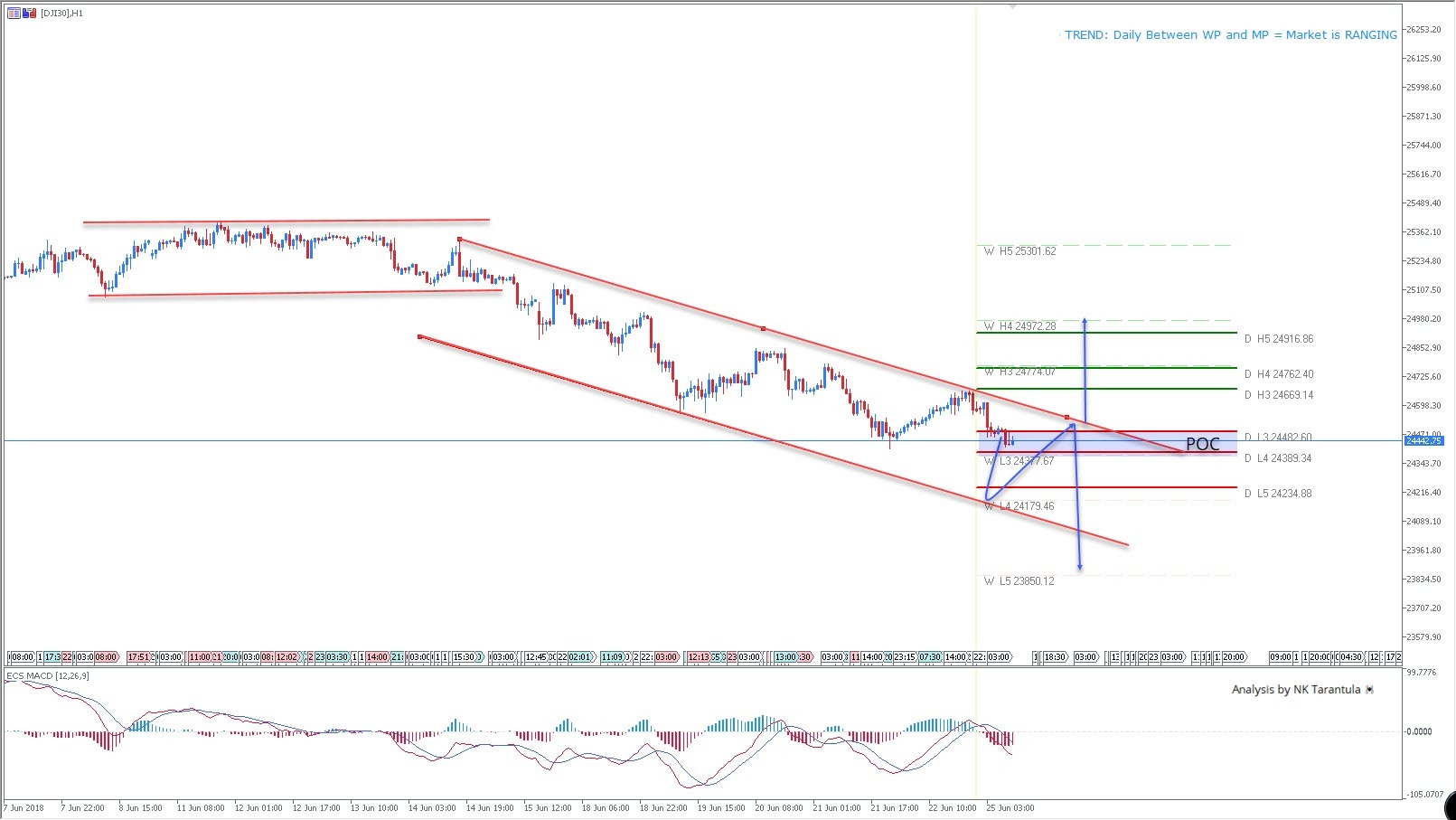
The DJI30 has been trapped in an equidistant channel suggesting further bearish continuation. Of course, continuation should happen if the price stays within the channel/PP boundaries, else there could be a spike to the upside. The POC 24390-24483 might reject the price to the upside targeting 24234 and 24179. Only below the channel bottom, the DJI30 might hit 23850 – strong weekly resistance. The upside might be exposed if the index breaks above 25000. Targets are 24774 and 24972.
W L3 - Weekly Camarilla Pivot (Weekly Interim Support)
W H3 - Weekly Camarilla Pivot (Weekly Interim Resistance)
W H4 - Weekly Camarilla Pivot (Strong Weekly Resistance)
D H4 - Daily Camarilla Pivot (Very Strong Daily Resistance)
D L3 – Daily Camarilla Pivot (Daily Support)
D L4 – Daily H4 Camarilla (Very Strong Daily Support)
POC - Point Of Confluence (The zone where we expect price to react aka entry zone)
Lira Jumps Higher On Erdogan Victory – But Will The Momentum Last?
All eyes are on the Turkish Lira this morning with the currency rallying sharply in early trade today, following the news that Turkish President Recep Tayyip Erdogan has won the weekend election in Turkey. The Lira had advanced as much as 3%at time of writing with the currency currently standing as the only emerging market to be trading higher against the USD. The improved sentiment in the Lira is likely linked to confirmation of continued political leadership in Turkey.
There will be some underlying concerns over whether this buying momentum for the Lira could actually last, especially when you consider that fears over the repercussions of an Erdogan victory had been one of the primary drivers behind the collapse in the Turkish Lira over the first half of 2018. There is every possibility that the rally in the Lira could be temporary. The currency has weakened beyond 20% during the first half of 2018, with one of the main contributors behind the Lira weakness being that Erdogan had promisedto become an influence in economic matters and central bank policy if he won the election.
Whether the Lira can actually maintain its strength over the next couple of days will be somewhat reliant on how international investors react to the news that Erdogan will have an extended rule of power in Turkey. Investor confidence in Turkey has suffered in the aftermath of fears that central bank independence would be at heavy threat in the event of an Erdogan victory, and it will take some serious convincing for investors to move back into Turkish assets.
The possibility that the impressive rally this morning in the Lira could just be temporary shouldn’t be ruled out. I would expect for investors to closely monitor the developments in Turkey over the upcoming period. If there is an air of calm within Turkey it would be seen as a positive for the Lira, however any reports that the central bank will be instructed to significantly lower interest rates would be seen as a major threat for the currency.
The other major headline in the FX markets is news of the Chinese Yuan weakening to its lowest level since December 2017. Fears over the possible ramifications that a trade war between the United States and China would have on the Chinese currency appear to have encouraged the Yuan to withdraw its previous gains in 2018 against the Dollar. The Yuan has now lost nearly 0.3% year-to-date, where it was previously seen as one of the best performing emerging market currencies this year.
There is speculation that the People’s Bank of China (PBoC) might be deliberately weakening the Yuan in an effort to strengthen the Chinese economy, in the event that the world’s two largest economies do actually get involved in a trade war. The central bank reduced the reserve ratio requirement for commercial banks by half a percentage point over the weekend, which some have attributed to providing the local economy with some ammunition should the trade war concerns with the United States intensify.
Elsewhere and in a week where political risk will still likely play a leading role in driving market sentiment, an exception to this rule will be traders keeping a close eye on a scheduled speech from Bank of England (BoE) Governor Mark Carney this coming Wednesday. Any comments on the future direction of UK interest rate policy will be particularly observed by the financial markets, after the Monetary Policy Committee (MPC) unexpectedly voted 6-3 to keep interest rates unchanged during the most recent policy meeting.
The news that BoE Chief Economist Andy Haldane had unexpectedly voted for a UK interest rate increase in June has revived optimism that the BoE might be closer to raising UK interest rates than anyone would expect. This optimism has also encouraged the GBPUSD to rebound away from its lowest level this year.