Sample Category Title
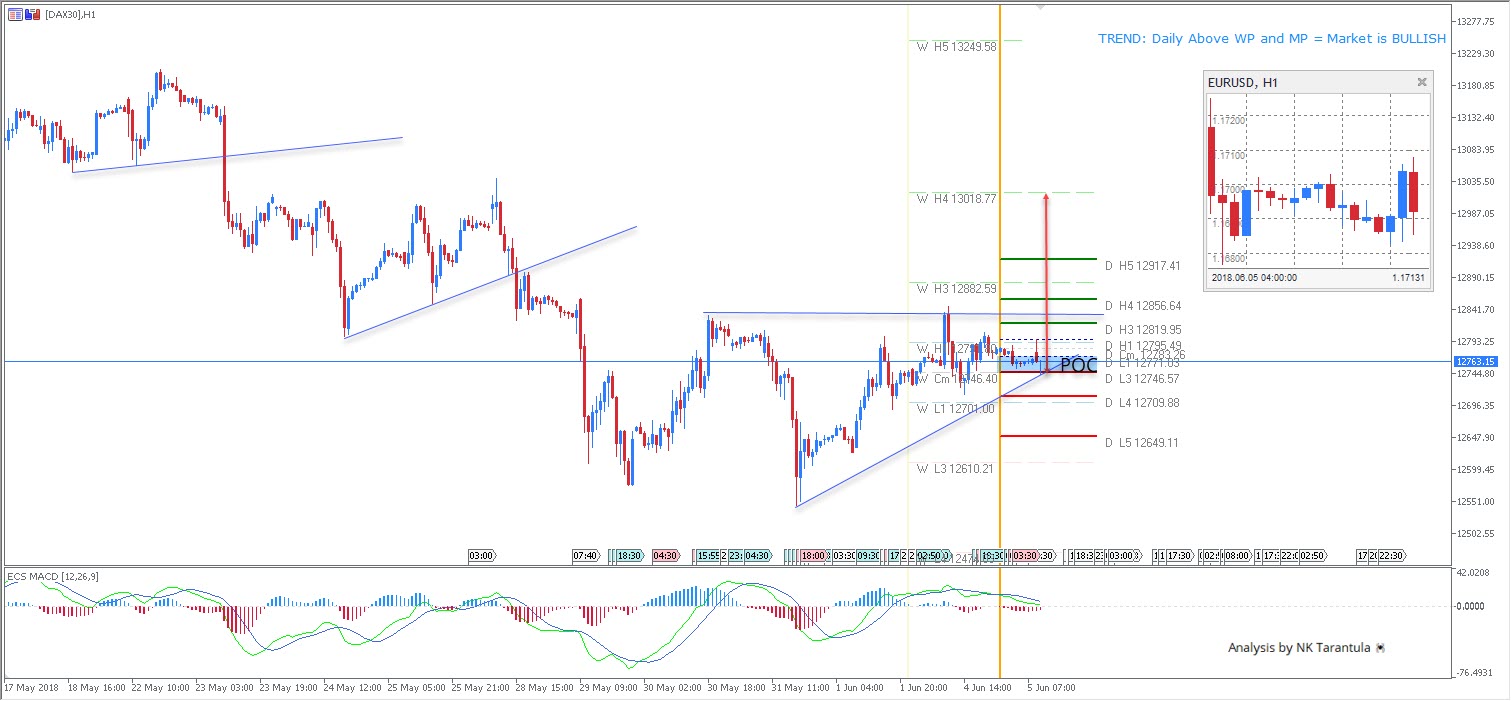
DAX30 Flat Top Ascending Triangle
EUR/USD movement is very important for the understanding of Dax and its unhedged exporters that benefit from a strong USD. Asian Equities rose slightly today, but the Dax 30 still has a resistance to break. The flat top ascending triangle is generally a bullish pattern and only the break of 12819 or 4h close above it, should provide a bullish continuation move. From the POC zone - 12745-12775, the price could bounce towards 12819. Breakout targets 12882 and 12917. Only a strong close above will target 13018 – Weekly H4 level.
W L3 - Weekly Camarilla Pivot (Weekly Interim Support)
W H3 - Weekly Camarilla Pivot (Weekly Interim Resistance)
W H4 - Weekly Camarilla Pivot (Strong Weekly Resistance)
D H4 - Daily Camarilla Pivot (Very Strong Daily Resistance)
D L3 – Daily Camarilla Pivot (Daily Support)
D L4 – Daily H4 Camarilla (Very Strong Daily Support)
POC - Point Of Confluence (The zone where we expect price to react aka entry zone)
WTI Crude Oil Futures Trade Below Ascending Trend Line, Shift From Positive Outlook To Negative
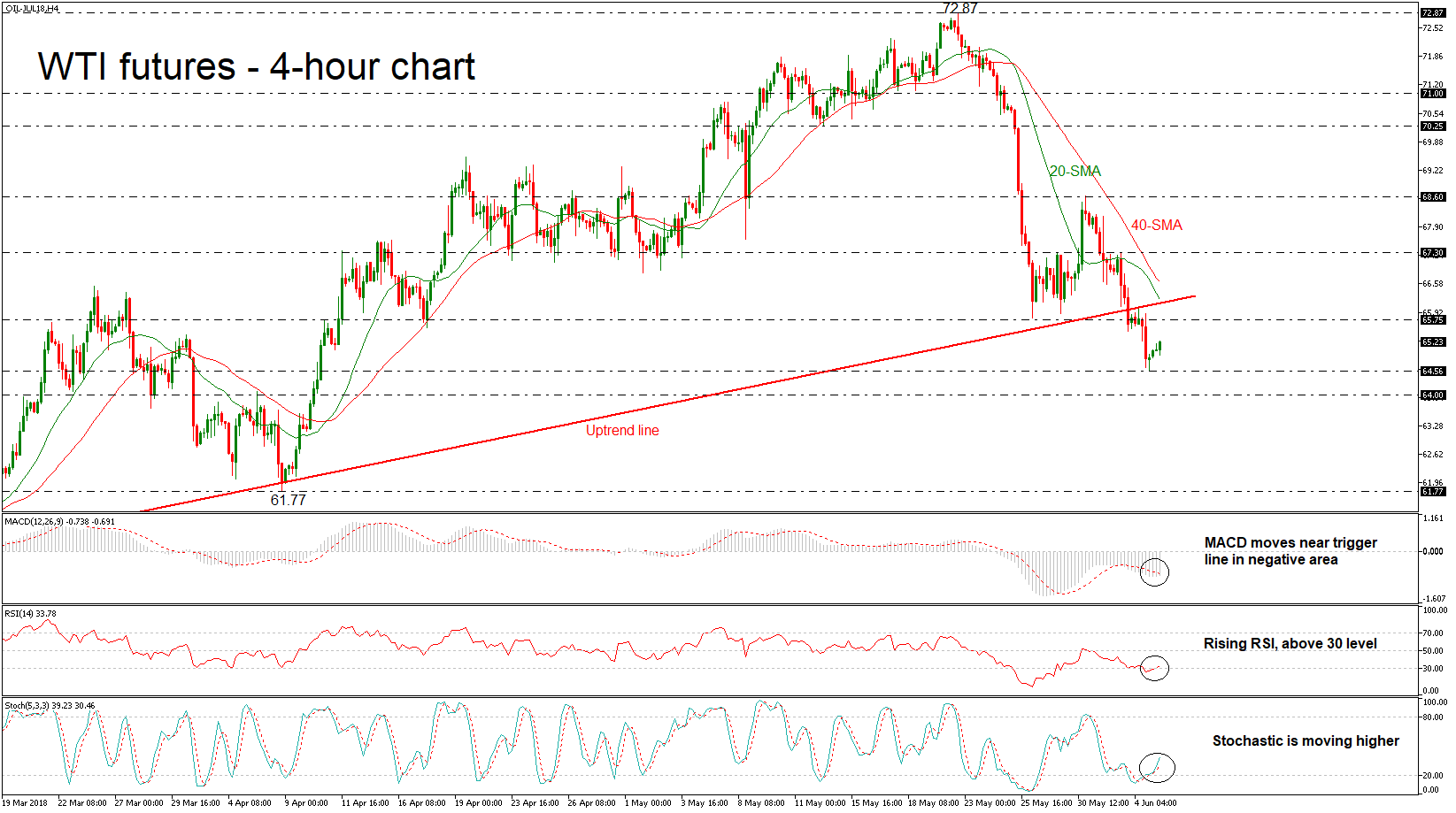
West Texas Intermediate crude oil futures fell sharply lower during yesterday’s trading session and penetrated the medium-term ascending trend line to the downside. The price reached a fresh two-month low of 64.56, shifting the bullish outlook to bearish. Currently, the price is moving slightly higher while the short-term technical indicators are endorsing the scenario for a minor correction.
Looking at momentum indicators, the RSI indicator is rising after the rebound on the oversold region, while the MACD oscillator is ready for a bullish crossover with its trigger line. Moreover, the %K line of the stochastic oscillator is moving above the %D line, suggesting further gains.
In the wake of positive pressures after the aggressive sell-off, the market could meet resistance at the 65.75. A successful close above this area could see a retest of the 20-period simple moving average (SMA) in the 4-hour chart, near 66.22, while the 40-SMA near 66.63 could be the next level in focus. A stronger barrier though could be found at the 67.30 resistance barrier.
Conversely, a move to the downside could see immediate support at the 64.56 low, but should the market increase its negative momentum below this zone, the 64.00 psychological level could act as major hurdle. In case of steeper declines, WTI could breach this trough, diving to the 61.77 bottom, identified by April 6.
Turning to the medium-term picture, the market seems to be in bearish mode given that the WTI trades below the medium-term ascending trend line, which had been holding since February 9.
Aussie Recovers From RBA-Induced Losses, UK Services PMI And EZ Retail Sales Due
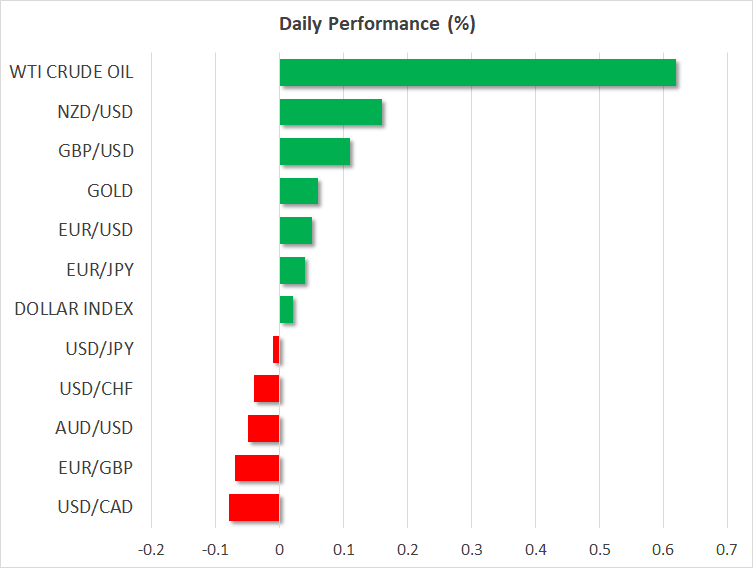
Here are the latest developments in global markets:
FOREX: The dollar index, which gauges the greenback against six major currencies, was little changed on Tuesday. Meanwhile, the aussie recorded some losses after some RBA comments on the outlook for inflation which are supportive of lower rates for longer. Nevertheless, the currency managed to largely recover its earlier losses.
STOCKS: Major US indices finished in the green yesterday, with the Dow and the Nasdaq Composite adding 0.7% and the S&P 500 rising by 0.45%. The tech-heavy Nasdaq also finished at an all-time high, with tech behemoths Apple, Amazon and Microsoft all achieving the safe feat. During Tuesday's Asian session, the Japanese Nikkei 225 added 0.15%, while the broader Topix index was roughly flat. Hong Kong's Hang Seng was up by 0.45%. Futures tracking major European indices were trading lower, with the same holding true for contracts on major Wall Street indices; though those on US benchmarks were only slightly lower. Electric vehicle-maker Tesla will be attracting interest today as it will be holding its annual shareholders meeting.
COMMODITIES: WTI and Brent crude were up by 0.6% and 0.25% at $65.12 and $75.51 per barrel respectively. Despite the rise, the benchmarks remain in correction mode overall, having posted considerable losses in previous days, including yesterday. Worries on rising supply are seen as a reason behind the fall – it can be argued that some recent comments by an OPEC committee have supported such concerns. The API weekly report on US crude stocks due at 2030 GMT might offer some short-term direction to prices. Gold was higher, though by less than 0.1%, at $1.292.51 an ounce.
Major movers: Dollar posts 2-week high versus the yen with trade risks still a consideration; aussie hurt by RBA
The dollar's index against a basket of currencies was not much changed at 0658 GMT. Dollar/yen was more or less flat, having earlier touched the 110 level to record a near two-week high. Market bets for a more aggressive Fed tightening cycle remaining elevated after Friday's largely strong US jobs report was seen as a factor contributing to the rise in the pair in recent days. However, the greenback seems susceptible to “Trump risk”, with key US allies getting more alienated as a result of the US administration's actions on the trade front. In this respect, a G7 meeting in Canada later in the week will be interesting to watch.
On the data front, Japan saw the release of household spending figures which surprised to the downside. Nevertheless, market reaction to the numbers was limited.
The euro was slightly higher versus the dollar, standing at a distance relative to last week's 10-month low of 1.1506. Euro/dollar was up by less than 0.1% and marginally above the 1.17 handle. Fading political uncertainty in Spain and more importantly Italy acted as catalysts for the common currency's recovery of some sorts in previous sessions; yesterday euro/dollar recorded a near two-week high of 1.7744, while the euro's rebounnd versus the safe-haven perceived yen is also notable.
Sterling was 0.1% higher against the greenback at 1.3326 ahead of the PMI release for the all-important for the UK economy services sector. The prints for the manufacturing and construction sectors, which were made public in previous days, managed to positively surprise.
The aussie, a big gainer on Monday on the back of stronger-than-anticipated data releases, lost some ground today, though it later recovered on a significant part of its losses. Contributing to the decline were a wider than projected current account deficit in Q1, as well as the RBA saying inflation will likely remain subdued for some time; the Bank kept rates unchanged at the historic low of 1.5% yet again upon completion of its meeting. Aussie/dollar was down by 0.05% at 0.7640; still this was not far below yesterday's six-week high 0.7666. Meanwhile, kiwi/dollar was up by 0.2% at 0.7042, relatively close to one-month high levels.
Day ahead: Eurozone retail sales, UK services PMI and US ISM non-manufacturing PMI in focus; trade risks remain in the background
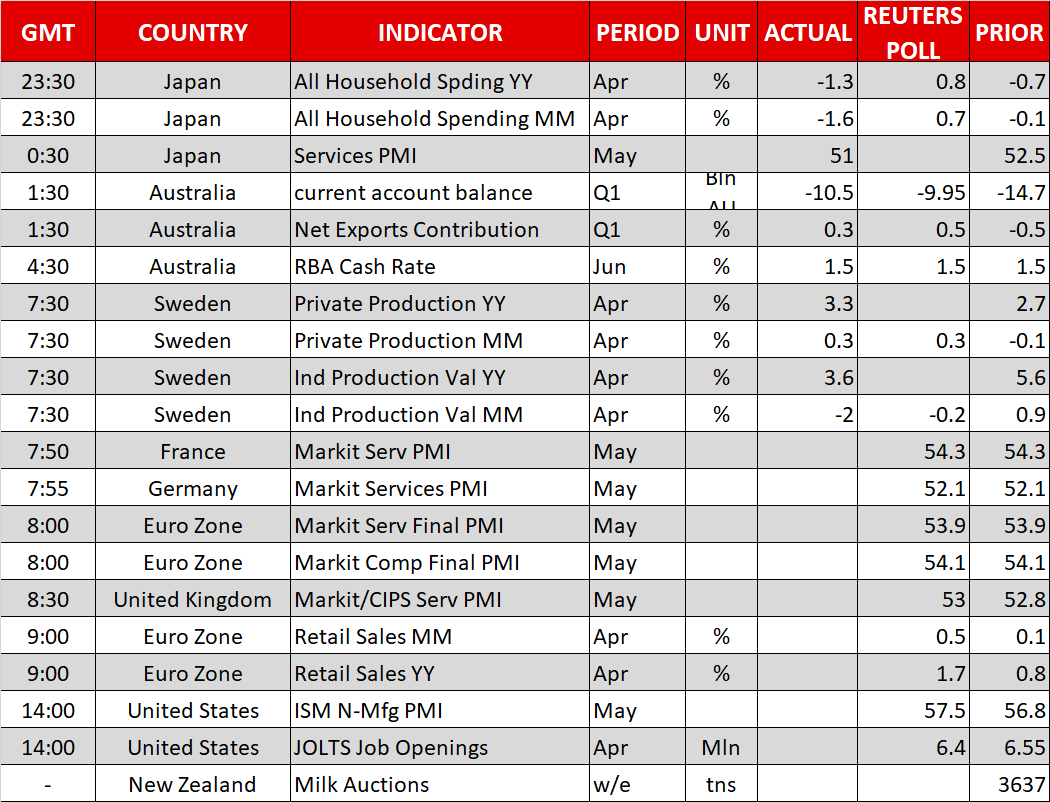
PMI readings and retail sales data will dominate the economic calendar on Tuesday, though attention will remain on the trade front, as investors fear that tit-for-tat retaliatory actions might take place. Brexit uncertainties are also back in the surface.
At 0800 GMT, the Eurozone will see the release of final Markit Services and Composite PMI figures for the month of May and forecasts are for the measures to stand at 53.9 and 54.1 respectively, as they were initially estimated. While the marks are the lowest since early 2017, they are above the threshold of 50 which separates growth from contraction. However, the impact on the euro might be moderate since preliminary data tend to be more market-sensitive. Therefore, the focus for the currency will turn to eurozone's retail sales due at 0900 GMT. In this case, analysts forecast an annual expansion of 1.7% in April, compared to a growth of 0.8% in the previous month, while month-on-month projections are for a rise of 0.5% compared to 0.1% seen in the previously recorded month. As political conditions in Italy have somewhat stabilized, with the focus turning back to the calendar, an upward surprise in the data could support the common currency.
In the UK, the Markit/CIPS Services PMI is expected to inch up to 53.0 in May from 52.8 in the previous month. Note that there are no initial estimates for the gauge; this is the first and only release. Yet, any news around Brexit are likely to have a greater impact on the pound as investors wait for the exit bill to return to the House of Commons on June 12 according to the Times newspaper on Monday. After a defeat in the House of Lords, House lawmakers are said to hold votes on the bill and propose changes in key areas, such as the customs union and the Irish border.
Meanwhile in the US, the Institute for Supply Management (ISM) is scheduled to deliver its non-manufacturing PMI print at 1400 GMT and analysts believe that the gauge has gained 0.7 points in May, rising to 57.5. At the same time, the Bureau of Labor Statistics will be issuing its JOLTS job openings report, with the number of positions expected to have eased to 6.4 million in April from a record high of 6.55m in March.
Elsewhere, the Global Dairy trade auction will take place today at a tentative time, with the results expected to move the kiwi, as dairy products hold the largest share of exports in New Zealand.
Trade developments will continue to be under the spotlight ahead of a G7 meeting in Quebec on Friday, where the EU and Canada are expected to express their anger on the Trump administration's decision to impose import tariffs on steel and aluminum coming from their respective countries. In the meantime, US trade tensions with China have also intensified after talks in Beijing did not lead to a breakthrough. Instead, China, in response to the recent tariff warnings by the US, said that the agreements reached in the latest negotiations in Washington will not take effect if the US pushes ahead with tariffs.
In oil markets, investors will be paying attention to the API weekly report on US crude oil inventories at 2030 GMT.
Technical Analysis: EURUSD looking mostly neutral in short-term
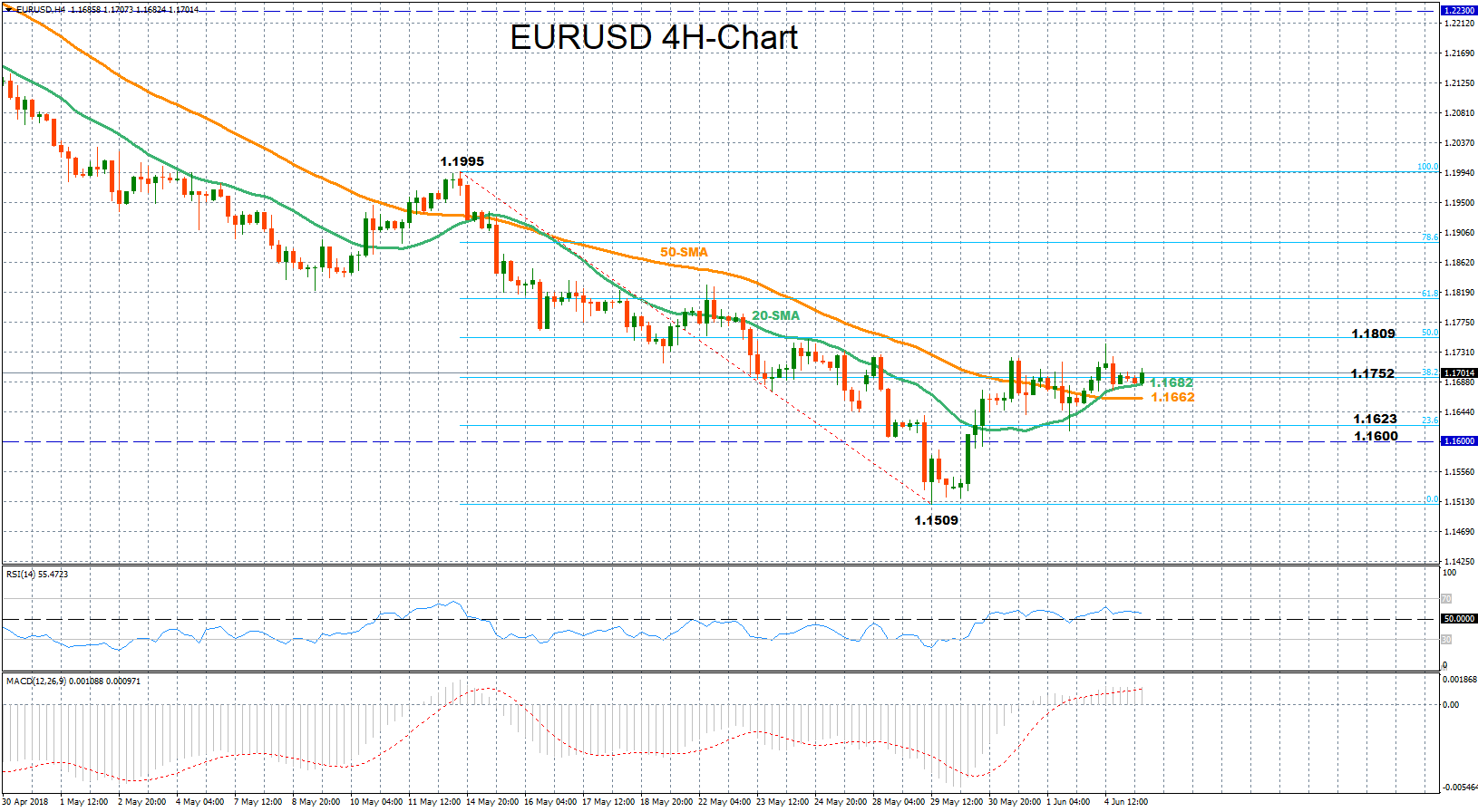
EURUSD is moving sideways after its rebound off 10-month lows on May 29. The RSI is also largely moving sideways in the four-hour chart in support of a neutral picture in the short-term. The MACD has also slowed down and is now on track to meet its red signal line. Trend signals, though, remain positive as the pair continues to hold above its moving averages.
If today's data releases out of the eurozone beat expectations, the pair could benefit, probably bouncing up towards yesterday's near two-week high of 1.1744 which is marginally below the 50% Fibonacci of 1.1752 of the downleg from 1.1995 to 1.1509. A break above from here could then spur further buying interest, driving the price up to the 61.8% Fibonacci of 1.1809.
Conversely, disappointing prints could pressure the market down to the 50-period (simple) moving average currently at 1.1662 (immediate support seems to be taking place at the 20-period SMA at 1.1682), while steeper declines could also reach the 23.6% Fibonacci of 1.1623 before the focus turns to the 1.1600 round level.
It should be kept in mind that US releases can also move the pair.
GBPUSD Fails To Post Significant Gains, Bearish Outlook In Medium Term
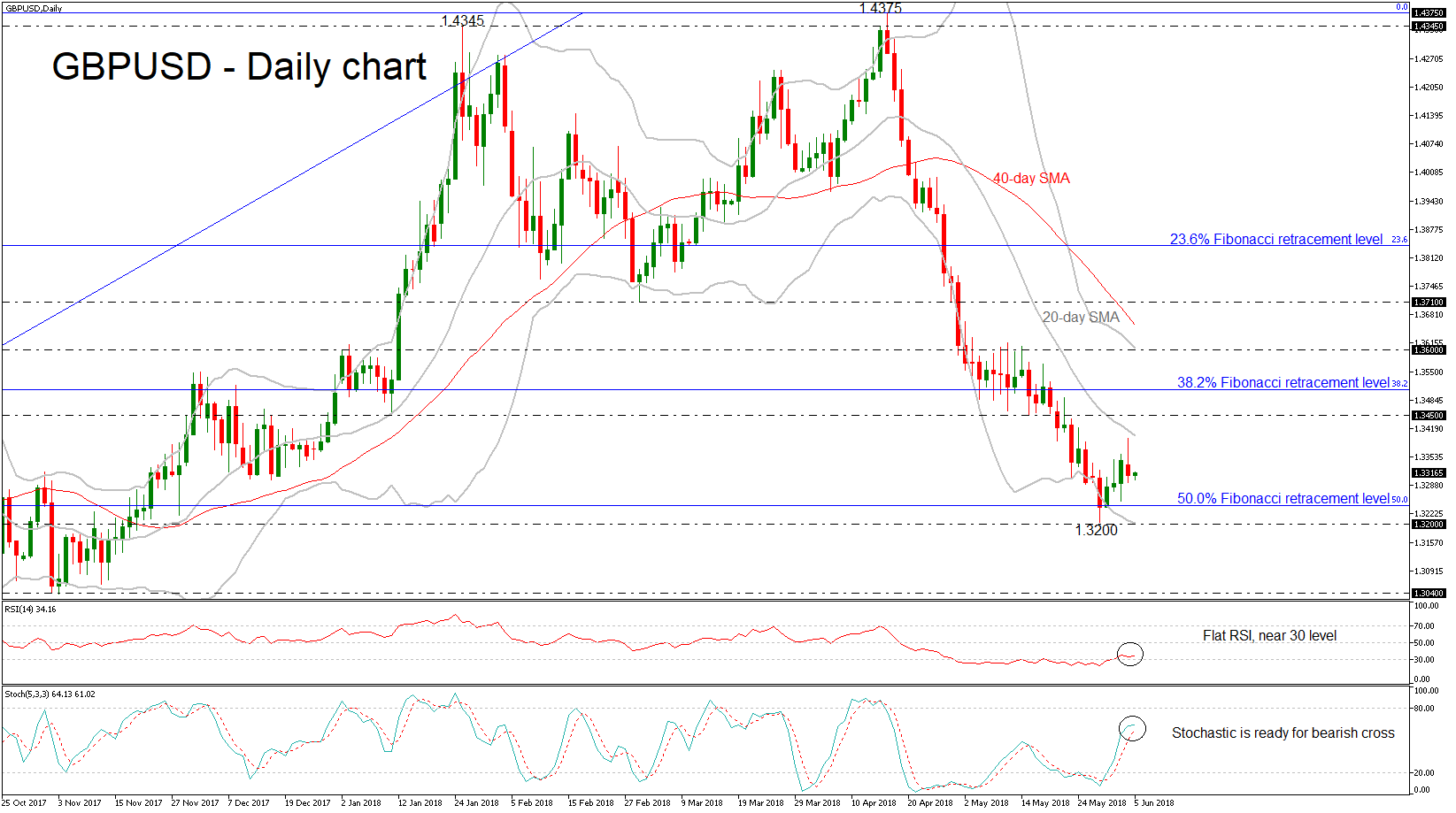
GBPUSD came under renewed selling pressure on Monday after three consecutive bullish days, but before the negative movement, it had jumped above the 1.3400 handle. Also, the price found strong resistance obstacle near the mid-level of the Bollinger Band (20-day simple moving average). The short-term technical indicators are neutral and point to a more weakness in the market.
Momentum indicators, in the daily timeframe, are pointing to a neutral to a negative bias in the short term with the RSI just above the 30 level and the stochastic oscillator holding in neutral territory. However, the %K line of the stochastic is attempting a bearish cross with the %D line, suggesting a downside resumption is nearing.
Further losses should see the price coming into contact with the 50.0% Fibonacci retracement level around 1.3240 of the upleg from 1.2100 to 1.4375 before hitting the May 29 low of the 1.3200 handle, which is acting as a major support. A drop below this region would reinforce the bearish structure in the medium term and open the way towards the next key support level of 1.3040.
In the event of an upside retracement, the 1.3450 level could act as a barrier before being able to retest the 38.2% Fibonacci. A break above this level would shift the medium-term outlook to a more neutral one as it would take the pair towards the upper Bollinger Band, which coincides with the 1.3600 psychological level.
It is worth mentioning that GBPUSD is looking more bearish over the last couple of months as the pullback on the 1.4375 resistance level has pushed the price further down.
RBA Left Cash Rate Unchanged, Affirmed that Credit Condition Remained Accommodative
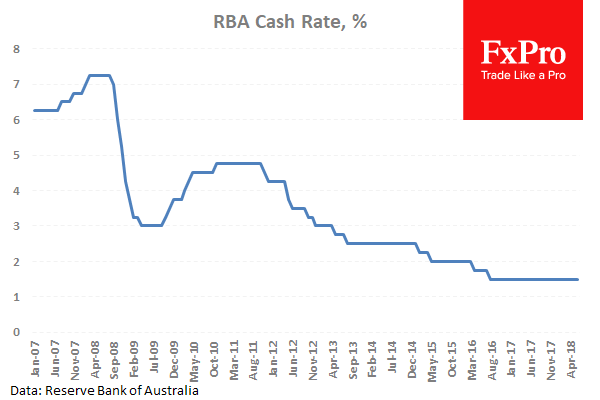
RBA left the policy rate unchanged at 1.5% in June, and made no change to the monetary policy guidance. The central bank remained confident over the global economic outlook. Indeed, it has so far not commented about the slowdown in economic activities in the Eurozone, UK and Japan, etc. At home, the members continued to expect growth to pick up and average a bit above +3% in 2018 and 2019. Meanwhile, the sluggish improvement in wage growth and inflation would continue to some time. An interesting reference RBA made was that “while there may be some further tightening of lending standards, the average mortgage interest rate on outstanding loans is continuing to decline”. This appears to be a response to those proposing a rate cut to offset the current tightening in credit condition. In short, the RBA should leave the policy rate unchanged for the rest of the year.
On global developments, the central bank noted that “financial markets have been affected by political developments in the Eurozone, particularly in Italy”. It added that “long-term bond yields in most major economies have declined recently and there has been some widening of corporate credit spreads”, compared with last month’s observation about the rising long term yields. Meanwhile, compared with last month’s observation about tighter short-term US yields, RBA noted that “conditions in US dollar short-term money markets have eased recently, although they are tighter than earlier in the year”.
At home, RBA retained the assessment that GDP growth would pick up to average a bit above 3% in 2018 and 2019. The members acknowledged recent slowdown in the job market. Yet they remained confident over the longer-term outlook. Data from the Australian Bureau of Statistics suggests that +52.9K of jobs have been created so far this year, equating to an average increase of +13.2K per month. This is way below the average of +34.6K addition in 2017. The country’s unemployment rate climbed higher to 5.6% in April from 5.4% late last year. The situation signals that the soft wage growth would persist, although the members judged that the trough has been reached. Meanwhile, RBA appeared more comfortable with the current level of Australian dollar, as it removed the reference last month that “the Australian dollar has depreciated a little recently”.
What worth attention this month is the comment on the housing credit. A noted in the accompanying statement, “housing credit growth has slowed over the past year, especially to investors”. RBA noted that “while there may be some further tightening of lending standards, the average mortgage interest rate on outstanding loans is continuing to decline”. To us, this is RBA’s response to speculations that the central bank might trim the policy rate in order to ease the credit market. The reference is a confirmation that barring abrupt economic slowdown, the next RBA monetary decision would be rate hike, rather than rate cut.
RBA Leaves Rates At On Hold 1.50%
Yesterday's session was quite after a pickup in volatility last week and there has been little in the way of movement overnight. This is despite some negative headlines that possibly sapped some of the market strength over the last 24 hours. Crude Oil has continued to fall with WTI reaching $64.50 as supply increases and reserves rise. The decline has been dramatic with prices at a high of $72.80 only two weeks ago. Iran has said that they will increase capacity to produce uranium gas after the US pulled out of the Iran deal last month. The RBA has left rates on hold at their meeting saying inflation is likely to remain low for some time and household consumption remains a source of uncertainty. AUDUSD rallied from 0.75800 yesterday to 0.76660 but fell back to 0.76255 after the decision.
UK Construction PMI (May) was out at 52.5 against an expected headline number of 52.0 from a prior number of 52.5. The recovery from the low created in April at 47.0 stalled and matched the previous read last month. The construction industry is seen as being under a degree of pressure since the high levels of 2014 at 64.6 showing contraction in the index but has recovered somewhat. GBPUSD moved higher after this data release from 1.33560 to 1.33982.
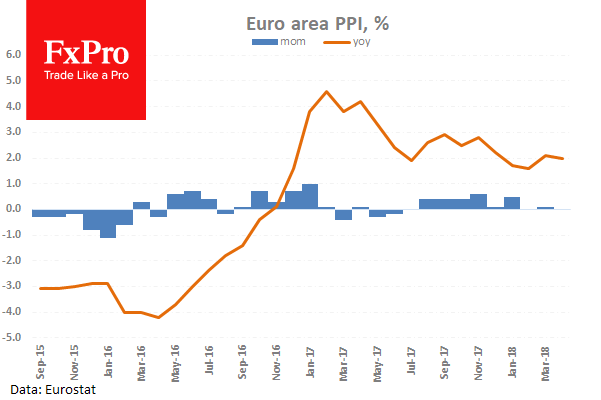
Eurozone Producer Price Index (YoY) (Apr) was 2.0% against an expected 2.4% from a previous 2.1%. Producer Price Index (MoM) (Apr) was 0.0% against an expected 0.4% from a previous 0.1%. The recovery in the Euro area is weaker but growing despite some sluggish economic data. PPI data is in danger of slipping under 0.0% signalling falling prices. EURUSD moved higher from 1.17075 to 1.17441 following this data release.
US Factory Orders (MoM) (Apr) were -0.8% against an expected -0.3% from 1.6% previously which was revised up to 1.7%. The decrease in orders exceeded expectations but remains in the recent range of this data point over the last three years has been between +3% and -3.5%. However the drop shows a decrease in demand for US produced goods. EURUSD moved higher initially from 1.17157 to 1.17250 but then sold off to 1.16770 in the time after this data release. 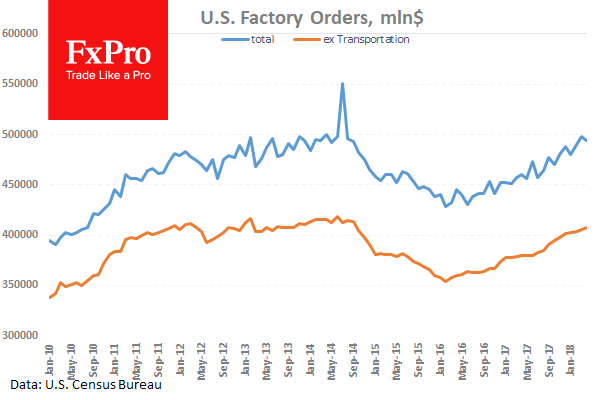
EURUSD is down -0.10% overnight, trading around 1.16852.
USDJPY is up 0.07% in the early session, trading at around 109.891
GBPUSD is down 0.02% this morning trading around 1.33119.
Gold is down -0.08% in early morning trading at around $1,290.91
WTI is up 0.11% this morning, trading around $64.98
UK Services PMI Data Expected To Tick Up
At 07:55 GMT, German Markit Services PMI (May) will be out with an expected headline number of 52.1 against 52.1 previously. After reaching a multi-year high in February at 57.3, this data has come back into its range under 56.0. German Markit PMI Composite (May) is expected to be 54.3 from a prior number of 54.3. EUR traders will be watching for the numbers to deviate from expectations and create volatility in the pairs.
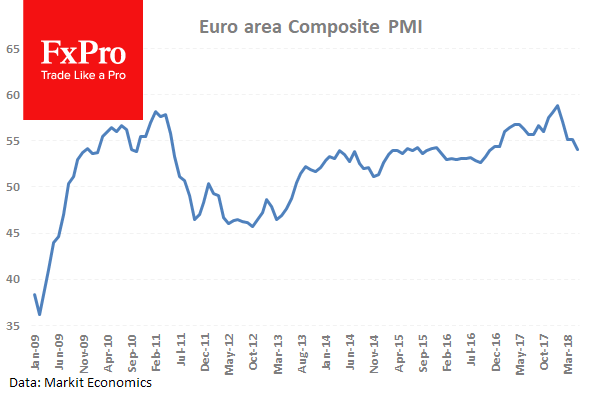
At 08:00 GMT, Eurozone Markit Services PMI (May) will be out with an expected headline number of 53.9 against 53.9 previously. This figure is expected to slip back after hitting a high of 58.0 in February. Markit PMI Composite (May) is expected to be 54.1 from a prior number of 54.1. EUR crosses can be impacted by this data release.
At 08:30 GMT, UK Markit Services PMI (May) is expected to come in at 53.0 from 52.8 previously. This data is continuing to decline from its 2013 high of 62.5 but it has fallen below 53.0, which was somewhat of a floor for the last 18 months. The number is expected to move back into this range above 53.0 today showing modest growth. Failure to do this will put GBP under further pressure. 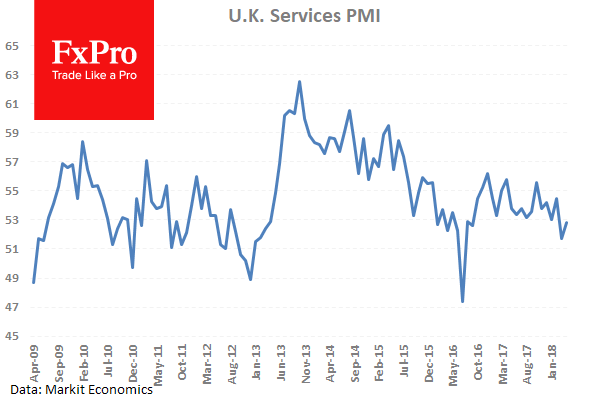
At 10:00 GMT, UK MPC Member Cunliffe is due to speak at the International Derivatives Expo, in London. This event can result in moves in GBP crosses from any comments made.
At 13:45 GMT, US Markit Services PMI (May) is expected to be 55.7 against a previous number of 55.7. This data is stable at present but a miss today can create a market reaction. Markit PMI Composite (May) is expected to be 54.8 against 55.7 previously, giving up some of its recent gains after a pickup in this metric. USD pairs can be moved by this data series.
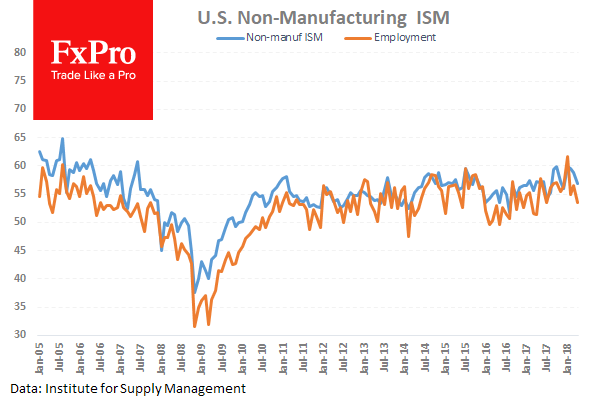
At 14:00 GMT, US ISM Non – Manufacturing PMI (May) is expected to be 57.5 against 56.8 previously. This is still in the upper range of the data releases we have seen over the past seven years but off the highs reached before the financial crisis above 65.0. The recent decline shows a slowing in purchases. USD traders will be closely watching this data release.
Tentative – GMT, Global Dairy Trade Price Index is expected to be released with a previous reading of 1.9%. A negative reading at the beginning of this month reversed the positive reading from mid April. NZD pairs can be affected by this data release.
At 17:30 GMT, German Buba President Weidmann is expected to deliver a speech titled “Reforms for a Stable Monetary Union” at the annual Hessian reception, in Brussels. EUR crosses may be affected by any comments made.
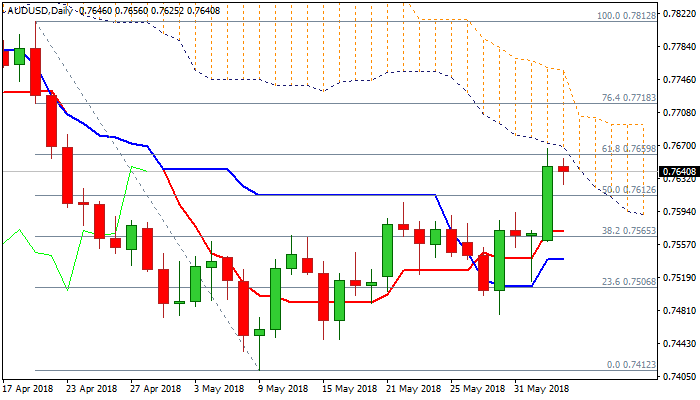
AUDUSD Outlook – Bulls Consolidate Under Falling Daily Cloud, No Impact From RBA
The Aussie dollar eases in early trading on Tuesday, consolidating Monday's strong advance (the biggest one-day rally since 21 Mar). The pair was up 1.10% on Monday, driven by upbeat Australian data and weaker greenback.
The RBA released its policy decision today, keeping interest rates unchanged as expected, while the central bank's statement was barely changed from the previous meeting in May, suggesting that the RBA may stay on hold for some time.
The decision had a little impact to the Aussie, with easing driven by techs, as slow stochastic is overbought on daily chart and momentum is turning south.
Bulls show signs of fatigue on approach to strong barriers at 0.7660 (Fibo 61.8% of 0.7812/0.7412 bear-leg which was cracked on Monday and stays intact today) and 0.7669 (base of falling daily cloud).
Also, initial attempt to penetrate weekly cloud (cloud base lays at 0.7641) was so far unsuccessful, adding to growing pressure.
Corrective dip is likely to precede fresh upside, with 0.76 zone expected to ideally contain dips and keep bullish near-term structure intact.
Bulls need sustained break above 0.7660 Fibo barrier and daily cloud base to signal continuation and expose targets at 0.7703 (daily cloud top) and 0.7718 (Fibo 76.4% of 0.7812/0.7412).
Initial bearish signal could be expected on loss of 0.76 handle, while reversal would be signaled on return and close below rising 10SMA (0.7572).
Res: 0.7660, 0.7669, 0.7718, 0.7736
Sup: 0.7625, 0.7615, 0.7600, 0.7572
GBPUSD Outlook – Holds Within Tight Range, UK Services PMI Could Provide Fresh Direction Signal
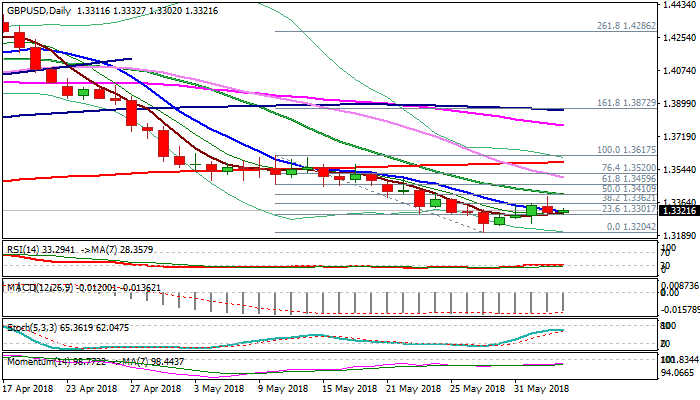
Cable is moving around falling 10SMA (1.3315) and holding within narrow range on Tuesday, after Monday's action stalled on approach to key barrier at 1.3410 (falling 20SMA / 50% retracement of 1.3617/1.3204).
Subsequent easing resulted in daily close in red as well as below 10SMA, which was negative signal.
Flat momentum lacks clearer direction signals with focus on UK services PMI data, which could spark fresh acceleration.
UK Services PMI is forecasted at 52.9 in May vs 52.8 in Apr, with release above 53 expected to provide fresh support to sterling for renewed attack at 20SMA pivot.
Conversely, PMI miss could trigger fresh weakness and generate bearish signal on repeated close below 10SMA.
Res: 1.3332, 1.3362, 1.3398, 1.3410
Sup: 1.3302, 1.3253, 1.3204, 1.3153
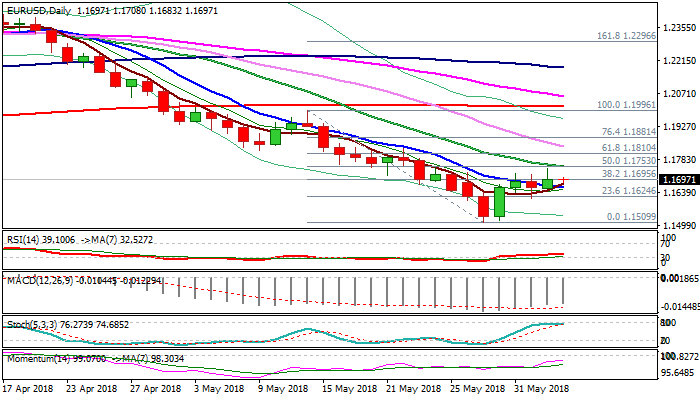
EURUSD Outlook – Positive Tone Above 10SMA Focuses Next Key Barrier At 1.1753
The Euro moves within tight range in early Tuesday’s trading but maintains positive tone after bullish signal was generated on eventual close above falling 10SMA and Fibo 38.2% of 1.1996/1.1509 bear-leg on Monday.
Scope exists for renewed attack at 1.1753 pivot (falling 20SMA / Fibo 50% retracement) after Monday’s rally stalled on approach.
Sustained break higher would signal an end of near-term consolidative phase and continuation of recovery from 1.1509 (29 May low) towards next targets at 1.1810 (Fibo 61.8%) and 1.1840 (falling 30SMA).
Bull-cross of 5/10SMA’s and rising 14-d momentum support the notion, however, caution on sideways-moving low stochastic at the overbought zone boundary, which could signal extended consolidation.
Bullish outlook is expected to remain intact above 10SMA, while return and close below would soften near-term structure and risk fresh weakness.
Res: 1.1708, 1.1753, 1.1810, 1.1840
Sup: 1.1681, 1.1663, 1.1641, 1.1617