Sample Category Title
USD/JPY Bearish ABC Zigzag Pattern Challenges 107.50
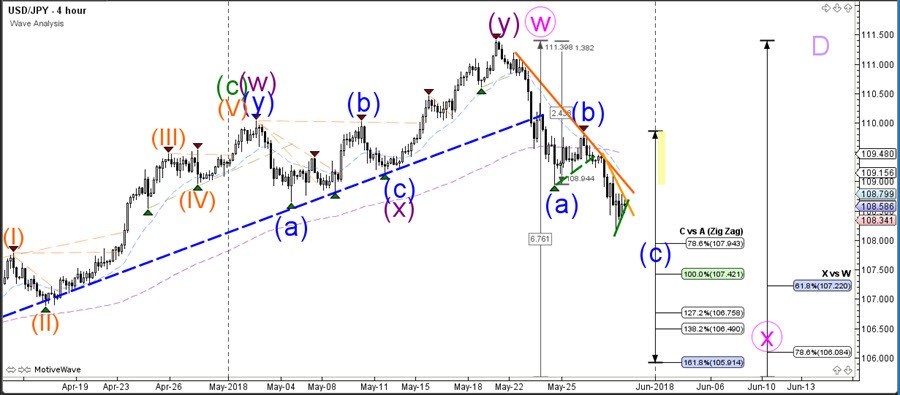
The USD/JPY broke below the bottom (green line), which confirmed the continuation within C (blue). Price is still in a downtrend as long as price stays below the resistance trend lines (orange) and a new bearish breakout could see price fall towards the Fibonacci targets.
The USD/JPY is probably building an ABC zigzag pattern (blue) within a larger WXY (pink) correction of a larger potential triangle on the daily chart – the wave D (light purple). The 50% is at 108 but a bearish break could see price test the 61.8% Fib at 107.25.
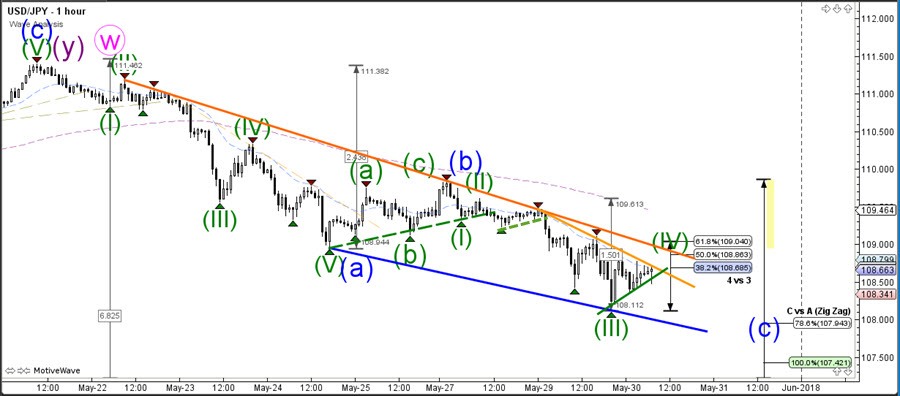
The USD/JPY broke below multiple support trend lines (dotted green) for a bearish breakout and continuation. Price could now be building a wave 4 (green) correction, which means that price could find resistance at the Fibonacci levels of wave 4 vs 3. A bearish breakout below the next support could a fall towards the Fibonacci targets.
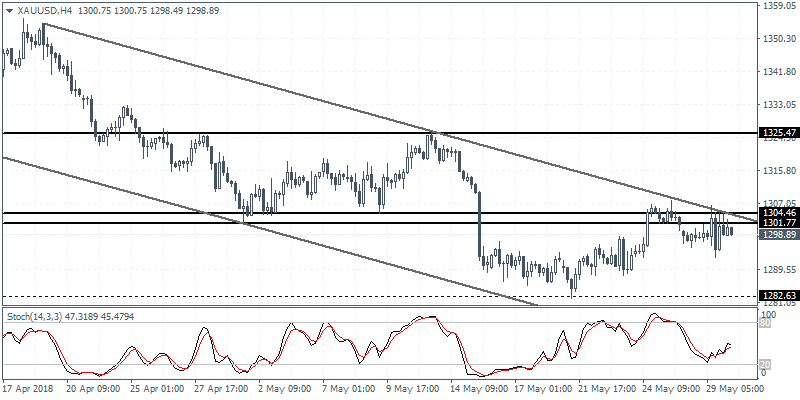
XAUUSD Intraday Analysis
XAUUSD (1298.89): Gold prices have been hovering near the resistance level of 1304 - 1301 for nearly five consecutive days. Price action could possibly breakout above this level. Clearing the resistance level could signal an upside momentum in prices. If support is established on a retest, then we expect USDJPY to potentially post gains toward 1325 level. To the downside, a retest of 1282 support is still pending which could be tested more firmly.
USDJPY Intraday Analysis
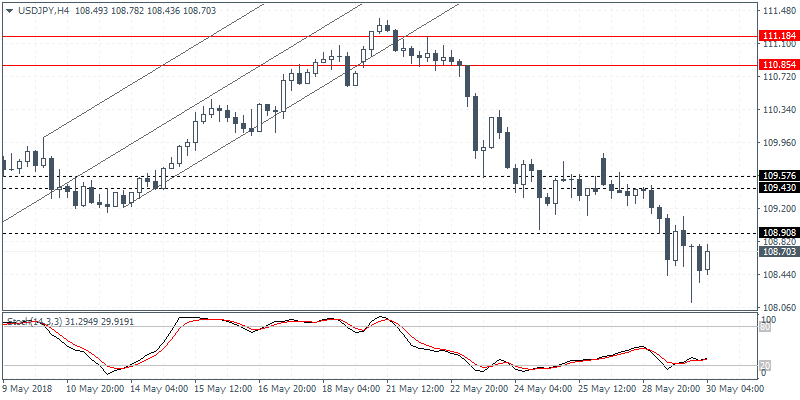
USDJPY (108.70): The falling market sentiment was reflected in the USDJPY currency pair which was seen clearing the lower support level of 108.90. The current retracement at this level is expected to see 108.90 level being retested for resistance. To the downside, we can expect to see continued decline. The next main support level comes in at 107.64 which marks an unfilled gap from April 20, 2018. The downside bias will shift unless USDJPY posts a rebound above 108.90 and clearing the next resistance at 109.43 - 109.57.
EURUSD Intraday Analysis
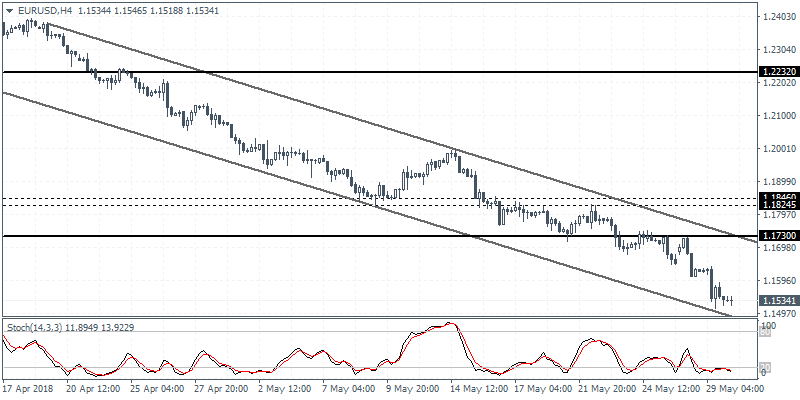
EURUSD (1.1534): The EURUSD currency pair continues to post losses with price action touching down to lows of 1.1533. The declines are likely to persist with the next downside target seen coming in at 1.1500. This would mark a fresh yearly low to this level. However, there is scope for the EURUSD to potentially post a bounce to the upside. With the resistance level at 1.1730 being tested any retracement in price action could be limited to the recent local highs of 1.1638.
BoC To Hold Rates Steady
The euro currency continued to weaken amid the political uncertainty from Italy. The common currency fell to fresh yearly lows at 1.1510 on Tuesday. Economic data was sparse leaving investors to focus on Italy which soured the general market sentiment.
The U.S. consumer confidence index from the conference board showed a decline to 128.0 on the index with previous month’s data also revised down to 125.6. The U.S. dollar however maintained its stronghold across the board.
The economic calendar picks up pace today starting with the import price and retail sales data from Germany. Revised GDP numbers from France for the first quarter will be coming out which is expected to confirm a 0.3% increase. Germany will also be reporting on the preliminary inflation figures which are expected to show a rebound of 0.3% in consumer prices on a monthly basis.
The ADP/Moody's private payroll numbers will be coming out ahead of this Friday's official payroll figures. Economists forecast that the private sector added 186k jobs during the month of May. This marks a somewhat slower pace of job gains compared to 204k that was registered previously. The private payrolls data will be followed by the final revised GDP estimates from the U.S. which is expected to remain unchanged at 2.3%.
The Bank of Canada will be holding its monetary policy decision later. Interest rates are expected to remain unchanged at 1.25% at today's meeting.
Currencies: Italian Risk-Off Trade Hammers Euro. Yen Resumes Its Safe Haven Role
- Rates: Have bond markets reached some kind of ST exhaustion move?
Bond markets faced a sharp repositioning yesterday as investors adapted investments to the latest developments in Italy. German and US core bond yields (10-y) are nearing key support. Today, the focus remains on Italy, especially on a BTP auction. Eco data are probably second tier. Even so, we keep an eye at the German inflation data and US ADP report. - Currencies: Italian risk-off trade hammers euro. Yen resumes its safe haven role
Italian uncertainty kept EUR/USD, USD/JPY and EUR/JPY on a downward trajectory yesterday. EUR/USD is extensively testing the mid 1.1550 support. The test is ongoing. For now we see no reason to fight the Italian-driven risk-off repositioning on global FX markets.
The Sunrise Headlines
- US markets suffered losses of more than 1% yesterday with Nasdaq (-0.5%) outperforming after renewed tariff talk. Asian indices lose ground as well this morning with China and Japan underperforming (> -1.5%).
- Italy may hold repeat elections as early as July after the man asked to be PM failed to secure support from political parties for even a stop-gap government, sources said, as markets tumbled on the growing political turmoil. (Reuters)
- The US sent a sudden, harsh message to its Chinese counterparts, saying the US was moving forward with its threat to apply tariffs on Chinese imports and other actions to restrict Beijing from accessing sensitive US technology. (WSJ)
- EU officials are weighing a much stronger warning on the risk of Brexit talks collapsing without a deal if the UK fails to lay out its Irish border position in more detail next month. A firm, written proposal is regarded as necessary to move forward. (BB)
- The RBNZ said financial system is better prepared to weather any unforeseen global shocks that could push up borrowing costs, but emphasised that more needed to be done to reduce high household and dairy sector debts. (Reuters)
- Weaker growth in the Eurozone would “significantly affect Portugal”, the IMF warned, saying “lingering domestic vulnerabilities” would amplify any external shock to the former bailout country’s economic recovery. (FT)
- Today’s eco calendar contains the US ADP employment report, EC confidence data, the German labour market report and German CPI. Italy taps the bond market, the OECD releases new forecasts and the Fed publishes the Beige Book
Currencies: Italian Risk-Off Trade Hammers Euro. Yen Resumes Its Safe Haven Role
Euro near recent lows, awating next step from Italy
Yesterday, the Italian risk-off trade continued. This sell-off also had a bigger fallout on non-Italian markets than was the case lately. EUR/USD slipped to the low 1.15 area. Temporary, it looks that repositioning on Italy had reached some kind of exhaustion move. However, selling resumed as efforts to form a short-term Italian government stalled. At the same time, the US stepped up its rhetoric regarding import tariffs on China. Treasury yields nosedived as the risk-off trade ever more affected US markets. It didn’t help the euro much. EUR/USD closed at 1.1540. The upward pressure on the yen also intensified as the risk-off become more broad-based. USD/JPY fell to 108.10, but closed at 108.77.
Overnight, Asian markets are joining the global risk-off trade. For now, it doesn’t translate in further gains of US Treasuries. Also the major euro and USD cross rates (USD/JPY, EUR/USD and EUR/JPY) are taking a breather. EUR/USD hovers around yesterday’s close. USD/JPY trades near 108.60. EUR/JPY returned north of 125 after yesterday’s sell-off.
Today, the calendar is well filled with, amongst others, EC confidence, German inflation and the US ADP labour report. We see an asymmetrical risk especially for the EMU data. A negative surprise in EC confidence will add to investor nervousness on Europe. At the same time, we are keen to see the reaction of EMU yields and the euro on a substantial up-tick in German inflation. In the current environment, we doubt that it will help the euro much. The focus will remain Italian politics and on the BTP bond auction. The outcome of the attempt to form a ST government is highly uncertain, but it’s difficult to see a scenario that eases the uncertainty. If the auction fails, it would add to the crisis momentum. Yesterday, the euro sell-off slowed temporary, but there is absolutely no indication of an imminent rebound. The downtrends in EUR/USD, EUR/JPY and USD/JPY remain in place and for now we see no good reason to catch those falling knives. Next intermediate resistance in EUR/USD is the mid 1.14 area (50% retracement).
Yesterday, EUR/GBP to some extended followed the decline of EUR/USD. However, gains of sterling remained modest. Today, we see no high profile UK topics issues on the agenda. The decline of EUR/GBP remained with the established ranges. Some further selling might occur if the Italian crisis persists, but we don’t expect sterling to become a major beneficiary of EMU/Italian uncertainty.
EUR/USD: test of 1.1550 support continues as Italian crisis develops
DIHK slashed 2018 German growth forecast to 2.2%
The Germany's Chambers of Industry and Commerce (DIHK) lowered 2018 growth forecast for the country to 2.2%, sharply down from prior estimate of 2.7%.
It noted in a report that "companies are looking to their future business with a little less optimism than before... scepticism is growing with regard to international business."
Swiss KOF dropped to 100, back at long term average
Swiss KOF economic barometer dropped to 100 in May, down from 103.3 and missed expectation of 104.7.
KOF noted that the Barometer is back at its "long-term average after over two years of above average values". And that "indicates a normalization of economic development".
The decline was "mainly driven by the negative development of the indicators for manufacturing and the construction sector."
IMF welcome China’s decisive policy shift to high quality growth
IMF released a statement on the preliminary findings after Article IV mission to China. There IMF noted that China's growth is expected to weaken only slightly to 6.6% in 2018. Growth would moderate gradually to around 5.5% by 2023.
IMF staff welcome the government's strategy to "more decisively shift the policy focus from high-speed to high-quality growth".
The goal would be "greatly helped by accelerating reforms in many areas, including de-emphasizing growth target, further reining in credit growth, boosting consumption, allowing market forces a more decisive role, deepening opening up and modernizing policy frameworks."
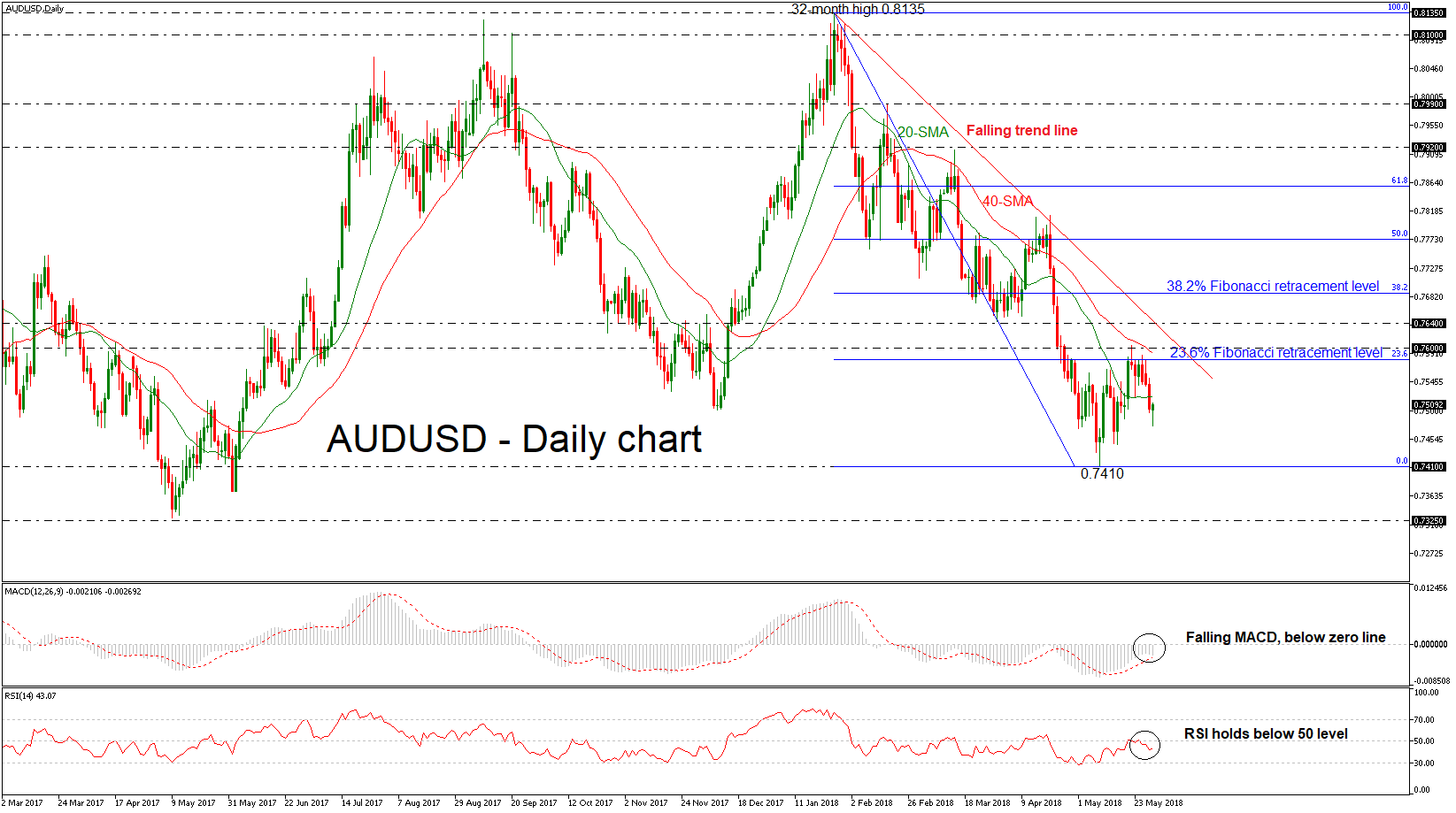
AUDUSD Creates 2-Week Low Of 0.7475, Bearish Structure Remains In Medium Term
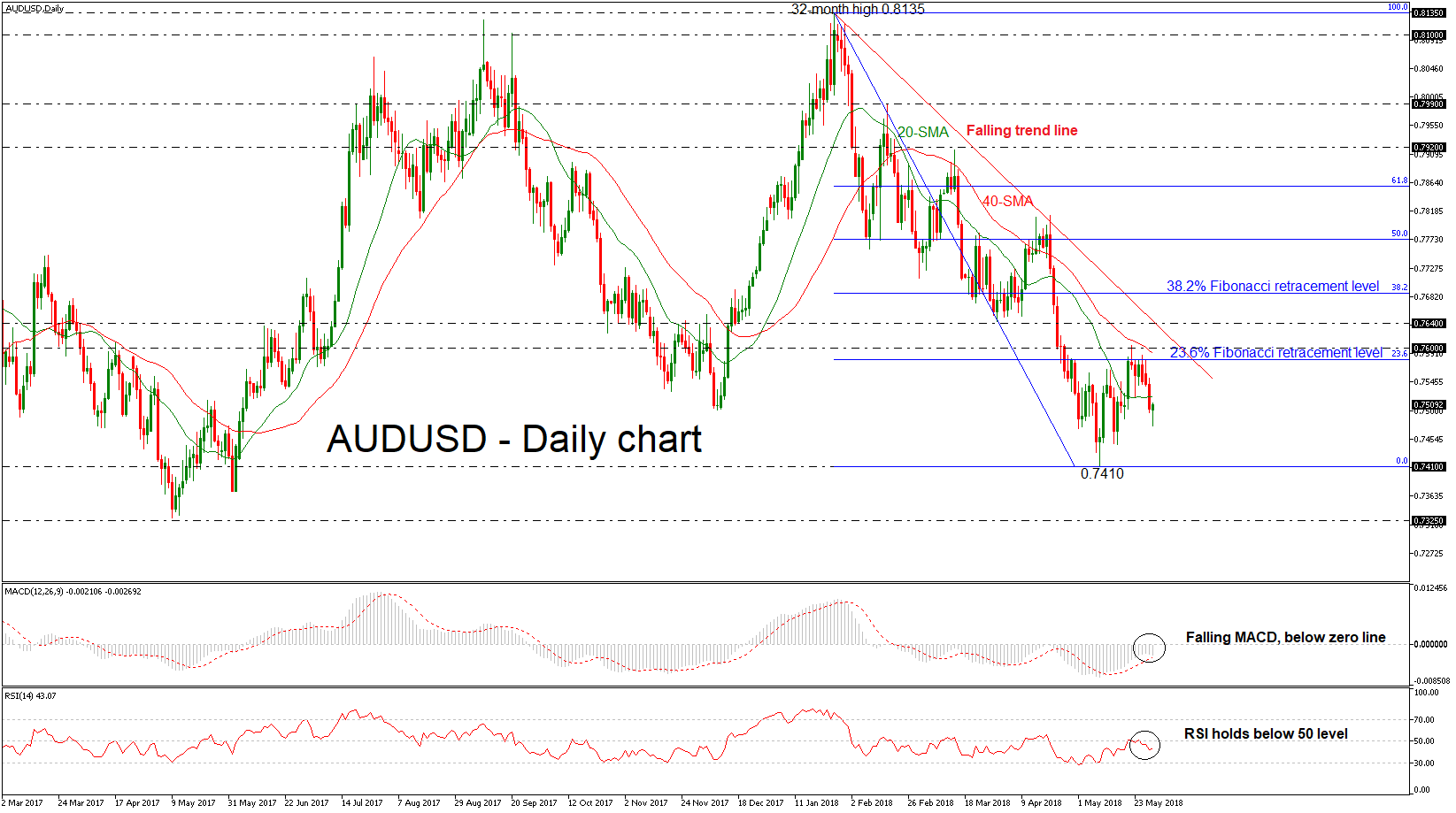
AUDUSD has been underperforming in the past three days, following the touch on the 23.6% Fibonacci retracement level of the downleg from 0.8135 to 0.7410, around 0.7580. Early this morning, the pair recorded a fresh two-week low of 0.7475 while it still trading below the 20-simple moving average (SMA) in the daily timeframe.
Short-term momentum indicators are also pointing to a continuation of the bearish bias. The MACD oscillator is heading south and is approaching the its trigger line, while the RSI indicator is developing below the threshold of 50.
Further losses should see the May 9 low of 0.7410 acting as a major support. A drop below this level would reinforce the bearish structure in the medium term and open the way towards the next key support level of 0.7325, taken from the trough on May 2017.
In the event of an upside reversal, the 23.6% Fibonacci mark at 0.7580 could act as a barrier before being able to re-challenge the 0.7600 handle. An upside extension would shift the medium-term outlook to a more neutral one as it would take the pair above the 40-day SMA. Further gains would lead the way towards the 0.7640 resistance level and the 38.2% Fibonacci of 0.7687.
In the bigger picture, AUDUSD is bearish as long as it holds below the descending trend line, which has been standing since January 26. In case it violates this line, bulls could take the upper hand.