

Sample Category Title
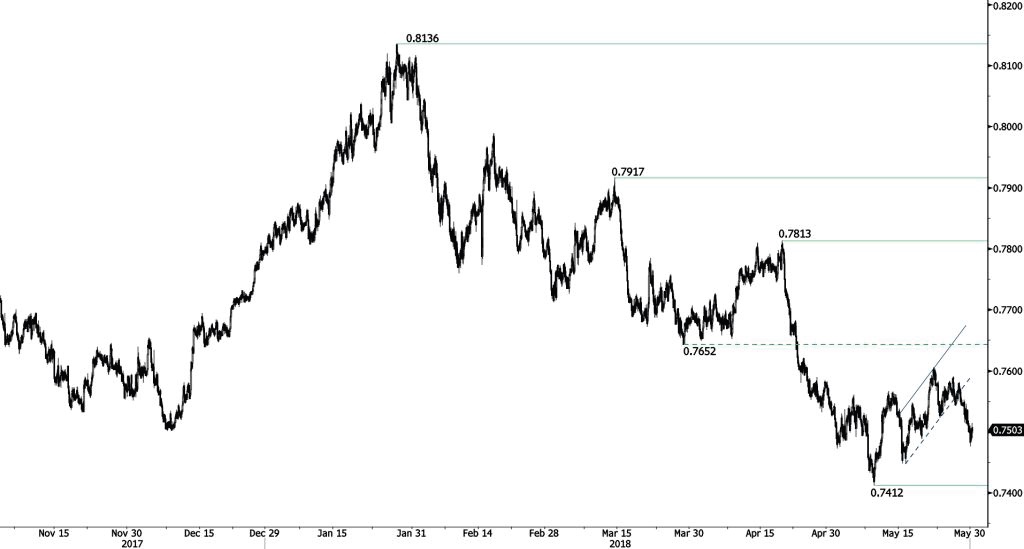
AUD/USD Weakening
AUD/USD has recently only been able to make marginal new highs, suggesting a potential weakening momentum. Hourly support and resistance remain at 0.7412 (09/05/2018 low) and 0.7813 (19/04/2018 high). The technical structure suggests short-term increase.
In the long-term, the upward trend slows down after failing to reach key resistance at 0.8164 (14/05/2015 low). Key support stands at 0.6009 (31/10/2008 low). A break of the key resistance at 0.8164 (14/05/2015 high) is needed to invalidate our long-term bearish view.
USD/CAD Bullish Continuation
USD/CAD continues to improve as can be seen by the bullish move above minor resistance at 1.2949. Hourly support can be located at 1.2621 (23/02/2018 low). Next resistance can be found at 1.3125 (19/03/2017 high). The technical structure suggests short-term upward moves.
In the longer term, the pair is trading between resistance point at 1.3805 (05/05/2017 high) and support at 1.2128 (18/06/2015 low). Strong resistance is given at 1.4690 (22/01/2016 high). The pair is likely to head lower. The pair is trading above its 200 DMA.
USD/CHF Choppy Trading
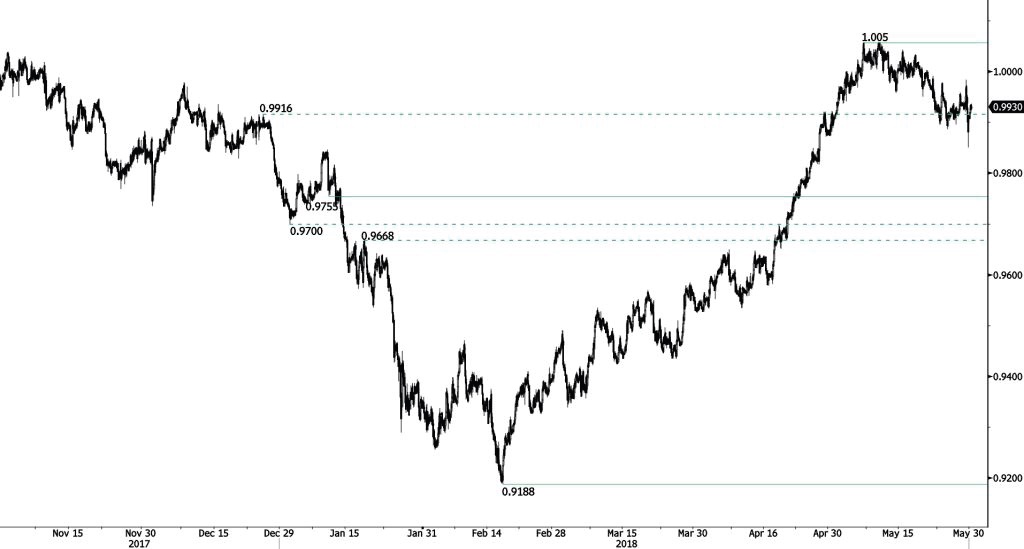
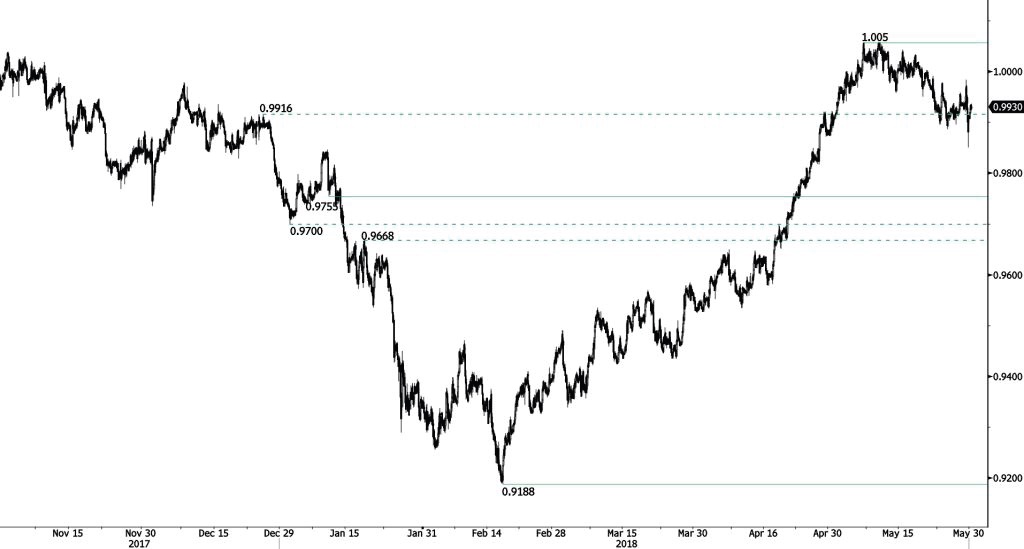
USD/CHF's has broken the support at 0.9916 (26/12/2017 high), validating a bearish reversal pattern with a downside risk at 0.9755. Key support and resistance given at 0.9755 (10/01/2018 low) and 1.0091 (09/05/2017 high) are maintained. The technical structure suggests short-term sideways trading moves.
In the long-term, the pair is still trading in range since 2011 despite some turmoil when the SNB unpegged the CHF. Key support lies at 0.9072 (07/05/2015 low) while resistance at 1.0344 (15/12/2016 high) is distanced. The technical structure favours a long term bullish bias since the unpeg in January 2015
USD/JPY Bouncing
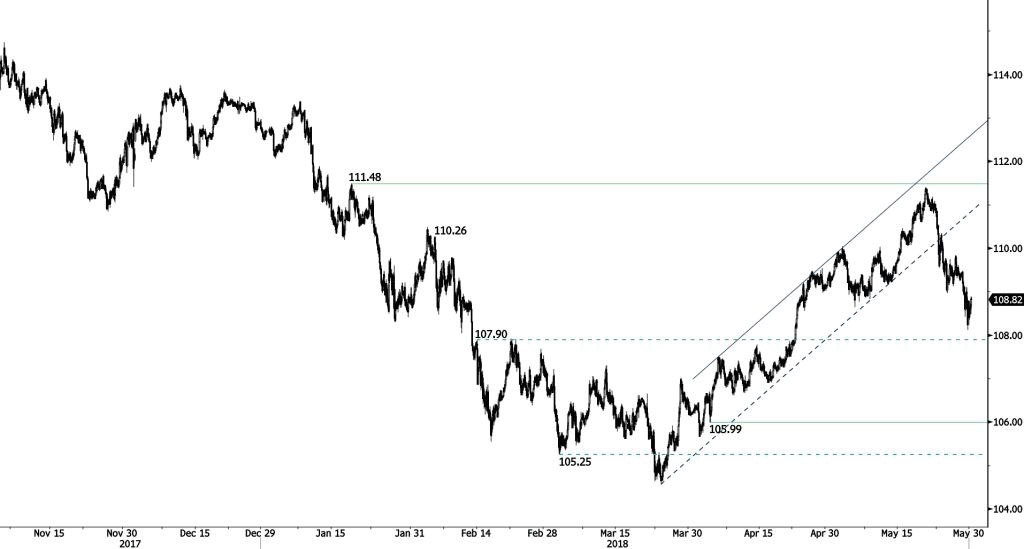
USD/JPY has recovered marginally after break of key uptrend support. Strong support and resistance are located at 107.90 (13/02/2018 low) and 111.48 (18/01/2018 high). The technical structure suggests short-term sideways trading moves.
We favor a long-term bearish bias. Support remains at 101.20 (09/11/2016 low). A gradual rise toward the major resistance at 125.86 (05/06/2015 high) seems unlikely. Expected to decline further support at 101.20 (09/11/2016 low). The pair trades slightly above its 200 DMA.
GBP/USD Bearish Pause
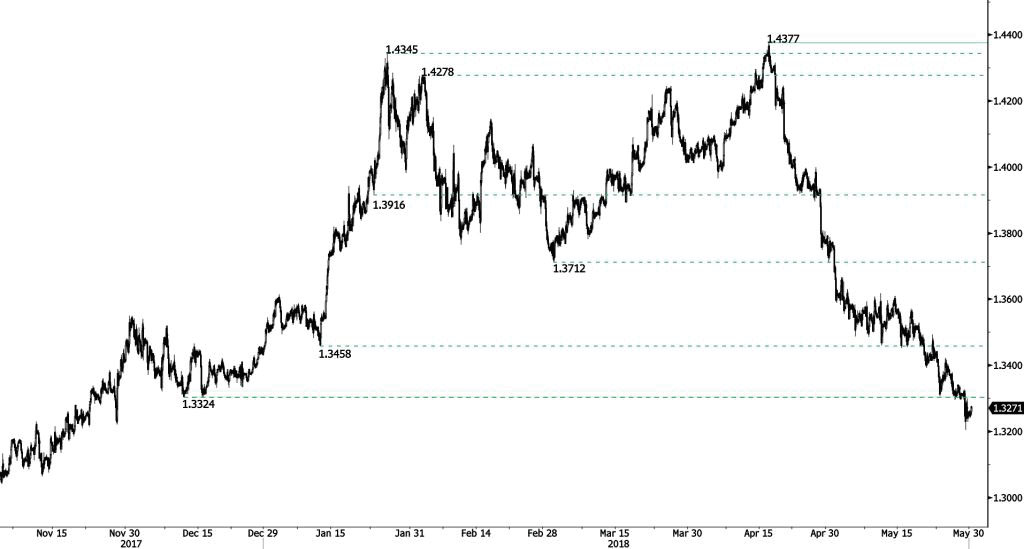
GBP/USD remains weak after breaking to the downside range defined by the support at 1.3503 (2008 low and 200d MA) . Further weakness towards the support at 1.3223 is favored. Key support and resistance are given at 1.3068 (13/11/2017 low) and 1.3458 (11/01/2017 low. The technical structure suggests further downside.
The long-term technical pattern is reversing. The Brexit vote had paved the way for further decline but the pair is moving to 2016 highs. Long-term support and resistance are given at 1.1841 (07/10/2017 low) and 1.5018 (24/06/2016 high).
EUR/USD Trying To Bounce
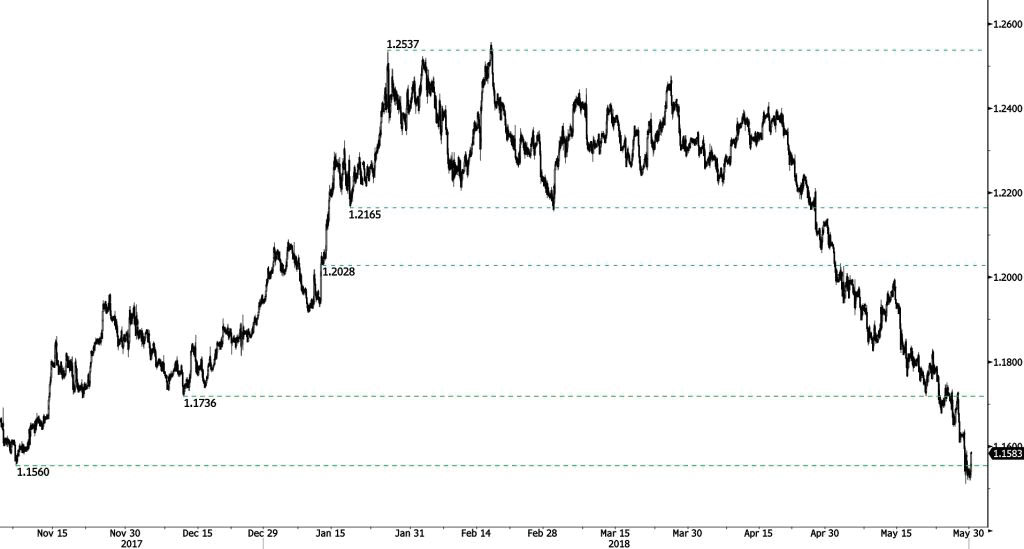
EUR/USD is again trying to bounce after break storng support at 1.1560. The short-term technical structure is negative as long as prices remain below the hourly resistance at 1.2036 (11/01/2017 low). Next key support and resistance are now given at 1.1463 (12/02/2018 low) and 1.2323 (17/01/2018 high).
In the longer term, the momentum is turning largely negative. We favor a continued bearish bias. Key resistance is holding at 1.2886 (15/10/2014 high) while strong support lies at 1.1554 (08/11/2017 low).
The Italian Market Panic: Drivers and Near-Term Outlook
Summary points:
- The Italian bond sell-off reached unprecedented levels yesterday and is starting to have significant global ramifications as we saw during the euro debt crisis in 2012.
- The current market panic is a reflection of several drivers, including possible continuing Italian political vacuum, poor market liquidity as well as fears over the lack of rescue options in case of a full-fledged Italian debt crisis.
- The likely failure to appoint an interim government may result in new elections or alternatively the immediate appointment of the Five Star/League government but with strings attached from the president to their policy programme.
- We continue to stay sidelined for now in respect to BTP exposure—it may be tempting to add a short BTP future but taking the ultra-high volatility into account, the risk adjusted return is not attractive.
Escalating Italian market panic taking on a global dimension
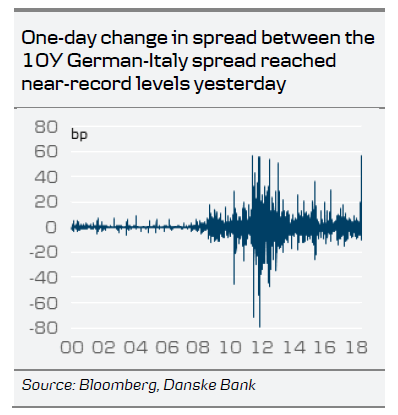
Italian bonds have been under significant pressure over the past couple of weeks, which accelerated into outright market panic yesterday where the daily change in the spread between Italian and German 10-year interest rates (+56 bp wider) is the second biggest spread widening since 2000 and exceeding spread increases seen during the euro debt crisis in 2012
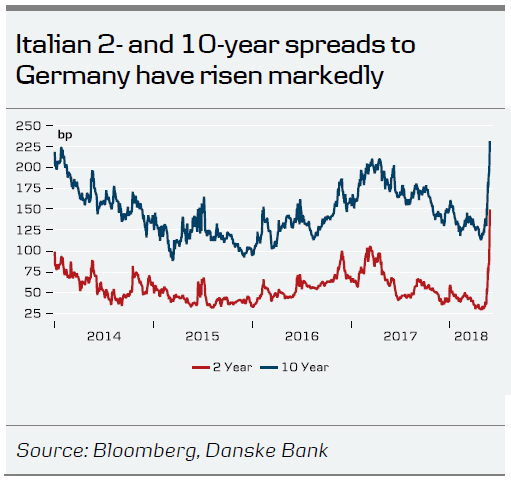
Italian spreads now are at levels which signal significant market concern around Italy. 2Y and 10Y yields are now higher than prior to when the ECB started its QE programme in March 2015. Furthermore, the front of the curve has taken a serious beating, where the 2y point is up around 300bp over the past month. The bearish yield curve flattening is a natural reaction to markets when a sovereign debt restructuring starts to become an underlying market fear. In those instances, a possible haircut is usually applied across the entire curve, hurting shorter-dated bonds more than longer-dated ones.
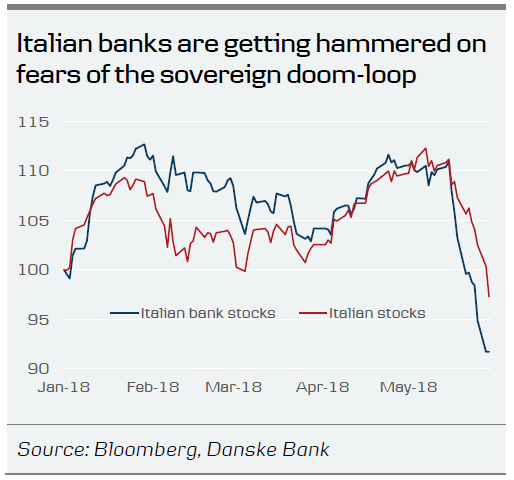
Given the uncertain political and economic outlook for Italy, Italian equities have taken a beating in the past weeks, falling 14% since mid-May. Italian bank stocks have been particularly hit, falling almost 20% over that period given concerns over a rise in non-performing loans in the case of crisis and possible losses on their sizeable holdings of BTPs amounting to 330bn Euros or 20% of GDP. Some Italian banks even hit limit-down during yesterday's trading sessions, indicating the unusual market environment seen yesterday.
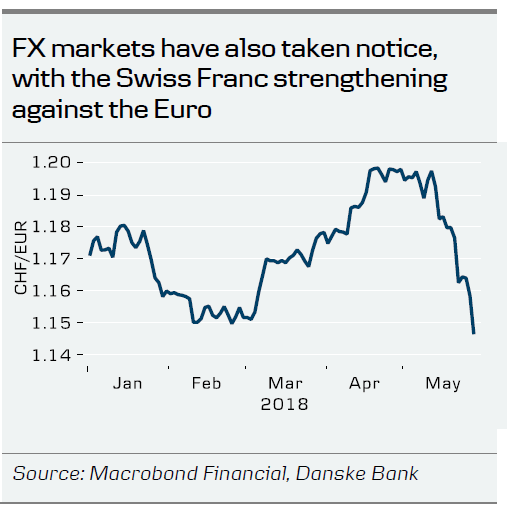
The concern about Italy is starting to impact global equity and FX markets. Yesterday, the Dow Jones lost 400 points and the Euro weakened while the Swiss Franc strengthened, meaning that the EUR/CHF has now fallen over 4% since mid-May.
In the following we look at the factors driving market sentiment toward Italian assets and what the likely scenarios are at this stage as well as the implications for Italian BTPs.
What is driving the sell-off?
The driver of the market panic comes as the new political majority in Italy is on a clear collision course with the EU, while technical factors and poor Italian economic fundamentals and the absence of any EU/ECB/ESM support at this stage also add to the sell-off:
- Political stalemate in Italy is likely to drag on: The attempt by Carlo Cottarelli to form a government is seen as faltering (a meeting is scheduled with him and President Mattarella later today), which could force the president to dissolve parliament, leading to elections within 60-70 days, i.e. at the earliest end-July. This is a very long period in the current negative market environment. In addition, the League has seen a significant rise in the polls, while Five Star has only lost a little bit of support. Hence, the coalition may come out with an even stronger public mandate at new elections.
- No incentive for ECB/EU/ESM to stabilise the situation at this juncture: While EU policymakers are probably looking at the situation in Italy with some concern (a full-blown Italian debt crisis could have severe repercussion for Italy and other Euro area countries—there are already signs of contagion to other periphery countries), we think that officials in Frankfurt, Berlin and Brussels are quietly hoping that the current market pressure will make the Italian populist politicians think twice about their intentions to implement a fiscally highly expansionary programme (on the face of it amounting to 6- 7% of GDP) and backtrack on structural reforms (lowering of pension age and state intervention in banking system). That said, the EU commission and other European politicians will probably be cautious, trying not to inflame the EU sceptical sentiment in Italy further in the run-up to elections by criticising the populist parties publicly.
- Bail-out fatigue in the German population means that the German government will find it harder to support a potential bail-out package. After the numerous bail-out programmes for Greece and other periphery countries, there is already a good deal of bail-out fatigue in Germany, which is one of the main reasons for the rise of AfD and FDP. This will make it very difficult for the German government to support any bailout programme compared with 2012.
- Poor market liquidity and volatility exacerbating selling pressures: Another factor exacerbating the sell-off is the more limited market liquidity following increased financial sector regulation since the financial crisis. This can, according to the IMF,1 create "air pockets" in the markets when strong selling pressures emerge like yesterday. In other words, markets that function well in normal times can suddenly face severe stress when selling pressure gets over a certain threshold.
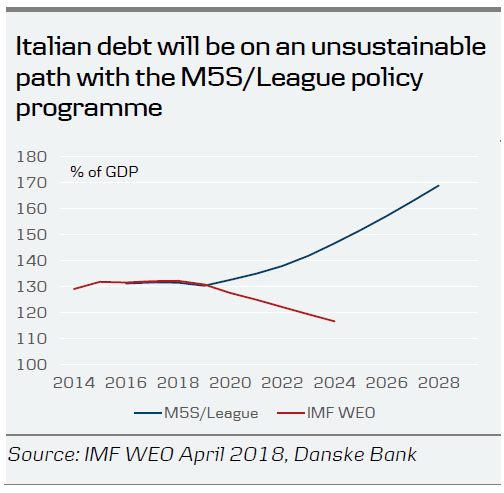
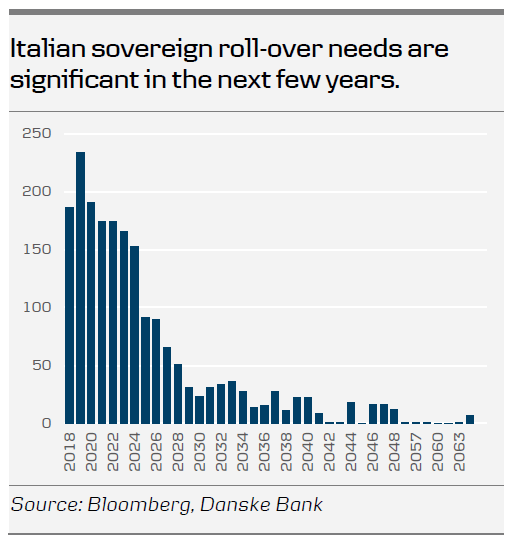
- The fear of a vicious circle given poor Italian macro- and debt fundamentals. As we pointed out in our research piece ahead of the Italian election, Italian Election Monitor - The good, the bad and the ugly scenarios for Italy), the combination of a weak economic growth outlook, huge public debt and fragile banking system makes Italy debt dynamics highly vulnerable to rising interest rates. In the chart on the right, we have updated the "ugly" scenario from that paper with the fiscal policies contained in the policy programme of the potential Five Star/League government combined with a rise in the interest spread between Italy and Germany to 400bp (the spread yesterday was 290bp). This combination will clearly put Italian debt on an unsustainable upward trajectory. Although the average maturity is seven years, Italy has an annual refinancing need of EUR250bn (with debt falling due around EUR200bn and a deficit of EUR50- 100bn), which presents a significant roll-over risk in the current market climate.
- Fear of Italy leaving the euro: Part of the reaction is also a reflection of markets perceiving the new election as an implicit vote on the euro. Although euro-sceptic rhetoric will likely factor more prominently in the next election campaign, we do not believe Five Star/League will campaign for an outright euro exit. Even if populist parties are able to increase their vote share, we assess the probability of Italy actually leaving the euro as very low, not only due to constitutional hurdles, but also because of the immense costs attached to such a move - for all partners, both in Italy and other euro area countries. A compromise solution between Italy and the EU is the more likely scenario at the end of the day in our view. However, we think rhetoric between the possible Five Star/League government and the EU can become quite lethal, raising market anxiety; even a small probability of an Italian euro-exit could have a big market impact in the current climate. Any news/headlines that would either reinforce or abate market fears on the topic of ITexit would hence continue to move markets in the near term.
How far can the sell-off go and what can stop it?
The rise in Italian yields seen yesterday will clearly not be sustainable if continued for a prolonged period. The fact that the crisis is starting to have significant global ramifications means that the pressure not only the Italian President and policy makers to find a solution will be immense, but also the EU side will begin to feel the heat to stop the rout.
New elections are a likely scenario given that the president will not find the Five Star/League option viable. However, as mentioned above, this will bring two months of political vacuum, which may be unbearable for the Italian economy especially in view of the strong polls for the League party. And it may just lead to an even stronger mandate for the populist parties. The coalition partners might try to sooth financial markets for example by stating publicly that they will abide by the 3% EU deficit target, de facto scaling down their spending programme. This would also make it potentially easier for the EU institutions who would not be in a hurry to come with support for Italy unless Five Star/League leaders tone down their Eurosceptic rhetoric and spending proposals.
Another option might be that in light of the immense market pressure, the president may have to accept the Five Star/League government option right away with some strings attached on the new government's policy programme. The calculation from the President's side may be that the political vacuum may aggravate the situation, which could trigger a run on Italian banks and possible imposition of capital controls (as we saw in the case of Greece after the Syriza government came into power). This would be disastrous for the Italian economy. Instead it may be better to try and steer the new government in a more moderate direction, which may be feasible given that the populist parties could be affected by waning public support as the continued sell-off of Italian assets and possible bank run could affect the wealth of ordinary Italian citizens.
FI markets - stay sidelined for now in respect to BTP exposure
The flattening of the BTP curve and jump in yields has been very dramatic and underlines that market participants now put a non-negligible probability on a debt restructuring.
We follow the political development, but also keep an eye on the rating agencies. Moody's warned today that it would follow suit on its negative watch from the weekend with a rating downgrade if a new government pursues expansionary fiscal policies or a weak structural reform agenda. We would also not be surprised to see similar comments/updates from the other rating agencies.
We continue to stay sidelined for now in respect to BTP exposure. It might be tempting to add a short BTP future or alternatively take advantage of the steep front-end of the BTP curve (1y vs 2y spread is around 180bp). However, taking the ultra-high volatility into account, the risk adjusted return is not attractive.
If we see a stabilisation in the BTP market we would rather look for opportunities in Spain and Portugal or alternatively in semi-core that has also widened significantly to Germany.
Our favoured periphery hedge remains to be positioned for a further widening of the Bund-spread.
Forex Technical Analysis: EUR/USD, USD/JPY, GBP/USD
EUR/USD
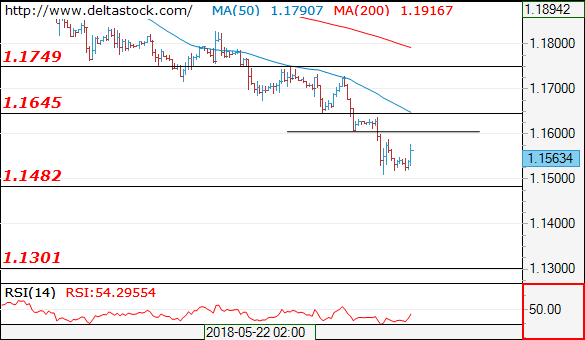
Current level - 1.1563
The sell-off here has reached the important weekly support at 1.1480, but there are still no signs of a reversal and the bias remains bearish below 1.1650, for a continuation towards 1.1300 area. Minor intraday resistance lies at 1.1600, but only a violation of 1.1645 area will signal, that a bottom is in place.
| Resistance | Support | ||
| intraday | intraweek | intraday | intraweek |
| 1.1650 | 1.2000 | 1.1550 | 1.1480 |
| 1.1750 | 1.2160 | 1.1480 | 1.1300 |
 USD/JPY
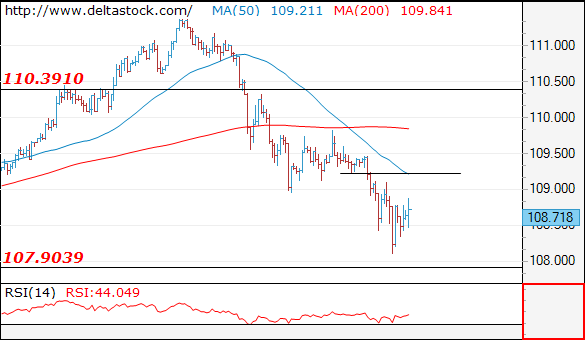
Current level - 108.71
I expect 109.20 to cap the upside, for another slide towards 107.80-90 major support.
| Resistance | Support | ||
| intraday | intraweek | intraday | intraweek |
| 109.20 | 111.40 | 108.20 | 107.80 |
| 110.40 | 114.40 | 107.80 | 106.70 |
GBP/USD
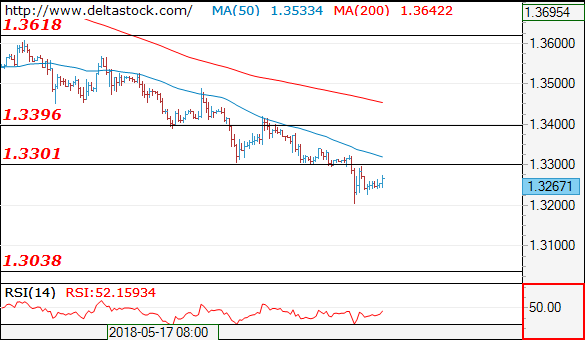
Current level - 1.3267
My outlook remains bearish below 1.3300 resistance area, for another leg downwards, to 1.3040 zone. Crucial on the upside is 1.3421 peak.
| Resistance | Support | ||
| intraday | intraweek | intraday | intraweek |
| 1.3300 | 1.3990 | 1.3200 | 1.3210 |
| 1.3421 | 1.4100 | 1.3110 | 1.3040 |
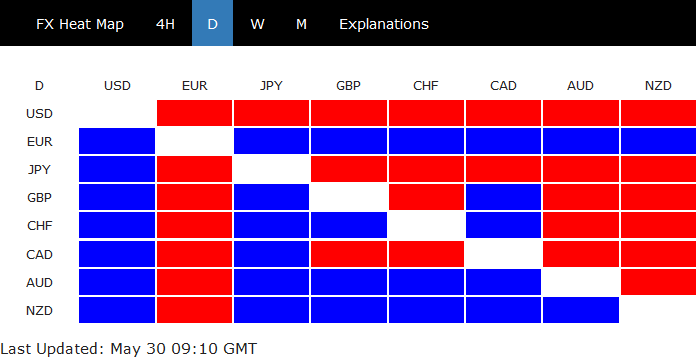
Euro recovers on oversold condition, German-Italian spread narrows
Euro is attempting a recovery today but that's mainly technical on oversold condition.
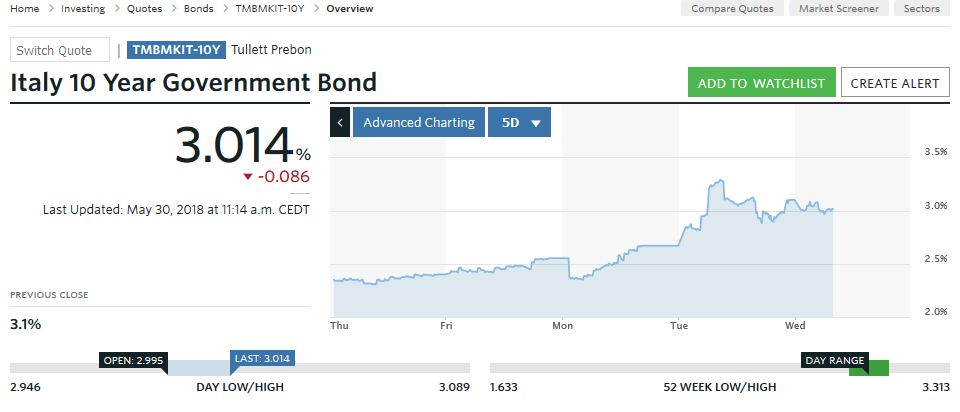
Italian 10 year yield dips to 2.946 earlier today but is back above 3.000 handle. It's possibly trying to settle at around 3% before another move.
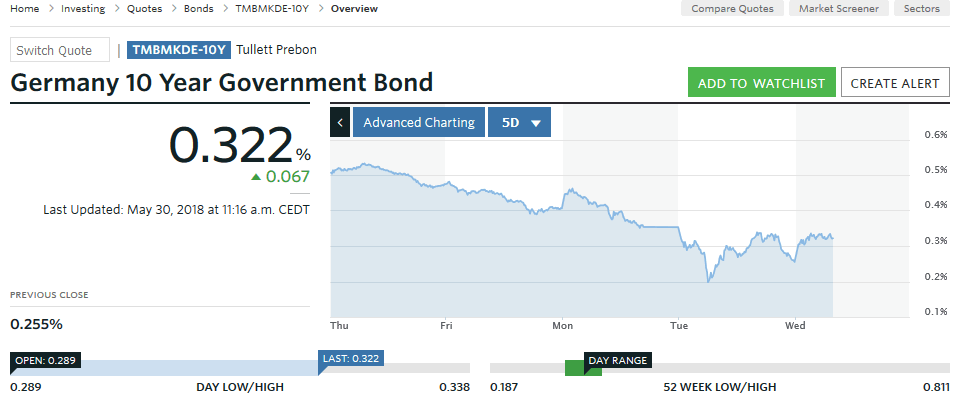
German 10 year bund yields hit as high as 0.338 and is now back at 0.322. It breached 0.2 handle earlier this week during bund buying climax.
Technically, 1.1639 in EUR/USD and 126.43 in EUR/JPY should be watched. Temporary bottoms are considered to be formed in both pairs until these minor resistance levels are breached. Otherwise, further decline is more likely than not.
Italian Political Crisis Sparks Fear In Markets
Markets remain in risk off mode again today after Indices fell yesterday to the lowest levels since early May led by Europe as the Italian political crisis deepens. The Italian President vetoed the nomination for Finance Minister by the populist government last week. The resulting collapse in the coalition led to the President appointing former IMF Director Carlo Conttarelli as Prime Minister. However Conttarelli is expected to lose a confidence vote in parliament which will lead to new elections as early as July. The Italian Stock market was down 2.66% with losses extending after hours to levels not seen since July 2017. Asian equities are down again with the Nikkei down 1.5% and the Korean Kospi down 1.57%. The Euro has fallen to 1.15100 as Bank of Italy chairman Ignazio Visco said that Italy risks losing the “asset of trust” with investors. Italian bond spreads have risen to the highest levels in four years.
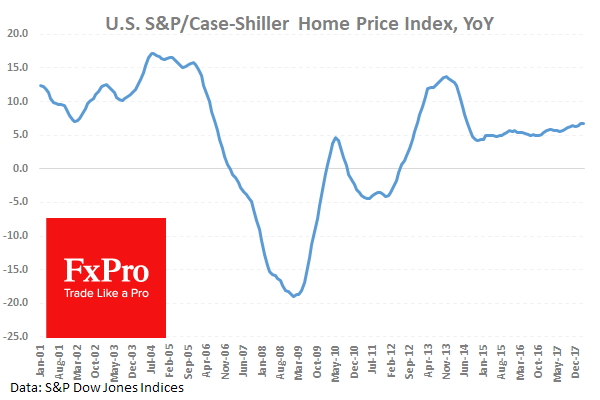
US S&P/Case Schiller Home Price Index (YoY) (Mar) was 6.8% against an expected 6.4% from a prior 6.8%. This measure has been holding a steady improvement since the late 2014 low, with this reading showing a beat on expectations to match the prior reading. USDJPY fell from a high of 109.057 to 108.812 as a result of this data.
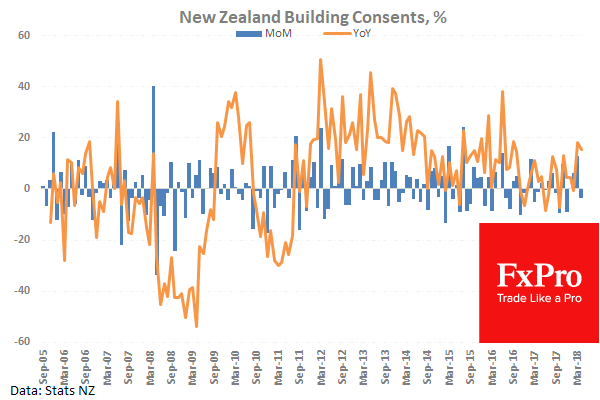
New Zealand Building Permits s.a. (MoM) (Apr) were -3.7% against a previous 14.7% which was revised down to 13.0%. This data is within a range from 20.0 to -12.0. The data as a result can appear volatile and can be affected by seasonal factors. NZDUSD fell from 0.69025 to 0.68925 after the data release.
EURUSD is up 0.13% overnight, trading around 1.15541.
USDJPY is down -0.02% in the early session, trading at around 108.730
GBPUSD is up 0.08% this morning trading around 1.32598.
Gold is up 0.02% in early morning trading at around $1,298.99
WTI is down -0.33% this morning, trading around $66.64