

Sample Category Title
EUR/AUD Mid-Day Outlook
Daily Pivots: (S1) 1.5397; (P) 1.5443; (R1) 1.5482; More....
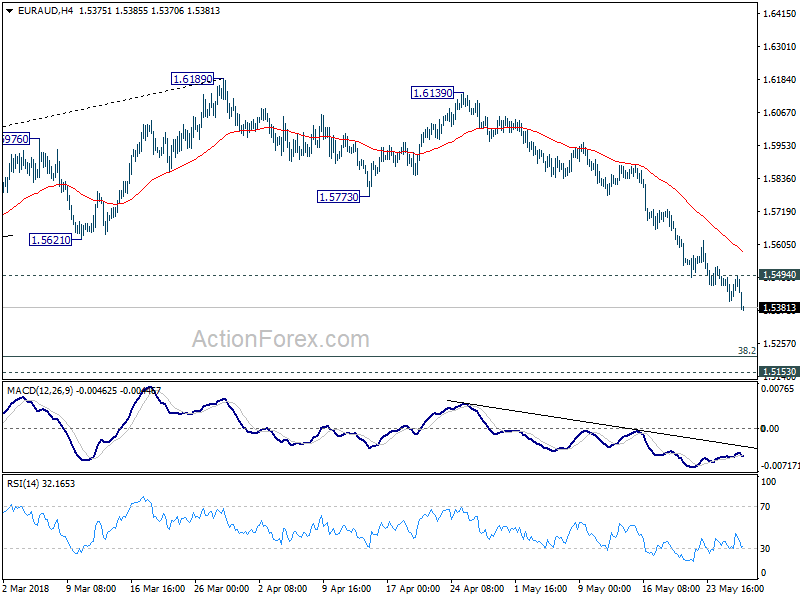
EUR/AUD extends to as low as 1.5370 so far today and intraday bias remains on the downside. Current decline from 1.6189 is expected to target 1.5153 key support level next. On the upside, above 1.5494 minor resistance will turn intraday bias neutral and bring consolidation, before staging another decline.
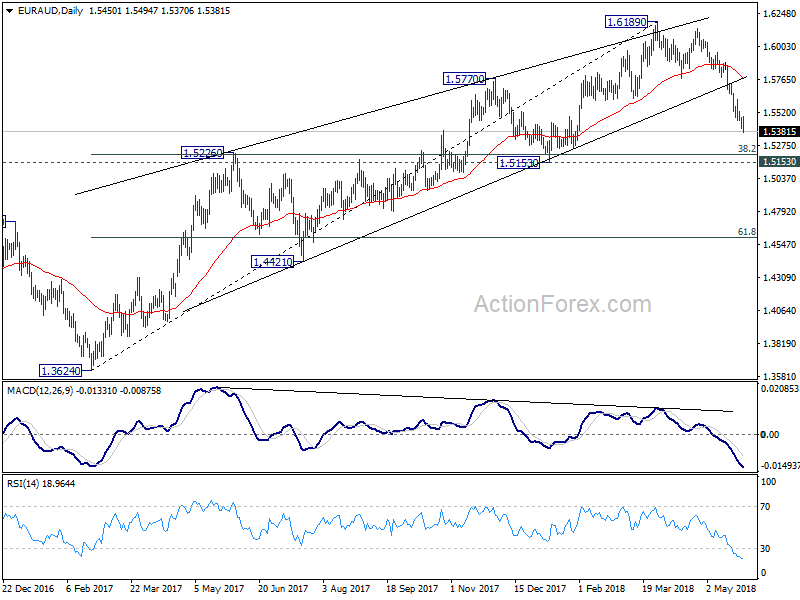
In the bigger picture, rally from 1.3624 (2017 low) should have completed at 1.6189 already, ahead of 1.6587 key resistance (2015 high). 1.6189 is seen as a medium term top. Deeper fall would be seen to 38.2% retracement of 1.3624 to 1.6189 at 1.5209 first. Decisive break there will pave the way to 61.8% retracement at 1.4604. In that case, we'll look for bottoming again below 1.4604. On the upside, firm break of 1.5773 support turned resistance is needed to indicate completion of the fall from 1.6189. Otherwise, further decline is expected in medium term, even in case of strong rebound.
Japan Maintains Positive Outlook Despite Q1 GDP Drop
The government of Japan, in a report released last week, left its assessment of the economy unchanged in May. The government report said that for the fifth consecutive month, Japan’s economy was recovering modestly despite the fact that the economy registered negative growth in the first quarter of this year.
The report also maintained its views on some of the key components of the economy such as private consumption and said that business investment was picking up while factory output was increasing at a moderate pace.
For the near term, the government maintained its outlook on the economy in a “recovery” mode as it said that the economy was supported by improvements in the labor markets and rising income conditions alongside the government efforts on fiscal spending.
The report reiterated the fact that the risks to the outlook came from the uncertainty in the global trade and overseas economy and the effects of fluctuations in the financial and capital markets globally.
Japan’s gross domestic production or GDP posted a contraction for the first time in the past nine quarters. Japan’s real GDP was seen to contract 0.2% in the first quarter ending March 2018, falling to an annualized GDP growth of just 0.6%. Factors such as severe weather conditions and higher fuel prices were seen hurting consumption leading to the decline in the GDP.
Japan’s cabinet office released its private consumption integrated estimates index which covers both the supply and demand side data. This index reported the first drop since the past two quarters, in Q1 of 2018. The index was down to 0.0% on the quarterly basis after rising 0.2% in the final quarter of 2017.
Motegi, Japan’s fiscal policy minister said in a statement that the GDP report from a few weeks ago reflected the third straight annual expansion in the economy in the fiscal year ending 2017 which was in March 2018. The GDP was seen growing 1.5% in the fiscal year of 2017 after rising 1.6% in the fiscal year ending 2016.
The GDP report showed that the total compensation of employees which comprises of gross salaries and other benefits rose 0.7% on a quarterly basis in the first three months of this year. This was after total compensation was seen falling 0.2% in the last quarter of 2017. This marked a year over year gains to 2.0% and was seen rising for the third consecutive year.
Speaking about inflation, the Japanese government said that consumer prices increased at a moderate pace in the recent months. This was an unchanged view from its previous assessment. In the month of March, the report had upgraded its outlook on inflation for the first time in nearly three years.
However, despite the unchanged outlook, most recent inflation data from Japan showed that the core consumer prices rose at a pace of 0.7% on an annualized basis in April 2018. The pace of increase had decelerated further from the previous months. This comes amid lower utility costs and the possibility that the Bank of Japan could eventually achieve the 2% inflation target in the next couple of years.
Underlying inflation which excludes fresh food and energy was seen rising at a pace of 0.4% in the year ending April 2018. This was a slower pace of increase compared to March’s increase in inflation at 0.5%. The increase in core CPI, in March 2018 was incidentally the largest gain since July of 2016.
Overall, the pace of the increase registered in the CPI was seen rising at a slower pace compared to the 1.0% increase in February which was attributed to the temporary factors that was responsible for pushing inflation higher.
NZDUSD : Possible Reversal Higher?
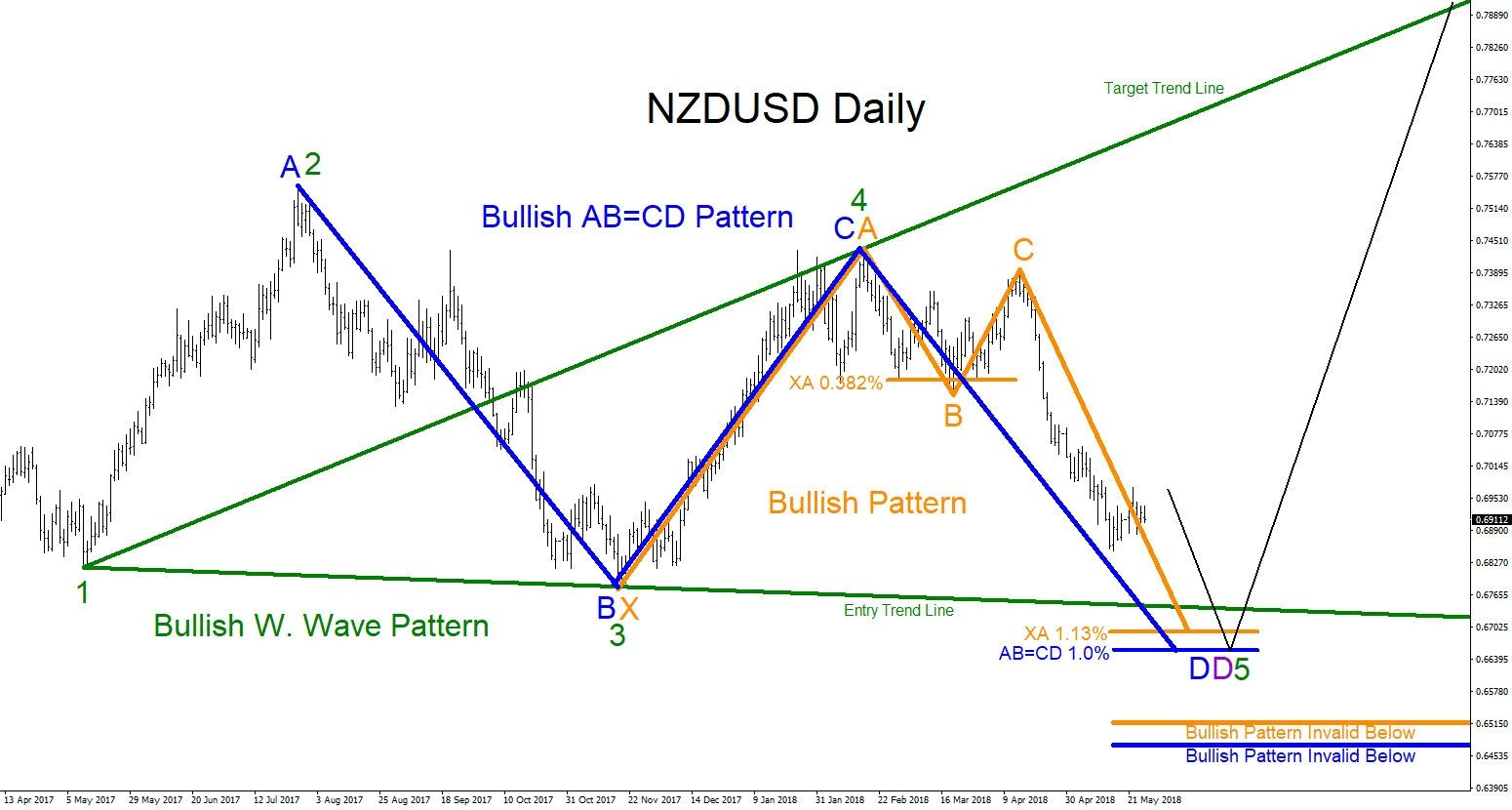
NZDUSD at the current moment looks to be in a 3 swing move lower (Daily chart) starting from the July 27/2017 highs. Expect price to continue lower and break below the November 17/2017 lows. If breaks lower, the next level of interest where NZDUSD can find support and possibly reverse and bounce higher can be seen at the 0.6690 – 0.6470 area. There are two clear bullish patterns that can possibly trigger BUYS in this area. In the Daily chart below first orange bullish pattern triggers BUYS at the XA 1.13% Fib.retracement level (0.6694) where the pair can find bulls waiting. Second blue bullish AB=CD pattern triggers BUYS at the 1.0% Fib. Extension level (0.6658) where the pair too can find bulls and push price higher. Orange bullish pattern is invalid if price moves below 0.6515 and the blue AB=CD bullish pattern invalidates if price moves below 0.6470. As long as price stays above these invalidation levels it is possible that NZDUSD will reverse higher.
USD/JPY Mid-Day Outlook
Daily Pivots: (S1) 109.10; (P) 109.42; (R1) 109.71; More...
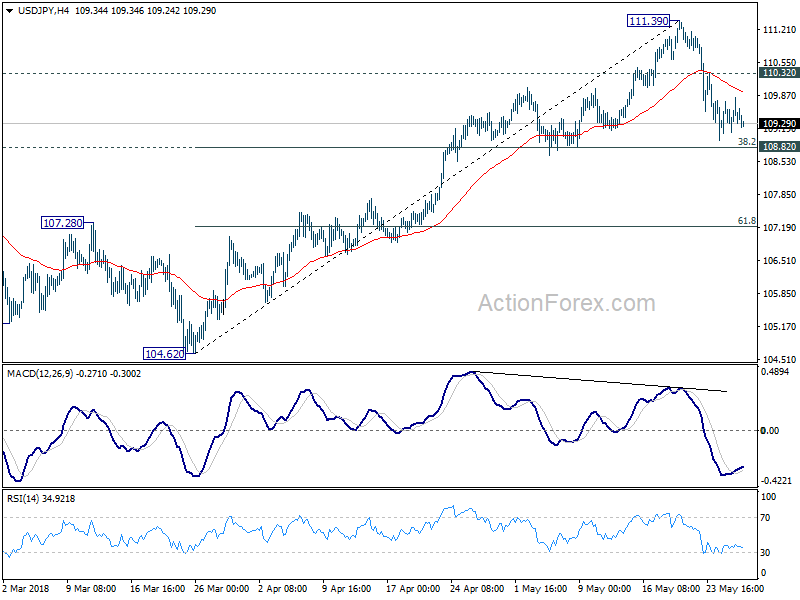
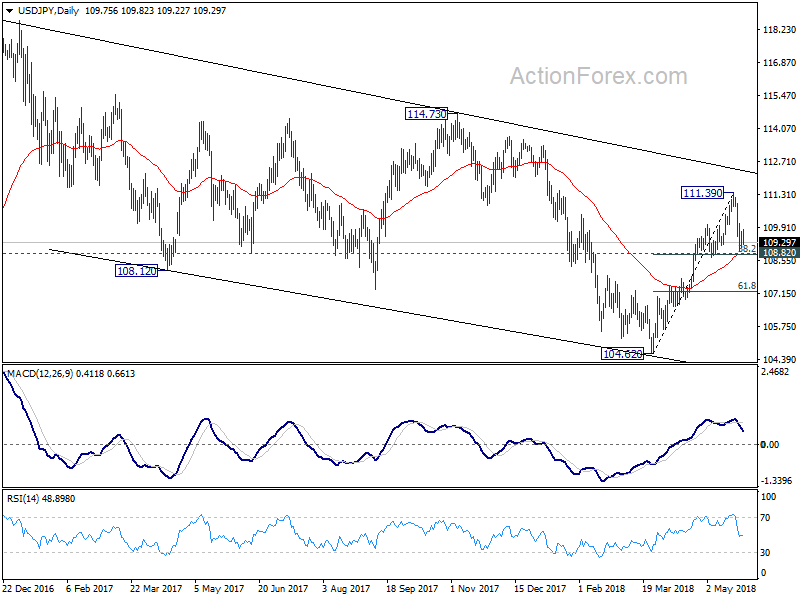
Outlook in USD/JPY remains unchanged. The correction from 111.39 could extend. But we'd expect support from 108.82 cluster support (38.2% retracement of 104.62 to 111.39 at 108.80) to bring rebound. On the upside, above 110.32 minor resistance will argue that the pull back is completed. And, in that case, retest of 111.39 high should be seen. However, firm break of 108.82 will dampen our view and bring deeper decline to 61.8% retracement at 107.20 and possibly below.
In the bigger picture, corrective decline from 118.65 (2016 high) has completed with three waves down to 104.62. Rise from 104.62 is possibly resuming the up trend from 98.97 (2016 low). This will be the preferred case as long as108.82 support holds. Decisive break of 114.73 resistance will confirm our view and target 118.65 and above. However, sustained break of 108.82 will dampen the bullish outlook and revive the case of a break of 104.62 low before bottoming.
USD/CHF Mid-Day Outlook
Daily Pivots: (S1) 0.9885; (P) 0.9911; (R1) 0.9926; More...
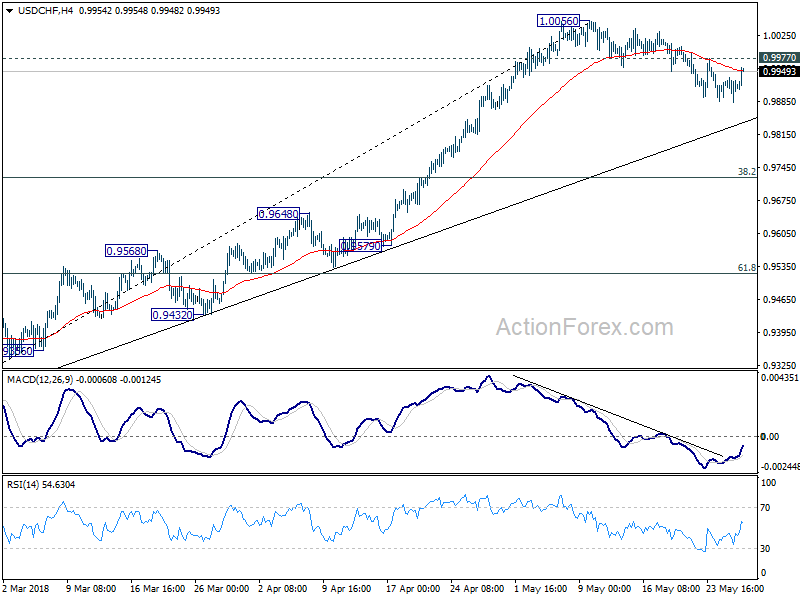
Intraday bias in USD/CHF is turned neutral with today's recovery. Focus is back on 0.9977 minor resistance. Break there will argue that corrective pull back from 1.0056 has completed already. Intraday bias will then be turned back to the upside for retesting 1.0056 high first. In case of another fall, we'd expect strong support from trend line (now at 0.9842) to contain downside and bring rebound. However, sustained break of the trend line will argue that it's a larger scale correction and will target 0.9724 fibonacci level.
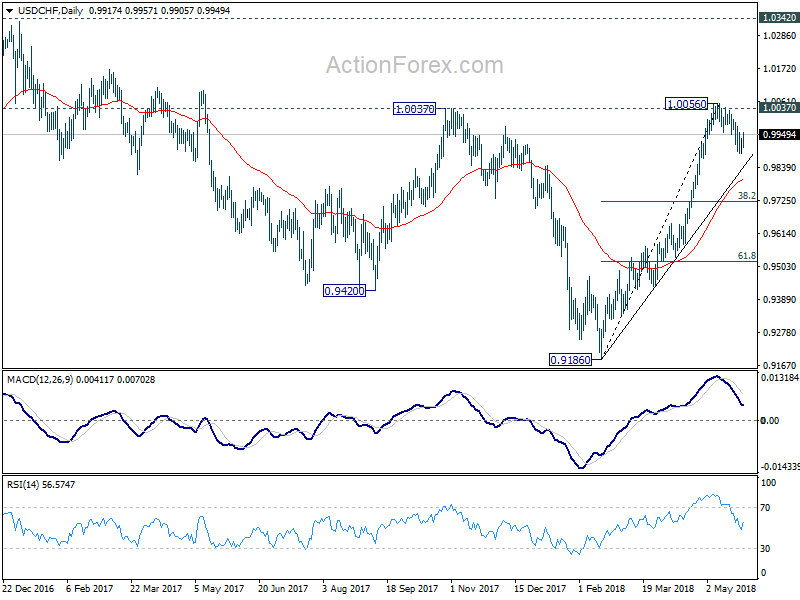
In the bigger picture, medium term decline from 1.0342 has completed with three waves down to 0.9186. Rise from there is currently viewed as a leg inside the long term range pattern. Hence, while further rally would be seen, we'd be cautious on strong resistance from 1.0342 to limit upside. For now, further rise is expected as long as 38.2% retracement of 0.9186 to 1.0056 at 0.9724 holds.
GBP/USD Mid-Day Outlook
Daily Pivots: (S1) 1.3263; (P) 1.3327; (R1) 1.3359; More...
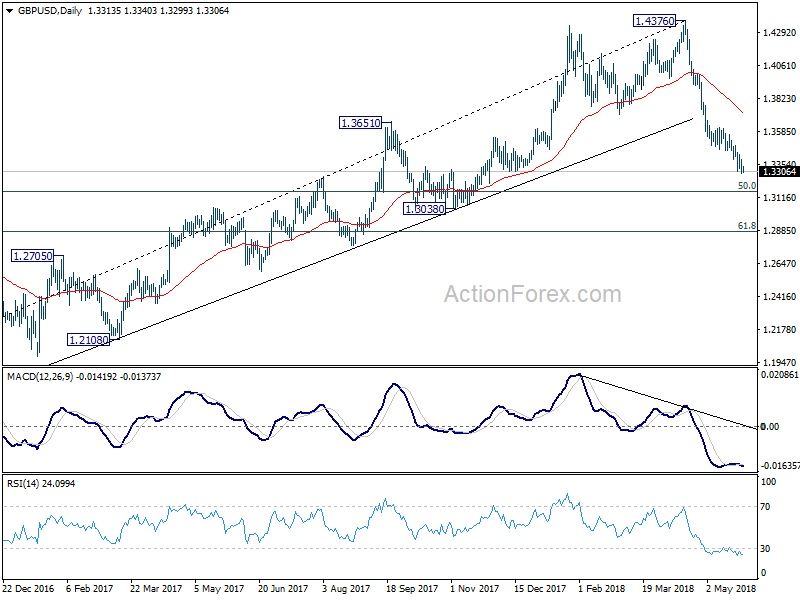
GBP/USD's fall is still in progress and intraday bias remains on the downside at this point. Current decline from 1.4376 should target 50% retracement of 1.1946 to 1.4376 at 1.3161. On the upside, above 1.3377 minor resistance will turn intraday bias neutral and bring consolidation. But break of 1.3568 resistance is needed to indicate short term bottoming. Otherwise, outlook will remain bearish in case of recovery.
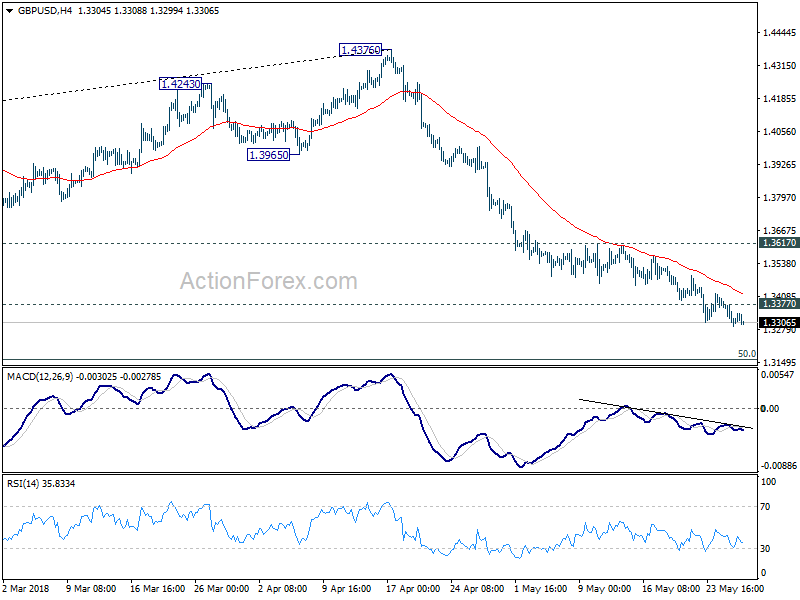
In the bigger picture, current development suggests that whole medium term rebound from 1.1936 (2016 low) has completed at 1.4376 already, with trend line broken firmly, on bearish divergence condition in daily MACD, after rejection from 55 month EMA (now at 1.4223). 61.8% retracement of 1.1936 (2016 low) to 1.4376 at 1.2874 is the next target. We'll pay attention to the reaction from there to asses the chance of long term down trend resumption. For now, outlook will stay bearish as long as 55 day EMA (now at 1.3730) holds, even in case of strong rebound.
EUR/USD Mid-Day Outlook
Daily Pivots: (S1) 1.1618; (P) 1.1676 (R1) 1.1707; More.....
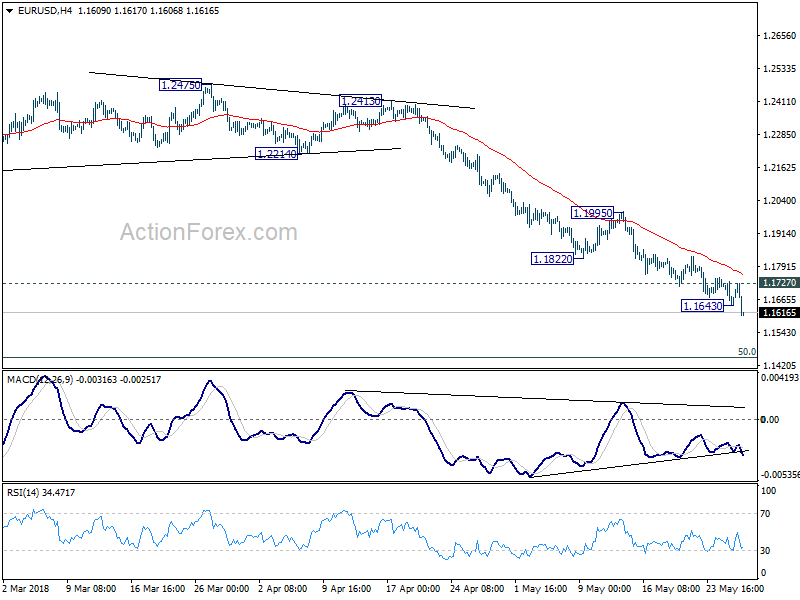
EUR/USD's decline resumes after brief recovery and reaches as low as 1.1606 so far. Intraday bias is back on the downside. Current fall from 1.2555 is in progress for 50% retracement of 1.0339 to 1.2555 at 1.1447 next. On the upside, above 1.1727 minor resistance will turn intraday bias neutral again. But after all, near term outlook will remain bearish as long as 1.1995 resistance holds, in case of recovery.
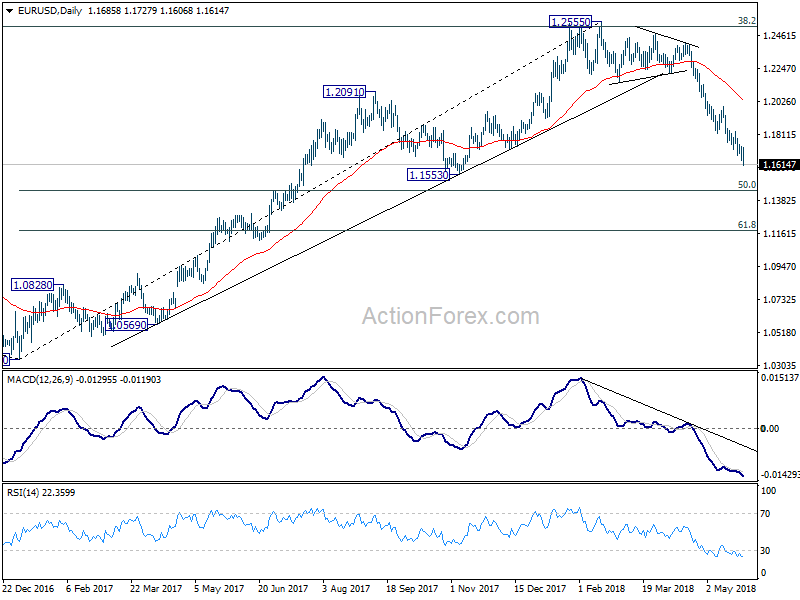
In the bigger picture, current development suggests that EUR/USD was rejected by 38.2% retracement of 1.6039 (2008 high) to 1.0339 (2017 low) at 1.2516. And, a medium term top was formed at 1.2555 already. Decline from there should extend further to 61.8% retracement of 1.0339 to 1.2555 at 1.1186 and below. For now, even in case of rebound, we won't consider the fall from 1.2555 as finished as long as 55 day EMA (now at 1.2049) holds.
EUR/JPY Mid-Day Outlook
Daily Pivots: (S1) 126.86; (P) 127.70; (R1) 128.25; More....
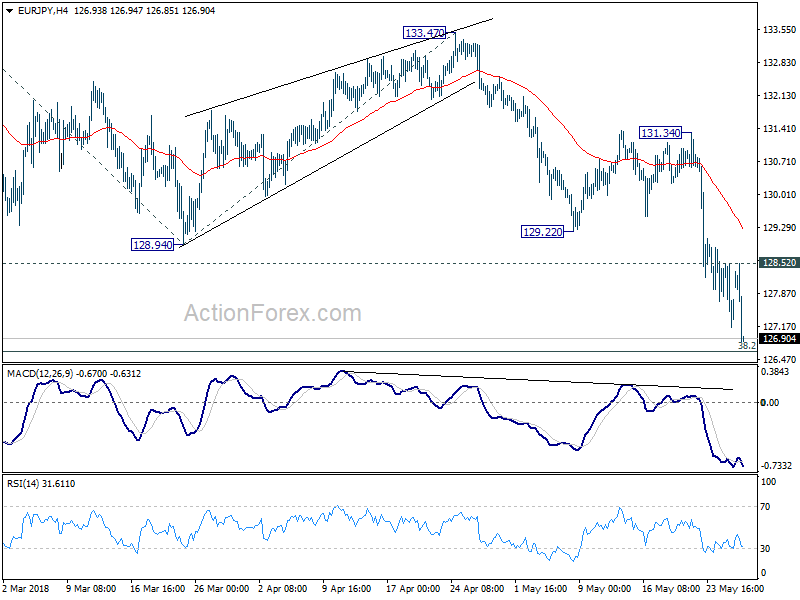
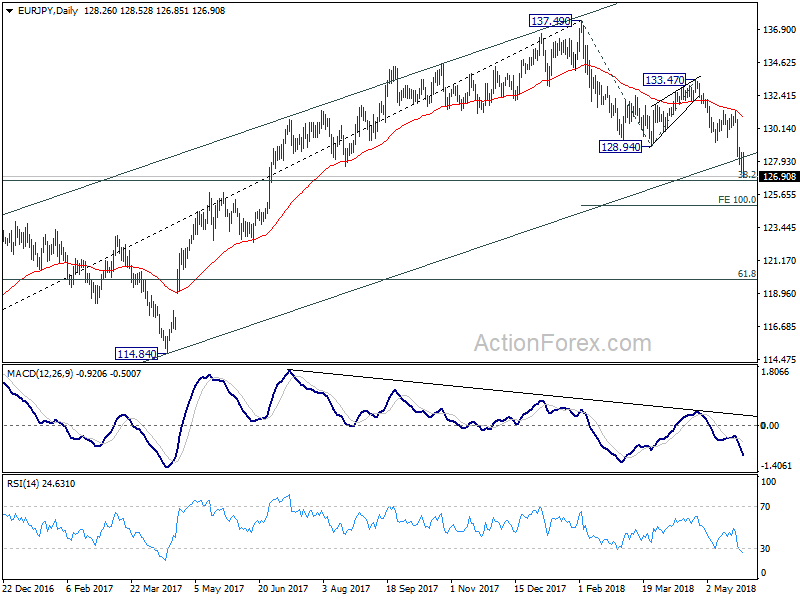
EUR/JPY's decline resumed after brief recovery and intraday bias is back on the downside. Current fall should now target 126.61 medium term fibonacci level. Based on current momentum, EUR/JPY will likely dive through this level to 100% projection of 137.49 to 128.94 from 133.47 at 124.92. On the upside, above 128.52 minor resistance will turn intraday bias neutral again. But after all, near term outlook will remain bearish as long as 129.22 support turned resistance holds and further fall is expected ahead.
In the bigger picture, bearish divergence in daily MACD and current strong downside momentum is raising the chance of medium term trend reversal. Sustained break of 38.2% retracement of 109.03 to 137.49 at 126.61 will argue that whole up trend from 109.03 has completed at 137.49 already. And, deeper decline would be seen to 61.8% retracement at 119.90 and below. Though, strong support from 126.61 and rebound from there would revive medium term bullish for another high above 137.49.
Euro Decline Resumes as Italy is Facing New Election Risks
Euro is back under broad based selling pressure after an ex-IMF official accepted the mandate to form an interim government. While traders were relieved that the anti-establishment eurosceptic coalition government couldn't be formed, they're now facing uncertainty of a new election. EUR/USD has already broken last week's low at 1.1643 to resume recent downside. 1.16 handle will likely be broken soon. EUR/JPY also followed and broke 127.14 temporary low.
Elsewhere in the currency markets, Canadian Dollar follows Euro and Swiss Franc as the weakest one. WTI crude oil is extending recent fall and hits as low as 65.80 so far today. New Zealand Dollar, Australian Dollar and Sterling are the better performing ones as no news is good news.
German-Italian yield spread widens again as ex-IMF official takes mandate to form interim government
Euro's rebound today was rather short lived. It's based on relief that the anti-establish, eurosceptic coalition government of the 5 Start Movement and the League couldn't be formed. But then the common currency is back under pressure as investors remember that Italy will now likely head to another election. That sentiment is also clearly reflected in widening of German-Italy yield spread again. German 10 year yield bund once jumped to 0.463 earlier today but it's down at 0.358, down -0.048. Italy 10 year government bond yield dropped to 2.35 earlier today but it's now at 2.664, up 0.112.
In swift arrangements, former IMF Director of the Fiscal Affairs Carlo Cottarelli accepted Italian President Sergio Mattarella's appointment to form an interim government. That came after Giuseppe Conte abandoned the effort to form a new coalition government of the 5-Star Movement and the League, following Mattarella's veto of eurosceptic Paolo Savona as the as economy minister.
The Prime Minister designate Cottarelli said that "I'll present myself to parliament with a program which - if it wins the backing of parliament - would include the approval of the 2019 budget. Then parliament would be dissolved with elections at the beginning of 2019." Or, "in the absence of (parliament's) confidence, the government would resign immediately and its main function would be the management of ordinary affairs until elections are held after the month of August."
Based on responses from political parties, the next elections will likely be held in August.
South Korean Moon: Meeting with Kim Jong-un was easy like a casual meeting
South Korean President Moon Jae-in said in a meeting with senior secretaries that the meeting with North Korean leader Kim Jong-un on Saturday was "just like a casual meeting" and that's "more important than anything". He added that "leaders easily got in contact, easily made an appointment and easily met to discuss urgent matters, without complicated procedures and formalities, just like a casual meeting."
Moon also noted that the Saturday meeting was organized on short notice after Kim's request. And that could be a model for further contact between the two Koreas. He noted "if we could hold working-level, back-to-back talks on both sides of Panmunjom if urgently necessary in addition to formal summits, it would expedite faster advancement of inter-Korean relations."
After Moon's effort to revive the Kim-Trump summit, US officials are now in North Korea for the details. It's reported that Sung Kim, the former US ambassador to South Korea, was leading the American delegation to meet North Korean officials. Sung Kim was hailed by a former senior South Korean official as " capable, level-headed, cautious, and has solid grasp of the issues and knows North Koreans well." At the same time, Sung Kim has "healthy scepticism".
Abe to tell Trump Japanese carmakers made huge contributions to the US economy
Japan Prime Minister Shinzo Abe was asked in the parliament today about Trump intention to impose tariffs on car imports using national security as excuse. Abe said he would seek to convince Trump that Japan carmakers are important in boosting the US economy.
He noted that Japan auto makers have "created jobs and made huge contributions to the U.S. economy." And he added that the number of cars Japanese automakers produce in the US is double the number it exports to the country.
And he emphasized that "as a country that prioritizes a rule-based, multilateral trade system, Japan believes that any steps taken on trade must be in line with World Trade Organization rules."
Separately, he added that "Japan has explained to the United States its stance that TPP is the best format for both countries. We will continue to talk with the United States based on this view."
EUR/JPY Mid-Day Outlook
Daily Pivots: (S1) 126.86; (P) 127.70; (R1) 128.25; More....
EUR/JPY's decline resumed after brief recovery and intraday bias is back on the downside. Current fall should now target 126.61 medium term fibonacci level. Based on current momentum, EUR/JPY will likely dive through this level to 100% projection of 137.49 to 128.94 from 133.47 at 124.92. On the upside, above 128.52 minor resistance will turn intraday bias neutral again. But after all, near term outlook will remain bearish as long as 129.22 support turned resistance holds and further fall is expected ahead.
In the bigger picture, bearish divergence in daily MACD and current strong downside momentum is raising the chance of medium term trend reversal. Sustained break of 38.2% retracement of 109.03 to 137.49 at 126.61 will argue that whole up trend from 109.03 has completed at 137.49 already. And, deeper decline would be seen to 61.8% retracement at 119.90 and below. Though, strong support from 126.61 and rebound from there would revive medium term bullish for another high above 137.49.
Economic Indicators Update
| GMT | Ccy | Events | Actual | Forecast | Previous | Revised |
|---|---|---|---|---|---|---|
| 23:50 | JPY | Corporate Service Price Y/Y Apr | 0.90% | 0.50% | 0.50% |
Canadian Dollar Knocking on 1.30 in Holiday-Thin Trade
The Canadian dollar is slightly lower at the start of the new trading week. Currently, USD/CAD is trading at 1.2982, up 0.09% on the day. On the release front, there are no Canadian or U.S events on the schedule. The U.S markets are closed for Memorial Day, so traders can expect a quiet day from the pair. On Tuesday, the U.S releases CB Consumer Confidence, which is expected to dip to 128.7 points.
The drama and uncertainty continue to swirl around the upcoming summit between President Trump and North Korean leader Kim Jong-un, which may or may not take place on June 12 in Singapore. Just a few days ago, Trump sent a letter to Kim, saying that Trump was canceling the much-anticipated meeting. However, the response from Pyongang was restrained, and the White House has sent a team to Singapore in case the summit is back on. Meanwhile, the leaders of South Korea and North Korea met on the weekend. That meeting was completely unexpected and raises hopes of a breakthrough in the long conflict between the two Koreas.
The Canadian dollar remains under pressure and has lost 1 percent in the month of May. On Monday, USD/CAD is just shy of the symbolic 1.30 level, which has held firm since March. The currency could face a rough week if, as expected, the Bank of Canada holds interest rates at 1.25 percent. Inflation has moved closer to the BoC target of 2 percent and economic growth has been steady, so the bank may opt for the sidelines when policymakers meet on Wednesday. However, with the Federal Reserve widely expected to raise rates next month, the Canadian dollar will be less attractive to investors.