

Sample Category Title
EUR/USD Analysis: Bears Couls Still Prevail Today
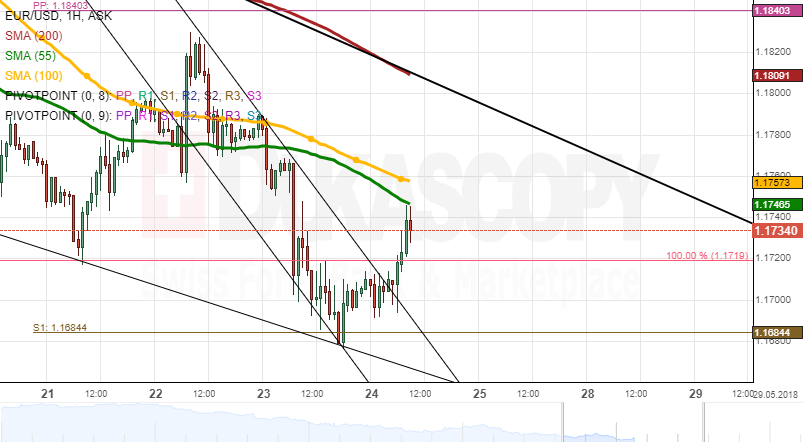
The pair failing to accelerate mid-Tuesday following a bullish breakout from the 55– and 100-hour SMAs was an early indication of a soon weakening of EUR/USD.
This scenario was fulfilled yesterday when the Euro lost 78 pips against its American counterpart and fell below the previous 2018 low of 1.17. The given fall was stopped by the weekly S1 located at 1.1685.
It is likely that the Euro tries to approach the aforementioned SMAs near 1.1760 during the following hours. Given that they have restricted effectively any attempts to accelerate during the past week, this area is unlikely to surrender today (except if fundamental events cause a strong surge north up to 1.18).
Technical signals still remain bearish, thus suggesting that today's target should be the weekly S2 at 1.16.
GBP/USD Analysis: Recovers From Plunge
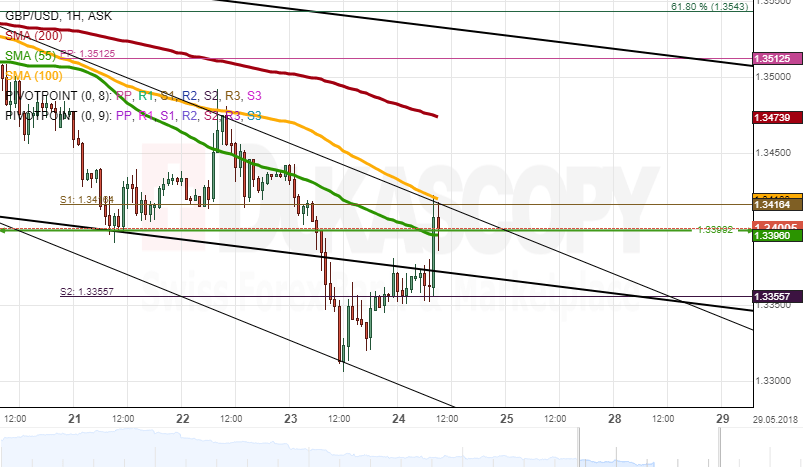
The first part of Wednesday's trading session for GBP/USD was spent under the bearish pressure. Additional downside momentum was provided by a sluggish UK CPI data release at early in the session.
As a result, the Sterling dashed through its previous 2018 low, the prevailing three-week channel and the monthly S1 prior to reversing back to the upside near 1.33. The rate recovered during the second part of the day, thus being located at the breached channel early on Thursday.
Following such a strong daily fall, the Sterling should try appreciating today; however, it is likely to find strong resistance in the 1.3400/20 area. In case this level is surpassed, the next target is 1.3460.
Meanwhile, downside potential is apparent until the weekly S3 at 1.3250.
USD/JPY Analysis: Weak After Strong Decline
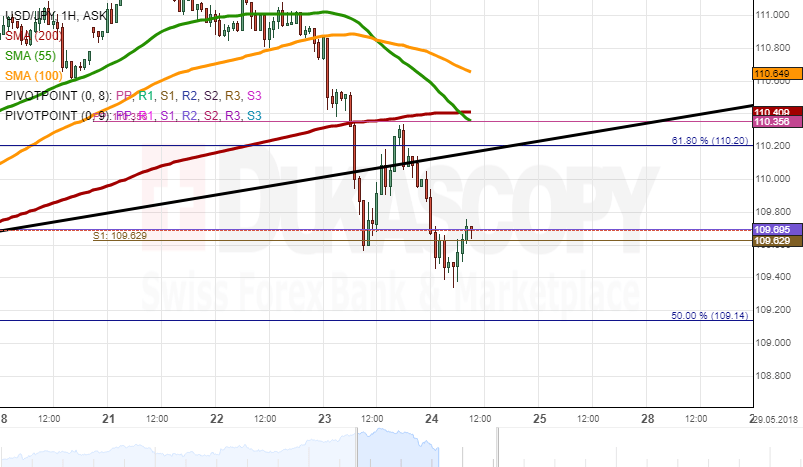
Any technical signals about USD/JPY's possible direction on Wednesday were shuttered by a 1.17% plunge during the morning hours. This massive decline was caused primarily by global geopolitical tensions which shifted risk-averse investors to the Yen as a save-haven currency.
Bulls managed to overtake the market for a few hours, but their gains were once again erased later in the evening. By Thursday morning, USD/JPY was trading at the 109.50 mark.
Technical indicators converging with the current price movement suggests that a bullish reversal might be under way. The daily high should be the combined resistance of the 200– and 55-hour SMAs and the weekly PP at 110.40. In case bears prevail, the Greenback should not fall below the 109.00 level.
Gold Analysis: Narrows Trading Range
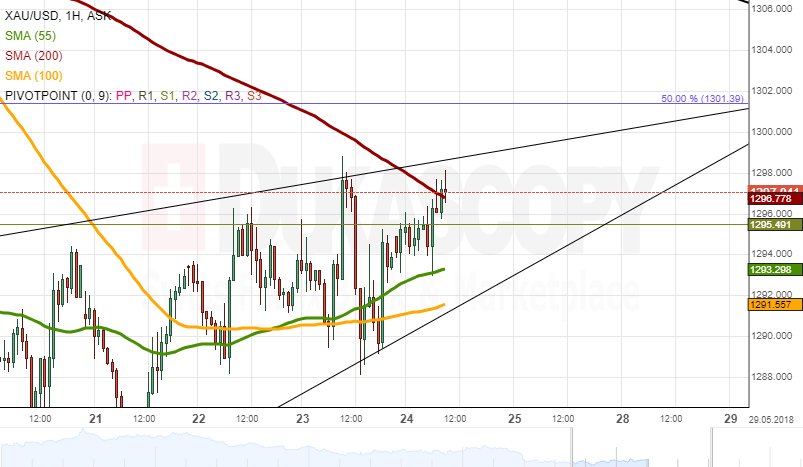
Gold remained steady against the US Dollar for the second consecutive session on Wednesday. The pair failed to accelerate and surpass the 200-hour SMA, but it likewise lacked the necessary downside momentum to breach the nearby-located 55– and 100-hour SMAs.
This has left the pair in a narrow range between all three moving averages this morning. A breakout should determine the rate's subsequent movement during the day.
Given that the southern barrier has held strong for several sessions, a breakout of the 200-hour SMA is regarded as a more likely scenario. In this case, the upside target should be the seven-week descending channel at 1,303.00.
Conversely, a fall below 1,290.00 should send the pair back to the senior channel or even lower at 1,280.00.
USD/TRY 4H Chart: Review After Turbulence
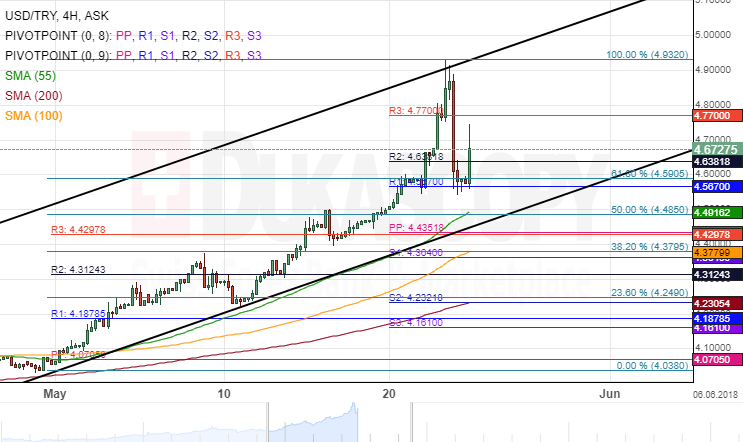
The USD/TRY pair has been mostly affected by the fundamentally economical, damaging reforms of the Turkish government. Moreover, recent events in the Turkish bond market have massively increased volatility.
However, rather incredibly the currency rates sudden decline began in consistency with the long term ascending channel pattern, which represents the surge of the recent months.
In accordance with the pattern, the US Dollar should decline against the Lira until it reaches the support of the channel. It could occur in any way, as the support can be touched by trading downwards, sideways or even going higher.
USD/CHF 4H Chart: Medium Term Decline
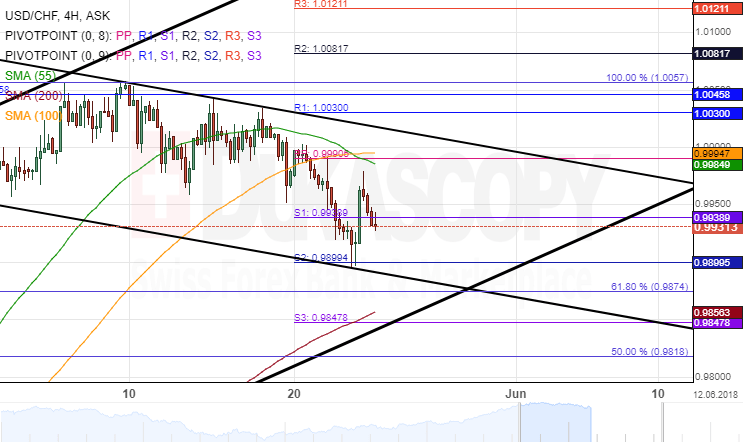
The US Dollar has been declining against the Swiss Franc in May. The decline began after the currency exchange rate met with the upper trend line of a dominant ascending channel up. Moreover, the reversal occurred just as the rate reached above the psychological 1.00 mark.
In the aftermath of the bounce off from the resistance, the currency exchange rate traded almost sideways. However, most recently the rate booked a point of reference, which provided the chance to mark a descending channel pattern.
The pattern is set to guide the rate to the lower trend line of the dominant channel. Although, that does not mean that the rate should be shorted, as the dominant support could be reached by trading sideways.
WTI Outlook: OIL Extends Weakness As Strong Rise Of Crude Inventories Weighs
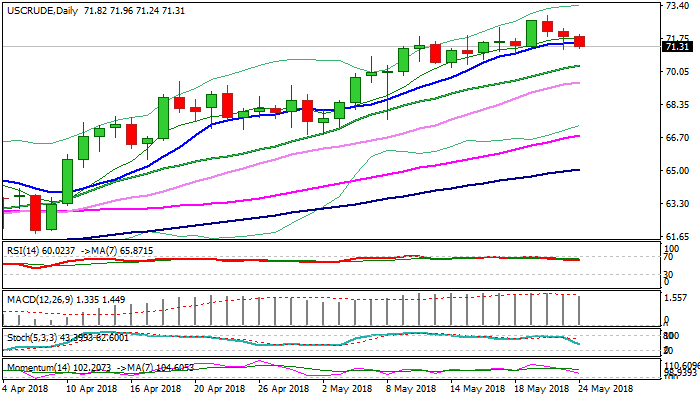
WTI oil remains in red for the third straight day and pressures Wednesday’s spike low at $71.18.
Concerns over strong rise in weekly oil inventories (US crude stocks rose 5.77 million barrels vs forecasted draw of 1.56 million barrels) and US production holding at all-time high, weigh on oil prices, helped by weaker dollar.
Pullback from new multi-year recovery high at $72.89 penetrated thick 4-hr cloud (spanned between $71.37 and $69.95) could extend towards strong supports at $70.61 (Fibo 38.2% of $66.91/$72.89) and 70.37$ (rising 20SMA).
Break below 10SMA ($71.50) was initial bearish signal, with further easing supported by south-heading 14-d momentum and slow stochastic).
Res: 71.37, 71.50, 71.96, 72.24
Sup: 71.18, 70.98, 70.61, 70.37
Italexit – A Bigger Thorn Than Brexit?
Brexit woes are still disturbing investors not only in the UK, but all over Europe. The future of the European Union without the United Kingdom is still ambiguous but then again this is direr for the U.K and the London property market is a clear evidence of this.
Setting the Scene
The EU not only needs to stop worrying about the UK, as it is a self-inflicted injury. The current situation over in Italy represents a much larger alarm situation for the EU.
The Five Star Movement party over in Italy was the last thing that investors wanted to see taking any control of power. But, that is all in the rear mirror now, the new government has shaped up with one of the weirdest collations in the history. Giuseppe Conte, the next prime minister of Italy would have difficult task on this hand. He has run a government which consists of two populist parties and this could change Rome’s relationship with Europe. Welcome to a strong possibility of Italexit.
This coalition could sabotage the EU’s aim because both collation partners are poles apart in terms of their views. One element which both the left-populist Five Star Movement and right populist League hold in common is anti-immigration. A free movement of labour and keeping the borders open to immigrants is the cornerstone of the European Union.
Investors Keeping Close Eye on Italy
For investors, Italy has been daunting choice of investment because of the banking situation and the country’s trade balance situation. It has mammoth amount of debt and little to no commitment to reduce that any time soon. To make matters worse, the upcoming government has plans to put this equation further out of whack. The left side wants to implement high-spending policies while the right side wants to lower the tax burdens. A great recipe for growth but not so great to deal with the country’s debt.
But, who cares about the current debt which is standing at 130 percent of gross domestic product!
If any country cannot be bullied and can laugh at the EU polices, it got to be Italy given that the EU rules and guidelines are all about the country’s current debt and GDP.
The new coalition government wants the EU to re-kindle its bank reform as well as the single market for goods and services within the EU. If things are not going to go their way, the threat of leaving the EU would be right on the door step and this makes the situation even more dangerous. Italy is firmly embedded in the EU so leaving the union would not be an option which the EU could afford.
The Trade
Investors are going to keep a close eye on this in the coming weeks with the Italian markets looking a lot feebler in relative perspective.
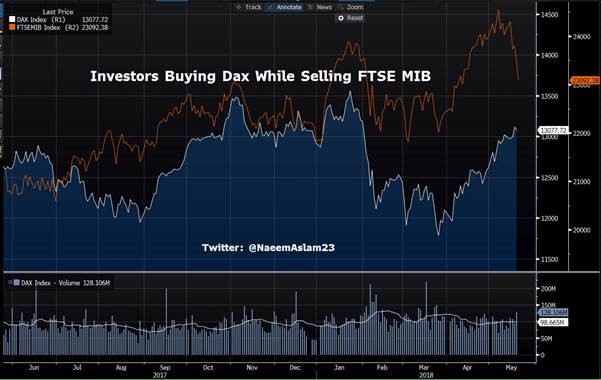
A trade which could make sense for investors would be going long on the DAX index and shorting the FTSE MIB as the situation becomes worse. Similarly, we expect the borrowing cost for Italian debt to move higher as well and the 10-year German government bond yields could drop.
At the same time, I also expect the situation to impact the eurozone’s currency adversely as well. Hence the possible trade could be going long on the dollar index while shorting the Euro. Naturally, any weakness in the Euro would push the DAX higher.
EU Katainen: US auto tariffs probe very difficult to understand
European Commission Vice President Jyrki Katainen respond to the Trump's intention to impose new tariffs on automobile imports. Katainen criticized that would be "against the WTO" and "it's very difficult to imagine it to create any sort of threat to national security. He reiterated that "it's very difficult to understand".
But he also noted that "we have now just heard what has been said and there is a long journey to the practice ... We don't expect this to further complicate the issue. We just have to find a solution that is fair."
ECB Praet: There are some clouds depsite good economic conditions
ECB Chief Economist Peter Praet said in in an event in Brussels today that economic conditions in Eurozone remain good. Recent data softness was partly due to temporary factors and "supply constraints" only. But he noted "there are some clouds and we should be watchful because that can go into confidence in a more fundamental way." Those clouds include the loose fiscal policy of Italy's new eurosceptic government, as well as international trade tensions.
ECB Governing Council member Vitas Vasiliauskas also noted that geopolitical factors would be analyzed before the central bank make a decision on its asset purchase program. In particular, Vasiliauskas noted the markets have already reacted to the Italian government change. And he said ECB has to take that into account.