Sample Category Title
Brent Oil Price Update: Crude Reacts to Iran Sanctions & Potential US Tariffs
- Brent Crude prices are experiencing volatility due to conflicting factors: increased US crude inventories but decreased fuel supplies, new US sanctions on Iran, and potential US tariffs.
- The possibility of extending Chevron's license to operate in Venezuela is being considered.
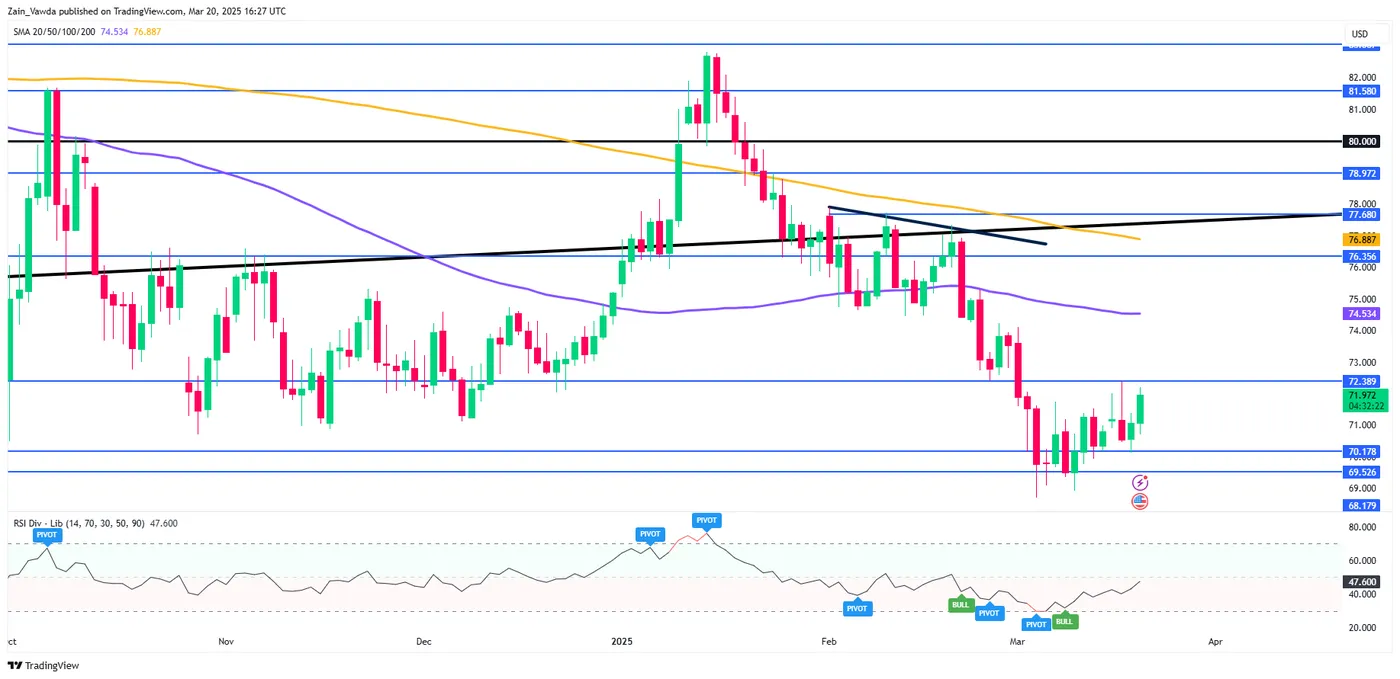
- Technically, Brent Crude is trading within a tight range (70.18 - 72.39), with the RSI indicator suggesting potential momentum shifts.
Brent crude prices remain in a tight range this week as bears and bulls jostle for supremacy. The back and forth between bulls and bears continued today as a larger-than-expected drop in U.S. fuel supplies and rising tensions in the Middle East offset the impact of a stronger dollar.
U.S. government data revealed that distillate inventories, like diesel and heating oil, dropped by 2.8 million barrels last week, much more than the 300,000-barrel drop predicted in a Reuters poll. Meanwhile, U.S. crude inventories increased by 1.7 million barrels, surpassing the expected rise of 512,000 barrels.
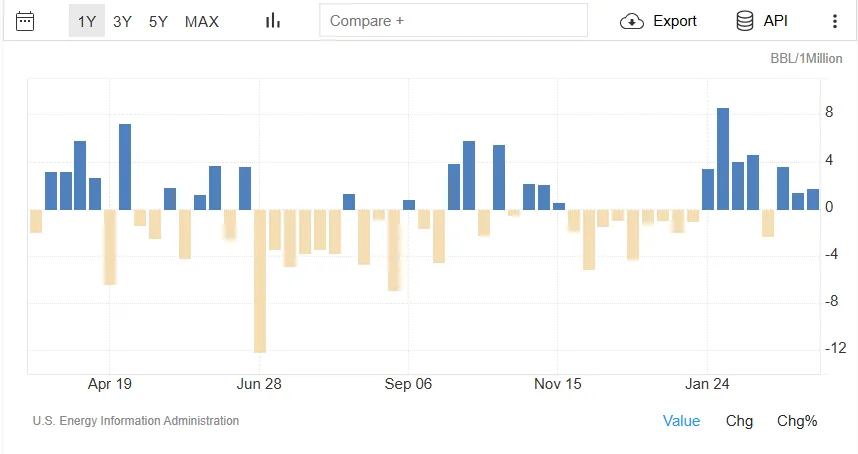
Source: TradingEconomics
There has been a slight jump in prices over the last hour or so as news filtered through that the US issued new Iran-related sanctions. The new sanctions related to Iran, targeting a person and several companies, including a small Chinese oil refinery, for buying and processing Iranian oil, according to the Treasury Department. Iran produces over 3 million barrels of oil per day.
Looking at recent developments and the chance that this move proves sustainable is rather slim. I am willing to stick my neck out and say that the choppy price action of late looks set to continue. Stimulus measures from China coupled with rising Geopolitical risk in the Middle East will keep Oil prices volatile.
There is also the proposed universal tariffs by the US due to be announced on April 2, 2025 which will also play a role. Depending on the scope of the tariffs this could have a negative impact on sentiment.
Chevron Venezuela Licence to be Extended?
President Donald Trump is thinking about allowing Chevron to continue operating in Venezuela, despite previously letting their sanction waiver expire earlier this year, according to the Wall Street Journal.
The idea of extending the waiver came up during Trump’s meeting with oil and gas executives at the White House on Wednesday. The president and his team are also discussing the option of placing tariffs on countries that buy Venezuelan oil. This move would aim to make it harder for China to expand its role in Venezuela’s oil industry.
Chevron has warned that if they leave Venezuela, China might step in to take their place. This argument appeals to Trump’s concerns about China’s growing influence.
Chevron has been sending about 240,000 barrels of Venezuelan oil to the U.S. every day under the waiver. This makes up a quarter of Venezuela’s total oil production.
Chevron also had big plans to increase exports from one of its projects, Petropiar, by 50% this year, reaching 143,000 barrels a day. These plans could move forward if President Trump agrees to replace some sanctions with tariffs and extends Chevron’s license.
Should this go ahead it will only add to concerns of oversupply which are already prevalent among many analysts and market participants.
Final Thoughts
Personally, I think this may be a bit premature. Oil inventory data shows the market is slightly under supplied in the early part of 2025. I think despite all the warning signs, there is a real possibility that supply and demand may remain balanced this year which could lead to long periods of Oil price consolidation moving forward.
Technical Analysis - Brent Crude
This is a follow-up analysis of my prior report “Brent Crude Update - Oil Prices Rally as EIA Reduces Oil Surplus Estimates” published on 12 March 2025.
From a technical analysis standpoint, Brent has remained confined to the range between 72.39 and 70.18 since March 12.
Oil continues to exhibit choppy price action with a bullish day usually followed up by a bearish day or an indecisive one.
Looking for signs of Oils next move and the RSI may be useful in this regard.
On the chart below, the period 14 RSI on a daily chart is approaching the neutral 50 level. A break above this level is usually a sign that momentum is shifting and this could help bulls push price out of the current range.
Immediate resistance at 72.39 before the 74.00 and 74.53 come into focus.
On the downside, support may be found at 70.18 before the 69.52 and 68.70 come into focus.
Brent Crude Oil Daily Chart, March 20, 2025
Source: TradingView
Support
70.18
69.52
68.70
Resistance
72.39
74.00
74.53
AUDNZD Wave Analysis
AUDNZD: ⬆️ Buy
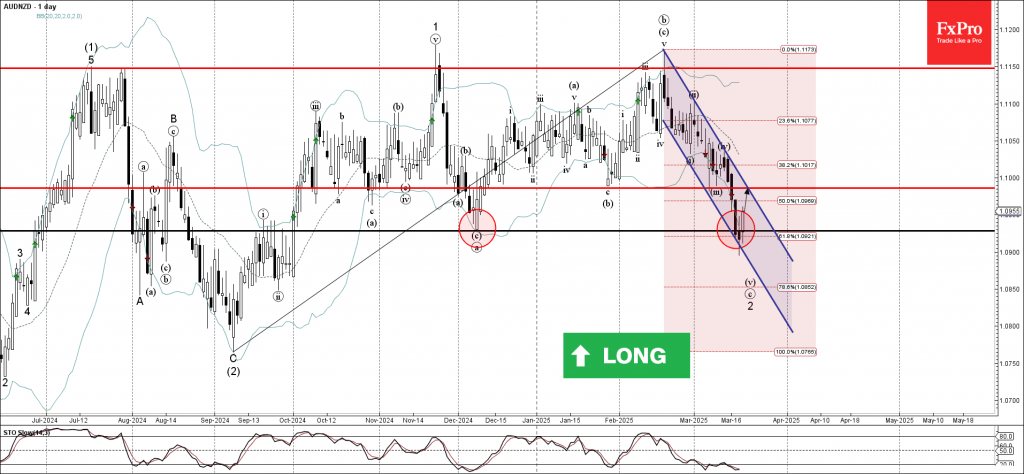
- AUDNZD reversed from key support level 1.0930
- Likely to rise to resistance level 1.0985
AUDNZD currency pair recently reversed up from the support zone between the key support level 1.0930 (former multi-month from December), support trendline of the daily down channel from February and the lower daily Bollinger Band.
The upward reversal from this support zone will likely form the daily Japanese candlesticks reversal pattern Morning Star – if the pair closes today near the current level.
Given the strength of the support level 1.0930 and the oversold daily Stochastic, AUDNZD currency pair can be expected to rise to the next resistance level 1.0985.
EURCAD Wave Analysis
EURCAD: ⬇️ Sell
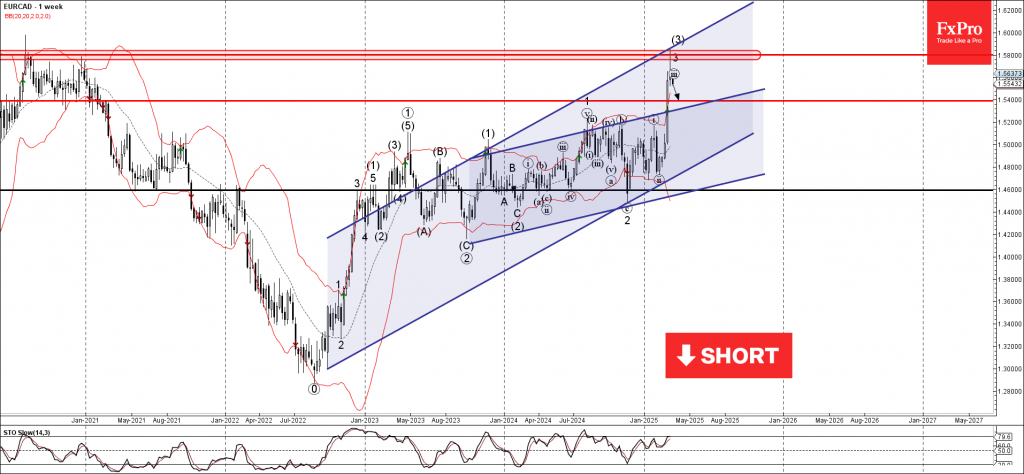
- EURCAD reversed from the resistance zone
- Likely to fall to support level 1.5400
EURCAD currency pair recently reversed sharply from the resistance zone between the key resistance level 1.5800 (former major resistance from 2020) and the resistance trendline of the weekly up channel from 2022.
The downward reversal from this resistance zone will likely form the daily Japanese candlesticks reversal pattern Evening Star.
Given the strength of the resistance level 1.5800, EURCAD currency pair can be expected to fall to the next support level 1.5400.
Bank of England Review – Slow and Steady
- As expected, the BoE today kept the Bank Rate unchanged at 4.50%.
- The vote split was slightly to the hawkish side but we do not see this as a broad shift in sentiment within the MPC.
- Overall, the statement revealed that BoE still favours a "gradual" and "careful" approach to easing monetary policy whilst highlighting heightened uncertainty.
- The market reaction was modest with Gilt yields tracking slightly higher and EUR/GBP moving lower on the hawkish vote split.
As expected, the Bank of England (BoE) decided to keep the Bank Rate unchanged at 4.50% today. The vote split had a hawkish twist to it with 8 members voting for an unchanged decision and Dhingra voting for a 25bp cut.
The BoE retained its previous guidance noting that "a gradual and careful approach to the further withdrawal of monetary policy restraint is appropriate". As expected, the BoE highlighted the elevated uncertainty noting that "economic uncertainties, both globally and domestically, had risen recently". The BoE likewise kept the wording that "monetary policy will need to continue to remain restrictive for sufficiently long until the risks to inflation returning sustainably to the 2% target in the medium term have dissipated further". On the inflation front, the MPC flagged an increased focus on the pass through from wage growth to non-energy core goods, where focus has previously been centred around primarily service inflation.
Overall, we think the communication today supports our call of a continuous gradual approach to the cutting cycle. We expect the next 25bp cut in May with the Bank Rate ending the year at 3.75%. While we have previously highlighted that we saw the risks skewed towards a swifter cutting cycle in 2025, we now see the risk picture as more balanced.
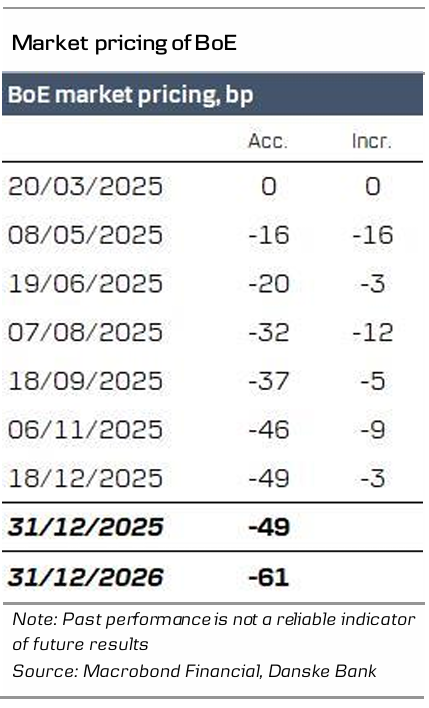
Rates. Gilt yields moved higher across the board on the hawkish vote split. Markets price 16p worth of cuts for May and around 50bp by YE 2025, cf. the margin table. We highlight the potential for BoE to deliver more easing in 2025 than currently priced, expecting three additional cuts this year with the next cut in May.
FX. EUR/GBP moved lower on the announcement with the hawkish vote split taking centre stage. The still cautious guidance delivered today highlights the more gradual approach of the BoE. More broadly, we expect EUR/GBP to move lower in the coming quarters driven by a relatively hawkish BoE compared to G10 peers, an investment environment characterised by continued tight credit spreads and a positive correlation for GBP to a USD positive investment environment (which we expect will return). While we continue to expect a growth pickup in the UK delivered from a fiscal boost, the shift in fiscal stance in Germany leaves the impact from the relative growth outlook more muted for the cross. The key risks are reignited debt concerns and a more forceful policy easing stance from the BoE.
Sunset Market Commentary
Markets
European markets took a different, more pessimistic view on yesterday’s Fed policy meeting compared to the US. They appear to have more attention to the (stagflationary) risks in the new forecasts instead of Powell’s reassuring message. European stocks dropped more than 1% with Wall Street suffering from spillover effects. But contrasting with the previous sessions, it’s US sentiment that now improved for the better. US equities quickly swapped losses for minor gains. Core bonds strengthened with Treasuries outperforming Bunds. US rates extend the post-Fed drop by declining 2.3-4.2 bps across the curve. They are off intraday lows though, helped by consensus-crushing existing home sales. Bunds had some catching up to do with Treasuries but were unable to post additional gains after gapping higher at the open. German yields ease between 1.6 and 3.7 bps against the backdrop of an important European summit on the matter of defense spending (and how to fund it), Ukraine and European competitiveness. Meanwhile several ECB members hit the wires, including president Lagarde. She stuck to the March message. Policy is “meaningfully less restrictive” and the ECB is data-dependent. Lagarde noted that elevated uncertainty (over trade) prohibits the ECB from committing to anything. Dutch governor Knot said the ECB is close to a neutral stance and is open-minded on the April decision. He cited uncertainty surround a range of sometimes opposing factors such as the impact from tariffs and the “budgetary expansion in the largest member state”. Estonia’s Muller believes tariffs pose upside risks while Portugal’s Centeno said it’s “more dubious”. USD and JPY take the lead on FX markets. EUR/USD slips to 1.083, DXY is testing 104. Sterling gains against the euro (EUR/GBP 0.835) after a slightly stronger than expected labour market report and the Bank of England’s status quo in a 8-1 vote. One member favoured a cut. Two members who voted for cuts at all three previous meetings today supported the halt, prompting a “hawkish pause” label to the decision. To hold the rate at 4.5% after February’s cut was a compromise between higher inflation and stronger-than-expected GDP growth versus “business survey indicators [that] generally continue to suggest weakness in growth and particularly in employment intentions.” Intensifying global trade policy uncertainty is obviously not helping in making a clearcut decision. So the BoE retained “a gradual and careful approach to the further withdrawal of monetary policy restraint […].” UK yields left the intraday bottoms (up to -7 bps) after the policy announcement and with a US-driven sentiment improvement now even trade flat.
News & Views
The Swedish Riksbank kept its policy rate unchanged at 2.25% and assesses that the rate will remain at this level going forward (over the policy horizon according to updated forecasts i.e. until 2028 Q1). That way, it officially puts an end to the cutting cycle that started slightly under a year ago at a policy rate of 4%. CPIF inflation has become higher than expected and is assessed to remain at between 2% and 3% for the rest of the year. The Swedish economy is in a recovery phase, but the rebound in the labour market will take a little longer. The overall growth and inflation outlook remains intact compared with December, which is obviously surrounded by a higher degree of uncertainty. The Executive Board stresses vigilance regarding contagion effects that could lead to inflation not falling back as expected. Today’s message didn’t really came as a surprise. EUR/SEK changes hands around 11.03. A reflationary-inspired euro helped avoid a break below the 11 support area earlier this month.
The Swiss National Bank lowered its key rate as expected by another 25 bps to 0.25%. The new inflation forecast has hardly changed since December. Without the rate cut, the forecast would have been lower in the medium term. It puts average annual inflation at 0.4% for 2025, 0.8% for 2026 and 0.8% for 2027, based on a 0.25% policy rate over the forecast horizon. That’s within the SNB’s 0%-2% inflation target. The SNB expects GDP growth of between 1% and 1.5% for this year and 1.5% in the next. Domestic demand is likely to benefit from rising real wages and the easing of monetary policy. Moderate economic activity abroad could dampen foreign trade. SNB President Schlegel added that today’s cut had an expansionary impact, implying a lower probability of more action down the road. The SNB will remain active in the FX market if necessary, but recently received some help from a stronger euro in battling CHF-strength. EUR/CHF trades around 0.9565 with the bottom of the broad 0.93-0.97 trading range in place since the start of last year becoming ever stronger.
USDCHF: Diverging Policies from the Fed and SNB – What to Expect?
USDCHF: What Do the Fed and the SNB Say?
The USDCHF has been at the centre of attention following the monetary policy decisions of the Federal Reserve (Fed) and the Swiss National Bank (SNB). What can we expect now?
The Fed Holds Rates, but the Dot Plot Gives Clues...
Yesterday, the Fed kept rates unchanged at 4.25%-4.5%, citing economic uncertainty and inflation risks. Powell mentioned concerns about tariffs and immigration restrictions.
The Dot Plot showed that most FOMC members expect only two rate cuts in 2025. This suggests that the Fed intends to maintain control over inflation and avoid loosening too quickly.
The SNB Cuts Rates… and Could Keep Going
Meanwhile, the SNB surprised the market by reducing its interest rate by 25 basis points, bringing it to 0.25%, its lowest level since 2022. This is the fifth rate cut since 2024, signalling concerns over low inflation and economic risks.
Additionally, the SNB clarified that it is still ready to intervene in the forex market if necessary.
What Happens Next with USDCHF?
The divergence is clear: the Fed remains cautious with rate cuts, while the SNB continues to loosen its monetary policy. This could support USDCHF in the short term, although volatility will depend on upcoming macroeconomic data and market sentiment.
Will the dollar rebound, or will the Swiss franc resist? Stay tuned for the next moves!
Technical Analysis - USDCHF, H4
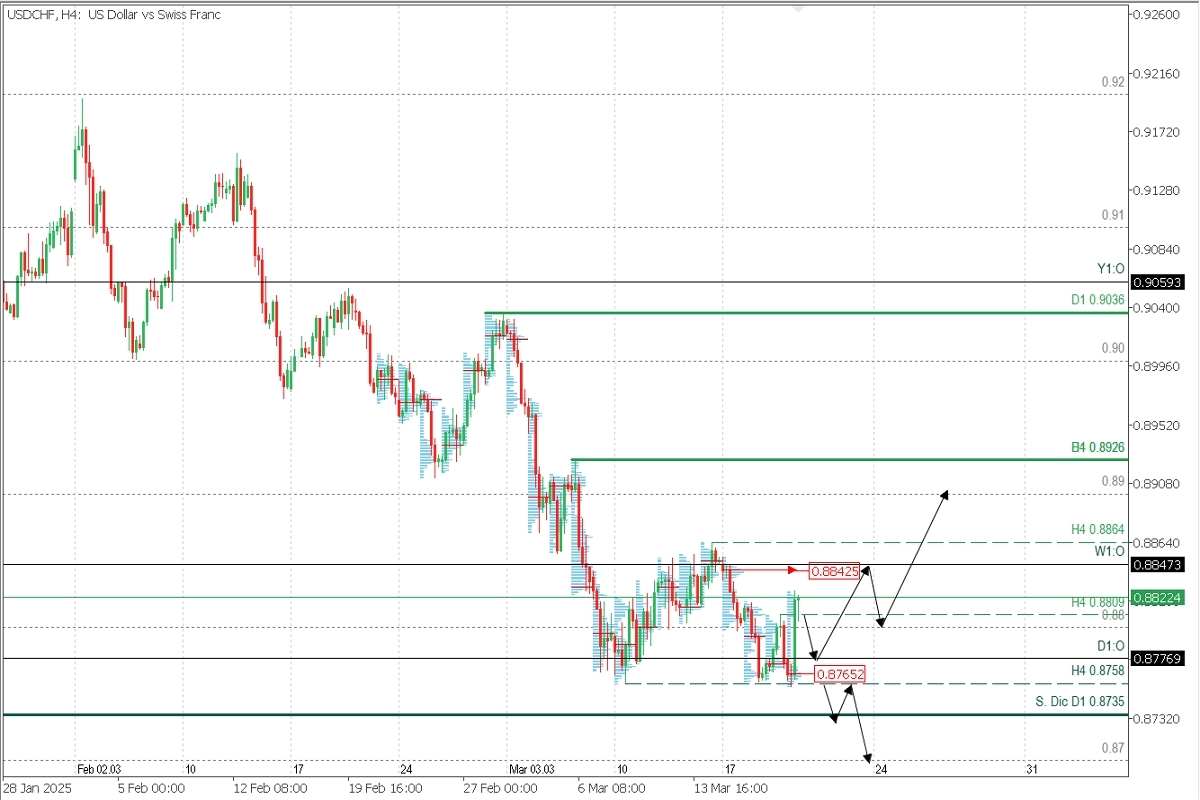
Supply Zones (Sell): 0.8842 // 0.89
Demand Zones (Buy): 0.8765
The recent SNB rate cut was the main driver of the price rally during the European morning, causing a breakout of the key H4 resistance at 0.8809, leaving a wide-range bullish candle with inefficiency (volume void) that the market typically corrects.
In this context, a pullback is expected to cover that area, seeking liquidity at the daily open (D1:O) 0.8776 and the Asian POC at 0.8765, demand zones (buy) that will likely be defended by bulls to trigger a new price rally towards the next supply zone at 0.8842, confirming the intraday bullish reversal. Only after breaking this level can we consider extending buys towards 0.89 and the next daily key resistance at 0.8926.
On the other hand, if the demand zone between 0.8776 and 0.8765 is decisively broken, the bullish trend will continue, as an increase in sell orders will likely lead to a break below December's support at 0.8735, extending the decline towards the psychological level at 0.87.
Technical Summary
- Bearish Scenario: Sell below 0.8809 with targets at 0.8777 and 0.8765, where we could return to buy if an intraday bullish reversal pattern forms on M5. If this doesn’t occur, sales will continue towards 0.8735 and 0.87 in extension.
- Bullish Scenario: Buy above 0.870 (waiting to form and confirm a reversal pattern on M5) with targets at 0.8842, 0.8864, and 0.89 in extension.
Crypto Market Testing Resistance
Market Picture
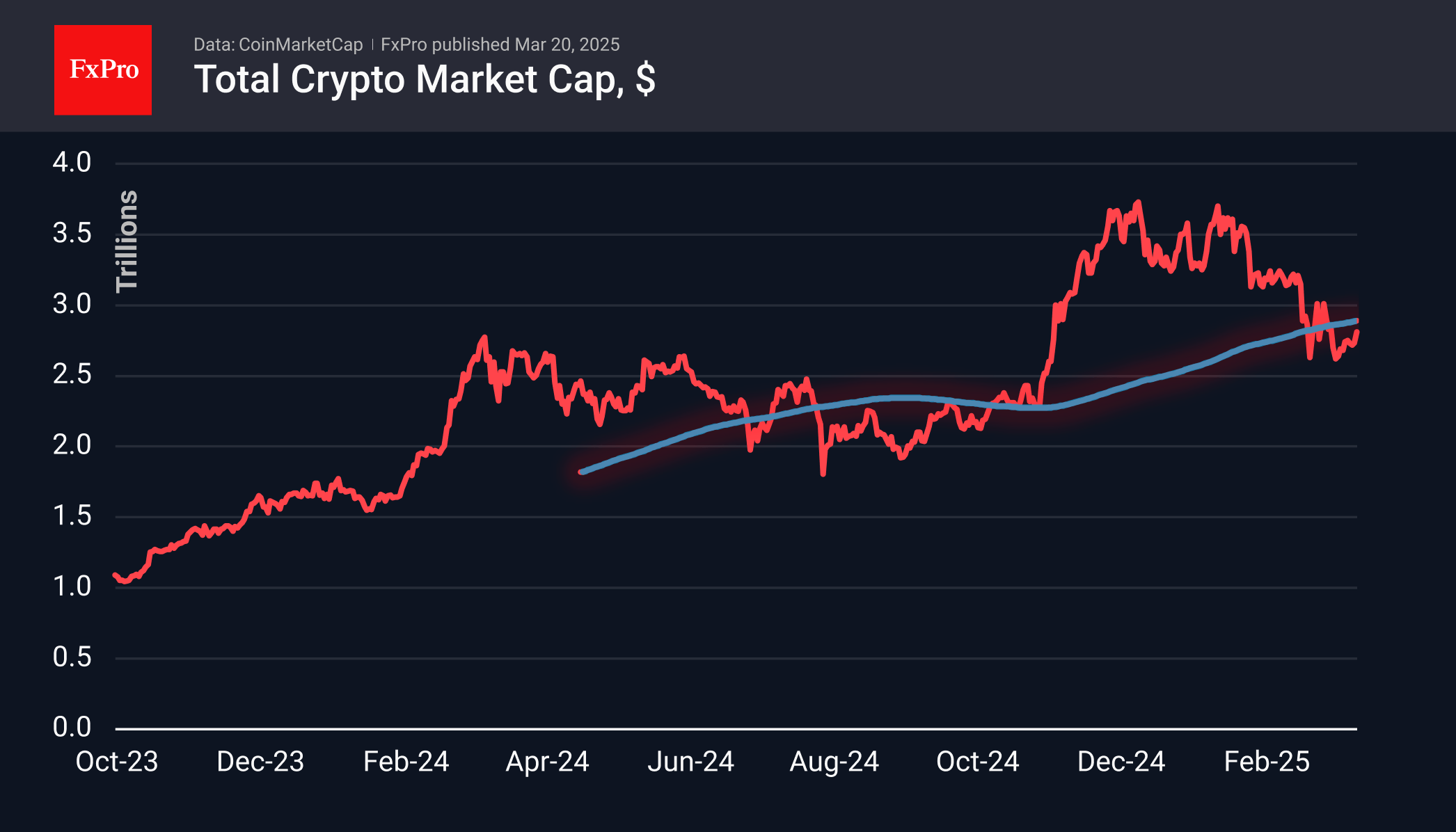
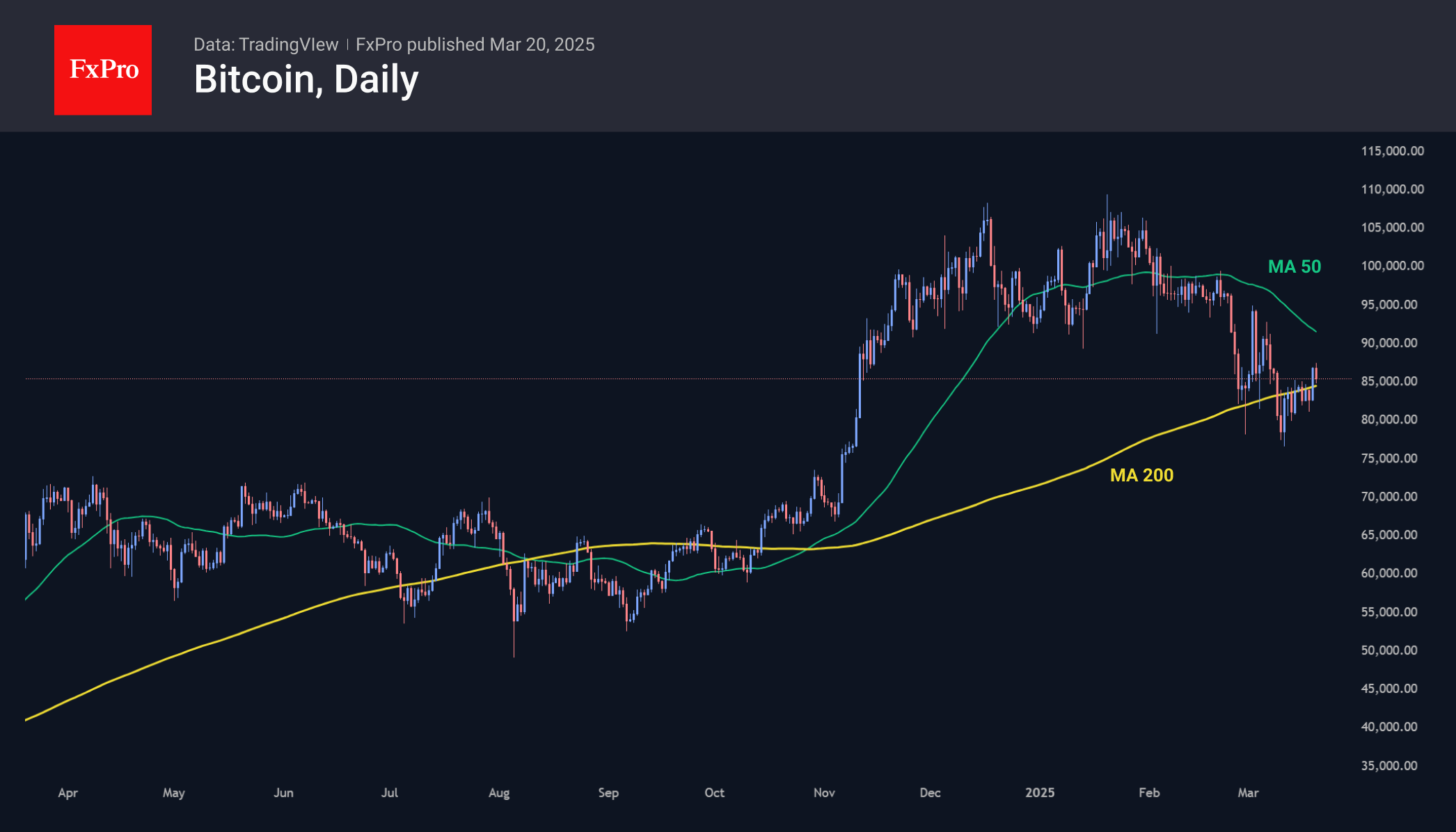
The cryptocurrency market has been on the rise, growing by over 5% since Tuesday and reaching a total capitalisation of $2.81 trillion. Optimists are hopeful that, after hitting recent highs, the market is ready to shift towards growth. However, despite this excitement, it’s important to note that the crypto market has yet to break above its 200-day moving average, currently sitting close to $2.9 trillion. A strong rally above this level could trigger an active buying phase, but there’s also a risk of bears setting up a trap, as they’ve done several times before.
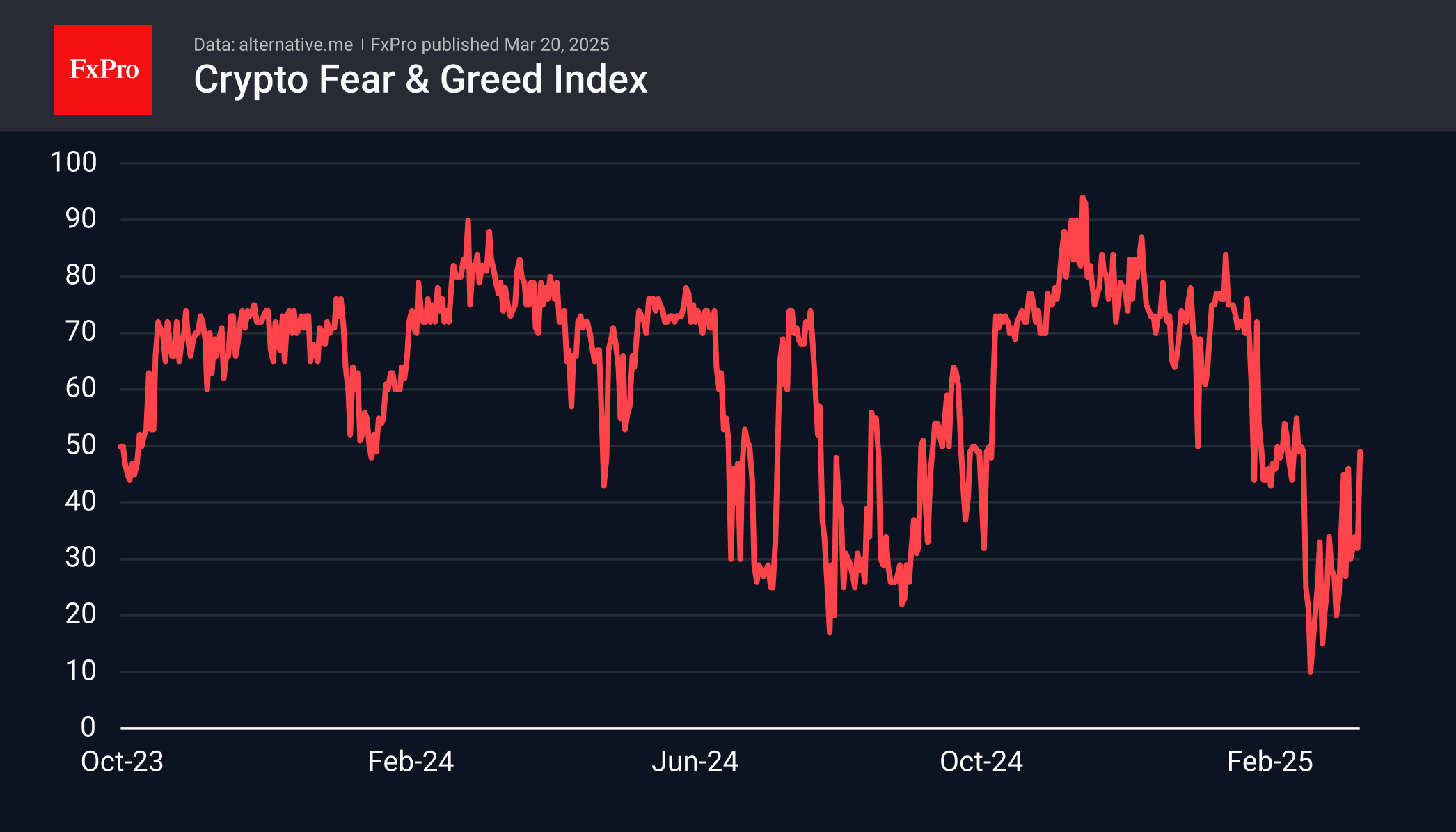
Sentiment has improved, though. The Fear and Greed Index climbed back to the middle of its range by the end of the week, a level we haven’t seen in four weeks. This shift out of the extreme low zone could be the first sign of a trend reversal, suggesting there’s still plenty of room for growth.
Bitcoin has been showing steady progress, with a nice bounce on Wednesday. Thursday morning saw a brief spike, pushing the price of Bitcoin above $87,300, its highest point in two weeks. This was an attempt to break through the 200-day moving average, but the rally was short-lived. For Bitcoin to maintain momentum, staying above this key level is crucial. If it does, it could spark renewed interest in buying a variety of coins that have been in a correction phase for a while.
News Background
In the news, there’s a significant update regarding Ripple. The US Securities and Exchange Commission (SEC) has dropped its case against the company. Ripple’s CEO, Brad Garlinghouse, confirmed the SEC’s decision to drop the appeal, bringing an end to a case that had been ongoing for over four years.
Meanwhile, a report from Artemis and Dune reveals impressive growth in the stablecoin market. Over the past year, the total supply of stablecoins has increased by 63%, while monthly transaction volume surged by 115%, reaching a total of $35 trillion.
The developers of the non-custodial wallet TON Space have added the ability to pay network fees to Telegram Stars. This solution will simplify messenger users’ work with crypto and allow them to buy digital goods in Mini Apps.
EUR/USD Mid-Day Outlook
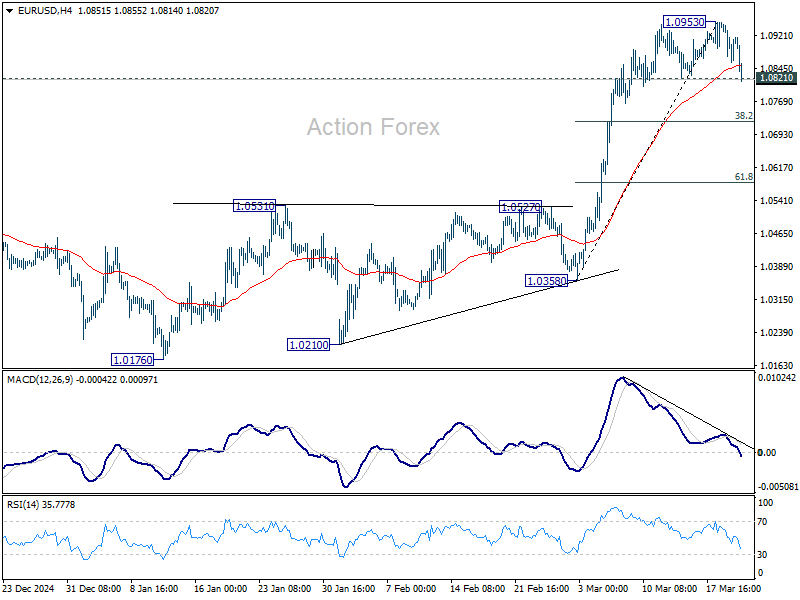
Daily Pivots: (S1) 1.0859; (P) 1.0904; (R1) 1.0948; More...
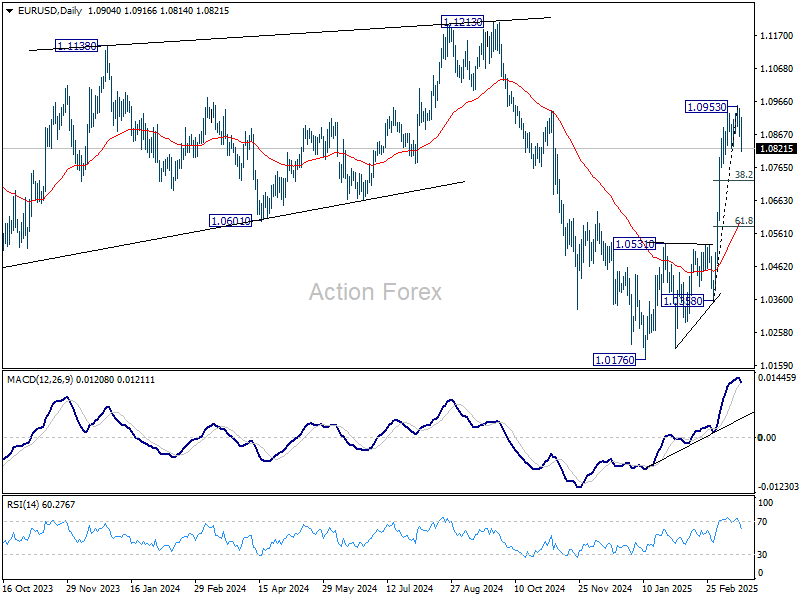
Extended decline in EUR/USD suggests that a short term top was formed at 1.0953, on bearish divergence condition in 4H MACD. Intraday bias is mildly on the downside for deeper pull back to 38.2% retracement of 1.0358 to 1.0953 at 1.0726. Strong support should be seen there to bring rebound. Meanwhile, break of 1.0953 will resume the rally from 1.0176 towards 1.1274 key resistance.
In the bigger picture, prior strong break of 55 W EMA (now at 1.0675) suggests that fall from 1.1274 (2024 high) has completed as a three wave correction to 1.0176. Rise from 0.9534 is still intact, and might be ready to resume. Decisive break of 1.1274 will target 100% projection of 0.9534 to 1.1274 from 1.0176 at 1.1916. Also, that will send EUR/USD through a multi-decade channel resistance will carries larger bullish implication. This will now be the favored case as long as 1.0531 resistance turned support holds.
USD/CHF Mid-Day Outlook
Daily Pivots: (S1) 0.8755; (P) 0.8783; (R1) 0.8803; More…
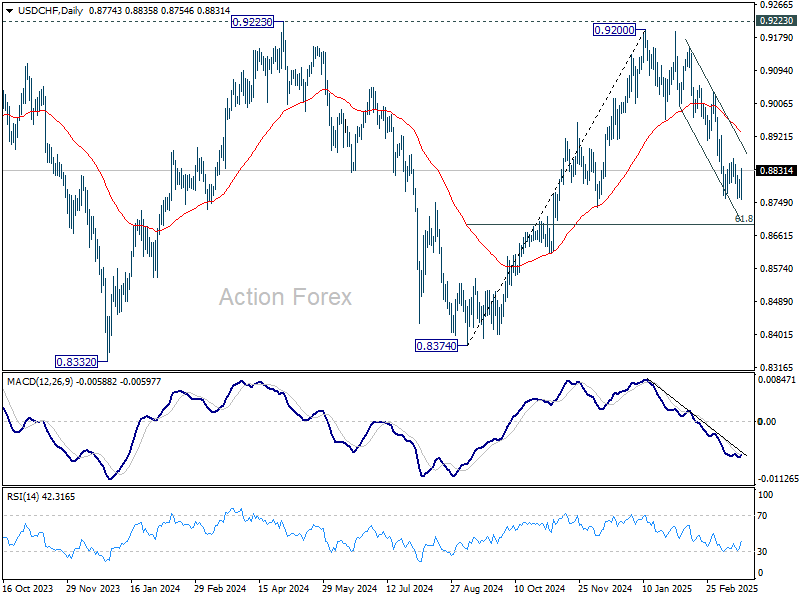
USD/CHF is still bounded in consolidation from 0.8757 and intraday bias remains neutral. In case of another recovery, upside should be limited by 0.8911 support turned resistance. On the downside, break of 0.8757 will resume the fall from 0.9200 to 61.8% retracement of 0.8374 to 0.9200 at 0.8690. Sustained break there will pave the way back to 0.8374 support.
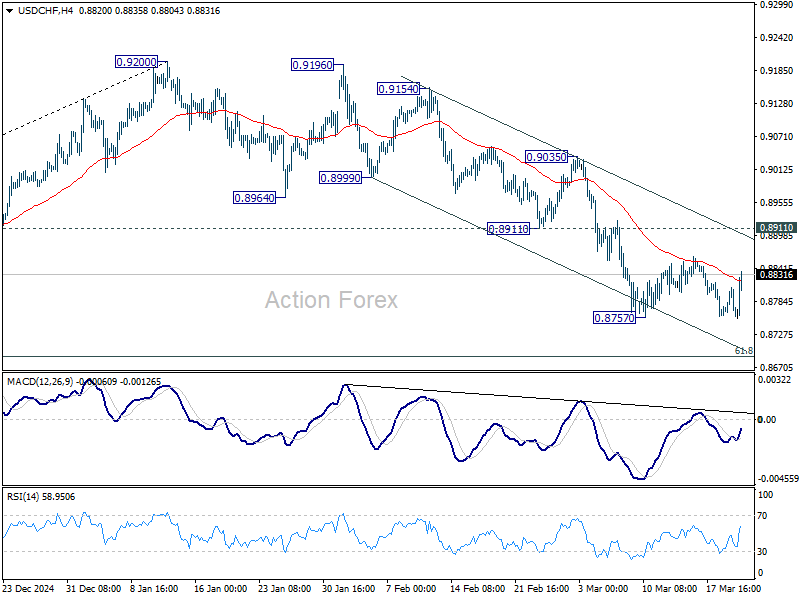
In the bigger picture, rejection by 0.9223 key resistance keep medium term outlook bearish. That is, larger fall from 1.0342 (2017 high) is not completed yet. Firm break of 0.8332 (2023 low) will confirm down trend resumption.