Sample Category Title
USD/JPY Heading Below 109
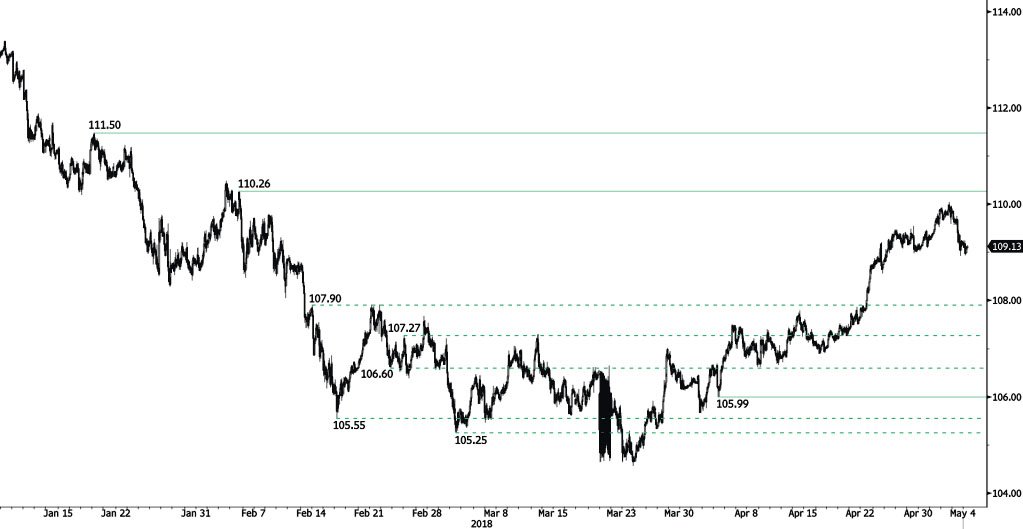
USD/JPY bullish pattern pauses, currently trading along 109.15 and approaching the 108.95 range. The bearish pattern started in January 2018 is weakening. Hourly support and resistance are given at 105.99 (04/04/2018 high) and 110.26 (05/02/2018 low). The short-term technical structure suggests short-term downward moves.
We favor a long-term bearish bias. Support remains at 101.20 (09/11/2016 low). A gradual rise toward the major resistance at 125.86 (05/06/2015 high) seems unlikely. Expected to decline further support at 101.20 (09/11/2016 low). The pair trades below its 200 DMA.
GBP/USD Slight Decrease
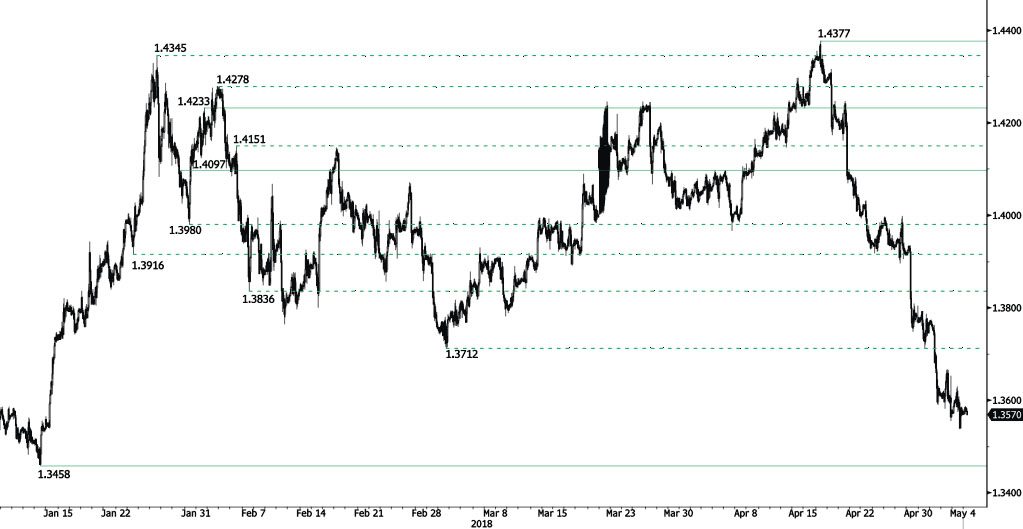
GBP/USD is slightly declining, trading below 1.36 and heading along the 1.3565 range. The pair is currently trading at mid-January low. Hourly support and resistance are given at 1.3458 (11/01/2018 low) and 1.4097 (29/01/2018 high). The technical structure suggests shortterm decrease.
The long-term technical pattern is reversing. The Brexit vote had paved the way for further decline but the pair is moving to 2016 highs. Long-term support and resistance are given at 1.1841 (07/10/2017 low) and 1.5018 (24/06/2016 high).
EUR/USD Weakening
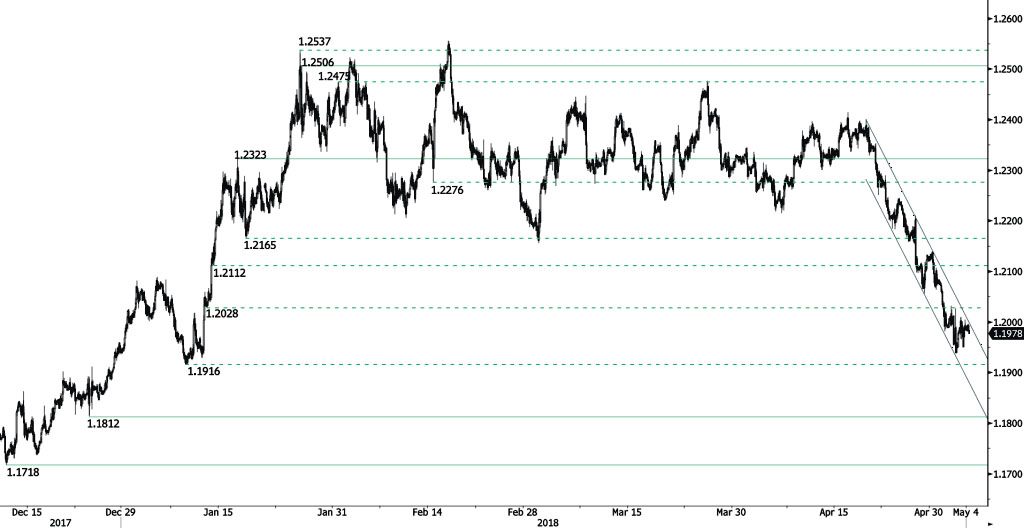
EUR/USD bearish pattern started from 1.24 (19/04/2018 high) continues, currently trading below 1.20 and heading along the 1.1970 range. The pair is currently trading at mid-January 2018 low. Hourly support and resistance are given at 1.1812 (25/12/2017 low) and 1.2323 (17/01/2018 high). The technical structure suggests shortterm downward moves.
In the longer term, the momentum is turning largely positive. We favor a continued bullish bias. Key resistance is holding at 1.2886 (15/10/2014 high) while strong support lies at 1.1554 (08/11/2017 low).
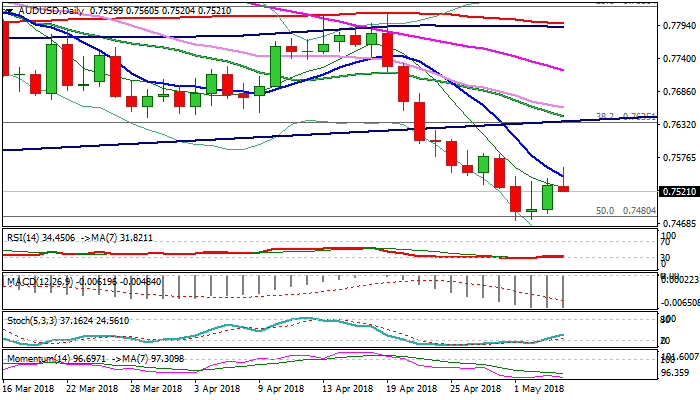
AUDUSD – Falling 10SMA Caps Recovery Attempts And Keep The Downside At Risk
The Aussie dollar eased after failing to break above falling 10SMA (0.7546) and risks to diminish positive signal on formation of Doji reversal pattern on daily chart.
Release of RBA's monetary policy statement showed mild impact on the Aussie, as the central bank pointed on faster growth but slow inflation, signaling that interest rates would remain at record lows for some time.
Downside is expected to remain at risk while falling 10SMA caps as strong bearish momentum adds to bearish pressure.
Weekly close below cracked 0.75 higher base to confirm negative scenario and open way for further weakness.
Immediate bears could be sidelined on close above 10SMA, however, reversal confirmation requires break and close above 0.7602 (Fibo 38.2% of 0.7812/0.7472 bear-leg).
Res: 0.7546, 0.7560, 0.7583, 0.7602
Sup: 0.7521, 0.7482, 0.7472, 0.7456
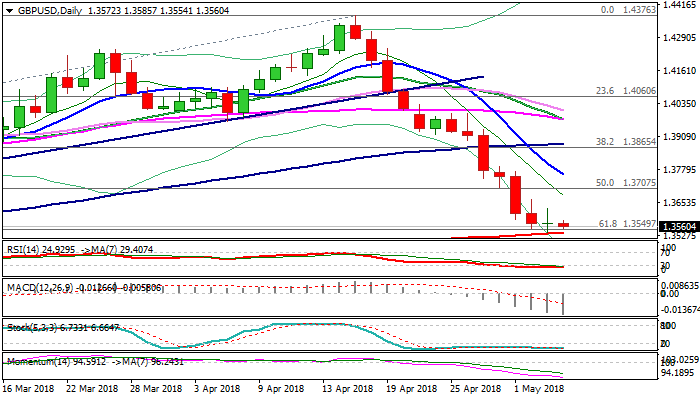
GBPUSD – 200SMA Holds And Thursday’s Doji Signals Indecision But No Firmer Bullish Signals For Now
Cable holds in tight consolidation range in early Friday's trading after 200SMA contained steep fall from 1.4376 and Thursday's long-legged Doji showed signs of indecision.
Daily MA's are in firm bearish setup and formed a number of bear-crosses, while 14-d momentum continues to trend lower, deeply in negative territory, maintaining strong pressure for eventual break through 200SMA pivot.
On the other side, oversold daily RSI and slow stochastic so far did not generate stronger bullish signal which could boost recovery.
Bears need clear break below cracked Fibo support at 1.3550 (Fibo 61.8% of 1.3038/1.4376) and 1.3535 (200SMA) to signal continuation of downtrend from 1.4376.
Alternative scenario requires strong bullish close on Friday to complete Doji reversal pattern on daily chart and generate bullish signal for stronger recovery.
US jobs data are expected to give more clues about pair's near-term direction.
Res: 1.3605, 1.3629, 1.3665, 1.3711
Sup: 1.3550, 1.3535, 1.3500, 1.3442
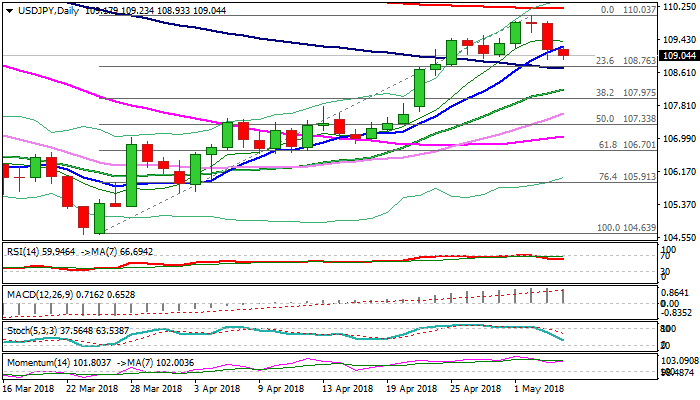
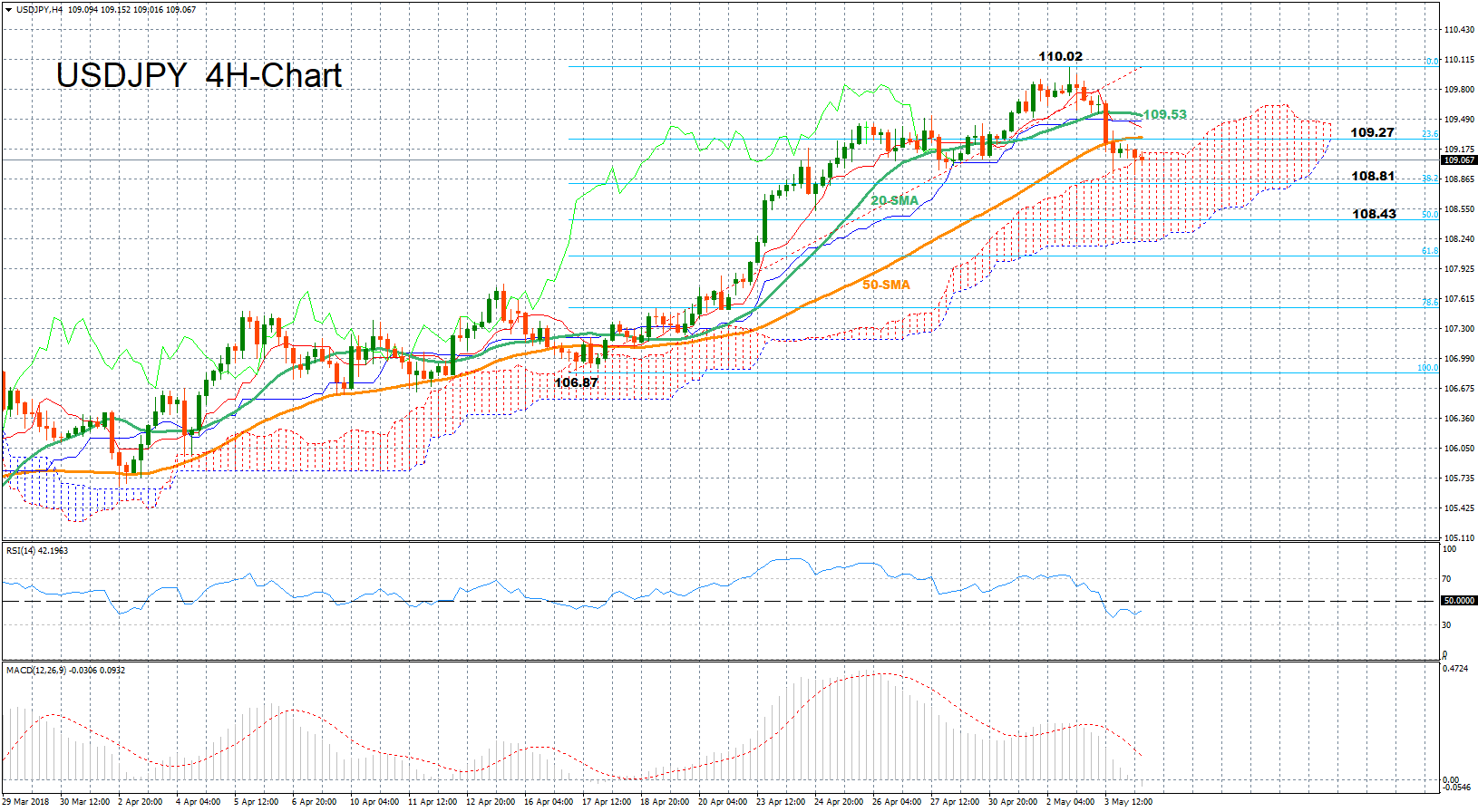
USDJPY – Risk Of Extension To Daily Cloud Top Seen On Break Below Double Fibo Support, US Jobs Data...
The pair is consolidating around 109 handle in early Friday's trading after suffering strong losses previous day.
Thursday's long bearish daily candle (the biggest one day loss since 22 Mar) weighs, as Doji reversal pattern was completed on daily chart.
Fresh weakness broke below 10SMA ( 109.26) and pressures double-Fibonacci support at 108.76/73 (Fibo 23.6% of 104.63/110.03 / Fibo 38.2% of 106.61/110.03, reinforced by 100SMA) break of which would generate strong bearish signal and risk extension towards daily cloud (108.05). Failure to take out 108.76/73 pivots would keep the pair in extended consolidation range, while sustained break above 110 barrier and 200SMA (110.18) is needed to shift focus higher and signal continuation of broader uptrend from 104.63 (26 Mar).
US jobs data are key event for the dollar today. US jobs growth is expected to accelerate in April (NFP Apr f/c 189K vs 103K previous month), unemployment rate is expected to drop to multi-year low of 4%, while wage growth is expected to remain steady.
Solid jobs data today would add to positive sentiment among traders on expectations the Fed may hike interest rates more times than expected in 2018 and create more positive environment for the dollar.
Res: 109.26, 109.53, 109.88, 110.03
Sup: 108.93, 108.73, 108.32, 108.05
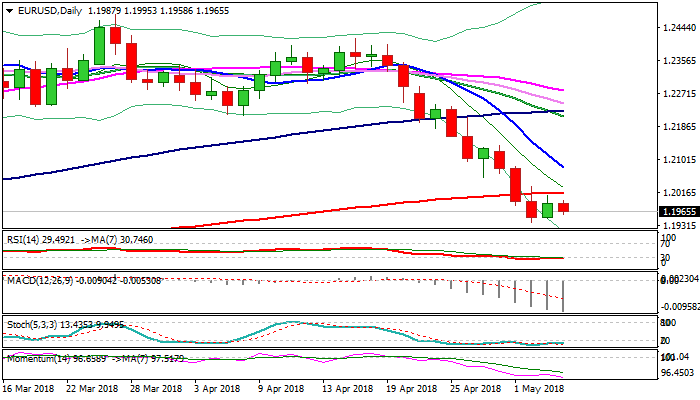
EURUSD Holds In Extended Consolidation But Bearish Bias Remains While 200SMA Caps
Overall outlook remains negative but bears pausing above strong Fibo support at 1.1936 (61.8% of 1.1553/1.2555 upleg).
Narrow consolidation extends into third straight day, capped by 200SMA (1.2015) which maintains pressure.
Signals from oversold conditions have been so far ignored, as daily MA’s in firm bearish setup and south-heading 14-d momentum keep bearish bias intact. Firm break below 1.1936 would open way for acceleration towards 1.1790 (Fibo 76.4% of 1.1553/1.2555), with upbeat US jobs data today needed to confirm scenario.
Conversely, sustained break above 200SMA would ease immediate bearish pressure, while stronger reversal signal requires lift and close above falling 10SMA (1.2080) and Fibo 38.2% of 1.2413/1.1937 fall (1.2119).
Res: 1.2000, 1.2015, 1.2050, 1.2080
Sup: 1.1936, 1.1915, 1.1900, 1.1854
Dollar Eases Off Highs Ahead Of Nonfarm Payrolls
Here are the latest developments in global markets:
FOREX: The US dollar index is higher on Friday, but by less than 0.1%, recouping some of the losses it posted yesterday. Today, all eyes will be on the US employment data for April, and particularly on the wages component of that report. Sterling/dollar is down by 0.1%, with the British pound remaining under pressure as markets continue to price out expectations for a BoE rate hike next week.
STOCKS: Wall Street closed mixed yesterday. Following some substantial losses posted early in the session, the major indices staged a decent recovery and managed to finish the session only a little lower, or even marginally higher. The rebound was likely aided by some optimistic comments from Treasury Secretary Steven Mnuchin, who noted the US and China had “very good conversations” on trade issues. The S&P 500 and the Nasdaq Composite declined by 0.23% and 0.18% respectively, while the Dow Jones rose, but only by 0.02%. Futures tracking the Dow, S&P, and Nasdaq 100 are all currently pointing to a slightly lower open today. In Asia, Japanese markets remained closed for a second straight day, while in Hong Kong, the Hang Seng fell by 0.9%. In Europe, futures tracking the major indices were a sea of green, signaling a higher open today.
COMMODITIES: Oil prices are practically flat on Friday, with both WTI and Brent crude being lower, but by less than 0.05%. That said, both benchmarks posted solid gains yesterday, buoyed by a tumble lower in the dollar, as well as continued speculation that the US will impose fresh sanctions on Iran. The self-imposed US deadline for making a decision on Iran is May 12. In precious metals, gold is higher though by less than 0.1%, last seen near the $1311/ounce hurdle. The dollar-denominated yellow metal also jumped yesterday, helped by a correction lower in the greenback.
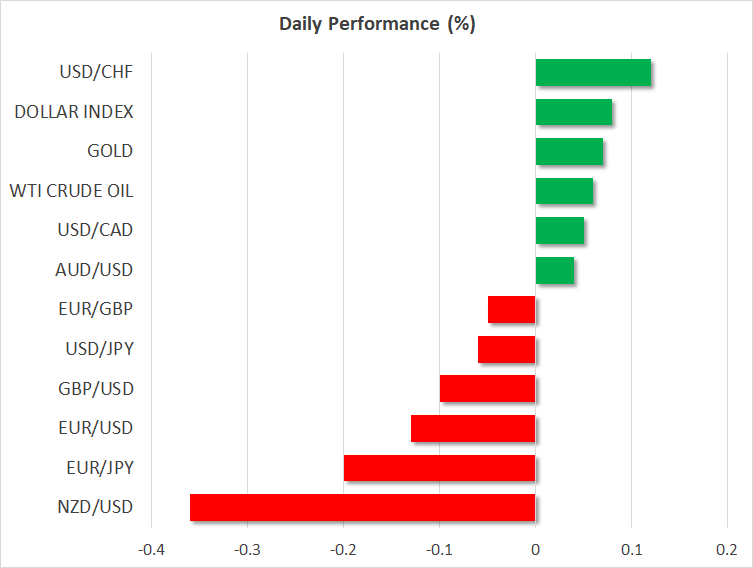
Major movers: Dollar dips ahead of NFP, sterling remains under selling interest
The US dollar corrected lower yesterday, easing off its four-month highs, perhaps as traders took some profits on their prior long-dollar bets and decreased their exposure ahead of today’s main risk event, the US employment report. Assuming that there are no major surprises in the NFP print and the unemployment rate, attention will fall primarily on wages. Policymakers and investors alike will be looking at whether the tight US labor market has finally started to produce higher wages, which would signal higher inflation down the road and consequently, a more hawkish Fed. The dollar is likely to move in tandem with any surprise in earnings; higher in case of a beat, and lower should they disappoint.
The British pound remained under pressure yesterday, after the all-important services PMI for April rose by less than expected. Coming on top of a disappointing manufacturing PMI, it confirms that the soft patch the economy experienced in Q1 has likely rolled over into Q2. The implied probability for a BoE rate hike next week has declined to a mere 8%, as markets continue to bet policymakers will postpone any tightening until later in the year, once they’ve had the opportunity to monitor whether this slowdown reflects transitory, or persistent factors.
The euro, meanwhile, barely responded to a worse-than-expected slowdown in Eurozone’s core inflation for April. Market chatter suggests the weakness may be owed mainly to seasonal phenomena, such as the timing of Easter this year, and that the ECB is likely to pay less attention to it as a result.
On the trade front, US Treasury Secretary Steven Mnuchin said on Thursday that the US and China are having “very good conversations”. US equity indices had been on the back foot, but Mnuchin’s optimism helped them to pare some earlier losses. Importantly, the S&P 500 managed to close above its 200-day moving average (MA) once again, after it crossed below it early in the session. What is worrisome, though, is that each successive bounce from the 200-day MA is becoming smaller and smaller in recent weeks, which signals weakening bullish momentum. For that to change, markets may need a fresh positive catalyst, such as the US-China negotiations bearing fruit.
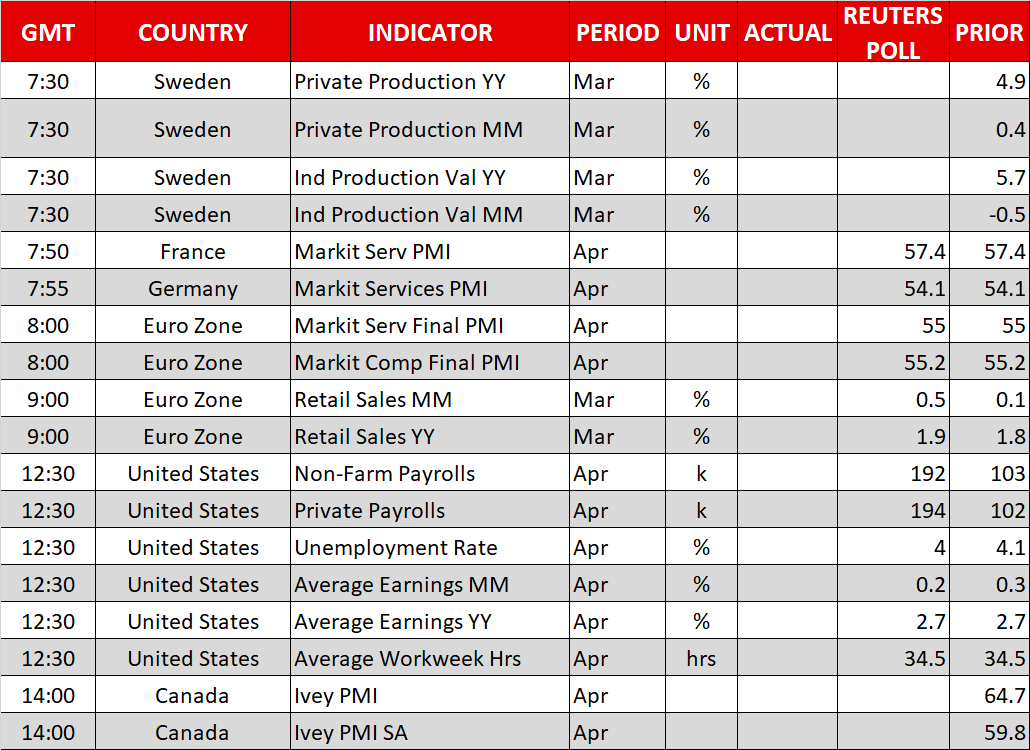
Day ahead: US nonfarm payrolls take the stage; Eurozone services & composite PMIs in focus
On Friday, all eyes will turn to April’s nonfarm payrolls report out of the US at 1230 GMT and once again the focus will be placed on the wage component, although Wednesday’s FOMC rate statement signaled that the Fed was willing to allow inflation to rise above the 2.0% target without any policy response. Still, investors will be eager to see whether the US labor market has tightened enough to push for larger pay rises and therefore for higher inflationary pressures.
According to analysts, the US economy is expected to have created 192k new job positions in private and public nonfarm sectors in April, surpassing the increase of 103k in March which was the lowest since October. The unemployment rate is anticipated to ease from 4.1% to a fresh 17-year low of 4.0%, distancing further below the full-employment level of 4.5-5.0%. But growth in average hourly earnings is projected to inch down by 0.1 percentage points to 0.2% on a monthly basis, leaving the annual gauge unchanged at 2.7%. In the event of an upward surprise, especially on the wage front, the dollar could rally back to the 110 handle versus the yen as this could increase the odds for the Fed to deliver three more rates hikes this year. However, if the numbers fall short of expectations, the greenback would more likely follow a downward path.
Earlier in the Eurozone, retail sales for March (0900 GMT), as well as the final Markit Services and Composite PMIs for April (0800 GMT), will have the potential to move the euro. Forecasts are for retail sales to have risen by 1.9% on a yearly basis, slightly faster than in February when the measure increased by 1.8%. The Markit Services PMI is said to remain unchanged at 55. Note that on Wednesday the Manufacturing equivalent beat projections, therefore, unless the Services PMI turns lower, the composite PMI should climb as well.
Canada will also see its Ivey PMI readings at 1400 GMT.
In oil markets, Baker Hughes will deliver its weekly US oil rig count report at 1700 GMT and it would be interesting to see whether the report will post another gain, marking five consecutive weeks of increases.
As for today’s public appearances, New York Fed President William Dudley will be participating in a conversation hosted by Bloomberg at 1445 GMT, while at 1730 GMT, San Francisco President John Williams will be making comments on CNBC before his speech at the Hoover Institution/Stanford University where he will discuss currencies, capital and central bank balances at 1900 GMT.
USDCAD In Neutral Bias Holding Below 50.0% Fibonacci Level
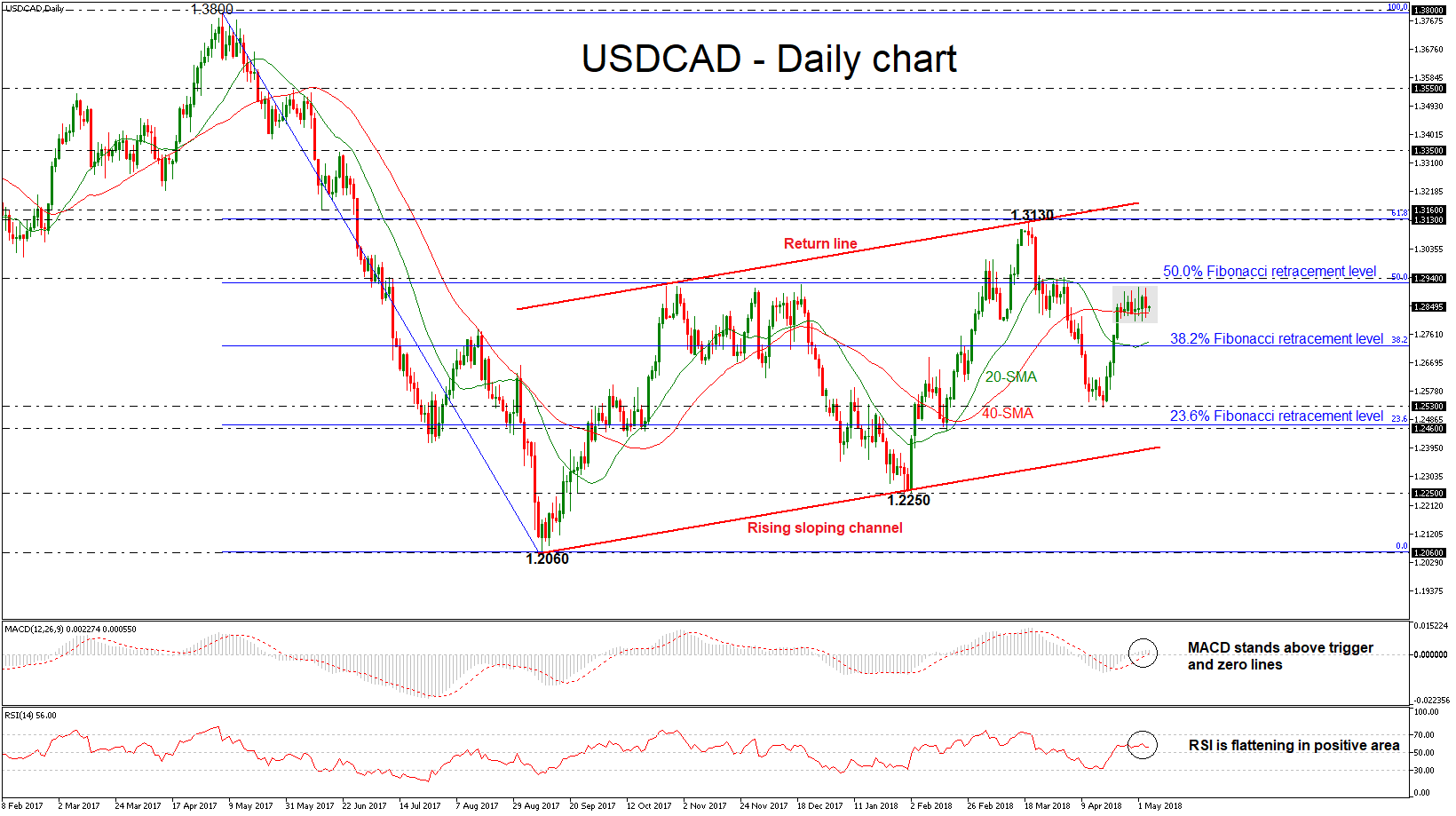
USDCAD remains below the 50.0% Fibonacci retracement level of 1.2925 of the downleg from 1.3800 to 1.2060 over the last 10 days and creates a narrow range with upper boundary the 1.2925 and lower boundary the 1.2800 handle. The price is also developing above the 40-day simple moving average (SMA) and has so far not slipped below it. When looking at the bigger picture, the pair has been trading within a rising sloping channel since September 2017, failing several times to exit from this range.
The technical indicators though, continue to send neutral signals, but they are still standing in positive zones. The MACD oscillator is standing slightly above the zero and trigger lines, while the RSI indicator is flattening, suggesting weak movement.
Should the pair manage to strengthen its positive momentum, the next resistance could come around the 50.0% Fibonacci level slightly below the 1.2940 strong resistance level. A break above this level would endorse the bullish bias and open the way towards the 1.3130 – 1.3160 resistance zone, which stands near the return line of the upward sloping channel.
In case of declines in the pair, immediate support may be found near the 38.2% Fibonacci of 1.2720, which holds near the 20-day SMA. A downside break of this zone would open the way towards the 1.2530 support barrier. If sellers manage to push below that hurdle too, that could drive the price until the 23.6% Fibonacci near 1.2460.
US-China Trade Talks In Focus, Dollar Waits For NFP
Asian stock markets fell while the Japanese Yen held steady, as investors closely monitored tense trade talks between the United States and China, in Beijing.
The chances of a breakthrough trade deal from the two-day meeting are seen as highly unlikely. However, the talks could be a positive step for the two nations to avoid a potential trade war. Although it is difficult to predict the outcome of the trade meetings, continual talks and negotiations between the Trump administration officials and Chinese officials may ease tensions. Any signs of a possible breakdown in negotiations between the US and China have the ability to weigh on risk sentiment, consequently punishing global stocks.
Will NFP push the Dollar higher?
It has certainly been another incredibly positive trading week for the Dollar, which has rallied to its highest level this year, moving above 92.80.
Friday’s main risk event will be the monthly US jobs report for April which should offer fresh insight into the health of the labour market. With inflation expectations rising and strong economic data boosting sentiment, today’s NFP report will be in sharp focus. Markets expect the US economy to have added 195k jobs in April, up from 103k in March, while unemployment is predicted to drop to 4.0% from 4.1%.
While the headline NFP figures and unemployment rate are both of great importance, much attention will be directed towards wage growth. Any signs of accelerating wage growth will suggest that inflationary pressures are building, ultimately reinforcing expectations of a rate hike in June.
Taking a look at the technical picture, the Dollar Index is firmly bullish on the daily charts. Although prices retreated from near 2018 highs on Thursday, this has less to do with a change of sentiment towards the Dollar, and more to do with investors profit taking. The Dollar Index trades firmly above the 200 Daily Simple Moving Average, while the MACD has crossed to the upside. Bulls remain supported above the 92.00 level with 93.00 acting as a key level of interest. Alternatively, sustained weakness below 92.50 could invite a decline back towards 92.00.
Commodity spotlight – Gold
Gold prices were flat during early trading on Friday as investors positioned themselves ahead of the anticipated US jobs data release.
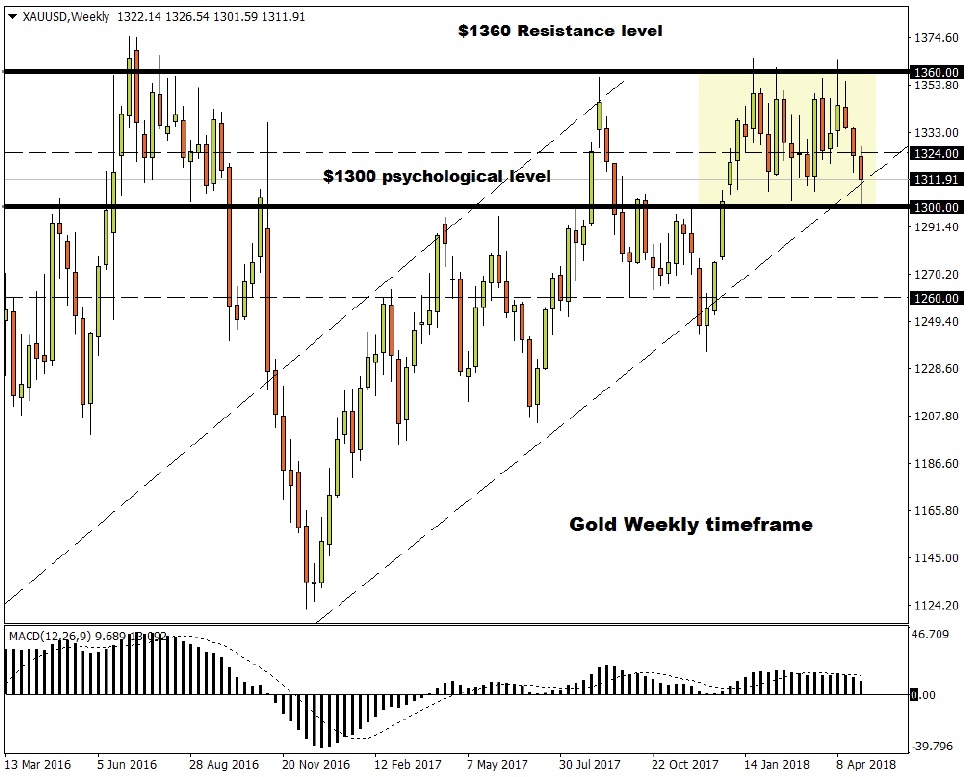
Price action suggests that Gold bulls and bears have been engaged in a tug of war since the start of the trading year, with support at $1300 and resistance at $1360. While geopolitical tensions and overall uncertainty supported bulls, bears have received constant inspiration from US rate hike expectations. With prices sinking close to the $1300 support level this week amid an aggressively appreciating Dollar, could the tug of war be coming to an end?
Gold bears may be offered an opportunity to attack and conquer the $1300 level today, if the NFP data results exceed market expectations.
Taking a look at the technical picture, the yellow metal is under pressure on the daily charts. Previous support around $1324 could transform into a dynamic resistance that encourages a decline towards $1300 and $1260, respectively.