Sample Category Title
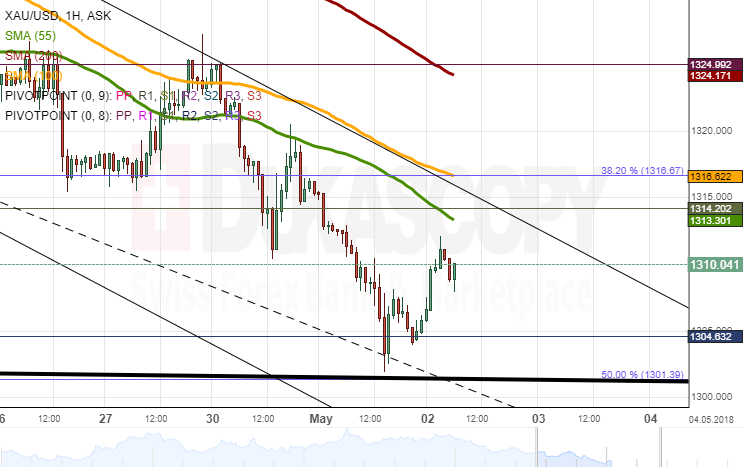
Gold Analysis: Faces Strong Resistance
The yellow metal was not an exception, as it was likewise pressured lower by the stronger US Dollar during the previous session. This fall allowed bears to push the pair down to the senior channel and the 50.00% Fibonacci retracement near 1,302.00.
This sentiment changed during the Asian session when Gold recovered some loses and returned near the 55-hour SMA near 1,315.00. It is likely that the given area, reinforced by the 100-hour SMA and the 38.20% Fibo retracement, provides a strong resistance for the pair, thus limiting a surge during the first part of the day, at least. This might result in another decline down to the 1,300.00 mark.
The market could lack high volatility prior to the Fed Monetary Statement released at 1800GMT which is likely to guide the rate for the remaining part of the day.
CAD/JPY 4H Chart: Meets Support
The Loonie has been moving in a descending channel against the Japanese yen since January. The exchange rate neat movement in this downtrend was interrupted in March when a U-turn north occurred after reaching a support level near the 80.06 mark.
The currency exchange rate has since started a new uptrend movement. Meanwhile, a breakout had occurred and can be observed on the chart.
The overall market sentiment is bullish; therefore, the CAD/JPY currency pair is likely to continue its upwards journey during the following trading sessions until it encounters a resistance set by the monthly R2 at 85.85.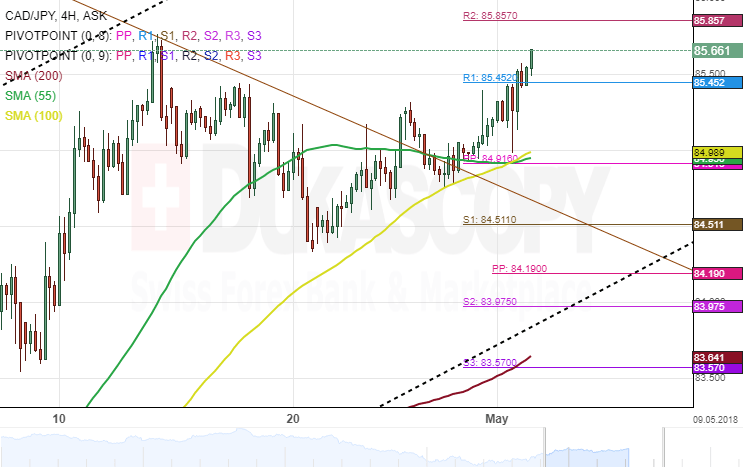
USD/CHF 4H Chart: Still bullish
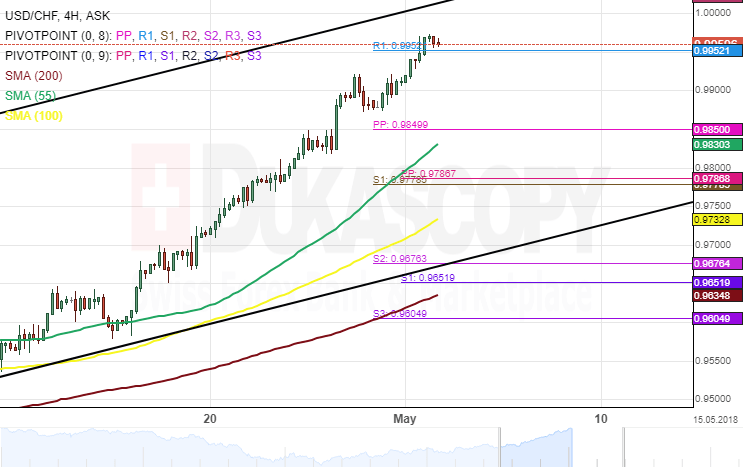
The bullish momentum that began mid-February has guided the USD/CHF exchange rate towards the upper boundary of a dominant ascending channel. This mark 8.59% increase in price during the last two months. The currency pair has breached a resistance formed by the monthly pivot point at 0.9952.
It seems that this may indicate a continuous move north that might be expected within the following trading days. The next barrier that might hinder the Buck from gaining further strength is located near 1.0045 which is a resistance cluster set by the combination of the weekly R1 and the monthly R2.
In the meantime, technical indicators favour bulls to control the market within this session. However, a corrective move south is very likely before the aforementioned target could be fulfilled.
USD/CAD: Canadian GDP
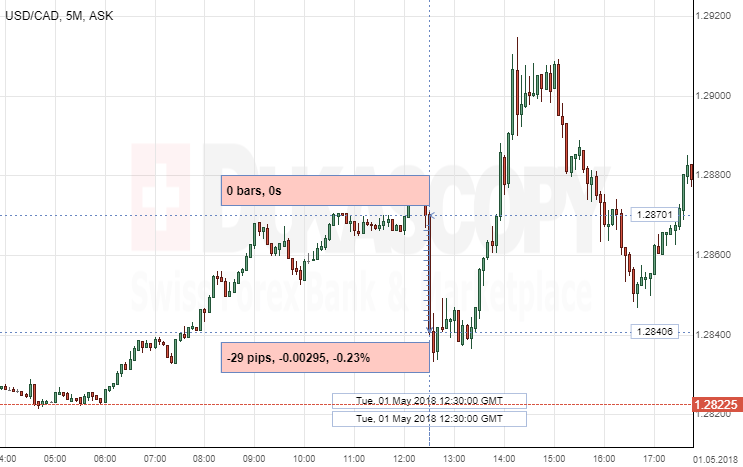
The Canadian Dollar strengthened against the Greenback, following the Canadian GDP data release on Tuesday. The USD/CAD currency pair lost 29 pips, or 0.23%, to continue fluctuating in the 1.2836 area.
The Statistics Canada released Gross Domestic Product that came out better-than-expected of 0.4% for the month of February, which caused USD/CAD's currency pair to move downwards.
Canada's economy has got back on its feet from –0.1% in the previous period, where one of the main reasons for such a rebound was extraction in oil and gas.
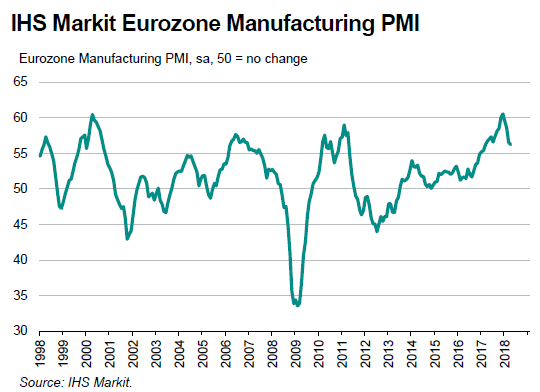
Eurozone PMI manufacturing revised up to 56.2, overall pace of expansion remains encouragingly solid
Eurozone PMI manufacturing was revised up to 56.2 in April, from 56.0. Markit noted
slower rates of expansion in five of the eight nations covered, and slower increases in new work and employment offset slightly stronger gain in output
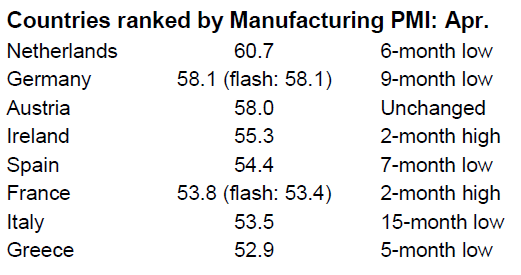
Among the countries, Germany PMI manufacturing hit a 9-month low, Italy hit 15-month low and Spain hit 7- month low. France and Ireland performed pretty well by climbing to 2 month high.
Comments from Chris Williamson, Chief Business Economist at IHS Markit:
"The manufacturing sector saw growth weaken further at the start of the second quarter, but let's not lose sight of the fact that the overall pace of expansion remains encouragingly solid.
"Although growth has slowed markedly compared to the start of the year, December had seen the best performance in over 20 years of survey data collection, with factory activity clearly surging at an unsustainable rate. Since then, supply constraints - including raw material scarcities, supplier delivery delays and skill shortages - have constrained production. Strikes, bad weather and unusually high levels of illness have also plagued businesses.
"Some of these adverse factors are therefore likely to be reversed in coming months, as capacity is increased, supply improves and factors such as strikes and weather cause fewer problems.
"However, anecdotal evidence from the surveys also highlights how demand has been curbed by other issues such as the stronger euro and rising prices. Uncertainty has also intensified due to worries regarding trade wars and Brexit, underscoring downside risks to the outlook.
"While the current pace of growth remains solid, the trend in the surveys in coming months will provide important clues as to the degree to which underlying demand may be waning and the extent to which policymakers should be concerned about the health of the economy."
GBP/USD: UK Manufacturing PMI
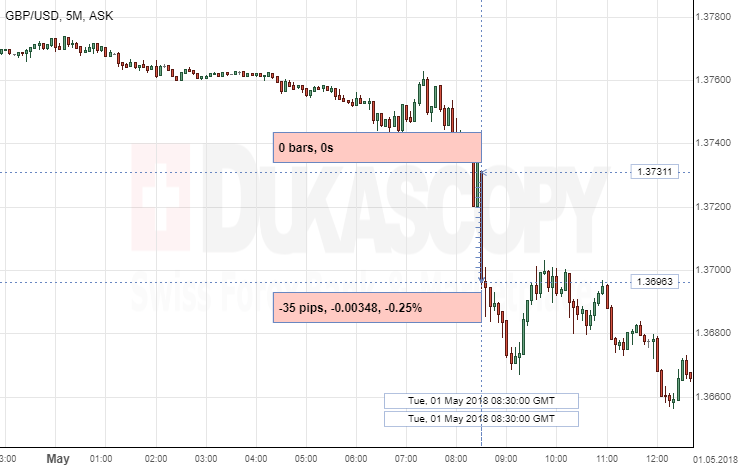
The British Pound strengthened against the Greenback, following the UK Manufacturing PMI data release on Tuesday. The GBP/USD currency pair lost 35 pips, or 0.25%, to continue fluctuating in the 1.3687 area.
The Markit released Manufacturing Purchasing Managers' Index that came out lower-than-expected of 53.9, compared to the 55.1 in the previous period. The biggest reaction or downward movement was made on GBP/CAD currency pair by 0.27%.
"The headline PMI dipped to a 17-month low as growth of production, new business and employment all slowed," said Rob Dobson, director at IHS Markit.
China PMI Supports Picture Of Moderate Slowdown
The Chinese PMI manufacturing for April was broadly in line with expectations. The details point to some softening ahead, though, which is in line with other indicators
We show the details of the PMI releases from NBS and Caixin in the charts overleaf. The key takeaways are as follows.
- Headline PMI manufacturing was broadly flat in April, for both NBS and Caixin, and stayed at decent levels.
- New orders are moving lower, which, in combination with higher inventory indices, points to a slowdown ahead (see chart below).
- Export orders, in particular, are weakening, suggesting the export engine is losing some pace. This is in line with our export model showing rising headwind from a stronger CNY and weakening of the global business cycle (chart).
A decline in industrial profit growth also points to a softening of the Chinese business cycle (chart). We look for a further decline in PMI in coming quarters.
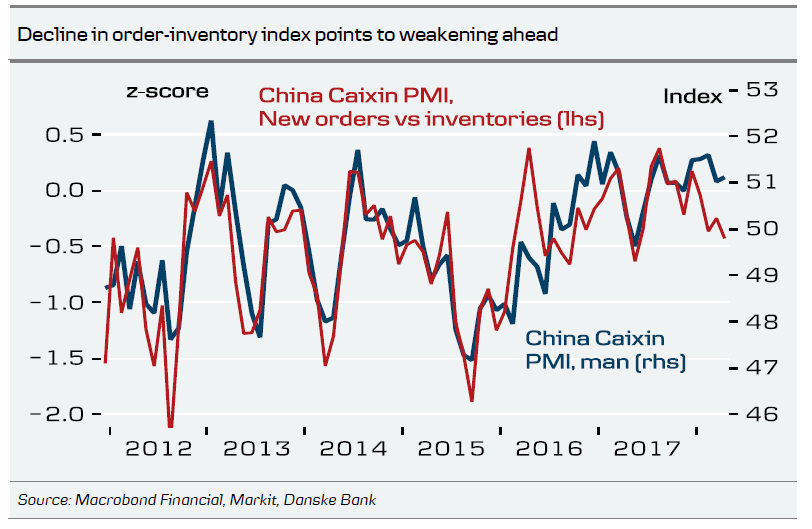
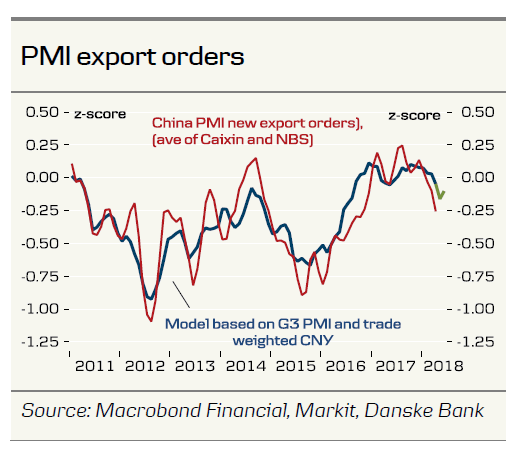
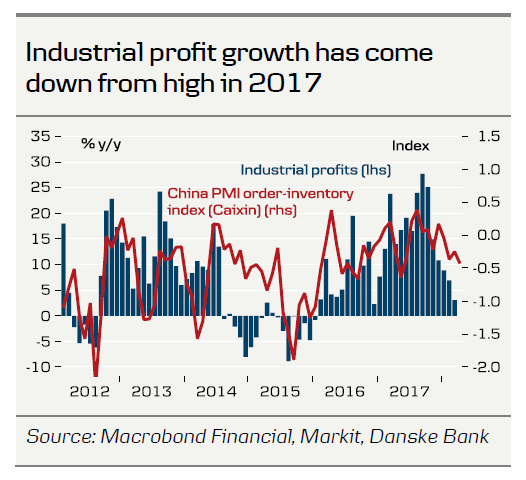
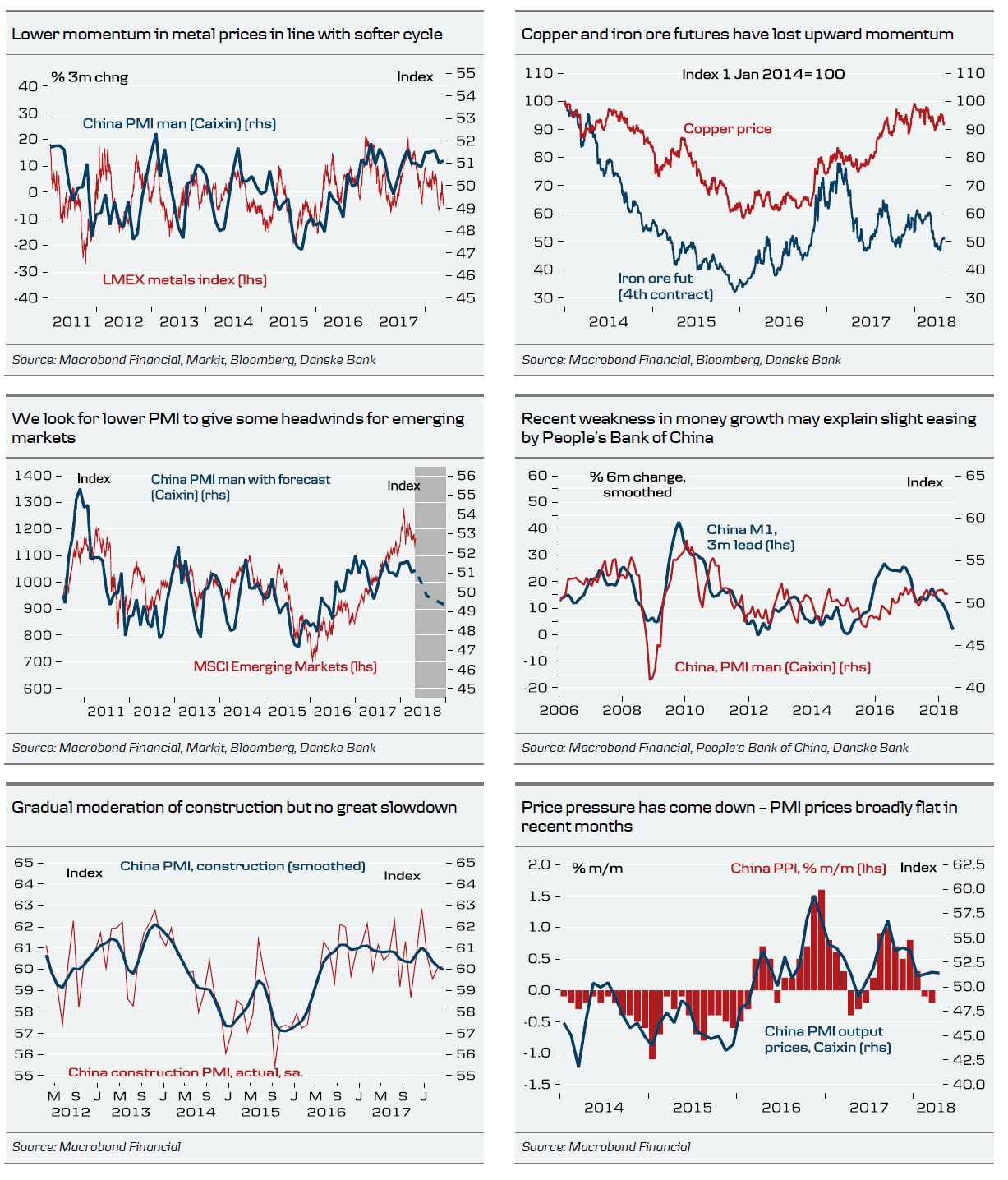
The recent slight easing of monetary policy by the People’s Bank of China may be a result of the rising signs of slower growth ahead, although another reason is to facilitate easier access to credit for small businesses despite the tightening measures against shadow banking and overall deleveraging.
The moderation of the Chinese business cycle is set to give less tailwind to emerging market assets and global metal prices. However, it provides support for both Chinese bonds and global bonds, through the disinflationary impact and contribution to a weaker global cycle.
German PMI manufacturing finalzied at 58.1, 9-month low but alarm bells aren’t ringing yet
German PMI manufacturing was finalized at 58.1, unchanged from first estimate. Markit noted that After reaching a record-high last December, the PMI has fallen in every month in 2018 so far. Slower rises in new orders and employment weigh on overall performance in April. And growth remains strong by historical standards, with output up markedly on the month
Comments from Phil Smith, Principal Economist at IHS Markit:
"The manufacturing PMI slipped to a nine-month low in April, but alarm bells aren't ringing yet. The sector boomed in the second half of 2017 and probably overheated; record input delivery delays show that supply has struggled to keep up with demand. The sector looks to have come off the boil in terms of its rate of growth, though it is still running relatively hot.
"By historical standards, April's increase in output was robust, and it coincided with another strong round of job creation as manufacturers continued in their efforts to expand capacity. But what's important in terms of staying in growth territory is the strength of new orders, which in April showed the smallest gain for 17 months. A further slowdown in order books in May would mean some downside risks to the outlook.
"The survey's forward-looking business confidence gauge has stabilised after falling throughout the opening quarter, to suggest that firms themselves see growth levelling off at a lower rate than those seen in recent months."
XAUUSD Intraday Analysis
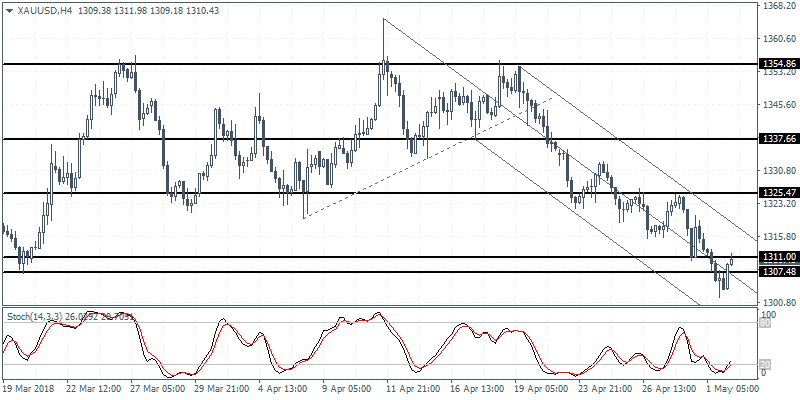
XAUUSD (1310.43): Gold prices posted a strong decline on the day as price action slipped below the 1311 - 1307 level of support. Gold prices briefly dropped to the 1301.80 level before recovering. With price action back in the support zone, only a clean breakout above 1311 will signal further gains. To the downside, we expect price action to be limited at the current levels. The previously breached support level at 1325 remains the upside target which could be tested for resistance
GBPUSD Intraday Analysis
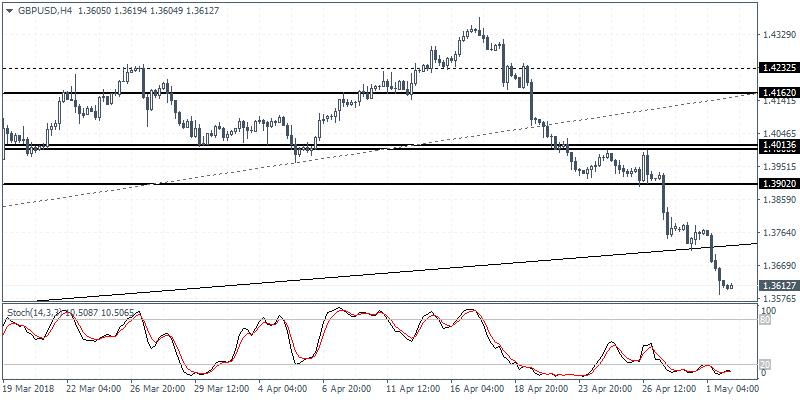
GBPUSD (1.3612): The British pound continued the declines yesterday following the doji pattern that was formed the previous day. The breakout from the long term rising trend line indicates that GBPUSD is likely to push lower. The next main support level is seen at 1.3530 which could be tested in the near term. A rebound in prices cannot be ruled out as we expect to see a modest correction in the near term. Further declines cannot be ruled out if GBPUSD breaks below 1.3530 which will see the next support level at 1.3500 coming into the picture.