

Sample Category Title
EURUSD Stalls Rally But Remains Bullish Above 1.20
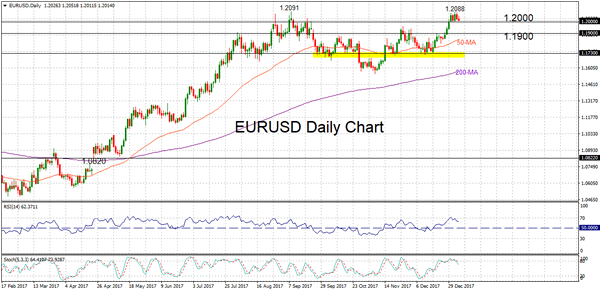
EURUSD remains steady in the near term after stalling a rally just under the key 1.2100 level. The overall outlook remains bullish as the 50-day and 200-day moving averages are bullishly aligned.
Upside momentum has started to fade as prices struggle to rise past the 1.2091 peak that was hit in September 2017.
The resistance level at 1.2100 will likely be a challenge to break but while short-term price action looks a little soft for now. However, both the RSI and the Stochastics are pointing to the downside, suggesting that weakness in prices cannot be ruled out in the near-term. Yet, underlying trend remains bullish.
EURUSD is expected to remain well supported on dips and the key level at 1.2000 is now seen as strong support, which has held for several days now. Consequently, a consolidation phase has been forming.
The risk of a move lower is limited but if EURUSD fails to regain upside momentum to break 1.2100 soon then the risk of a drop would increase quickly.
EUR/JPY Daily Outlook
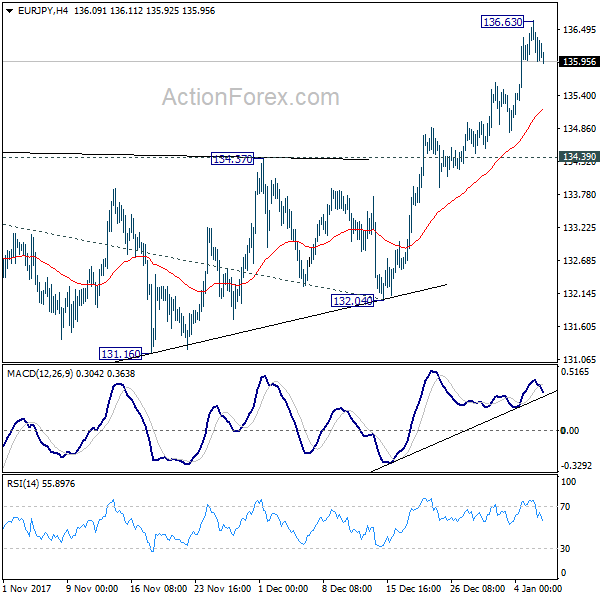
Daily Pivots: (S1) 135.76; (P) 136.20; (R1) 136.42; More....
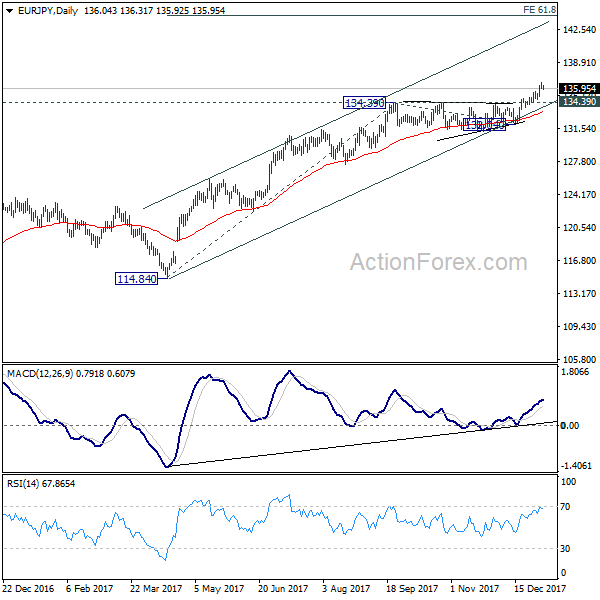
Intraday bias in EUR/JPY remains neutral for consolidation below 136.36 temporary top. Downside of retreat should be contained by 134.39 resistance turned support to bring another ally. Above 136.63 will extend the larger up trend towards 61.8% projection of 114.84 to 134.39 from 132.04 at 144.12.
In the bigger picture, medium term rise from 109.03 (2016 low) is seen as at the same degree as the down trend from 149.76 (2014 high) to 109.03 (2016 low). It should now be targeting 141.04/149.76 resistance zone. On the downside, break of 132.04 support is needed to be the first sign of medium term reversal. Otherwise, outlook will stay bullish in case of pull back.
EUR/USD Downsides Remain Supported Above 1.1950
Key Highlights
The Euro traded as high as 1.2088 recently against the US Dollar before starting a correction.
There is a major bullish trend line forming with support at 1.2000 on the 4-hours chart of EUR/USD.
Downsides in the Euro remain supported around the 1.2000 and 1.1950 support levels.
The US NFP in December 2017 posted 148K, less than the market forecast of 190K.
EURUSD Technical Analysis
The Euro made a nice upside move this past week and traded above 1.2050. EUR/USD formed a high at 1.2088 and is currently correcting lower.
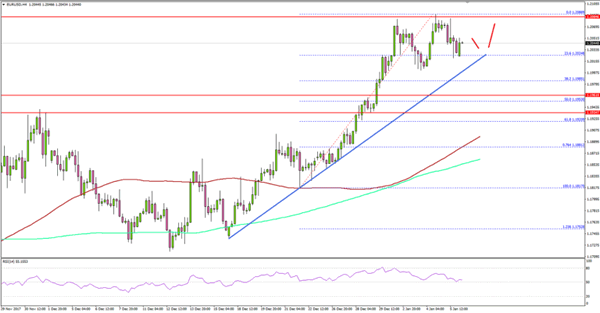
It tested the 23.6% Fib retracement level of the last wave from the 1.1817 low to 1.2088 high. On the downside, there is a major bullish trend line forming with support at 1.2000 on the 4-hours chart.
The trend line support is likely to act as a strong buy zone in the short term around 1.2000. Should there be a break below 1.2000, the pair could test the 50% Fib retracement level of the last wave from the 1.1817 low to 1.2088 high near 1.1950.
Therefore, it seems like there are a few crucial supports on the downside such as 1.2000 and 1.1950. On the upside, the recent high near 1.2080 is a resistance zone. A clear break above 1.2080 could push the pair further above 1.2100.
On the positive side, both 100 and 200 simple moving averages (4-hours) are at 1.1860-80 with an upside angle. Thus, the chances of more gains in EUR/USD are high once the current correction completes either near 1.2000 or 1.1950.
US NFP
This past week, the US saw the non-farm payrolls release for December 2017. The market was looking for an increase of 190K in jobs compared with the last 228K. However, the actual was on the lower side, as the NFP posted 148K.
On the other hand, the last reading was revised up from 228K to 252K. The unemployment rate remained at 4.1% in Dec 2017. Overall, the result was disappointing, which is why short-term downsides in EUR/USD will most likely find support.
EUR/GBP Daily Outlook
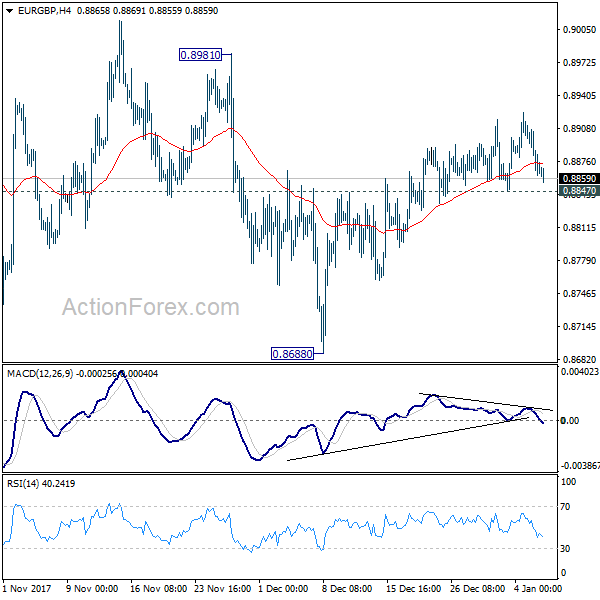
Daily Pivots: (S1) 0.8849; (P) 0.8880; (R1) 0.8895; More...
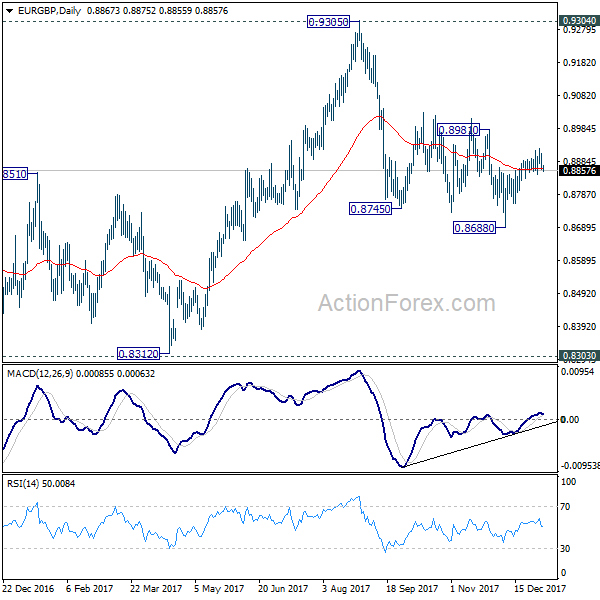
Intraday bias in EUR/GBP stays neutral for the moment. On the downside, break of 0.8847 minor support will argue that the rebound form 0.8688 has completed. In such case, intraday bias will be turned back to the downside for 0.8688 support. Break will resume whole fall from 0.9305. On the upside, break of 0.8981 resistance is needed to confirm upside momentum. And in that case, near term outlook will be turned bullish for retesting 0.9305.
In the bigger picture, there are various ways to interpret price actions from 0.9304 high. But after all, firm break of 0.9304/5 is needed to confirm up trend resumption. Otherwise, range trading will continue with risk of deeper fall. And in that case, EUR/GBP could have a retest on 0.8303. But we'd expect strong support from 0.8116 cluster support (50% retracement of 0.6935 to 0.9304 at 0.8120) to contain downside.
EUR/AUD Daily Outlook
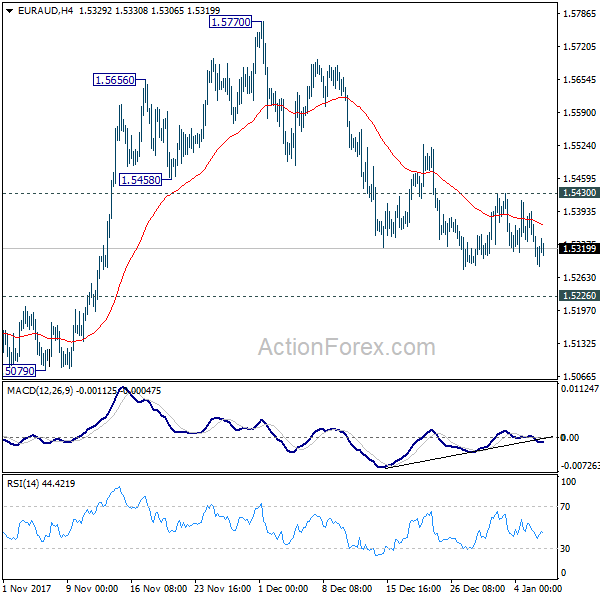
Daily Pivots: (S1) 1.5255; (P) 1.5324; (R1) 1.5361; More....
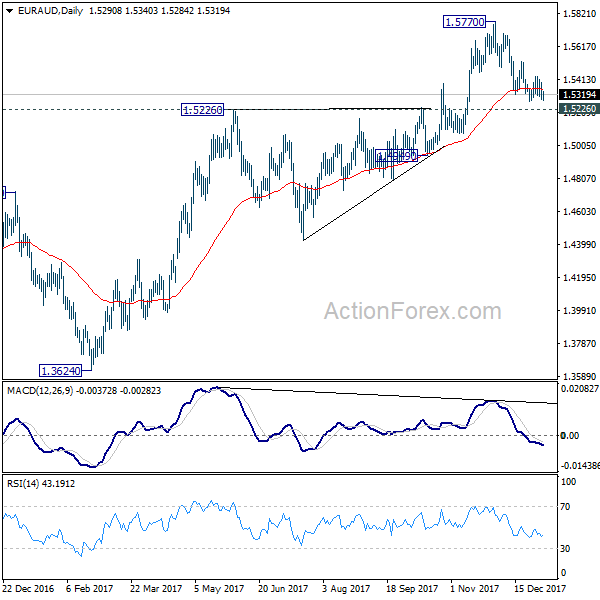
No change in EUR/AUD's outlook. While deeper decline cannot be ruled out, near term outlook stays bullish as long as 1.5226 resistance turned support holds. Break of 1.5430 minor resistance will now indicate completion of the correction from 1.5770 and turn bias back to the upside for retesting 1.5770. However, sustained break of 1.5226 will indicate larger reversal and target 1.4949 support next.
In the bigger picture, we're holding on to the view that corrective decline from 1.6587 medium term top (2015 high) has completed at 1.3624. Rise from 1.3624 is expected to extend to retest 1.6587. We'll hold on to this bullish view as long as 1.5226 resistance turned support holds. Firm break of 1.6587 will resume long term rise from 1.1602 (2012 low). However, sustained break of 1.5226 will indicate trend reversal and target 1.3624 again.
A Critical Week For The U.S. Dollar After A Fragile Start
After having the worst annual performance since 2003, the dollar continued to struggle in the first trading week of 2018. The dollar index fell to a three-and-a-half-month low to trade below 92, leaving many traders wondering whether this year will be another devastating one for the greenback. When looking at the Commitment of Traders (COT) report, speculators are not showing interest in buying the U.S. dollar yet, and the latest groupof data did nothing to support the dollar.
Friday's jobs report did not motivate the dollar bulls to return, with non-farm payrolls rising 148,000 in December, versus expectations of 190,000. Although I think the numbers weren'tbad, and the labor market remains healthy with unemployment at 4.1%, wages are not yet showing signs of acceleration, and this remains the key missing ingredient of the U.S. economy's recovery.
The latest minutes of the Fed's meeting also showed that policymakers aren't sure whether inflation will return to the central bank's target, which is why markets believe that only two rate hikes will occur in 2018, as opposed to the three in the Fed's dot plot. This week, many Fed speakers are due to speak, including the two dissenters that were against a rate hike in December, Neel Kashkari and Charles Evans. Whether they have changed their mind, or still believe rates shouldn'tbe hiked remains to be seen, but we'll also tune into other Fed speakers for fresh insights.
If the Fed speakers don't delivernews, tier one economic releases may provide needed clues. Consumer prices and retail sales are both due forrelease on Friday. Given that energy prices spiked in December, consumer prices are expected to increase 0.2%. However, I think traders will be more interested in the core CPI figure, which strips out volatile items like food and energy. Any upside surprise in the inflation numbers will likely bring back the dollar bulls.
Given that the major U.S. economic releases are four days away, many traders will focus on whether any technical breakouts will occur. EURUSD failed to break above 1.2092 (2017 high) last week, but a successful breakout will likely lead to further buying of the single currency, towards 1.22. Similarly, Sterling is only 100 pips short of 1.3656 (2017 High). So traders should keep a close eye on these levels.
EUR/CHF Daily Outlook
Daily Pivots: (S1) 1.1701; (P) 1.1740; (R1) 1.1759; More...
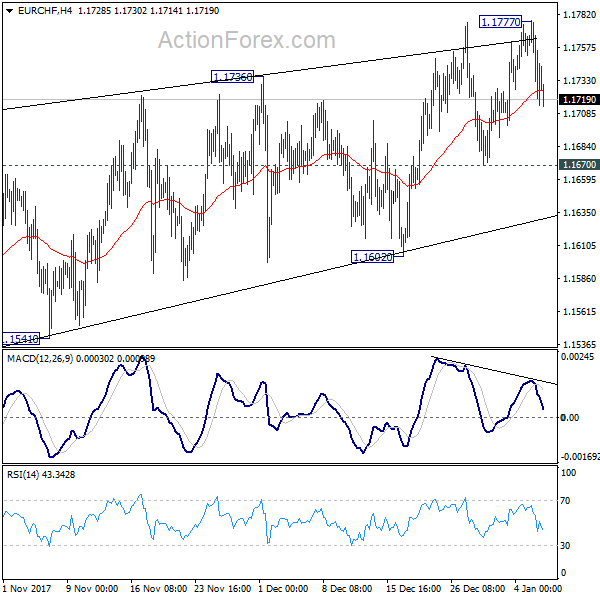
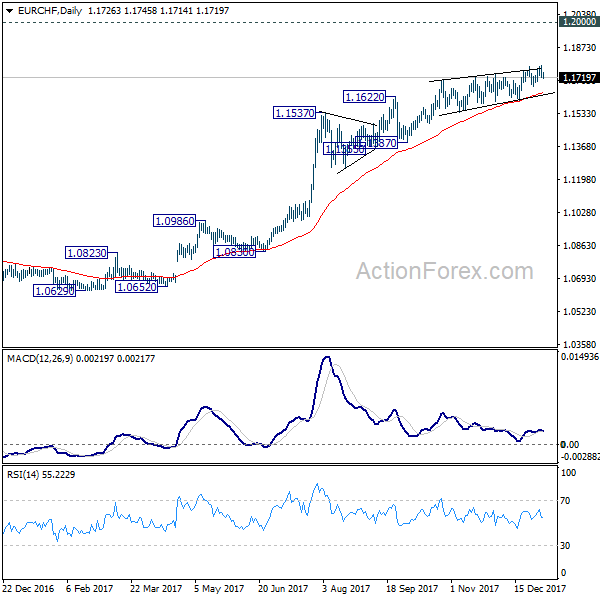
EUR/CHF weakens today but stays above 1.1670 minor support. Intraday bias remains neutral first. We're holding on to the view that it's close to topping, if not formed. And even in case of another rise, strong resistance should be seen well below 1.2 handle to bring medium term reversal. On the downside, below 1.1670 minor support will turn bias to the downside for 1.1602 support first. Further break of 1.1602 will indicate reversal and turn outlook bearish for 1.1387 and below.
In the bigger picture, while a medium term top could be around the corner, there is no change in the larger outlook. That is, long term rise from SNB spike low back in 2015 is still in progress and would extend. As long as 1.1198 resistance turned support holds, we'll hold on to this bullish view and expect another to prior SNB imposed floor at 1.2000. Though, we'll reassess the outlook if 1.1198 is firmly taken out.
Australia’s Construction Sector Growth Slid In December
For the 24 hours to 23:00 GMT, the AUD rose 0.08% against the USD and closed at 0.7870 on Friday.
LME Copper prices declined 1.5% or $105.5/MT to $7097.0/MT. Aluminium prices declined 1.1% or $24.5/MT to $2205.5/MT.
In the Asian session, at GMT0400, the pair is trading at 0.7849, with the AUD trading 0.27% lower against the USD from Friday's close, after overnight data revealed that Australia's AiG performance of construction index dropped to a level of 52.8 in December. In the prior month, the index had recorded a level of 57.5.
The pair is expected to find support at 0.7831, and a fall through could take it to the next support level of 0.7813. The pair is expected to find its first resistance at 0.7871, and a rise through could take it to the next resistance level of 0.7893.
Going ahead, traders would keep a close watch on Australia's building approvals data for November, slated to release overnight.
The currency pair is trading below its 20 Hr moving average and showing convergence with its 50 Hr moving average.

Euro-Zone’s Annual Inflation Slowed As Anticipated In December
For the 24 hours to 23:00 GMT, the EUR declined 0.2% against the USD and closed at 1.2047 on Friday, after data indicated that annual inflation in the Euro-zone slowed in December.
The Euro-zone's preliminary consumer price index (CPI) climbed 1.4% on an annual basis in December, meeting market expectations and after recording a rise of 1.5% in the prior month, thus indicating that strong economic conditions in the common currency region have not translated into higher inflation.
Separately, Germany's retail sales rebounded more-than-expected by 2.3% on a monthly basis in November, surging by the most in a year and hinting that an upturn in the nation's private consumption is on the cards. Retail sales had recorded a drop of 1.2% in the previous month, while markets had anticipated for a gain of 1.0%. Additionally, activity in the nation's construction sector expanded at its quickest pace in four months, after it advanced to a level of 53.7 in December, driven by robust growth in commercial building work. The PMI had recorded a reading of 53.1 in the preceding month.
The greenback advanced against a basket of major currencies, as investors shrugged off downbeat US non-farm payrolls report and cherished robust wage growth data.
Non-farm payrolls in the US increased less-than-anticipated by 148.0K in December, against market anticipations for an advance of 190.0K. Non-farm payrolls had recorded a revised increase of 252.0K in the previous month. On the other hand, the nation's average hourly earnings of all employees gained 0.3% on a monthly basis in December, meeting market expectations, thus offering initial signs of a pick-up in wage growth. Average hourly earnings of all employees posted a revised increase of 0.1% in the prior month. Moreover, the nation's unemployment rate remained steady at 4.1% in December, in line with market expectations.
Another set of data revealed that the ISM non-manufacturing PMI in the US unexpectedly eased to a level of 55.9 in December, defying market expectations for a rise to a level of 57.6 and compared to a reading of 57.4 in the prior month. Further, the nation's trade deficit widened to a nearly six-year high level of $50.5 billion in November, as imports of goods jumped to a record high amid strong domestic demand. The nation had posted a revised trade deficit of $48.9 billion in the prior month, while market participants had envisaged for a deficit of $49.9 billion.
Nevertheless, the nation's factory orders climbed 1.3% on a monthly basis in November, surpassing market expectations for an advance of 1.1%. Factory orders had registered a revised rise of 0.4% in the previous month. Also, the nation's final durable goods orders gained 1.3% in November, confirming the preliminary print and following a revised decline of 0.4% in the prior month.
Meanwhile, the Philadelphia Federal Reserve (Fed) President, Patrick Harker pencilled-in only two interest rate increases in 2018, while the San Francisco Fed President, John Williams shared his expectation of three interest rates hikes this year, citing an already strong economy. Further, the Cleveland Fed President, Loretta Mester, stated that she expects roughly four interest rate hikes this year.
In the Asian session, at GMT0400, the pair is trading at 1.2033, with the EUR trading 0.12% lower against the USD from Friday's close.
The pair is expected to find support at 1.2008, and a fall through could take it to the next support level of 1.1984. The pair is expected to find its first resistance at 1.2070, and a rise through could take it to the next resistance level of 1.2108.
Moving ahead, investors would focus on the Euro-zone's retail sales figures for November, the Sentix investor confidence index for January as well as Germany's factory orders data for November, all due to release in a few hours.
The currency pair is trading below its 20 Hr and 50 Hr moving averages.

Pound Trading A Tad Higher This Morning
For the 24 hours to 23:00 GMT, the GBP rose 0.11% against the USD and closed at 1.3566 on Friday.
In the Asian session, at GMT0400, the pair is trading at 1.3568, with the GBP trading marginally higher against the USD from Friday’s close.
The pair is expected to find support at 1.3533, and a fall through could take it to the next support level of 1.3497. The pair is expected to find its first resistance at 1.3595, and a rise through could take it to the next resistance level of 1.3621.
Looking ahead, traders would keep a close watch on UK’s Halifax house prices for December, scheduled to release in a few hours.
The currency pair is showing convergence with its 20 Hr moving average and trading above its 50 Hr moving average.
