

Sample Category Title
USDCAD Bounces from Dangerous Zone on Upbeat US Data
The pair accelerated sharply higher as the greenback was strongly boosted by upbeat US data.
US new home sales unexpectedly rose in October (6.2% / 685K vs -6.0% / 625K forecast) hitting the highest level since October 2007.
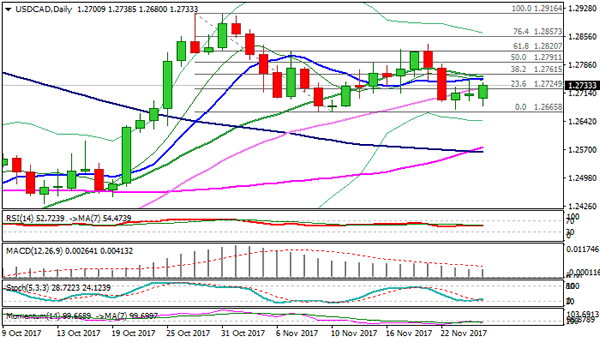
Fresh rally moves away from dangerous zone at 1.2665/70 (lows of 10 Nov / 23 Nov) which mark the breakpoint for bears from 1.2916 (27 Oct high).
Higher base is forming here but break above next strong barriers at 1.2750 zone (4-hr cloud base / converging 10/20SMA's) is needed to confirm and open way for further recovery.
Further recovery would then open next pivot at 1.2783 (4-hr cloud top).
Lower oil prices would be also supportive for further weakness of the loonie.
Conversely, recovery rejection under 10/20SMA's would signal extended consolidation and keep the downside at risk.
Res: 1.2750; 1.2761; 1.2791; 1.2820
Sup: 1.2680; 1.2665; 1.2628; 1.2598
UK100 Index Enters Ichimoku Cloud; Neutral Bias Intact
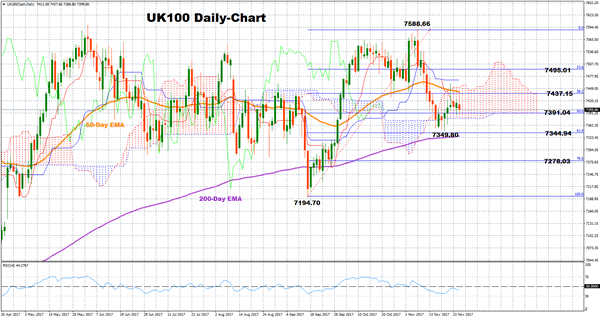
UK100 paused its recent downtrend at a six-week low of 7349.80 on November 20 and has been trading flat around that level since then, painting a neutral picture in the short-term. In the medium-term, the index is also in a consolidation phase.
The index is currently located inside the Ichimoku cloud, retracing the 50% Fibonacci level of the upleg from 7194.70 to 7588.66 (September 15 – November 7) at 7391.04. In the short-term, the bias is likely to remain neutral as the RSI is moving sideways slightly below 50, while the oscillator is also flat in the four-hour and the one-hour chart. The Kijun-sen and the Tenkan-sen lines, which posted a bearish cross on November 17 have also flattened out, supporting this view.
In case downside pressure emerges, the index is likely to find support around the 61.8% Fibonacci at 7344.94, where the 200-day exponential moving average is also placed. However, any violation of this point would extend the downleg started from a six-month high of 7588.60 on November 7, turning the short-term bias from neutral to bearish. Then from here, steeper declines would also target the 78.6% Fibonacci at 7278.03.
To the upside, the 38.2% Fibonacci of 7437.15 could represent strong resistance as the 50-day EMA is also laying in that area. Further increases would meet additional resistance levels at the 23.6% Fibonacci of 7495.01 and at the previous top of 7588.66.
To sum up, in the medium-term, the outlook is neutral as long as UK100 moves between 7194.70 and 7588.66.
USD Selling Remains the ‘By Default’ FX Trade, For Now?
- European equities traded choppy in this week's opening trading session. At the time of writing, they lose around 0.25%. US stock markets opened narrowly mixed.
- Germany's political stalemate showed signs of easing as the Social Democrats started haggling over terms of a renewed coalition with Chancellor Merkel's conservative bloc rather than outright blocking an alliance between Germany's two biggest parties.
- EU authorities have approved Ireland's plans to pay off the last of its crisis-era bailout loans from the IMF early, in a move the government claims will save it around €150m in debt servicing costs. Ireland will repay the remaining €4.5bn from €22.5bn in IMF rescue cash and another €1bn in bilateral loans from Sweden and Denmark.
- The Senate tax bill is headed for a marathon debate this week with the aim to hold a floor vote as early as Thursday. Should it pass, Republican leaders will have to hammer out a compromise between different provisions in the House and Senate bills.
Rates
Core bonds marginally higher in uneventful session
The Bund opened the session unchanged and traded a bit erratic throughout the European session, but overall with a positive bias. The changes are minimal and technically insignificant. The eco calendar was thin and ignored. Equities and oil prices traded range-bound. In this context, the moves of core bonds were range-bound too, but with a slightly upward bias. The US curve flattening was modest, but resumed its trend after a 2-day pause. The German curve was marginally affected. The sole EMU eco releases, Italian economic and consumer confidence, were weaker than expected, but didn't play a role on trading. Later today, the US new home sales will be released and the Treasury sells 2- and 5-yr. Treasury Notes. We don't expect these to fundamentally change the course of core bonds.
At the time of writing, the German yield curve bull flattens slightly with yields up to 1.8 bps (30-yr) lower. The US yield curve flattens too with yields up to 0.8 bps higher at the shorter end (2-yr) and up to 1.7 bps lower at the very long end. On intra-EMU bond markets, yield spreads are virtually unchanged.
Currencies
USD selling remains the 'by default' FX trade, for now?
There was little economic news in the US or in EMU today. Risk sentiment turned a bit more cautious, even as European losses remain modest. Softer equity sentiment was a good enough reason to keep the dollar in the defensive. USD/JPY dropped below the 111 big figure. EUR/USD set a minor new correction top north of 1.1950. Dollar selling remains the preferred FX trade as long as there is no high profile eco or other news.
Overnight, sentiment on Asian markets gradually tuned negative. China and South Korea took the lead in the correction. Japanese equities reversed an opening gain into a small losses. USD/JPY more or less copied the intraday price action on Japanese equity markets. An initial up-tick was reversed. USD/JPY returned to the 111.40 area. EUR/USD traded little changed near 1.1925.
European equities opened slightly lower, but tried to decouple from the correction in Asia. The tentative European equity rebound temporary slowed the dollar's decline, but the US currency never gave the impression that even a modest rebound was imminent. Changes in interest rate differentials were negligible and no driver for FX trading. There were further indications that the SPD and the CDU/CSU are moving to real coalition talks for a German government. This might have been a slightly supportive for the euro. However, dollar softness was the dominant FX trend.
This trend continued in US dealings as risk sentiment dwindled. EUR/USD touched a now correction top in the 1.1960 area. USD/JPY also set a new correction low as the pair dropped below the 111 big figure. Dollar selling remains the way of least resistance. EUR/USD trades currently in the 1.1955 area. USD/JPY is changing hands around 110.90. The dollar is still desperately looking for good news.
Cable breaks beyond intermediate resistance
There were no eco data in the UK today. EU and UK negotiators still try to engineer behind closed doors a proposal that might convince EU leaders at the mid-December summit to give the green light for negotiations on the further relationship between the UK and the EU. For now, there are no signs that big progress has been made. Even so, in technical traded, sterling (re)gained a few ticks against the euro and the dollar. EUR/GBP trades in the 0.8935 area. Cable broke above the 1.3348 intermediate resistance and trades in the 1.3375 area. This move is mostly due to USD weakness rather than GBP strength.
Trade Idea Wrap-up: USD/CHF – Sell at 0.9845
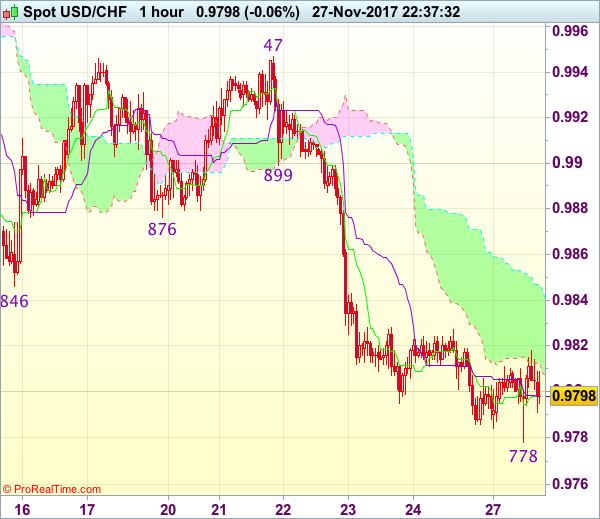
USD/CHF - 0.9810
Most recent candlesticks pattern : N/A
Trend : Near term down
Tenkan-Sen level : 0.9798
Kijun-Sen level : 0.9798
Ichimoku cloud top : 0.9845
Ichimoku cloud bottom : 0.9809
Original strategy :
Sell at 0.9835, Target: 0.9735, Stop: 0.9870
Position : -
Target : -
Stop : -
New strategy :
Sell at 0.9845, Target: 0.9735, Stop: 0.9880
Position : -
Target : -
Stop : -
As dollar has remained under pressure after last week’s selloff, adding credence to our bearish view that top has been formed at 1.1038 and bearishness remains for the decline from there to extend weakness to 0.9730-37 support area, however, near term oversold condition should limit downside and reckon support at 0.9705 would hold from here, bring rebound later.
In view of this, we are looking to sell dollar again on recovery as previous support at 0.9846 should turn into resistance and limit upside. Only break of 0.9875-80 would defer and signal a temporary low is formed instead, bring test of 0.9899 but price should falter well below resistance at 0.9947.
Trade Idea Wrap-up: GBP/USD – Buy at 1.3280
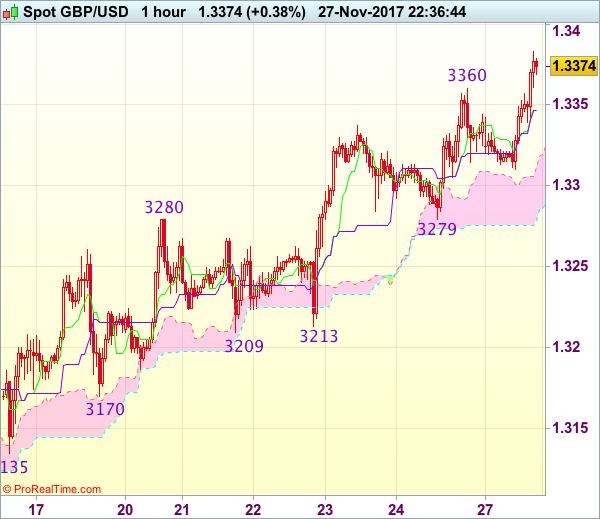
GBP/USD - 1.3359
Most recent candlesticks pattern : N/A
Trend : Near term up
Tenkan-Sen level : 1.3347
Kijun-Sen level : 1.3347
Ichimoku cloud top : 1.3311
Ichimoku cloud bottom : 1.3265
Original strategy :
Buy at 1.3280, Target: 1.3380, Stop: 1.3245
Position : -
Target : -
Stop : -
New strategy :
Buy at 1.3280, Target: 1.3380, Stop: 1.3245
Position : -
Target : -
Stop : -
As cable has maintained a firm undertone after breaking above previous resistance at 1.3338, adding credence to our view that the erratic rise from 1.3027 low is still in progress and bullishness remains for this move to extend gain to 1.3395-00, however, reckon upside would be limited to 1.3417-20 (61.8% Fibonacci retracement of 1.3658-1.3027) would hold from here due to loss of near term upward momentum.
In view of this, we are looking to buy sterling on pullback as 1.3270-80 should limit downside. Below 1.3250 would defer and risk correction to 1.3230 but only break of support at 1.3209-13 would abort and signal a temporary top is formed instead, bring further weakness towards support at 1.3170.
GBPUSD at New Two-Month High; Bulls Eye Target at 1.3415
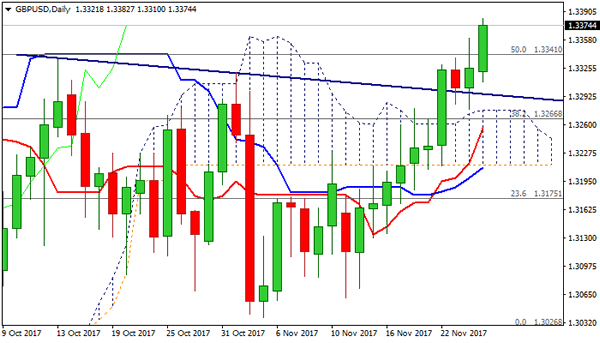
Cable posted new nearly two-month high at 1.3382 on Monday after fresh bullish acceleration triggered stops above Friday's high at 1.3359.
Immediate focus lies at 1.3401 (02 Oct high) ahead of key target at 1.3415 (Fibo 61.8% of 1.3655/1.3026 descend), violation of which would generate another strong bullish signal.
No signs of rally's stall so far, despite overbought slow stochastic on daily chart, but some hesitation on approach to 1.3415 target could be anticipated.
We expect broken trendline which connects former tops at 1.3337 and 1.3320 (1.3305) to limit dips, guarding key n/t support at 1.3276 (daily cloud top).
Res: 1.3401; 1.3415; 1.3455; 1.3506
Sup: 1.3305; 1.3276; 1.3256; 1.3214
Trade Idea Wrap-up: EUR/USD – Buy at 1.1870
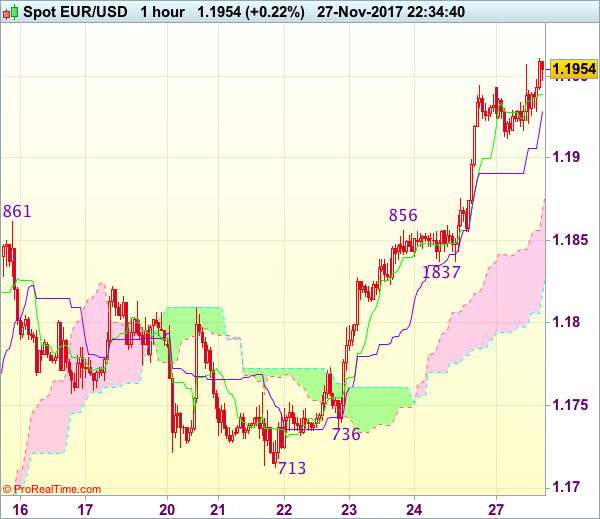
EUR/USD - 1.1936
Most recent candlesticks pattern : N/A
Trend : Near term up
Tenkan-Sen level : 1.1939
Kijun-Sen level : 1.1928
Ichimoku cloud top : 1.1868
Ichimoku cloud bottom : 1.1818
Original strategy :
Buy at 1.1870, Target: 1.1990, Stop: 1.1835
Position : -
Target : -
Stop : -
New strategy :
Buy at 1.1870, Target: 1.1990, Stop: 1.1835
Position : -
Target : -
Stop : -
As the single currency has surged again after last week’s rally above resistance at 1.1861, adding credence to our bullish view that recent upmove has resumed and upside bias remains for the rise from 1.1554 low to extend gain to 1.1950-60, then 1.1980, however, reckon psychological level at 1.2000 would limit upside, risk from there has increased for a retreat to take place later.
In view of this, we are looking to buy euro on pullback as said previous resistance at 1.1861 should turn into support and contain downside, bring such rise. Below minor support at 1.1837 would defer and suggest a temporary top is possibly formed, bring correction of recent rise to 1.1800-05 first.
Trade Idea Wrap-up: USD/JPY – Sell at 111.65
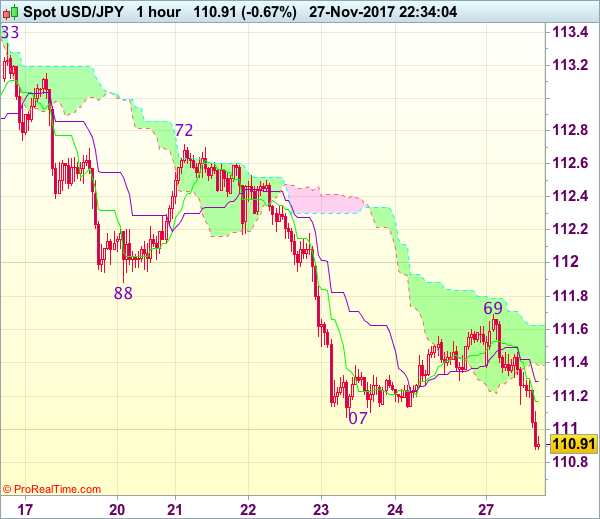
USD/JPY - 110.93
Most recent candlesticks pattern : N/A
Trend : Near term down
Tenkan-Sen level : 111.17
Kijun-Sen level : 111.29
Ichimoku cloud top : 111.63
Ichimoku cloud bottom : 111.39
Original strategy :
Sell at 111.85, Target: 110.85, Stop: 112.20
Position : -
Target : -
Stop : -
New strategy :
Sell at 111.65, Target: 110.55, Stop: 112.00
Position : -
Target : -
Stop : -
As the greenback has remained under pressure after last week’s selloff, bearishness remains for the selloff from 114.74 top to extend further weakness to 110.70 and possibly towards 110.50, however, near term oversold condition should limit downside to 110.20-25 and reckon 110.0 would hold from here.
In view of this, we are looking to sell dollar on recovery as resistance at 111.69 should limit upside and bring another decline later. Above 111.88 (previous support now resistance) would defer and signal a temporary low is formed, bring a stronger rebound to 112.30-35 but price should falter below resistance at 112.72, bring another decline later.
Dollar Drops Below 111 Yen, US Housing Report Next
The Japanese yen has posted gains in the Monday session. In North American trade, USD/JPY is trading at 110.94, down 0.53% on the day. On the release front, SPPI edged lower to 0.8%, just shy of the estimate of 0.9%. In the US, the sole indicator is New Home Sales, which is expected to slow to 627 thousand. On Tuesday, the US releases CB Consumer Confidence, with an estimate of 123.9 points. We'll also hear from Fed Chair Designate Jerome Powell and Treasury Secretary Steven Mnuchin.
The changing of the guard at the Federal Reserve starts this week, as Jerome Powell testifies before the Senate Banking Committee on Tuesday for his confirmation hearing. Will Powell be a clone of outgoing chair Janet Yellen? Powell inherits an economy that is in excellent shape, but persistently low inflation remains a nagging problem. Fed policymakers have differing views on what to do about inflation, with some members proposing that the Fed drop its 2 percent target, in favor of a "gradually rising path" for prices. The Fed remains confounded by low inflation and wage growth, despite a labor market that is at full capacity. Still, the Fed will likely pull the rate trigger next month, and could raise rates up to 3 more times in 2018 if the economy continues to expand at its current pace.
The Bank of Japan has declared more than once that it will hold the course on its massive easing program, even though the Japanese economy has rebounded in 2017, in large part due to stronger global demand for Japanese products. Recently, however, there have been some slight hints that the Bank of Japan might be having second thoughts. BoJ Governor Haruhiko Kuroda recently acknowledged that ongoing easing could hurt bank margins. Kuroda said that BoJ needed to pay attention to the "reversal rate", whereby a rate cut by the central bank discourages bank lending. Still, most economists don't expect a cutting of stimulus until in the near future, so any hints of a change in the status quo would likely shake up the Japanese yen.
Canadian Dollar Dips, Markets Eye Powell Testimony
The Canadian dollar is down slightly in the Monday session. Currently, USD/CAD is trading at 1.2683, down 0.23% on the day. On the release front, there are on Canadian releases on the schedule. In the US, the sole indicator is New Home Sales, which is expected to slow to 627 thousand. On Tuesday, the US releases CB Consumer Confidence, with an estimate of 123.9 points. We'll also hear from Fed Chair Designate Jerome Powell and Treasury Secretary Steven Mnuchin. Canada releases the Raw Materials Price Index, and BoC Governor holds a press conference about the Financial System Review.
Federal Reserve policymakers remain upbeat about the U.S economy, according to the minutes of the most recent policy meeting. The minutes indicated that policymakers expected the U.S economy to continue showing strong growth, and predicted that interest rates will be raised in the "near term". The members discussed the vexing question of why inflation has been persistently low (no quick-fix solution was provided), with most agreeing that a tight labor market should lead to higher inflation levels. Although policymakers did not provide further hints about the timetable of a rate hike, the markets remain convinced that additional rates are imminent. The odds of a rate hike in December are 93%, and the odds of a January raise are at 91%.
The markets will be keeping a close eye on Jerome Powell, who testifies before the Senate Banking Committee on Tuesday for his confirmation hearing. Will Powell be a clone of outgoing chair Janet Yellen? Powell inherits an economy that is in fine shape, but persistently low inflation remains a nagging problem. Fed policymakers have differing views on what to do about inflation, with some members proposing that the Fed drop its 2 percent target, in favor of a "gradually rising path" for prices. The Fed remains confounded by low inflation and wage growth, despite a labor market that is at full capacity. Still, the Fed will likely pull the rate trigger next month, and could raise rates up to 3 more times in 2018 if the economy continues to expand at its current pace.