

Sample Category Title
Summary 11/27 – 12/1
Monday, Nov 27, 2017
[php_everywhere] [/php_everywhere]
Tuesday, Nov 28, 2017
[php_everywhere] [/php_everywhere]
Wednesday, Nov 29, 2017
[php_everywhere] [/php_everywhere]
Thursday, Nov 30, 2017
[php_everywhere] [/php_everywhere]
Friday, Dec 1, 2017
[php_everywhere] [/php_everywhere].
The Weekly Bottom Line: Plenty to be Thankful For
U.S. Highlights
- In a Thanksgiving-shortened week, there was plenty to be thankful for as far as the U.S. economy in 2017. Growth has accelerated well above trend, and unemployment is at a 17-year low. Moreover, the economy is showing signs of rebounding from the hurricane-related devastation.
- Fed Chair Janet Yellen announced that she will resign her seat on the Board when Jerome Powell is sworn in as Chair. America can be thankful for her deft management of monetary policy over the past four years.
- Congress returns after the Thanksgiving break next week, and has three weeks to reach a compromise on tax legislation if it wants to achieve its Christmas deadline. A deal is within reach if Republicans are willing to compromise on the size of tax cuts.
Canadian Highlights
- It was generally a weak week, with wholesale and retail trade volumes both falling in September. The latest headlines from the NAFTA discussions suggest that negotiators remain far apart on a number of key issues. Concluding the talks this winter appears optimistic at best at this time.
- We expect third quarter GDP growth to be reported at 1.7% next Friday, a marked deceleration from recent quarters. Most important in the report will be the signals regarding momentum heading into the end of the year. A weak signal would likely extend the Bank of Canada's current pause in interest rate normalization.
U.S. - Plenty to be Thankful For
It was a fairly quiet week for markets and economic data, given the Thanksgiving holiday. Taking a step back from the week-to-week news, there is certainly plenty to be thankful for when it comes to the economy. Growth has accelerated through 2017, and the unemployment rate has continued to fall. The unemployment rate was at a 17-year low in October, and broader measures of underemployment are now in line with pre-recessionary lows.
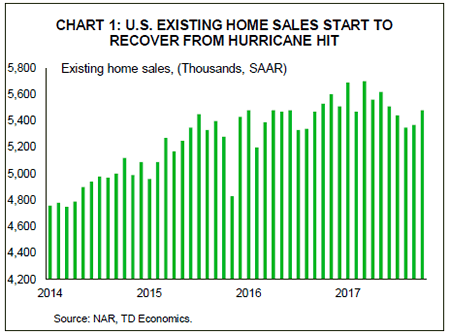
There are also further signs that regions devastated by the hurricanes are starting to recover. Existing home sales were up in October, as activity returned to normal particularly in hurricane affected regions (see Chart 1). Encouragingly, strong demand was also observed in other regions, as the October data marked the third consecutive increase in home sales. While some disruptions, including supply constraints, could linger a bit longer, we anticipate a gradual improvement through the end of the year, as hurricane-affected areas return to normalcy. Beyond the next few months, housing demand activity should remain buoyant alongside an improving labor market.
The minutes from the FOMC's meeting earlier this month showed that many members see the economy as "operating at or above full employment". The Fed can also be thankful that the balance sheet normalization process has gotten underway without a hitch. In fact, members agree that the next Fed statement in December should only contain a brief reference to the program, and subsequent statements might not mention the program at all.
America can also be thankful for Fed Chair Janet Yellen's deft management of monetary policy over the past four years. She has competently executed the gradual removal of the extraordinary stimulus put in place to deal with the financial crisis. But, change is inevitable and on Monday Chair Yellen announced her resignation from the Board once Jerome Powell is sworn in as Chair.
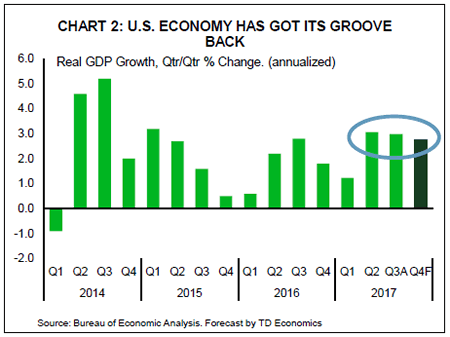
Sound monetary policy has helped U.S. economic activity recover over the last decade. Next week, we'll receive the second estimate of Q3 GDP growth, which was initially reported at a solid 3% annualized rate. Recent indicators suggest we could see an upgrade to around the 3.3% mark. Right now, growth in the fourth quarter is tracking just shy of 3%. Looking at recent history, the economy seems to finally have got its groove back after a period of softness through 2015-2016 (see Chart 2).
Clearly this is not an economy in need of fiscal stimulus. Nevertheless, the Senate will return from its Thanksgiving break next week, and forge full-steam ahead to try to pass its tax cut legislation. In its current form, the proposed Senate tax cut would provide a small fiscal boost over the next few years, but also contains many unpopular elements.
Congress has three weeks to reach a compromise if they want to put a bill before the President by Christmas. It's a tight timeline. But, if Republicans are willing to compromise, perhaps by reducing the size of the corporate tax cut in order to preserve either the Affordable Care Act's individual mandate or other popular deductions currently on the chopping block, a deal is within reach.
Canada - Reality Bites
This week we got another reminder that the unsustainably strong growth of the Canadian economy over the past few quarters is giving way to a more modest (but still healthy) pace of growth. One-off shocks, including hurricane impacts in the U.S. and retooling activity at major plants suggest that the deceleration in Q3 is likely to be more dramatic than anticipated. Ultimately though, the moderation should not be a surprise: with an output gap that is effectively closed, Canada is entering a mature phase of the economic cycle.
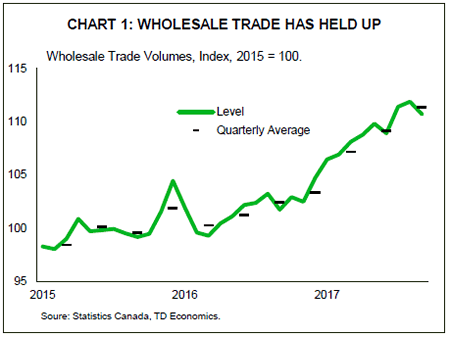
Broadly consistent with this theme, the economic data this week was something of a mixed bag. Starting with the positives, wholesale trade volumes fell back somewhat in September on relatively broad-based softness, but with healthy gains in prior months, sales volumes remained up on the quarter (Chart 1). This was the sixth straight quarterly expansion of wholesale sales volumes, marking the best run for this indicator since 2005/2006. Profits also continued to rise, with Statistics Canada reporting an 8.5% quarter-on-quarter gain in operating profits for Q3. Financial corporations led the way, helped by the Bank of Canada's summer interest rate hikes, but profits among manufacturers and retailers were also generally up. One notable exception was motor vehicle and parts makers, where the already mentioned retooling hit activity and ate into profitability.
It was not all rosy news however. NAFTA negotiations are seeing little progress, with revised U.S. negotiating objectives released late last week suggesting little movement towards compromise on a number of contentious issues including local content requirements. At this point, it seems safe to assume that the process will not be completed by the spring 2018 target, prolonging uncertainty.
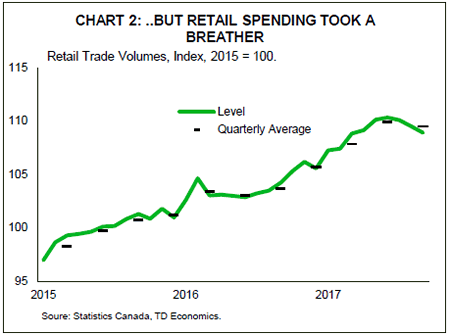
Also disappointing expectations were Canadian retail sales. While a tiny of headline gain was eked out thanks to rising gas prices, volumes fell for a third straight month (Chart 2). The retail trade data provide a view into only a slice of overall consumer spending, but suggests that unlike in recent quarters, consumption is likely to play a diminished role in overall economic growth.
Just how diminished a role will be answered next Friday, December 1st, when Statistics Canada releases its estimate of third quarter GDP. Current tracking points to growth of 1.7% quarter-on-quarter annualized, a marked deceleration from Q2's red-hot 4.5% pace. As is typical, there are risks around this expectation: international trade in goods was very weak in the second quarter, but there is also the question of how Statistics Canada will treat the robust jobs figures, particularly hours worked.
Beyond these immediate questions lies the unknown of how the Bank of Canada will interpret the figures. A 1.7% pace of growth would be in line the with Bank's expectations in the October Monetary Policy Report, meaning the more crucial information will relate to economic momentum heading into the final months of the year. The generally soft economic performance in September (labour markets excluded) suggests that there may be less momentum than the Bank is anticipating. When considered in the context of 'intense data dependency', a soft out-turn in the data may delay any Bank action.
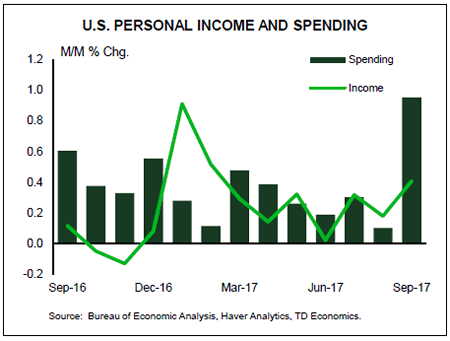
U.S.: Upcoming Key Economic Releases
U.S. Personal Income & Spending - October
Release Date: November 30, 2017
Previous Result: Income 0.4% m/m, Spending 1.0% m/m
TD Forecast: Income 0.3% m/m, Spending 0.3% m/m
Consensus: Income 0.3% m/m, Spending 0.3% m/m
Headline PCE inflation is expected to slip marginally to 1.5% in October, reflecting a 0.1% rise in prices on the month. Some giveback from gasoline prices, which surged following the hurricanes, is the main source of the deceleration. Food prices are also expected to be flat for the third month, which will keep prices little changed on a y/y basis. Excluding food and energy, core PCE inflation is likely to firm to 1.4% y/y on a 0.2% m/m increase. However, the unrounded m/m increase is likely to be weaker than that reported in the CPI release: healthcare services prices have a higher weight in PCE and we expect them to remain weak in the October PCE report.
Nominal PCE (personal spending) is expected to rise 0.3% in October. This indicates a solid footing for real spending, which is tracking well above a 2% pace for Q4. We expect gains to be driven by nondurables and services, with a modest drag from vehicle sales as they come off their hurricane-induced September highs. We also expect a firmer 0.4% increase in October personal income, leading the personal savings rate marginally higher.
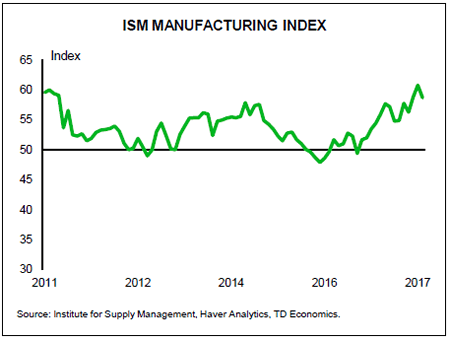
U.S. ISM Manufacturing Index - November
Release Date: December 1, 2017
Previous Result: 58.7
TD Forecast: 57.9
Consensus: 58.3
We expect the ISM manufacturing PMI to slip further to 57.9, reflecting some give back from prior hurricane-induced strength. The supplier deliveries component, which surged after the hurricanes, should drive the moderation as it still remains several points above its recent trend. Employment growth could also come off relatively toppish levels. Scope for a significant drop in the overall index is low given the continued strength in regionals surveys, and as such we expect the ISM PMI to stand near its 6-month average in the 57-58 range. Such levels are consistent with healthy above-trend GDP growth near 3% for the fourth quarter.
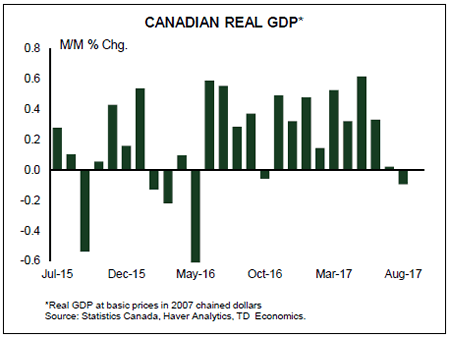
Canada: Upcoming Key Economic Releases
Canadian Real GDP - Q3 and September
Release Date: December 1, 2017
Previous Result: 4.5% q/q (annualized), -0.1% m/m
TD Forecast: 1.7% q/q (annualized), 0.1% m/m
Consensus: N/A
Canadian economic growth is expected to have come back down to earth with a 1.7% (q/q, annualized) expansion in the third quarter. The key culprit behind the deceleration looks to be net trade, as goods export volumes fell 14% on the quarter, far outpacing a modest pullback in imports. Consumer expenditures are expected to decelerate somewhat, to 2.7%. Much of the resilience in spending is pinned on services - an area with limited early indicators, thus presenting a slight downside risk to growth expectations. The volatility in housing markets in the wake of Ontario's Fair Housing Plan will likely be manifested in a second quarterly contraction (-5.5%). Offsetting this weakness somewhat is an expected uptick in business inventories, and still healthy non-residential investment (+5.8%) as firms continue their gradual reinvestment process.
Industry-level GDP should post a 0.1% increase in September owing to a rebound in the goods producing sector. Manufacturing output will benefit from a sharp increase in gasoline production though we see two way risks to output further upstream. We also look for a pickup in construction and utilities output, with the latter driven by a late summer heat wave. Things look less upbeat on the services side, with retail and wholesale trade significantly weaker on the month, though stronger housing activity should help to support the headline print.
Canadian Employment - November
Release Date: December 1, 2017
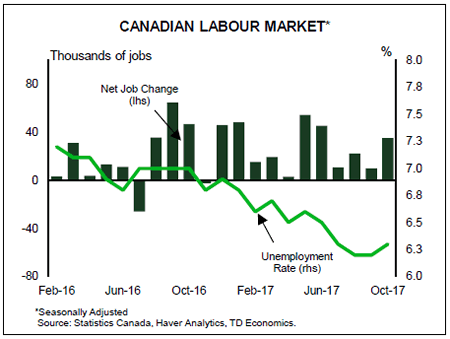
Previous Result: 35.3k, unemployment rate: 6.3%
TD Forecast: 15k, unemployment rate: 6.3%
Consensus: N/A
We look for the labour market to remain on a solid footing in November with the addition of 15k jobs, which should leave the unemployment rate at 6.3%. We expect the details of the report to show an outperformance in the service sector and part-time employment is also likely to rebound after the loss of 150k positions over the last two months. Average hourly earnings have risen by an average of 0.4% m/m since June and we are likely to see a more moderate increase in November; however wage growth is still likely to push to 2.5% y/y or higher on account of modest base effects. Lastly, rising labour force participation for young workers should help keep the unemployment rate stable at 6.3% with risks leaning higher. College students have been out of school since October 16th due to faculty strikes and we look for more students to seek part time work as the disruptions drag on longer.
Chart: Canadian Employment
Euro Shines as SPD Agrees to Resume Coalition Talks; Dollar Sinks to Two-Month Low
Euro bulls pushed the euro to a fresh two-month high during the European session after upbeat readings on German business climate improved sentiment on the Eurozone's outlook and political risks in Germany eased. The dollar weakened even further amid a strengthening euro, while disappointing PMI readings added further losses to the currency.
Business confidence in Germany reached new record highs in November, with the headline business climate index jumping by 0.9 points to 117.5 compared to the expected 116.6. Businesses also remained optimistic about their activities over the next six months, driving the relevant index up by 1.8 points to 110.0. Analysts forecasted the index to retreat to 108.9. However, it should be mentioned that the Ifo institute stated that survey responses were collected prior to the collapse of the coalition talks on Sunday.
Positive developments on the political front emerged after a senior member of the center-left SPD party said on Friday that "the SPD will not say no to discussions", expressing the party's willingness to start coalition talks with Merkel's Christian Democrats. Recall that the Social Democrats, Merkel's ex-coalition partners turned to the opposition in September after they recorded their worst election result. The German President, Frank Walker Steinmeier, noted that he would hold talks with Merkel and the SPD next week.
Euro/dollar managed to break the 1.1900 key level for the first time in two months, reaching $1.1930 and being 0.68% up on the day. Euro/yen and euro/pound touched a fresh one-week high of 132.69 (+0.38%) and 0.8920 (+1.0%) respectively.
The dollar index weakened by 0.42% to a two-month low of 92.70 on the back of a rising euro and as US markets were partially closed following the Thanksgiving holiday.
The November flash IHS Markit manufacturing PMI out of the US was released at 53.8, below expectations for a reading of 54.8 and October's reading of 54.6. The respective reading for the services sector came in at 54.7. This compares to forecasts of 55.6 and October's 55.3 and constitutes a four-month low. The composite reading that blends the manufacturing and services sectors came in at 54.6, also a four-month low. Still, all readings were above the 50-mark, pointing to expansion. IHS Markit chief economist Chris Williamson made reference to "another month of solid growth in November, putting the economy on course for a reasonable, though by no means stellar, fourth quarter." Dollar/yen fell within the first the first minutes of data release, though it quickly recovered the losses. Dollar/yen was last trading at 111.49 (+0.25%).
The British Prime Minister, Theresa May, arriving in Brussels on Friday for a summit with Easter European leaders and the European Council President, Donald Tusk, said she would make efforts to secure Brexit talks would lead to future trade relations, offering an improved divorce bill which was also backed by cabinet members last week.
Back in Ireland, political stability was in danger, after the head of the opposition party, Fianna Fail Micheal Martin, submitted a no-confidence measure to be voted on Tuesday on the Deputy Prime Minister, Frances Fitzgerald, over her handling of a police scandal. The leader of the minority government, Fine Gael, though ruled out the resignation of Fitzgerald increasing the risk of snap elections in the country. This could also harm Britain's efforts to persuade EU leaders next month at the EU summit to open negotiations on post-Brexit trade relations as the Irish border is one of the three issues the EU demands to resolve before negotiations move to future trade relations.
Pound/dollar broke a seven-week high of 1.3356 before it inched down to 1.3334, trading 0.24% up on the day.
In other currencies, the aussie erased earlier losses, climbing to $0.7625, while the kiwi also rebounded towards $0.6885. Dollar/loonie pared today's gains, falling to 1.2708.
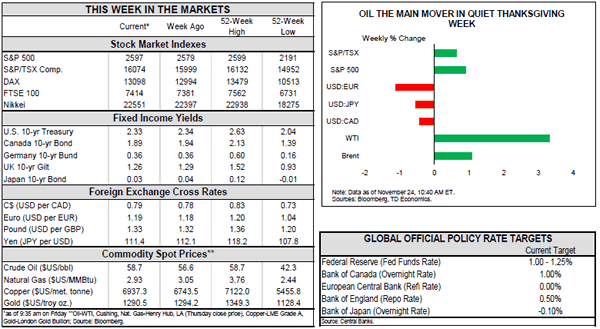
In commodities, gold retreated by 0.20% to $1,288.30 per ounce and oil prices were mixed. WTI crude increased by 1.0% to a fresh two-year high of $58.92 per barrel before it edged down to $58.52 as the disconnection of a Keystone pipeline from Canada to the US last week continued to tighten the market. Brent pulled back by 0.27% to $63.38 after touching a two-week high of $63.84 a barrel. Moreover, a layer of uncertainty over Russia's stance on supply cuts at the next week's OPEC meeting was removed after the Russian Energy Minister, Alexander Novak, said that Russia was ready to announce the need for an additional period of cuts at the OPEC's meeting on November 30 but did not mention how long would the cuts last after the March expiry.
Dollar Drops in Thanksgiving Week with US Taxes in Spotlight
December Fed rate hike priced in but fundamentals favour EUR
The US dollar depreciated on Friday touching a five week low against major currencies. The US Thanksgiving holiday truncated the week with European economic data outperforming US indicators. The US closed the week with disappointing purchasing manager index (PMI) estimates in the manufacturing and service sectors. European PMIs beat estimates and on Friday German confidence data rose more than forecasted. US President Donald Trump will meet with Senate Republicans to discuss the vote on the Senate bill to be voted later in the week.
The euro was boosted by political news out of Germany. After German Chancellor Angela Merkel failed to reach a coalition with three other parties the head of Germany's second largest party and former partner in the grand coalition was seen relaxing his opposition to once again form a partnership with Merkel's SDU. Earlier in the week the German leader had said that she preferred a new round of elections than a minority government.
Stability in German politics also boosted the pound. The British currency reached a 2 month high after the Brexit divorce is now more likely to be smoother than the original rhetoric from both sides made it seem. Prime Minister Theresa May still has to convince her own party and the EU that they will pick up the tab for the divorce if the UK wants to move onto trade negotiations.
Organization of the Petroleum Exporting Countries (OPEC) will meet in Vienna alongside Russia and the other major producers that have taken part in the production cut agreement. The deal is set to expire in March, but comments from both camps have hinted at a possible extension that could very well be announced at the end of the summit. The energy producers will meet on Thursday, November 30.
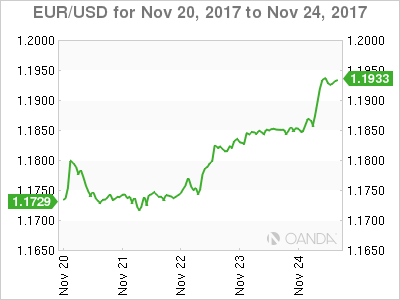
The EUR/USD gained 1.03 percent this week. The single currency is trading at 1.1909 due to positive indicators and some headway into a new coalition in German politics. The pair was flat earlier in the week but the miss in US durable goods sales (–1.2 percent). The main event in the US before the Thanksgiving holiday was the publication of the Federal Open Market Committee (FOMC) minutes from the November meeting. The market is already pricing in a rate hike in December, but further evidence of the internal debates regarding US inflation were expected. The minutes did not disappoint as there seems to be a strong contingent of Fed voting members who are concerned with weak inflation. That anxiety is not likely going to affect the coming rate hike, but will dampen the pace of rate hikes in 2018.
The Conference Board will release the US consumer confidence report on Tuesday, November 28 at 10:00 am EST. American consumers have remained optimistic about economic conditions, but sometimes that confidence has not correlated to increased spending. US preliminary quarterly GDP will be published on Wednesday, November 29 at 8:30 am EST. Economists are forecasting a 3.3 percent gain in a refinement on the first estimate. Manufacturing PMI data will be published by the Institute for Supply Management on Friday, December 1, at 10:00 EST with the disappointing advanced manufacturing PMI data from Markit on manufacturing posted earlier today, investors will be closely following the release.
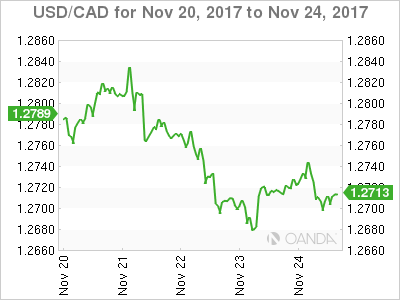
The USD/CAD lost 0.46 percent in the last five trading days. The currency pair is trading at 1.2711 as the softness of the US dollar combined with higher oil prices. Weak Canadian retail prices on Thursday were not enough to stop the loonie rally. Sales rose less than expected in September despite gas prices rising. Vehicle and clothing purchases declined validating the caution expressed by the Bank of Canada (BoC) of late. The central bank hiked twice in 2017 putting the Canadian benchmark rate at 1.00 percent, but with concerns about NAFTA, economic growth slowing down are enough to keep the BoC in the sidelines until next year.
Friday, December 1 will be a busy week for CAD traders. Statistics Canada will release the monthly GDP figures as well as the employment report both at 8:30 am EST. GDP is expected to have shrunk by 0.1 percent and there is some anxiety on the job front as the first ADP job report for Canada showed a loss of 5,700 in October.
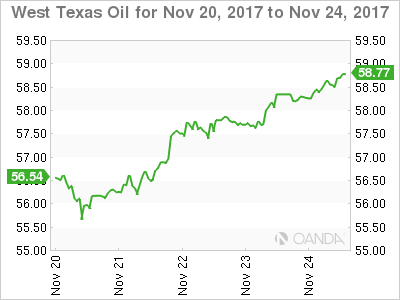
Energy prices continued to gain during the week. The price of West Texas Intermediate is trading at $58.48 after a weak dollar and Russian Energy Minister comments supporting a possible extension of the OPEC production cut agreement. Oil ministers will meet in Vienna on Thursday a year after a deal was reached to reduced crude production to stabilize prices by the Organization of the Petroleum Exporting Countries (OPEC). Russia and other major producers joined the agreement in December, and have already extended the deal until March of 2018, but the likely outcome from the meeting in Vienna is a second extension. The main topic of debate is for how long as different timelines have been discussed. Russia has taken the leadership position in a time when Saudi Arabia is opening too many fronts in the diplomatic arena.
The mercurial nature of OPEC members has already resulted in failed summits in the past, but it appears that Russia is seen as a conciliatory third party that could push through an extension.
Market events to watch this week:
Tuesday, November 28
- 2:00am GBP Bank Stress Test Results
- 10:00am USD CB Consumer Confidence
- 11:15am CAD BOC Gov Poloz Speaks
- 3:00pm NZD RBNZ Financial Stability Report
Wednesday, November 29
- All Day All OPEC Meetings
- 8:30am USD Prelim GDP q/q
- 10:30am USD Crude Oil Inventories
- 7:00pm NZD ANZ Business Confidence
- 7:30pm AUD Private Capital Expenditure q/q
Thursday, November 30
- 8:30am USD Unemployment Claims
Friday, December 1
- 4:30am GBP Manufacturing PMI
- 8:30am CAD Employment Change
- 8:30am CAD GDP m/m
- 10:00am USD ISM Manufacturing PMI
*All times EDT
EUR/USD Clears 1.1880 Resistance
- European equities trade mostly in positive territory with the German Dax outperforming (+0.75%). US stock markets opened with small gains after yesterday's close (Thanksgiving).
- Germany's Social Democrats are ready to talk to their conservative rivals about the formation of a government led by Angela Merkel in a potentially decisive move to break the political deadlock in Berlin. Martin Schulz, SDP Chairman, said that if the SPD decides to take part in government, the decision will be put to a vote of its members.
- German companies are more confident than ever as they tap into the global economic upswing. The German Ifo institute's business climate indicator climbed to 117.5 from a revised 116.8, beating economists' estimates for the gauge to remain unchanged. The increase was mainly driven by the forward-looking "expectations" component.
- UK households withdrew money from their tax-free savings accounts at the fastest rate on record in October, whereas businesses built up their cash reserves instead of investing, highlighting the impact of the Brexit-induced squeeze on living standards and business confidence.
- Ireland's minority government looked set to collapse after the party propping it up (Fianna Fail) submitted a motion of no confidence in the deputy prime minister, weeks before a summit on Britain's plans to leave the EU.
- Financial markets have understood the Bank of England's message on future interest rate policy, although the Brexit process risks throwing things off course, new BoE policymaker Tenreyro said in an interview. Two more hikes are likely needed in the next 3 years to meet the inflation goal.
Rates
Stuck in no man's land
Global core bonds are stuck in no man's land. The Bund and US Note future moved respectively in a 60-tick and a 16/32 sideways range this week. Traded volumes remained low with US trading desks thinly staffed because of Black Friday. The Bund initially lost ground today, but was already almost at the intraday low when the German Ifo printed a very strong business climate indicator. Progress in German coalition talks (SPD backtracks on previous commitment to move to opposition) positively impacted risk sentiment during European dealings. Brent crude remains upwardly oriented and close to multi-year highs, betting on significant oil production cut extension at next week's OPEC-meeting in Vienna.
At the time of writing, German yields shift around 1.5 bps higher across the curve. The US yield curve bear steepens slightly with yield changes varying between flat and +1.7 bps (30-yr). On intra-EMU bond markets, 10-yr yield spread changes versus Germany widen up to 2 bps. There's no specific Irish underperformance even if the country entered a political crisis which will most likely result in fresh elections. The main opposition party announced a no-confidence vote against deputy PM Fitzgerald. PM Varadkar, who rules a minority government, said he won't abandon his deputy.
Currencies
EUR/USD clears 1.1880 resistance
Recent trends of euro resilience and USD softness simply continued today. The euro was supported by a very strong German Ifo business confidence. Even so, USD weakness prevailed. positive risk sentiment and neutral interest rate markets were insufficient to stop the bleeding for the US currency. EUR/USD is testing the 1.19 big figure. USD/JPY struggles to remain above this week's low.
Asian markets showed a diffuse picture overnight. Most regional indices traded near opening levels. Mainland China initially underperformed, but losses were smaller than yesterday and indices reversed the losses towards the end of the session. The dollar tried a rebound after a two-day setback. USD/JPY returned to the 111.50 area, but the US currency didn't regain ground against the euro. EUR/USD held around 1.1850.
European equities opened little changed, but soon started a gradual intraday uptrend. Core yields rose slightly early in the session. A very strong German Ifo business confidence supported the moves. Interest rates differentials between the euro and the dollar basically hovered sideways. The dollar gained a few ticks against the euro and the yen at the start in Europe, but the move lacked momentum. EUR/USD turned back north, starting the test of 1.1880 resistance. USD/JPY came again under pressure despite positive equity sentiment.
Fortunes for the US currency didn't improve as US traders returned from Thanksgiving holiday. EUR/USD broke beyond 1.1880 resistance and tries to stay north of the 1.19big figure. Headlines that the SPD considers to join a German government coalition maybe added to the euro's positive momentum. USD/JPY (111.40) still trades north of yesterday's low, but the picture isn't convincing. The dollar remains under pressure ignoring signals from other markets. A return to the 1.2092 top might be on the cards if the EUR/USD break above 1.1880 is confirmed.
Sterling trading mixed as Brexit uncertainty lingers
Sterling was captured in technical, order-driven trading. EUR/GBP gained a few more ticks north of 0.89, supported by the rise of EUR/USD. Cable profited from an overall weak dollar. Bank of England member Tenreyro repeated that two more interest-rate increases will probably be needed to get inflation back to target over the policy horizon. However, Brexit can force the BoE to adapt its policy response. UK PM May arrived in Brussels for a EU summit and will meet several EU leaders including EU president Tusk. The UK wants progress in the Brexit negotiations in return for a higher UK payment for the separation bill. However, for now it is unclear whether the EU will consider the UK's concession sufficient. Amongst others, the issue of the Irish boarder remains a hard nut to crack. EUR/GBP trades near 0.8920. Cable hovers in the 1.3340 area.
Week Ahead – Manufacturing PMIs and Inflation Data to Dominate; OPEC Meeting also Eyed
After a relatively quiet week, the economic calendar is looking busier for the coming seven days. Manufacturing PMIs will be released in most major economies as the month comes to an end, and inflation measures for the Eurozone, Japan and the United States will also highlight the week. Canada will be in focus too as GDP and jobs figures are published, while the outcome of a meeting of major oil producers will be awaited by commodity traders.
Aussie capex eyed ahead of Q3 GDP
The Australian dollar is attempting to recover from 5-month lows with the help of a weaker greenback and not-so-dovish remarks by RBA Governor Philip Lowe. Data on Thursday might offer the aussie a further leg up as third quarter numbers on capital and building expenditure are released. The indicators are a prelude to third quarter GDP figures due the following week. Economic growth in Australia remains one of the best in the G7 but persistently low inflation has pushed back expectations of an RBA rate hike from 2018 to 2019. Strong economic data is therefore unlikely to significantly alter the outlook for the aussie without any signs of a pick-up in underlying inflation. Also due the same day are building approvals and private sector credit figures for October.
Canadian growth to slow in Q3
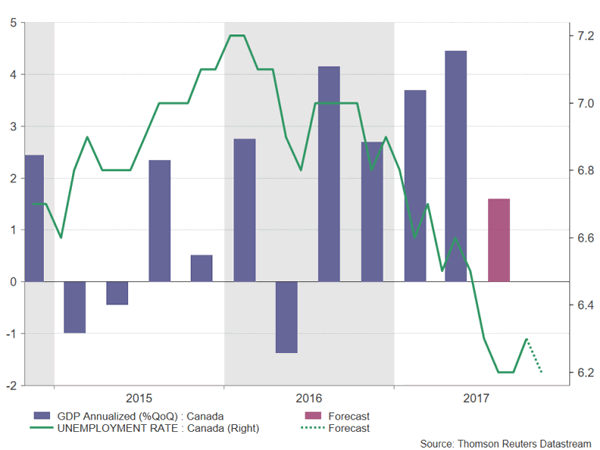
Indications of softer growth in Canada in the second half of 2017 after a strong first half have led investors to price out the possibility of a third rate hike by the Bank of Canada this year. The receding expectations contributed to the Canadian dollar retracing as much as 50% of its May to September uptrend. Any upside surprise to Friday's jobs report and GDP data could help the loonie break resistance around C$1.2660. Employment is expected to increase by 10k in November, pushing the jobless rate down to 6.2%. The economy is forecast to expand at an annualized rate of 1.6% in the third quarter, a notable easing from the prior quarter's 4.5% rate.
Another potential mover for the loonie next week is a speech by the Bank of Canada Governor Stephen Poloz on Tuesday.
Eurozone inflation to edge up
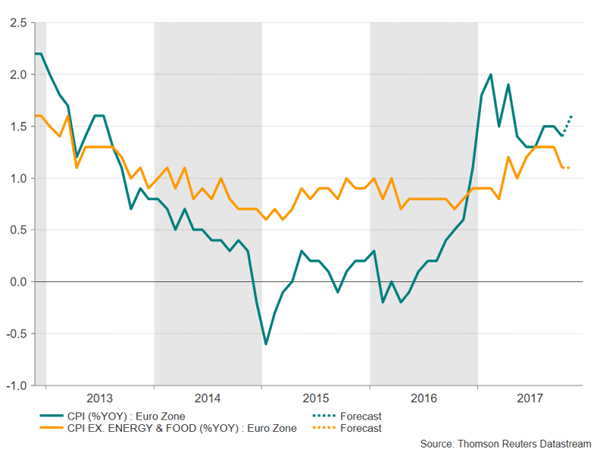
Eurozone manufacturing activity soared to a 17½-year high in November according to IHS Markit's flash estimate released this week. The final reading is due on Friday and there will be more business surveys in the form of the European Commission's economic sentiment index on Wednesday. The services sector also performed strongly, and the combined data drove the euro to a two-month high of just above $1.19 this week. However, next Thursday's flash inflation readings for November may take some of the steam off the currency as they will likely indicate that the European Central Bank still has some way to go before inflation gets onto a sustained path upwards. Flash inflation is forecast to nudge up by 0.1 percentage points to 1.6% year-on-year, but core inflation, which excludes food and energy prices is expected to hold steady at 1.1%.
Plentiful data out of Japan
It will be a busy week for Japan as a batch of key economic indicators are released. First up are October retail sales on Wednesday, followed by the preliminary industrial output reading for the same period on Thursday. Household spending and inflation data are out on Friday, along with the unemployment rate, all for October. Spending by household is forecast to suffer a month-on-month drop of 1.4% in October, while core CPI is expected to rise from 0.7% to 0.8%. In addition, the final Nikkei manufacturing PMI and third quarter capital expenditure figures will be released. The yen is unlikely to see a big reaction to the data, but with some talk of the Bank of Japan considering raising its yield target on long-term Japanese government bonds, upbeat numbers next week may fuel such speculation.
US PCE inflation in focus after Fed minutes shock
The US economic calendar gets back into full swing next week starting with new home sales on Monday and the CaseShiller 20 city house price index on Tuesday. Also on Tuesday is the Conference Board's consumer confidence index. On Wednesday, the second estimate of GDP growth for the third quarter is expected to show a small upward revision from 3% to 3.2%. The main focus though will be Thursday's personal consumption expenditures (PCE) report.
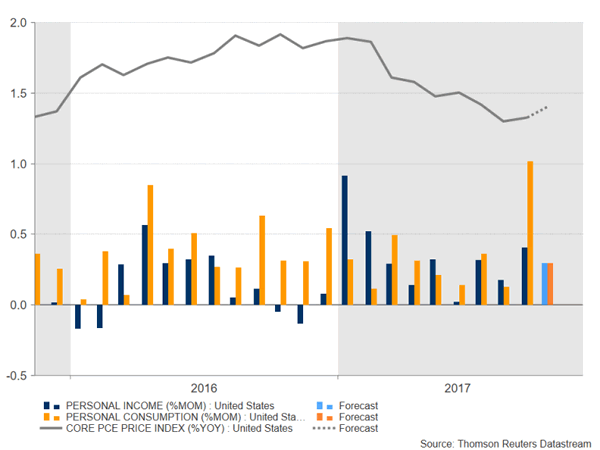
Personal spending and income are forecast to ease slightly month-on-month in October after a strong September. More important will be the Fed's preferred inflation gauge, the core PCE price index, as a further fall in this measure would give the FOMC doves a stronger case to freeze rates over the coming months. The FOMC minutes of the Oct. 31-Nov. 1 policy meeting published this week showed policymakers were becoming increasingly uncertain about the prospect of inflation rising to 2%. The dovish minutes led to a fresh sell-off in the US dollar, particularly against the yen. Weak readings next week could add further downside pressure on the currency. The core PCE price index is expected to tick up by 0.1 percentage points to 1.4% m/m in October.
There will be more data on Thursday, including the Chicago PMI and pending home sales, and on Friday, all eyes will be on the ISM manufacturing PMI. The ISM manufacturing PMI is forecast to ease slightly from 58.7 to 58.5 in November.
OPEC meets to discuss extension to output deal
In other noteworthy data next week, the UK and China will also see the release of PMI surveys. The UK manufacturing PMI is out on Friday, while in China, the government's non-manufacturing and manufacturing PMIs are due on Thursday ahead of the Caixin manufacturing PMI on Friday.
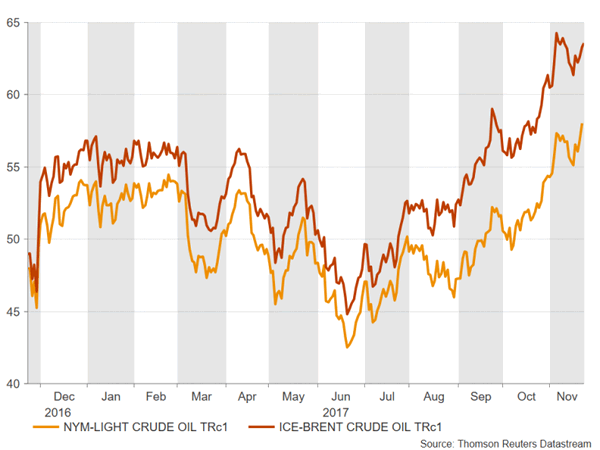
Finally, OPEC members meet in Vienna on November 30 along with some non-OPEC producers, including Russia, to decide whether to extend the current output cap agreement. There have been strong indications in recent weeks, particularly from Saudi officials, that a 9-month extension after March 2018 is highly probable, although, Russia appears less committed. Failure to reach a deal could drag oil prices below their recent two-year highs, but given that March 2018 is still some time away, expectations of an agreement before then would likely limit any losses.
USD/JPY Down Due to a Flattening Yield Curve
Strength can be seen in the Yen, as strong PMI Manufacturing data in Japan may suggest a strengthening in their large Export sector. Yield curves have flattened on US Treasuries, causing some allocation of funds out of US Treasuries and perhaps into other asset classes, that may be outside of USA and thus, some selling of USD's and into foreign asset markets.
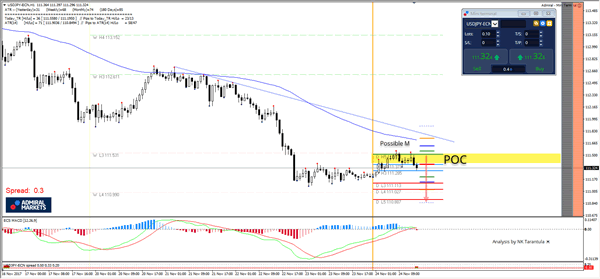
As I already showed yesterday on the USD/JPY, the price went up hitting my target (see the live entry I made on the webinar) and at this point it is rejecting fro the POC that is strong due to W L3 and D H5 resistance. 111-35-50 is the zone and as long as 111.80 holds the target is 110.85. Watch for possible M pattern that might signify the continuation.
- H3 - Weekly Camarilla Pivot (Weekly Interim Resistance)
- W H4 - Weekly Camarilla Pivot (Strong Weekly Resistance)
- D H4 - Daily Camarilla Pivot (Very Strong Daily Resistance)
- D L3 - Daily Camarilla Pivot (Daily Support)
- D L4 - Daily H4 Camarilla (Very Strong Daily Support)
- PPR - Progressive Polynomial Channel
- POC - Point Of Confluence (The zone where we expect price to react aka entry zone)
Weekly Focus: Inflation Data Takes the Center Stage
Market movers ahead
- In the US we expect PCE inflation to moderate to 1.5% y/y in October in line with CPI numbers, due to negative contributions from the energy component.
- We forecast a rebound in euro area HICP inflation in November to 1.6% y/y, driven by a recovery in core inflation and higher energy prices.
- In the UK, PMI manufacturing for November is due, which we expect to increase in line with higher euro area PMIs.
- October inflation figures released in Japan will likely show that underlying price pressures remain muted.
- In Scandinavia Q3 GDP data are in focus for Denmark and Sweden.
Global macro and market themes
- Fed increasingly worried over lack of inflation; US curve flattening continues.
- The ECB could decouple the QE decision from the inflation outlook; EUR/USD upside risks remain in 2018.
- Riksbank worries over Swedish housing risks set to keep SEK weak but rates have yet to adjust.
Australia & New Zealand Weekly: RBA Governor Relaxed With Modest Increase in Household Leverage
Week beginning 27 November 2017
- RBA Governor relaxed with modest increase in household leverage.
- Australia: private capex, dwelling approvals, CoreLogic home prices, private credit.
- NZ: RBNZ Financial Stability Report, building consents, bus. confidence, terms of trade.
- China: Official and Caixin PMIs.
- Euro Area: Unemployment, CPI.
- US: Yellen testimony to Congress, beige book, GDP 2nd est, PCE deflator, Senate
- Banking Committee to confirm new Fed chair.
- Key economic & financial forecasts.
Information contained in this report was current as at 24 November 2017.
RBA Governor Relaxed With Modest Increase in Household Leverage
The RBA released the minutes of the Monetary Policy Meeting of the Reserve Bank Board for November and this was followed by Governor Lowe's speech at the ABE annual dinner.
There were no major surprises in the minutes but the general tone seems somewhat more subdued than we have seen in recent reports. Further to that, the Q&A session following Governor Lowe's speech later that day provided further insight into the RBA's views on household leverage.
The minutes show the Board sticking with its expectation that inflation will increase but "only gradually". This is consistent with the revised forecasts in the Statement on Monetary Policy for underlying inflation. In August, the Bank forecast underlying inflation at 2.0% in 2018 and 2.5% in 2019 (mid-points of the range). This has now been revised to 1.75% in 2018 and 2.0% in 2019.
The downward revision in the level of inflation is attributed to the reweighting of the CPI by the Australian Bureau of Statistics. That explains the move from 2.0% (mid-point) to 1.75% in 2018. However, that downward revision does not explain the decision to reduce the 2019 forecast from 2-3% (2.5% mid-point) to 2.0% - a further 0.25ppt adjustment is not justified by the movement to annual revisions. This is likely to indicate the expectation that the pick-up in inflation will be slower than previously anticipated.
There is clear concern about weak wages growth, "various measures of growth in wages had not yet picked up and had been lower in preceding quarters than forecast a year earlier". Some recognition that part of this explanation might be structural is given, "the possibility that globalisation and technology were leading wage growth to be less responsive to changes in the demand for labour". This was noted as a global theme and may partly explain the decision to slow down the expected pace of pick-up in inflation.
Commentary around the consumer is downbeat. Retail sales have been weak and consumer spending in the September quarter is expected to be lower than in June - the outlook depends upon household income growth which is described as "uncertain". Of genuine concern is the risk that households could make sustained changes to their consumption and savings decisions if they expect low income growth to persist.
The Bank continues to recognise strong employment growth. However there is a high degree of uncertainty around associated wage pressures and resulting inflation. If pressure on margins from strong competition persists, and combines with faster productivity growth, there could be a delay in the pass through to inflationary pressures.
The Board noted that "expectations of future cash rate movements implied by financial market prices had been scaled back indicating that the cash rate was expected to remain unchanged over the following year or so". In fact, our assessment of market pricing still points to around a 70% chance of a rate hike by the end of next year. This interesting observation from the Board may indeed be revealing their own current preferences. Certainly the mood of these minutes is consistent with an expectation of no change in rates.
The minutes continue to emphasise the need to manage risks associated with high and rising household debt. Market participants that continue to expect a rate hike next year are probably relying on that concern. Certainly the inflation environment, as assessed by the Bank itself, does not support the case for higher rates.
The Board recognises that housing credit growth has eased a little but remains faster than household income growth. Prospects for this issue creating concern for the Board are encouraging - "conditions in the established housing market had eased in all major cities". These conditions are of course a lead indicator for credit growth and associated rising household leverage.
If household leverage is increasing modestly not because credit growth is lifting but because of subdued income growth, then authorities are likely to be comfortable with rising debt. Concerns around rising household debt should really be relevant only when credit growth itself is accelerating.
Delivered a few hours after the release of the minutes, Governor Lowe's address to the Australian Business Economists touched on many of the topics outlined in the minutes and the November Statement on Monetary Policy, released earlier in the month.
During the Q&A, I was very interested in gauging the Governor's views on household leverage. The minutes do refer to rising household debt, but the issue is more about leverage.
Over the course of 2018, we expect that household credit growth will slow from 6% to 4.5%. That will be due to a further easing in housing market demand and even tighter lending policies from the banks. In fact, it is reasonable to expect that overall house prices are likely to flat line in the major cities.
With housing credit slowing and income growth possibly lifting from the muted 2.0% of 2017 to 3-4% in 2018, household leverage will rise further. But that will be in an unusual circumstance where income growth remains weak and credit growth, while stronger than income growth, is slowing.
My question to the Governor was how he viewed rising leverage under the circumstances set out above. It is my view that slowing credit growth should not be seen as consistent with a destabilisation of household balance sheets since there is no evidence of credit excess.
I put my point to the Governor and his response was clear. He accepted that household credit growth at around 6% (not even meeting the slowdown which I expect) was quite okay, implying that even if leverage was rising due to tepid income growth, financial stability was not being threatened. This is a very important observation since, while the RBA consistently denies an interest in house prices, there is a very clear interest in credit growth. If that is slowing, probably due to a consolidation in house prices, then there is a degree of comfort in official circles despite possible rising leverage.
From our perspective, given the inflation environment and our views on economic growth, the only possible scenario that would lead to a rate hike would be some concern around rising leverage. This concern would only be relevant if there was a marked increase in credit growth. That prospect seems highly remote and for us eliminates the only obvious upside risk to rates in 2018.
Westpac continues to expect that the RBA cash rate will remain on hold over the course of 2018 and 2019.
The Week that Was
In a week that was cut short by Thanksgiving in the US, policy makers again took centre stage. On the whole, their tone was cautious.
For Australia, there was an increased focus on the minutes of the November RBA board meeting following the downward revision to their inflation forecasts in the November Statement on Monetary Policy. Consistent with these revised forecasts (underlying inflation of 1.75%yr at end-2018 and 2.0%yr at end-2019), the minutes cited an expectation that inflation will pick up "only gradually".
While these revisions have been attributed to the ABS' CPI re-weighting, to our mind the 0.5ppt revision to the 2019 forecast is too large to solely be due to this factor. Disappointing wages growth and the consequence for consumer spending (more below) as well as more modest expectations for wages and inflation are clearly at play.
Following the release of the November minutes, Governor Lowe delivered a speech to the Australian Business Economists' Annual Dinner. In it he again highlighted the weakness in wages (growth in average hourly earnings "running at the lowest rate since at least the 1960s") and paid close attention to the consequences for consumption: annual growth of near 2.5%yr against the RBA's perennial expectation that it would accelerate to 3.5%yr. While they have now lowered their forecast peak in consumption growth to 3.0%yr, this is arguably still too high. We in contrast believe consumption growth is set to remain around 2.5%yr, which will deliver GDP growth near that figure over the forecast horizon.
A risk to our forecast that the cash rate will remain on hold through both 2018 and 2019 has been household credit growth's material outpacing of income growth - resulting in a significant increase in household leverage. While the RBA and APRA remain vigilant, Governor Lowe and the RBA Board have taken confidence in macro-prudential policy's power as both house price growth and credit growth have slowed. For a full discussion of this topic, see Bill's weekly essay on the previous page.
Taking a step back from the immediate, the release of the latest state accounts for the 2016/17 financial year offers a great deal of detail on sectoral and industry performance across the states. At the top level, in 2016/17 broad based gains across industry as well as in infrastructure investment by the public sector saw Victoria and NSW outperform, with growth of 2.9% and 3.3%. Of the mining states, Qld saw moderate growth, +1.8%yr, while in WA activity continued to contract as the mining investment downturn reached its nadir.
For those with an interest in the New Zealand economy, this week also saw the release of our New Zealand team's quarterly outlook. The election of the new government in New Zealand has resulted in a softer growth forecast for 2018, but upward revisions to 2019 and 2020. On the RBNZ, our New Zealand team anticipates that current market expectations will be disappointed as the RBNZ remains on hold until late-2019.
Finally, turning to the US, the FOMC clearly sought to cement market expectations of a rate hike in December in their October/November meeting minutes. The economy was seen as continuing to enjoy above-trend growth thanks to robust gains for household consumption. Built on income gains as well as strong confidence, this trend is expected to persist. Inevitably though, an economy cannot be built on consumption alone. Investment is necessary, and this is an area of the growth outlook where we harbour doubts. Should, as we expect, investment growth remain tepid, then productivity and income growth will be held back. This is a key reason why we believe that this rate hike cycle is likely to top out around 1.875%, after the December decision and two further hikes in 2018.
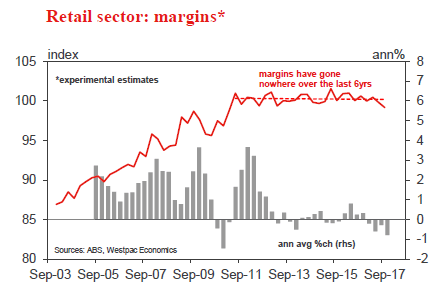
Chart of the week: Amazon soon to launch in Australia
Looking to the very near future is the long-awaited launch of Amazon Australia. The consequences for our economy will be varied and take time to play out. But briefly, based on offshore experience, expect further disinflationary pressures and margin compression for retailers, and a shift in the investment plans of retailers away from 'bricks and mortar' toward their online presence.
While Amazon's launch may spur consumption in the near-term, the overall impact on the volume of sales in the medium to long-term is likely to be marginal. On this point, it is important to recognise the power that sentiment and expectations around family finances have on spending. Until we see a lift in wages growth, consumers' capacity to spend is likely to remain restricted.
New Zealand: Week Ahead & Data Wrap
Growth slowdown under way
Our latest quarterly Economic Overview, released this week, traces the contours of growth that we expect for the New Zealand economy over the coming years. We've revised down our GDP forecast for 2018, but upgraded our forecasts for 2019 and 2020. These changes reflect the impact of the new Government's policies, but also the tone of the recent data.
Market opinion generally seems to be that the new Government's policies will boost GDP, inflation and the OCR. We agree with that, but only up to a point. Increased government spending will certainly boost activity, but the crowding-out of private activity must also be considered. Meanwhile, the Government's plans to cool the housing market and reduce net migration will weigh on the economy next year. Our view remains that the Reserve Bank will not need to raise interest rates until late 2019.
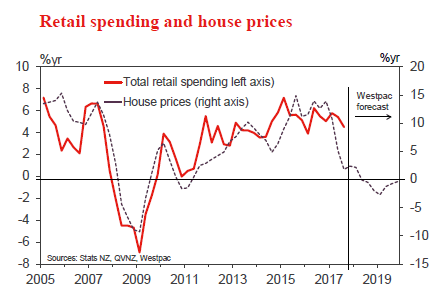
This week's data releases highlighted some of the conditions we see for a slowdown in growth in the near term. Retail spending eked out a modest gain of just 0.2% in the September quarter, after a 1.8% rise in the June quarter. This was partly a comedown from major sporting events such as the Lions rugby tour in the June quarter, reflected in particular in a sharp drop in accommodation and hospitality spending in September. But there has also been a more widespread slowdown in spending growth compared to recent years, especially in housing-related categories such as furniture and hardware.
In New Zealand, consumer spending growth tends to be closely correlated with the strength of the housing market. The latest slowdown in retail spending suggests that the relationship is alive and well. House sales are down by about a third from last year's peak, and the double-digit house price growth we saw in previous years has given way to a period of quite subdued gains.
We think that the recent housing slowdown will persist for some time. To be fair, nationwide house prices have perked up in the last few months, and we wouldn't be surprised to see a further rise in the near term - there have been some reductions in fixedterm mortgage rates, and there could be a short-lived rush to get into the housing market ahead of the new Government's restrictions on non-resident buyers. But we think that other policy changes, such as the planned extension of the 'bright line' test for taxing capital gains on investment properties, will push house prices lower again over 2018 and beyond. If we're right, that implies a significantly slower pace of spending growth than retailers have been used to over recent years.
Another factor that will dampen spending growth in coming years is a slowdown in migration-led population growth. While net migration in the month of October was a little higher than we expected, the details support our view that the balance has passed its peak.
Departures of non-New Zealand citizens have been steadily rising since mid-2016 and are now 30% higher than this time last year. This group includes people who would have come over in recent years on temporary work and student visas. Typically those who come over on these programs stay for around three to four years. Given that the surge in foreign arrivals began in 2013, we've been expecting to see a corresponding surge in departures. This trend looks likely to continue for some time yet, and will drive a substantial downturn in total net migration over the coming year.
We expect annual net migration to slow from around 70,000 people now to a low of 10,000 people by 2021. Most of the expected change is due to natural forces that drive net migration (such as the strength of the global economy), and has been a feature of our forecasts for some time. However, the new Government's proposed changes to visa requirements for students and low-skilled workers has given us reason to revise our forecast even lower.
The slowdown in net migration will have a number of significant impacts on the economy. Most notably, it will result in population growth slowing from 2.1% currently to 0.8% - a huge reduction in the rate of potential GDP growth and a key reason that we expect lower GDP growth over time.
The other notable development this week was a further fall in dairy prices at the latest GlobalDairyTrade auction. The decline in dairy product prices since the middle of this year, despite cuts to milk production forecasts in that time, suggests that the weakness lies on the demand side of the equation.
We noted in our latest Economic Overview that while global growth as a whole is improving, the mix of growth is not quite as favourable for New Zealand's exporters. China - the dominant market for many of our agricultural exports - is starting to slow, as it looks to reorient away from the credit-fuelled investment that has driven growth in recent years.
The outlook for dairy isn't gloomy by any means - we expect a farmgate milk price of $6.20/kg for this season, which is close to the average of the last decade. But it's likely to leave farmers cautious about new spending and more focused on debt reduction, after two very poor seasons in 2015 and 2016 that put a severe strain on dairy farm balance sheets.
Data Previews
Aus Oct dwelling approvals
Nov 30, Last: 1.5%, WBC f/c: -1.5%
Mkt f/c: -1.0%, Range: -4.0% to 2.0%
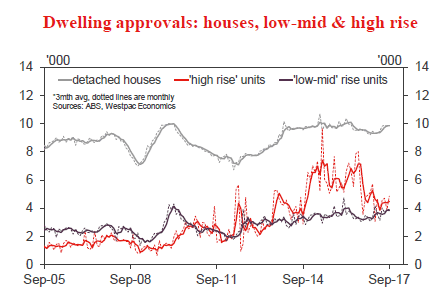
- Sep dwelling approvals came in above expectations with total approvals up 1.5% and the detail showing a surprise 20% jump in high rise and a modest gain for non high rise approvals.
- Both high rise and non high rise segments are still pointing to likely slowdowns in the months ahead. Site purchases point to a further wind down in high rise projects. Meanwhile construction-related housing finance approvals - a reasonable proxy for non high rise approvals - pulled back sharply through Aug-Sep. Of course, linking these indicators to month to month moves in approvals is difficult, particularly for high rise activity. On balance we expect approvals to retrace 1.5% but the high rise jump in Sep could see a sharper pull back depending on the 'lumpy' projects in this segment.
Aus Q3 business capex
Nov 30, Last: 0.8%, WBC f/c: -0.3%
Mkt f/c: 1.0%, Range: -5.5% to 3.0%
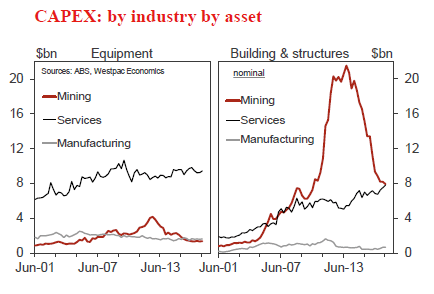
- Business spending on capex increased by 0.8% in the June quarter, to be 3% below the level of a year ago. Weakness is centred in mining, -15%yr, with a partial offset from services, +3.7%yr.
- Equipment spending rebounded in the June quarter, +2.7%, led by services, to be flat over the year.
- There is an emerging stabilisation in building & structures with the mining investment wind-down almost complete. The Q2 outcome was -0.6%qtr, -5%yr.
- For Q3, we anticipate a 0.3% decline in capex spend, including: a rise in equipment (+0.8%), led by services; and only a relatively small decline in building & structures, -1.2%.
Aus 2017/18 capex plans, AUDbn
Nov 30, Last (Est 3): 101.8
Mkt f/c: 105.4, Range: 103.0 to 110.0
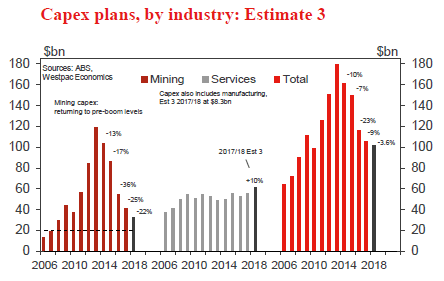
- Capex spend will inevitably decline in 2017/18, with the final stages of the mining investment wind-down the key force.
- Recall that Est 3 for 2017/18 is $101.8bn, which is 3.6% below Est 3 a year ago, a decline of $3.8bn. That was an improvement on -6.4% for Est 2.
- Est 3 by industry is: mining -22%, -$9.2bn; services +10% (upgraded from +6%); and manufacturing -2.6%.
- Est 4 of 2017/18 capex plans is likely to paint a broadly similar picture: mining lower and services advancing, led by a rise in non-residential building work as indicated by the lift in approvals (notably for offices, particularly in Victoria).
- An Est 4 of around $104n would be 3% below Est 4 a year ago, broadly equivalent to the -3.6% for Est 3 on Est 3. It would represent a near 3% upgrade on Est 3, matching the average for the previous four years.
Aus Oct private credit
Nov 30, Last: 0.3%, WBC f/c: 0.4%
Mkt f/c: 0.4%, Range: 0.2% to 0.6%
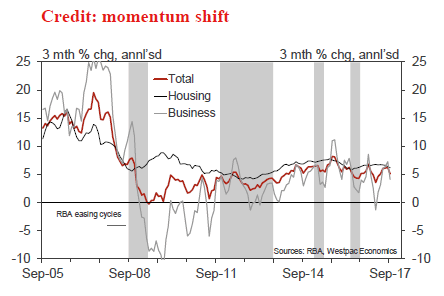
- Credit to the private sector grew by a more modest 0.3% in September, down from a 0.45% average over Q2 and Q3. Over the past year, credit expanded by 5.4%.
- The September outcome was largely driven by a softer month for business (a +0.1% down from the recent average of 0.4%). Notably, commercial finance has pulled back, partially reversing earlier gains. Over the past year, business credit rose by 4.3% as business investment expands.
- For October, we anticipate a 0.4% rise in credit, constrained by another relatively soft update for business.
- Housing credit is slowing gradually, a trend that is likely to continue at this late stage of the cycle as the sector responds to tighter lending conditions. In September, housing credit grew by 0.48%, 6.6%yr, with the 3 month annualised pace at 6.2%, down from a peak of 6.8% in May.
Aus Nov CoreLogic home value index
Dec 1, Last: flat, WBC f/c: -0.1%
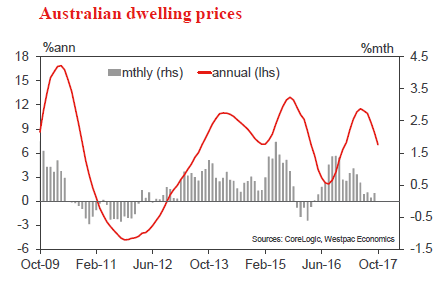
- The CoreLogic home value index held flat in Oct taking annual growth to 7%yr, an abrupt slowdown from the 11.4%yr peak in May. Policy measures continue to have a material impact. Although official rates remain near historic lows, regulators introduced a new round of 'macro prudential' tightening measures in late March. Meanwhile a range of other changes have also seen a progressive tightening of conditions facing foreign buyers.
- The daily measure points to another weak month in Nov with prices nationally looking to have dipped -0.1%. That would drag annual price growth down to around 5.5%yr, the slowest pace since this time last year.
NZ RBNZ Financial Stability Report
Nov 29
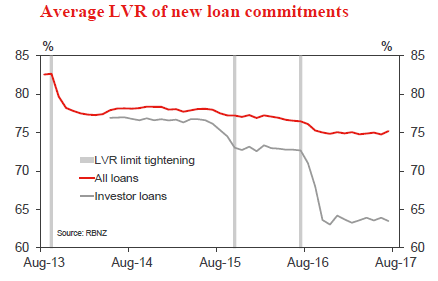
- The RBNZ's six-monthly review of the state of the financial system is likely to be relatively sanguine. Banks are well capitalised, loan impairments remain low, and mortgage lending growth has slowed.
- The RBNZ has said it is reviewing the criteria for easing the loan-to-value ratio restrictions on mortgage lending. We think the key hurdle is whether easing the LVR restrictions would lead to a resurgence in housing market pressures. For now the RBNZ has taken a cautious view as to whether the new Government's policies will suppress house prices, but on our forecasts there should be sufficient evidence of this by mid-2018.
NZ Oct residential building consents
Nov 30, Last: -2.3%, WBC f/c: -2.0%
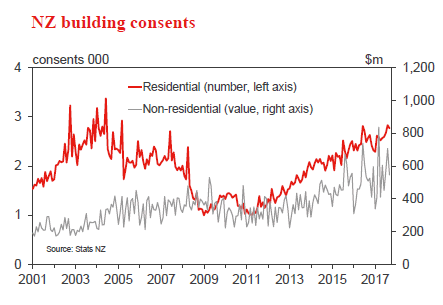
- Consent issuance softened in September, but remained at a firm level. Much of the recent strength in consents relates to the apartments/multiple category. Issuance in this category can be lumpy on a month-to-month basis. And following a large rise in recent months, we expect a moderation in this group will pull total consent issuance down 2% in October.
- Issuance in Auckland will warrant close attention. If the pickup we saw in recent months is sustained, Auckland would finally start eating into its significant shortage of housing.
- While a large amount of work is being consented, there are questions about capacity in the construction sector. We expect that the level of building activity will remain elevated for some time, but future increases may be gradual.
NZ Nov business confidence
Nov 30, Last: -10.1
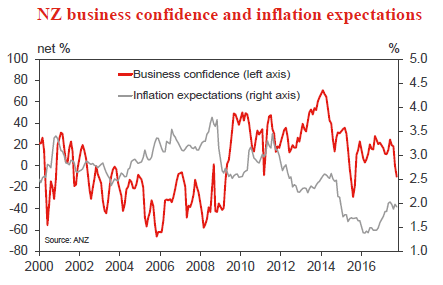
- Business confidence has been dropping since August, falling into negative territory in October. A key reason for this was uncertainty ahead of September's general election. New Zealand business confidence is expected to decline further in November reflecting nervousness around the policy environment following the formation of the Labour-led government.
- On the activity front, we anticipate that capacity constraints will continue to hinder activity in a range of sectors, particularly construction. In addition, tightness in credit conditions, difficulties accessing skilled labour and slowing economic growth will continue to weigh on businesses' expectations for activity over the coming months. Putting this together, we expect businesses' investment intentions will soften going into 2018 as businesses adjust to the new policy environment.
- Inflation expectations are expected to remain close to the RBNZ's target midpoint.
NZ Q3 terms of trade
Dec 1, Last: 1.5%, WBC f/c 1.5%
Mkt f/c: 1.3%, Range: 0.0% to 3.7%
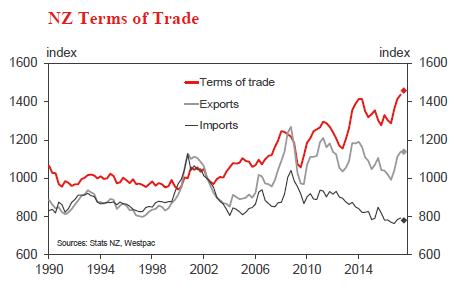
- New Zealand's terms of trade rose 1.5% in the June quarter, falling just shy of setting a new 66-year high. We expect it to reach that milestone in the September quarter.
- We estimate that export prices were flat overall for the quarter. Dairy prices were unchanged after a strong surge in the previous few quarters. Meat and log prices were up slightly, while the stronger currency suggests lower prices for manufactured goods exports.
- We expect a 1.5% fall in import prices, largely due to a 6% fall in petroleum products.
Canadian Dollar Inches Higher, Investors Search for Cues
The Canadian dollar has ticked lower in the Friday session. Currently, USD/CAD is trading at 1.2715, up 0.05% on the day. On the release front, there are no major indicators. Canada releases Corporate Profits, and the US will publish manufacturing and services PMIs.
Janet Yellen is winding up her term as head of the Federal Reserve, with Jerome Powell taking over in February. Yellen has consistently said that she expects inflation levels to pick up, but earlier in the week she admitted that she is "very uncertain" about this, adding that she and other Fed policymakers are not sure if low inflation is transitory. Wage growth has also been lackluster, despite the labor market being a full capacity. Despite the lack of inflation, investors expect a rate hike in December, and up to three rate hikes in 2018. The markets have priced in a December hike at 91%, and the odds of a January raise are at 89%.
Although few would argue that the NAFTA trade agreement has benefited the economies of the US, Canada and Mexico, the agreement could be in trouble. A fifth round of talks over NAFTA failed to lead to significant progress, prompting the US to send an ominous warning to Canada and Mexico. The US wants to raise the North American content of vehicles from 62.5% to 85% and require that 50% of content come from the US. As well, the US wants to put restrictions on Canadian and Mexican agriculture. Unsurprisingly, Mexico and Canada have rejected these proposals. Negotiators are hoping to wrap up a new deal by March 2018, but the US chief negotiator warned that "absent rebalancing, we will not reach a satisfactory result". The uncertainty over NAFTA could weaken confidence in the Canadian economy, and may lead the Bank of Canada to delay rate hikes while the negotiations continue.