

Sample Category Title
GBP/USD Elliott Wave Analysis
GBP/USD – 1.3173
Although cable met resistance at 1.3230 and retreated, as sterling found support at 1.3062 earlier this week and has rebounded, suggesting further consolidation above recent support at 1.3027 would take place and mild upside bias remains for another bounce to said resistance, break there would extend gain to 1.3290-00 but reckon resistance at 1.3338 would cap upside, bring further choppy trading. Only a break of 1.3338 would retain bullishness and signal the fall from 1.3658 top has ended at 1.3027 and bring a stronger subsequent bounce to 1.3400 and possibly towards resistance at 1.3455. Having said that, if our view that top has been formed at 1.3658 is correct, upside would be limited to 1.3500-10 and bring another decline later.
Our preferred count on the daily chart is that cable's rebound from 1.3500 (wave (A) trough) is unfolding as a wave (B) with A ended at 1.7043, followed by triangle wave B and wave C as well as wave (B) has possibly ended at 1.7192, below support at 1.4232 would add credence to this count, then further fall to 1.4000 level would follow but reckon downside would be limited to 1.3655 support and price should stay above previous support at 1.3500.
On the downside, expect pullback to be limited to 1.3090-00 and support at 1.3062 should hold, bring another rebound later. Only a drop below indicated strong support area at 1.3027-39 would revive bearishness and confirm the fall from 1.3658 top has resumed for weakness to 1.3000, then towards 1.2950 but support at 1.2909 should limit downside and another previous support at 1.2852 would remain intact.
Recommendation: Buy at 1.3090 for 1.3290 with stop below 1.2990.
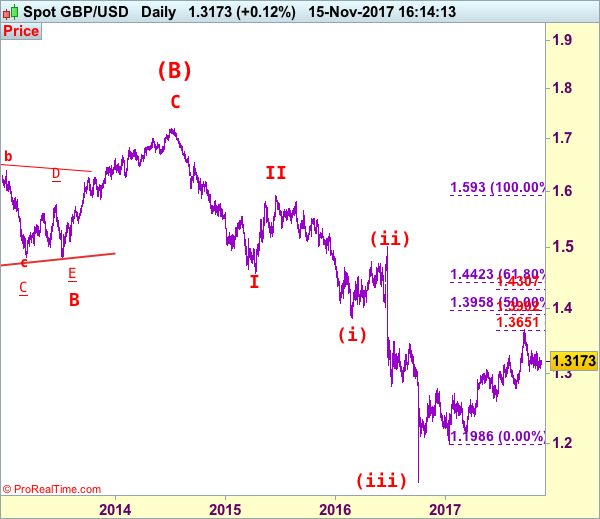
Longer term - Cable's rise from 1.0520 (Feb 1985) to 2.0100 (September 1992) is seen as [A], the decline to 1.3682 is labeled as (B) and (C) wave rally has ended at 2.1162 (9 Nov, 2007) which is also the top of larger degree wave B with circle. The selloff from there is a 5-waver with wave (A) ended at 1.3500 (23 Jan 2009), wave (B) itself is labeled as A: 1.6733, triangle wave B: 1.4813 and wave C as well as top of wave (B) ended at 1.7192 (2014), hence the selloff from there is an impulsive wave (C) with wave I : 1.4566, wave II 1.5930, an extended wave III is unfolding and already exceeded our downside target at 1.3500 and 1.3000, hence weakness to 1.2500 and possibly 1.2000 cannot be ruled out, however, price should stay well above psychological level at 1.0000.

Can Cable Continue To Hold 1.3040-1.3000?
Key Highlights
- The British Pound is holding an important support area near 1.3040 against the US Dollar.
- There is a major bearish trend line with resistance at 1.3160 on the 4-hours chart of GBP/USD.
- The UK CPI in Oct 2017 increased 3%, less than the forecast of +3.1% (YoY).
- Today in the UK, the Claimant Count Change for Oct 2017 will be released which is forecasted to register a change of 2.3K.
GBPUSD Technical Analysis
The British Pound seems to be struggling near 1.3160 against the US Dollar. The GBP/USD pair needs to stay above 1.3040 to avoid any further declines.
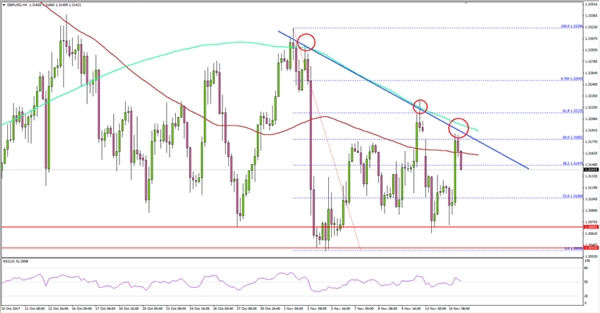
Recently, the pair corrected from the 1.3039 low and moved above the 50% Fib retracement level of the last decline from the 1.3320 high to 1.3039 low. However, the upside move was protected by 1.3200 and the 200 simple moving average (green, 4-hour).
There is also a major bearish trend line with resistance at 1.3160 on the 4-hours chart. Buyers need to push the pair above 1.3160 and 1.3200 to avoid a crucial downside break.
The important support is at 1.3040, which must hold. Otherwise, a break of 1.3040 would open the doors for a push below 1.3000.
UK Consumer Price Index (CPI)
Recently in the UK, the Consumer Price Index report for Oct 2017 was released by the National Statistics. The forecast was aligned for an increase of 3.1% in the CPI compared with the same month a year ago.
However, the actual result was a bit on the lower side as the CPI increased 3%, unchanged from September 2017. In terms of the monthly change, there was an increase of 0.1%, less than the forecast of +0.3%. It was also less than the last increase of 0.3%.
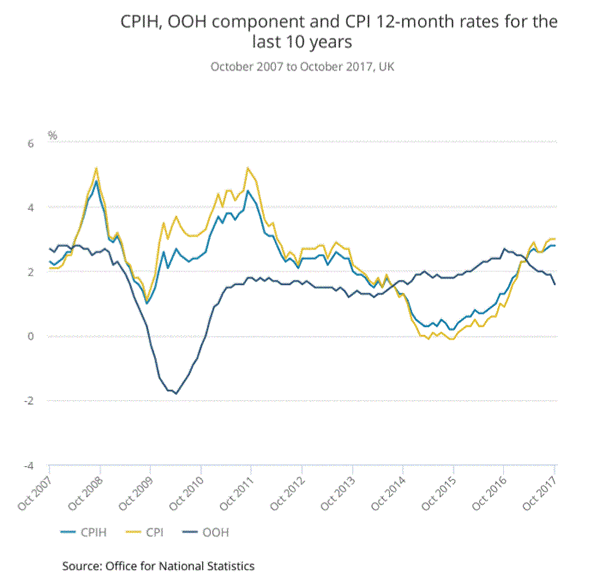
The report added:
Rising prices for food and, to a lesser extent, recreational goods provided the largest upward contributions to change in the rate between September 2017 and October 2017.
Overall, the GBP/USD is under pressure and finding it hard to move above 1.3160-1.3200. Today's employment figures might ignite the next move either above 1.3200 or below 1.3040.
Economic Releases to Watch Today
UK Claimant Count Change Oct 2017 – Forecast 2.3K, versus 1.7K previous.
UK ILO Unemployment Rate Sep 2017 (3M) – Forecast 4.3%, versus 4.3% previous.
UK Average Earnings Including Bonus Sep 2017 (3Mo/Year) – Forecast +2.1%, versus +2.2% previous.
UK Average Earnings Excluding Bonus Sep 2017 (3Mo/Year) – Forecast +2.2%, versus +2.1% previous.
US Consumer Price Index Oct 2017 (MoM) – Forecast +0.1%, versus +0.5% previous.
US Consumer Price Index Oct 2017 (YoY) – Forecast +2.0%, versus +2.2% previous.
US Consumer Price Index Ex Food & Energy Oct 2017 (YoY) – Forecast +1.7%, versus +1.7% previous.
US Retail Sales Oct 2017 (MoM) – Forecast +0.1%, versus +1.6% previous.
Trade Idea: EUR/JPY – Buy at 132.95
EUR/JPY - 133.47
New strategy :
Buy at 132.95, Target: 134.95, Stop: 132.35
Position: -
Target: -
Stop:-
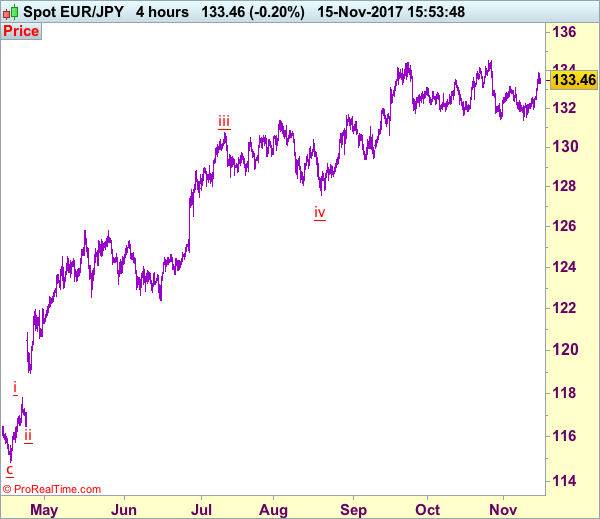
Although the single currency has retreated after rising to 133.89 and consolidation below this level would be seen, reckon downside would be limited to 132.95-00 and bring another rise later, above said resistance at 133.89 would extend the rise from 131.40 low towards previous resistance at 134.50, however, break there is needed to retain bullishness and extend recent upmove towards 135.00, then 135.50 but upside would be limited to 136.00-10.
In view of this, we are looking to buy euro on pullback as 132.95-00 should limit downside and bring another rise later. Only below previous resistance at 132.60 would abort and suggest top is formed instead, bring weakness to 132.20-25 but support at 131.93 should limit downside, price should stay well above said support at 131.40.
Our latest preferred count is that wave (ii) is ABC-X-ABC which ended at 123.33 and wave (iii) is unfolding with wave iii ended at 100.77, followed by wave iv at 111.57 and wave v as well as the wave (iii) has ended at 97.04, followed by wave (iv) at 111.43 and wave (v) has ended at 94.12 which is also the end of the larger degree v, this also implied the major wave (C) has also ended there, hence major correction has commenced from there with (A) leg unfolding in its lower degree wave c which has possibly ended at 145.69. Under this count, A-B-C wave (B) has commenced with A leg ended at 136.23, wave B at 143.79 and wave C has possibly ended at 149.79.
Our larger degree count is that the decline from 139.26 is wave (C) and is sub-divided into a diagonal triangle i-ii-iii-iv-v with wave i - 105.44, wave ii- 123.33, wave iii - 97.03, wave iv - 111.43, followed by the final wave v as well as the end of wave (C) at 94.12, this also mark the bottom of larger degree wave B. Under this count, major rise in wave C has commenced as an impulsive wave with minor wave III ended at 145.69, wave V is still in progress for further gain to 150.00. Having said that, this so-called wave V could well be the first leg of larger degree 5-waver wave C and this wave C should bring at least a retest of wave A top at 169.97 (July 2008).
XAUUSD Intraday Analysis
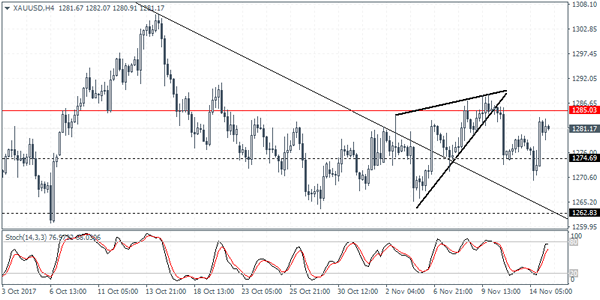
XAUUSD (1281.17): Gold prices posted a bounce back after price briefly slipped below the support level at 1274.70. The strong gains in gold prices saw price rising just close to the main resistance level of 1285 level. A breakout above 1285.00 is requiredin order for gold to continue posting further gains. However, weakening momentum could keep gold prices hovering near the resistance and the support levels. The sideways range below 1285.00 could be seen nearing completion on a potential upside breakout in price. The next main target for gold will come in at 1320.00 upon a successful breakout.
USDJPY Intraday Analysis
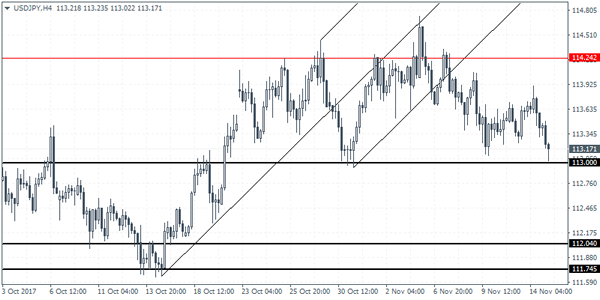
USDJPY (113.17): The USDJPY was seen closing on a bearish note yesterday. Price action is weaker in the early Asian trading session as price approaches the short term support level at 113.00. The initial decline to this level was met with a strong pullback. However, we expect a firmer test of support at this level. A break down below 113.00 could send the USDJPY lower towards the next main support level at 112.04. In the near term, the range at the current levels could be seen continuing, but this could change in the event of a break down below 113.00.
EURUSD Intraday Analysis
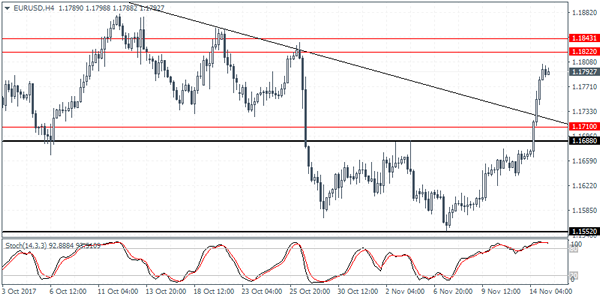
EURUSD (1.1792): The euro posted strong gains yesterday, rising over 1% on the day. The gains came as the single currency was seen steadily rising over the past few sessions. Yesterday's GDP data from Germany showed an upbeat print of 0.8%. This helped the euro to break past the resistance level of 1.1688 - 1.1710. The break of the falling trend line marks some upside bias in the EURUSD. In the near term, we expect the pullbacks to be limited to the support level that could be established near 1.1688 - 1.1710 level. The new range of 1.1822 - 1.1710 is likely to be maintained in the near term. However, watch for a potential break down below the support level which could suggest a continuation to the downside.
US Dollar Eases As Euro Jumps On Better GDP Data
The US dollar was seen trading weaker yesterday. This came despite the US producer price index rising 0.4% on the headline and 0.4% on the core, beating the forecasts. Earlier in the day, the European session saw the release of the final German GDP figures. Surprisingly, data showed that German GDP advanced 0.8% on the quarter ending September. The euro posted strong gains rising back above the 1.1700 handle by yesterday's close.
The UK's inflation report released yesterday showed that consumer prices stabilizing, rising at a pace of 3.0%. This was the same pace of increase as seen in the month before and was slightly below forecasts.
Looking ahead, economic data from the UK continues with the release of the monthly jobs report. The UK's unemployment rate is expected to remain steady at 4.3% while wage growth is expected to weaken somewhat. In the US trading session, the monthly inflation figures will be coming out that could be the major highlight of the day. This is followed by the retail sales numbers.
Currencies: Euro In Pole-Position. Will US Data Be Strong Enough To Save The Dollar?
Sunrise Market Commentary
- Rates: Positive bias core bonds
European stock markets remain fragile and oil prices could be prone to a more pronounced downward correction. Both are supportive for core bonds (bull flattening) even if traditional market correlations were loose of late. US CPI and retail sales are expected to moderate, but in current sentiment such outcome could be considered disappointing. - Currencies: Euro in pole-position. Will US data be strong enough to save the dollar?
Strong EMU eco data squeezed the euro sharply higher yesterday. A decline in US yields weighed on the dollar. Today, the focus is on the US CPI and retail sales. Both series are expect soft after a strong reading in September. If so, they won't help the dollar short-term.
The Sunrise Headlines
- US stock markets opened weaker, but didn't suffer additional losses by the closing bell. They ended around 0.25% lower. Risk aversion reigns in Asia overnight with Japan underperforming, losing up to 1.5%.
- Senate Republicans attached a provision to their tax overhaul that would repeal the requirement that all Americans have health insurance, a new twist in the GOP lawmakers' efforts to rewrite much of the US tax code.
- The Japanese economy grew by 1.4% Q/Qa in Q3 2017 as the country recorded its longest run of unbroken expansion since 2001 (7 quarters). The pace was slower than in Q2 (2.6% Q/Qa) though and below consensus (1.5% Q/Qa).
- AUD/USD falls to lowest since July as traders push back expectations for RBA tightening after weaker-than-expected wage price data (0.5% Q/Q and 2% Y/Y vs 0.7% and 2.2% expected). Consumer confidence also disappointed.
- Oil prices dropped yesterday following the IEA's prediction that growth in US oil output until 2025 will be the strongest seen by any country in the history of crude markets, making it the “undisputed” leader among global producers.
- The Federal Reserve should aim to raise interest rates gradually, despite weak inflation readings, in part because any spike in demand could push the US economy beyond its sustainable levels, Atlanta Fed Bostic said.
- Today's eco calendar heats up contains US CPI inflation, retail sales and empire manufacturing. UK traders focus on the labour market report. Several central bankers speak and Germany holds a 10-yr Bund auction
Currencies: Euro In Pole-Position. Will US Data Be Strong Enough To Save The Dollar?
Euro in pole position. US data key for next USD move
Euro strength was name of the game yesterday. A very strong German Q3 GDP propelled the euro. Other EMU eco data confirmed the health of the EMU economy. Initially, there was again a disconnect with the moves on interest rate markets. The dollar also ignored a stronger US PPI. Later in the session, a risk-off driven decline in US yields put the dollar further under pressure. EUR/USD closed the session at 1.1798 (from 1.1667). Quite an impressive gain! USD/JPY finished the session at 113.46.
Profit taking on risky assets continues in Asia overnight. Equities extend their correction. Some commodities correct lower after their recent rally. Japan Q3 growth was marginally below consensus at 1.4% Q/Qa, with especially private consumption being a drag on growth. The Q3 GDP report probably added to the decline of Japanese equities. USD/JPY is drifting further south in the 113 big figure (113.25 area), but the gains of the yen remain modest given the global risk-off. EUR/USD (1.1790 area) maintains yesterday's gains. The Aussie dollar set a new ST correction low on soft wage data and on a weaker than expected consumer confidence. AUD/USD dropped further below the 0.7625 support area and trades currently at 0.7580.
The focus for trading is on the US data today, with CPI, Empire manufacturing survey and retails sales. CPI inflation is expected at 0.1% M/M and 2.0% Y/Y after a strong September reading (0.5% M/M, 2.2% Y/Y). Yesterday's PPI's were higher than expected, but we doubt that the same factors will be at work for the CPI. Headline retail sales are expected unchanged after a strong September print. The control group underlying measure is expected to rise a modest 0.3% M/M. Monthly (nominal) sales data are volatile and a soft October figure shouldn't question the established trends in the US economy. Today's data might be unconvincing and unable to change the day-to-day sentiment in favour of the US currency. The debate on the US tax bill also remains a sources of uncertainty. Of late, a global risk-off sentiment was usually more supportive for the euro than for the dollar.
We started the week with a cautious bias on the dollar. Yesterday's short-squeeze of EUR/USD was a bit exaggerated given the data and developments in other markets, but it illustrates markets' ST hesitant mind-set vis-à-vis the dollar and the ST positive momentum on the single currency. For now we don't fight the sort-term decline of the dollar as we see no a trigger to improve sentiment. We look out whether a further risk-off will continue to support the euro (keep an eye on EUR/JPY).
From a technical point of view, EUR/USD dropped below 1.1670/62 support, but subsequent follow-through price action occurred very slowly. The pair dropped to a new post-ECB low on Tuesday last week, but the move petered out. Yesterday's rebound north of 1.1690 questions recent downside momentum. Next resistance stands at 1.1837/80. A break above the latter would suggest a full retracement to the 1.2092 correction top. We don't preposition for such a scenario yet unless there comes real negative news from the US. USD/JPY's momentum was positive in past months. The pair regained 110.67/95 resistance and tested the 114.49 MT range top. The attempt failed. A sustained break would improve the technical picture. However; last week's price action was unconvincing despite a solid interest rate support. A break below 112.96 would indicated further downside ST.
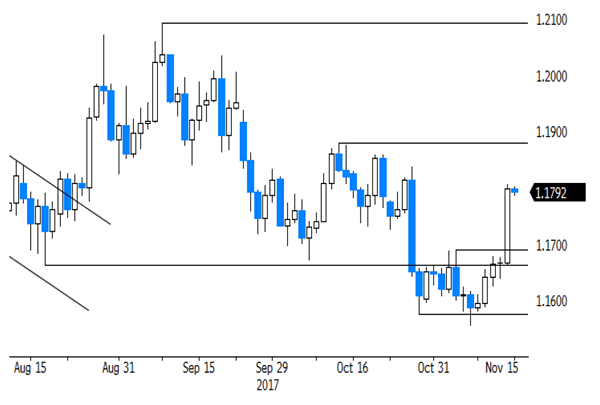
EUR/USD rebounds north of 1.1690. Next resistance comes in at 1.1837/80
EUR/GBP
EUR/GBP nears ST range top/resistance
UK headline inflation was stable at 3.0%M Y/Y yesterday (consensus 3.1% Y/Y). Other price indicators were also slightly softer than expected. In its November inflation report, the BoE assumed inflation to peak above 3.0% in October. If inflation cools from current levels, the BoE can shift into wait-and-see modus. Sterling won't get any additional interest rate support anytime soon. This prospect weighted on sterling. Cable dropped (temporary?) below 1.31, but the decline was reversed as cable followed the rebound of EUR/USD. The pair closed the session at 1.3165. EUR/GBP extended gains well north of 0.89. The move was reinforced by overall euro gains. EUR/GBP closed the day at 0.8961.
The UK labour market data will be published today. The unemployment rate is expect stable at the very low level of 4.3%. Employment growth is expected to moderate. Wage growth is expected to remain very soft (2.1% Y/Y). We expect the labour market report to be lest important for sterling trading. The market focus probably will be on the wage data. Given very low expectations, there is room for a slight upward surprise. This might give sterling some relief after yesterday's sharp decline (against the euro). However, we don't expect today's labour report to change the broader picture for sterling trading. Markets will also continue to keep an eye at the debate on the ‘EU Withdrawal Bill' in the UK Parliament. Of course, the global euro moves will also affect EUR/GBP trading. We have a EUR/GBP bias short-term and we don't change that assessment yet. That said, the upside momentum might slow a bit after the recent rally.
MT technical: Sterling rebounded in September as the BoE prepared markets for a rate hike. This rebound ran into resistance as markets anticipated that any rate hikes would be very gradual and limited. This view was confirmed at this month's BoE policy meeting. EUR/GBP currently trades in a 0.8733/0.9033 consolidation range. A downside test of this range was rejected. We assume that the 0.8733-0.8652 support will be tough to break. A EUR/GBP buy-on-dips approach for return action to the EUR/GBP 0.9023/33 ST range top is favoured
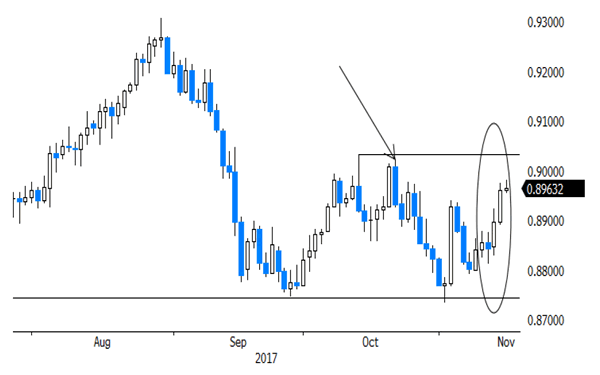
EUR/GBP nears MT range top. Time for the rebound to take a breather?
Trade Idea: AUD/USD – Hold short entered at 0.7720
AUD/USD – 0.7580
Original strategy:
Sold at 0.7720, Target: 0.7550, Stop: 0.7705
Position: - Short at 0.7720
Target: - 0.7550
Stop:- 0.7705
New strategy :
Hold short entered at 0.7720, Target: 0.7550, Stop: 0.7650
Position: - Short at 0.7720
Target: - 0.7550
Stop:- 0.7650
As aussie has fallen again after meeting renewed selling interest at 0.7650, retaining our bearishness for recent decline from 0.8125 top to extend further weakness to 0.7550, having said that, loss of downward momentum should prevent sharp fall below there and reckon 0.7500 would hold from here, bring rebound later.
In view of this, we are holding on to our short position entered at 0.7720. Above said resistance at 0.7650 would defer but only break of indicated resistance at 0.7701 would signal low is formed, bring retracement of recent fall towards previous support at 0.7770 but reckon 0.7800 would limit upside and 0.7825-35 should hold.
On the 4-hour chart, recent upmove from 0.7329 is unfolding as an impulsive rise with wave 3 as well as smaller degree wave (iii) extending, only minor wave v of (iii) has ended at 0.8125, hence bullishness remains for this move to extend headway to 0.8200, then towards 0.8300, however, reckon upside would be limited to 0.8400 and the final wave 5 should falter below 0.8500, bring correction later.
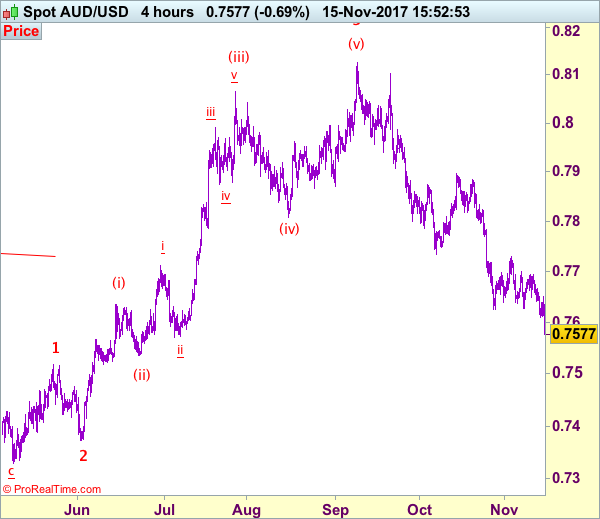
Forex: Data Boosts EUR Can CPI Boost USD?
EUR received a boost on Tuesday, as data from Destatis showed German Preliminary GDP climbed to 0.8% in Q3, beating forecasts of 0.6%. In addition, Q1 growth was adjusted higher to 0.9% from the previous 0.7%. The recent increase in exports and business investment appears to be the main driver behind the improvement, as consumer and government spending were stable through the quarter. Germany’s economy is now growing at an annualized rate of 2.8% the best growth the country has seen for 6 years. Whilst the economy is growing there is very little inflationary pressure as German inflation is well below target. With the German economy doing well, the markets expect this growth to precipitate to other member states and, as a result, EUR climbed over 1% on Tuesday. The upward momentum has carried through overnight with EURUSD touching 1.18 in early trading.
Data from the US on Tuesday indicated producer prices rose 0.4% last month, which beat expectations. The data helped boost PPI to 2.8% in the 12 months up to October, for the largest yearly increase in wholesale inflation in nearly 6 years. The markets will now be focusing on US consumer inflation data later today. Forecasts are calling for a slight increase. The current CME Group’s FedWatch tool puts the probability of a December rate hike of a quarter point at 91.5%. If, however, today’s data is weak, that may reduce the probability of a December rate hike by the Fed.
EURUSD is currently trading around 1.1795.
USDJPY is 0.25% lower in early Wednesday trading, at around 113.15.
GBPUSD is 0.2% lower in early session trading, at around 1.3140.
Gold is little changed overnight, currently trading around $1,281.25.
WTI is slightly higher, currently trading around $55.28.
Major data releases for today:
At 09:30 GMT, UK National Statistics will release Average Earnings (including and excluding Bonus) for the previous 3 months and current year to September. Both data sets are expected to come in at 2.1%, a slight fall from the previous reading of 2.2%. With inflation outpacing earnings in the UK, the markets will be interested to see if the gap can be closed that will determine future monetary policy decisions.
At 13:30 GMT, the US Census Bureau will release Retails Sales (MoM) for October. Retail Sales are forecast to come in at 0.0%, a significant decline from the previous reading of 1.6%. If consumer spending has zero growth, the markets will expect to see a lower CPI reading that will be released at the same time.
At 13:30 GMT, the US Census Bureau will release a plethora of data related to CPI, with the main focus being on CPI & CPI excluding Food & Energy (YoY) for October. CPI is forecast to come in lower at 2.0% from the previous release of 2.2%. CPI excluding food & energy is forecast to be unchanged at 1.7%. Any significant deviation from the forecast will likely cause USD volatility.
At 15:30, the US Energy Information Administration will release Crude Oil Stocks change for the week ending November 10th. The forecast is for a draw of -2.850M being the reverse of the previous release that saw inventories rising 2.237M. The release can often cause volatility in both WTI & Brent if it is widely different from expectations.