Sample Category Title
Brazilian Real Takes A Breather, AUD Consolidates Above $0.76
BRL not out of the wood yet
The Brazilian real came under renewed pressures starting mid-October as US yields initiated a much-awaited recovery. The entire EM complex suffered as the entire US yield curve shifted to the upside. The move is far from over as the 2-year Treasury yield hit a 9-year high yesterday and tested the 1.6535% threshold before stabilizing at around 1.64%. The shrinking interest rate differential between the US and Brazil is reducing the incentives to invest into riskier emerging market assets.
Regarding the Brazilian real, investors are being more cautious against the backdrop of lower Brazilian rates and uncertainties about the pension reform. The government led by Michel Temer was poised to water down the original version, as it didn’t have enough vote to pass Congress. Obviously, investors reacted negatively to the news as it means that more time will be necessary to reduce the fiscal deficit.
Finally, the central bank is expected to slow down the pace of easing as inflation has moved below the central bank’s target band of 4.5%+/-1.5%. Inflation has stabilized at around 2.50%y/y since the end of the summer. Now that the BCB has successfully brought back inflation down to acceptable levels, the market do not expect more than another 50bps this year, which bring the Selic rate to 7%.
Although the real has room to improve against the backdrop of improving economic condition, we believe the tighter US monetary policy will reduce significantly investors’ appetite for Brazilian assets, especially since the government appears to struggle passing its reforms. The 3.0 level in USD/BRL is a solid support and there is little chance of USD/BRL moving below.
RBA provide dovish statement
Risk appetite in Asia remains weak with steady selling in EM FX and stocks. No surprisingly, US President Trump and President Xi Jinping attendance at the Apec summit has failed to generate positive sentiment. Despite the friendly glad-handing, markets can’t shake the fact that the two nations seem to be on collision course (economically at least). Even advancements in financial liberalizations with China allowing foreign ownership on financial institutions (more details to follow) did not provide a positive impulse. In Australia, the RBA released their Statement on Monetary Policy.
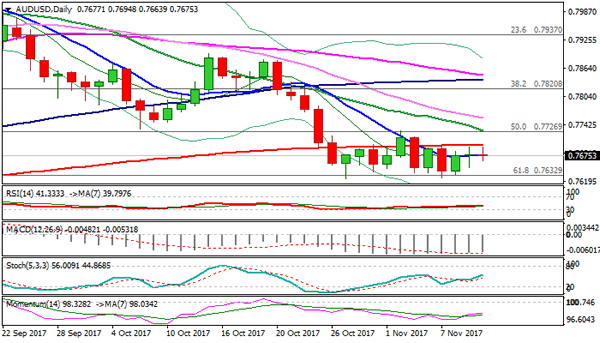
Overall the reports sounded dovish as core inflation is not expected to reach 2% till 2019 and GDP growth will linger around 3% for the next few years. As in many developed markets economies, unemployment numbers are positive yet failing to materialize into wage inflation. The RBA also highlighted their concern over high household debt which is likely to constrain personal consumption in the near term. Finally, the report issued a warning that season drop in Chinese import numbers, specifically iron ore, due the crack down on steel production to curb pollution could be a lasting trend. Australia dependence on Chinese commodity demand suggest volatility near-term as demand and policy action clash. AUDUSD failure to clear 200d MA resistance suggest a retest of 0.7627 base support. Failure for support to hold would trigger a bearish breakout to 0.7530.
Technical Outlook: AUDUSD – Downside At Risk As 200SMA Caps
The Australian dollar holds in directionless mode after Thursday's action ended in long-legged Doji and upside attempts being repeatedly capped by 200SMA (0.7697) which limited action of this week. Overall picture remains negative and keeps risk on the downside as the pair is in consolidation phase (within 0.7625 and 0.7730) of larger downtrend from 0.8124 (08 Sep peak). Sustained break above 200SMA would ease persisting downside risk and allow for fresh upticks towards key barrier at 0.7730 (consolidation top/falling 20SMA), break of which would generate stronger bullish signal. Otherwise, near term focus is expected to remains at the downside, with firm break below 10SMA (0.7675) to re-expose temporary base at 0.7625 zone (reinforced by weekly 55SMA and Fibo 61.8% of 0.7328/0.8124 ascend).
Res: 0.7697, 0.7730, 0.7760, 0.7793
Sup: 0.7663, 0.7649, 0.7625, 0.7572
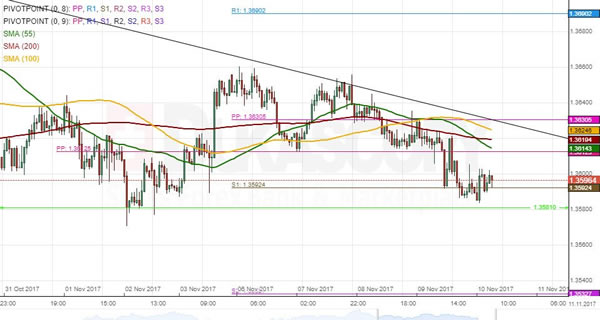
USD/SGD 1H Chart: US Dollar About To Breach Triangle
USD/SGD has been trading in a channel up since late August. This formation began when the rate reached a 2017 low at 1.3358 on September 8; the US Dollar has since moved up to the 1.36 mark. Another notable pattern that can be distinguished is a descending triangle. During its last wave down from the channel, the US Dollar was diminishing its trading range, but at the same time it failed to move below the 1.3580 mark, thus creating this aforementioned triangle. Technical indicators are in favour of a short-term recovery which is likely to hinder near a resistance cluster formed by the 55-, 100– and 200-hour SMAs circa 1.3625. In case this area is breached, the rate might push for the 1.3720 mark. Conversely, a failure to do so might strand the rate in a narrow trading range slightly above the 1.3580 mark. The Greenback should eventually break out to the downside and aim for the lower channel boundary near 1.3520.
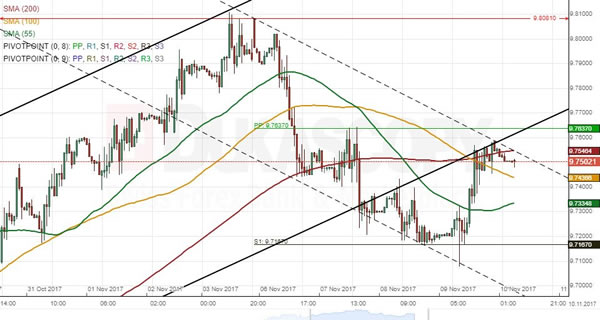
EUR/SEK 1H Chart: Euro Tests 200-Hour SMA
Following a five-week appreciation against the Swedish Krona in an ascending channel, the common European currency has formed a channel in the opposite direction and is thus gradually moving lower. The pair reached a 2017 high last week when the rate reversed from the 9.8081 area. This suggests that a decline in both medium and long term is a likely option. The rate is currently testing the upper line of the junior channel—an area which is likewise reinforced by the 200-hour SMA. From this perspective, the rate should rebound from the this resistance and edge lower. However, given the steepness of the descending channel, this formation is unlikely to hold for long. Technical indicators flash mixed signals, but the overall tendency seems to point southwards. The rate might go as low as the monthly PP circa 9.68 during the following trading sessions prior to making a minor recovery.
EUR/USD Analysis: Advances In Ascending Channel
The Dollar was quoted weaker against the Euro on Thursday amid concerns that the Senate would postpone corporate tax cuts until 2019. The situation did not improve even when the House relevant committee approved the current tax plan. On hourly chart these changes resulted only in minor adjustments of the current ascending channel boundaries. As an area near the 1.1630 level represents location of the weekly PP, the 55-, 100- and 200-hour SMAs, the exchange rate is not expected to make major advances in the southern direction. On the other hand, starting from the 1.1660 and up until the 1.1680 mark the pair will face different resistance barriers, including the 23.6% Fibonacci retracement level, which most probably are going to hamper the pair from active surging as well.
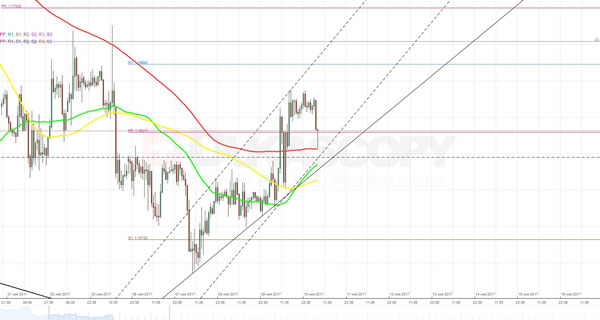
GBP/USD Analysis: Struggles To Bypass 200-Hour SMA
As it was expected, a combined resistance barrier formed by the weekly PP and the 38.2% Fibonacci retracement level managed to constrain the cable near the 1.3150 level.
Unless the Pound receives a proper impulse from some fundamental even, there is a little chance that it will manage to bypass the 200-hour SMA. But even in the best-case scenario the pair is unlikely to break above another resistance area this time protected by the 50% Fibonacci retracement level at 1.3180. If the Sterling starts to depreciate the initial fall is expected to be stopped by the 55- and 100-hour SMAs. However, once the pair manages to bypass them, the plunge might continue up until the 1.3100 mark located near the 23.6% retracement level.
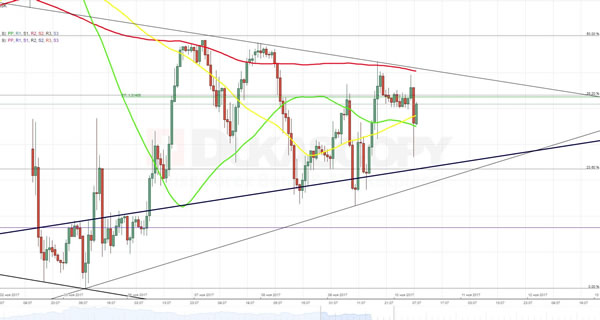
USD/JPY Analysis: Rebounds From 113.17
In line with expectations, the Yen continued to gain value against the Dollar under pressure from the slipping 55-, 100- and 200-hour SMAs. On the one hand, the currency rate continues to fluctuate within the descending channel formation, which implies further movement in the southern direction. On the other hand, the combined support level set up by the monthly PP at 113.25 and the weekly S1 at 113.22 indicates that this trading session the exchange rate is likely to spend wavering between the 113.60 and 113.30 marks.
The situation can be altered during the day amid the news coming from the APEC summit where Presidents Trump and Putin are expected to have a meeting.
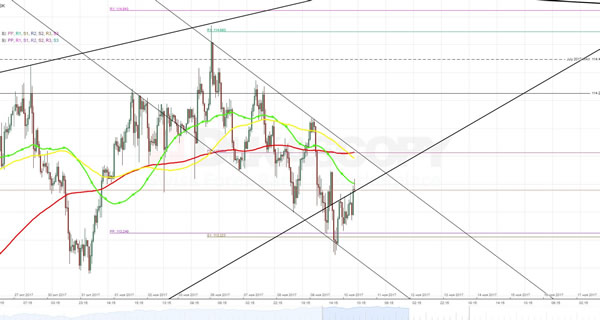
XAU/USD Analysis: Continues To Climb In Rising Wedge Formation
The yellow metal is continuing to trade against the buck at the intersection of large ascending channel and junior rising wedge formations.
Although the larger pattern managed to constrain the bullish sentiment for now, but the rising 55-, 100- and 200-hour SMAs as well as ongoing concerns over implementation of the US President Donald Trump’s tax plan suggest that such upward movement is going to continue and might actually reach the upper trend-line of another dominant descending channel near the 1,293.00 mark. However, from daily chart perspective the breakout from rising wedge formation is expected to happen earlier near the 1,288.00 level.
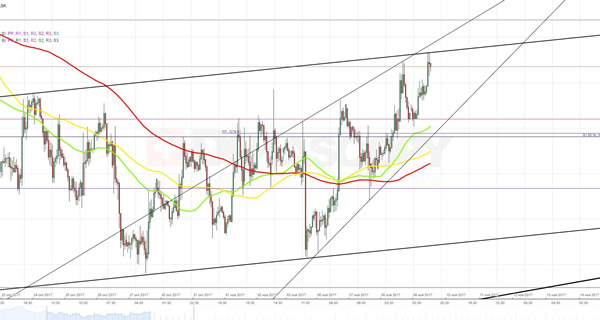
USD/CAD: Canadian New Housing Price Index
The Canadian Dollar appreciated against the Greenback, reflecting Canadian economic report. Ahead of the release, USD/CAD slid through the 1.2690 area, then returned to 1.2720, from where another data as well as investors’ worries about delaying the US corporate tax cuts sent the pair down to finish the session at 1.680. The bearish sentiment is likely to be sustained in the pair due to the lack of reports on Friday.
Statistics Canada reported on Thursday that the country’s House Price Index rose 0.2% in September, matching analysts’ expectations. The strongest increase was registered in British Columbia, while remaining areas showed mixed results. On an annual basis, September’s new housing prices increased 3.8% for the third month in succession.

Trade Idea: GBP/USD – Hold short entered at 1.3170
GBP/USD – 1.3151
Original strategy :
Sold at 1.3170, Target: 1.3000, stop: 1.3230
Position: - Short at 1.3170
Target: - 1.3000
Stop: - 1.3230
New strategy :
Hold short entered at 1.3170, Target: 1.3000, stop: 1.3230
Position: - Short at 1.3170
Target: - 1.3000
Stop:- 1.3230
Although sterling has rebounded again after finding support at 1.3085 and further consolidation would be seen, reckon upside would be limited to 1.3200 and bring another decline later, below 1.3075-85 would suggest the rebound from 1.3039 has ended and bring retest of this level later. Looking ahead, a break below recent low at 1.3027 would confirm early decline from 1.3658 top has resumed for weakness to psychological support at 1.3000, break there would encourage for further decline towards 1.2950-60 later.
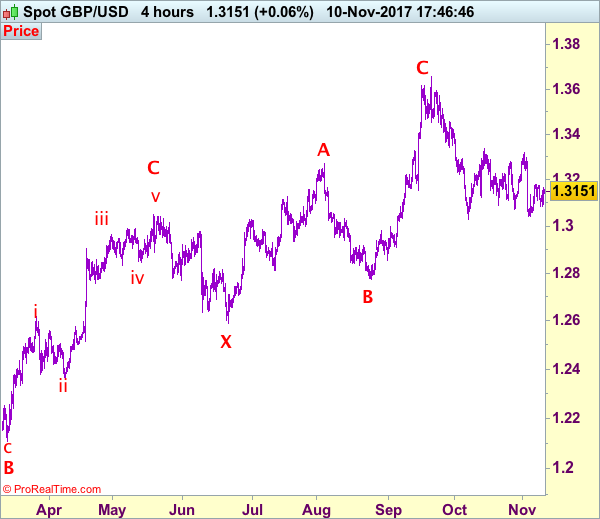
In view of this, we are holding on to our short position entered at 1.3170. Above 1.3220 would defer and prolong choppy consolidation, risk rebound to 1.3250-60 but resistance at 1.3299 should limit upside and price should falter below last week’s high at 1.3321, bring another retreat later. Our preferred count is that (pls see the attached chart) the wave IV is unfolding as a complex double three (ABC-X-ABC) correction with 2nd wave B ended at 1.2774, hence 2nd wave C could have ended at 1.3658.
Our preferred count on the daily chart is that cable's rebound from 1.3500 (wave (A) trough) is unfolding as a wave (B) with A ended at 1.7043, followed by triangle wave B and wave C as well as wave (B) has ended at 1.7192, the subsequent selloff is the larger degree wave (C) which is still unfolding with minor wave (III) of larger degree wave 3 ended at 1.1986, hence wave (IV) correction is in progress which could either be a triangle wave (IV) of a complex formation but upside should be limited to 1.3500 and price should falter well below 1.4000, bring another decline in wave (V) of 3 for weakness to 1.1500, then 1.1200.