

Sample Category Title
RBNZ Highlights Delicate Balance
Slight shifts in central bank rhetoric highlight the uncertainty in central banks and markets. The New Zealand dollar was the top performer on the day while the pound lagged. Chinese CPI is due up next.
Central banks have been playing a game for years. The aim is to keep the domestic currency low while controlling inflation and instilling confidence in the broader market. That paradigm frequently leads to mixed messages. In addition, policy makers often quickly backtrack when hawkish moves lead to a spike in the currency.
The stakes were on full display in the RBNZ decision. The central bank has long pledged to remain accommodative for a considerable period so it was no surprise when rates were left at 1.75%. The unexpected move was a shift in the forecast for inflation. They now see rates rising in Q2 2019 compared to Q3 previously. That was enough to send the kiwi to 0.6966 from 0.6925.
The market emphasis on forecasts isn't new but it's increasingly prevalent. The kneejerk reaction to the FOMC is now more about things like the dots than the words in the statements. In the longer term, we suspect central banks will be irked by the increasing irrelevance of written language versus forecasts but for now, the data domination is the main trade.
Up next is the CPI report from China, which is expected to accelerate to 1.8% from 1.6%. The data is due at 0130 GMT and it's a reminder that even in emerging markets where growth is near 7%, inflation isn't a formidable problem. That said, a surprise uptick about 2% could make waves in broader markets.
Pound Slips as Dollar Strengthens on Tax Reform Hopes
The British has posted losses in the Wednesday session. In North American trade, GBP/USD is trading at 1.3109, down 0.44% on the day. On the release front, there are no major events out of the UK or the US. On Thursday, the UK releases NIESR GDP Estimate and the US will publish unemployment claims.
BoE Governor Mark Carney hasn't shied away from public statements on Brexit, much to the angst of many lawmakers. Carney weighed in again on Brexit in a television interview on the weekend. Carney expressed concern at the lack of uncertainty over a final deal with the European Union, saying that the economy "should really be booming, but it's just growing." According to Carney, the BoE wanted a scenario with a smooth transition out of the EU, with a trade deal that was somewhere in between full membership in a single market and a 'no deal' outcome. The BoE cut rates in August 2016, just after the Brexit vote. This reflected the Bank's fear of a sharp downturn in the British economy, which did not occur. The BoE raised rates last week (for the first time since 2007), in what was widely viewed as a corrective measure to the August 2016 rate cut.
After failing to pass a new healthcare act, President Trump has his sights set on tax reform, a key item in his domestic platform. Trump wants Congress to pass legislation overhauling the tax code before the end of the year, but that could prove to be too tight of a deadline. Most Democrats have come out against the proposal, and not all Republicans are on board. The bill would cut corporate taxes from 35% to 20%, but predictably, Democrat and Republican lawmakers are at odds as to whether the bill will lower taxes for the middle class. The bill is presently being debated in a congressional committee and is expected to move to the House floor next week. The Senate will present its version of the bill on Thursday, so we can expect plenty of activity in Congress in the next few weeks. Expectations that Trump will cut taxes has been the catalyst for a stock market rally over the past year, and if the bill does become law, the US dollar will likely gain ground.
Will U.K. Inflation Recede?: Implications for BoE Policy
Executive Summary
The Monetary Policy Committee (MPC) of the Bank of England (BoE) recently hiked its main policy rate for the first time in more than 10 years. The U.K. economy has not weakened as much as the MPC had feared last year in the immediate aftermath of the Brexit referendum, so the rate hike simply takes back the "insurance" easing that the central bank undertook in August 2016. So is the MPC's rate hike a once-and-done affair, or does more tightening lie ahead?
We look for the CPI inflation rate in the United Kingdom to slowly recede toward the two percent inflation target in the quarters ahead as the price-lifting effects of sterling depreciation fade. If, as we expect, the economy continues to grow, then we believe that the MPC will feel confident enough to raise rates again next summer. That said, we certainly acknowledge the downside risks to our forecast that emanate from Brexit uncertainty. If these uncertainties cause businesses to retrench via lower investment and/or cuts to payrolls, the British economy could weaken further. In that event, prospects for further monetary tightening in the United Kingdom would fade.
CPI Inflation Has Overshot the Central Bank's Target This Year
In a recent report we discussed the outlook for Eurozone CPI inflation that was derived from our proprietary models and the implications of those forecasts for ECB monetary policy going forward.1 We follow a similar methodology in this report for the United Kingdom. Namely, we discuss two forecasting models of British CPI inflation, and then use the forecasts that are generated by those models to inform our views about U.K. monetary policy going forward.
Starting in 1997, when the BoE gained operational independence, the British government gave the central bank an inflation target of 2 percent over the medium term. The BoE has generally been successful in fulfilling its mandate, although there have been periods over the past 20 years in which the BoE has either overshot or undershot its inflation target. For example, CPI inflation significantly undershot the BoE's target throughout 2015 and 2016, but it has consistently been above target most of this year (Figure 1).
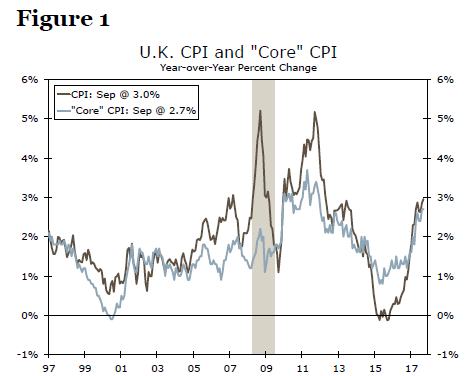
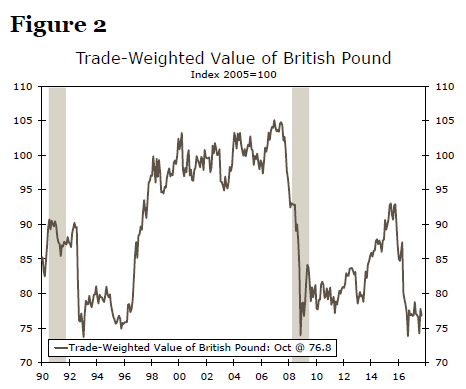
The stabilization in energy prices that has occurred during the past year or so helped to lift the overall CPI inflation rate back toward the core rate of inflation, which excludes energy and other goods with volatile prices. That said, the core inflation rate has also risen markedly this year, which has helped to pull the overall rate of inflation even higher. Much of this increase in the core inflation rate reflects the significant decline in the trade-weighted value of the British pound in the immediate aftermath of the Brexit referendum in June 2016 (Figure 2). The sharp depreciation of sterling lifted import prices, which subsequently imparted upward momentum to CPI inflation.
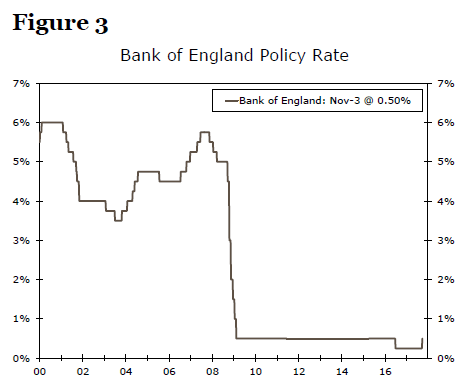
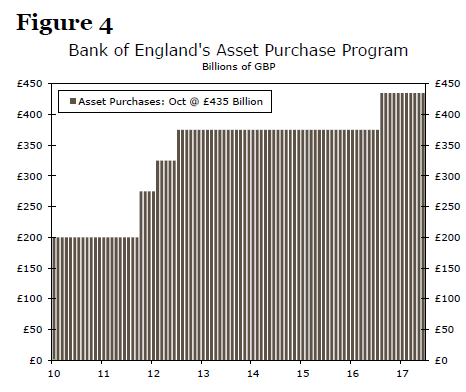
Despite the above-target rate of inflation in 2017, the MPC refrained from tightening monetary policy for much of the year due to the uncertainties that Brexit imparted to the British economy. Indeed, in the immediate aftermath of the Brexit referendum last year the MPC reduced its main policy rate by 25 bps (Figure 3) and it increased the size of its government bond purchase program from £375 billion to £435 billion (Figure 4). The MPC reasoned that economic weakness associated with Brexit uncertainty could eventually cause CPI inflation to undershoot its target. However, real GDP growth has not slowed as much as the BoE had feared at the time of the Brexit referendum, so the MPC recently took back its rate cut. But the BoE continues to maintain its £435 billion stock of government bond purchases.
Will Inflation Recede Back Toward Target?
With the economy continuing to expand, albeit at a slow pace (real GDP was up only 1.5 percent on a year-ago basis in Q3-2017), and with CPI inflation a full percentage point above target, will the MPC hike rates further in coming months? To shed some light on this question, we used a model similar to the one that we employed in our analysis of Eurozone inflation dynamics that was noted previously. Specifically, we model CPI inflation in the United Kingdom to be a function of the output gap (i.e. the difference between actual GDP and potential GDP as a percent of the latter), long-run inflation expectations, and the sterling-denominated price of Brent oil. We then use our forecasts of these independent variables to generate a forecast of U.K. CPI inflation through the end of 2019. The results are shown in Figure 5.
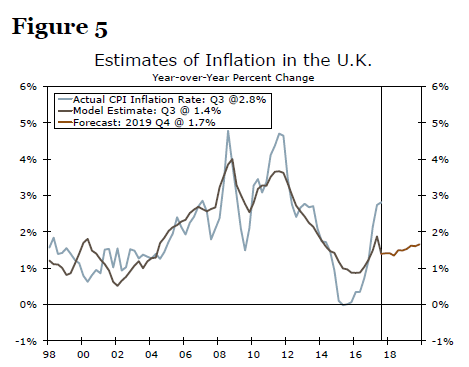
As in the case of our Eurozone analysis, our model does a reasonable job of capturing the inflation dynamics in the United Kingdom, although it tends to under-predict sizeable swings that sometimes can arise. Indeed, the model is currently under-predicting the actual CPI inflation rate by nearly 1.5 percentage points. This large error probably reflects the sharp depreciation of sterling over the past year which is not captured by our model.
The actual inflation rate and the model-generated inflation rate have tended to eventually converge when large errors have occurred in the past, and we look for the difference to narrow in the months ahead. Specifically, we look for the actual CPI inflation rate to recede as the one-off effects of sterling depreciation on the price level run their course. But our model-generated forecast of inflation drifts higher in coming months, so the actual rate of inflation likely will not fall all the way back to the current model prediction (1.4 percent).
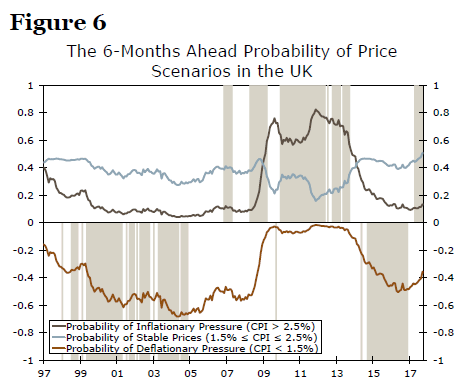
This assessment is consistent with our probit model, which suggests that the probability of "deflationary pressure" (i.e., a CPI inflation rate less than 1.5 percent within six months) is falling while the probability of "stable prices" (i.e., CPI inflation between 1.5 percent and 2.5 percent within six months) is rising (Figure 6). Our actual forecast looks for CPI inflation in the United Kingdom to recede from its current rate of 3 percent back to 2 percent by mid-2019. Our CPI inflation forecast is in line with both the consensus forecast and with the inflation outlook of the BoE.
How Quickly Will the MPC Tighten Policy?
As noted above, the MPC decided at its last policy meeting on November 2 to raise it main policy rate by 25 bps. In the statement that announced the rate hike, however, the MPC did not seem to be in a hurry to tighten further, saying that any future rate hikes "would be expected to be at a gradual pace and to a limited extent." Furthermore, the statement highlighted the downside risks to the economic outlook posed by the uncertainty of the Brexit process.
We expect that the MPC will maintain this wait-and-see approach for the next few months. In our view, the MPC will refrain from hiking rates again until the third quarter of 2018. This view is predicated on our assumption that Brexit uncertainty does not derail the economic expansion. If, as we expect, inflation recedes in coming months now that sterling has stabilized, then growth in real consumer spending should pick up as real income growth recovers. Stronger GDP growth should eventually give enough comfort to a majority of MPC members to hike rates again.
That said, we acknowledge the downside risks to our forecast that emanate from Brexit uncertainty. A "soft" Brexit would make only minor changes to the economic and financial relationship that the United Kingdom has with the other 27 members of the European Union (EU-27). On the other hand, a "hard" Brexit could potentially entail an entire reorganization of that relationship. At this point, negotiations between the United Kingdom and the EU-27 are underway, but nobody really knows now what the ultimate relationship will eventually be. This uncertainty about the U.K.'s future relationship with its most important trading partners - about one-half of British exports go to the EU-27 - could eventually weigh on investment and hiring decisions in the United Kingdom.
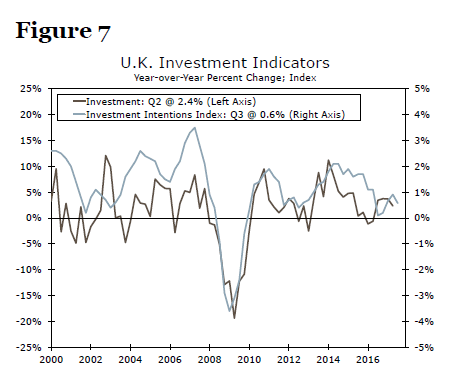
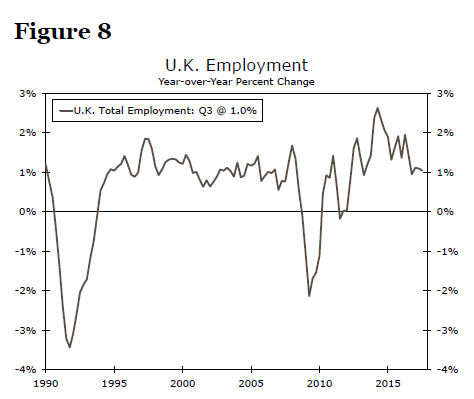
In that regard, investment spending and payrolls in the United Kingdom both continue to grow. However, a measure of investment "intentions," which has a fair degree of correlation with growth in actual investment spending, remains fragile (Figure 7). Employment continues to grow, but it has decelerated over the past year or so (Figure 8). If Brexit uncertainty causes businesses to retrench via reduced investment spending and cuts to payrolls in coming months, the MPC surely would shelve any intentions to hike rates next year.
Conclusion
The value of the British pound weakened significantly in the immediate aftermath of last year's Brexit referendum, which then caused the CPI inflation rate to shoot above the BoE's target of two percent. Rather than tighten policy, however, the MPC decided in August 2016 to cut its main policy rate by 25 bps. The MPC reasoned that economic weakness, which it expected in the quarters after the Brexit referendum, could eventually cause the CPI inflation rate to undershoot the two percent target. But the economy has not weakened as much as the MPC had feared, so it recently took back that rate cut.
We look for the CPI inflation rate in the United Kingdom to slowly recede back toward the two percent inflation target in the quarters ahead as the price-lifting effects of sterling depreciation fade. If, as we expect, the economy continues to grow, then we believe that the MPC will feel confident enough to raise rates again next summer. Looking further ahead, we forecast two 25 bps rate hikes in 2019.
That said, the U.K. economic outlook is held hostage, at least in part, to uncertainties associated with the Brexit negotiation process. Unfortunately, it is essentially impossible to accurately predict the outcome of that process at this time. But if these uncertainties cause businesses to retrench via lower investment and/or cuts to payrolls, the British economy could weaken further. In that event, prospects for further monetary tightening in the United Kingdom would fade. Stay tuned.
Monetary Policy Convergence: What About the ECB?
While global central banks have begun to tighten policy, the ECB has continued its largely accommodative stance, and market participants have adopted a wait-and-see approach to future policy rate expectations.
The Slow Trend Toward Monetary Policy Convergence
Global central banks have slowly begun to reverse largely accommodative monetary policy stances over the past several years. Just last week the Bank of England raised its target rate 25 basis points to 0.50 percent, following a similar sized rate hike by the Bank of Canada in September. In the U.S., the FOMC is expected to raise the fed funds rate at its December meeting.
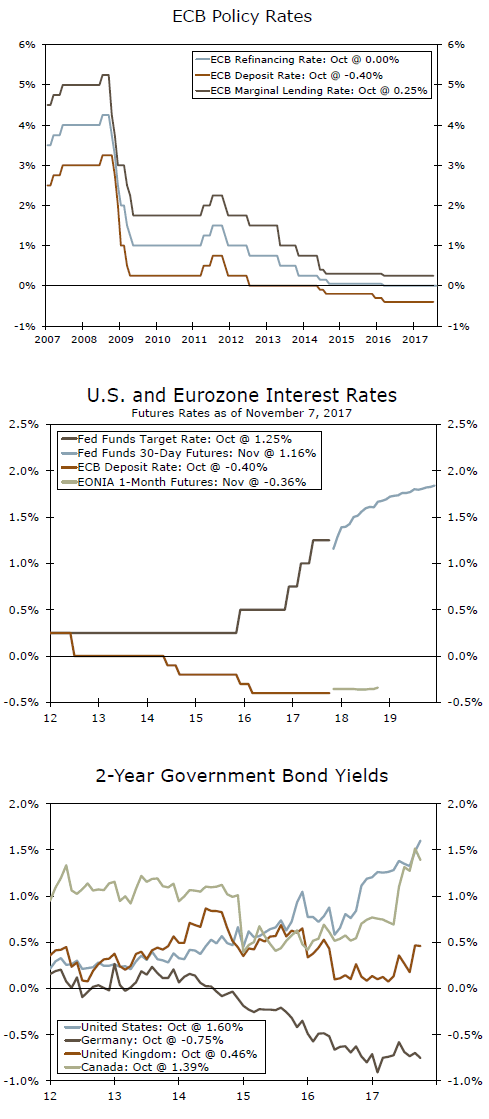
However, policy normalization has taken a significantly slower pace in the Eurozone compared to the U.S. Although the European Central Bank (ECB) announced late last month its decision to taper asset purchases from €60 billion per month to €30 billion per month beginning in January 2018, policy is still largely accommodative, with the ECB's deposit rate still in negative territory (top chart). However, economic conditions in both the Eurozone and U.S. have some similarities: solid GDP growth in the third quarter, lower unemployment rates and slowly improving inflation leave many wondering why the ECB has been so slow on the uptake to tighten policy relative to other central banks.
A Case of Mismatched Expectations?
The spread between futures contracts for the fed funds rate and comparable Euro Overnight Index Average (EONIA), the Eurozone's overnight interbank rate, suggests current policy divergence is expected to persist for some time (middle chart). In November, the spread is 151 basis points, and interest rate futures imply that the widening reaches 200 basis points by October 2018.
However, the more likely story is that of mismatched expectations. When the ECB announced its decision to taper last month, the euro actually declined more than 2 percent against the dollar. Even though the decision was generally a move toward less accommodation, it was viewed as dovish. Until the ECB begins to raise rates, we may continue to see mismatched expectations. At this point in the cycle, market participants need evidence of future rate hikes to price in upward movement in futures contracts, especially as other central banks have already begun to tighten. Government bond yields also reflect this view. For example, the spread between the U.S. and German two-year widened to roughly 236 basis points in October (bottom chart).
What Does ECB Policy Look Like Going Forward?
In our view, futures spreads are just one factor among many that help predict the pace of rate hikes. For example, in a report released earlier this week, "Eurozone Inflation Outlook: Implications for ECB Policy," we discuss how we predict inflation in the Eurozone to trend higher in the coming months, likely pushing the ECB to begin to hike rates in early 2019. However, for now, the wait-and-see approach to monetary policy in the Eurozone on the part of market participants will likely continue.
Yen Gains Ground, BoJ Summary of Opinions Next
USD/JPY has posted losses in the Wednesday session, erasing the gains seen on Tuesday. In North American trade, USD/JPY is trading at 113.64, down 0.31% on the day. On the release front, there are no key US events on the schedule. Japan releases Core Machinery Orders and Current Account, and the Bank of Japan will publish its Summary of Opinions.
The BoJ will release its Summary of Opinions later on Wednesday, and the markets are not expecting any dramatic announcements. The Bank has repeated that it does not plan to change its inflation target of around 2 percent, even though inflation is running well below the target. The summary will provide details of the BoJ's forecasts for inflation and economic growth, and a positive projection could boost the Japanese yen. Earlier in the week, the minutes of the October policy meeting indicated that many board members were satisfied that the inflation target would be met under current policy. BoJ Governor Kuroda echoed this message and called the economic expansion "highly sustainable", and the markets took his optimism as a sign that the BoJ has no plans to inject further stimulus in the near future.
While US President Trump continues his visit to Asian Pacific countries, there is plenty of activity in Congress. After failing to pass a new healthcare act, President Trump has his sights set on tax reform, a key item in his domestic platform. Trump wants Congress to pass legislation overhauling the tax code before the end of the year, but that could prove to be too tight of a deadline. Most Democrats have come out against the proposal, and not all Republicans are on board. The bill would cut corporate taxes from 35% to 20%, but predictably, Democrat and Republican lawmakers are at odds as to whether the bill will lower taxes for the middle class. The bill is presently being debated in a congressional committee and is expected to move to the House floor next week. The Senate will present its version of the bill on Thursday, so we can expect plenty of activity in Congress in the next few weeks. Expectations that Trump will cut taxes has been the catalyst for a stock market rally over the past year, and if the bill does become law, the US dollar will likely gain ground.
Tax Reform Worries Hold Back Dollar Bulls; Kiwi Eyed ahead of RBNZ Meeting
In the absence of important data releases, the US tax story remained front and center during today's European session trading. Housing data out of Canada did gather some attention. The Energy Information Administration's (EIA) weekly report out of the US, which is due later in the day, has the capacity to generate some movement in oil prices.
The dollar's index against a basket of currencies was down by 0.1% at 1503 GMT with the US currency's advance being halted over talk of a possible delay in the implementation of tax reforms. The greenback was on the rise as the tax story was gaining momentum with the dollar index recording a three-and-a-half-month high of 95.15 in late October. It yesterday came extremely close to revisiting the aforementioned peak. However, a Washington Post article, citing unidentified sources, indicated that Senate Republicans are contemplating on a one-year delay in the implementation of major tax cuts in order to comply with Senate rules. The report said a repeal of deductions for state and local taxes is also under consideration. This dented forex market participants' appetite to go long the dollar.
Versus the yen, the dollar was down by 0.4%, falling to 113.38 at its lowest, this being an eight-day low. A pullback in Treasury yields also made the dollar less attractive. Indicatively, the US 10-year note today hit 2.30%, its lowest in almost three weeks. Euro/dollar was 0.1% higher, eyeing the 1.16 handle. Yesterday the pair touched 1.1552, a level not experienced since July 20. The dollar was stronger relative to sterling with pound/dollar being 0.55% down at 1.3093.
The US president's Asia tour continues. Today he is in China with trade and North Korea expected to be on the table as he meets with his Chinese counterpart Xi Jinping. Trump yesterday urged nations to deny aid and assistance to North Korea while he today called out by name China and Russia, saying that all responsible nations should deny Kim Jong Un's regime any form of support.
A Wall Street Journal poll released yesterday showed Donald Trump's approval rating declining, with the fall being evident even in counties that had supported him during last year's election.
Canadian seasonally adjusted housing starts stood at 222.8k in October, above expectations of 210.0k and September's upwardly revised 219.3k (from 217.1k). September building permits data released a few minutes later showed the value of permits rising by 3.8% m/m, exceeding forecasts for a contraction by 0.2%. This marks the first increase in the value of building permits in three months and came on the back of strength in the non-residential sector as permits in Canada's residential sector declined. The previous month's fall in the value of permits was revised to 5.1% m/m from 5.5%. The loonie was gaining today relative to the greenback even before the data releases. The currency was supported after some comments made yesterday by Bank of Canada Governor Stephen Poloz were perceived as less dovish than expected by market participants. Dollar/loonie last stood at 1.2727, down 0.35% on the day.
Ahead of the completion of the Reserve Bank of Zealand's meeting on monetary policy kiwi/dollar was trading 0.4% up on the day at 0.6928. The central bank's decision on interest rates as well as its monetary policy statement are due at 2000 GMT. The RBNZ is expected to hold its official cash rate at the record low of 1.75%. Talk of a dual central bank mandate, where beyond price stability, full-employment is an objective as well, is also in focus.
In commodities, gold stood 0.65% higher on the day and not far below the near three-week high of $1285.80 an ounce recorded earlier in the day. The dollar-denominated metal benefitted as the greenback's advance stalled but also potentially on Trump's North Korean rhetoric which might refuel tensions – gold has a safe-haven allure. WTI and Brent crude were down by 0.65% and 0.7% at $56.83 and $63.24 a barrel respectively, easing a bit from the more than two-year highs reached the day before. The EIA weekly data for the week ending November 3 are due at 1530 GMT. The report is expected to show a reduction in crude oil inventories by 2.88 million barrels.
Yen Outperforms as Risk Rally Falters
- European equities fell prey to most profit taking showing losses of about 0.5%. Italy underperforms. US equities also trade with modest losses of 0.1% /0.2% as the recent rally is running into resistance.
- Germany's influential Council of Economic Experts has warned that the eurozone's largest and most powerful economy is in danger of overheating. The Council expects 2.2% growth in 2018 after 7 years of strong growth. Potential growth is estimated at 1.4%.
- British businesses expect to increase the pay rises they offer staff over the next year, as it becomes increasingly difficult to attract and hold on to workers, according to a BoE survey, supporting its confidence that the recent squeeze on living standards will ease. The BoE found recruitment difficulties were "above normal" in many sectors
- Donald Trump on Wednesday warned North Korea not to "underestimate" America, as he wrapped up a two-day visit to South Korea that analysts widely regarded as a foreign-policy success. Mr Trump also did not employ the fiery rhetoric he has previously directed at North Korea, although he reminded Pyongyang that the US had positioned serious military assets in the vicinity of the Korean peninsula.
- Discussions on the long-term sustainability of Greece's debt are expected to start after the conclusion of a review of reforms by its lenders, PM Tsipras said. He told lawmakers that discussions with lenders were progressing well. The government has previously said that talks with lenders on the bailout review would be concluded by January.
- Poland's central bank kept interest rates on hold (1.5%) in the face of rising price pressures. A dovish majority on the 10-person MPC has to contend with only two members who urge a rate increase now or next quarter, with two others open to a hike once growing wage pressure pushes inflation above target.
Rates
Bund higher in technical/sentiment driven trading
In a technical, sentiment-driven and data-free session, core bonds continued to drift higher, flattening the curves, as they did in the past four sessions. Gains remained modest, though. The German 5-yr Bobl tap was okay, but not great. At the time of writing, German bonds outperform US Treasuries slightly. The German yield curve flattens with yields dropping between 0.2 (2-yr) and 0.9 bp. US yields are little changed between 0.4 bp (2-yr) and flat (10-yr).
The Bund might have got some help from weaker equities and technical oriented traders. They drove the Bund for a first test of the contract high (163.43) mid-morning. The Bund hesitated and lingered around that level until a second attempt in early afternoon pushed it through the resistance, with an intra-day top at 163.63. This time with equities flat-lined or even rebounded modestly. That suggests technical Bund trading was indeed part of today's story. The test isn't over yet with the Bund coming slightly off the intra-day highs as lack of follow through buying might disappoint the technically oriented bulls. The upcoming $23B 10-yr T-Note auction later today may weigh somewhat on US Treasuries.
On intra-EMU bond markets, 10-yr yield spreads versus Germany reversed yesterday's narrowing, widening between 3 (Italy) and 7/9 bps (Portugal & Spain). The widening might been partly due to Portuguese fresh supply, even as the auction yield was the lowest ever for a 10-year bond (1.94%). The bid/cover of 1.57 was rather weak, but only due to the higher-than-usual amount issued. In the case of Spain, political tensions amid low trading ahead of a holiday may explain the underperformance, even as political tensions in general had only modest impact in past months. .Semi-core 10-yr spreads (Belgium/France) widen 1 to 2 bps. Peripherals and semi-core underperformed due to Bund strength on the back of a technical break higher (new contract high).
Currencies
Yen outperforms as risk rally falters
Trading in the major USD cross rates was again technical in nature in absence of eco data. Sentiment on risk turned less buoyant, as investors took some profit on the global equity rally. Uncertainty on the progress in the US tax bill was also a sources of investors caution. USD/JPY (113.50 area) and EUR/JPY (131.65 area) suffered from the risk-off bias. At the same time, the euro remained in the defensive as EUR/USD struggled not to fall below the 1.16 mark. Interest rate differentials moved marginally against the single currency.
Several regional indices held near multi-year/record levels in Asia this morning, but the upward momentum eased. The latest up-leg in the global risk rally had only a limited impact on core bond yields. This also hampered the upside momentum in USD/JPY. The pair struggled not to fall below the 114 big figure. EUR/USD (1.16 area) traded off yesterday's correction low (EUR/USD 1.1533). Even so, the setback of the dollar remained modest.
There was absolutely no economic news to guide FX trading this morning and changes in interest rate differentials were negligible. If anything, they widened marginally in favour of the dollar. EUR/USD held an extremely tight sideways range roughly between 1.1610/1.1585. European equities opened mildly positive but fell prey to profit taking. This tentative risk-off trade also weighed on the likes of EUR/JPY and USD/JPY.
The trends from Europe continued during the US session. USD/JPY drifted further south in the 113 big figure (currently 113.50 area). Uncertainty on the progress in the US 'tax bill architecture' was probably one of factors of investor cautious. Still, it had little impact on EUR/USD. EUR/JPY was also a victim of today's investors caution (currently 131.65 area from 132.15 this morning). EUR/USD trades just below 1.16. The German bund trying to regain an important technical level was probably a euro negative, too.
Political uncertainty haunts sterling again
On Friday and earlier this week, sterling reversed most of the decline triggered after last week's soft BoE policy statement. Markets apparently hoped for some progress in the Brexit negotiations that restart this week. However, UK politics again came to haunt sterling today. There were plenty of press reports that UK PM May is weighing to fire International Developments Secretary Patel on unauthorized contacts with Israel officials. If so, it would be the second removal of a UK Cabinet member within a week. Aside from the internal turbulence within the UK government, EU policy makers continue to stress the need for more clarity on the UK separation bill, trumping hopes that Brexit negotiations would lead to a positive result anytime soon. Cable dropped from the 1.3175 area and currently trades just below the 1.31 big figure. EUR/GBP rebounded to the 0.8860 area.
China Import Report Boosts Aussie
The EUR/USD was consolidating today due to the lack of new drivers for movements in either direction. Trader's risk averseness increased following Donald Trump's speech in South Korea regarding the threat from North Korea. Even though investors are used to these kinds of comments from the US president, geopolitical tensions do stimulate interest in safe-haven assets like gold and the Japanese yen. Investors are waiting for tomorrow's publication of the ECB economic bulletin and EU Economic forecasts.
The aussie is gaining ground today against the US dollar despite the weaker than expected gain in the Chinese trade balance surplus. The figure increased to 38.2 billion dollars for October, missing the 39.4 billion expected but still better than the 28.5 billion dollars in September. The figure that did give a boost to the markets today was the import figure of the world's second largest economy which grew by 17.2% on an annualized basis which is 1.2% better than forecasts. The Australian dollar got a boost following the release as China is the largest buyer of Australian exports.
A key event later today will come from the Reserve bank of New Zealand's statement on monetary policy and their interest rate decision which may trigger an increase in volatility. Also, later this evening we have the release of macro statistics in Japan. Reports on the trade balance, core machinery orders, current account balance and bank lending in Japan are due at 23:50 GMT.
EUR/USD
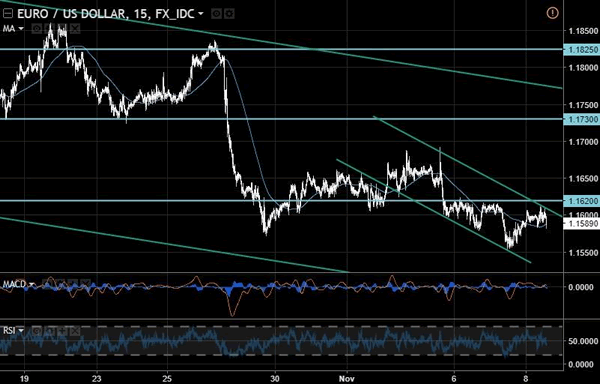
The EUR/USD price rose to the upper limit of the local descending channel but was not able to break through its upper limit. As a result, quotes resumed falling within the channel and the immediate objectives in case of maintaining the current momentum will be at 1.1550 and 1.1500. On the other hand, the signal for a local trend change to positive is possible if the price overcomes resistance at 1.1620.
AUD/USD
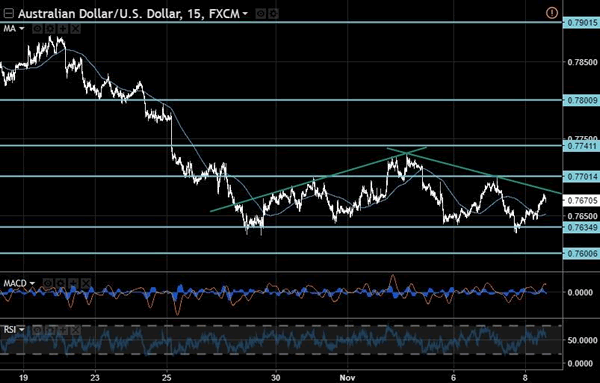
The AUD/USD price is approaching the inclined resistance line and breaking through it is likely to lead to continued increases up to 0.7700 and 0.7740. We should note that the amplitude of price fluctuations is reducing which may be a sign of a powerful movement coming up soon. The signal to sell with potential targets at 0.7500 and 0.7320 may follow the price fixing below 0.7635.
USD/JPY
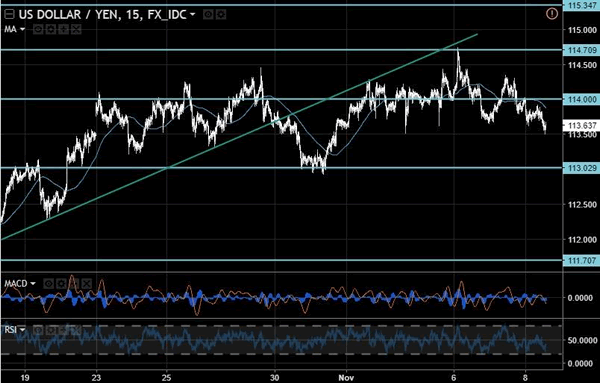
The USD/JPY was falling during the trading session and as a result, quotes reached the 113.50 mark. The closest target within the descending movement is likely to be 113.00. The RSI on the 15-minute chart came close to the oversold zone which points to the possibility of a rising correction soon with the potential of the price returning to 114.00 or the SMA100 on the 15-minute chart.
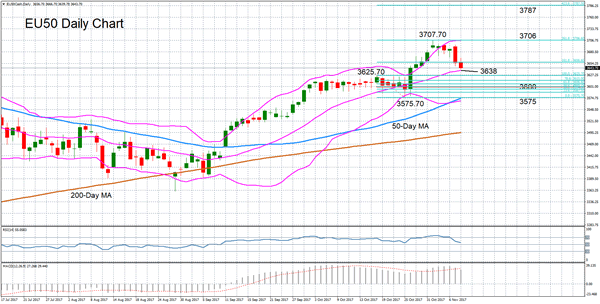
EU Stocks 50 Index Retreats from 2-Year High But Outlook Still Bullish
The EU 50 stocks index has turned bearish in the short term after the recent upleg became overstretched. The RSI is trending down after scaling overbought levels, pointing to a downside momentum in the near term.
Further losses could see prices finding immediate support from the middle Bollinger band at 3638. A move to the lower channel of the Bollinger bands would strengthen the negative bias and open the way towards the 3600 level, which is the 50% Fibonacci retracement of the downleg from 3625.70 to 3575.70. Further declines would likely see strong support being formed around the 50-day moving average and the lower Bollinger band in the 3570-75 region. A breach of this region would risk shifting the current bullish medium-term outlook to neutral.
The bullish structure has weakened somewhat as indicated by the MACD sliding below its signal line, though with price action firmly above the moving averages, it remains intact for now. A resumption of the uptrend should see resistance coming at the 261.8% Fibonacci retracement level at just above 3700, which also coincides with the upper Bollinger band. A break above that level would take the index to fresh 2-year highs to the 423.6% Fibonacci level at 3787 and towards its 2015 peak of 3835.20
Still Not Much Sign of Slowing in Canadian Housing Starts
Highlights:
- Nominal Housing starts were stronger than expected in October, rising to 223k from 219k in September. Last quarter's average, also at 223k, matched the strongest pace in five years.
- A sharp decline in single-unit starts, which hit a one year low in October, was offset by an increase in multi-unit construction. Those moves continue their respective trends seen in recent months.
- On a regional basis, starts picked up in Quebec and British Columbia, led by the multi-unit segment in both cases. Starts in Ontario dropped in both singles and multis.
- In a separate report, building permits fell to 208k annualized units in September from 214k in August.
Our Take:
The trend in Canadian housing starts held up at an elevated pace in October. At the national level there are few signs that a slowdown in the resale market, which began in April, is feeding through to homebuilding activity. On a regional basis, however, we do see some evidence of the two trends aligning. Housing starts have declined in Ontario, particularly in the single-unit segment which was at multi-year highs earlier in 2017 but has been hit particularly hard on the resale side following policy changes at the provincial level. That slowdown has been offset by stronger activity in British Columbia and Quebec. The former has seen a resurgent housing market following last year's policy-induced slowing, while the Quebec's strong economy appears to have boosted both starts and resales. Homebuilding has also picked up in the Prairies this year as those economies rebound from a slowdown in the energy sector.
We continue to expect a moderation in starts at the national level over the next year that would be more in keeping with what we are seeing on the resale side. The combination of policy changes, including measures set to go into effect in January, and rising interest rates is expected to result in a sustained cooling in existing home sales and less price pressure. In that environment it is hard to see housing starts remaining so far above 200k, which is still well in excess of underlying demographic demand.