Sample Category Title
DAX Unchanged as Markets Await German CPI Report
The DAX has ticked higher in the Monday session. Currently, the DAX is at 13,233.50, up 0.12%. German Retail Sales gained 0.5% in September, matching the forecast. Later in the day, Germany releases Preliminary CPI, with an estimate of 0.1%. In the US, the key event is Personal Spending, which is expected to gain 0.8%. On Tuesday, the eurozone releases CPI Flash Estimate and Preliminary Flash GDP. The US will publish CB Consumer Confidence.
The focus is on consumer data in Germany at the start of the week. Retail sales rebounded in impressive fashion, gaining 0.5% after two straight declines. We'll also get a look at Preliminary CPI, the primary gauge of consumer spending. The indicator has posted two consecutive gains of 0.1%, and the same reading is expected in the September reading. On an annualized basis, retail sales has gained 4.1%, indicative of strong consumer spending.
On Thursday, the DAX posted its strongest daily gain since August, jumping 1.3 percent. The catalyst for the gain was the ECB, which cut its asset purchase program (QE) from EUR 60 billion to 30 billion/mth. The ECB extended the program, which was due to terminate in December, to September 2018. However, investors were disappointed with ECB President Mario Draghi's dovish stance, with Draghi stating that QE would remain open-ended. There were expectations that the ECB would announce a date when the program would end. ECB President Mario Draghi has given himself plenty of wiggle room, as he can simply extend QE beyond next September. As for monetary policy, the ECB maintained interest rates at a flat 0.00%, and Draghi provided no hints about the timing of future rate hikes. The ECB appears in no rush to tinker with rate policy, and we're unlikely to see any rate increases until QE is completed.
Spaniards woke up to more uncertainty on Monday morning. On Friday, the central government made good on its threat and imposed direct rule on Catalonia. Just prior this move, the Catalonian government pre-empted Madrid and declared independence. There have been huge demonstrations in Barcelona, both in favor and against secession from Spain. Both governments have declared that moves by the other are null and void, so what happens now? The answer may lie with Catalonia's 200,000 civil servants, who must decide whether to follow orders from Madrid, or join a civil disobedience campaign which is being organized by the Catalan government. So far, the Spanish government has taken a hard line against the independence movement, deposing Catalan President Carles Puigdemont and threatening to file rebellion charges against him. Prime Minister Mariano Rajoy has called elections in Catalonia for December 21, but with developments folding on a daily basis, that date appears eons away.
Daily Technical Analysis: EURUSD, GBPUSD, USDJPY, USDCHF
EURUSD
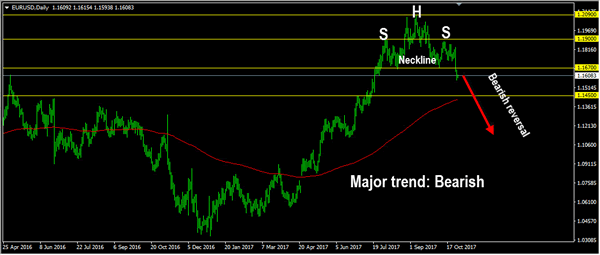
The EURUSD had a significant bearish momentum last week, broke below the “neckline” of the “head and shoulders” formation as you can see on my daily chart below. This fact confirms the bearish reversal scenario with nearest target seen at 1.1450. The bias is bearish in nearest term. Immediate resistance is seen around 1.1650/70 area. A clear break above that area could lead price to neutral zone in nearest term testing 1.1725 area but as long as stay below 1.1900 I remain bearish and any upside pullback should be seen as a good opportunity to sell.
GBPUSD
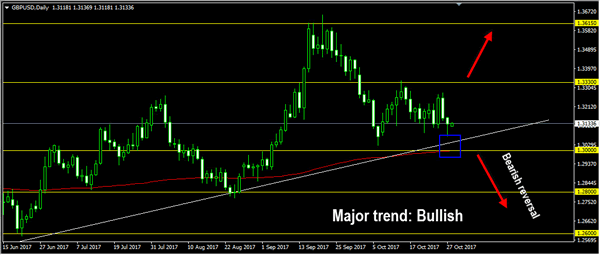
The GBPUSD was indecisive last week. The bias is neutral in nearest term probably with a little bearish bias testing the trend line support and daily EMA 200 located around 1.3000 region which remains a good place to buy with a tight stop loss. Immediate resistance is seen around 1.3162. A clear break above that area could trigger further bullish pressure testing 1.1.3225 area. On the downside, a clear break and daily close below 1.3000 would stop the major bullish trend and could be an early signal of a bearish reversal scenario with nearest target seen at 1.2800 area.
USDJPY
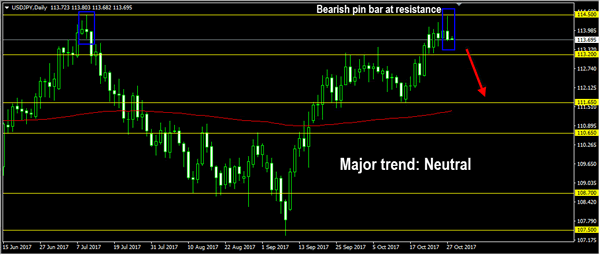
The USDJPY was indecisive last week. Price printed a bearish pin bar formation near 114.50 key resistance as you can see on my daily chart below suggests a potential bearish view. The bias is bearish in nearest term testing 113.20 support area. A clear break below that area would expose 112.50 or lower. On the upside, 114.50 remains a key resistance and good place to sell with a tight stop loss as a clear break above that area would expose 115.50 or higher. Overall I remain neutral.
USDCHF
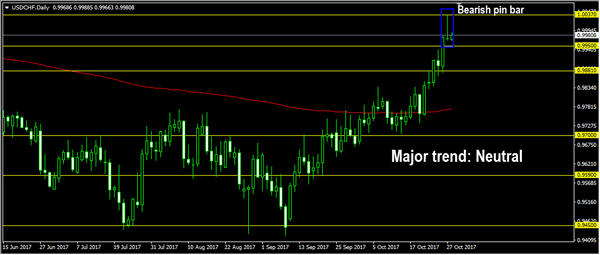
The USDCHF continued to trade higher last week topped at 1.0037 but closed lower at 0.9971. I still prefer a bullish scenario at this phase but we have a bearish pin bar formation as you can see on my daily chart below suggests a potential bearish pullback. The bias is neutral in nearest term. Immediate support is seen around 0.9950. A clear break below that area could trigger further bearish pressure testing 0.9910 – 0.9881 area. Immediate resistance is seen around 1.0037. A clear break above that area would nullify the bearish pin bar scenario targeting 1.0100 or higher. Overall I remain neutral.
EUR/USD – Euro Steady As German Retail Sales Rebound
The euro has posted slight gains in the Monday session. Currently, EUR/USD is trading at 1.1637, up 0.24% on the day. On the release front, German Retail Sales gained 0.5% in September, matching the forecast. This was a sharp improvement from the reading of -0.4% a month earlier. Later in the day, Germany releases Preliminary CPI, with an estimate of 0.1%. In the US, the key event is Personal Spending, which is expected to gain 0.8%. On Tuesday, the eurozone releases CPI Flash Estimate, and Preliminary Flash GDP. The US will publish CB Consumer Confidence.
In Spain, the Catalonia saga continues. On Friday, the central government made good on its threat and imposed direct rule on Catalonia. Just prior this move, the Catalonian government pre-empted Madrid and declared independence. There have been huge demonstrations in Barcelona, both in favor and against secession from Spain. Both governments have declared that moves by the other are null and void, so what happens now? The answer may lie with Catalonia’s 200,000 civil servants, who must decide whether to follow orders from Madrid, or join a civil disobedience campaign which is being organized by the Catalan government. So far, the Spanish government has taken a hard line against the independence movement, deposing Catalan President Carles Puigdemont and threatening to file rebellion charges against him. Prime Minister Mariano Rajoy has called elections in Catalonia for December 21, but with developments folding on a daily basis, that date appears eons away.
EUR/USD recorded it worst week since March, declining 1.3 percent. As expected, the ECB finally pressed the trigger and chopped QE from EUR 60 billion to 30 billion/mth. The ECB extended the program, which was due to terminate in December, to September 2018. However, investors were disappointed with ECB President Mario Draghi’s dovish stance, with Draghi stating that the ECB’s bond-buying program (QE) would remain open-ended. There were expectations that the ECB would announce a date when the program would end. ECB President Mario Draghi has given himself plenty of wiggle room, as he can simply extend QE beyond next September. As for monetary policy, the ECB maintained interest rates at a flat 0.00%, and Draghi provided no hints about the timing of future rate hikes. The ECB appears in no rush to tinker with rate policy, and we’re unlikely to see any rate increases until QE is completed.
Central Banks In Focus In Big Week For Markets
- Fed, BoJ and BoE meetings taking place this week;
- BoE expected to raise rates for the first time in a decade;
- US labour market and inflation data this week also key;
It's been a relatively calm start to trading on Monday but that isn't likely to last long with the rest of the week packed full of major economic and political events that should ensure markets remain quite volatile.
With the Federal Reserve, Bank of Japan and Bank of England all holding monetary policy meetings this week, there'll undoubtedly be a strong focus on central banks. When it comes to the Fed though, it may not be the interest rate decision itself that attracts the most attention, rather President Donald Trump's announcement on who will succeed Janet Yellen as Chair from February, with the incumbent still in the race.
With Stanley Fischer, the vice Chair, having left the Fed recently, there's actually two posts that need filling so it's possible that two of the three frontrunners – Jerome Powell, John Taylor and Yellen – take up prominent roles at the central bank. The Fed is not expected to make any changes to monetary policy at this week's meeting with a rate hike currently priced in for December – 98% according to Fed Funds futures versus 1% this week.
The BoE on the other hand is expected to raise interest rates this week, the first such move in a decade, with policy makers claiming to be concerned about above-target inflation in an environment that has so-far weathered the Brexit storm better than expected. Interestingly, despite markets strongly pricing in a rate hike – 85% as of this morning – policy makers have given the impression that they are not so convinced in recent public appearances. Should they vote in favour of a hike on Thursday, I will be very surprised if the decision is unanimous.
It's not just about central banks this week though with a whole host of economic data being released, including arguably the most important of the lot, the US jobs report. Markets may be pricing in a rate hike from the Fed in December but weak data between now and then will raise doubts about whether they will follow through. Wages are a key concern for policy makers when it comes to the shortfall in inflation, whereas job growth has been strong for some time, making the conundrum of why wage growth hasn't followed an increasing frustration.
We'll get inflation data for the US today in the form of the core personal consumption expenditure price index – the Fed's preferred measure – which is expected to show price growth remaining relatively subdued at 1.3% year over year. This will be accompanied by income and spending figures, the latter of which is expected to be particularly strong for September, with the former bouncing back to 0.4%.
Finally this week there's a number of companies that will report third quarter earnings, including 139 S&P 500 companies.
CRUDE OIL Approaching Long-Term Resistance
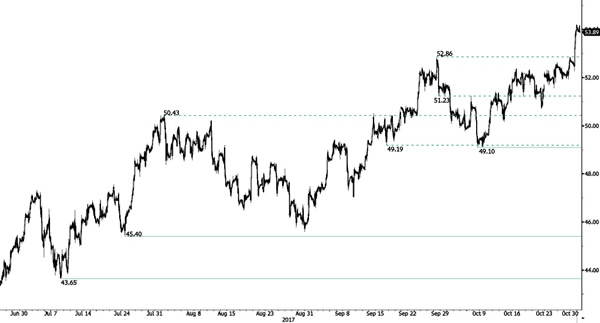
Crude oil has surged. Strong resistance given at 52.86 (28/09/2017) has been broken. Expected to show continued increase within this range.
In the long-term, crude oil has recovered after its sharp decline last year. However, we consider that further weakness are very likely. For the time being the pair lies in an upside momentum. Strong support lies at 35.24 (05/04/2016) while resistance can now be found at 55.24 (03/01/2017 high).
SILVER Continued Decline
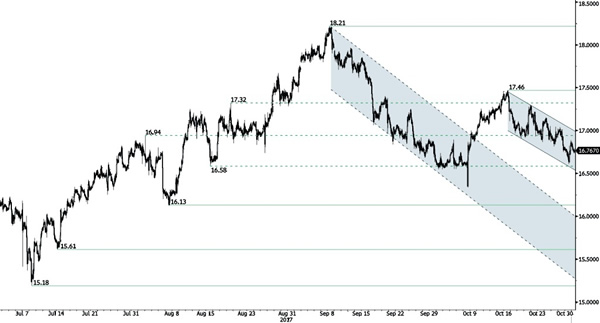
Silver is again grinding lower. Hourly support can be found at 16.60 927/10/2017 low). Hourly resistance is given at 17.46 (13/10/2017 high). Additional support can be found at 16.13 (06/10/2017 low).
In the long-term, the trend is rater negative. Further downsides are very likely. Resistance is located at 25.11 (28/08/2013 high). Strong support can be found at 11.75 (20/04/2009).
GOLD Riding Lower
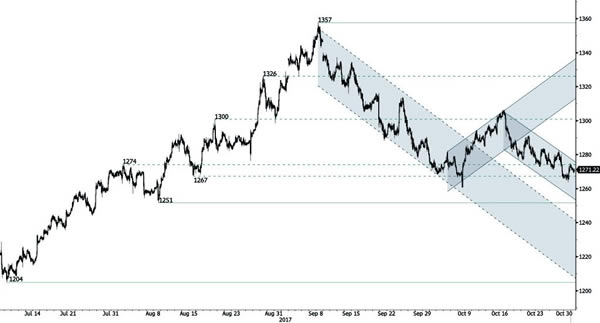
Gold remains weak. The technical structure confirms an underlying bearish trend. Strong support lies at a distance at 1204 (10/07/2017 high). Resistance is now located at 1288 (20/10/2017).
In the long-term, the technical structure suggests that there is a growing upside momentum. A break of 1392 (17/03/2014) is necessary ton confirm it, A major support can be found at 1045 (05/02/2010 low).
BITCOIN Setting A New All-Time High
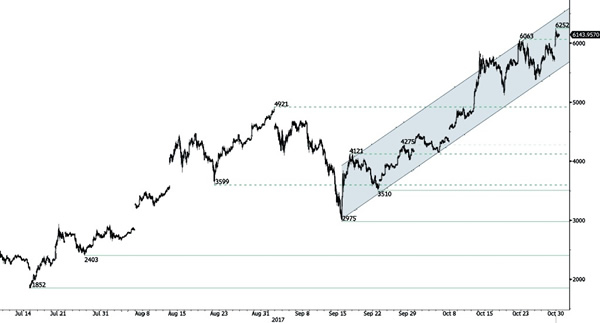
Bitcoin has broken key resistance at 6063. Strong support stands very far at 2975 (22/08/2017 low). The technical structure shows a very positive short-term momentum. Support can be located at 5325 (rising trendline). In the short-term, the digital currency should continue rising.
In the long-term, the digital currency has had an exponential growth. There are decent likelihood that the asset will reach $10'000.
EUR/CHF Back Within Former Uptrend Channel
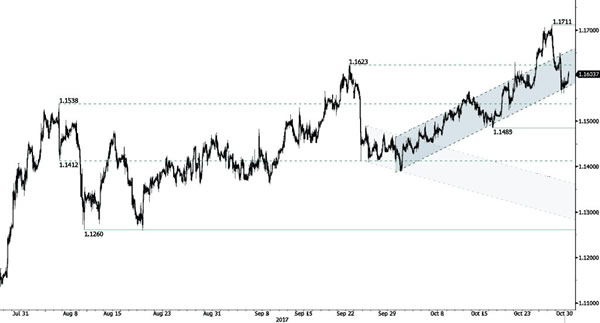
EUR/CHF is back within former uptrend channel. Support is given at 1.1610 (27/10/2017 low). Rising channel suggests further bullish momentum.
In the longer term, the technical structure has reversed. Strong resistance is given at 1.20 (level before the unpeg). Yet, the ECB's QE programme is likely to cause persistent selling pressures on the euro, which should weigh on EUR/CHF. Supports can be found at 1.0184 (28/01/2015 low) and 1.0082 (27/01/2015 low).
EUR/GBP Heading Lower
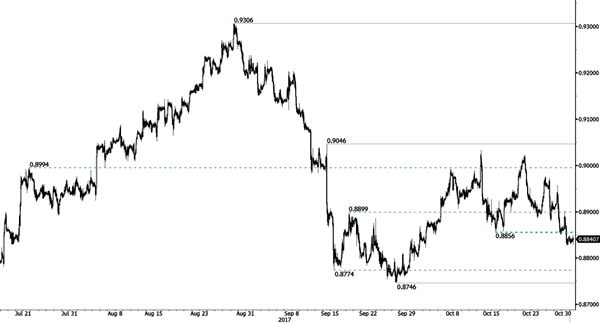
EUR/GBP is showing downside pressures. However, as long as prices are below the resistance at 0.9046 (05/09/2017 high), the shortterm technical structure is biased to the downside Hourly support is given at a distance at 0.8746 (27/09/2017 low).
In the long-term, the pair has largely recovered from recent lows in 2015. The technical structure suggests a growing upside momentum. The pair is trading above from its 200 DMA. Strong resistance can be found at 0.9500 (psychological level).