

Sample Category Title
EUR/USD Mid-Day Outlook
Daily Pivots: (S1) 1.1735; (P) 1.1767 (R1) 1.1798; More...
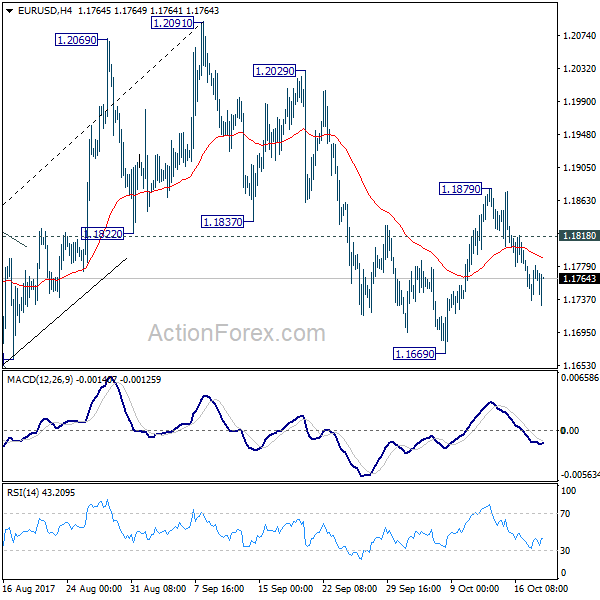
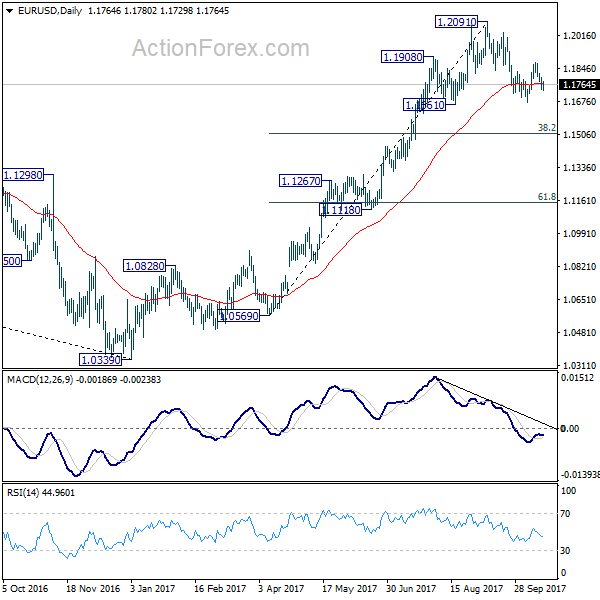
As long as 1.1818 minor resistance holds, deeper fall is expected in EUR/USD to 1.1669 support. Break there will confirm resumption of the whole corrective fall from 1.2091. In that case, EUR/USD will target 38.2% retracement of 1.0569 to 1.2091 at 1.1510. Strong support is expected there to complete the correction. Nonetheless, above 1.1818 will turn bias back to the upside and extend the rebound from 1.1669 through 1.1879.
In the bigger picture, rise from medium term bottom at 1.0339 is not finished yet. It's expected to continue after pull back from 1.2091 completes. And, next target will be 38.2% retracement of 1.6039 (2008 high) to 1.0339 (2017 low) at 1.2516. However, it should be noted that there is no confirmation of trend reversal yet. That is, such rebound from 1.0399 could be a correction. And the long term fall from 1.6039 (2008 high) could resume. Hence, we'd be cautious on strong resistance from 1.2516 to limit upside.
GBP/USD Mid-Day Outlook
Daily Pivots: (S1) 1.3136; (P) 1.3211; (R1) 1.3269; More....
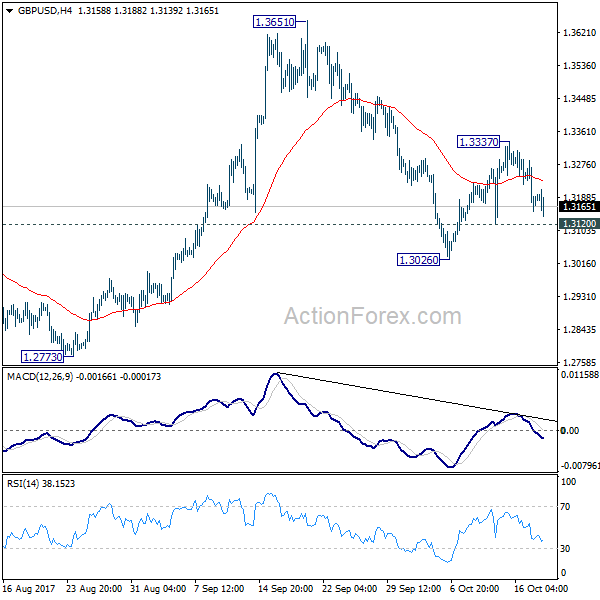
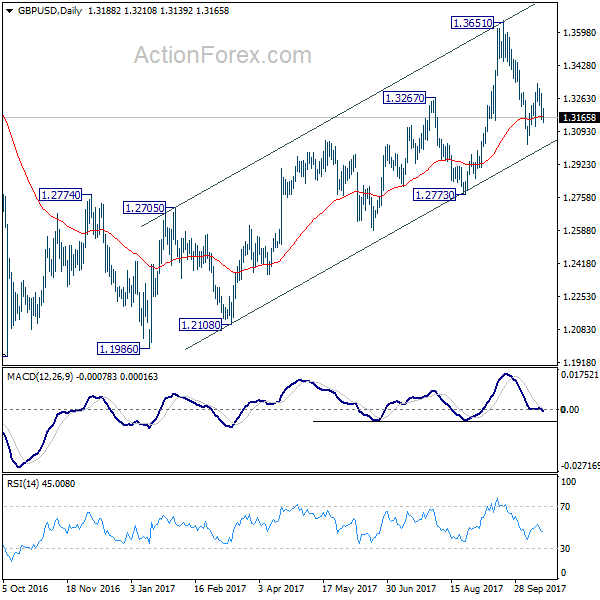
GBP/USD is holding above 1.3120 minor support and intraday bias remains neutral first. On the downside, break of 1.3120 will indicate that recovery from 1.3026 is completed at 1.3337. And fall from 1.3651 is resuming for 1.2773 support. That will revive that case that medium term rise from 1.1946 has completed at 1.3651. Meanwhile, above 1.3337 will bring retest of 1.3651 high instead.
In the bigger picture, while the medium term rebound from 1.1946 was strong, GBP/USD hit strong resistance from the long term falling trend line. Outlook is turned a bit mixed and we'll turn neutral first. On the downside, decisive break of 1.2773 key support will argue that rebound from 1.1946 has completed. The corrective structure of rise from 1.1946 to 1.3651 will in turn suggest that long term down trend is now completed. Break of 1.1946 low should then be seen. On the upside, break of 1.3835 support turned resistance will revive the case of trend reversal and target 38.2% retracement of 2.1161 (2007 high) to 1.1946 (2016 low) at 1.5466.
Strong Risk Appetite Sends Swiss Franc and Yen Lower, DAX Hit Record, DOW to Follow
Dollar trades generally higher today, except versus Canadian Dollar. But strength of the greenback is rather unconvincing against Euro, Aussie and even Sterling. The more decisive moves are found in USD/CHF and USD/JPY. That should be more likely due to strong risk appetite. German Dax hit new record high at 13094.76 earlier today and is maintaining most of the gains at the time of writing. US futures also point to higher open as DOW would extend recent record runs. Meanwhile, weaker than expected housing data from US also limits greenback's rally . Housing starts dropped to 1.13m in September, below expectation of 1.18m. Building permits also dropped to 1.22m, below expectation of 1.27m. From Canada, manufacturing shipments rose 1.6% mom in August.
Dollar strength on Taylor speculation far-fetched
The greenback is trading as the strongest one for the week and boosted by media report that US President Donald Trump was impressed by Stanford University Economic John Taylor at the Fed Chair candidate interview. Bets for Taylor to be the next Fed chair increased, making him one of the top three candidates alongside Jerome Powell and Kevin Warsh. Market reaction to the rise of Taylor was USD strength and an upward shift in the UST yield curve, hinging on hopes that this creator of the Taylor rule would accelerate the pace of rate hike if he has become the Fed' chief. We believe such expectation is a bit too far-fetched. More in Taylor Rule, Taylor Rules?
UK job data unlikely to derail BoE November hike
UK unemployment rate was unchanged at 4.3% in August, staying at 42 year low. Average weekly earnings rose 2.2% 3moy, above expectation of 2.1% 3moy. Claimant counts rose 1.7k in September, below expectation of 3.2k. Claimant count rate was unchanged at 2.3%. The set of data should have done little to change the chance of a November BoE rate hike. But wage growth was lagging behind CPI, which was at 3% in September, highest in more than five years. That will more likely than not to keep BoE's hands tied on more rate hikes in 2018.
ECB asset purchase program survived another legal challenge
ECB's asset purchase program survives another legal challenge today. Germany's Federal Constitutional Court rejected the request to stop Bundebanks from participation. The court said in a statement that "because of the high volume of purchases by the Bundesbank, disrupting bond purchases would endanger or even thwart the program's goal to raise inflation to about 2 percent." And, "granting the interim bid now would be more than just conserving the status quo, it would be identical with granting the lawsuit."
Chinese President Xi pledged to take center stage in the world
Chinese President Xi Jinping laid out his ambition to transform China by 2050, to become more "prosperous and beautiful." He hailed the economic progress under "socialism with Chinese characteristics". And said it presents as a "new choice for other countries". Xi also pledges to "take center stage in the world". On foreign policy, Xi emphasized that "no one should expect China to swallow anything that undermines its interests". On economy, he targets to move industries to "medium-high end" of the global value chain and foster a number of "world-class advanced manufacturing clusters". Regarding markets, Xi pledged to "improve the framework of regulation underpinned by monetary policy and macro-prudential policy, and see that interest rates and exchange rates become more market-based."
USD/JPY Mid-Day Outlook
Daily Pivots: (S1) 111.99; (P) 112.23; (R1) 112.43; More...
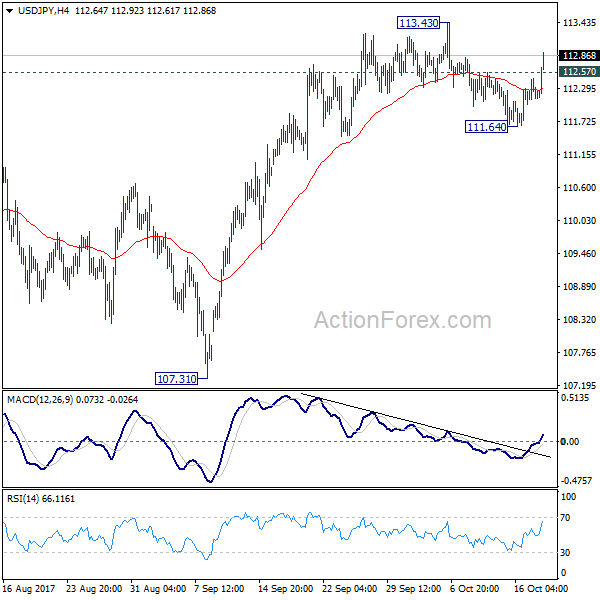
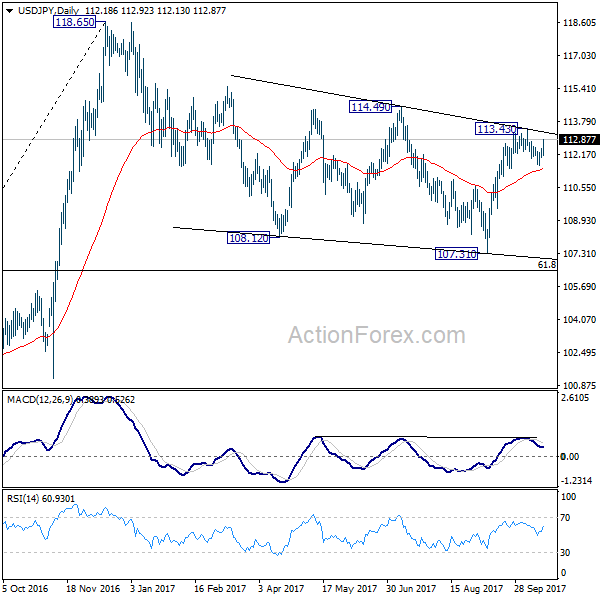
USD/JPY's strong rebound and break of 112.57 minor resistance suggests that pull back from 113.43 has completed at 111.64 already. And, rise from 107.31 is possibly resuming. More importantly, the development revives the case that correction from 118.65 has completed at 107.31. Intraday bias is now back on the upside for 113.43 first. Further break of 114.49 will confirm and pave the way to retest 118.65. However, break of 111.64 will mixed up the outlook again.
In the bigger picture, rise from 98.97 (2016 low) is seen as the second leg of the corrective pattern from 125.85 (2015 high). It's unclear whether this second leg has completed at 118.65 or not. But medium term outlook will be mildly bearish as long as 114.49 resistance holds. And, there is prospect of breaking 98.97 ahead. Meanwhile, break of 114.49 will bring retest of 125.85 high. But even in that case, we don't expect a break there on first attempt.
Economic Indicators Update
| GMT | Ccy | Events | Actual | Forecast | Previous | Revised |
|---|---|---|---|---|---|---|
| 23:30 | AUD | Westpac Leading Index M/M Sep | 0.10% | -0.08% | ||
| 08:30 | GBP | Jobless Claims Change Sep | 1.7K | 3.2K | -2.8K | -0.2K |
| 08:30 | GBP | Claimant Count Rate Sep | 2.30% | 2.30% | ||
| 08:30 | GBP | ILO Unemployment Rate 3M Aug | 4.30% | 4.30% | 4.30% | |
| 08:30 | GBP | Average Weekly Earnings 3M/Y Aug | 2.20% | 2.10% | 2.10% | 2.20% |
| 12:30 | CAD | Manufacturing Shipments M/M Aug | 1.60% | -0.30% | -2.60% | |
| 12:30 | USD | Housing Starts Sep | 1.13M | 1.18M | 1.18M | |
| 12:30 | USD | Building Permits Sep | 1.22M | 1.25M | 1.27M | |
| 14:30 | USD | Crude Oil Inventories | -2.7M | |||
| 18:00 | USD | Federal Reserve Beige Book |
Trade Idea Update: USD/JPY – Buy at 112.50
USD/JPY - 112.81
Original strategy :
Buy at 112.30, Target: 113.30, Stop: 111.95
Position : -
Target : -
Stop : -
New strategy :
Buy at 112.50, Target: 113.50, Stop: 112.15
Position : -
Target : -
Stop : -
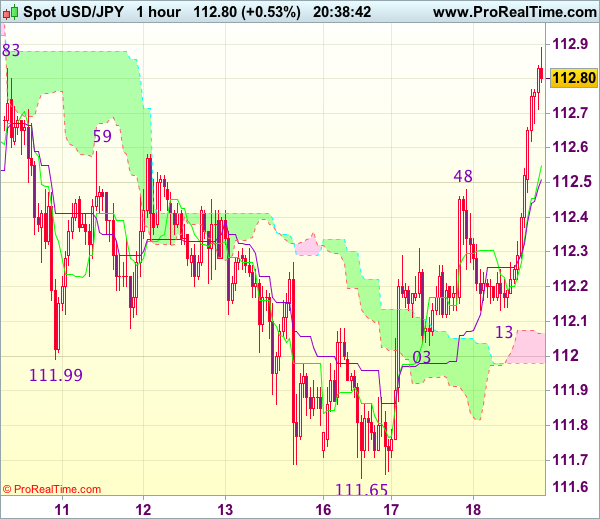
As dollar has surged again after finding renewed buying interest at 112.13 and just broke above resistance at 112.83, adding credence to our view that low has been formed at 111.65 and consolidation with mild upside bias remains for the rise from 111.65 low to extend gain to 112.95-00, however, near term overbought condition should limit upside to 113.30 and resistance at 113.44 should hold on first testing.
In view of this, we are looking to buy dollar on pullback as previous resistance at 112.48 (now support) should contain downside and bring another rise later. Below 112.25-30 would risk test of support area at 112.03-13 but price should stay well above said low at 111.65, bring another rise later.
Taylor Rule, Taylor Rules?
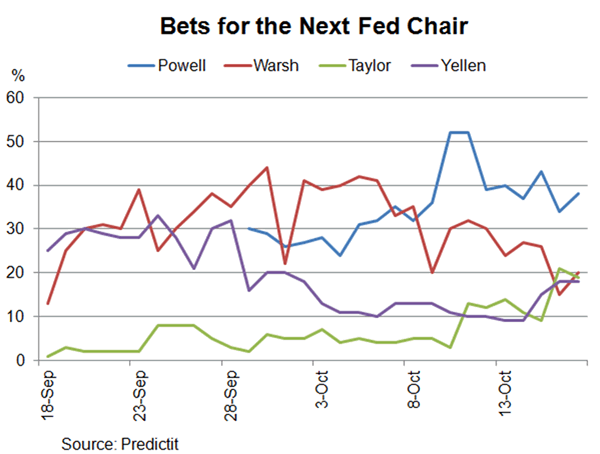
Lacking other exciting news, the market was thrilled by the media report that US President Donald Trump was impressed by Stanford University Economic John Taylor at the Fed Chair candidate interview. Bets for Taylor to be the next Fed chair increased, making him one of the top three candidates alongside Jerome Powell and Kevin Warsh. Market reaction to the rise of Taylor was USD strength and an upward shift in the UST yield curve, hinging on hopes that this creator of the Taylor rule would accelerate the pace of rate hike if he has become the Fed' chief. We believe such expectation is a bit too far-fetched.
First, the Fed's monetary policy decision is made by a committee of 12 voting members. As such, it would be difficult for a more hawkish or dovish Chair to alter the final decision. Second, although the Taylor rule implies a much higher policy rate than then current one, the elements comprising the formula is not unchangeable. Indeed, Taylor last week suggested that "one can easily adjust the equilibrium interest rate in the rule". It is expected that his stance would be more aligned with the mainstream if he is appointed. Third, a hawkish Fed chair would be in conflict with Trump's economic policy which aims at boosting growth with deregulation and tax reform. Trump in his election campaign had reiterated a number of times his preference for a weak US dollar. Assuming the US economic developments continue as expected by the Fed, its monetary stance would be more or less unchanged, i.e. rate hike to remain gradual and data-dependent while balance sheet reduction would carry out as schedule, with whoever being the next chair.
Fed Chair Appointment
It is widely believed that Trump would announce his decision on the next Fed chair before he leaves for Asia on November 3. The market has identified five key candidates for the role, namely, Jerome Powell, Kevin Warsh, John Taylor, Gary Cohn and Janet Yellen. While the dovish-centre Powell remains the most likely candidate, bets for Warsh and Taylor have been rising of late. Both Warsh and Taylor are considered as in the hawkish camp. For the former, he criticized at the Hoover Institution Monetary Policy Conference in May about the Fed's balance sheet reduction strategy, noting that the "preferred sequencing of rate increases and balance sheet reductions differ markedly from what was agreed when we conceived QE in the 'war room' amid the crisis". Back in 2010, Warsh criticized the then-Fed chair Ben Bernanke's QE extension.
Talk is cheap. During his capacity as a FOMC governor from 2006 to 2011, Warsh voted largely in line with the majority in the majority. He had not dissented on any vote cut and QE decision during the period of GFC. He also voted for the second round of QE, despite his reservation.
Taylor Rule, Taylor Rules?
Taylor is believed to be the "most hawkish" candidate amongst the five. This also explains why the greenback and Treasury yields rose after reports suggesting that Trump has good impression on him.
Taylor's hawkish image is more driven by his eponymous monetary policy rule (Taylor Rule), which implies that the Fed funds rate should be much higher than the current rate. The Atlanta Fed website (https://www.frbatlanta.org/cqer/research/taylor-rule.aspx) has a simulated Taylor rule model for one to plug in different values to get various estimates of Fed fund rates. If the neutral rate is set at the traditional 2%, the Fed funds rate, using Taylor rule, would be 2.94%, compared 1.25% currently. However, if we set the neutral rate at -0.2%, one derived from the model developed by San Francisco Fed president John Williams and Thomas Laubach, the Fed funds rate would be around 0.74%. This illustrates that how one interprets the neutral rate, another elements in the Taylor rule, affect the outcome.
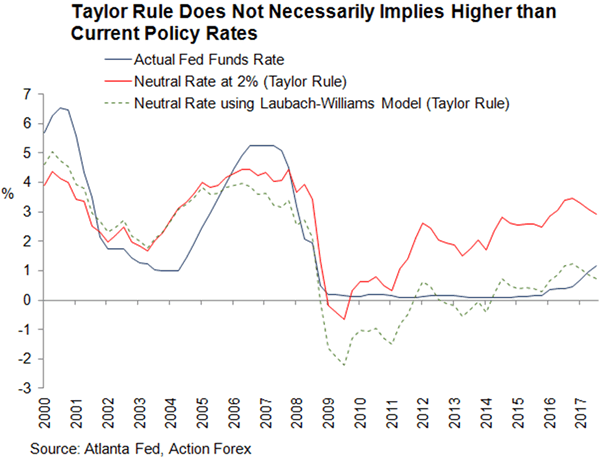
For John Taylor himself, his monetary stance may not be as hawkish as one has expected. In his speech titled Rules Versus Discretion: Assessing the Debate Over the Conduct of Monetary Policy at the Boston Fed conference last Friday, Taylor noted that "one can easily adjust the equilibrium interest rate in the rule". He added that the most important suggested change in policy rules in recent years is probably to "adjust the intercept to accommodate the lower estimate of the equilibrium real interest rate (R*)". He appears content with the situation that the FOMC members have recently adjusted the average estimate of the neutral by "at least one percentage point lower" than the original 2%.
Fed's Monetary Decision Marking
Unlike the RBNZ in which the government has unique power over the interest rate decision, the Fed's monetary decision is determined by the FOMC, a Committee consisting of 12 voting members: 7 members of the Board of Governors , the New York Fed president, and 4 of the remaining 11 Fed presidents, who serve one-year terms on a rotating basis. For the members in the Board of Governors, a full term is fourteen years with one term beginning every two years. A full term for the New York Fed president is five years. As such, the Committee turns over slowing. This avoids drastic changes in the monetary stance. There are also nonvoting fed presidents who attend the FOMC meetings, participate in the discussions, and contribute to the Committee's assessment of the economy and policy options. It would be quite impossible for the chair to override the monetary decision.
An important feature of Trumponomics is to stimulate US economy through deregulations and tax reform. He has also proposed improving the country's competitiveness on trade by a weak US dollar. It would be conflicting if the Fed chair he chooses turn out to be hawkish which would potentially send the currency higher.
We do not expect the next Fed chair to very much derail from the current monetary stance which seeks to increase the policy rate gradually and as the economic data justify. The balance sheet normalization process would also be largely in line with schedule.
Next EURUSD Down Leg Below 1.1730
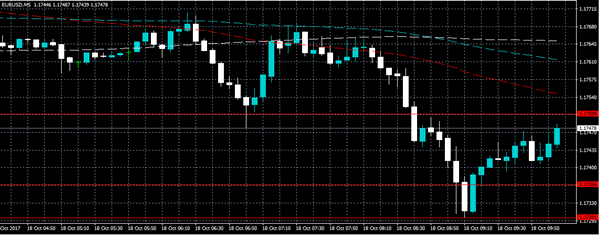
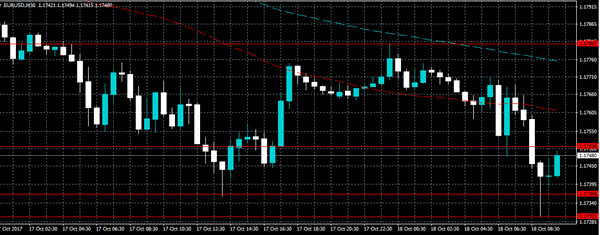
The euro has continued to slip lower against the U.S dollar on Wednesday, with the EURUSD pair moving to a new weekly price-low of 1.1730. Continued fears over Catalonia and a strengthening U.S dollar are the main factors contributing to intraday euro weakness. The pair is currently trading around the 1.1748 level, as investors await the start of the U.S trading session.
A move below the 1.1730 support level is likely to trigger the next major move lower in the EURUSD pair. Below the 1.1730 level, sellers are likely to target the 1.1713 level, and the pairs 200-week moving average, at 1.1685.
If the EURUSD fails to push price below the 1.1730 level, buyers are likely move to test intraday buying demand above the 1.1750 level. Further resistance above 1.1750 is found at the 1.1780 and 1.1798 levels.
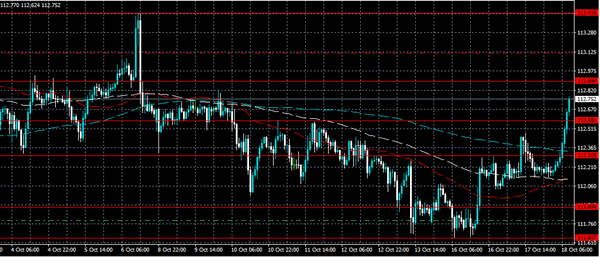
USDJPY Further Bullish Above 112.58
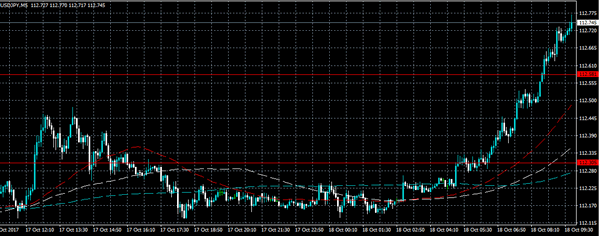
The U.S dollar has moved sharply higher against the Japanese Yen, hitting 112.76 during the European session, as the U.S dollar index gains strength across the board. The USDJPY pair is currently trading at the highs of the day, ahead of the release of key U.S housing data and the Federal Reserve's Beige Book.
The USDJPY pair is likely to continue to advance higher while trading above the key 112.58 technical level. Buyers are likely to target the 112.89 and 113.10 resistance levels. Further extended intraday technical resistance is found at 113.25 and 113.43.
Should the USDJPY pair start to decline below the 112.58 support level, intraday sellers are likely to push price-action back towards the 112.30 and 112.10 technical levels.
USD/CAD – Canadian Dollar Quiet Ahead Of Cdn. Manufacturing Sales
The Canadian dollar continues to have an uneventful week. In the Wednesday session, USD/CAD is trading at 1.2523, up 0.02% on the day. We could see some movement from the pair in the North American session, as Canada releases Manufacturing Sales. The markets are braced for a third straight decline, with an estimate of -0.1%. The US will release two key housing indicators. Building Permits is expected to slow to 1.25 million, and Housing Starts are forecast to remain unchanged at 1.18 million. On Thursday, the US releases unemployment claims and the Philly Fed Manufacturing Index.
With the Canadian economy performing well, could another rate hike be in the cards? The Bank of Canada surprised with a rate hike in September, but policymakers are concerned over tensions about NAFTA. Talks between Canada, the US and Mexico over re-negotiating NAFTA have floundered, raising the possibility that Donald Trump will scrap the agreement. The BoC would prefer not to raise rates until the NAFTA negotiations are settled. However, the Federal Reserve is widely expected to raise rates in December and the BoC will be under pressure to follow suit and protect the Canadian dollar.
With the Federal Reserve dropping strong hints that it will raise rates in December, the odds of a December hike are currently at a sizzling 91 percent. Just one month ago, the odds were 50-50 that the Fed would raise rates at the December meeting. Low inflation levels have been a key reason that the Fed has been reluctant to raise rates, but Fed Chair Janet Yellen and other policymakers have expressed optimism that inflation will move closer towards the Fed’s inflation target of 2 percent. The markets will be looking for some clues about the Fed’s rate plans, as FOMC members William Dudley and Robert Kaplan speak on Wednesday.
Technical Outlook: Copper Extends Pullback, News From China In Focus
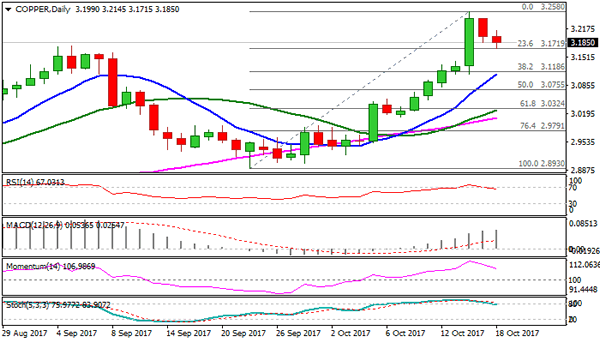
Copper future contract for December delivery fell further on Wednesday, extending pullback from three –year high at $3.2580 posted on Monday.
Fresh bearish extension on Wednesday dented strong support at $3.1770 (former high of 05 Sep/Fibo 23.6% of $2.8930/$3.2580 rally) and shows signs of further easing as bearish signal is generating on reversal of daily RSI and slow stochastic from overbought zone. Firm break here would risk bearish extension towards next strong supports at $3.1186/10 (Fibo 38.2%/Monday's low/rising 10SMA). Break here would sideline bulls and signal deeper correction.
Markets are closely watching the announcement from China's Communist Party Congress which started today and has boost of manufacturing and construction activities in the agenda.
China is the top consumer of metal and strengthening of these sectors signals higher demand and higher price of Copper. Traders expect more negative tones from the meeting which could signal deeper correction but larger picture shows strong uptrend which is expected to resume after correction.
Res: 3.2145, 3.2415, 3.2580, 3.2855
Sup: 3.1715, 3.1345, 3.1110, 3.0755
Market Update – European Session: UK Earnings Data Beats Expectations
Notes/Observations
UK earnings data beat expectations and keeps market on edge for possible BOE rate hike in coming months
UK ILO Unemployment steady and matches its 42-year low
Overnight
Asia:
China President Xi opened the 19th National Congress (held every 5 years): China to continue to grow at medium to high speed, economy shifting to period of seeking high quality. Reiterates pledge to deepen market-oriented reform of its exchange rate as well as its financial system, while at the same time strengthening the role of state firms in the economy
China FX Regulator SAFE: Expect CNY currency (yuan) exchange rate to have more stable foundation after 19th party congress
Europe:
ECB's Hansson (Estonia): Economic optimism may warrant 'small' monetary changes
Spain said to be planning to govern Catalonia from Madrid. Central government plan would include allowing Generalitat President Puigdemont to remain in office, but would strip him of power, with the central government assuming the functions of government in Madrid.
Business Europe advocacy group letter to EU’s Tusk stated that Euro companies were extremely concerned with slow pace of Brexit talks. Urged British government to rapidly provide concrete negotiating proposals to advance talks; want to avoid cliff edge
Northern regions Lombardy(Milan) and Veneto (Venice) to hold votes on regional autonomy on Sunday, Oct 22nd (**Insight Unlike Catalonia's vote, outright independence from the rest of Italy is not on the ballot)
Americas:
Fed's Harker (hawk, voter): Sees one more rate increase in 2017 and 3 in 2018
President Trump: I will make a decision about Fed Chair in a short time; I like all 5 candidates (**Note: expected to announce Fed decision before he leaves for Asia trip on Nov. 3rd)
Treasury semi-annual currency report again did not name an FX manipulators; removed Taiwan from the watch list while China, Germany, Japan, South Korea, and Switzerland remain on the monitoring list. Chinese currency has moved recently in a direction that would help correct the bilateral trade imbalance with the US
NAFTA ministers joint statement: to extend NAFTA talks beyond end of 2017 deadline; to lengthen the period between round four and round five of NAFTA talks
Energy:
Weekly API Oil Inventories: Crude: -7.1M v +3.1M prior
Economic Data
(ZA) South Africa Sept CPI M/M: 0.5% v 0.4%e; Y/Y: 5.1% v 5.0%e (6th straight reading within the SARB target)
(ZA) South Africa Sept CPI Core M/M: 0.4% v 0.3%e; Y/Y: 4.6% v 4.5%e
(UK) Aug Average Weekly Earnings 3M/Y/Y: 2.2% v 2.1%e; Weekly Earnings Ex Bonus 3M/Y: 2.1% v 2.0%e
(UK) Sept Jobless Claims Change: +1.7K v -0.2K prior; Claimant Count Rate: 2.3% v 2.3% prior
(UK) Aug ILO Unemployment Rate: 4.3% v 4.3%e (holds at 42-year low)
(EU) Euro Zone Aug Construction Output M/M: -0.2% v 0.2% prior; Y/Y: 1.6% v 2.8% prior
Fixed Income Issuance:
(DK) Denmark sold total DKK1.92B in 2020 and 2027 DGB bonds
(SE) Sweden sold total SEK2.5B in 2022 and 2028 Bonds
(NO) Norway sold NOK3.0B vs. NOK 3.0B indicated in 2021 Bonds; Avg Yield: 0.92% v 1.01% prior; Bid-to-cover: 2.65x v 2.01x prior
SPEAKERS/FIXED INCOME/FX/COMMODITIES/ERRATUM
Equities
Indices [Stoxx600 +0.2% at 391.3, FTSE +0.3% at 7537, DAX +0.3% at 13027, CAC-40 +0.2% at 5371, IBEX-35 -0.3% at 10184, FTSE MIB -0.1% at 22305, SMI +0.2% at 9292, S&P 500 Futures flat]
Market Focal Points/Key Themes:
European Indices trade mostly higher across the board with the Spanish IBEX once again under performing. The range remains narrow continuing the muted moves seen in October.
Dutch names Akzo Nobel reported results which missed consensus, as well as cutting its outlook, elsewhere ASML saw positive results, however shares do trade lower. Reckitt Benckiser trades slightly low after missing estimates, as well as announcing the creation of two new business units.
Other notable movers include Elisa after in line results, while Duerr trades lower despite raising their outlook.
Looking ahead notable earners include Abbott Labs and US Bancorp.
Equities
Consumer discretionary [RWS [RWS.UK] -15% (Acquistion, Placing), Zalando [ZAL.DE] -3.1% (prelim Q3)]
Materials: [Akzo Nobel [AKZA.NL] -1.7% (Earnings)]
Industrials: [ Duerr [DUE.DE] -2.9% (Lifts outlook)]
Technology: [ ASML [ASML.NL] -0.5% (Earnings)]
Telecom: [ Elisa [ELISA.FI] -5% (Earnings)]
Healthcare:[ Reckitt Benckiser [RB.UK] -0.4% (Earnings, cuts outlook), Biomeriux [BIM.FR] +1.1% (Earnings)]
Speakers
ECB chief Draghi reiterated his view that had a window of opportunity to enact structural reforms with monetary policy being accommodative,
Germany Constitutional Court rejected injunction to stop Bundesbank participation in ECB's asset purchases. Plaintiffs must wait until end of proceedings when judges could still ban Bundesbank participation (**Reminder: On Aug 15th German Federal Constitutional Court sent a lawsuit targeting ECB QE program to European Court of Justice)
Spain PM Rajoy: Have acted with moderation on Catalonia; reiterates call that leader Puigdemont to clarifyits independence claim
Spain Dep PM Saenz: Spain will apply article 155 if Catalans do not comply
Spain Budget Min Montoro: To present 2018 budget in coming weeks
Currencies
USD maintains a steady tone with market participants continuing to focus on Trump appointment for the Fed Chair position. Recent speculation was that Sanford’s Taylor was leading the contention (seen as hawkish thus USD bullish).
GBP traders were focus on unemployment and earnings data out of the UK. The slight beat on hourly earnings kept the door open for BOE to possible enact a rate hike in coming months. UK ILO Unemployment steady and matches its 42-year low. GBP/USD initially tested 1.3212 in the aftermath of the data but quickly saw the move retrace
EUR/USD was little changed in the session as ECB chief Draghi provided no clues on monetary policy ahead of next week’s rate decision.
USD/JPY was higher with focus on the upcoming Japanese elections (Oct 22nd) seen as maintain its Abenomic path to recovery.
The CNY currency (Yuan) was firmer as Chinese President Xi Jinping pledged to deepen reforms in his address at the 19th Party Congress
Fixed Income
Bund futures trade at 162.45 down 18 ticks as Federal Constitutional Court rejects bid to stop the Bundesbank ’ s cooperation with European Central Bank on quantitative easing program while lawsuits challenging the bond-buying plan are pending.Resistance stands initially at 162.75, followed by 163.51.
Gilt futures trade at 124.63 down 29 ticks after British unemployment rate stayed steady in August and wage inflation beat estimates. Continued downside eyeing 123.26. Upside targets 124.90 then 125.24.
Wednesday’s liquidity report showed Tuesday’s excess liquidity rose to €1.812T from €1.813T and use of the marginal lending facility climbed to €320M from €160M.
Corporate issuance saw $3B come to market via 3 issuers, headlined by Banco Santander $2.5B debt offering.
Looking Ahead
(SA) Saudi Arabia Crude Oil Data Published: JODI
05:30 (DE) Germany to sell €1.0B in 1.25% Aug 2048 Bunds;
05:30 (PT) Portugal Debt Agency (IGCP) to sell €1.0-1.25B in 3-month and 12-month bills
06:00 (BR) Brazil Oct FGV Inflation IGP-10 M/M: 0.5%e v 0.4% prior
06:30 (BR) Brazil Aug Economic Activity Index (Monthly GDP) M/M: -0.3%e v +0.4% prior; Y/Y: 2.0%e v 1.4% prior
06:45 (US) Daily Libor Fixing
07:00 (US) MBA Mortgage Applications w/e Oct 13th: No est v -2.1% prior
07:00 (ZA) South Africa Aug Retail Sales M/M: +0.3%e v -0.6% prior; Y/Y: 2.7%e v 1.8% prior
07:00 (RU) Russia to sell combined RUB30B in 2021 and 2033 OFZ bonds
07:30 (IT) ECB’s Angeloni (SSM Board member) in Berlin
07:45 (BE) ECB’s Praet (Beligium, chief economist)
08:00 (PL) Poland Sept Sold Industrial Output M/M: 6.8%e v 5.9% prior; Y/Y: 5.2%e v 8.8% prior
08:00 (PL) Poland Sept Retail Sales M/M: -1.1%e v +1.2% prior; Y/Y: 7.9%e v 7.6% prior
08:00 (PL) Poland Sept PPI M/M: 0.3%e v 0.4% prior; Y/Y: 3.1%e v 3.0% prior
08:00 (US) Fed’s Dudley (dove, FOMC voter) with member Kaplan (moderate, voter) on economic development
08:05 (UK) Baltic Dry Bulk Index
08:30 (US) Sept Housing Starts: 1.175Me v 1.180M prior; Building Permits: 1.240Me v 1.272M prior (revised from 1.300M)
08:30 (CA) Canada Aug Manufacturing Sales M/M: -0.3%e v -2.6% prior
09:00 (RU) Russia Sept Real Retail Sales M/M: -1.0%e v +3.8% prior; Y/Y: 2.1%e v 1.9% prior
09:00 (RU) Russia Sept Unemployment Rate: 4.9%e v 4.9% prior
10:15 (FR) ECB’s Coeure (France) on panel in Frankfurt
10:30 (US) Weekly DOE Crude Oil Inventories
11:00 (CO) Colombia Aug Trade Balance: -$0.9Be v -$0.5B prior