

Sample Category Title
A Trendless 24 hours
A Trendless 24 hours
For the most part, its been another trendless 24 hours in forex land as the markets appeared content to bang around in current ranges ahead of CPI. While tax reform has again stumbled out of the gate, the dollar has recovered some semblance of composure after PPI has surprised to the upside, boosting expectations for tonight's pivotal inflation print ( CPI).However, it's apparent that until more details are reaped from both the Fed and Tax reform, the market will play home on the range second guessing positioning and doing an about-face on headline risk
In a headline giddy Thursday, there appeared to be a significant compromise brewing amongst Republicans but given the bloated nature of the current Tax code for every compromise tabled there seems to be another band-aid fixed elsewhere. Understanding and patience will be the name of the game for this to pass but it would not surprise me if we found ourselves back dead in the water next week.
The pound was the most prominent headline chaser falling to 1.3120 on an ambiguous headline ” BARNIER SAYS BREXIT TALKS HAVE REACHED DEADLOCK”. IN fact, this comment was completely misread as he was simply referring to the ” divorce bill”.Then GBP rocketed to just shy of the 1.3300 level when German newspaper Handelsblatt says Barnier may offer the UK a 2y transition stay in the EU market if the UK agreed to settle its financial obligations with the EU and sign a divorce agreement.The proposed extension sits well with the markest and reduces the likelihood of a “Cliff Edge” scenario, but this is not a new negotiating ploy so chasing top side sterling risk is definitely at one's peril.
On the Fed Chair front, its expected this critical decision will be not arriving until November with the latest market straw polls indicating 50 % of participants view Jerome Powell as the incumbent. This view has also weighed on dollar sentiment this week given his more centrist -doveish lean than the markets early front-runner Kevin Warsh.
What have we gleaned from this week?
1) The FOMC minutes confirmed that the Fed is erring on data dependency. Not surprisingly when they are now faced with both a possible interest rate hike and the daunting task of balance sheet reduction
2) Tax Reform, for the most part, remains stuck in the muck despite some concessions.
3) EU political concerns are fading.
The sum of these parts suggests buoyant risk appetite a less attractive US dollar with higher Beta currencies like the Aud and Kiwi the near-term shooting stars. But let's see what surprises CPI may have in store.
USD/CAD Canadian Dollar Lower After Oil Falters
The Canadian dollar depreciated on Thursday due to a report by the International Energy Agency that dampened the energy market’s optimism on demand growth. The IEA numbers put demand for Organization of the Petroleum Exporting Countries (OPEC) crude would be at around 32.5 million barrels which is 150,000 barrels below current production levels. The OPEC and other major producers agreed to cut output and it seems that even after that supply is still higher than demand.
Canadian home resale prices dropped to a seven year low, while new home prices remained flat. The major catalyst of the Canadian real estate cool down was the Bank of Canada (BoC) two rate hikes so far in 2017. The central bank remains cautious about what even higher rates could do to households that are carrying record levels of debt, particularly in mortgages.
The US dollar traded higher versus the loonie after US data posted strong gains. US producer prices rose by the most in six months. The PPI was up 0.40 percent in September and comes at a time when the market is giving more weight to inflation data. The data is particularly strong considering the weather played a huge factor during that period.
The fourth round of NAFTA negotiations will kick off in Virginia this week. The Trump administration has played hardball ahead and during the negotiations with even the US Chamber of Commerce saying that rules of origin demands could torpedo the talks.
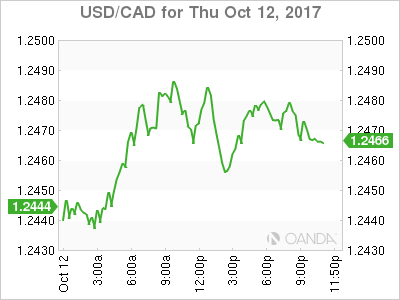
The USD/CAD is trading at 1.24780 at the end of the North American session. Inflation data in the US is expected to continue to boost the USD after a strong PPI. The Fed minutes released yesterday were full of concerns from FOMC members about persistent low inflation. Canadian data will be absent on Friday as there are no major releases schedules with all eyes on US retail sales and consumer price index.
The US Bureau of Labor Statistics will release the consumer price index (CPI) on Friday, October 13 at 8:30 am EDT. Core CPI is expected to have gained 0.2 percent, the same as last month for the change in inflation excluding food and energy. The more volatile CPI reading is forecasted at 0.6 percent. US retail sales data will also be released at the same time with core sales anticipated to have gained 0.9 percent. The headline figure adding back auto is expected to have jumped 1.7 percent. The rebound in both is expected to be directly linked to the negative impact hurricanes Harvey and Irma had on purchasing decisions.
The rise of US producer prices (PPI) on Thursday by 0.4 percent doubled the forecast and another inflationary data gain on Friday could put the FOMC minutes in a new light. If inflation is indeed rising faster than expected it could move the emphasis on the doves and put the hawks back in the drivers seat ahead of the December Fed meeting.
The release of the consumer price index on Friday will be a decisive indicator to close out the week of the US dollar. The minutes from the September Federal Open Market Committee (FOMC) meeting showed a growing concern that the factors keeping inflation low could be more longer term than originally thought. Many FOMC members still see another rate hike as appropriate despite those concerns leaving the decision on the table for December but the outlook for 2018 is for less tightening actions from the U.S. Federal Reserve.
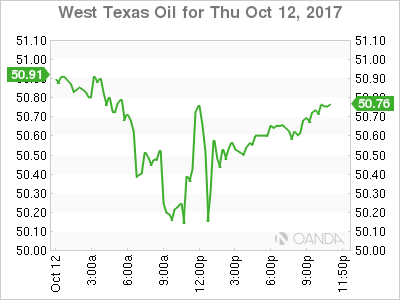
Oil gave back some of the gains of the week despite optimism from producers about higher energy demand forecasts and the release of the US weekly crude inventories showing a 2.7 million barrel drawdown on Thursday. The main factor for the decline in prices was a report by the International Energy Agency that forecasted lower demand for Organization of the Petroleum Exporting Countries (OPEC) crude. Current production is more that the appetite which means that oil prices can only recover if OPEC and other major producers not only extend the duration of the cut agreement, but limit their production even further.
US supply is not bound by this agreement and continues to ramp up higher making the OPEC cuts less effective. The US has turned from a net importer of oil to an exporter and with global demand for energy products stable the downward pressure on prices will continue until something changes.
Market events to watch this week:
Friday, October 13
8:30am USD CPI m/m
8:30am USD Core CPI m/m
8:30am USD Core Retail Sales m/m
8:30am USD Retail Sales m/m
Dollar Mixed Ahead Of US Inflation Indicator
Retail sales and inflation to make or break USD
The US dollar is higher against the NZD, AUD, GBP and JPY but finds itself lower against the CAD, EUR and CHF. The currency did not build a lot of momentum after the release of the Federal Open Market Committee (FOMC) minutes released Wednesday. The US central bank remains committed to higher rates, but there is a growing concern about consistent low inflation.
The US Bureau of Labor Statistics will release the consumer price index (CPI) on Friday, October 13 at 8:30 am EDT. Core CPI is expected to have gained 0.2 percent, the same as last month for the change in inflation excluding food and energy. The more volatile CPI reading is forecasted at 0.6 percent. US retail sales data will also be released at the same time with core sales anticipated to have gained 0.9 percent. The headline figure adding back auto is expected to have jumped 1.7 percent. The rebound in both is expected to be directly linked to the negative impact hurricanes Harvey and Irma had on purchasing decisions.
The rise of US producer prices (PPI) on Thursday by 0.4 percent doubled the forecast and another inflationary data gain on Friday could put the FOMC minutes in a new light. If inflation is indeed rising faster than expected it could move the emphasis on the doves and put the hawks back in the drivers seat ahead of the December Fed meeting.
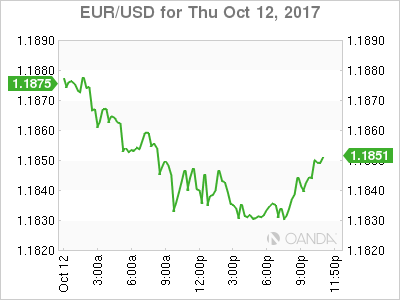
The EUR/USD gained 0.20 percent since the Asian open on Thursday. The single currency is trading at 1.18364 on the back of strong eurozone data. Industrial production was 3.8 percent in August and beat expectations of a 2.6 percent rise. The improvement of economic indicators has been steady and could provide further evidence of recovery ahead of the European Central Bank (ECB) meeting. The central bank is anticipated to start tapering its QE program this year, which is boosting the EUR.
While the Fed tried to communicate to the market that tapering did not mean tightening it seems ECB President Mario Draghi wants to be more clear on the subject by saying earlier today that current rates will remain well past the end of the bond buying program. The market is not buying it, as it happened with the Fed and the EUR is rising. German policy makers will not be happy with those words as they have pushed for and end to all stimulus
US data also posted strong gains. US producer prices rose by the most in six months. The PPI was up 0.40 percent in September and comes at a time when the market is giving more weight to inflation data. The data is particularly strong considering the weather played a huge factor during that period.
The release of the consumer price index on Friday will be a decisive indicator to close out the week of the US dollar. The minutes from the September Federal Open Market Committee (FOMC) meeting showed a growing concern that the factors keeping inflation low could be more longer term than originally thought. Many FOMC members still see another rate hike as appropriate despite those concerns leaving the decision on the table for December but the outlook for 2018 is for less tightening actions from the U.S. Federal Reserve.
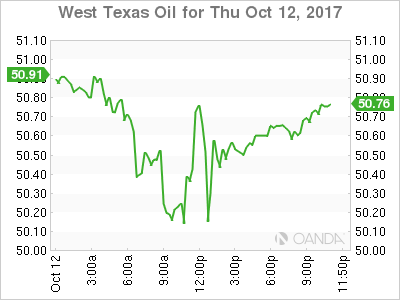
Oil gave back some of the gains of the week despite optimism from producers about higher energy demand forecasts and the release of the US weekly crude inventories showing a 2.7 million barrel drawdown on Thursday. The main factor for the decline in prices was a report by the International Energy Agency that forecasted lower demand for Organization of the Petroleum Exporting Countries (OPEC) crude. Current production is more that the appetite which means that oil prices can only recover if OPEC and other major producers not only extend the duration of the cut agreement, but limit their production even further.
US supply is not bound by this agreement and continues to ramp up higher making the OPEC cuts less effective. The US has turned from a net importer of oil to an exporter and with global demand for energy products stable the downward pressure on prices will continue until something changes.
Market events to watch this week:
Friday, October 13
8:30am USD CPI m/m
8:30am USD Core CPI m/m
8:30am USD Core Retail Sales m/m
8:30am USD Retail Sales m/m
Pound Gets A Glimmer Of Hope
The Bank of England meeting draws ever-closer but Thursday's big rebound in the pound shows it's still all about politics and Brexit. The New Zealand dollar was the top performer while the euro lagged. Chinese trade balance isn't on most economic calendars but it might be released early. A new GBP trade was issued to Premium members today, 6 days after the last GBP trade was closed at a profit.
A report in the German press said that the EU's Barnier wants to offer Theresa May a two year transition period before the full Brexit. Cable had been slumping on the day but immediately shot to 1.3250 from 1.3175 and continued another 40 pips higher from there before running into resistance at 1.3300.
In a sense, the headline shouldn't come as a surprise. The term 'transition period' is a misnomer. The EU will basically offer the UK another two years in the EU, under all the same EU terms. There is no transitioning, it's the same old deal.
At the same time, it's the first actual attempt at negotiating from the EU. Up to this point, all the signals suggested they were intent on punishing the UK so as to dissuade anyone else from exiting. Still, this may prove to hardly be an effort to negotiate. What we did learn for sure is that any negotiation-positive headlines provide longer lasting pound gains than any hawkish BoE chatter. It will be interesting to compare that to BOE headlines in the weeks ahead as we sort out whether May or Carney is the hand guiding GBP. But before November's BoE decision/inflation report, stay tuned for the next week's crucial UK-EU talks.
In US news, PPI numbers were released Thursday and core measures were a touch on the high side. Normally, that wouldn't be notable but it sparked a 20-pip rally in the US dollar. It was later erased but the initial reaction underscores how sensitive the market will be to Friday's CPI report.
Another report that could move markets (and the Aussie) is the September China trade balance report at 0200 GMT. The balance is less-important than imports and exports, where are expected up 16.5% and 10.9%, respectively.
Trade Idea Wrap-up: GBP/USD – Stand aside
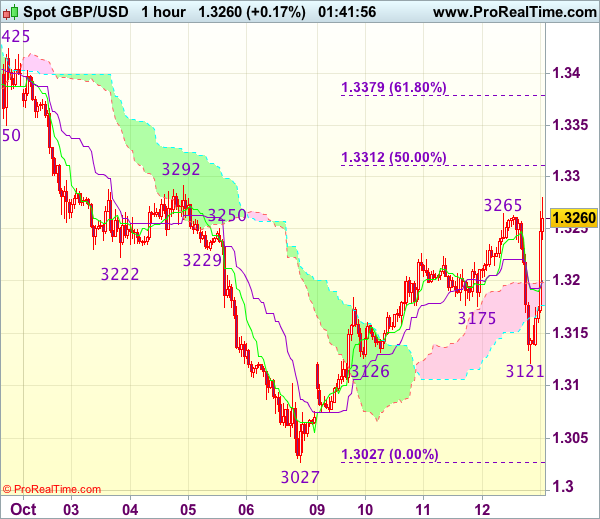
GBP/USD - 1.3275
Most recent candlesticks pattern : N/A
Trend : Down
Tenkan-Sen level : 1.3206
Kijun-Sen level : 1.3206
Ichimoku cloud top : 1.3199
Ichimoku cloud bottom : 1.3176
Original strategy :
Sold at 1.3200, stopped at 1.3235
Position : - Short at 1.3200
Target : -
Stop : - 1.3235
New strategy :
Stand aside
Position : -
Target : -
Stop : -
Despite intra-day initial fall to 1.3121, the subsequent rally dampened our bearishness and suggesting near term upside risk remains for the rise from 1.3027 to bring a stronger retracement of recent decline towards 1.3310-15 (50% Fibonacci retracement of 1.3596-1.3027), however, near term overbought condition should limit upside to 1.3345-50 and price should falter below 1.3375-80 (61.8% Fibonacci retracement) and bring retreat later.
In view of this, would not chase this rise here and would be prudent to stand aside in the meantime. Below 1.3240 would bring test of the Kijun-Sen (now at 1.3206) but only break there would suggest top is possibly formed, bring weakness to the lower Kumo (now at 1.3176) and then 1.3150.
Trade Idea Wrap-up: USD/CHF – Hold short entered at 0.9755
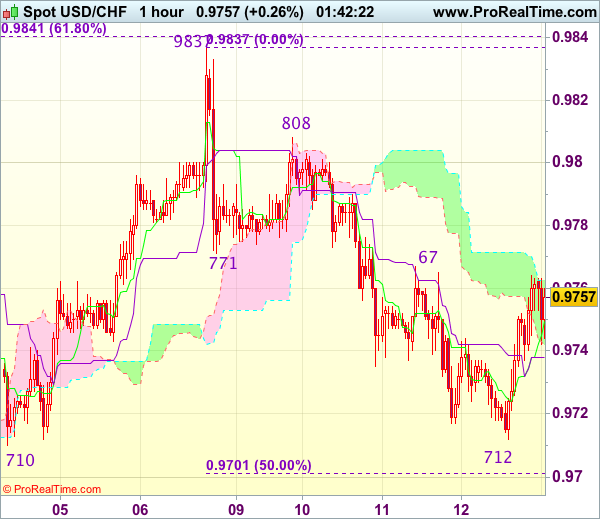
USD/CHF - 0.9749
Most recent candlesticks pattern : N/A
Trend : Near term up
Tenkan-Sen level : 0.9750
Kijun-Sen level : 0.9739
Ichimoku cloud top : 0.9763
Ichimoku cloud bottom : 0.9742
Original strategy :
Sold at 0.9755, Target: 0.9655, Stop: 0.9790
Position : - Short at 0.9755
Target : - 0.9655
Stop : - 0.9790
New strategy :
Hold short entered at 0.9755, Target: 0.9655, Stop: 0.9790
Position : - Short at 0.9755
Target : - 0.9655
Stop : - 0.9790
Although the greenback has rebounded after holding above previous support at 0.9710 and consolidation with initial upside bias is seen, reckon resistance at 0.9767-71 would limit upside and bearishness remains for the decline from 0.9837 top to resume after consolidation, below said support at 0.9710-12 would confirm and extend weakness to 0.9669-70 (61.8% Fibonacci retracement of 0.9565-0.9837 and previous support) but previous support at 0.9642 should remain intact due to oversold condition.
In view of this, we are holding on to our short position entered at 0.9755. Only break of resistance at 0.9808 would signal an intra-day low is formed and indicate the pullback from 0.9837 has ended, bring retest of this level later.
Trade Idea Wrap-up: EUR/USD – Buy at 1.1805
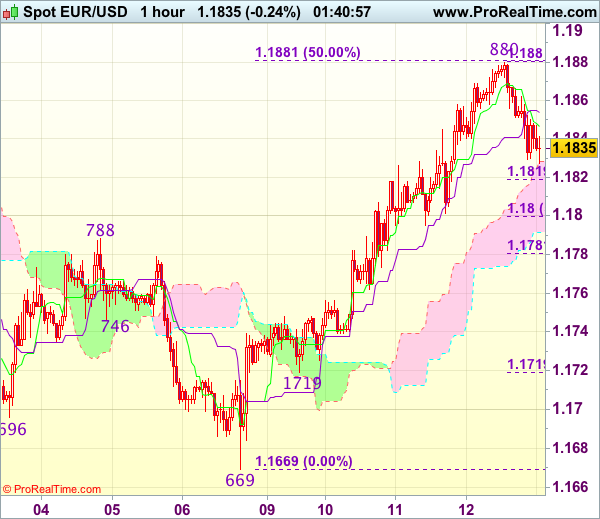
EUR/USD - 1.1844
Most recent candlesticks pattern : N/A
Trend : Near term up
Tenkan-Sen level : 1.1847
Kijun-Sen level : 1.1854
Ichimoku cloud top : 1.1828
Ichimoku cloud bottom : 1.1792
Original strategy :
Buy at 1.1805, Target: 1.1905, Stop: 1.1770
Position : -
Target : -
Stop : -
New strategy :
Buy at 1.1805, Target: 1.1905, Stop: 1.1770
Position : -
Target : -
Stop : -
As the single currency has retreated after rising to 1.1880 earlier today, suggesting minor consolidation below this level would be seen and pullback to 1.1815-20 (38.2% Fibonacci retracement of 1.1719-1.1880) is likely, however, reckon 1.1800-01 (50% Fibonacci retracement and previous support) would contain downside and bring another rise later, above said resistance at 1.1880 would signal the rise from 1.1669 low is still in progress for gain to 1.1895-00 (61.8% Fibonacci retracement of 1.2035-1.1669) but overbought condition should prevent sharp move beyond 1.1930-35 (61.8% Fibonacci retracement of 1.2093-1.1669) and 1.1970 should remain intact.
In view of this, would not chase this rise here and we are still looking to buy euro on subsequent pullback as 1.1800-05 should limit downside and bring another rebound. Below minor support at 1.1795 would defer and risk correction to 1.1770 but downside should be limited to 1.1745-50 and price should stay above indicated support at 1.1719, bring another rise later.
Trade Idea Wrap-up: USD/JPY – Sell at 112.80
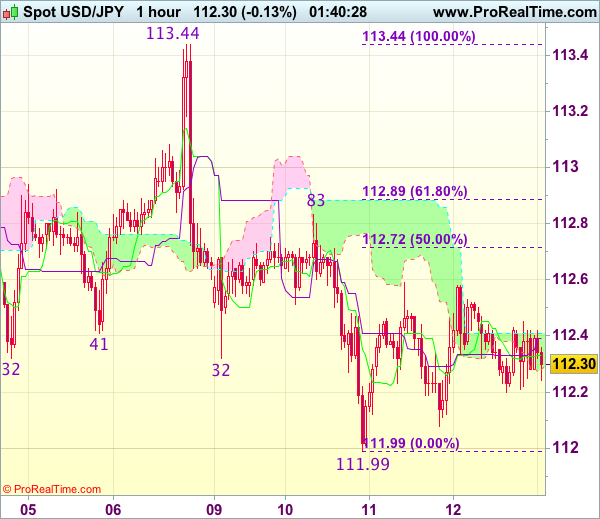
USD/JPY - 112.43
Most recent candlesticks pattern : N/A
Trend : Near term down
Tenkan-Sen level : 112.39
Kijun-Sen level : 112.33
Ichimoku cloud top : 112.41
Ichimoku cloud bottom : 112.39
Original strategy :
Sell at 112.80, Target: 111.80, Stop: 113.15
Position : -
Target : -
Stop : -
New strategy :
Sell at 112.80, Target: 111.80, Stop: 113.15
Position : -
Target : -
Stop : -
Although dollar has retreated after faltering below resistance at 112.59, as long as this week’s low at 111.99 holds, risk of another rebound to 112.70-75 (50% Fibonacci retracement of 113.44-111.99) cannot be ruled out, however, reckon 112.83-89 (yesterday’s high and 61.8% Fibonacci retracement) would limit upside and bring another decline later, below said support at 111.99 would add credence to our view that top has been formed at 113.44 and extend weakness to 111.75-80, then towards 111.47 support but oversold condition would limit downside and reckon 111.11 support would remain intact.
In view of this, we are looking to sell dollar on recovery as 112.83 resistance should limit upside and bring another decline. A break of indicated level at 112.83-89 would abort and signal low is formed, bring a stronger rebound to 113.10-20 but price should falter well below said last week’s high at 113.44.
Traders Waiting for Consumer Inflation Data from US
The EUR/USD price fell today despite positive news on industrial production growth in the Eurozone. Production expanded by 1.4% in August against the forecasted increase of 0.6% and 0.3% growth in July. The possibility of a rate hike in December for the US received another boost following the release of producer price index data that showed growth of 0.4% in September which doubled August's figure. Investors are anticipating retail sales data and the consumer inflation report in the US which are key indicators for the FOMC. An acceleration of inflation growth will lead to an increased probability of monetary policy tightening before the end of 2017 and that in turn will put significant pressure on the EUR/USD quotes.
The British pound lost some ground due to the lack of progress in negotiations between the UK and European Union on the terms for Brexit. Trade talks that were anticipated to start next week will now be delayed and the news is putting pressure on the sterling.
The USD/JPY quotes are consolidating in expectation of new drivers. Tensions between the US and North Korea and between Catalonia and Spain have eased which leads to lower interest in defensive assets like the Japanese yen. The yen did receive some positive news from the report on Bank lending in Japan that has slowed to 3.0% in September, which was by 0.4% better than the average forecast. An increase in volatility for the guppy is expected tomorrow after the release of the consumer price index (CPI) report in the US.
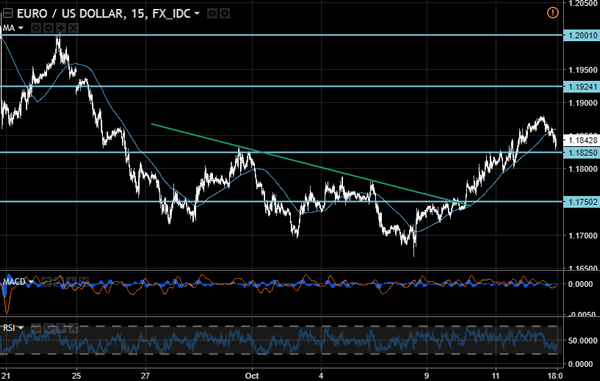
EUR/USD
The single currency rolled back today and approached an important support line at 1.1825. Breaking through this level may become the trigger for further price drops with objectives at 1.1750 and 1.1620. In case of opening short positions, the stop should be set above 1.1875. We do not exclude growth resuming with potential goals at 1.1925 and 1.2000.
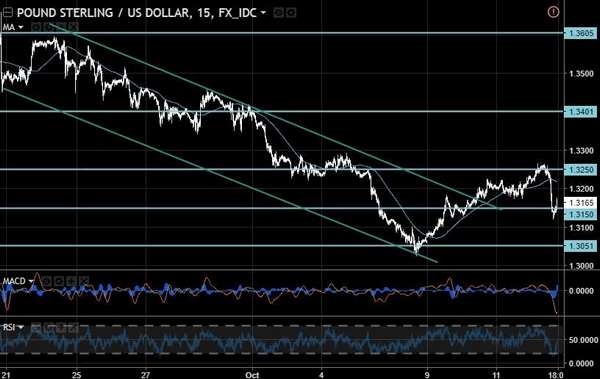
GBP/USD
The British pound dropped sharply today, but was able to rebound upwards after an unsuccessful attempt to fix below 1.3150. The next target in case of continuing the positive impulse will be 1.3250 and its overcoming may become the basis for more price increases to 1.3400 and 1.3600. In order to resume the descending movement to the 1.3000-1.3050 range, it will need to fix below 1.3150.
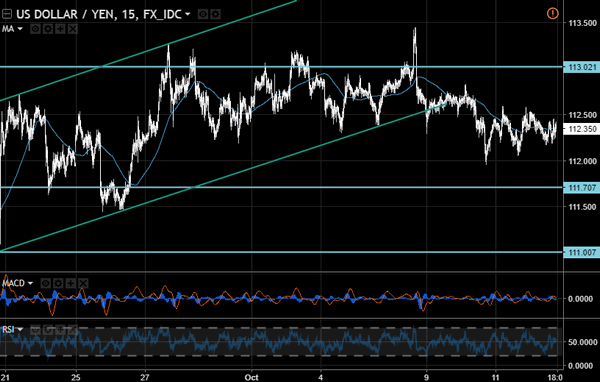
USD/JPY
The amplitude of price fluctuations of the USD/JPY is falling and that may signal a powerful movement soon. The trigger for this move may come from the CPI report in the US that will be published tomorrow at 12:30 GMT. In order to continue growth up to 114.00 and 114.70 the quotes need to overcome 113.00. The closest supports that may be reached in case of a decline are located at 111.70 and 110.30.
Pound Drifts Lower after Barnier Says Brexit Talks are in “Deadlock”; Dollar Recovers
The pound could not sustain its rally started during the Asian session on Thursday after discouraging comments on Brexit's progress by the EU chief negotiator pushed the currency down, making it the worst performer among its major peers. The pound's weakness, as well as US data on PPI and initial jobless claims, gave a lift to the dollar.
The fifth round of Brexit talks, which are to be temporarily suspended when the two-day EU summit starts on October 19, was not constructive enough for the negotiations to move to the next stage of trade talks according to the EU's Brexit negotiator Michel Barnier. Barnier, reporting in Brussels on Thursday, said that despite "new momentum" in the discussions, the divorce bill reached "a state of deadlock" as the UK was not ready to clarify the amount it should pay to leave the block. Therefore, he added, "I am not able in the current circumstances to propose next week to the European Council that we should start discussions on the future relationship." Earlier this week, the European Council President, Donald Tusk, said that talks on trade issues would not come until December the earliest.
Sterling tumbled by almost 1% on Barnier's comments, falling to a three-day low of $1.3120 before climbing to $1.3171.
The dollar reversed earlier losses generated after the FOMC meeting minutes released late on Wednesday projected a more dovish tone than expected, revealing that Fed policymakers were debating whether factors weighing on inflation are more persistent or not. The dollar's gains arose on the back of a weaker pound and on encouraging US PPI and initial jobless claims numbers.
Particularly, producer prices rose by 0.2 percentage points to 2.6% y/y in September, slightly surpassing the forecast of 2.5%. The core equivalent climbed to 2.2% y/y, while analysts expected the index to remain flat at 2.0%.
Regarding US jobless claims, the number of people applying for unemployment benefits for the first time, increased by 243,000 during the week ending October 7, exceeding expectations of 251,000. This was the smallest rise since late August and favorably compares to the previous post of 258,000, which was downwardly revised from 260,000. The 4-week average measure declined from 267,000 (revised downwards from 268,250) to 257,500.
Tomorrow, a report on US CPI will give a clearer picture on inflation, while retail sales data will provide some evidence on consumption.
The dollar index was trading 0.16% up at 93.16 after it picked at an intra-day high of 93.20. Dollar/yen was moving sideways around 112.37, being 0.10% down on the day.
The euro drifted lower by 0.16% on the day after rising to a more than a two-week high of $1.1879 earlier in the session. Better than expected readings on the Eurozone's industrial production did little for the currency, with industrial output growing by 3.8% y/y in August, above the forecast of 2.6% and the previous upwardly revised mark of 3.6%. On a monthly basis, the figure recorded the highest growth since the beginning of the year, climbing by 1.4% and surpassing projections for a moderate expansion of 0.5%. Political developments in Spain, though, were the under the spotlight as investors were waiting for the Catalan leader, Charles Puigdemont, to respond to warnings made yesterday by the Spanish Prime Minister, Mariano Rajoy, who called Catalonia to clarify its status of independence in five days (three more days would be given to revoke the region's decision if it indeed declared independence in violation of Spanish laws).
ECB chief Mario Draghi and the Fed Governors Lael Brainard and Jerome Powell will be giving speeches today. It could be the case that their comments will generate some market volatility.
Euro/pound moved up by 0.30% to 0.8991 after it reached a one-month high of 0.9032 earlier in the session.
The monthly oil report delivered by the Paris-based International Energy Agency highlighted that global demand for oil slowed down in 3Q17 mainly due to the impact of hurricanes. Forecasts for global demand, though, remained steady at 1.6% growth for 2017 and at 1.4% for 2018. On the other hand, global oil supply in September increased as non-OPEC output rose moderately, while OPEC production was unchanged. For 2018, analysts anticipate global supply to grow at the same pace as demand, rebalancing the market.
WTI crude and Brent gave up gains earned the last two days following the report, with the former falling by 1.83% to $50.36 per barrel and the latter retreating by 1.32% to $56.19. The EIA weekly report, that among others includes information on crude stockpiles, will be released soon.
Gold gained 0.13%, trading at $1,292.60 per ounce.