

Sample Category Title
EUR/USD Analysis: Breaks 100% Fibonacci Retracement Level
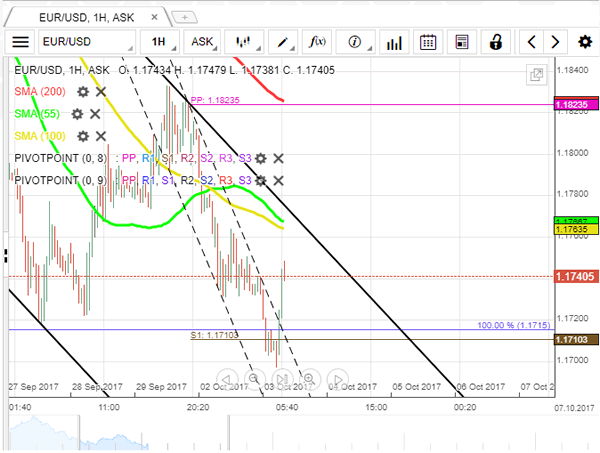
Contrary to expectations, the currency pair broke through the combined support set up by the 100% Fibonacci retracement level at 1.1715 and the updated weekly S1 at 1.1710.
The reason behind such deep immersion was based on several reasons, such the Catalan referendum and a release of better than expected data on the US manufacturing activity.
There is a small chance that the Euro will manage to restore some positions against the Dollar.
However, the average market sentiment remains 58% bearish. In addition to that, now traders can rely on the above technical barriers, as a resistance to push the rate towards the 1.17 mark.
By the way, from the south the rate does not face any notable obstacles up until the monthly S1 at 1.1658.
GBP/USD Analysis: Reaches Bottom Edge Of Channel Down
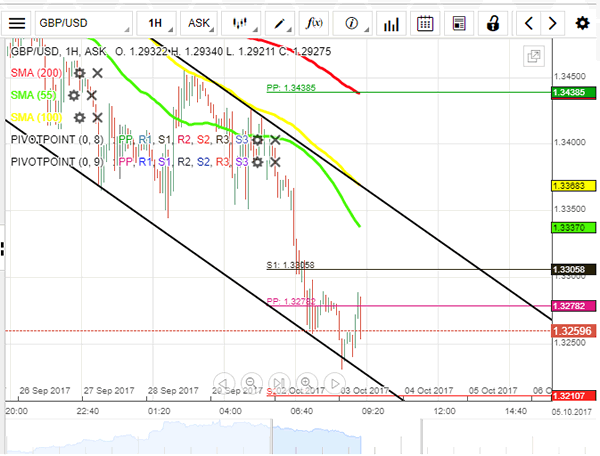
A combination of release of worse than expected British and better than expected American manufacturing activity data created a downside momentum, which was strong enough to drive the pair through a combined support formed by the monthly PP at 1.3322 and the weekly S1 at 1.3305 and push right to the bottom edge of senior descending channel.
From daily perspective, the exchange rate has to continue to pave the way to the south. But in the short run it might make a rebound, as the above boundary is additionally secured by the weekly S2 at 1.3210. Plus there is a need to take into account that the 1.3200 mark represents a psychological support level and might be surrounded by many buy limit orders.
However, the UK Construction PMI data release might also leave certain impact on the pair.
USD/JPY Analysis: Breaks From Junior Channel
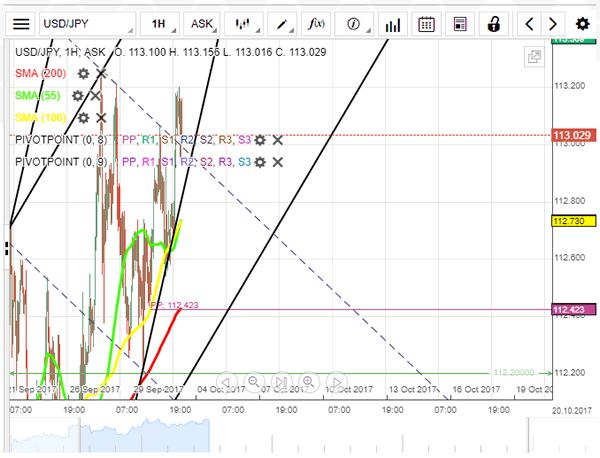
In line with expectations, the Greenback continued to gain value against the Yen, breaking through the upper edge of a junior descending channel. The surge was mainly based on release of positive information on the US manufacturing activity.
However, a combination of the 55- and 100-hour SMAs located near the lower support line of a dominant ascending channel additionally supported the above-mentioned soar.
Because of the hawkish Fed outlook, anticipation of Trump's tax reform and other favourable fundamental background, the pair is expected to continue to head to the north.
However, there is a need to take into account that due to 48 pips advance just in three hours the Yen might force the pair to make a temporary rebound and restore some lost positions.
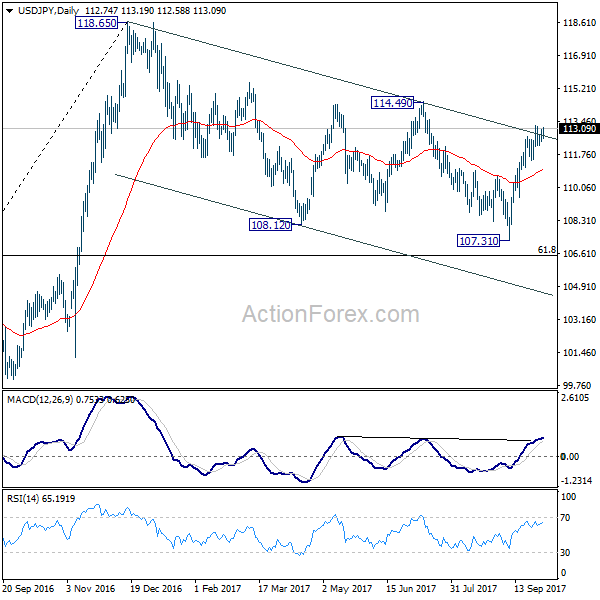
USD/JPY Daily Outlook
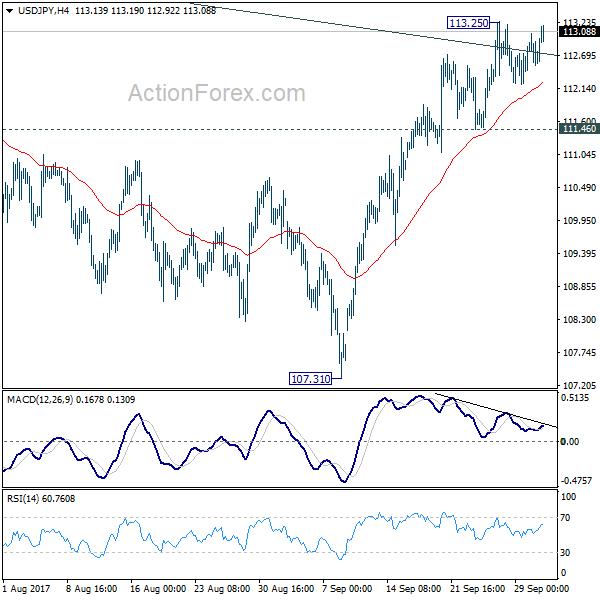
Daily Pivots: (S1) 112.42; (P) 112.74; (R1) 113.06; More...
USD/JPY is staying in consolidative trading in tight range below 113.25 temporary top. Intraday bias remains neutral first. As long as 111.46 minor support holds, further rise is in favor. Sustained break of medium term channel resistance will argue that correction from 118.65 is already completed with three waves down to 107.31. Break of 114.49 will confirm this bullish case and target a test on 118.65 next. On the downside, considering bearish divergence condition in 4 hour MACD, break of 111.46 will suggest rejection from the channel resistance and turn bias back to the downside.
In the bigger picture, rise from 98.97 (2016 low) is seen as the second leg of the corrective pattern from 125.85 (2015 high). It's unclear whether this this second leg has completed at 118.65 or not. But medium term outlook will be mildly bearish as long as 114.49 resistance holds. And, there is prospect of breaking 98.97 ahead. Meanwhile, break of 114.49 will bring retest of 125.85 high. But even in that case, we don't expect a break there on first attempt.
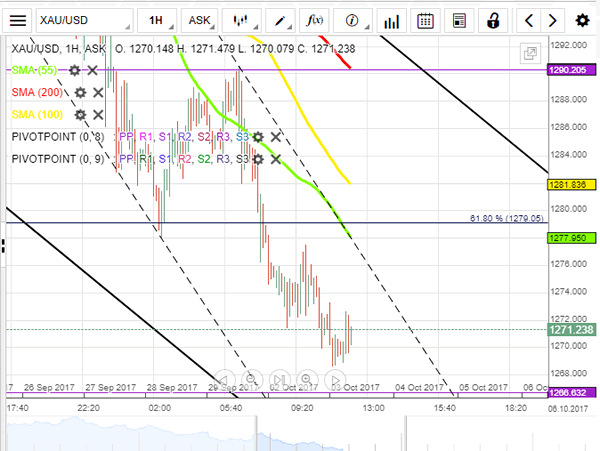
XAUUSD Analysis: Ready To Test Weekly S1 At 1,266.63
In accordance with expectations, for couple of hours the fall of the exchange rate was stopped by the 100-day SMA. However, a release of better than expected information on the US manufacturing activity ultimately led to appreciation of the buck against all major currencies including the gold.
From technical perspective, the pair is about to reach to weekly S1 at 1,266.63, which represents the only notable support level that separates the pair from the bottom edge of a dominant ascending channel.
Given that informational background remains in favour of the buck and there are scheduled no macroeconomic data releases today, the pair is expected to successfully bypass this barrier and continue to move to the south.
However, there is a need to take into account that the average market sentiment became 59% bullish.
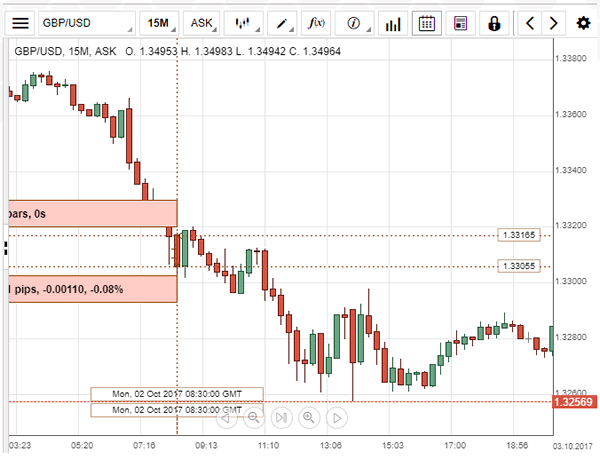
GBP/USD: UK Manufacturing PMI
The GBP/USD kept declining gradually after the weaker-than-anticipated Britain's manufacturing PMI figures. The Sterling fell against the US Dollar by 11 base points to rebound from the 1.3305 mark, but continued to consolidate nearing the 1.3280 area additionally fuelled by US economic report bullish sentiment for the Greenback.
Markit report showed on Monday that the UK Manufacturing PMI fell to 55.9 points in September, below initially anticipated 56.4 points. The decline in the Index was related to the strengthening of the British Pound, which made manufactured products less attractive to be purchased. Meanwhile, the pair partially lost its gains due to expectations for the BoE interest rate increase in November.
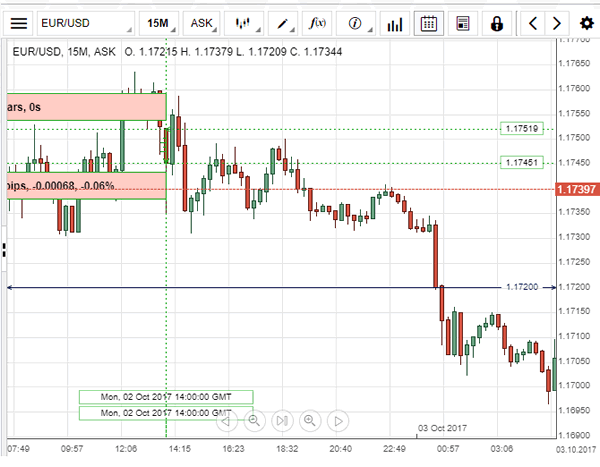
EUR/USD: ISM Manufacturing PMI
The Greenback sustained Monday's gains against the Euro, as ISM manufacturing data showed better-than-expected figures.The US Dollar rose slightly against the European single currency by 7 base points to keep its stronger position, with the pair falling further below the 1.1720 level this morning.
The ISM stated that its index for the US manufacturing activity surged to 60.8 points in September, reaching the highest level in more than 10 years. Solid advances in ISM-reported figures to a certain extent reflected affects from Hurricanes. The report also showed an increase in its exports measure as producers benefited from the Dollar's weakness, which made US supplies more attractive to overseas buyers.
USD/CAD Daily Outlook
Daily Pivots: (S1) 1.2473; (P) 1.2499; (R1) 1.2533; More....
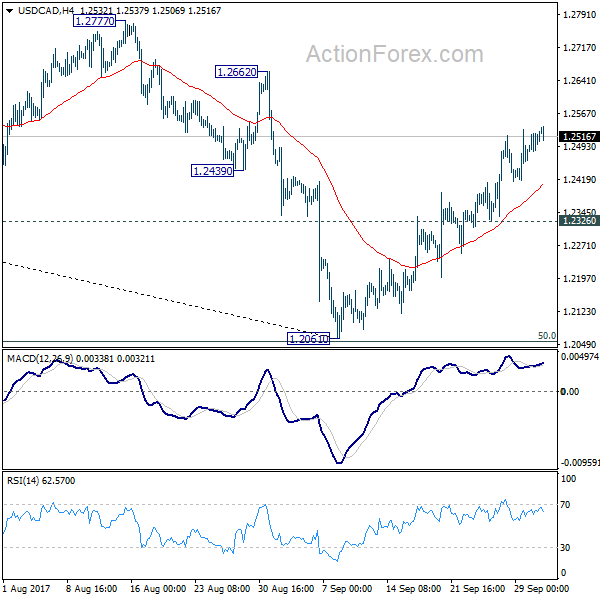
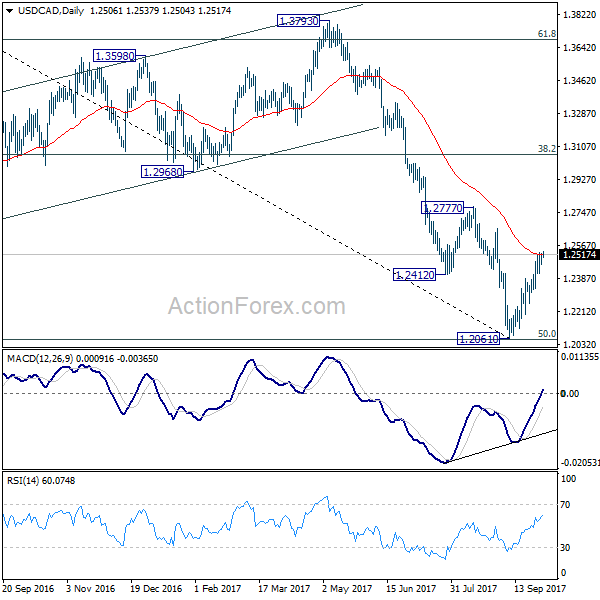
USD/CAD's rebound from 1.2061 is still in progress. Intraday bias remains on the upside for 1.2777 resistance first. As noted before, current development argues that the pair has successfully defended 1.2048 fibonacci level. Decisive break of 1.2777 will target 38.2% retracement of 1.4689 to 1.2061 at 1.3065 next. However, break of 1.2326 will dampen this bullish view and turn bias back to the downside for 1.2061 instead.
In the bigger picture, current development argues that USD/CAD has defended 50% retracement of 0.9406 (2011 low) to 1.4869 (2016 high) at 1.2048. And with 1.2048 intact, we'd favor the case that fall from 1.4689 is a correction. Break of 1.2777 will further affirm this bullish case. That is, larger up trend from 0.9406 is not completed. However, on the other hand, firm break of 1.2048 will indicate that fall from 1.4689 is at least a medium term down trend and should target 61.8% retracement at 1.1424 and below.
RBA Upbeat On Economic Growth, No Rush To Hike Rates
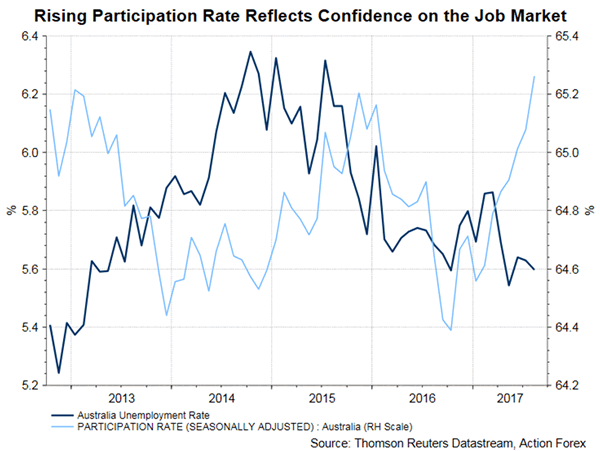
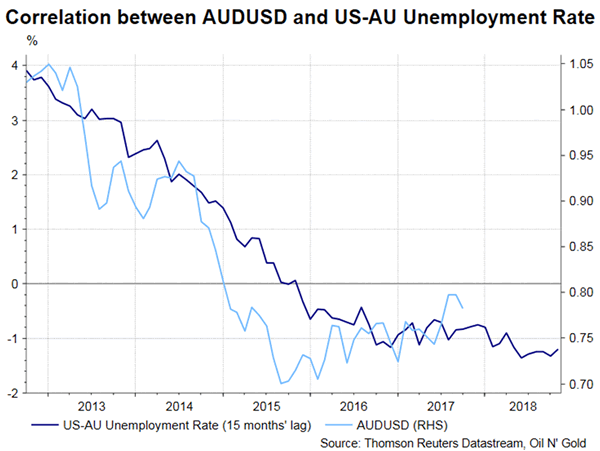
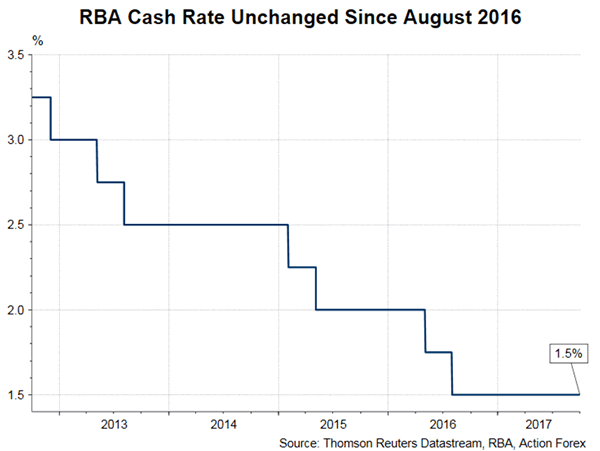
RBA left the cash rate unchanged at 1.5% in September. The accompanying statement contained few changes from the previous one. This perhaps explains the modest drop in Aussie after the release, as the market had expected a more hawkish message. The central bank is upbeat over the economic developments, hinging on the improving non-mining investment. Policymakers also acknowledged the strength in the job market, pointing to the rise in participation rate as well as a number of forward-looking indicators. Comments on the exchange rate were limited, with the central bank reiterating the impact of a strong Aussie on inflation, GDP growth and employment. We expect the central bank to keep the policy rate unchanged until 2H18.
Policymakers retained the view that domestic economy would 'gradually pick up over the coming year'. The members acknowledged that 'non-mining business investment is picking up'. They did not mention the decline in mining investments this month, signaling the negative impact of which has almost dissipated. On the job marker, the RBA noted that it has 'continued to grow strongly over recent months'. It took note that rise in labour force participation as an indication of rising confidence in the employment situation. However, persistently low wage growth should continue for some time.
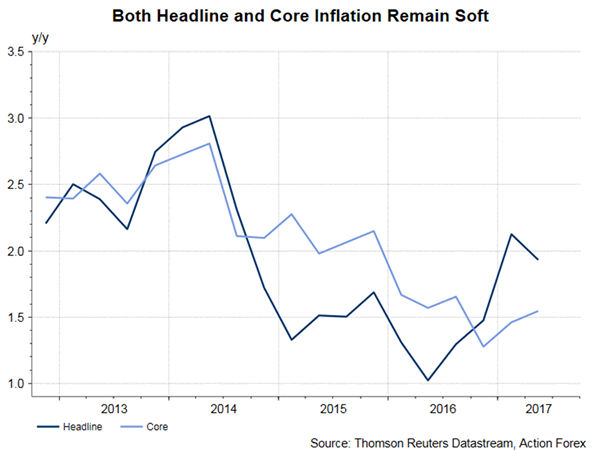
The central bank did not comment on the decline in AUDUSD (-2.3%) since the last meeting. It only attributed its appreciation since mid-year partly to a lower US dollar It warned that the higher exchange rate would prolong 'subdued' inflation, and weigh down on the outlook for output and employment.
Other than the mild drop in Australian dollar, market reaction of the announcement was muted. IB futures-implied RBA has priced in a 64% chance of a 25bp hike by May, and 100% by August 2018. These bets were similar to those before the announcement. We expect the central bank to keep the policy rate unchanged until 2H18.
Europe Seen Higher After Record Highs In US
European equity markets are expected to open a little higher on Tuesday, buoyed by decent gains in Asia overnight and new record highs in the US on Monday.
AUD Slips as RBA Maintains Neutral Stance
The Reserve Bank of Australia left its cash rate on hold at 1.5% overnight and released a relatively neutral statement alongside it that praised certain elements of the global and domestic economy while once again warning about the detrimental effects of a strong Australian dollar.
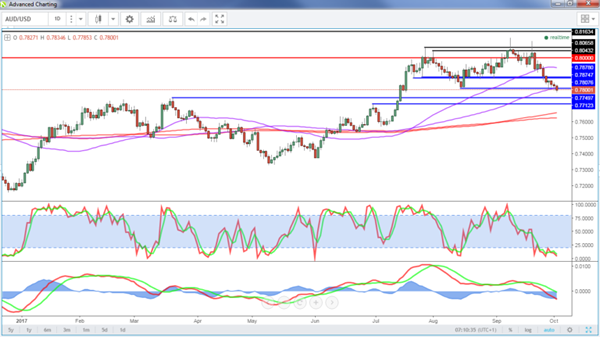
The statement gave no indication that the RBA is preparing to raise or cut interest rates any time soon, with upside and downside risks aplenty providing the central bank little incentive to do so. The Aussie dollar fell a little after the release to trade below 0.78 against the dollar, back to levels last seen in mid-July.
Spanish Unemployment and UK Construction eyed
While political distractions will likely continue to tick over in the background – this week's primary focus being the aftermath of the Catalonia referendum – this week is more about the economic data given the sheer volume of numbers being released. Spanish unemployment is up first today, with the data expected to show a second consecutive monthly increase, this time of 21,300. Given the general improvement in the labour market in recent years and the tendency of unemployment to rise at this time of year, I don't think anyone will be too concerned by the data.
Construction becomes the latest sector in the UK to come under the microscope when the PMI survey for September is released this morning. Monday's manufacturing PMI fell a little short of expectations but remained comfortably in growth territory, supported by the weaker pound, despite its recent recovery. The construction PMI is expected to remain unchanged at 51.1, having slipped back here after a summer of much more optimistic readings. The most important of the UK PMIs comes tomorrow though, with the services sector representing more than three quarters of economic output.
Potential Future Fed Chair Makes an Appearance
While there's no US economic data being released today, we will hear from Jerome Powell who currently sits on the board of governors at the FOMC but is also one of the four candidates currently being considered for Chair of Federal Reserve once Janet Yellen's term ends in February.