Sample Category Title
GBPUSD Short-Term Bearish, Recent Rally At Risk Of Reversal
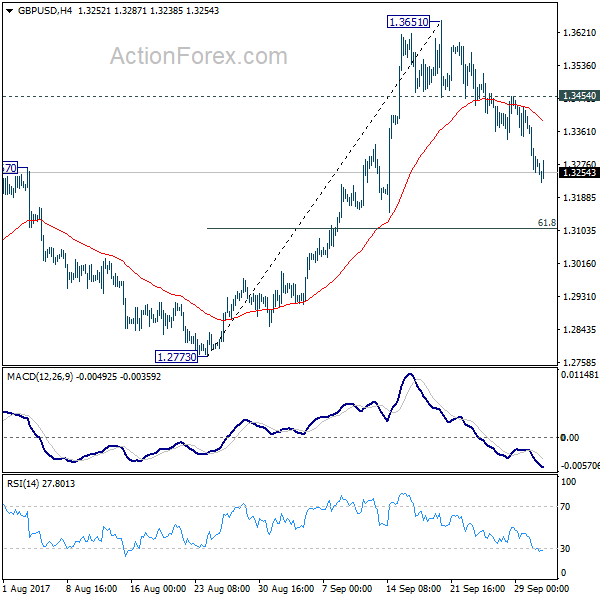
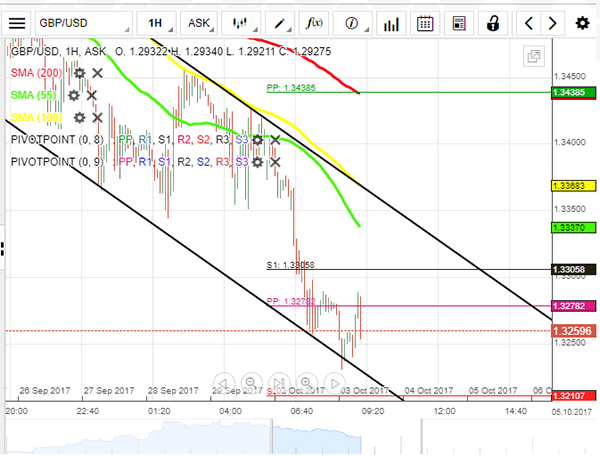
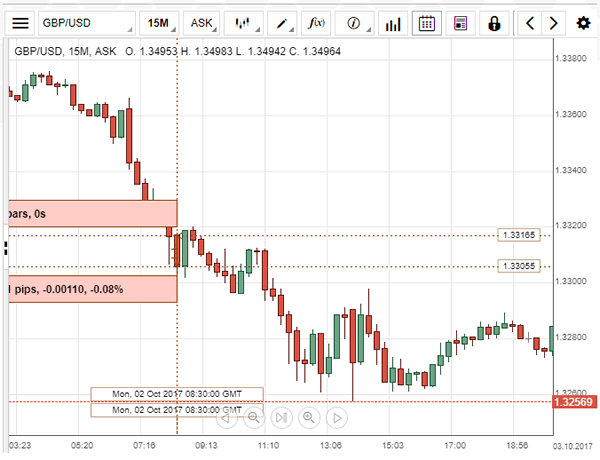
GBPUSD is increasingly bearish after breaking below the key 1.3400 level and the 2-week decline is threatening to reverse the September rally to 1.3656. The brief consolidation range near the highest levels since June 2016 broke down last week and momentum signals are turning more negative.
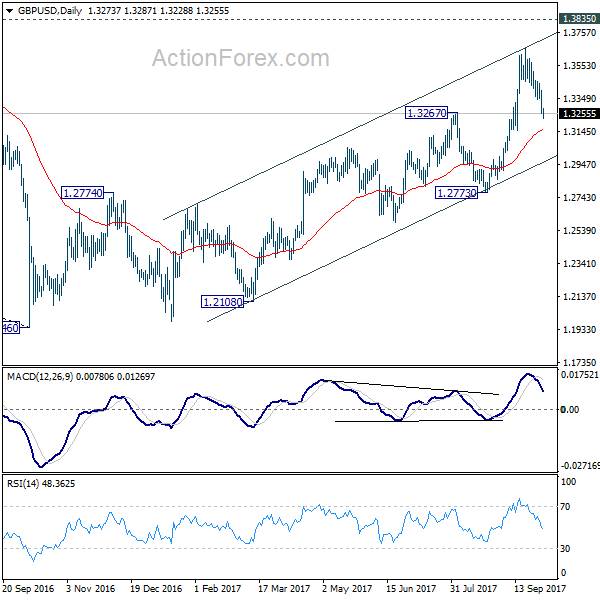
The broader market structure looks bullish, showing GBPUSD slowly advanced from the 1.2000 area since the early part of this year. The crossover of the 50-day moving average above the 200-day MA in May gave a bullish signal. It remains to be seen whether the recent drop in prices is just a corrective move of the strong September rally.
GBPUSD is testing fresh 2-week lows and is approaching key support at 1.3200. This level is approximately the mid-point of the recent advance from 1.2773. A break below 1.3200 opens up the way for a drop towards the 50-day MA and to the key 1.3000 level.
Only a rise back above 1.3400 would ease downward pressure and indicate that the 2-week decline from 1.3656 was a corrective move of the broader uptrend.
GBPUSD is expected to remain under pressure in the short-term as momentum signals are shifting. RSI is falling and MACD is reversing its rise. Near term risk is tilted to the downside but the broader bullish picture is still intact as long as the market remains above 1.3200.

Dollar Bulls In Charge On Improved US Economic Outlook, Aussie Down After RBA Policy Meeting
On Tuesday, rising economic prospects in the US kicked the dollar higher to a 1 ½-month high against its major rivals during Asian trading, while a steady monetary policy and an unchanged economic outlook as indicated overnight by RBA policymakers sent the aussie down to a two-month low.
The spot dollar index stretched its uptrend during the Asian session, reaching a fresh 1 ½-month high of 93.92 as confidence in the US economic environment was enhanced after the release of upbeat manufacturing PMI readings on Monday and the Fed retained its hawkish stance on monetary policy. Additional support for the greenback was also found as the US 10-year Treasury yields peaked at a three-month high of 2.371 percent overnight, whereas geopolitical tensions did not escalate despite Trump refusing to start a discussion with North Korea on nuclear issues for the second time.
Dollar/yen rose by 0.20% on the day to 112.96 ahead of the Japanese snap elections later in the month. Meanwhile, the leader of the newly launched Party of Hope and Tokyo's governor, Yuriko Koike, showed reluctance to join the snap elections scheduled for October 22.
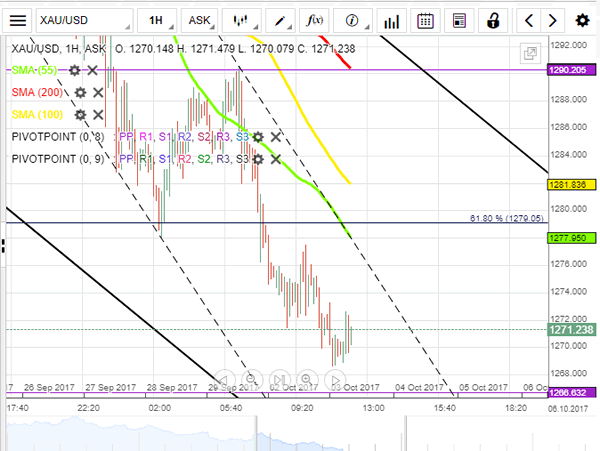
Gold stood flat at a two-week low of $1,270 per ounce.
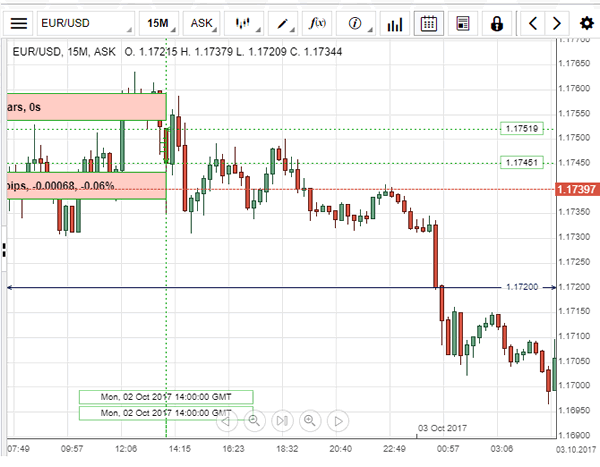
The euro extended losses during the session, breaking marginally the $1.17-key level at $1.1695 as political uncertainties in Spain and Germany were on the rise after a violent independent vote in Spain on Sunday and inconclusive federal elections in Germany on September 24. Investors will now focus on the ECB meeting minutes published on Thursday for any clues on monetary policy moving forward.
The pound posted losses versus the greenback, edging down to $1.3262, weighed by risks revolving Brexit and economic conditions in the nation.
In the first hours of Asian trading, the RBA decided to keep interest rates on hold at a record low of 1.5%. Moreover, the monetary statement did not defer much compared to the one released in September as policymakers reiterated their concerns on a stronger currency, subdued inflation, and wage growth whilst they also stayed cautious on household debt levels. A few hours earlier, August's housing data out of Australia came in lower than expected, adding to losses for the aussie. Building approvals grew by 0.4% m/m compared to an upwardly revised contraction of 1.2% seen in the previous month, missing expectations of a 1.1% growth. Private house approvals declined by 0.6% m/m after rising by 1.0% (revised upwards from 0.0%).
The aussie tumbled to a two-month low of $0.7784 but it managed to climb to 0.7810 before Asian markets close for the day.
The kiwi retreated by 0.35% amid political uncertainty in New Zealand while businesses were more concerned about the country's economic outlook in the next six months, driving the NZIER business confidence index to 5% in the third quarter from the 18% posted in the previous quarter.
In energy markets, oil was trading flat near yesterday's two-week lows. WTI crude stood around $50.40 per barrel and Brent was hovering around $55.88.
Euro Selloff Continues As U.S. 10-Year Yields Hit 3-Month High
The Euro selloff resumed on Tuesday, sending the single currency to $1.17 in Asia trade, the lowest in six weeks. The political risks have been gradually increasing in the past two weeks; it started with the German Federal Election, which led to the surge of the far-right, and now Catalonia’s independence vote. The political risk premium has been reflected in the Spanish-German yield spreads, which widened substantially on Monday. 10-year yield spreads gained eight basis points to trade at their highest levels since early June 2017. Politics has clearly overshadowed the economic improvement in the Eurozone, and this will likely remain the case for the rest of the week. With consumers and business confidence remaining high however, the PMI is continuing to show improvement in the manufacturing and services sector, and the economy is set to expand by 2.2% in 2017.It is these factors that will lead the single currency in the long run.
In contrast, the dollar continued to find support from improving economic data and a rise in yields. The ISM Manufacturing Index hit a 13-year high, supported by new orders and an increase in prices. Hurricanes Harvey and Irma probably disrupted the data a little, but there has been a broad economic improvement strengthening expectations that the Federal Reserve will hike interest rates in December. Looking into the U.S. bond yields, fixed income traders also seem to agree that an interest rate hike is coming soon. After falling to 2.01% on 8 September, U.S. 10-year bond yields have appreciated by more than 330 basis points in just 18 trading days.
Mr. and Mrs. Watanabe like these developments, as they have been waiting for opportunities to increase their carry trades. This is why USDJPY is trading at its highest level since mid-July. However, one should be careful, as the snap election in Japan takes place in just three weeks. Markets so far, are pricing an easy defeat for Shinzo Abe, but given that Tokyo governor Yuriko Koike is becoming more popular, one should hedge his long positions.
In other currency news, the Aussie was the worst performing major currency early Tuesday, after the Reserve Bank of Australia held interest rates at 1.5%. Although Governor Philip Lowe stated that growth in the Australian economy would gradually pick up over the coming year, his warning on the Australian dollar strength drove the selloff. Such comments are always short-lived, and traders need to focus on economic fundamentals. AUDUSD is becoming an attractive long as we approach 0.77, the 50% retracement from the most recent surge (0.7331 – 0.8124).
Aussie Dollar Struggle Continues Vs US Dollar
Key Highlights
- The Aussie Dollar declined recently and broke the 0.7875 support against the US Dollar.
- There are two key bearish trend lines formed with resistance near 0.7820 on the 4-hours chart of AUD/USD.
- RBA made no changes in rates in the recent interest rate decision (Number 2017-21).
- Australia's HIA New Home Sales in August 2017 rose 9.1%, better than the last revised -15.4%.
AUDUSD Technical Analysis
The Aussie Dollar started a major downtrend after failing to remain above 0.8000 against the US Dollar. The AUD/USD pair recently broke a major support area near 0.7875, opening the doors more losses.

The pair is now well below the 100 and 200 simple moving averages (H4) and traded as low as 0.7786. On the upside, there are two key bearish trend lines formed with resistance near 0.7820 on the 4-hours chart.
Considering the recent decline and the price action, there is a chance of AUD/USD correcting by 30-40 pips in the near term. However, there are many hurdles on the upside for buyers near 0.7840 and 0.7860.
Above trend lines, the 50% Fib retracement level of the last decline from the 0.7899 high to 0.7786 low is a major hurdle. Moreover, the broken support at 0.7875 might now act as a barrier for an upside break.
On the downside, a break of the 0.7785 low could take the pair towards the next support at 0.7740.
RBA Interest Rate Decision and HIA New Home Sales
Today, the RBA Interest Rate Decision (Number 2017-21) was announced by the Reserve Bank of Australia. The central bank made no changes in the interest rate from 1.5%.
The statement concluded as:
The low level of interest rates is continuing to support the Australian economy. Taking account of the available information, the Board judged that holding the stance of monetary policy unchanged at this meeting would be consistent with sustainable growth in the economy and achieving the inflation target over time.
Moreover, the HIA New Home Sales figure for August 2017 was released by the Housing Industry Association. The forecast was slated for a minor rise of around 2% in sales compared with the previous month.
However, the result was positive as there was an increase of 9.1% in sales. On the other hand, the last reading was revised down from -3.7% to -15.4%.
The ANZ job advertisements report for August 2017 was also published today by the Australia and New Zealand Banking Group Limited (ANZ). According to the report, there was no increase in the ANZ job advertisements compared with the last revised +2%.
Overall, the AUD/USD pair might correct higher in the short term, but upsides remain capped near the 0.7840-60 levels.
Euro Trades Below 1.1710
The euro has fallen below key weekly technical support against the U.S dollar, after solid economic data from the United States economy provoked another round of buying in the U.S dollar index.
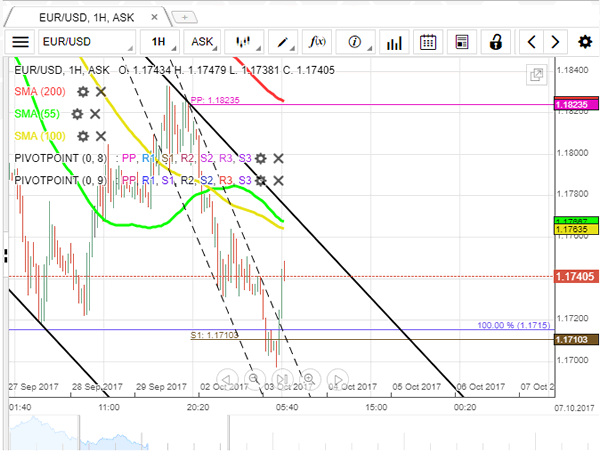
Trading sentiment in the EURUSD pair is expected to remain bearish while political tension in Catalonia worsen, and price-action continues to trade below the euro's 200-week moving average, at 1.1710.

With today's economic calendar in the U.S and Europe remaining fairly light, the U.S dollar index is likely to dictate intraday trading.
The next series of higher time frame closes on the four and eight-hour price-candles around the 1.1710 technical level will be crucial for the EURUSD.

Key intraday technical support below 1.1710 is located at the August monthly low, at 1.1662 and the euro's 100-day moving average, at 1.1654. Below 1.1654, further support is found at 1.1610 and 1.1580.
To the upside, key intraday resistance is located at yesterday daily price-low, at 1.1730 and the euro's calculated daily pivot point, at 1.1748. Above the 1.1748 level, the 1.1770 level is critical former support now turned resistance.
USDJPY Above 113 AS Greenback Soars
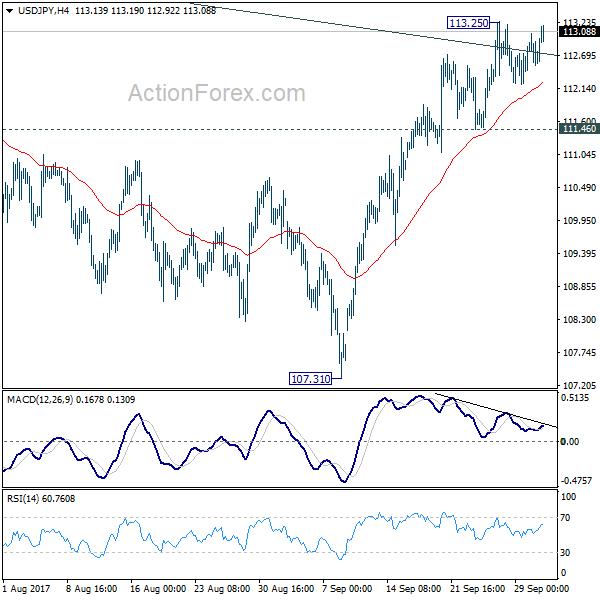
The USDJPY pair has moved back above the 113 level, as the U.S dollar index continues to climb higher, after yesterday's United States ISM manufacturing PMI posted its highest reading in six years.
Trading sentiment surrounding the USDJPY pair is increasingly bullish today, with weekly fundamentals and technicals both currently favoring further upside.

Price-action on the USDJPY pair has so far reached 113.18, which is still slightly below the former weekly price-high of 113.25.
A move above the 113.25 level is expected to accelerate buying in the pair, whilst a move below the 112.70 would be technically bearish.

Key intraday resistance on the USDJPY pair is located at 113.25, 113.57 and 113.89. A move above the 113.89 level would likely further buying towards 114.10 and 114.45.
To the downside, key intraday support is found at the former weekly high, at 112.90 and the key 112.70 level. Once below 112.70, further support is found at the pairs weekly pivot point, at 112.41.
.
Tuesday: Calm Before The Storm?
Investors can expect a lighter release schedule on Tuesday as they brace for a more active second half of the week headlined by US jobs data and central bank speeches.
Action begins in Europe at 07:00 GMT with a report on Spain's unemployment situation. The total level of unemployed is expected to rise by 21,300 for September, following an increase of 43,300 the month before.
At 08:30 GMT, CIPS and IHS Markit will produce the monthly construction purchasing managers' index (PMI). The report is expected to show a slight weakness in industry activity for the month of September.
The European Commission's statistical agency will report on producer inflation at 09:00 GMT. The monthly PPI is expected to edge up by 0.1%, translating into a year-over-year gain of 2.3%.
Shifting gears to North America, Federal Open Market Committee (FOMC) member Jerome Powell is scheduled to deliver a speech bright and early at 08:30 GMT. Powell was interviewed by President Trump for the position of Fed Chair, which could become vacant this February.
In policy news, the Reserve Bank of Australia (RBA) kept its trend-setting interest rate at a record low of 1.5% on Tuesday. The decision was widely expected by the financial markets. The Australian central bank has remained on the sidelines of monetary policy since August 2016, when it cut rates for the second time that year.
AUD/USD
A dovish RBA weighed on the Australian dollar Tuesday, as the AUD/USD dipped below 78 cents. The pair was down 0.4% to trade at its lowest level in around seven weeks. The Aussie has declined roughly 300 pips against the US dollar since 20 September. In the meantime, the greenback has regained momentum against a cross-section of its competitors. The short-term outlook is tilted to the downside as a bearish central bank continues to drive away the bulls.

EUR/USD
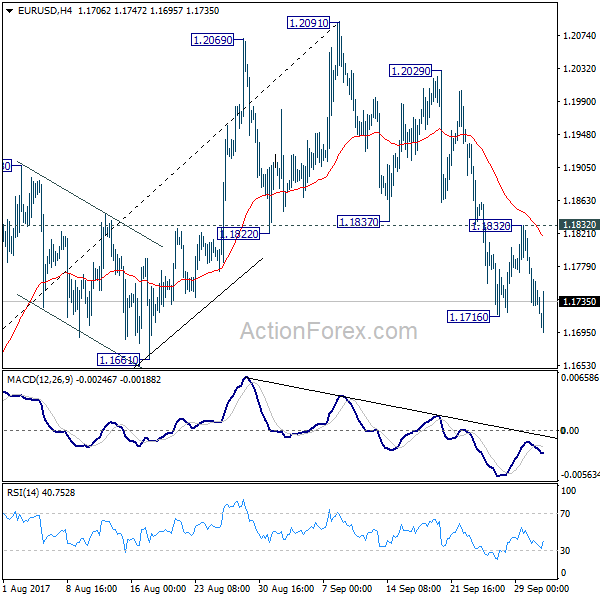
The euro was back on the defensive Monday, as the US dollar continued to steamroll the competition. The EURU/USD is down more than 100 pips from the Friday high. Prices slipped another 0.2% on Tuesday to trade in the low 1.17 region. The common currency has plunged roughly 400 pips from the 8 September multiyear high. The EUR/USD is testing the 1.1708 daily low from 27 September. On the opposite side of the ledger, resistance is seen at 1.1833.

USD/JPY
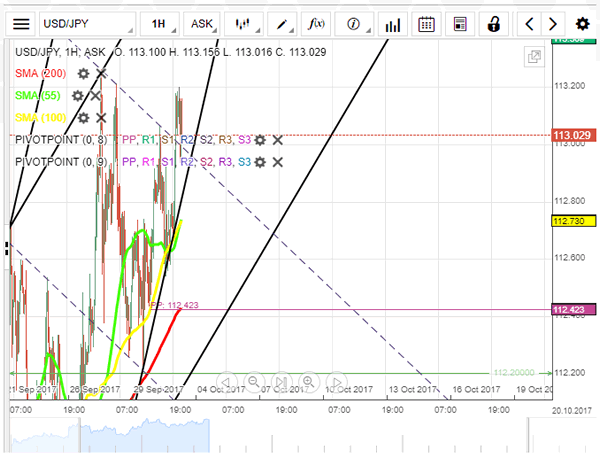
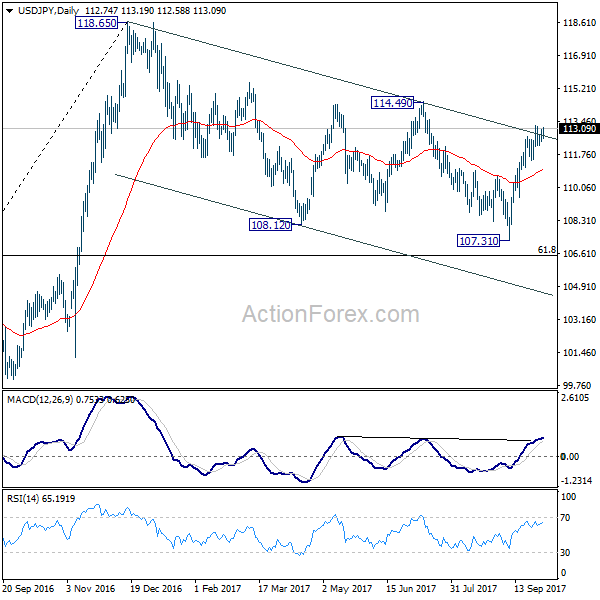
The USD/JPY broke above 113.00 on Tuesday, reaching its highest level in three months. The combination of improved risk sentiment and caution ahead of the Japanese general election have triggered heavy volatility in the yen. The USD/JPY has gained 4.5% since 11 September. The bulls are now targeting the critical 114.40 region. This level isn't as far as it appears, given the pair's strongly bullish bias above the 100-day simple moving average (SMA).

Elliott Wave View: EURUSD In A Flat Correction
EURUSD Short Term Elliott Wave view suggests that the decline from 9/8 peak is unfolding as an expanded Flat Elliott Wave structure. Down from 9/8 high (1.2094), Intermediate wave (A) ended at 1.1837 and Intermediate wave (B) ended at 1.2034. Intermediate wave (C) is in progress as 5 waves. Minor wave 1 of (C) ended at 1.186, and bounce to 1.2 ended Minor wave 2 of (C). Down from there, Minor wave 3 of (C) ended at 1.1716, and bounce to 1.1832 ended Minor wave 4 of (C). Minor wave 5 of (C) remains in progress and can reach as low as 1.16207. This area will also complete Primary wave ((W)) and end cycle from 9/8 peak. Afterwards, pair should bounce within Primary wave ((X)) to correct cycle from 9/8 peak in 3, 7, or 11 swing before turning lower again.
Alternatively, if pair extends below 1.16207, then the entire move lower from 9/8 high could be labelled as 5 waves impulse. In this case, the current decline will only end Intermediate wave (3). Then pair should bounce in Intermediate wave (4) before the decline resumes again.
EURUSD 1 Hour Elliott Wave Chart

Expanded Flat is a 3 waves corrective pattern, and the inner subdivision is labeled as A,B,C with 3,3,5 structure. That means waves A and B are always corrective structures i.e. could be WXY, WXYXZ, Zigzag or any 3 waves corrective pattern. Wave C is either 5 waves impulse or ending diagonal pattern. In the graphic below, we can see what Expanded Flat structure looks like. Inner structure has ABC labeling, where wave B can complete below or above the starting point of wave A. Wave C should complete below the end point of wave A (usually at 1.236-1.618 fibonacci extension A related to B).

Forex: Upbeat Data Boosts USD
On Monday, the US Institute for Supply Management (ISM) released data showing the index of national factory activity surged to a reading of 60.8 in September, the highest reading since May 2004, from 58.8 in August. The gains appear to be attributive to the re-build, following the devastation caused by Hurricanes Harvey & Irma, with gains in new orders and raw material prices. Further data released on Monday indicated a rebound in Construction Spending in August, which will further harden expectations the Fed will raise rates in December.
With higher than expected construction spending in August, and the surge in factory activity in September, the Atlanta Federal Reserve’s GDP Now forecast model is indicating that the US economy is on target to grow at 2.7% annualized in Q3. The previous forecast, on September 29th, had suggested a 2.3% growth rate.
Eurozone data released on Monday showed factories, in the eurozone, having their strongest month for over 12-months. However, whilst such data would normally see a rise in EUR, the violence marred independence vote in Spain’s Catalonia region has created concern in the markets with the political risk this could cause to the European Community. Spain now faces its biggest constitutional crisis in decades, as reports suggest that over 90% of voters have chosen to “leave” Spain. Investors will be keenly watching the Spanish Governments response and if this could lead to a “decoupling” of Catalonia.
As expected, the Reserve Bank of Australia left interest rates unchanged at 1.5% earlier today.
EURUSD continued its recent downward trend, falling 0.4% on Monday and continuing lower in early Tuesday trading. Currently, EURUSD is trading around 1.1720.
USDJPY is relatively unchanged overnight, currently trading around 112.95.
GBPUSD continues to move lower with the uncertainty surrounding Brexit negotiations and Prime Minister Theresa May’s apparent lack of party support. Currently, GBPUSD is trading around 1.3265.
After dropping 0.35% on Monday, Gold has retraced slightly in early Tuesday trading to currently trade around $1.272.
WTI suffered a near 2.5% loss on Tuesday on oversupply fears. Currently, WTI is trading around $50.65.
Major economic data releases for today:
At 09:30 BST, the UK Chartered Institute of Purchasing & Supply and Markit Economics will release UK PMI Construction for September. Consensus is calling for a reading of 50.8, slightly worse than the previous release of 51.1, which is very close to the 50 level that would suggest stagnation. A reading of
50.8 underlines the uncertain economic outlook facing the UK and the difficulty the Bank of England has in gauging economic growth. A release considerably different from consensus will see GBP experience high volatility.
At 9:00 BST, Eurostat will release Eurozone PPI (YoY) for August. The forecast is for a higher reading of 2.3% (previously 2.0%). A reading of 2.3% or above could see EUR strengthen and add further impetus for the ECB to reign in stimulus and possibly look at raising interest rates.
Currencies: Dollar Tries To Break ST Top
Sunrise Market Commentary
- Rates: Sentiment-driven trading
Today's eco calendar is empty suggesting sentiment-driven trading (currently negative core bonds) with many investors potentially side-lined in the run-up to key US eco releases later this week. The sell-off in Spanish assets could slow as Catalonia seems to favour dialogue instead of unilaterally declaring independence. - Currencies: Dollar tries to break ST top
The dollar extended its gradual rebound yesterday even as the gains were not impressive. Still, the US currency is nearing recent highs against a series of currencies including the euro and the yen. The eco calendar is thin today, but a further rise in US yields might help the dollar to clear these hurdles.
The Sunrise Headlines
- Wall Street (+0.5%) began the fourth quarter with a quartet of closing highs as upbeat data helped boost optimism on the health of the US economy. Asian risk sentiment is somewhat more mixed overnight with China still closed.
- The Reserve Bank of Australia leaves interest rate unchanged at record low 1.5% for 14th month, having previously said it doesn't need to follow global peers that are tightening policy. AUD/USD tests 0.78 support.
- The Catalan government said it wanted to avoid a 'traumatic split' from Spain and appealed to the EU to help mediate with Madrid in signs it was holding back from an early declaration of independence.
- Relatively calm market conditions could encourage the European Central Bank to extend its asset purchase scheme for a relatively longer period but with reduced monthly spending, ECB chief economist Praet said.
- Dallas Fed Kaplan sounded a cautious note, saying officials should 'look hard' at whether taking action in December is warranted. Minneapolis Fed Kashkari argued that the Fed's own actions, not transitory factors, are responsible for weak inflation.
- The Bavarian sister party (CSU) of German Chancellor Merkel's CDU has said her conservative bloc must agree policies on immigration, pensions and healthcare before opening coalition negotiations with two other parties.
- Today's eco calendar is extremely thin with only US car sales
Currencies: Dollar Tries To Break ST Top
Dollar extends gradual rebound
Yesterday, the dollar traded with a cautiously positive bias as global investors extended last week's reflation trade. At the same time, the euro faced some headwinds from the uncertainty on Catalonia. The USD rebound lost momentum in the afternoon trade despite a very strong ISM manufacturing. Still the US currency finished the session with modest gains. EUR/USD finished the session at 1.1733 (from 1.1814). USD/JPY closed the session at 112.77 (from 112.51). US equities set again new records, but were no big help for the dollar.
Overnight, Asian equities ex-Australia join the positive sentiment from WS. The dollar also receives a better bid supported by strong equities and a minor rise in US yields. USD/JPY rebounded north of 113. EUR/USD dropped to a new correction low and trades in the low 1.17 area. The Reserve Bank of Australia as expected left its policy rate unchanged at 1.5%. The policy statement brought no new information, but repeats that a stronger Aussie dollar weighs on inflation, growth and employment. The Aussie dollar declined after the RBA statement and trades around 0.78.
Today, EMU eco reports are limited to the August PPI (producer prices). It is no market mover, as most national PPI data have already been released. US car sales are expected to have rebounded in September after a sharp dip in August. That's good news for the economy, but markets usually ignore the car sales report.
The dollar rallied last week, as chances on a December Fed rate hike have risen and as the US government stepped up its efforts to put the tax reform on the rails. Both factors propelled US yields and the dollar, but the dollar rebound ran into resistance at the end of last week. It apparently needs good eco news and higher US yields. Yesterday's USD performance was mildly positive, but the pair near the recent highs against several other currencies including the euro and the yen. A positive risk sentiment and a rise in US yields may be needed to support the USD rebound today.
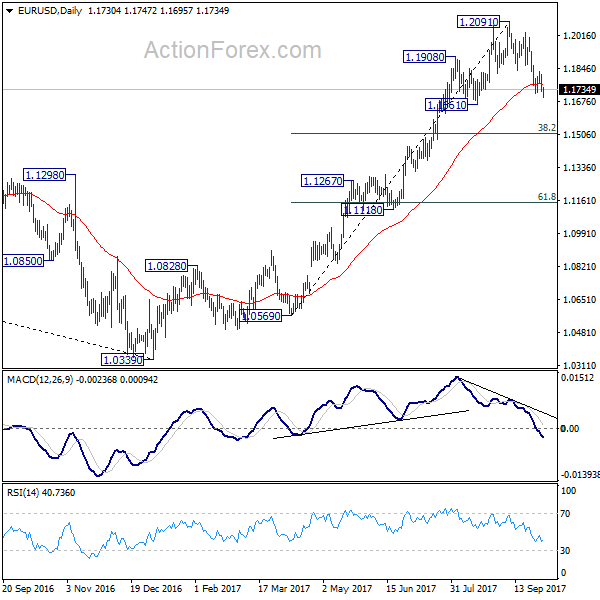
From a technical point of view EUR/USD hovered in a consolidation pattern between 1.1823 and 1.2070, but broke below last week. There was some hesitation in the USD rebound at the end of last week, but EUR/USD closed below the 1.1823 previous range bottom. The rise in US yields is needed to support the USD rebound. Next support in EUR/USD comes in at 1.1662, while 1.1423 marks the 38% retracement from the 2017 rally. The day-to-day momentum in USD/JPY is constructive, but for and important part due to yen weakness. However, USD sentiment is currently also improving. USD/JPY regained 110.67/95 (previous resistance), a short-term positive. The 114.49 correction top is the next important resistance. .
EUR/USD correction lower continues
EUR/GBP
EUR/GBP bottom to become more solid? .
Yesterday, sterling declined against an overall stronger dollar, but also against the single currency. The latter was under slight pressure from the independence vote in Catalonia. Sterling declined after the slightly softer than expected UK manufacturing PMI (55.9). The political bickering on the Brexit strategy between Foreign Secretary Boris Johnson and PM May also weighed on the UK currency. EUR/GBP rebounded to the 0.8868 area and finished the session at 0.8838. The daily losses in cable were substantial as sterling softness coincided with dollar strenght. The pair closed the day at 1.3276 (from 1.3398 on Friday).
Today, the eco calendar only contains the UK construction PMI. A stabilisation at expected. Investors will also keep an eye at the annual conference of the Conservative party in Manchester. The party is divided on the Brexit strategy and PM May's leadership is contested. However, we expect PM May to stay in charge for now. The noise on Brexit might be a modest negative for sterling. Over the previous days, sterling lost some momentum. Sterling may extend its correction against the dollar. A further decline of EUR/USD may be a hurdle for sustained EUR/GBP gains. Even so, a more solid floor is building in EUR/GBP.
EUR/GBP made an impressive uptrend from April to set a MT top at 0.9307 late August. UK price data amended the dynamics and hawkish BoE comments reinforced a sterling rebound. Medium term, we maintain a EUR/GBP buy-on-dips approach as we expect the mix of euro strength and sterling softness to persist. However, the prospect of (limited) withdrawal of BOE stimulus puts a solid floor for sterling ST term. We look how far the current correction goes. EUR/GBP nears support at 0.8743 and 0.8652, which is difficult to break. We look to buy EUR/GBP on dips
EUR/GBP: downside support becomes more solid?