

Sample Category Title
USD/CHF Daily Outlook
Daily Pivots: (S1) 0.9111; (P) 0.9133; (R1) 0.9171; More…
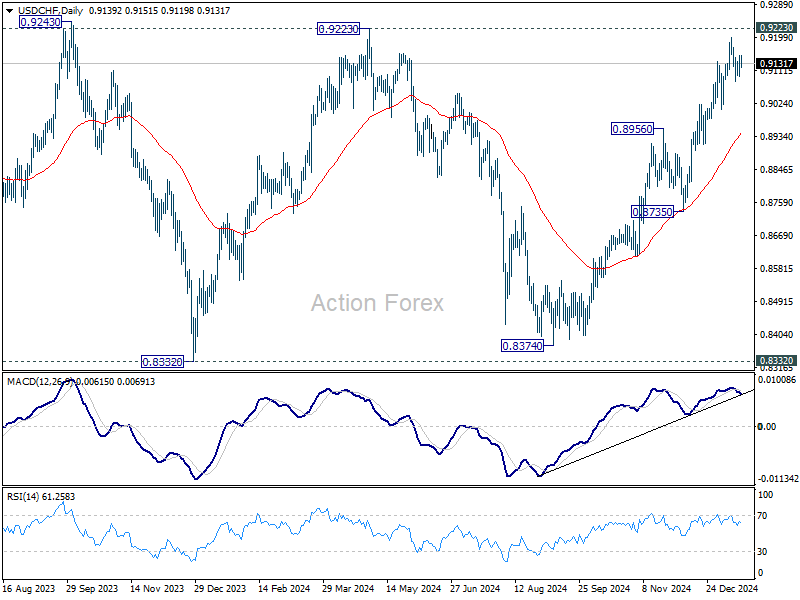
Range trading continues in USD/CHF below 0.9200 and intraday bias remains neutral. More consolidations could be seen but outlook will stay bullish as long as 0.9007 support holds. On the upside, decisive break of 0.9223 will carry larger bullish implications. However, break of 0.9007 will confirm short term topping, and turn bias back to the downside for 55 D EMA (now at 0.8944).
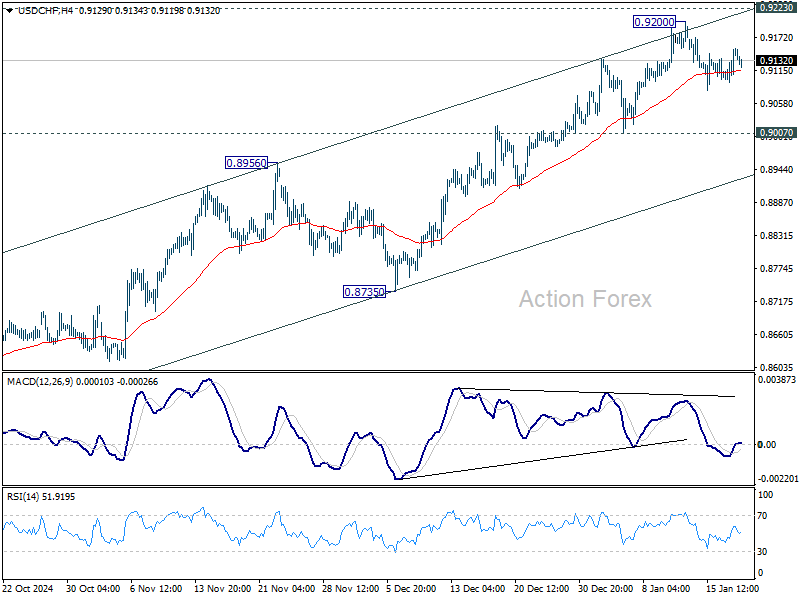
In the bigger picture, as long as 0.9223 resistance holds, price actions from 0.8332 (2023 low) are seen as a medium term corrective pattern. That is, long term down trend is in favor to resume through 0.8332 at a later stage. However, sustained break of 0.9223 will be an important sign of bullish trend reversal.
GBP/USD Daily Outlook
Daily Pivots: (S1) 1.2137; (P) 1.2193; (R1) 1.2226; More...
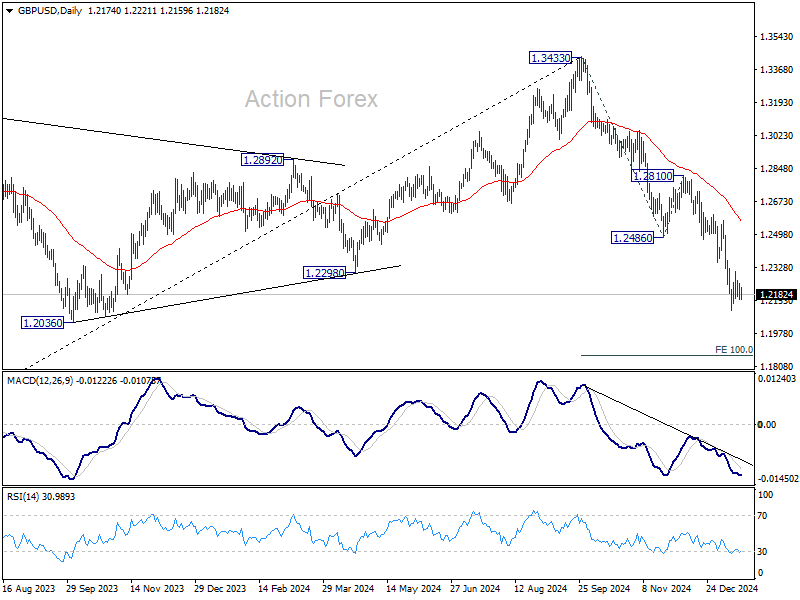
Intraday bias in GBP/USD remains neutral as range trading continues above 1.2099. More consolidations would be seen and stronger recovery cannot be ruled out. But outlook will remain bearish as long as 1.2486 support turned resistance holds. On the downside, break of 1.2099 will resume the fall from 1.3433 to 100% projection of 1.3433 to 1.2486 from 1.2810 at 1.1863.
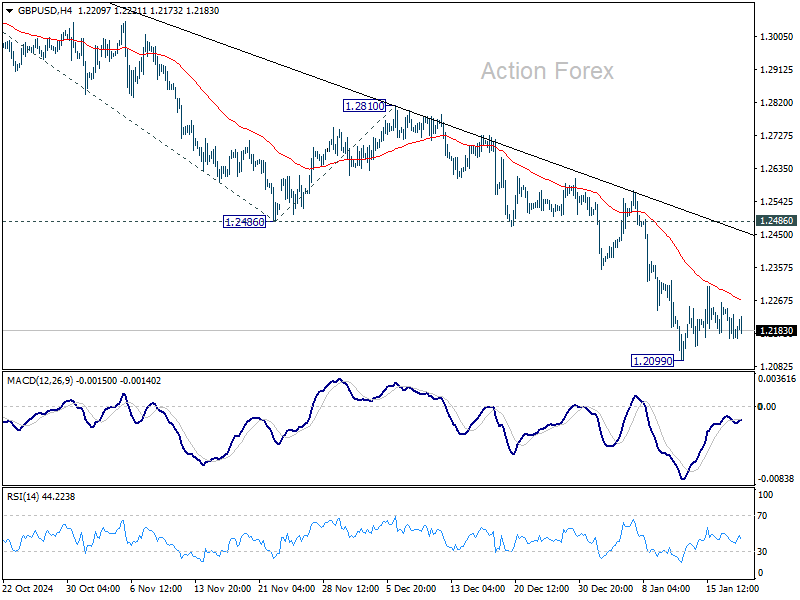
In the bigger picture, rise from 1.0351 (2022 low) should have already completed at 1.3433, and the trend has reversed. Further fall is now expected as long as 1.2810 resistance holds. Deeper decline should be seen to 61.8% retracement of 1.0351 to 1.3433 at 1.1528, even as a corrective move.
XAU/USD Analysis: Gold Prices Poised for a New Trend
Although today is a public holiday in the US (Martin Luther King Jr. Day), financial markets are unlikely to remain calm, as traders and investors will be closely watching the inaugural speech of Donald Trump, the 47th President-elect, scheduled for 20:00 GMT+3.
Trump's speech could impact gold prices in USD, particularly if it addresses:
→ Monetary policy: With current Federal Reserve rates trending lower, non-yielding assets like gold may become more attractive.
→ International trade: If Trump’s remarks on tariffs are particularly bold, gold’s status as a “safe haven” asset could boost its appeal.
→ The dollar's value: Policies aimed at strengthening the USD and reducing national debt may influence gold prices inversely.
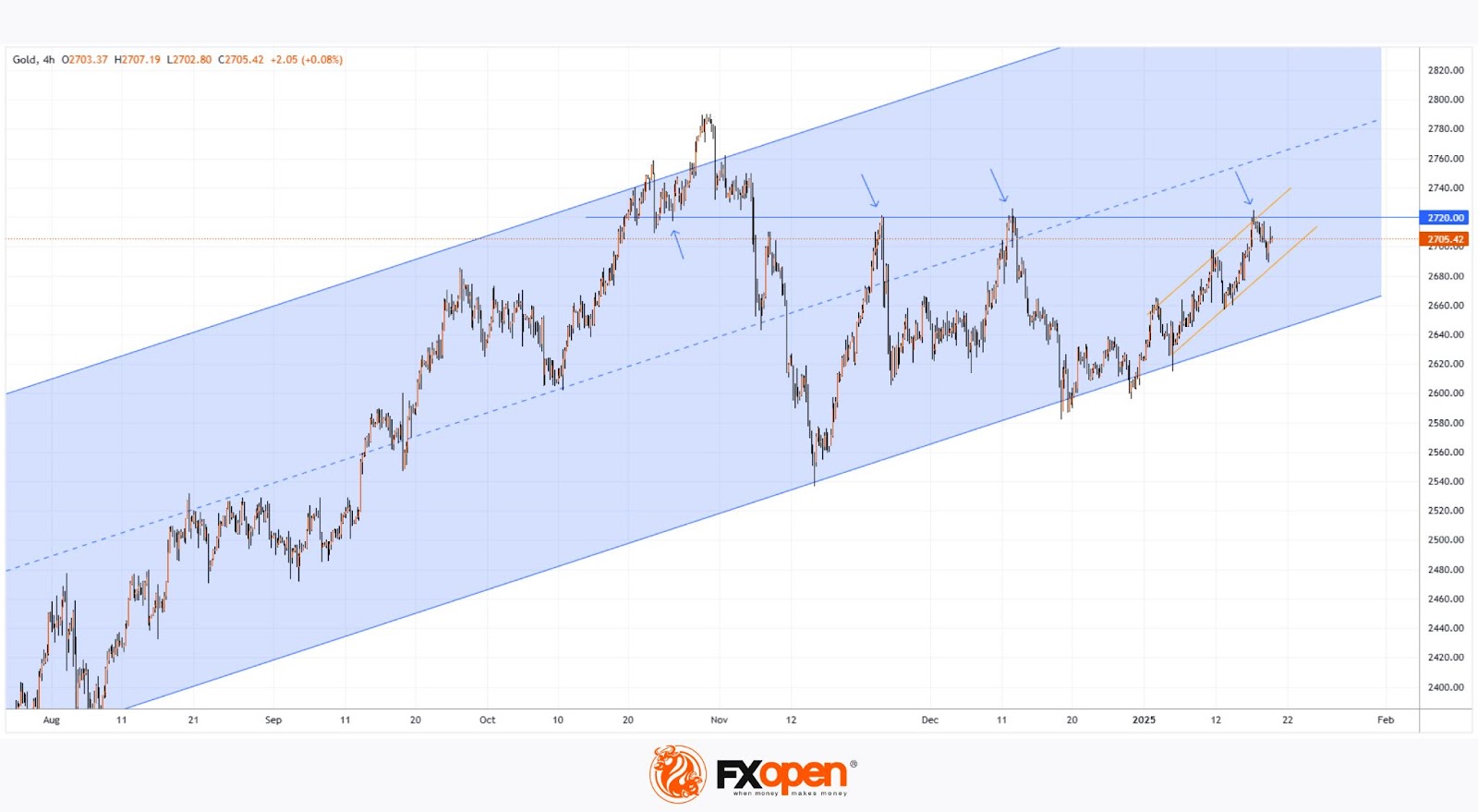
Technical analysis of the XAU/USD chart shows that gold prices are trading within a narrowing triangle:
→ The lower boundary is supported by the ascending channel that began in March 2024.
→ Resistance sits at $2,720 per ounce. Although this level served as support in October, bulls have struggled to break it since December (as indicated by the arrow).
While bullish sentiment dominates the gold market (evident from the orange trend lines relevant for January), Trump’s speech could trigger volatility spikes. These fluctuations may shift the current sentiment balance and spark the formation of a new trend for XAU/USD.
Start trading commodity CFDs with tight spreads. Open your trading account now or learn more about trading commodity CFDs with FXOpen.
This article represents the opinion of the Companies operating under the FXOpen brand only. It is not to be construed as an offer, solicitation, or recommendation with respect to products and services provided by the Companies operating under the FXOpen brand, nor is it to be considered financial advice.
EUR/USD Daily Outlook
Daily Pivots: (S1) 1.0247; (P) 1.0289; (R1) 1.0313; More...
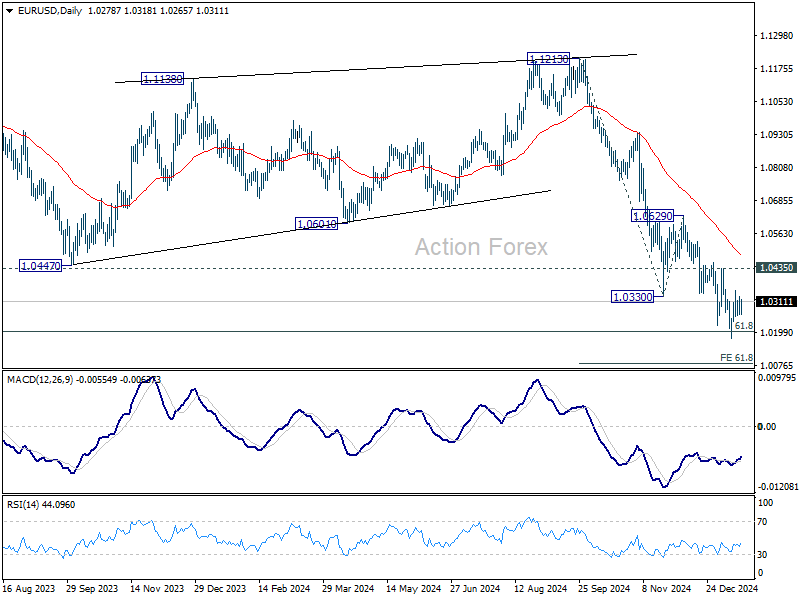
EUR/USD recovers mildly today but stays in the middle of near term range above 1.0176. Intraday bias stays neutral and outlook remains bearish with 1.0435 resistance intact. On the downside, break of 1.0176 will resume the fall from 1.1213 and target 61.8% projection of 1.1213 to 1.0330 from 1.0629 at 1.0083. However, firm break of 1.0435 will confirm short term bottoming, and turn bias back to the upside for stronger rebound.
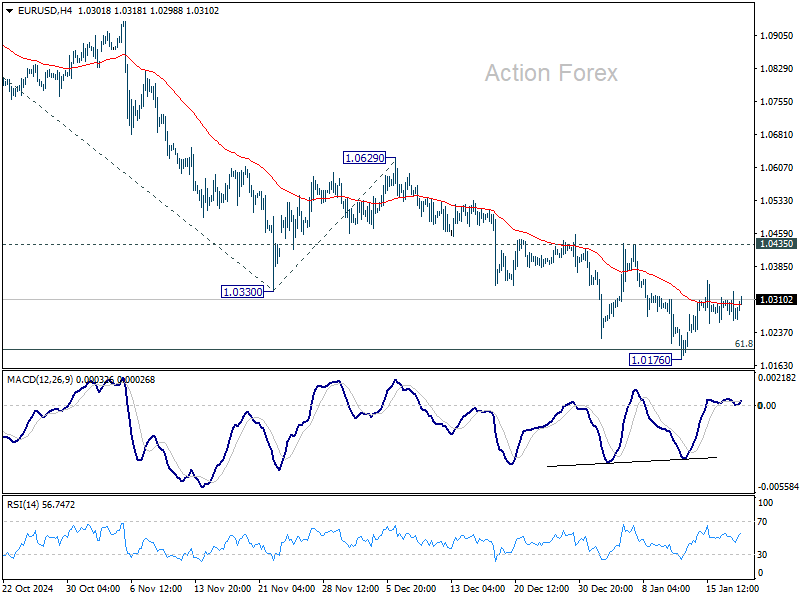
In the bigger picture, fall from 1.1274 (2023 high) should either be the second leg of the corrective pattern from 0.9534 (2022 low), or another down leg of the long term down trend. In both cases, sustained break of 61.8 retracement of 0.9534 to 1.1274 at 1.0199 will pave the way back to 0.9534. For now, outlook will stay bearish as long as 1.0629 resistance holds, even in case of strong rebound.
Greenback Eases Ahead of Trump’s Executive Actions, Bitcoin Takes Leads and Hits New Record
Dollar is trading slightly lower today as markets await Donald Trump’s inauguration as the 47th US President. Attention is focused on his inaugural speech, expected to confirm his policy priorities. However, the real market-moving event is likely to be the series of executive actions Trump has promised to enact immediately.
Over 200 directives are anticipated, including legally binding executive orders and proclamations, with particular interest in measures affecting tariffs and deregulations in sectors like energy and cryptocurrencies.
One key area of focus is Trump’s potential tariff policies, which would surely reshape US trade relationships with allies and adversaries and impact global market. Deregulation efforts, spanning traditional energy sectors to the fast-growing cryptocurrency industry, are also expected to influence investor sentiment.
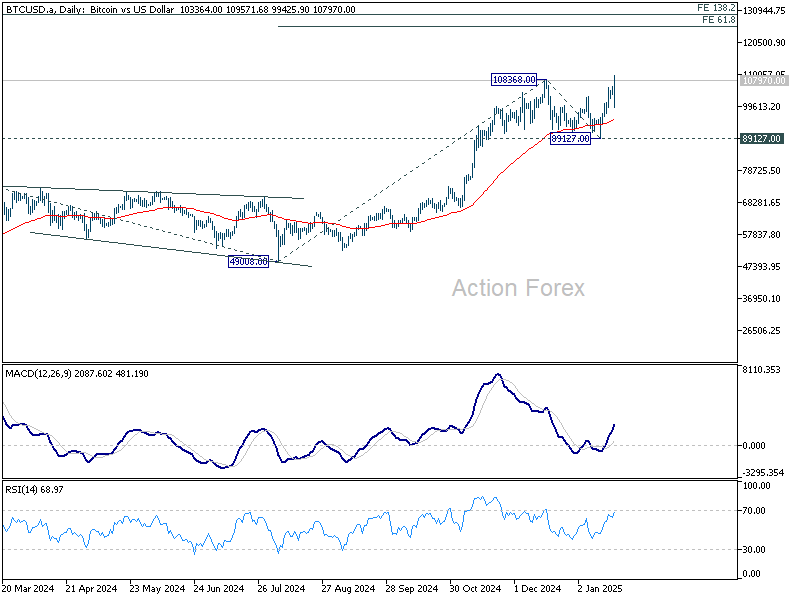
Meanwhile, Bitcoin has reached a new all-time high, reflecting the renewed bullish sentiment in cryptocurrencies. Technically, next near term target is 61.8% projection of 49008 to 108368 from 89127 at 125812. Outlook will stay bullish as long as 89127 support holds, even in case of pull back.
While Trump’s inauguration and executive actions are dominating headlines, global markets are also preparing for several other key events. BoJ is widely expected to raise its policy rate. UK employment data will provide insight into the labor market's response to the Autumn Budget. Inflation data from Canada and New Zealand will help shape monetary policy projections of BoC and RBNZ. PMI data from major economies will round out the week’s events.
ECB's Holzmann: January rate cut not as certain with elevated inflation risks
Austrian ECB Governing Council member Robert Holzmann expressed skepticism over a potential rate cut at ECB's upcoming January meeting. In an interview with Politico, Holzmann stated, “A cut is not a foregone conclusion for me at all,” emphasizing his commitment to approaching the discussion with an "open mind."
Holzmann highlighted that ECB decisions are fundamentally data-driven and noted that inflation remained “well above” 2% in December, with January figures expected to reflect similar levels. He cautioned that "cutting interest rates when inflation rises faster than anticipated, even temporarily, risks hurting credibility."
As a known policy hawk, Holzmann also revealed increased doubts about inflation settling around ECB’s 2% target by the end of the year. He cited unexpected developments since the December decision, including faster-than-expected depletion of gas reserves due to colder weather, the effective closure of the Ukraine gas transit, and the risks of persistently high energy prices.
China maintains LPR as offshore Yuan recovers ahead of key support
China’s central bank maintained its benchmark lending rates unchanged on Monday. The one-year loan prime rate was steady at 3.1%, while the over-five-year LPR, which influences mortgage rates, remained at 3.6%.
The offshore Yuan strengthened notably against the Dollar, continuing to draw support from a a key long-term level. This comes despite market speculation that China might allow Yuan to weaken further to counteract the economic effects of new tariffs introduced under Donald Trump’s presidency.
A weaker currency would bolster export competitiveness by making Chinese goods more affordable internationally. However, Beijing faces a dilemma: while a controlled depreciation could help exporters, an uncontrolled fall could lead to heightened volatility in domestic financial markets and reduced investor confidence.
Acknowledging these risks, PBOC Governor Pan Gongsheng reaffirmed the central bank’s commitment to exchange rate stability last week, stating, “We will resolutely prevent the risk of the exchange rate overshooting, ensuring that the Yuan exchange rate remains generally stable at a reasonable, balanced level.”
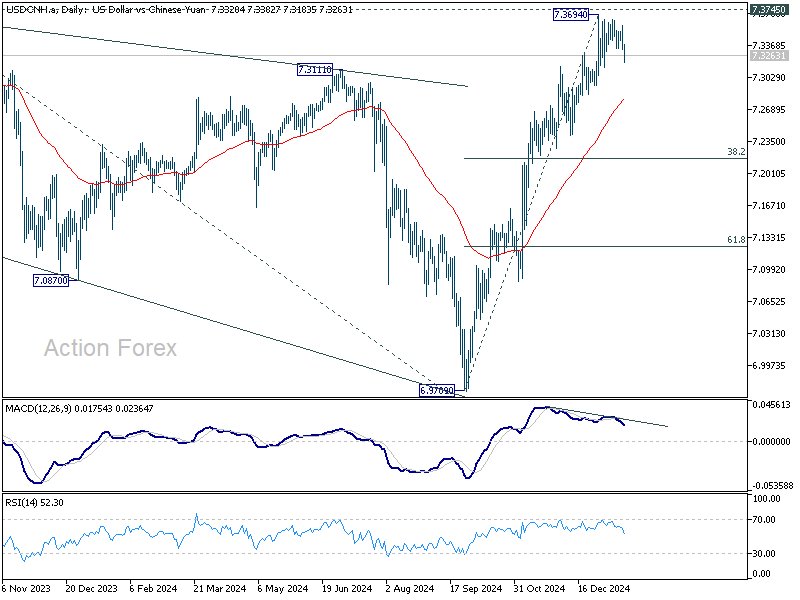
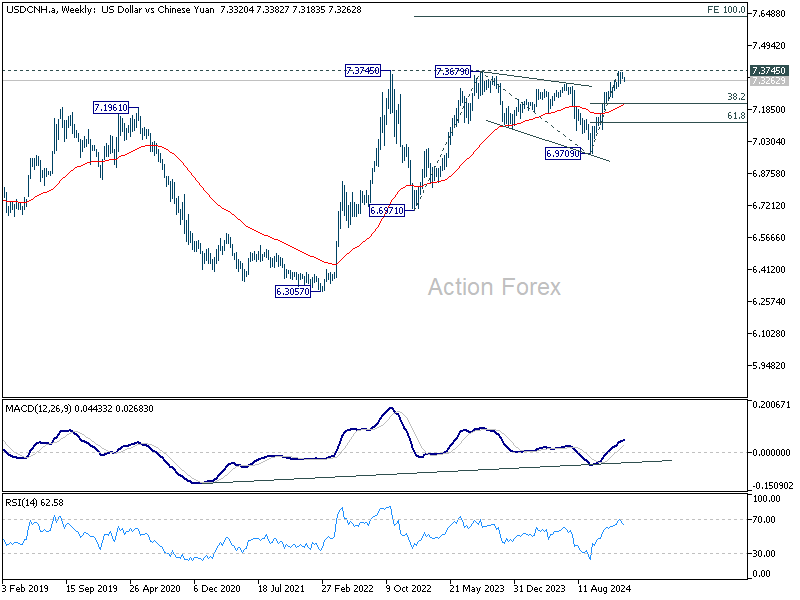
Technically, a short term top should be confirmed at 7.3694 in USD/CNH with today's dip. But it's early to call for bearish reversal as long as 55 D EMA (now at 7.2797) hits. Further rally remains in favor through 7.3745 (202 high) to resume the long term up trend.
Nevertheless, firm break of 55 D EMA should bring deeper pull back to 38.2% retracement of 6.9709 to 7.3694 at 7.2172, which is close to 55 W EMA (now at 7.2097) even just as a correction to rise from 6.9709.
From BoJ to inflation data and PMIs, global markets have more to focus on than Trump
While the inauguration of Donald Trump dominates the headlines in US markets, global investors are turning their attention to a week packed with pivotal high-impact economic events that would provide crucial clues about the monetary policy paths of key economies.
BoJ’s upcoming meeting is a top priority for global markets. After repeated signals from Governor Kazuo Ueda and other top officials, markets should be well-prepared for a 25bps rate hike, raising the policy rate to 0.50%. However, beyond the rate decision, the focus will shift to BoJ's updated economic projections and policy guidance.
While Ueda is expected to remain cautious about committing to a specific timeline for normalization, he may strike a more optimistic tone regarding wage growth, based on reports from branch managers. Additionally, BoJ could raise inflation forecasts in its quarterly outlook, both of which would add hawkish tones to the meeting.
In the UK, attention is squarely on employment data, which will shed light on the labor market’s response to the government’s Autumn Budget. The markets are already pricing in over 75 basis points of BoE rate cuts in 2025. Meanwhile, IMF is projecting an even deeper 100bps reduction. The strength of the labor market will play a pivotal role in determining the scale of monetary easing this year, making this release a key driver for Sterling sentiment.
Inflation data from Canada and New Zealand also hold significant importance. In Canada, BoC has indicated that the pace of rate reductions will slow, but uncertainty remains over the timing of pauses. A Reuters poll suggests an 80% chance of a 25bps cut on January 29, following December’s larger 50-bps move. CPI data will either reinforce or challenge this expectation.
Meanwhile, New Zealand’s Q4 inflation report is expected to show further easing in price pressures, consistent with RBNZ’s forecasts. If the trend persists, RBNZ could deliver another 50bs rate cut at its February meeting
Other data to watch this week include Germany’s ZEW Economic Sentiment Index and PMI reports from several major economies. These releases will provide additional context on global economic momentum and inform central bank decisions in the months ahead.
Here are some highlights for the week:
- Monday: Japan machine orders, tertiary industry index; Germany PPI; Swiss PPI; BoC business outlook survey.
- Tuesday: New Zealand BNZ services; UK employment; Germany ZEW economic sentiment; Canada CPI.
- Wednesday: New Zealand CPI; UK public sector net borrowing: Canada IPPI and RMPI.
- Thursday: Japan trade balance; Canada retail sales; US jobless claims.
- Friday: Australia PMIs; Japan CPI, PMIs, BoJ rate decision; Eurozone PMIs; UK PMIs; Canada new housing price index; US PMIs, US existing sales.
EUR/USD Daily Outlook
Daily Pivots: (S1) 1.0247; (P) 1.0289; (R1) 1.0313; More...
EUR/USD recovers mildly today but stays in the middle of near term range above 1.0176. Intraday bias stays neutral and outlook remains bearish with 1.0435 resistance intact. On the downside, break of 1.0176 will resume the fall from 1.1213 and target 61.8% projection of 1.1213 to 1.0330 from 1.0629 at 1.0083. However, firm break of 1.0435 will confirm short term bottoming, and turn bias back to the upside for stronger rebound.
In the bigger picture, fall from 1.1274 (2023 high) should either be the second leg of the corrective pattern from 0.9534 (2022 low), or another down leg of the long term down trend. In both cases, sustained break of 61.8 retracement of 0.9534 to 1.1274 at 1.0199 will pave the way back to 0.9534. For now, outlook will stay bearish as long as 1.0629 resistance holds, even in case of strong rebound.
ECB’s Holzmann: January rate cut not as certain with elevated inflation risks
Austrian ECB Governing Council member Robert Holzmann expressed skepticism over a potential rate cut at ECB's upcoming January meeting. In an interview with Politico, Holzmann stated, “A cut is not a foregone conclusion for me at all,” emphasizing his commitment to approaching the discussion with an "open mind."
Holzmann highlighted that ECB decisions are fundamentally data-driven and noted that inflation remained “well above” 2% in December, with January figures expected to reflect similar levels. He cautioned that "cutting interest rates when inflation rises faster than anticipated, even temporarily, risks hurting credibility."
As a known policy hawk, Holzmann also revealed increased doubts about inflation settling around ECB’s 2% target by the end of the year. He cited unexpected developments since the December decision, including faster-than-expected depletion of gas reserves due to colder weather, the effective closure of the Ukraine gas transit, and the risks of persistently high energy prices.
China maintains LPR as offshore Yuan recovers ahead of key support
China’s central bank maintained its benchmark lending rates unchanged on Monday. The one-year loan prime rate was steady at 3.1%, while the over-five-year LPR, which influences mortgage rates, remained at 3.6%.
The offshore Yuan strengthened notably against the Dollar, continuing to draw support from a a key long-term level. This comes despite market speculation that China might allow Yuan to weaken further to counteract the economic effects of new tariffs introduced under Donald Trump’s presidency.
A weaker currency would bolster export competitiveness by making Chinese goods more affordable internationally. However, Beijing faces a dilemma: while a controlled depreciation could help exporters, an uncontrolled fall could lead to heightened volatility in domestic financial markets and reduced investor confidence.
Acknowledging these risks, PBOC Governor Pan Gongsheng reaffirmed the central bank’s commitment to exchange rate stability last week, stating, “We will resolutely prevent the risk of the exchange rate overshooting, ensuring that the Yuan exchange rate remains generally stable at a reasonable, balanced level.”
Technically, a short term top should be confirmed at 7.3694 in USD/CNH with today's dip. But it's early to call for bearish reversal as long as 55 D EMA (now at 7.2797) hits. Further rally remains in favor through 7.3745 (202 high) to resume the long term up trend.
Nevertheless, firm break of 55 D EMA should bring deeper pull back to 38.2% retracement of 6.9709 to 7.3694 at 7.2172, which is close to 55 W EMA (now at 7.2097) even just as a correction to rise from 6.9709.
Dollar Resilience Basically Remained in Place
Markets
The correction in US yields that started on (marginally) softer than expected US CPI data and comments from Fed Waller finally met first support on Friday as markets returned their focus to the new Trump era. Solid US housing and production data helped build this floor. US yields in a bear flattening move added between 5.3 bps (2-y) and 0.2 bps (30-y). EMU/German yields intraday also showed signs of bottoming but still closed the day in red (German 2-y -0.1 bp, 30-y -2.0 bps). Still, the yields’ move didn’t change the constructive bias on global equity markets. US indices closed the session up to 1.5% higher (Nasdaq). Europe this time slightly underperformed the US (EuroStoxx50 +0.81%), but the index still firmly confirmed the break above the cycle top. Last week’s setback in the USD on lower US yields and the broader risk-on mostly remained modest and this dollar resilience basically remained in place at the end of last week. At 109.35, DYX still closed the week within striking distance of the correction top (110 area) reached on Monday. EUR/USD extended the short-term consolidation pattern (close 1.0273), but in this process last week failed to challenge any significant resistance level, suggesting that underlying USD strength/euro weakness still remained in place. UK and sterling trailed as weaker-than-expected retail sales confirmed a mediocre narrative on the economy as the government tries to convince the country and markets on the viability of its economic/budgetary policy. EUR/GBP (0.8442) closed the week near the 0.845 resistance area.
Asian equity markets mostly open in positive territory. Regional investors apparently take comfort from the headlines on a what was said to have been a good conversation between Donald Trump and Chinese leader Xi Jinping. ECB Board member Isabel Schnabel in an interview with Finanztip this weekend indicated that for now she sees no major risk that could prevent the bank from reaching the 2.0% target, allowing it to continue its easing cycle. However, after steep rate cuts executed of late, she said that the point is coming closer for the bank to evaluate whether and to what extent the ECB can cut rates further.
Today’s calendar in Europe is empty and US markets are closed in observance of Martin Luther King day. All eyes evidently will be on Washington as Donald Trump will be sworn in as the 47th president of the US. The president is expected to announce an avalanche of executive orders in the first hours/days after taking office, with sweeping measures to be announced on migration, tariffs, deregulation and American energy policy amongst others. The wide scope of potential surprises makes a consistent market reaction not evident, but the focus likely will be on the pace and nature of the first import tariffs. Visibility on longer-term market impact/reaction function stays low, but we assume that even ‘disruptive’ Trump measures won’t be disruptive for the Trump trade in a first instance. (US) yields might to look for a bottom after last week’s correction. The 4.20% area serves as a first support area for the US 2-y yield. The 1.0400/1.0450 area remains strong resistance for the EUR/USD cross rate.
News & Views
Average asking prices for newly listed UK homes rose by 1.7% M/M in January to be 1.8% higher compared with the same period last year. The nominal average price of £366 189 is only £9k below the peak hit in May of last year. Other signs of momentum come from increases in agreed sales (+11% Y/Y), the number of buyers contacting agents about properties (+9% Y/Y) and the number of new properties coming to the market (+11% Y/Y). Property website Rightmove, who conducted the survey, said that current drive could rapidly peter out should hopes on BoE rate cuts not materialize as they are key in reducing mortgage rates. April’s expiry of a lower rate of property purchase tax on less expensive homes is seen as currently boosting demand but equally represents a risk from Q2 onwards for momentum to be sustained.
The German conservative opposition block CDU/CSU polled a first time below 30% since April in the run-up to February 23 parliamentary elections. They maintained their lead over the far-right AfD though which also dropped a point to 21%. Support for social Democrats of Chancellor Scholz (16%) and greens (13%) was unchanged with relative gains going to smaller parties. With centre-left and centre-right all refusing a tie-up with AfD, election night will decide on whether CDU/CSU-leader Merz will be able to set-up his preferred two-way coalition or whether he’ll have to explore the three-way alliance.
GBP/USD Under Pressure, USD/CAD Powers Higher
GBP/USD started a fresh decline below the 1.2320 zone. USD/CAD is rising and might aim for more gains above the 1.4500 resistance.
Important Takeaways for GBP/USD and USD/CAD Analysis Today
- The British Pound started another decline from the 1.2320 resistance zone.
- There is a short-term bearish trend line forming with resistance at 1.2205 on the hourly chart of GBP/USD at FXOpen.
- USD/CAD is showing positive signs above the 1.4400 support zone.
- There is a key bullish trend line forming with support at 1.4420 on the hourly chart at FXOpen.
GBP/USD Technical Analysis
On the hourly chart of GBP/USD at FXOpen, the pair struggled to continue higher above the 1.2320 resistance zone. The British Pound started a fresh decline and traded below the 1.2270 support zone against the US Dollar, as discussed in the previous analysis.
The pair even traded below 1.2250 and the 50-hour simple moving average. Finally, the bulls appeared near the 1.2100 level. The recent swing low was formed at 1.2160 and the pair is now consolidating losses.
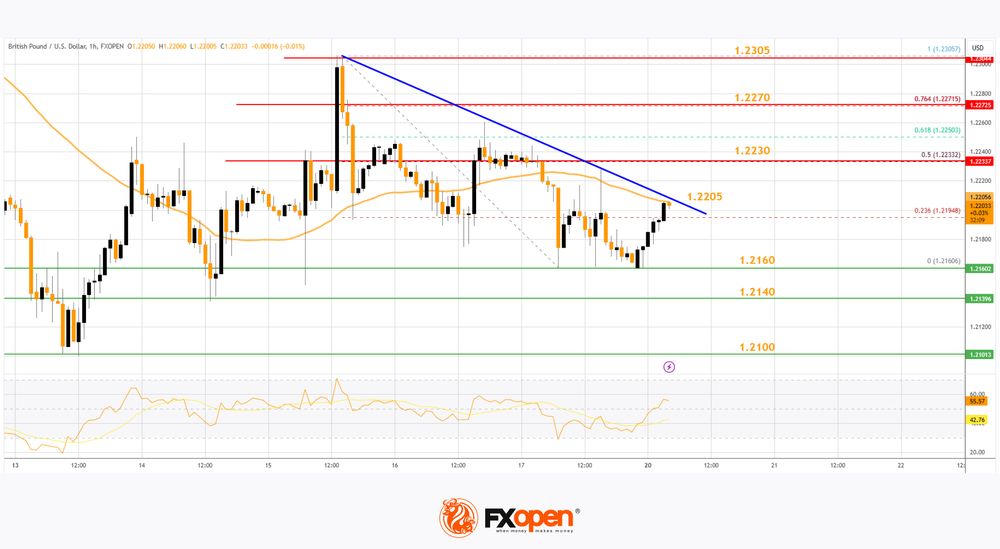
Immediate resistance on the upside is near a short-term bearish trend line at 1.2205. The first major resistance is near the 1.2230 zone and the 50% Fib retracement level of the downward move from the 1.2305 swing high to the 1.2160 low.
The main hurdle sits at 1.2270 and the 76.4% Fib retracement level of the downward move from the 1.2305 swing high to the 1.2160 low. A close above the 1.2270 resistance might spark a steady upward move.
The next major resistance is near the 1.2305 zone. Any more gains could lead the pair toward the 1.2320 resistance in the near term.
Initial support on the GBP/USD chart sits at 1.2160. The next major support sits at 1.2140, below which there is a risk of another sharp decline. In the stated case, the pair could drop toward 1.2100.
USD/CAD Technical Analysis
On the hourly chart of USD/CAD at FXOpen, the pair formed a strong support base above the 1.4300 level. The US Dollar started a fresh increase above the 1.4345 resistance against the Canadian Dollar.
The bulls pushed the pair above the 1.4380 and 1.4400 levels. The pair cleared the 50-hour simple moving average and climbed above 1.4450. A high was formed at 1.4485 and the pair recently corrected some gains.
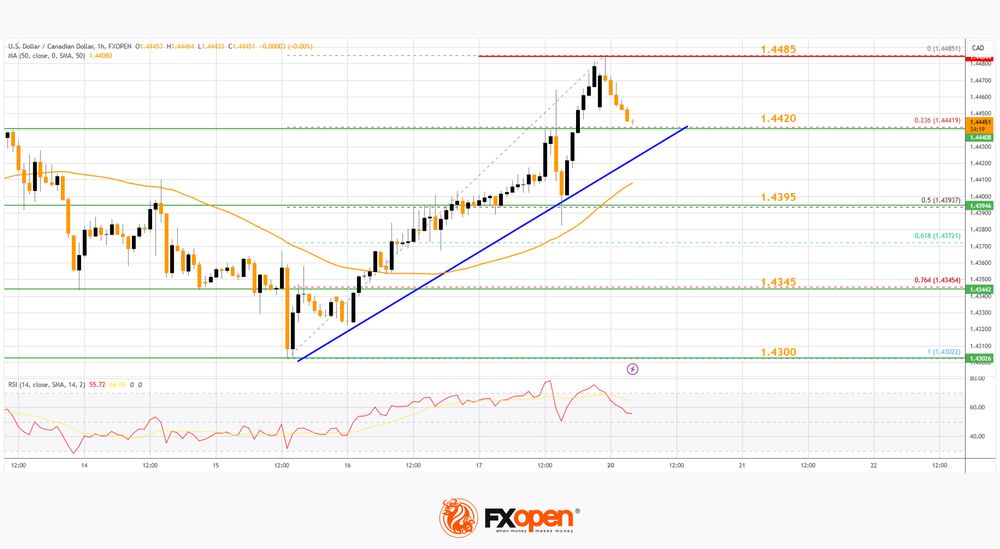
There was a move toward the 23.6% Fib retracement level of the upward move from the 1.4302 swing low to the 1.4485 high. Initial support is near the 1.4420 level.
There is also a key bullish trend line forming with support at 1.4420. The next major support is near the 1.4395 level or the 50% Fib retracement level of the upward move from the 1.4302 swing low to the 1.4485 high.
The main support sits near the 1.4345 zone on the same USD/CAD chart. A downside break below the 1.4345 level could push the pair further lower. The next major support is near the 1.4300 support zone, below which the pair might visit 1.4250.
If there is another increase, the pair might face resistance near the 1.4485 level. A clear upside break above 1.4485 could start another steady increase. The next major resistance is the 1.4540 level.
A close above the 1.4540 level might send the pair toward the 1.4580 level. Any more gains could open the doors for a test of the 1.4620 level.
Trade over 50 forex markets 24 hours a day with FXOpen. Take advantage of low commissions, deep liquidity, and spreads from 0.0 pips. Open your FXOpen account now or learn more about trading forex with FXOpen.
This article represents the opinion of the Companies operating under the FXOpen brand only. It is not to be construed as an offer, solicitation, or recommendation with respect to products and services provided by the Companies operating under the FXOpen brand, nor is it to be considered financial advice.
Trump and Coin
After a few weeks of hesitation around the beginning of the new year, the equity bulls finally returned to the market last week on the back of a set of slower-than-expected inflation figures from both the US and the UK, and a set of stronger-than-expected US big bank results. The global bond yields retreated in the developed world from a peak reached earlier last week and let the equities take a breather. The US equity indices posted their best weekly performance since the US post-election rally of last year, and the non-tech sectors performed better than their tech peers. Both Nasdaq and the S&P500 closed the week above the downtrending channel top building since mid-December, while the Dow Jones recovered half of losses that it had accumulated after hitting a record high back in December 5th and outperformed its US peers. The more cyclical Stoxx 600 stocks gained around 2.40% – a bit less than their US peers, while the FTSE 100 rallied more than 3% to an ATH level.
In the FX, the US Dollar retreated on the back of soft CPI and softening Federal Reserve (Fed) expectations, leading to a slow down of the selloff in the EURUSD and Cable. The euro is trying to hang on to the 1.03 level this morning, while Cable is drilling past the 1.22 at the time of writing. The USDJPY, on the other hand, starts the week in favour of the Japanese yen as the Bank of Japan (BoJ) is expected to announce a rate hike this Friday – with hope that their action won’t send a shockwave across the global financial markets as it had been the case in summer 2023, and on hope that Trump’s policies won’t have a dramatic impact on the Japanese fundamentals.
The Trump and coin
Today, Donald Trump will be sworn in and officially move into the White House. A good part of Trump trade has already happened – the small and mid-caps rallied, energy and financials outperformed and cryptocurrencies touched the sky. Therefore, the first week under Trump may not bring a lot of surprises... (but it may as well!) The WSJ writes that Donald Trump has already prepared 100 – yes 100 – executive orders to take swift action after today’s inauguration, including an order to make crypto a policy priority and giving insiders of the crypto market a good voice within his administration.
Trump launched a cryptocurrency of his own on the Solana blockchain and the coin gained up to 600% in three days reaching a $15bn capitalization before easing – a little bit – also sending Solana to a fresh record high.
But beyond that optimism, Trump policies are expected to be a double-edged sword. His pro-growth policies and deregulation are expected to benefit to the US economy but his tariff policies will certainly lead inflation higher and soften the Fed doves’ hands for easing policy. In addition, exploding debt levels will likely further push the borrowing costs higher.
Optimism in Asia
The week kicks off on a positive note in Asia. Tiktok is back and running in the US after a short blackout during the weekend. Donald Trump wants to extend the deadline for the company to find US partners to continue running the popular social media platform in the US. And Trump optimism goes beyond that. He and Xi Jinping held ‘a very good’ phone call to ‘make the world more peaceful and safe’. The Chinese CSI 300 is up this Monday although the People’s Bank of China (PBoC) kept its lending rates unchanged for the third straight month to contain the downside pressure on the yuan, the 10-year yield is trying to push higher...
Earnings
This week, big names including Netflix, P&G and American Express will go to the earnings confessional. The S&P500 companies are expected to print an almost 12% earnings growth in Q4. Pulling the Magnificent 7 out of the equation, the S&P500’s earnings growth is expected to be around 4%. Strong earnings and prospects of further rate cuts – though slower – could give support to equity valuations.
Oil rally slows near $80pb
Crude oil’s 20% rally since December 10th sees strong resistance above the $80pb level and the six-week ceasefire deal in Gaza helps easing the price of a barrel this Monday. But geopolitical risks prevail with Trump aiming to go after Russian oil giants, Iran and Venezuela. The IEA not expects a lower output surplus this year and the latter should give support to oil prices. Minor support is seen near the $77.30pb level – the minor 23.6% Fibonacci retracement on the latest rebound, and the major support stands near the $75.30/40pb region that shelters the major 38.2% retracement and the 200-DMA.