

Sample Category Title
(ECB) Mario Draghi – Sustaining Openness in a Dynamic Global Economy
Speech by Mario Draghi, President of the ECB, at the Economic Policy Symposium of the Federal Reserve Bank of Kansas City, Jackson Hole, 25 August 2017
The global recovery is firming up. In some countries like the United States, this process has been visible for some years, in others like Europe and Japan, the consolidation of the recovery is at an earlier stage. So it is fitting that our discussions are now focusing not only on how to stabilise the economy, but also on how to make it more dynamic – while at the same time improving people's welfare. At the centre of this debate is the question of how to raise potential output growth, which has slowed from around 2% in OECD countries in 2000 to around 1% today.
Without stronger potential growth, the cyclical recovery we are now seeing globally will ultimately converge downwards to those slower growth rates. Slower growth will in turn make it harder to work through the debt and demographic challenges facing many advanced economies.
With the population growth rate in those economies projected to slow, the burden of raising potential growth must fall on productivity. There are a number of areas in which domestic policies can encourage an upward shift in productivity growth, such as competition, research and development, and insolvency regimes.
But when thinking about the global economy, one of the key ingredients for raising productivity is openness. Open trade, investment and financial flows play a key role in the diffusion of new technologies across borders that drive forward efficiency improvements.
The social consensus on open markets has, however, been weakening in recent years. This is driven not so much by a belief that open markets no longer create wealth, but by the perception that the collateral effects of openness outweigh its benefits. People are concerned about whether openness is fair, whether it is safe and whether it is equitable.
As Karl Polanyi observed many years ago, if the dislocation created by an open market goes beyond a certain point, protectionism is society's natural response.
So a central element of efforts to raise productivity growth – and build a dynamic global economy – must involve responding to these concerns about openness. And this is a feat countries cannot accomplish by themselves. Although domestic welfare policies are, of course, essential to the task, a commitment to working together through multilateral institutions is just as important.
This is because fears about fairness, safety and equity ultimately reflect a lack of trust in other countries' regulation and enforcement. One of the main reasons why multilateral institutions exist is to create regulatory convergence, and therefore to increase trust between countries. And perhaps the most important area where this applies today is global financial sector regulation.
Openness as the key to a dynamic global economy
One of the key questions facing the global economy is whether the trend towards ever greater economic openness, which has defined the last three decades, is coming to an end. Temporary trade barriers have indeed risen from covering around 1% of products in 2000 to more than 2.5% today, with the crisis accelerating this pattern. The same is true of anti-dumping actions.
That said, at the global level openness is still viewed favourably; three-quarters of people consider growing trade and business ties with other countries to be a positive trend. But those polled in rich countries are more negative than in the pre-crisis period.
Given the established gains of trade, this is plainly a concerning trend for the global economy. International trade results in a more efficient use of production factors and in specialisation where comparative advantage exists, thereby raising productivity growth. And welfare gains from trade for firms and consumers follow from the wider availability of cheaper and better quality products.
Moreover, for advanced economies the importance of trade may actually be growing. As economies converge towards the global technological frontier, innovation becomes more important for sustained productivity growth. And as OECD research has shown, openness to trade is a crucial factor in enabling an economy to benefit from frontier innovation.
According to OECD estimates, in the case of a 2% acceleration in multi-factor productivity (MFP) growth in a frontier economy, the productivity spillover will be 0.3 percentage points higher for a country that trades intensively with the frontier economy than for one which trades less intensively. To put this in context, MFP growth has averaged only around 0.5% in OECD countries since 2000.
Thus a turn towards protectionism would pose a serious risk for continued productivity growth and potential growth in the global economy. And this risk is particularly acute in the light of the structural challenges facing advanced economies.
Old-age dependency ratios are rising, putting more pressure on public finances. By 2025 there will be 35 people aged 65 and over for every 100 persons of working age in OECD countries, compared with 14 in 1950. At the same time, public debt levels have surged in those countries from 56% of GDP in 2007 to around 87% today. Only higher potential growth can provide a lasting solution.
So, clearly, to foster a dynamic global economy we need to resist protectionist urges. But to do so, we also need to identify how best to respond to protectionism.
The role of multilateral cooperation in making openness sustainable
Much has been written over the past few years about the negative effects of free trade and the need to pay more attention to those who benefit less from it. The debate has typically focused on the extent to which welfare policies can be used to share the gains of trade more evenly.
Though this is a complex issue, I have no doubt that making better use of public policies to support the more vulnerable members of society, not just financially but also through education and retraining, is a vital part of the equation. More work needs to be done in this area and it is important to learn from best policy practices.
But the other key question is: how can we work together to make openness sustainable? What role can multilateral cooperation play towards this goal? This is the angle I would like to address today. Its importance becomes clear when one thinks about the three main areas of concern that people have about open markets that I mentioned earlier.
First, there is the concern about whether openness is fair – i.e. whether all are playing by the same rules and applying the same standards. This manifests itself in fears about currency manipulation by trading partners, dumping practices and lack of reciprocal market access.
Second, there is the concern about whether openness is safe – i.e. whether it exposes people to harmful spillovers from abroad. This is perhaps most visible, at least for economists, in the case of cross-border capital flows, but it also applies in areas such as agriculture and biotechnology.
Third, there is the concern about whether openness is equitable – that is, whether it disproportionately benefits some groups in society over others. Though it is not straightforward to disentangle the effects of trade and technology on inequality – and they may in fact be linked – the perception that openness contributes to inequality has become more widespread.
In each case, multilateral cooperation, leading to regulatory convergence, is a precondition for addressing the underlying causes of these concerns. To demonstrate this, let me draw on our experience of managing openness within the European Union.
As regards fairness, the point is obvious: regulatory convergence provides the strongest assurance that the playing field is level right across the European market. This is why, as borders have opened within Europe, common supranational powers of legislation and enforcement have strengthened in parallel.
For example, the Single European Act in 1986 not only launched the single market, it also substantially extended the powers of the EU to make laws, the role of the European courts to rule on them, and the powers of the Commission to execute them. The logic was that a single market could only be sustainable over time if all participants could be certain that they faced the same rules, and had recourse to the same courts in the case of infractions.
Despite the political events of last year, this symmetry between regulatory convergence and market deepening has, by and large, been a success. In fact, the free movement of people, goods and services within Europe is regularly mentioned in polls as one of the two most positive aspects of the EU, the other being peace among its Member States.
Similarly, what has permitted the Single Market to survive various financial and consumer protection crises is its ability to restore safety by adapting market-wide regulation and enforcement.
To give an illustration, the internal market for frozen foods overcame the mis-selling scandal of 2013, when horsemeat was sold as beef, in large part because it was met with an improved food labelling and EU-wide inspection regime that restored trust. By contrast, a perceived lack of regulatory convergence between the EU and other countries, especially regarding food safety, is one reason for opposition to preferential trade agreements, such as the TTIP.
More fundamentally, following the sovereign debt crisis, the euro area experienced first-hand the risks of a diverging supervisory and regulatory framework for cross-border finance – and faced a serious threat of financial market fragmentation when those flows reversed. Safety was restored by elevating supervision and resolution to the European level with the banking union. This was key to re-establishing trust in the banking system and reviving cross-border capital flows within Europe. These are only the first steps, but the direction of travel has been drawn.
When it comes to the effects of openness on equity, it is admittedly less obvious how multilateral cooperation represents a solution to the fears being expressed. As I said, such fears typically have to be addressed by national distributional policies. But there is also an important international dimension, in particular related to tax avoidance.
Indeed, the problem many have with openness is not just that it redistributes income between different social groups. Almost everything that happens in a market economy – skill-biased innovation, churning of firms – redistributes income in some way, and we have in place mechanisms to deal with those outcomes, such as tax systems.
Where trade may differ from these other market forces, however, is in the perception that, in Dani Rodrik's words, it "undercuts the social bargains struck within a nation and embedded in its laws and regulations". For example, increasing openness to trade and finance is perceived by some to shift the burden of taxation from footloose capital to labour, or to create pressures to reduce labour protections to boost the competitiveness of domestic producers – the "race to the bottom".
Such perceptions, and the sense of injustice they fuel, are deeply damaging to public faith in open markets – and this is where multilateral solutions can play a role.
Addressing tax arbitrage between jurisdictions, for instance, can clearly best be achieved by countries cooperating via international institutions. Likewise, taking a stand against race-to-the-bottom dynamics that threaten labour protections, calls for a common regulatory approach. Again, our experience in Europe offers some insights into how this can work, as well as into some of the difficulties involved.
Thanks to its common legal framework, the EU has successfully upheld labour standards even as its market has expanded to lower-income countries. The Single Market has no doubt prompted some relocation of jobs across countries, and this has at times triggered fears of "social dumping". But in fact openness has not fundamentally challenged labour protections.
One main reason for this is that safeguards central to the European social model have been progressively embedded in European law, ensuring gradual convergence in labour standards among EU countries. Thus, while there is still heterogeneity, the gap between them is narrowing.
Preferences about the degree and type of social and labour protection differ across the world, and I am not claiming that those in the EU should be a model for everybody. The point here is that through multilateral decision-making, the EU has successfully built and defended the single market, addressing the perception that openness is always a source of inequality.
At the same time, in areas where unanimous decision-making is more prevalent, Europe has not always used the potential of its multilateral structure to the same extent. This is the case, for instance, in combatting profit-shifting and tax avoidance, although progress is now being made, which clearly chimes with the mood of EU citizens.
In short, there are certain concerns about equity that can most effectively – and perhaps only – be addressed through multilateral actions. As such, in tandem with well-targeted welfare policies, they are a key part of the policy toolbox for making openness sustainable.
Implications for the global economy
Clearly, the European model involves several unique features. In particular, it depends on a relatively advanced political structure that helps reconcile multilateral cooperation with democratic control, which is difficult to replicate elsewhere. Still, EU countries are generally more open than other advanced economies and perhaps have fewer problems of skewed income distribution. So what lessons can we draw for the global economy from our experience?
The most salient is that, at a time when disaffection with openness is growing, multilateral institutions become more, not less important. They provide the best platform to address concerns about openness without sacrificing open markets.
So organisations like the WTO, which make sure that trade is governed by rules and is subject to fair arbitration, remain vital to ensuring that global trade is perceived as fair and safe – while at the same time avoiding protectionism in disguise. And bodies that foster global cooperation, such as the G20, remain just as necessary to reconcile openness with equity. The OECD/G20 initiative to combat tax base erosion and profit-shifting is just one example of such cooperation.
That said – and going by our experience in Europe – the area where we need a special focus today is cross-border finance. Organisations that facilitate convergence in financial regulation and supervision, such as the Financial Stability Board and the Basel committees, are key in this context.
Within these committees, a substantial amount of work has been done since the crisis to strengthen microprudential regulation, as well as to design and calibrate macroprudential tools. This work has been essential for at least three reasons.
The first reason is that finance is the most mobile production factor, and therefore the most likely to cause dangerous spillovers. This makes convergence in financial regulation one of the most important components of a sustainable open economy.
And we should remember that diverging financial regulation would endanger not only financial openness, but also global trade, since they are often two sides of the same coin: finance and trade are complementary in spreading knowledge and underpinning global value chains. A striking feature of the global financial crisis was indeed the collapse in world trade: between the third quarter of 2008 and the second quarter of 2009 global trade volumes declined by approximately 15%.
The second reason is that we have only recently witnessed the dangers of financial openness combined with insufficient regulation. International financial flows both contributed to and propagated the global financial crisis and the ensuing collapse of trade, output and employment.
Financial integration only survived relatively unscathed because the global regulatory response was swift and decisive, creating a financial system that posed fewer risks to the world economy. Any reversal would call into question whether the lessons of the crisis have indeed been learnt – and thus whether financial integration can still be considered safe.
Third, financial regulation interacts critically with monetary policy. Lax regulation implies an underestimation by regulators of incentives which lead to behaviour that is individually profitable, but socially costly. Given the large collective costs that we have observed, there is never a good time for lax regulation. But there are times when it is especially inopportune.
Specifically, when monetary policy is accommodative, lax regulation runs the risk of stoking financial imbalances. By contrast, the stronger regulatory regime that we have now has enabled economies to endure a long period of low interest rates without any significant side-effects on financial stability, which has been crucial for stabilising demand and inflation worldwide.
With monetary policy globally very expansionary, regulators should be wary of rekindling the incentives that led to the crisis.
To design and agree, in reciprocal trust, a regulation that preserves financial stability without unnecessarily restricting the flow of credit to the economy, while revisiting the post-crisis regulatory framework where necessary, the FSB and the Basel committees remain essential. This is also because, for large economies, changes in domestic regulation have international consequences. Global financial conditions account for 20-40% of the variation in countries' domestic financial conditions, as shown by recent research from the IMF.
Conclusion
Let me conclude.
To inject more dynamism into the global economy we need to raise potential output growth, and to do so with ageing societies we need to lift productivity growth. For advanced economies that are close to the technological frontier, this depends crucially on openness to trade.
Yet openness to trade is under threat, and this means that policies aimed at answering this backlash are a vital part of the policy mix for dynamic growth. Some of those policies can be implemented domestically, but some can only be effectively enacted through multilateral cooperation.
Multilateral cooperation is crucial in responding to concerns about fairness, safety and also equity. By encouraging regulatory convergence, it helps protect people from the unwelcome consequences of openness. And protection ensures that we do not lapse into protectionism over time.
The European experience provides some insights into the opportunities and challenges involved. It also shows the importance of ensuring that, at all times, openness remains under democratic control. Multilateral institutions are necessarily staffed by experts. But it is essential that they always remain accountable to elected representatives who set the parameters and have the final say.
Yen Edges Higher as Yellen Mum on Interest Rate Plans
USD/JPY has posted slight losses in the Friday session. In North American trade, the pair is trading at 109.26, down 0.26% on the day. On the release front, Tokyo Core CPI improved to 04%, edging above the estimate of 0.3%. In the US, durable goods reports were mixed. Core Durable Goods Orders improved to 0.5%, edging above the estimate of 0.4%. However, Durable Goods Orders declined 6.8%, weaker than the estimate of -6.0%. At the Jackson Hole meeting of central bankers, Janet Yellen has concluded her speech and the yen has responded with slight gains.
Federal Reserve Chair Yellen spoke at the Jackson Hole Symposium earlier in the day. Yellen did not take advantage of an ideal opportunity to address US monetary policy, choosing instead to discuss financial reforms, saying that measures put in place in 2007 and 2009 had been effective, adding that future reforms should remain modest. Her comments seemed aimed at a domestic audience, as her message to exercise caution comes at a time when President Trump is looking into wide-ranging reforms in the finance industry. The pro-business Trump has complained that the financial sector is over-regulated and has said that he wants to ease current regulations.
The Fed has not provided much guidance in recent weeks as to its plans regarding interest rates, and Janet Yellen did not address the issue in her speech at Jackson Hole. A December rate hike remains on the table, but the Fed policymakers have sounded lukewarm about another hike in 2017, and the odds of a rate hike in December remain below 50%. One of the principal impediments to rate hike is inflation, which remains at stubbornly low levels. This, despite solid economic growth and a labor market that is close to capacity.
Like other Western economies, Japan remains gripped with low inflation. This has resulted in the Bank of Japan keeping in place its ultra-accommodative monetary policy. Unlike the US and Europe, however, the BoJ has given no indications of tightening policy anytime soon, insisting that that inflation must first rise closer to its target of 2%. There was some good news from Tokyo Core CPI, the primary gauge of consumer inflation, in August. The indicator gained 0.4%, marking its strongest gain since April 2015. The economy is headed in right direction, as GDP has expanded for six consecutive quarters. In the second quarter, GDP impressed with a gain of 1.0%, well above the forecast of 0.6%. Still, with inflation nowhere near the BoJ's target, the bank's radical stimulus program is likely to remain in place for the foreseeable future.
Weekly Market Outlook: Time To Deleverage Carry Trades
- Time To Deleverage Carry Trades - Peter Rosenstreich
- NZD: Local Developments Don't Matter - Arnaud Masset
- Switzerland: CHF In Depreciation Mode - Yann Quelenn
- Gold & Metal Miners
FX Market - Time To Deleverage Carry Trades
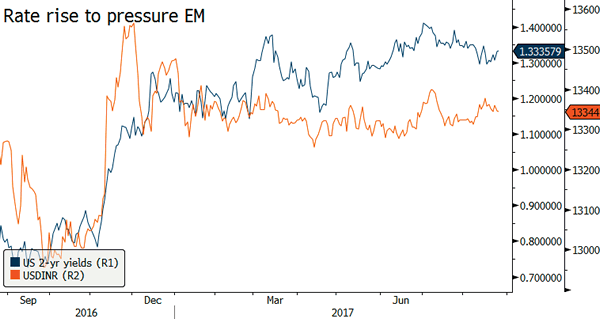
We have been a massive advocates for the EM carry trade strategy over the last 12 months. However conditions have moved forward, and price actions indicate, that its time to step-off the pedal slightly (although not completely). Friday's Wyoming speeches from Yellen's and Draghi have preoccupied the market sentiment proving a justification for EM stagnation. Hence many are calling for a risk rally when neither central banker introduces new information on monetary policy. Yet, the fact remains the Fed and ECB are moving toward tightening. Government bond yield basically risen since April with each pullback getting smaller and quicker. The rational is simple.
First, geopolitical risk have increased in our view. Despite our overarching rule to discount, Trump generated hype, each event, which passes without incident increases the likelihood that the next time will be a actually crisis. North Korea, NAFTA, US debt-ceiling all are teetering on the edge with limited hope of a clean diffusion. Second, financial stability concerns. Global equity markets are clearly in overvalued territory with technology specifically having mind numbing valuation. Positive growth environment, solid corporate earning and hopes of Trump stimulus gave asset prices a massive boost. But higher forward P/E would need a real revenue justification not just a story book pitch. Finally and most importantly, the end of ultra-low monetary policy is near. Bond traders have made fortunes betting against central banks data forecasts and dots, yet this time the punch bowl is going away (although not revealed in Jackson Hole). Despite soft US data, disbelief in Europe's strong recovery and potentially the end of "Abenomics", the Fed and ECB are preparing to tighten. In September the Fed will start reducing there massive balance sheet while the ECB will begin openly discussing the removal of emergence measures. Both small but important steps none-the-less.
EM currencies were acquired on good valuations, growth momentum, low risk environment and high carry. However, most importantly EM currencies have gained on statically-low G10 policy rates. The correlation between EM and US interest rates has reconnected after months of delinkage. As core market bond yields continue to move higher selling pressure will mount on higher volatility and lower risk EM & G10 currencies. A replication of "2013 Taper Tantrum" is not an impossible.
Economies - NZD: Local Developments Don't Matter
After losing 4.8% of its value against the US dollar, the New Zealand dollar has finally stabilised above the $0.72 threshold as investors awaited the outcome of the Jackson Hole Policy Symposium. Market participants spent most of last week waiting on the sidelines and maintained a slight bullish USD bias. However, the Kiwie was the worst performer amongst the G10 complex as it fell 1.30% against the greenback as investors continued to unwind their long positions. Even the positive surprise in trade data failed to rekindle interest in the Kiwie.
Trade data surprised to the upside
New Zealand's trade balance surprised to the upside in July as it rose to NZ$85m, while economists expected a deficit of NZ$200. This is the first time since 2012 that the country reports a trade surplus for the month of July. The good news came on the back of an unexpected increase in dairy exports, which jumped 51% to NZ$1.27bn. Overall, exports rose 17%y/y or NZ$668 million to reach NZ$4.63 billion. Imports were up NZ$232 (+5.4% y/y) amid sharp increase in vehicles, part and accessories imports (+15%y/ y). The unexpected surged in exports is particularly surprising as the Kiwie has been appreciating substantially since the beginning of the year and reached 0.7558 at the end of July, its highest level against the greenback since May 2015.
Driven by central banks
The lack of reaction to the publication of NZ trade data by market participants highlighted a situation which has gone since the beginning of the summer. Central bankers are the main drivers in the FX market with Draghi and Yellen keeping investors in suspense. Both institutions are facing growing unease as inflation levels have decelerated in their respective country.
The Fed has been delaying the announcement of the starting date of its balance sheet run-off for several months, while the ECB has been reluctant to give further information regarding tapering. Therefore investors will most likely have to wait September and more specifically the Fed and ECB meetings to get further clarity. Against this backdrop the Kiwie, just like most currencies, will be tossed around as investors get ready for Yellen and Draghi. We maintain our hawkish view on the USD and therefore expect the Kiwie still has room to depreciate further. It will just take more time than initially anticipated. A break of the 0.72 support area will open the road towards 0.7113 (Fibo 61.8%).
Economics - Switzerland: CHF In Depreciation Mode
Domestic sight deposits decline
Last Monday has been released the Swiss domestic sight deposits which has declined to CHF 470.3 billion from CHF 476.3 billion while the EURCHF is now consolidating around CHF 1.1350 for one single euro note. We start seeing the sight deposits growth slowing down. The FX reserves has largely increased in July as the CHF was weakening. We consider that for the time being the SNB does not need to intervene as much as it intervened in the past.
The CHF appreciation is providing the Swiss central bank with some relief. Yet, we consider that the CHF is still significantly overvalued. The main driver is still the single currency and the 7th of September, the ECB meeting will be key. There are room for disappointment as markets expect the European central bank to start further tightening by reducing the asset purchase program. On the contrary we believe that the European institution will show further cautiousness and that downside pressures on the EURCHF pair are likely.
For the time being the EURCHF is heading higher and this will likely continue to happen before the European central bank meeting. Markets seem to buy the rumours. We stand ready to sell the news at the ECB meeting. One week later the September 14th the SNB will likely remains its rate unchanged.
Swiss Trade Balance widens
Regarding other data, the Swiss trade balance has increased in July to 3.51 billion from 2.81 billion in June mostly due the continued decrease of imports growth that accelerated. The Franc over-valuation is pushing down the exports but the trade balance resists well and is still largely positive for July.
Watch exports are one of the major exports driver with a growth of 3.6% y/y. Markets did not react much on the trade balance data and are definitely focusing on the next ECB meeting. The summer is definitely quiet for Switzerland.
On top of that the Greek issue should soon be back to centre stage as its debt is not sustainable. Fitch upgraded this weekend the debt rating to B- from CCC with a positive outlook. This contributes to drive in the short-run the euro higher as markets will price in the possibility of further upgrade. We recall that the charge of the Greek debt is not sustainable in the long run and will send money flowing back in Switzerland. Any appreciation of the EURCHF should pave the way for reloading short euro positions.
Themes Trading - Gold & Metal Miners
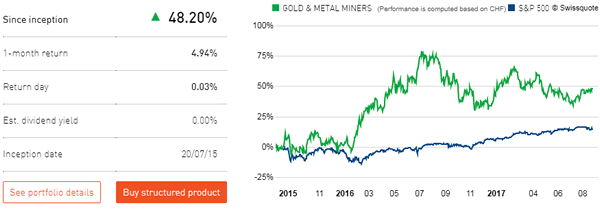
The sudden collapse in commodity prices in 2014 sent mining stocks into free fall. In the long term, however, precious metals - and gold in particular - are the perennial go-to sources of protection against inflation and economic downturns, something investors should be looking out for. The gold market is dynamic, and there are compelling reasons why gold producers could rally. Consumer demand remains solid, with around 2,500 tons of gold mined worldwide every year. Over the long haul, gold as a commodity has appreciated by more than 287% over the past 15 years; by comparison, the S&P 500 has gained less than 44% over the same period. In a period of central bank policy shifts, it is reasonable to envisage a rebound in metal prices - something mining stocks will benefit from. Gold miners are a good way to tap into the benefits of precious metals without paying storage costs.
Cable Accelerated Higher after Yellen’s JH Speech
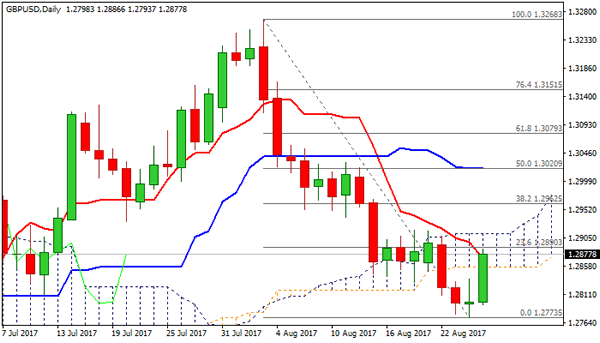
Cable accelerated higher after Yellen's JH speech and rose above daily cloud base at 1.2857, which was seen as pivotal barrier and expected to cap corrective upticks.
Near-term shorts have been stopped, with stronger correction seen as likely scenario as fresh rally is forming Morning Doji Star reversal pattern on daily chart.
Acceleration faced next barrier at 1.2890 (100SMA / Fibo 23.6% of 1.3268/1.2773 descend) which guards next pivot provided by daily cloud top and the ceiling of former consolidation range at 1.2912/17.
Break of these barriers would generate bullish signal for further bullish acceleration and expose next barrier at 1.2962 (Fibo 38.2% of 1.3268/1.2773).
Daily indicators are turning north and support scenario.
Res: 1.2890; 1.2912; 1.2924; 1.2962
Sup: 1.2857; 1.2831; 1.2793; 1.2773
Euro Climbs after Yellen Speech
EUR/USD has posted considerable gains in the Friday session. Currently the pair is trading at 1.1877, up 0.67% on the day. On the release front, German Final GDP gained 0.6%, matching the estimate. German Ifo Business Climate ticked lower to 115.9, beating the forecast of 115.5 points. In the US, durable goods reports were mixed. Core Durable Goods Orders improved to 0.5%, edging above the estimate of 0.4%. However, Durable Goods Orders declined 6.8%, weaker than the estimate of -6.0%. At the Jackson Hole meeting of central bankers, Janet Yellen has concluded her speech, and ECB President Mario Draghi will follow later today. The euro gained ground after Yellen's speech, and traders should be prepared for some volatility after Draghi's remarks.
It's Day 2 of the Jackson Hole Symposium, and the markets heard from Janet Yellen earlier in the day. Yellen opted not to discuss US monetary policy, which was not a major surprise, but still disappointed the markets nonetheless, and the euro responded with strong gains. Yellen instead chose to discuss financial reforms, saying that measures put in place in 2007 and 2009 had been effective, adding that future reforms should remain modest. Her comments come at a time when President Trump is looking into wide-ranging reforms in the finance industry. Trump has complained that the financial sector is over-regulated and is hampering businesses.
The Fed has not provided much guidance in recent weeks as to its plans regarding interest rates, and Janet Yellen did not address the issue in her speech at Jackson Hole. A December rate hike remains on the table, but the Fed policymakers have sounded lukewarm about another hike in 2017, and the odds of a rate hike in December remain below 50%. One of the principal impediments to rate hike is inflation, which remains at stubbornly low levels. This, despite solid economic growth and a labor market that is close to capacity.
Weekly Market Outlook: US Employment Report, Eurozone’s Inflation, Other Key Data in Focus
Next week's market movers
- In the US, the employment report for August is anticipated to show further tightening in the labor market. Although that could lift somewhat expectations for another rate hike this year, we think that inflation data may be the primary determinant of the Fed's next move.
- In Eurozone, preliminary inflation data for August will be closely watched as a confirmation of whether the ECB remains set to announce QE tweaks soon.
- We also get key economic data from Germany, the UK, the US, and Canada.
On Monday and Tuesday, there are no major events or indicators on the economic calendar.
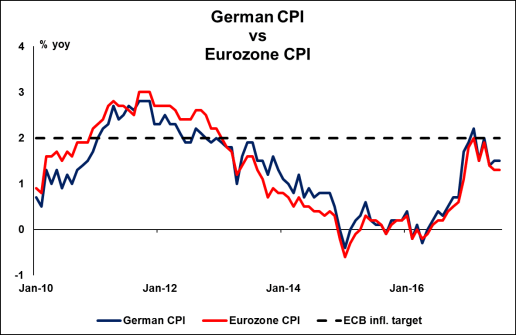
On Wednesday, Germany's preliminary CPI for August will be in focus and the consensus is for the inflation rate to have risen from the previous month. We share that view, considering that the nation's preliminary composite PMI for August showed that prices charged rose at the fastest pace in five months. Meanwhile, the monthly print of August 2016 that will be dropping out of the yearly calculation was -0.1% mom, implying that anything higher than that now could drag the yearly CPI rate higher. A pickup in German inflation could raise speculation that Eurozone's inflation, due out the following day, may also accelerate. However, we would like to stress that Germany only reports a headline, not a core, inflation rate. Thus, investors may focus primarily on Eurozone's core CPI in order to gauge the timing of the ECB's next policy action.
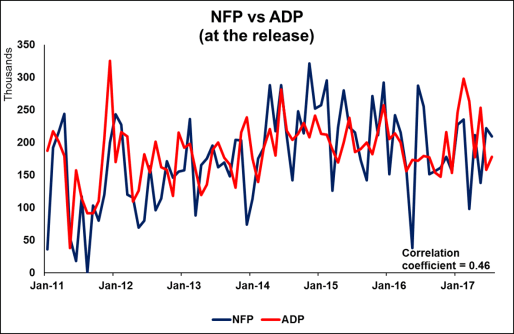
In the US, the ADP employment report for August is due out. The forecast is for the private sector to have added 178k jobs, the same number as in July. Such a solid print could heighten speculation that the NFP print due out on Friday will also meet its forecast of 185k. However, we have to sound a note of caution. Even though the ADP print is the only major gauge of the NFP, the correlation between the two figures has fallen markedly in recent months.
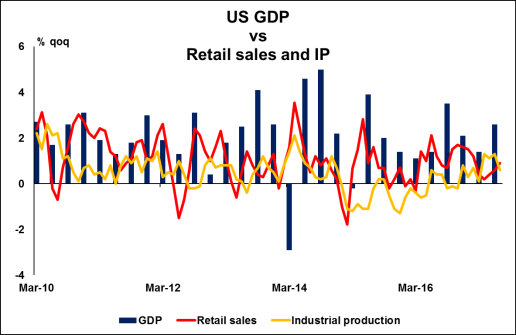
Staying in the US, we also get the 2nd estimate of GDP for Q2 and expectations are for a slight upward revision from the preliminary estimate. Indeed, the only major indicators released after the 1st estimate of GDP were personal spending and factory orders for June. Even though they came out more or less in line with estimates, they showed decent upward revisions in May's prints, supporting the case for a marginal upward revision in GDP. Something like that would be an encouraging development for FOMC policymakers, but we think that inflation data may play the biggest role in determining the timing of the next rate increase.
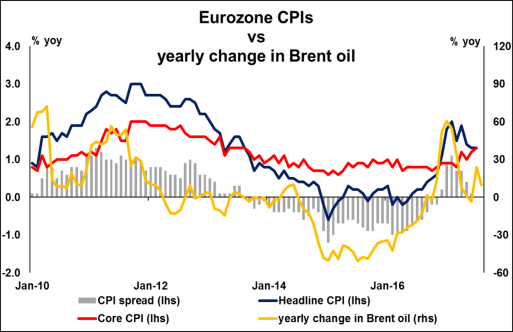
On Thursday, Eurozone's preliminary CPIs for August will take center stage. The forecasts are mixed, with the headline rate expected to tick up and the core rate anticipated to tick down. We share the view for an uptick in the headline rate, but we see the risks surrounding the core forecast as tilted to the upside, perhaps for an unchanged rate, or even a fractional increase. The headline forecast is supported by the bloc's preliminary composite PMI for the month, which showed that output prices rose at the fastest pace in three months. As for the core rate, the yearly change in oil prices remains close zero, which makes us believe if the headline inflation rate indeed increases, the core rate may move in a similar fashion. We believe that this could well be another set of data supporting the case for the Bank to announce some changes to its QE program soon. Absent any significant deterioration in upcoming indicators, we think that a realistic scenario is one where the Bank removes it QE easing bias in September, thereby paving the way for a formal announcement in October that the pace of QE purchases may be reduced by the turn of the year.
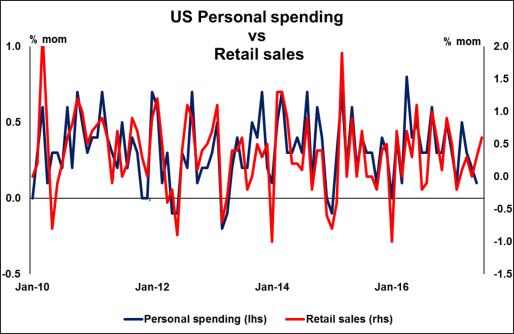
From the US, we get personal income & spending, as well as the core PCE price index, all for July. Kicking off with income and spending, both of these rates are expected to have risen from the previous month. The income forecast is supported by the uptick in the nation's average hourly earnings rate for the same month, while the spending forecast is supported by the acceleration in July's retail sales.
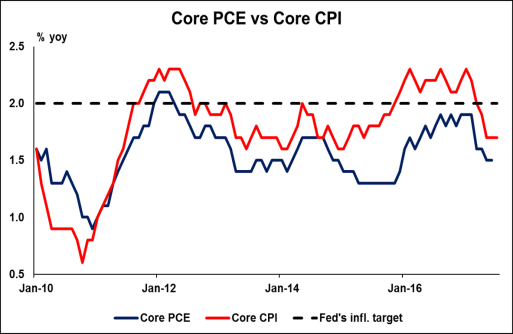
Turning to the core PCE index, in the absence of a forecast, we see the case for the rate to have remained unchanged, with risks tilted to the downside. We base our view on the core CPI rate for the month, which held steady at +1.7% yoy. However, the fact that the services PMI showed that average prices charged by firms increased at a weaker pace than the previous period suggests that if there is a movement in the core PCE rate, it may be to the downside.
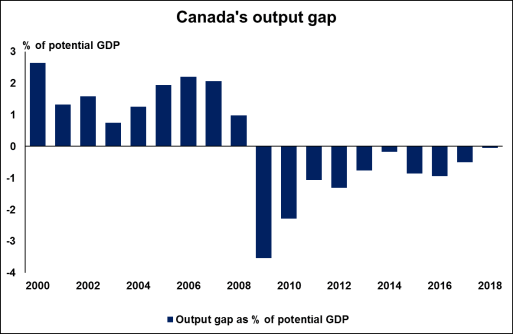
In Canada, GDP data for Q2 will attract attention, though no forecast is available yet. Our own view is that the nation's economy may have grown at the same pace as previously, with downside risks. Even though April's and May's average monthly GDP is roughly equal to the average of the Q1 monthly prints, the soft retail sales for June suggest that the economy may have lost some momentum towards the end of Q2. In any case, a slight slowdown would still be in line with the BoC's latest forecasts and thus, we doubt that such a print will have much effect on the elevated market expectations regarding another BoC rate hike this year. Indeed, the economy's output gap continues to narrow at a steady pace and is expected to close entirely by the turn of the year, which implies that inflationary pressures are likely to pick up afterwards.
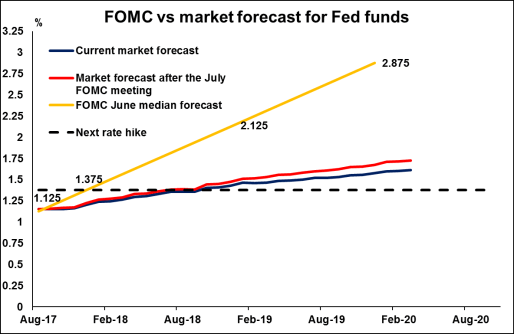
Finally on Friday, the US employment report for August will take center stage. The consensus is for nonfarm payrolls to have risen 185k, slightly lower than the 209k in July, but still a strong number that is consistent with even further tightening in the labor market. The unemployment rate is expected to have remained very low at 4.3%, while average hourly earnings are forecast to have risen at the same pace as in the previous month, something that would drag the yearly rate slightly higher. Such a strong report could raise somewhat the probability for another Fed rate hike this year, which declined recently after the July FOMC minutes showed more officials being concerned with low inflation.
Having said that though, we believe that the primary determinants of whether the Fed will indeed proceed with another rate increase this year are inflation data. The latest prints showed that even though the headline CPI rate rebounded marginally after dropping for 4 months, the core rate remained unchanged, which cast more doubts on whether the softness in inflation can indeed be attributed to idiosyncratic factors. In our view, a strong rebound in inflation is needed before rate-hike expectations rise materially and help the dollar reverse its latest downtrend.
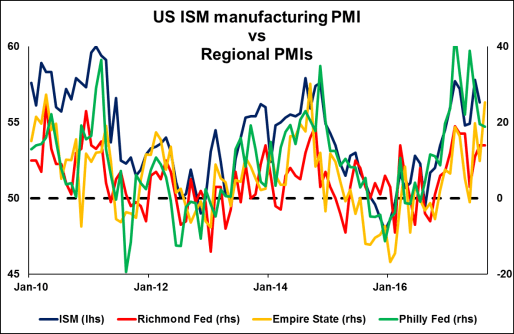
We also get the nation's ISM manufacturing PMI for August and the forecast is for the index to tick down, but to remain at a healthy level, consistent with strong growth in the sector. We view the risks surrounding the forecast as balanced, given that the regional manufacturing indices did not paint a clear picture of the sector's health during the month. Even though the Empire State print rose notably, the Philly Fed index edged lower, while the Richmond Fed one remained unchanged. In any event, we think that the ISM print may attract less attention than usual, as investors may still be digesting the all-important employment data that will be released a few minutes earlier.
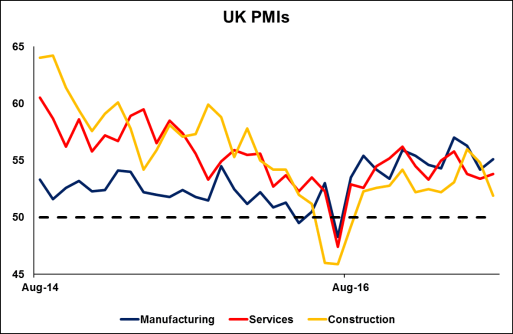
In the UK, the manufacturing PMI for August is due out. Expectations are for the index to decline marginally, but to remain at a healthy level. In any case, we don't expect such a print to affect the BoE's policy plans. Back in June, Governor Carney made it clear that any near-term rate hike would likely depend on a pickup in wages and business investment. Given that wage growth has shown little-to-no signs of firming, and that the latest investment prints for Q2 were stagnant in both quarterly and yearly terms, we doubt that any rate hike is looming. In fact, we believe that the hawkish BoE members may even withdraw their rate-hike votes at the upcoming meetings, in light of the aforementioned soft data.
Dollar Posts Short-Lived Gains as Core Durable Goods Orders and Shipments Move Higher
On Friday, July's readings on US core durable goods orders showed that the amount spent on non-volatile items such as transportation came in higher than expected, pushing the dollar up during the mid- European trading hours. However, the dollar could not maintain its gains arising from the data following less hawkish talk by Fed Chief Jannet Yellen.
According to the numbers published by the Census Bureau, new orders for durable goods excluding transportation picked up from 0.1% in June to 0.5% m/m (5.3% y/y) in July, surprising analysts who expected orders for long-lasting manufacturing products to increase by 0.4% instead. Manufacturing shipments, rose by 0.4% m/m, similar to the previous month (4.7% y/y).
Non-defense capital goods orders excluding aircraft jumped by 0.4% m/m (3.3% y/y), after no change in the previous month. Shipments in the same category, which are closely watched as they are used to estimate investments on equipment that is included in the GDP measure, were up by 1.0% m/m (2.4% y/y), exceeding the forecasted 0.6% and the 0.3% seen in the previous month.
Regarding transportation equipment, the decline in orders widened massively from 1.6% in June to 19.0% m/m in July, missing expectations of a 19.1% expansion (+4.6% y/y). On the other hand, shipments posted a weaker rise of 0.5% m/m (0.3% y/y), compared to 2.4% in June, despite analysts anticipating a pullback of 0.6%.
In total, durable goods orders turned negative in the aforementioned month, decreasing by 6.8% m/m (+5% y/y) while expectations were for the figure to increase by 6.4% after it stagnated in June. In contrast, shipments rose by 0.4% m/m (3.2% y/y) above the forecast of no growth, but below the previous mark of 1.3%.

The above data indicated that companies continued investing on equipment despite uncertainty around tax cuts weighing on business decisions. However, a few hours before the data release, the head of the White House national economic council, Gary Cohn, said that Trump has scheduled to give a series of speeches in the days ahead (starting in Missouri on Wednesday) to convince the public about tax reforms. Nevertheless, Congress, which returns from a summer break, will also play a significant role on the future path of fiscal policy as it will debate during September whether to raise the debt ceiling.
Turning to the reaction in the forex markets, the dollar gained immediately against its rivals after the data release, but plummeted afterwards following comments from the Fed Chief Janet Yellen who stated during her speech at the ongoing Jackson Hole conference on Friday that any adjustments on financial rules should be "modest". The dollar index jumped initially by 0.25% to 93.29 as durable goods data went public, before sinking to 92.75. Euro/dollar retreated by 0.26% to a low of 1.1785 but it managed to rebound to 1.1857 after Yellen's remarks, while dollar/yen moved up by 0.25%, before dropping to 109.24.
EURUSD Jumps after the Greenback Was Hurt by Yellen
EURUSD jumps after the greenback was hurt by Yellen; focus turns to Mario Draghi's speech
The Euro was inflated after Fed chief Janet Yellen stayed quiet about the hottest points, monetary policy and start of winding down its massive balance sheet in her Jackson Hole speech.
Mainly expected outcome hurt the greenback, as traders were hoping Yellen would provide some hints about Fed's intensions in the coming meetings.
The single currency has eventually broken strong obstacles at 1.1828/46 (former highs) and turned focus towards barriers at 1.1900 zone.
Fresh rally has improved near-term outlook and for now neutralized downside risk that was rising in recent congestion and inability to break higher.
Rally may show signs of hesitation ahead of key barrier at 1.1910, with focus turning towards the speech of Mario Draghi, scheduled later today.
It is quite likely that Draghi will stick to the theme of symposium and avoid to talk about policy and QE program easing, which may disappoint fresh bulls.
Res: 1.1889; 1.1910; 1.1950; 1.2000
Sup: 1.1846; 1.1828; 1.1800; 1.1770

Week Ahead – US Data to Dominate Week; Final PCE Inflation and Jobs Numbers Before September Fed Meeting
The summer doldrums should be over next week as major data releases breathe some life into the forex markets. The United States will by far have the busiest economic calendar as the Fed gets its hands on the last jobs report and PCE inflation figures before the September FOMC meeting. Outside of the US, manufacturing PMIs will be the main focus, while Japan will also have a relatively packed data release schedule.
Australian data to be eyed ahead of Q2 GDP release
The Australian dollar has been consolidating for the past month after hitting a more than two-year peak as a combination of risk aversion and exchange rate warnings by RBA officials have weighed on the currency. Rising metal prices have limited its losses though and data due next week may refuel the stalled rally. Second quarter figures on capital expenditure out on Thursday will be watched carefully as it will be a good indication to the GDP growth figures for the same period due the following week. Also to watch out of Australia next week are July building approvals on Wednesday and private sector credit (July) and the AIG manufacturing index (August) on Thursday.
Canada likely enjoyed another quarter of strong growth
After growing by a solid 3.7% annualized rate in the first quarter, economists are forecasting Canada's economy to expand by about 3.5% in the three months to June. Such a figure (due on Thursday) could be enough to warrant a second rate hike by the Bank of Canada in the autumn, following its decision in July to raise rates by 25 basis points. It could also lift the Canadian dollar to fresh two-year highs. The loonie has already seen strong bullish sentiment this week, rising to three-week highs against a subdued greenback.
Eurozone flash inflation to be watched as ECB meeting nears
As speculation builds about whether the European Central Bank will make an announcement on winding down its asset purchases at its September 6-7 policy meeting, next week's flash CPI estimates could provide some clues as to the ECB's next move. Eurozone inflation is forecast to edge up from 1.3% to 1.4% year-on-year in August's preliminary reading. However, the core rate is expected to ease by 0.1 to 1.2%. A bigger concern for ECB policymakers at the moment however, might be the euro's rapid rise, particularly against the US dollar, which it has gained 12% in the year to date.
Other Eurozone data next week will include the economic sentiment index for August on Wednesday, the bloc's July unemployment rate on Thursday and the final reading of the August manufacturing PMI on Friday.
Japanese household spending forecast to ease in July
After expanding for the first time in 16 months on an annual basis in June, household spending in Japan is expected to fall back slightly but remain positive. Household spending, out on Monday, is forecast to moderate from 2.3% to 0.7% y/y in July, with annual retail sales on Tuesday also expected to ease. The preliminary industrial output figures for July are due on Wednesday and are forecast to show a monthly contraction of 0.5% after a 2.2% gain in the prior month. Rounding up the week on Friday is the Nikkei manufacturing PMI.
Japan was the fastest growing economy in the G7 during the second quarter but the strengthening recovery has yet to generate significant wage and price pressures, leaving the Bank of Japan to trail other central banks in moving towards tighter monetary policy. The yen therefore is unlikely to see much reaction to next week's data.
More manufacturing PMIs to watch
Other notable manufacturing PMI releases next week will include those out of China and the UK. China will see manufacturing PMI figures from both the National Bureau of Statistics (Thursday) and Caixin/IHS Markit (Friday), as well as the non-manufacturing PMI (also on Thursday).
Meanwhile in the UK, the Markit/CIPS manufacturing PMI, due on Friday, is expected to post a marginal decline to 55.0 in August. The rest of the week will be exceptionally quiet for the UK however, as the London market will be closed for a Bank Holiday on Monday, with no other major data releases scheduled.
Nonfarm payrolls and PCE inflation in focus
US data will once again grab the most attention next week, with the highlight likely to come from the August jobs report. Before then, a flurry of releases should keep traders busy, starting with the Conference Board's consumer confidence index on Tuesday. The index is expected to fall slightly to 120 in August from 121.1 in July when it hit a 16-year high. Actual consumer spending hasn't been as strong as some of the surveys have been indicating, nevertheless it did rebound in the second quarter, helping GDP growth to pick up. The second estimate of GDP growth is due on Wednesday and the annualized quarterly rate is forecast to be revised up from 2.6% to 2.7%.
On Thursday, the latest monthly personal consumption expenditure (PCE) figures will be watched closely both by the Fed and by investors. Personal income is expected to rise by 0.3% month-on-month in July after flat growth in the prior period. Personal consumption is also forecast to improve, expanding by 0.3% m/m. The core PCE price index, which is the Fed's preferred measure of inflation, is expected to increase by 0.1% m/m in July. The annual rate weakened from a peak of 1.8% in January/February to 1.5% during April-June. An acceleration in July that would take it closer to the Fed's 2% target could help revive expectations of one more rate hike later this year.
A bigger risk event for the dollar will come on Friday with the August nonfarm payrolls numbers. July's unexpectedly strong report was unable to provide the dollar with a sustained boost, with markets still not convinced that a strong labour market alone will be enough to push the Fed to raise rates again this year, especially when wage growth remains muted. The US economy is expected to add 185k jobs in August, with the unemployment rate holding steady at 4.3%. Average earnings are forecast to rise by 0.3% m/m in August, the same rate as in July. Also important on Friday is the ISM manufacturing PMI. The index is forecast to dip slightly to 56.2 in August.
Yellen Induces Dollar’s Tumble, Traders Await Draghi for Further Moves
The dollar tumbled against all majors following the speech of Federal Reserve Chair Yellen at the Jackson Hole symposium. The US currency managed to trade higher against the yen for most of the European session and got a small lift after the release of US durable goods data, but that was short-lived. The dollar index fell 0.43% to last trade at 92.89.
The US dollar traded around the value of 109.57 yen for most of the day leading up to Yellen's speech. However, the greenback tumbled against all majors as soon as her speech was released to the public. The Fed Chair focused on financial stability and avoided addressing issues of interest such as the Fed's next steps on monetary policy.
Looking at reactions in forex markets, the dollar was trading at 109.36 yen, the euro/dollar pair rose to 1.1855 and sterling reached $1.2854 in early exchanges during the US session. The antipodean currencies gained as well with the kiwi up at $0.7242 and the aussie recording a 0.51% gain to last trade at $0.7938.
Traders will be keeping their eyes on the Jackson Hole events, especially the speech by European Central Bank President Mario Draghi at 19:00 GMT.
The euro got an early boost above the key $1.18 mark following the release of the German Ifo Business Climate index. Based on the figure for August, the business climate in Germany is better than expectations (115.9 versus the forecasted level of 115.5). Also, expectations of businesses in Germany for the following six months are upbeat. The index came in at 107.9 against the forecasts of 106.8.
US durable goods orders were the main economic data release during late European session. The Commerce Department's report for July signaled a mixed message for the start of the third quarter. Excluding transportation, orders for durable goods rose 0.5% last month, the third straight monthly gain, signaling that the US economy is picking up steam. However, orders for transportation equipment plunged 19%, weighing on the overall orders for durable goods. The latter fell 6.8% month-on-month in July, against expectations of a 6.0% decline and a 6.4% gain in June. Initially, the data boosted the dollar, but the gains were short-lived in the wake of Yellen's speech.
Oil prices continued rising during the day on the news that the heart of the US oil industry is going to get hit by Hurricane Harvey that threatens to become the worst storm to hit the US in 12 years. WTI was last trading at $47.84 a barrel and Brent crude was at $52.41. Oil traders will be watching the Baker Hughes oil rig figures that are due later today.
On the back of the weakness in the US currency, gold prices rose to trade at $1,288.61 an ounce.