Sample Category Title

EUR/CHF’s Catch Up Is Done

  • Venezuela Pushes Oil Higher - Peter Rosenstreich
  • Status Quo For The Bank Of England - Yann Quelenn
  • EUR/CHF's Catch Up Is Done - Arnaud Masset
  • Football Business

Economics - Venezuela Pushes Oil Higher

Last weeks weak EIA inventories data refocused the markets attention on US output and forced oil prices into a mild bearish reversal pattern. Yet oil is now facing a convergence of supportive fundamental events that will likely drive the prices to $55brl in the short term. Following further draws on inventories, rising in consumption and growing geopolitical uncertainties bullish trend should remain strong. However, these fundamental factors are unlikely to provide support in the midterm.

Summer demand, above the general improvement trend remains seasonally strong. This is because of growing demand in the US, but also globally (think China and Saudi Arabia). Higher demand has helped to limit deeper production induced corrections. OPEC surprisingly has done a good job at forcing nations to adhere to production quotas. While markets have turned a blind eye to chaos in the Middle-East, low spare capacity and expanded crisis regions has weighted on oil traders. The sanctions on North Korea, Iran and Russia is unlikely to have significant effect on production but there will clearly be supply erosion. Russia sanctions have targeted companies that support the construction of Russian energy export pipelines. In addition, new sanctions have tightened rules against technology used for the exploration or production of new shale.

Finally, in our view the situation in Venezuela is spiraling toward the event horizon. While taking Venezuela completely offline will not cause an "oil crisis" it will further pressure prices higher. Venezuela's Maduro regime staging of a fake "election" which preselected candidates will rewrite the country's constitution has split the country in two. In all effective terms, Venezuela has shifted into an outright dictatorship. The oppositions only have demonstration or escalation in violent as political tools. Cessation of Venezuelan production would be minor as it only supplies the market with 1m brl daily. Yet markets should not expected Saudi to step in as they did in 2003. Event risks have increased significantly giving oil prices a boost.

Economies - Status Quo For The Bank Of England

Last Thursday, the BoE announced its key rate that remains unchanged at 0.25%. Markets estimate that rates should only increase by early 2018. That was definitely not a surprise. The asset purchase target will be kept at £435 billion. 10 billion of corporate bonds will also be purchased but this does not change from what was previously decided.

For the time being, the British Central Bank is largely enjoying a weak pound in the wake of the Brexit vote. The economic collapse predicted after the referendum has not materialised and fundamental data are correct. Inflation is currently standing at 2.6%, growth at 1.7% (annualized) and unemployment rate keeps on declining, now at 4.5%.

We still consider that the Brexit vote has had favourable consequences for UK, in particular by lowering the pound value which is why we should see inflation heading towards 3%, probably in October. It is definitely clear that the sterling decline accounts for the growing inflation. By the way, consumer prices forecasts for 2018 have been raised to 2.5% from 2.4%. After 2019, they are expected to hold higher than the BoE target. This should likely trigger at some point a rate hike - Two are saying BoE policymakers. We remain bullish on the pound as in our view, markets are still overestimating the Brexit effect.

However, the British central bank slashed its growth forecasts expectations to 1.7% for this year from 1.9%. Policymakers underlined concerns about consumer spending growth which is too slow to drive growth higher. On top of that, Brexit negotiations outcome remain uncertain and investment levels should likely diminish on those fears.

The pound is getting stronger against the greenback but is weakening against the single currency. Indeed, Trump was unable to deliver what he promised and the Fed fears to increase rates. On the ECB side, markets estimate that the monetary policy divergence between the US and the Eurozone will now narrow down and that European policymakers are ready to increase rates in the late part of this year.

In addition, the BoE is still targeting £435 billion in its asset purchase program and it may soon be the time to reduce the flow of liquidity the BoE injects in the market. By now, the amount injected has been of £375 billion - around 25% of the annual UK GDP -. Current economic developments definitely represents a great moment for the British institution which decided not to act towards a monetary policy normalization. Current pounds levels are still providing the BoE with a window of opportunity to raise rates and drive growth.

Economics - EUR/CHF's Catch Up Is Done

SNB's profit plummet amid CHF appreciation

The Swiss National Bank reported a profit of CHF 1.2 billion for the first half of 2017, compared to CHF 7.9 billion for the first quarter. The sharp appreciation of the Swiss franc against most of its peers, mostly the US dollar, ate up the profits from shares and bonds investments. The Swissie rose 5.9% against the USD, 2.4% against the CAD and 2.1% against the JPY. As the SNB declared on Monday: "...financial result depends largely on developments in the gold, foreign exchange and capital markets. Strong fluctuations are therefore to be expected, and only provisional conclusions are possible as regards the annual result". Therefore it is hard to draw any relevant forecast regarding the year-end results, especially since those results do not reflect the sharp depreciation of the Swissie against the euro of the last few days.

Foreign currency investments rose to 728 billion as of June 30th from CHF 714 billion three months ago and 700bn six months ago, highlighting clearly that the SNB is committed to defend the Swiss franc.

SNB's profit plummet amid CHF appreciation

Last week, the CHF continued to extend gains and reached 1.1538, the highest level since the SNB removed the floor in January 2015. We see the last two weeks' sharp appreciation as a catch-up session for the Swissie. Despite a broad-based appreciation of the euro, the Swiss franc held ground, which led directly to a sustain appreciation of the CHF against the USD. However at some point EUR/CHF couldn't stay completely immune to the euro appreciation, after all the end of the ECB's ultra-loose monetary policy will impact the EU/CH interest rate differential as well. Therefore this is more a healthy adjustment, rather than the end of the CHF overvaluation.

Since early May and prior to the EUR/CHF rally, the single currency was up only 1.6% against the Swiss, while it has risen 5% in average against most of its peers (TWI index was up 5.3%). Due to its safe-haven status, it is normal that to some extend the Swiss franc is insensitive to short-term variation. However, as the rally gained traction, EUR/CHF has had to join the party and catch up with the rest. As of August 4th, EUR/CHF was up roughly 5.8% since early May, while the EUR TWI rose 6.7%. The rally is over. However, it is important to remember that such a move has been made possible by the solid risk appetite and partial unwinding of safe haven trades.

Although the EUR/CHF still may have some legs, we doubt the pair will pass the 1.20 threshold. The 1.15-1.18 area looks like to be a good equilibrium given the current valuation of the single currency. The pair still has upside potential should the euro continue to strengthen. Do not count on CHF weakness yet.

Themes Trading - Football Business

Football is the most popular sport in Europe, bar none. Investing in football shares is a very risky business, since it is highly dependent on onthe- pitch results. However, the return on investment can be sky-high. In 2014, when Benfica Lisbon reached the Europa League final, the club's stock price tripled. That same year, Borussia Dortmund's stock price surged when it reached the Champions' League quarter finals.

Football stocks are not just about fan loyalty: they can become solid investments. After years of tough economic conditions in Europe and the UK, growth is beginning to emerge. This means consumers have more discretionary cash in their pockets and can support their clubs financially. According to consulting firm Deloitte, combined revenues for the English Premier League soared by 29% to £3.26bn in 2013-2014; in their first profit-making season since 1999, clubs made pre-tax profits of £187m. Today, prize money is rising, so a strong season is the key to extraordinary stock performance. Television revenue is also increasing sharply: broadcasters acquired the 2016-2019 rights to the English Premier League for more than $8bn, almost twice as much as three years ago...

In this theme, we have defined our weightings according to the odds of each club performing well this season. In the end, football is just like investing: it's all about how much you believe. Let's kick off!

Fed Likely to Continue Tightening on Strong Jobs Report

Market still eager to buy EUR/USD despite strong report

In terms of employment growth, we have now had two strong reports in a row, as employment rose by 209,000 in July and June was revised up to 231,000. Some of the strength in recent months is likely catch-up from the weakness earlier this year, as US growth seems stable slightly above trend growth.

As employment has risen for 82 consecutive months and the labour market recovery is expected to continue, focus was on the unemployment rate and wage growth, as these are more important for the Fed's decision whether to continue tightening monetary policy or not. The unemployment rate fell from 4.4% to 4.3%, while wage growth was unchanged at 2.5% against expectations of a fall to 2.4%. The combination of lower unemployment and better wage data sent EUR/USD slightly lower on the announcement, as it supports the Fed's case for announcing 'quantitative tightening' (shrinking the balance sheet) in September and raising rates again in December.

However, we still think the jobs report underpins the Fed's dilemma: unemployment and (wage) inflation are low at the same time (the opposite situation of the 1970s), just as we wrote in Flash Comment US: Fed's dilemma, 7 July. Also, the Fed was slightly more dovish at the latest meeting (see FOMC Review: Smidgen dovish but it does not alter the overall picture, 26 July). The reason the Fed continues hiking is Janet Yellen and co's strong belief in the Phillips curve. The tight labour market should be sufficient to push wage growth and inflation higher eventually.

In our view, the problem is that the tightness of the labour market is not the only factor determining wage growth, as second-round effects following many years with low inflation have hit wage growth. When employees expect inflation to remain low, they can live with low wage growth, as real wage growth may still be solid, making it less likely inflation will reach the target.

EUR/USD fell slightly on the NFP announcement. However, the very modest price action shows the market's eagerness to buy EUR/USD. In our view, we could see a push towards 1.20 over the coming one to two weeks, as momentum is very strong. However, the move is likely to fade ahead of the Jackson Hole symposium on 24-26 August and the ECB meeting on 8 September, with the pressure building on the ECB to raise concerns about the strength of the EUR. The effective EUR is now back to September 2014 levels. Fundamentally, we expect EUR/USD to rise further over the coming 12 months on relative growth and valuations. We forecast EUR/USD at 1.22 in 12M.

RBA Statement on Monetary Policy – Upbeat Forecasts Despite Higher AUD

Week beginning 7 August 2017

  • RBA Statement on Monetary Policy - Upbeat Forecasts Despite Higher AUD.
  • RBA: Governor Lowe and Assistant Governor of Financial Markets Kent speak.
  • Australia: Westpac-MI Consumer Sentiment, housing finance, NAB business survey.
  • NZ: RBNZ policy decision, inflation expectations, retail card spending, house sales.
  • China: CPI, trade balance.
  • US: CPI.
  • Key economic & financial forecasts.

Information contained in this report was current as at 4 August 2017.

RBA Statement on Monetary Policy - Upbeat Forecasts Despite Higher AUD

The Reserve Bank has released its August Statement on Monetary Policy. These Statements are released on a quarterly basis with the last Statement printing in May this year. The most important aspects of the Statements are the Bank's growth, inflation and unemployment forecasts.

The forecasts are predicated on two key assumptions. Firstly that the exchange rate will remain unchanged from the current spot level throughout the forecast period (out to December 2019), and secondly that interest rates will broadly follow market pricing.

In May, the AUD was assessed at USD 0.74 and TWI 64. For the August forecasts, it appears that an Australian dollar of USD 0.80 and TWI 67 has been chosen. In May, markets only gave a slight probability to any rate movements in 2018 whereas today markets have priced in one rate hike of 0.25% by end 2018.

In summary, financial conditions in August have tightened markedly relative to May. Surprisingly however, the Bank has not lowered its above trend growth forecasts for 2018 and 2019. These remain at 2¾ - 3¾ per cent (mid-point 3¼ per cent) in 2018 and are 3 - 4 per cent (mid-point 3½ per cent) in the year to December 2019. The period for the forecasts has been extended from mid- 2019 to end 2019. In May, growth to June 2019 was forecast at 3¼ per cent and this has now been raised to 3½ per cent.

There has been a reduction in the growth forecast for 2017 from 3 per cent (mid-point) to 2½ per cent. That largely reflects a lower than expected first quarter growth rate of 0.3% compared to the Bank's likely estimate at the time of the May Statement of 0.6%. We estimate that in May, the assumption was that for the last three quarters of 2017, growth would average around 0.8% per quarter. This now appears to have been slightly lowered and taking into account the lower starting point, explains the reduced growth forecast in 2017. We are a little surprised by this given we expect that in the second half of 2017, there will be a catch up effect from the weather related slowdown in Q1, giving our own estimate for 2017 of 2.8% growth.

However from a policy perspective, the more important growth forecasts are now 2018 and 2019. Westpac expects growth in both those years of around 2.5%, slightly below trend of 2.75%, and well below the above trend forecasts of 3¼ and 3½ per cent respectively, we see in today's SoMP.

Key differences between our own view and the RBA's view are firstly that wages growth will remain anchored containing income growth and complimented by a shock to household budgets from rising energy costs; consumer spending growth will remain around 2.6%. The Bank is clearly expecting stronger consumption growth than our forecast and that has other spill over implications.

Of most importance will be the ongoing slow growth in nonmining business investment which we expect to be contained to around 2%, well below where the Bank appears to be pitching their forecasts. We certainly have sympathy with the Bank's observation that "a recovery in non-mining investment has been forecast for some time and, given the subdued signals from leading indicators, (it is possible) that a substantial pick up is still some way off".

We are also expecting a more substantial drag from residential dwelling construction of around -0.3% compared to the Bank's assessment that the growth impact in 2018 and 2019 of slowing housing will be broadly neutral.

From our perspective, a fall in housing construction; subdued consumer spending and a drag on services exports from the high Australian Dollar will constrain employment growth through 2018. The Bank sees things differently, expecting recently strong employment growth to persist into 2018, with the unemployment rate expected to fall to 5.4% by the end of 2019 compared to our current forecast that the unemployment rate will in fact be rising through 2018, reaching 6% by year's end.

Two other domestic factors are important, firstly the Bank is of the view that "wage growth is expected to pick up gradually over the next few years". That is despite convincing evidence offshore, that countries with full employment, and in the case of the US, an unemployment rate considerably below the full employment rate, are not experiencing wage pressures. This different assessment of household income growth is one of the key explanations behind our more downbeat view of the economic outlook. Secondly, we expect that the wealth effect from sharply rising house prices in NSW and Victoria is about to reverse. There is no argument that household debt levels are elevated. The prospect of very limited further increases of house prices in those markets may start to dampen consumer spending in particular by discouraging households to further subsidise consumption growth by lowering their saving rates.

The rise in the Australian dollar poses some near term challenges to the forecasts. The Bank even obliges by setting out their own modelling results of the impact of the appreciation of the trade weighted exchange rate on inflation and growth. It quotes that "a 10 per cent appreciation (if not associated with rising commodity prices) would be expected to lower year-ended inflation by around ½ a percentage point over each of the following two years. Output would be expected to be lower by ½ to 1 per cent in around 2 years' time effectively taking ¼ to a ½ per cent off growth rates in each of those two years". With the TWI already having appreciated by 5 per cent, and the Bank not changing its growth forecasts, it appears that other factors particularly around government spending and a general more encouraging environment justifies the forecasts. Of course it is also likely that with the Bank expecting a fall in commodity prices and further interest rate increases from the US Federal Reserve, there may be some subjective adjustments to the model based forecasts.

As discussed there is no change to the Bank's underlying inflation forecasts remaining at 1½ to 2½ per cent in both 2017 and 2018 to be followed by 2½ per cent in 2019. That is despite the guidance from the modelling indicating that were the 5 per cent appreciation to be sustained, then those numbers would have to be adjusted down by ½ a per cent in both 2018 and 2019.

The modelling does qualify the results by noting that the results only hold if the appreciation is not associated with higher commodity prices. However, to the extent that commodity prices have risen recently, the Bank explicitly points out that mining companies have not recycled their increased prosperity back into the economy through investment and employment but rather payed down debt, increased dividends or increased share buybacks.

There is one area of discussion where we do concur with the Bank's views. We do expect that the Chinese authorities will continue to gradually tighten financial conditions although we are not expecting the style of credit induced sharp slowdown we saw in 2015.

Conclusion for Policy

From a policy perspective, the Bank's forecasts of growth lifting to well above trend in 2018 and 2019, and inflation returning to the middle of the target band in 2019 would imply that it is expecting to be raising rates probably in the second half of 2018.

However, the Bank has the luxury to delay any rate decisions until it can clearly test whether its forecast dynamics around higher consumer spending growth, a solid lift in investment spending, rising wages growth, benign housing developments and falling unemployment (along with what we suspect a falling AUD) come to pass.

As discussed, we are much less confident about that scenario and therefore expect rates to remain on hold next year.

Bill Evans, Chief Economist

Data wrap

Jun dwelling approvals

  • Dwelling approvals were much stronger than expected in the June month, rebounding 10.9% from a 5.4% drop in May. Westpac and the consensus forecast was for a 1% gain.
  • Our view was based on high rise approvals levelling out after a sharp pull-back over the previous 12mths (the second half of 2016 in particular) with some strength showing through in non-high rise components, the latter reflecting a recent lift in construction related finance approvals. Instead high rise approvals rebounded strongly month to month - still more likely to be noise than a renewed uptrend - but non high rise segments also posted a strong gain.
  • Private sector detached house approvals rose 3.4% in the month, to be up nearly 2%qtr over Q2 as a whole. High rise approvals look to have jumped about 14% but were still down for Q2 as a whole and about 20% below year ago levels. Interestingly, 'mid rise' unit approvals surged 30% in the month - this small segment tends to be more stable than high rise but may be finding more favour with developers in part due to changes in state government planning policies.
  • By state, the high rise jump was concentrated in NSW. The lift in non-high rise approvals was broadly-based, NSW up 11%, Qld up 9% and Vic up 5%.
  • The value of renovation approvals rose 6.7%, building on a 13.9% rebound in May from a 14.7% drop in April. Looking through the volatility, renovation approvals look to be back on a moderate but not particularly convincing uptrend. Notably, recent gains have been across all major states.
  • The value of non res building approvals dipped 2.6% in the month but is still up firmly on a year ago (trend approvals up 12.7%yr). The lift continues to come across a range of subsegments including offices, retail, hotels & recreation, and education.
  • Overall, while the headline surge is clearly flattered by month to month noise in the high rise segment, the gains in non-high rise approvals look more 'genuine'. That should provide a little more counter-weight to the high rise construction boom wind down that is expected to dominate activity from late this year although it remains to be seen how enduring the strength in 'non high rise' segments in recent months will prove to be.

June private credit

  • Credit grew by 0.6% in June, up from gains of 0.4% in each of the three previous months. As is often the case, a shift in the business segment - on this occasion a spike - is the source of monthly volatility in total credit.
  • Annual total credit growth lifted to 5.4%, up from 5.0% in May. In part this is due to base effects, with the weak June 2016 result dropping out of the calculations. Total credit grew by only 0.2% in June 2016 as uncertainty ahead of the July 2 Federal election saw business credit contract, down 0.4%.
  • Annual credit growth of 5.4% represents a moderation from 6.2% in mid-2016. Over this period, business growth has slowed to 4.4% from 6.5%, reflecting both a loss of appetite from borrowers and lenders. Housing credit growth of 6.6% currently rounds down from 6.7% a year earlier.
  • Housing credit growth is set to slow in response to the recent tightening of lending standards and out of cycle interest rate increases by the commercial banks. As well, the impacts of the RBA's rate cuts in May and August 2016 have passed. More generous state government first home buyer initiatives, taking effect from 1 July, will provide a partial offset.
  • There is tentative evidence that housing credit is beginning to slow. In June, housing credit expanded by 0.50%. This represents a step-down from a 0.55% average pace in the March quarter. It follows outcomes of 0.51% in April and a surprise 0.56% rise in May, which was most likely noise.
  • On a quarterly base, the tentative slowdown in housing credit is evident. The recent quarterly growth profile is: 6.0% annualised in Q2 2016; lifting to 6.5% in Q3; 6.7% in Q4; and 6.8% in 2017 Q1; then moderating to 6.5% in Q2; and printing at 6.2% annualised for the month of June 2017.
  • Note that the total value of housing finance has trended a little lower of late, declining by 1.5% over the four months to May. While some month to month volatility is likely, we expect this emerging downtrend to continue.
  • As to investor housing credit, this grew by 0.41%mth in June, the softest monthly result since May 2016 - partly due to switching to the owner-occupier market. Annual growth is 7.4% currently, while the 3 month annualised pace is 6.0%.
  • Turning to business, lending has been volatile around a weaker trend over the past year or so. There was the dampening impact from heightened uncertainty around the Federal election. This was followed by a burst of lending late in 2016 around infrastructure privatisation, contributing to a 1.1% jump in business credit in the month of December.
  • In the business segment of late, there has been an underlying loss of appetite from some borrowers (including deleveraging by the mining sector) and from some lenders (partly to reduce exposures to selected industries and larger companies).
  • Business credit growth of 0.9% in the month of June exceeds that suggested by recent trends in commercial finance (see chart overleaf), possibly reflecting the impact of a sizeable transaction. Commercial finance while up from the lows of early 2017 is not particularly strong.
  • Business investment in the real economy by the non-mining sectors is advancing, but growth is currently relatively subdued, pointing to only modest growth in business credit (see chart overleaf).

Jun & Q2 retail trade

  • The June retail report came in above expectations both for the month and Q2. Sales rose a further 0.3% in June, extending the strong rebound in Apr-May from a weather affected contraction in Feb-Mar.
  • The market was looking for a more moderate 0.2% gain. Annual sales growth has now lifted back to 3.8%yr, the strongest pace since Apr 2016 although some of this momentum will clearly fade as weather effects drop out of the picture.
  • For Q2 as a whole, real retail sales, i.e. 'volumes' rose 1.5% as the weather effects rebound coincided with aggressive price discounting. The quarterly gain was the strongest since June 2009 when aggressive fiscal and monetary stimulus were giving a major boost to household cash flows.
  • The quarter saw nominal sales up 1.4% and retail prices dip 0.1%, including a 0.1% dip for food that was a surprise given weather events also disrupted fresh fruit and vegetable supplies. Annual growth lifted to 2.5%yr.
  • The detail points to fairly broad based strength. While food retail was flat in June and department stores recorded a 0.3% decline other storetypes recorded solid gains (total retail ex basic food up 0.5%mth, +3.3%yr).
  • The Q2 gain was even broader with all storetypes except cafes & restaurants recording gains over 1%qtr.
  • It's a similar story with the state breakdown with all states except Vic recording gains in the June month and all states except WA recording 1%+ gains.
  • Overall this is a significant upside surprise. Although the retail survey is a partial measure that does not always 'map' to the quarterly consumption figures in the national accounts, the jump from a flat Q1 to strong Q2 is a clear positive signal.
  • Vehicle sales also posted another solid rise in Q2. Private sector business surveys also indicate conditions in 'consumer service' sectors have remained more buoyant than for retail throughout the first half of the year.
  • Overall this points to upside risk to our current 0.8%qtr forecast for Q2 consumption, with an increase closer to 1% now looking more likely

Jun trade balance

  • Australian exports and Australia's trade balance have been buffeted by weather disruptions of late, particularly the fury of Cyclone Debbie.
  • In June, Australia's trade surplus narrowed to $856mn, falling short of expectations (mkt median $1.8bn and Westpac $1.4bn).
  • The surplus for May was downgraded, lowered to $2.0bn from $2.5bn. April was also revised, sliding from a small surplus of $90mn to a small deficit of $76mn.
  • Imports for June were stronger than anticipated, increasing by 2.4% (+$730mn). We anticipated a small fall, -0.7% (-$200mn), led lower by weaker fuel prices. Fuel did fall, down $463mn. However, strength was evident across capital goods, consumption items, and gold.
  • Exports declined in June, but not as sharply as expected. Exports fell by 1.4%, -$439mn vs a forecast -4.0%, -$1.3bn.
  • Export weakness in June was evident in metal ores and coal, on weaker prices and volumes, broadly as anticipated. The upside surprises were in the volatile gold segment and fuels proved to be more resilient than anticipated.
  • For the June quarter, the trade surplus narrowed to $2.8bn from $7.5bn for the March quarter. This reflected the impact of falling commodity prices. Total export prices fell by an estimated 4.5% in the quarter and the terms of trade declined by around 5%.
  • Real net exports had a broadly neutral impact on growth in the June quarter, on our initial calculations, largely meeting our expectations, a forecast of +0.1ppts.

New Zealand: Week ahead & Data Wrap

This week Stats NZ gave us the lowdown on New Zealand's labour market. The most striking aspect of the data was a 0.2% drop in employment, as measured by the Household Labour Force Survey. But we are not reading anything into that - it is probably survey volatility rather than the start of a new trend. The alternative Quarterly Employment Survey (which surveys employers) registered FTE employment growth of 0.7%, and we have observed no anecdotes or other data pointing to a sudden shift away from the long-established trend of robust employment growth.

Looking more broadly at the data, New Zealand's labour market story is much as it has been for a couple of years now. Jobs are certainly being created at a rapid pace, but that is only just enough to keep up with rapid population growth. Consequently, the unemployment rate is falling only gradually - it is now 4.8%, compared to 5.1% a year ago.

At these levels, unemployment is still too high to put significant pressure on employers, so wage growth remains slow. The labour cost index has registered just 1.6% wage growth over the past year - wage growth has been stuck at that slow pace since 2013.

From here we do expect the unemployment rate to fall further, but only slowly and not by enough to generate the sort of rapid wage growth we experienced in the mid-2000s. Our forecasts have the unemployment rate reaching a low point of 4.5% later this year, before rising again late in the decade as the economy digests the inevitable slowdown in earthquake-related construction work and a slower housing market.

Occasionally one hears suggestions that if only we dialled back on migration, then the resident population would have more of a shot at the available jobs and the unemployment rate would come down faster. That is known as the "lump of labour" fallacy - it wrongly assumes that the number of jobs available is fixed. In reality, New Zealand's rapid rate of population growth at present is itself generating demand in the economy, and is therefore responsible for some of the employment growth. If the rate of net migration were to slow sharply, it is unclear whether the unemployment rate would rise (via job losses in construction, for example) or fall.

The devil is in the detail when it comes to assessing the impact of rapid population growth on the labour market. We suspect that the composition of net migration at present is affecting the distribution of income growth in New Zealand. More bodies on the ground means more sales for businesses such as retailers and construction firms. But the preponderance of low-wage workers in the current mix of net migration may well be negatively impacting low-skill wage rates in New Zealand.

The other key development this week was Fonterra's announcement that it has upgraded its forecast of the farmgate milk price for the current season to $6.75. Demand conditions around the world are certainly positive at present, but we are wary of European and US farmers lifting production in response to high prices. We are also conscious that there is scope for New Zealand's milk production season to outstrip forecasts. With the possibility of extra supply hitting the market, we prefer to stick with our forecast of a $6.50 milk price.

Next week we expect the Reserve Bank will surprise markets with a dovish Monetary Policy Statement. Financial market pricing currently suggests that the OCR will begin rising from mid-2018, but the RBNZ has been sharply at odds with that view. The RBNZ sees the OCR as "on hold for the foreseeable future", and is on the record saying it is equally likely that the next move in the OCR could be up or down.

Over the past few months there has been a run of soft data in New Zealand, including GDP, inflation, the housing market and building consents. At the same time, the exchange rate has risen to levels that the RBNZ will be finding uncomfortable.

That said, we do not expect the Reserve Bank to make a big splash. The data has been soft, but the situation does not warrant the RBNZ altering its bottom-line guidance. We would expect the final sentence of the press release to be a virtual repeat of the past four: "Monetary policy will remain accommodative for a considerable period. Numerous uncertainties remain and policy may need to adjust accordingly."

But the RBNZ could still strike a dovish tone by issuing a completely flat OCR forecast (the previous incarnation featured a gradual drift higher in the OCR from 2019). The RBNZ might also sum the situation up with a catch-all phrase along the lines of: "Developments since the May Monetary Policy Statement have on balance softened the outlook for medium term inflation."

And finally, the RBNZ will almost certainly lambast the high exchange rate, possibly going so far as to say that if the exchange rate fails to fall, the outlook for monetary policy will need to be reassessed.

The other key piece of data to watch out for next week is the RBNZ's survey of inflation expectations. This popped higher last quarter, but is expected to pull back this quarter. A surprise on expectations in either direction could well influence the RBNZ's MPS later in the week.

Data previews

Aus Aug Westpac-MI Consumer Sentiment

Aug 9, Last: 96.6

  • The Westpac-Melbourne Institute Consumer Sentiment Index rose 0.4% from 96.2 in June to 96.6 in July. Despite the lift, sentiment has tended to drift lower in 2017, the survey detail pointing to renewed pressures on finances.
  • The Aug survey is in the field over the week to Aug 6. Developments over the last month look mostly positive for sentiment including: the RBA's decision to leave rates unchanged at its Aug meeting, the Governor also sending a clear signal that rate rises were unlikely any time soon; a terrorist bomb plot allegedly foiled in Sydney; a strong rally in the AUD (up near 4¢ US vs the July survey); a further modest recovery in the ASX (up 0.7% since July but still below its April highs); another solid 1.6% rise in dwelling prices; a continued improvement in labour market conditions and lower petrol prices.

Aus Jun housing finance (no.)

Aug 9, Last: 1.0%, WBC f/c: 1.5%

Mkt f/c: 1.5%, Range: 0.5% to 3.0%

  • The number of owner occupier loans rose 1% in May to be down 3.5%yr. This was the second monthly observation since APRA's macro prudential tightening in late March and associated increases in rates for investor and 'interest only' loans. Some of the rise in owner occupier loans is likely due to switching between investor and owner occupier products. A lift in refinancing suggests we may also be seeing existing borrowers move from interest only to standard loans. Notably both the value of investor loans and the total value of loans also held up a bit better than expected (down 1.4% and up 0.1% respectively).
  • For June, industry data points to another lift in owner occupier loans, which we expect to be up 1.5%mth. Note that a second round of mortgage rate increases for 'interest only' loans came through late in the month.

NZ Jul house prices and sales

Aug 7-11 (tbc), Sales last: -9.9%, Prices last: 2.8%yr

  • The housing market has continued to cool this year, as mortgage rates have risen and loan-to-value ratio restrictions have held back investors. Uncertainty about housing and tax policy after next month's election may also be suppressing activity.
  • House prices are now down slightly on year-ago levels in Auckland and Christchurch, and further declines seem likely. Elsewhere, prices have continued to rise, but the pace is slowing in most regions.
  • House sales have fallen by 25% over the last year. Industry figures suggest that this was followed by a sharp drop in new listings in July - property owners don't sell into a falling market if they don't have to.

NZ Q3 survey of inflation expectations

Aug 7, Two years ahead, last: 2.17%, Westpac f/c: 2.0%

  • The Reserve Bank's survey of inflation expectations has attracted a great deal of market attention recently, having played a key role in the RBNZ's decision to cut the OCR last year. Now the tables have turned: expectations of inflation two years ahead rose to 2.2% in the latest quarter, back above the 2% target midpoint for the first time since 2014.
  • However, the RBNZ has been eager to point out that it doesn't respond to the survey mechanically, and recent RBNZ research suggests that expectations have become more backward-looking. That's probably even more true now that the survey is held immediately after the CPI release; the drop in the actual inflation rate from 2.2% to 1.7% in Q2 will have been front of mind for respondents this time.
  • Consequently, we think that inflation expectations will also pull back this quarter, to something like 2% (which was also our submission to the survey).

NZ RBNZ Monetary Policy Statement

Aug 10, last: 1.75%, Westpac f/c: 1.75%, Mkt f/c: 1.75%

  • We expect the RBNZ will leave the OCR at 1.75% and reiterate that monetary policy is on hold for the foreseeable future.
  • The press release will probably emphasise the softer tone to recent data, and the RBNZ's discomfort with the high exchange rate.
  • The RBNZ may expunge any hint of hikes from its OCR forecast, and issue slightly more dovish guidance in the press release.
  • An MPS along these lines would surprise financial markets, possibly causing swap rates and the exchange rate to fall on the day.

NZ Jun retail card spending

Aug 10, Last: flat, Westpac f/c: +0.1%

  • Overall retail spending was flat in June. However, the headline result was strongly influenced by sharp falls in petrol prices over the month. Spending in core categories was actually up 0.8%, underpinned by a solid 2.4% gain in hospitality spending on the back of the Lions tour and related strength in tourism.
  • We're forecasting a subdued 0.1% gain in total spending in July. In part, this reflects continued declines in fuel prices that have weighing on nominal spending. Core spending is expected to have risen by a modest 0.3% over the month. While interest rates are still low, they have been pushing upwards. In addition, the slowdown in the housing market will dampen spending in a number of areas.

US Jul CPI

Aug 11, Last: 0.0%, WBC 0.1%

  • Growing doubts over the US inflation pulse has materially reduced market expectations of further policy action by the FOMC. Heralding the start of the second half of 2017, the July CPI report will be a critical outcome for the market.
  • Recently we highlighted that the vast majority of the deceleration in annual inflation, from 2.8%yr in February to 1.6%yr in June, had been due to transitory factors - most notably weak energy prices and an unusually large decline in the price of wireless telephone services. Abstracting from these two factors, annual core inflation at June was 2.1%yr. There is therefore little reason to be concerned that disinflation will become entrenched.
  • That said, strong inflation is also unlikely anytime soon as wage growth remains modest. We look for a 0.1% rise in headline prices; excluding food and energy, a 0.2% gain is expected.

Weekly Focus: Investment Recovery Set to Boost Global Growth

Market movers ahead

  • We estimate CPI core inflation for July is unchanged at 1.7%. Inflation remaining low should keep the US Fed on a cautious path in its normalisation of monetary policy.
  • German industrial production for July may indicate whether the strong momentum in Q2 has continued in Q3. High business confidence points to further solid growth.
  • In China, attention is set to be on currency reserve, trade and inflation numbers. We estimate the currency reserve (which is measured in USD) has increased due to the revaluation of non-USD reserves, as the US dollar weakened considerably in July.
  • The focus in Scandinavia will be on Swedish industrial production and Norwegian inflation. We expect figures for Swedish industry to show handsome growth, while inflation in Norway is likely to have fallen slightly in July, following a significant rise in June.

Global macro and market themes

  • The outlook for global investment is turning more positive. Business confidence is high, profit growth has risen substantially, real interest rates are at a historical low and political uncertainty has held back investment for several years.
  • A self-reinforcing capex recovery could strengthen global growth and presents a slight upside risk to our global growth forecasts.
  • The key risk factors to monitor are tensions with North Korea and the potential for a trade war if the US implements protectionist measures to shield US industry.
  • We look for equities and bond yields to range trade before moving higher in 2018 on the back of a continuing recovery in the global economy.

Full Report in PDF

USD/JPY Surged after Strong US Jobs Fata and Tested Strong Resistance at 111.00

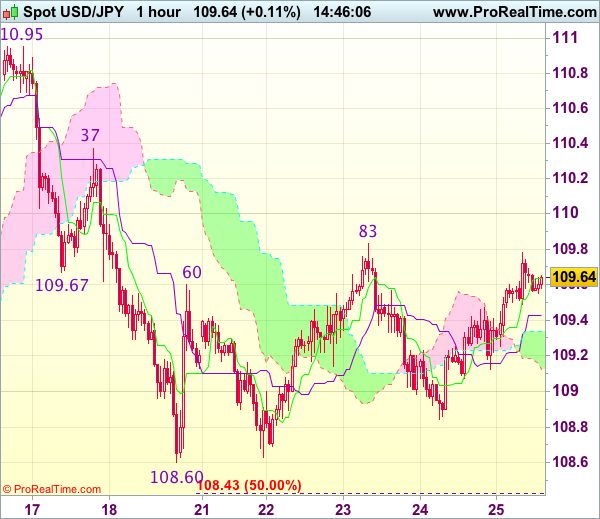
The pair surged after strong US jobs data and tested strong resistance at 111.00, provided by daily Tenkan-sen line, below which recovery attempts in past two days were capped.

Fresh acceleration emerged from 109.90 zone, where attempts to extend larger bears were repeatedly contained.

This proves strong supports at 110.00 zone and fresh acceleration higher suggests further delay of bears from 114.49 high.

The greenback regained bullish momentum after US jobs data, with fresh near-term bulls being also attracted by daily cloud twist.

Initial bullish signal could be expected on today's close in bullish outside day pattern, with close above daily Tenkan-sen to reinforce positive stance.

Lift above thin daily cloud which twists on Monday, as well as converged daily 100/55SMA's would generate stronger bullish signal for further retracement of $114.49/109.84 descend.

Conversely, repeated close below daily Tenkan-sen would signal prolonged consolidation.

Res: 111.00; 111.38; 111.51; 111.65
Sup: 110.28; 110.00; 109.84; 109.62

Non-Farm Payrolls Result in EUR/USD Fall

The US dollar strengthened today after the release of a strong report from the non-farm payrolls in America that in July increased by 209,000 against the expected 189,000. Positive news from the labor market increases the probability of a rate hike by the Fed during this year and that in turn may lead to growth of the greenback. The unemployment rate in the US declined by 0.1% to 4.3% and the average hourly earnings in the US increased by 0.3% in line with the expected figure.

The common currency received modest support today from news on German factory orders which grew by 1.0% in July. The euro was further buoyed from the increase in Italian retail sales by 0.6% for the previous month which was 0.5% better than the forecast.

The Canadian dollar received a boost from unemployment statistics released today which showed the jobless rate fall by 0.2% in July to 6.3%. This positive was offset by the better than expected figures from the US and weak trade balance data in Canada, according to which the trade deficit was 3.6 billion versus the forecasted 1.3 billion.

The AUD/USD fell today following the Reserve Bank of Australia reducing its forecast for GDP growth to 2% from 3% for 2017. Previous forecasts were for 2.5% to 3% economic expansion. The aussie came under even more pressure from the commodity markets which are seeing a correction following a strong rally. Later today Baker Hughes will release its report on drilling activity in the US and if we see a decline in the price of oil, then the AUD may continue to fall.

EUR/USD

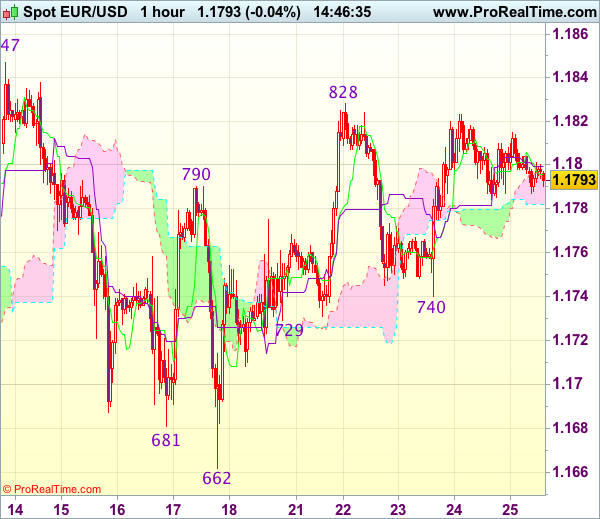
After some consolidation below the resistance level of 1.1900, the EUR/USD price started to decline and may reach the lower limit of the local rising channel and support at 1.1800. Breaking through those levels may become the reason for the price to fall to 1.1700 and 1.1620. In case of growth resuming, the first target will be at 1.1900.

USD/CAD

The USD/CAD price experienced a rise in volatility after labor market releases in both the US and Canada. The price is confidently growing after a consolidation within a narrow range. Overcoming 1.2670 may become a trigger for further price increases to 1.2800 and higher. A downward correction is likely to be limited by the strong support line at 1.2550.

AUD/USD

The AUD/USD quotes have fixed below the lower limit of the local rising channel and breaking the local minimum near 0.7915 may become a confirmation for the sell signal with the stop above 0.8000 and potential targets at 0.7800 and 0.7740. We do not rule out a rebound due to the RSI on the 15-minute chart being in the oversold zone.

Dollar’s Weekly Losses Cut Down by Solid Employment Report

The July employment report provided much-needed relief to the beleaguered greenback on Friday, while the pound continued to lose ground on fears the Bank of England would keep rates near record lows for longer.

The main highlight of the day was the July jobs numbers out of the United States. The market is keeping a close eye on US economic numbers as they will likely determine whether an additional Fed rate hike will take place by the end of the year. The report pointed to a healthy and growing labor market, as 209 thousand new jobs were created last month against an upwardly revised 231 thousand payrolls in June. The expectation was for 183 thousand. Both average hourly earnings (+0.3% m/m) and the unemployment rate (4.3%) were in line with expectations and also pointed to good prospects for US workers. The drop in the unemployment rate to 4.3% came at the same time as the participation rate ticked up to 62.9% from 62.8%, which was again a welcome development.

Euro/dollar retraced its gains to drop below the 1.18 level to 1.1793 as a result of the strong report. Dollar/yen also rallied to just shy of 111. 10-year Treasury yields climbed to 2.28% after the report from around 2.22% prior to the release of the numbers. Two-year yields, which are sensitive to Fed rate expectations, rose by 2.5 basis points to 1.367%.

Rising treasury yields gave a boost to the dollar, which was also strong against the commodity dollars. The Australian dollar dropped below the 79 cent mark to 0.7891 while dollar/loonie jumped to 1.2663 from 1.2577. Canada released its own decent employment numbers today, which showed its unemployment rate falling to 6.3%. On the other hand, Canada's trade deficit worsened in June as it reached 3.6 billion Canadian dollars against a deficit of 1.36 billion the previous month.

The pound continued to slide against its major forex counterparts, following the dovish interpretation the market gave to the Bank of England meeting and economic forecasts released the previous day. Euro/pound seemed to solidify its position above the psychologically important 90 pence mark by rising to 0.9051; the highest since October 2016. While pound/dollar had climbed to 1.3266 only yesterday, following the US employment numbers, it fell to as low as 1.3056; a drop in excess of 2 cents in little over 24 hours. The market seems to think that the BoE is even less likely to raise rates in the future, despite Governor Carney's warning that the chances of a rate hike were higher than those the market was discounting.

In other economic data, earlier today German factory orders for June climbed by 1% month-on-month against expectations of a 0.5% rise. During the Asian session Australian June retail sales rose by 0.3% against analyst forecasts of a 0.2% increase, while the RBA expressed its worries over household debt levels and a rising currency in its Statement of Monetary Policy.

In commodities, gold dropped by more than a percent to $1254 an ounce as the greenback strengthened, while WTI oil languished at just below $49 a barrel. Oil traders will be waiting for the outcome of the OPEC meeting on compliance measurement next week.

Gold Slides as Nonfarm Payrolls Beats Forecast

Gold has posted sharp losses in the Friday session, wiping out the gains seen on Thursday. In North American trade, spot gold is trading at $1255.08, down 1.07% on the day. On the release front, employment numbers were solid. Nonfarm payrolls slowed to 209 thousand, but easily beat the estimate of 182 thousand. Wage growth remained steady at 0.3% and the unemployment rate edged down to 4.3%, matching the forecast.

US indicators ended the week on a positive note, as employment data matched or beat expectations. This was good news for the US dollar, which is broadly higher in Friday trade. The markets were pleasantly surprised as Nonfarm Payrolls easily beat expectations. The labor market remains very strong, but record low levels of unemployment have failed to translate into stronger wage growth, which remained stuck at 0.3% in July.

The Federal Reserve is expected to begin trimming its balance sheet next month, and this could be bearish for gold prices. The Fed is expected to initiate the wind-down by not replacing maturing bonds, which will reduce the balance sheet by $200 billion in 2017, according to the Institute of International Finance (IFF). The IFF estimates that this would be equivalent to three normal interest hikes. Gold prices move inversely to rate hikes, so as the Fed trims down its portfolio, the dollar could move higher against gold.

Federal Reserve policymakers continue to talk about the possibility of a December rate hike, but with the odds for a December increase pegged at just 42%, it's clear that the markets are skeptical about a third rate hike in 2017. Investor attention has shifted to the Fed's balance sheet, which stands at $4.2 trillion. Fed policymakers have broadly hinted at reducing purchases of bonds and securities starting in September, but San Francisco Fed President John Williams was more forthcoming about the Fed's plans this week, in a clear message that was likely aimed at giving notice to the markets. In a speech on Wednesday, Williams said that the economy had "fully recovered" from the 2008 financial crisis and called on the Fed to start trimming the balance sheet "this fall". Williams added that the process would be gradual and would take four years to reduce the balance sheet to a "reasonable size". On Wednesday, two other FOMC members also came out in support of starting to taper the balance sheet – St. Louis Fed President James Bullard and Cleveland Fed President Loretta Mester.

Trade Idea Wrap-up: USD/CHF – Buy at 0.9700

USD/CHF - 0.9738

Most recent candlesticks pattern : N/A

Trend                                    : Near term up

Tenkan-Sen level                  : 0.9718

Kijun-Sen level                    : 0.9718

Ichimoku cloud top                 : 0.9691

Ichimoku cloud bottom              : 0.9673

Original strategy :

Buy at 0.9700, Target: 0.9800, Stop: 0.9665

Position : -

Target :  -

Stop : -

New strategy  :

Buy at 0.9700, Target: 0.9800, Stop: 0.9665

Position : -

Target :  -

Stop : -

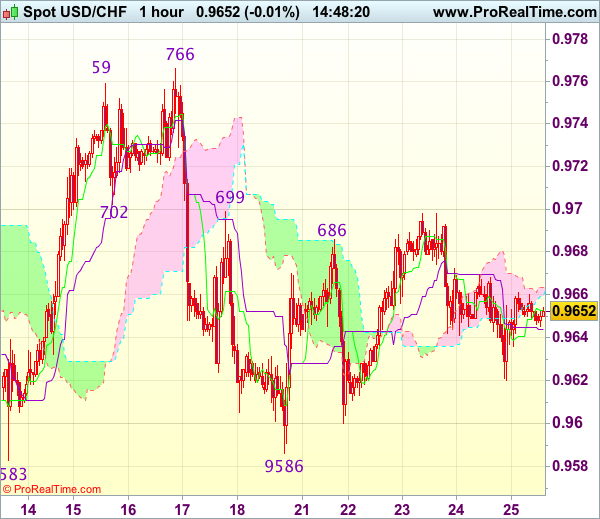
As the greenback has surged again in NY morning and broke above indicated resistance at 0.9727, adding credence to our bullish view that recent upmove is still in progress and upside bias remains for further gain to 0.9775 (50% projection of 0.9438-0.9727 measuring from 0.9631), however, near term overbought condition should limit upside to 0.9800-10 (61.8% projection) and reckon 0.9830-40 would hold from here, bring retreat later. 
 
In view of this, would not chase this rise here and would be prudent to buy dollar on pullback as 0.9700 should limit downside. Below 0.9670-75 would defer and suggest top is possibly formed, risk test of support at 0.9631 but break there is needed to add credence to this view, bring retracement of recent rise to 0.9596 (previous resistance turned support). 

Trade Idea Wrap-up: GBP/USD – Sell at 1.3110

GBP/USD - 1.3043

Most recent candlesticks pattern   : N/A

Trend                                 : Near term down

Tenkan-Sen level                 : 1.3099

Kijun-Sen level                    : 1.3099

Ichimoku cloud top              : 1.3191

Ichimoku cloud bottom        : 1.3191

Original strategy :

Sell at 1.3130, Target: 1.3030, Stop: 1.3165

Position : -

Target :  -

Stop : -

New strategy  :

Sell at 1.3110, Target: 1.3010, Stop: 1.3145

Position : -

Target :  -

Stop : -

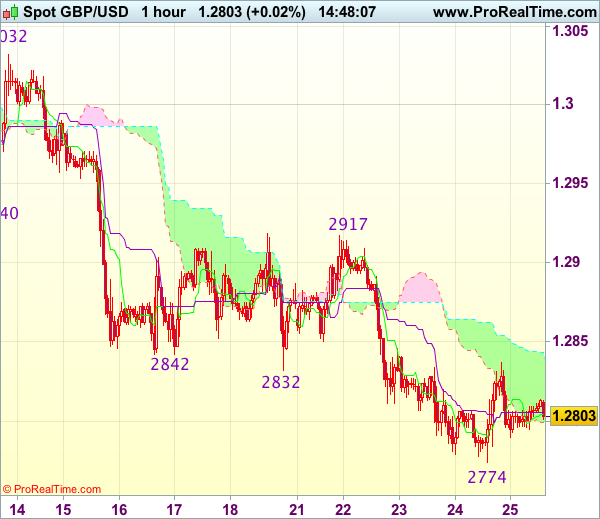
As cable met renewed selling interest at 1.3165 and has dropped sharply on dollar’s broad-based rebound, suggesting the selloff from 1.3269 top is still in progress and may extend weakness to 1.3005-10 (100% projection of 1.3269-1.3112 measuring from 1.3165), below there would extend weakness to support at 1.2999, then 1.2986 (61.8% Fibonacci retracement of 1.2812-1.3269) but reckon 1.2955-60 would hold from here. 

In view of this, we are looking to sell cable on recovery as previous support at 1.3112 should limit upside. Only break of 1.3165 is needed to signal low is formed instead, bring a stronger rebound to 1.3200 but upside should be limited to 1.3240-50 and price should falter below said resistance at 1.3269.