

Sample Category Title
Japan’s Annual Inflation Advanced As Expected In July
For the 24 hours to 23:00 GMT, the USD rose 0.63% against the JPY and closed at 109.57.
In the Asian session, at GMT0300, the pair is trading at 109.64, with the USD trading 0.06% higher against the JPY from yesterday's close.
Overnight data showed that Japan's national consumer price index (CPI) climbed 0.4% YoY in July, meeting market expectations. The CPI had registered a similar rise in the prior month.
The pair is expected to find support at 109.22, and a fall through could take it to the next support level of 108.79. The pair is expected to find its first resistance at 109.92, and a rise through could take it to the next resistance level of 110.19.
Moving ahead, Japan's jobless rate, industrial production, retail trade, small business confidence and consumer confidence data, all slated to release next week, will pique significant amount of investor attention.
The currency pair is trading above its 20 Hr and 50 Hr moving averages.

Switzerland’s Industrial Production Rebounded In The Three Months To June
For the 24 hours to 23:00 GMT, the USD marginally rose against the CHF and closed at 0.9653.
In economic news, Switzerland's industrial production rebounded 2.9% on an annual basis in 2Q 2017. In the previous quarter, industrial production had registered a revised drop of 1.0%.
In the Asian session, at GMT0300, the pair is trading at 0.9647, with the USD trading 0.06% lower against the CHF from yesterday's close.
The pair is expected to find support at 0.9622, and a fall through could take it to the next support level of 0.9596. The pair is expected to find its first resistance at 0.9671, and a rise through could take it to the next resistance level of 0.9694.
Going forward, investors will keep a close watch on Switzerland's ZEW expectations survey, retail sales, UBS consumption indicator and KOF leading indicator data, all slated to release next week.
The currency pair is showing convergence with its 20 Hr moving average and trading below its 50 Hr moving average.

Loonie Extends Its Gains In The Morning Session
For the 24 hours to 23:00 GMT, the USD declined 0.24% against the CAD and closed at 1.2517.
In the Asian session, at GMT0300, the pair is trading at 1.2509, with the USD trading 0.06% lower against the CAD from yesterday’s close.
The pair is expected to find support at 1.2490, and a fall through could take it to the next support level of 1.2470. The pair is expected to find its first resistance at 1.2545, and a rise through could take it to the next resistance level of 1.2580.
Going ahead, market participants will eye Canada’s GDP report, slated to release next week, to gauge strength in the Canadian economy.
The currency pair is trading below its 20 Hr and 50 Hr moving averages.

European Open Briefing: Asian Stock Markets Gained Slightly On Friday
Global Markets:
- Asian stock markets: Nikkei rose 0.53 %, Shanghai Composite up 1.22 %, Hang Seng climbed 0.81 %, ASX 200 down 0.01 %
- Commodities: Gold at $1292.33 (+0.03 %), Silver at $16.94 (+0.01 %), WTI Oil at $47.77 (+0.72 %), Brent Oil at $52.44 (+0.75 %)
- Rates: US 10-year yield at 2.18, UK 10-year yield at 1.05, German 10-year yield at 0.38
News & Data:
- GBP Second Estimate GDP q/q 0.3 % vs 0.3 % expected
- GBP Prelim Business Investment q/q 0.0 % vs 0.2 % expected
- USD Unemployment Claims 234 K vs 237 K expected
- USD Existing Home Sales 5.44 M vs 5.55 M expected
- USD Mortgage Delinquencies 4.24 % vs 4.71 % previous
- Asia stocks resilient, dollar up before Yellen, Draghi speeches
- Oil prices rise as Hurricane Harvey heads for U.S. Gulf coast- RTRS
Markets Update:
Asian stock markets gained slightly on Friday but continued to be more subdued than usual as global investors remain on the sidelines ahead of key comments at a central-banking conclave in Jackson Hole.
USDJPY is currently seen trading at 109.62 as the dollar bulls seem to have a slight edge this morning. USD continued to be slightly stronger on Friday, extending Thursday’s 0.5 percent gain, and heading for an overall weekly rise of 0.4 percent.
EURUSD was seen trading slightly lower at 1.1795. Overall we can see that the price took on more of a Sober approach ahead of the Jackson hole conclave. The dollar index (DXY), which tracks the greenback against a basket of six major peers, was seen trading slightly higher at 93.32 after gaining 0.2 percent, targeting its first monthly rise in six months.
AUDUSD slid to lows of 0.7885 early in the session before retracing back to approach 0.7900 and is barely net changed for the day. Continuing the trend from Thursday. Aussie continues to seesaw around the 0.79 handle.
Upcoming Events:
- 08:00 GMT – (EUR) German Ifo Business Climate
- 12:30 GMT – (USD) Core Durable Goods Orders m/m
- 12:30 GMT – (USD) Durable Goods Orders m/m
- 16:00 GMT – (USD) Fed Chair Yellen Speaks
- 19:00 GMT – (USD) ECB President Draghi Speaks
Will Draghi And Yellen Deliver A Summer Bombshell?
The Jackson Hole Symposium is this week's most anticipated event, in part due to a severe lack of other newsworthy market stories but also because two very important central bankers are scheduled to appear.
The Federal Reserve and the European Central Bank are not only two of the most important central banks in the world, they're expected to be among the more active over the next year, with the former having already begun raising interest rates and the latter in the process of winding down its quantitative easing program.
With announcements expected from both in the coming months, investors will be looking to their speeches at Jackson Hole – a platform used to prepare markets for policy changes by previous Fed Chairs Alan Greenspan and Ben Bernanke – for similar policy signals.
Janet Yellen – Federal Reserve Chair
Yellen's remarks will be poured over by investors, primarily for clues on the future path of interest rates, with the prolonged period of low inflation now starting to unsettle some policy makers. The Fed had previously indicated that it plans to raise interest rates one more time this year but investors have been unconvinced for some time and recently, the scepticism has started to spill over into commentary from some policy makers.
Swing voters within the FOMC, such as Jerome Powell and Robert Kaplan, appear to be among those that still need convincing, while others just appear to lack the belief they once had. Should nothing change then I expect the Fed will likely hold off until next year to raise interest rates further but with the committee appearing so split, it's very difficult to call. This is perfectly reflected in current market implied rate hike expectations.
It's also worth noting that the Fed will soon effectively be tightening on two fronts, with the central bank set to announce in September that it plans to start reducing the size of its balance sheet which was built up in the aftermath of the financial crisis through quantitative easing. The balance sheet currently stands close to $4.5 trillion, a level many believe is far too high.
If the Fed starts the process of balance sheet reduction next month, it may buy them a little more time on interest rates and allow them to wait for inflation to pick up before hiking again.
Whatever they decide, traders will be keenly following Yellen's comments for any suggestion that the pace of rate hikes will be slower than previously expected. Should this happen, we could see further weakness in the dollar and yields could fall.
Mario Draghi – ECB President
While getting policy clues out of Janet Yellen may be difficult, in the case of Draghi it's like trying to draw blood from a stone, at least recently anyway.
The ECB has become obsessed, it seems, with the euro rate and bond yields, and the unintentional tightening in financial conditions that these could trigger. At the end of June, Draghi suggested that recent progress could allow the central bank to pull back on unconventional measures – a clear reference to tapering of asset purchases – and markets were quick to respond.
Despite the market's reaction being far from extraordinary, officials at the ECB were quick to clarify his remarks and effectively reverse the moves that followed it. Clearly they're far more concerned about what are relatively minor moves than they would have us believe.
After this mishap, it seems likely that Draghi will very much keep to the script during his appearance at Jackson Hole and, unfortunately for us, I expect this script will be rather uneventful. Not only will the next ECB meeting in September come with new macroeconomic projections that will shape their decision on QE after December, but his speech also falls at a relatively illiquid time of the day and month. The ECB will want to avoid any sharp appreciation in the currency and a similar rise in bond yields at all costs.
If anything, Draghi may deliver a rather dovish message that still leaves the door open to tapering at the end of the year while carefully managing the euro lower.
Of course, there is the potential that a warning of a policy shift comes from the event – and we should be prepared for significant volatility in case it happens – I just don't expect it to come from Draghi this time around. And Yellen may remain tight lipped as well given the uncertain outlook on inflation.
Hurricane Harvey Hits Oil As Gold Relaxes In Jackson Hole
Hurricane Harvey's landfall tonight in Texas promises severe disruption in the oil sector while gold continues to chill ahead of the Jackon Hole Symposium.
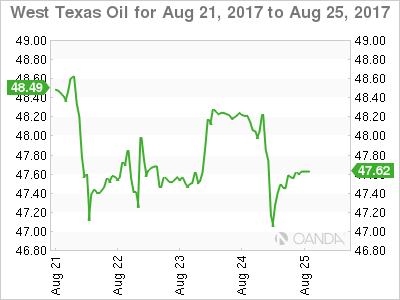
Oil prices moved lower overnight with WTI by far the worst performer, falling 1.60% in New York trading despite Hurricane Harvey bearing down on the Texas coast, promising extensive disruption to both refining and extraction operations. The answer may well lie with gasoline futures, which moved the opposite way and rose 2 percent on the day. We suspect that a stronger U.S. dollar overnight and position squaring ahead of Janet Yellen's keynote speech at Jackson Hole were the underlying drivers as Brent also fell, but only by 0.70%.
If Hurricane Harvey's potential to cause disruption and damage in Texas is what the experts are predicting, we expect that the sell-off in WTI may only be transitory. Damage and flooding to refineries and shale fields disrupted production in the Gulf of Mexico and infrastructure damage is unlikely to be bearish for WTI.
WTI spot trades at 47.60 this morning, at its 100-day moving average. Overnight it broke its trend line support of the last week with this line now resistance just above at 47.80. Overnight support lies at 46.90 followed by 46.45. The picture is not positive from a technical perspective, however, given the event risks mentioned we will take it with a grain of salt for now.
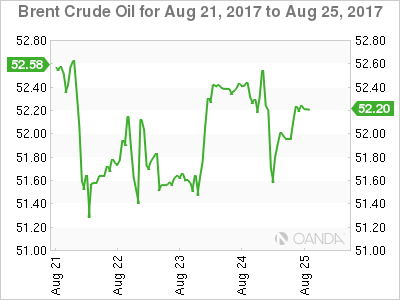
Brent spot continues to trade at a healthy premium to WTI, moving slightly higher from its close to 52.40 this morning. It tested but closed above its 200-day average at 51.85 and support remains untested at 51.20. Resistance at 52.70 continues to be the center of attention. Otherwise, the contract seems content to range trade at the upper end of its monthly range into the weekend.
Gold
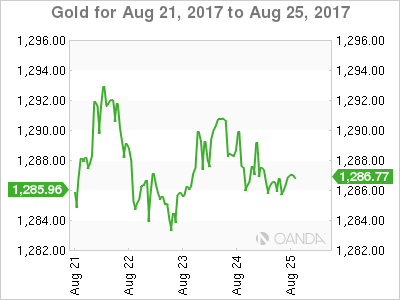
The summer doldrums continued overnight as gold produced a sideways day ahead of the start of the Jackson Hole Symposium. The trend line support, today at 1282.50, remained untested overnight with gold trading in a 1284.50/1291.50 range.
Ms. Yellen's speech will decide the near term fate of the U.S. dollar, so patience will be required until her keynote address this evening.
Gold's price action continues to be constructive as it consolidates the gains of the last ten days. Resistance remains at 1296.00 followed by the Friday high at 1301.00 with support at 1279.00 and 1267.00.
Daily Technical Outlook And Review: EUR/USD, GBP/USD, AUD/USD, USD/JPY, USD/CAD, USD/CHF, DOW 30, GOLD
A note on lower timeframe confirming price action...
Waiting for lower timeframe confirmation is our main tool to confirm strength within higher timeframe zones, and has really been the key to our trading success. It takes a little time to understand the subtle nuances, however, as each trade is never the same, but once you master the rhythm so to speak, you will be saved from countless unnecessary losing trades. The following is a list of what we look for:
- A break/retest of supply or demand dependent on which way you're trading.
- A trendline break/retest.
- Buying/selling tails ... essentially we look for a cluster of very obvious spikes off of lower timeframe support and resistance levels within the higher timeframe zone.
- Candlestick patterns. We tend to only stick with pin bars and engulfing bars as these have proven to be the most effective.
We typically search for lower-timeframe confirmation between the M15 and H1 timeframes, since most of our higher-timeframe areas begin with the H4. Stops are usually placed 1-3 pips beyond confirming structures.
EUR/USD
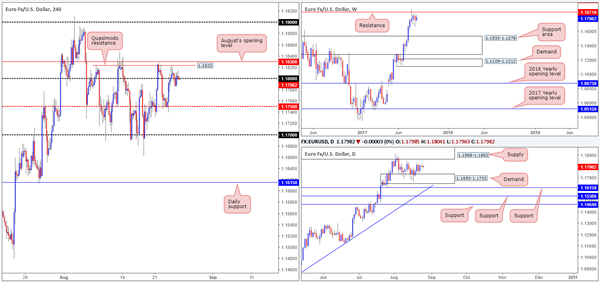
In recent trading we can see that price took on more of a sober approach on Thursday. Clinging to the 1.18 handle, the pair only managed to range a mere 33 pips on the day. In light of the somewhat lackluster approach, we continue to follow a neutral bias in this market. Here’s why.
Directly above current price there’s a nearby H4 Quasimodo resistance level at 1.1823 (shadowed closely by August’s opening level at 1.1830). However, considering that the USDX shows room for the H4 candles to push down as far as the trendline support extended from the low 11853, we may see the two noted H4 resistances give way sometime today.
The story over on the weekly chart shows that the buyers and sellers remain battling for position below a major resistance at 1.1871. A similar picture can be seen on the US dollar index (USDX), only inverse from a weekly support drawn in at 11854. Looking down to the daily timeframe, price is currently seen sandwiched between a supply zone coming in at 1.1968-1.1862 and a demand base lodged at 1.1650-1.1733.
Suggestions: A decisive close above 1.1830 on the H4 chart likely clears the footpath north up to the 1.19 band. While this may be true on the H4 timeframe, the bigger picture shows we have both the underside of the current daily supply at 1.1862 and the weekly resistance at 1.1871 to contend with before 1.19 can be achieved. This, for us, makes buying beyond 1.1830 just too much of a risk, and therefore a market best left on the back burner for the time being.
Data points to consider: German IFO business climate survey at 9am, ECB President Draghi speaks at 8pm. US Core durable goods orders at 1.30pm, Fed Chair Yellen speaks at 5pm GMT+1. US Jackson Hole symposium (all day).
Levels to watch/live orders:
- Buys: Flat (stop loss: N/A).
- Sells: Flat (stop loss: N/A).
GBP/USD:
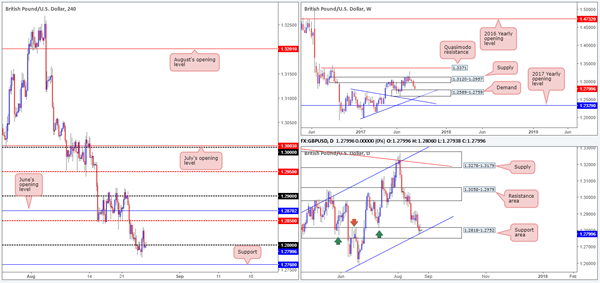
Kicking this morning’s report off with a look at the weekly timeframe, we can see that price is loitering just ahead of a demand base pegged at 1.2589-1.2759. Looking down to the daily timeframe, however, the unit is seen shaking hands with a support area at 1.2818-1.2752, which happens to intersect closely with a channel support line etched from the low 1.2365. Also of particular interest here is this area is seen glued to the top edge of the aforementioned weekly demand.
A closer look at price action on the H4 timeframe shows price briefly rose above the 1.28 handle yesterday, and managed to clock a high of 1.2836 on the day. Still, like the EUR/USD, the GBP ended the day pretty much unchanged with price closing a few pipettes back below 1.28.
Suggestions: In view of the unit’s close proximity to the weekly demand, as well as price currently interacting with a daily support area, we’re STILL reluctant to take on any medium/long-term shorts at this time. However, we are still interested in buying from the 1.28 neighborhood. But for this trade to come to fruition, we still require a decisive H4 close back above 1.28. This, alongside a retest and a reasonably sized H4 bullish candle (preferably printed in the shape of a full, or near-full-bodied candle) would, in our opinion, be enough to validate a long trade. The first area of concern would be the H4 mid-level resistance at 1.2850, followed closely by June’s opening level at 1.2870.
Data points to consider: US Core durable goods orders at 1.30pm, Fed Chair Yellen speaks at 5pm GMT+1. US Jackson Hole symposium (all day).
Levels to watch/live orders:
- Buys: Watch for H4 price to close back above 1.28 and then look to trade any retest seen thereafter ([waiting for a reasonably sized H4 bullish candle to form following the retest is advised] stop loss: ideally beyond the candle’s tail).
- Sells: Flat (stop loss: N/A).
AUD/USD
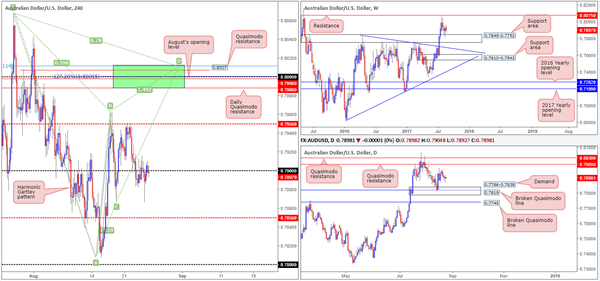
AUD/USD prices are effectively unchanged this morning, despite the pair ranging almost 50 pips on the day. As you can see from the H4 timeframe, the candles spent the day seesawing around the 0.79 handle. As of current price though, the sellers are seen pressing south, which could lead to the unit challenging the mid-level support at 0.7850 today.
At this time, there is very little to hang our hat on as far as trading opportunities go! This is largely due to the higher- timeframe direction. On the weekly timeframe, the bulls continue to defend the support area at 0.7849-0.7752 which could eventually see price advancing higher. Down on the daily timeframe, nonetheless, the candles appear confined between a demand area at 0.7786-0.7838 and a Quasimodo resistance at 0.7988, meaning the unit could effectively trade either way!
Suggestions: With the above notes in mind, our team has decided to remain flat for the time being.
Data points to consider: US Core durable goods orders at 1.30pm, Fed Chair Yellen speaks at 5pm GMT+1. US Jackson Hole symposium (all day).
Levels to watch/live orders:
- Buys: Flat (stop loss: N/A).
- Sells: Flat (stop loss: N/A).
USD/JPY
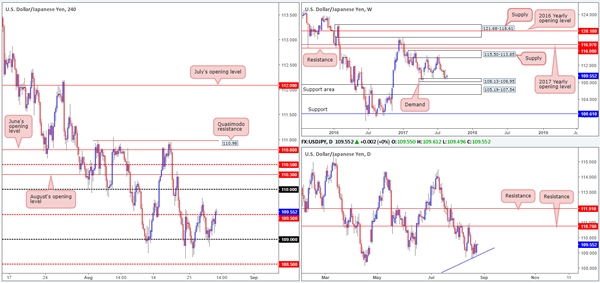
USD/JPY bulls seem to have a slight edge this morning. On the weekly timeframe, price is currently showing promise from demand pegged at 108.13-108.95. Uniting nicely with this weekly demand is a daily trendline support etched from the low 100.08. Should the bulls continue to climb from this trendline, the next upside target in view is a resistance level marked at 110.76.
Bouncing over to the H4 candles, we can see that price was recently bid above the mid-level resistance at 109.50. This, given the current landscape on the higher timeframes, could attract fresh buyers into the market place and pull price up to at least the 110 handle.
Suggestions: Drill down to the lower timeframes and look to enter long from the 109.50. To do this, you may want to consider using the techniques displayed at the top of this report.
Data points to consider: US Core durable goods orders at 1.30pm, Fed Chair Yellen speaks at 5pm GMT+1. US Jackson Hole symposium (all day).
Levels to watch/live orders:
- Buys: 109.50 region ([waiting for a lower-timeframe confirming buy signal to form before pulling the trigger is advised] stop loss: dependent on where one confirms this area).
- Sells: Flat (stop loss: N/A).
USD/CAD
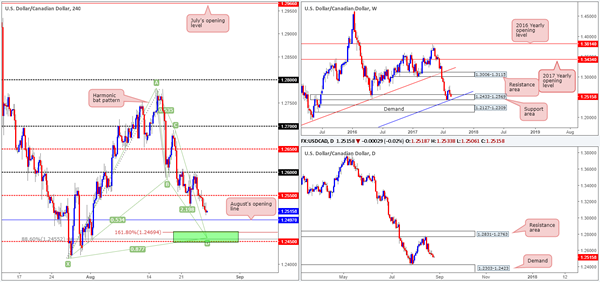
After touching gloves with the 1.26 handle early on in Wednesday’s session, the pair has since been on the decline. With the H4 mid-level support at 1.2550 now out of the picture, August’s opening level at 1.2497 is the next support on the hit list. Beyond this monthly level, however, is a H4 Harmonic bat completion point at 1.2455.
Despite the stronger-than-expected rebound seen from the weekly support area given at 1.2433-1.2569 three weeks ago, weekly action recently pulled back and is now seen trading back within the walls of this zone. Technically speaking, the selloff is likely due to the daily resistance area coming in at 1.2831-1.2763. Should the bears continue to dominate from this zone, the next area on the hit list is the demand penciled in at 1.2303-1.2423 (positioned just below the aforementioned weekly support area).
The H4 Harmonic bat pattern mentioned above boasts a powerful XA retracement (88.6% Fib retracement at 1.2455) and is located just ahead of the H4 mid-level support 1.2450. It is also positioned within the noted weekly support area and its converging weekly trendline support taken from the low 0.9633.
Suggestions: In the event that the Harmonic pattern completes, we will be interested buyers here. Additional confirmation, in our opinion, is not required since we can comfortably place stops beyond the X point (1.2413) and still achieve adequate risk/reward.
Data points to consider: US Core durable goods orders at 1.30pm, Fed Chair Yellen speaks at 5pm GMT+1. US Jackson Hole symposium (all day).
Levels to watch/live orders:
- Buys: 1.2450 (stop loss: 1.2411).
- Sells: Flat (stop loss: N/A).
USD/CHF
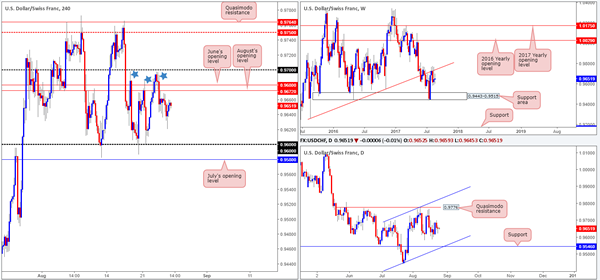
Using a top-down approach this morning, the weekly timeframe shows that the trendline resistance extended from the low 0.9257 remains in play. This has, in our opinion, firmly placed the weekly support area at 0.9443-0.9515 back on the hit list. Also noteworthy is the daily timeframe. The chart shows room for the pair to trade as far down as support coming in at 0.9546, which happens to unite with a channel support etched from the low 0.9438. A closer look at price action on the H4 timeframe shows the unit is currently trading within striking distance of June and August’s opening levels at 0.9680/0.9672.
Suggestions: Despite the higher-timeframe picture suggesting further downside, we’re wary about selling from 0.9680/0.9672, as price has whipsawed through these levels on three occasions over the past two weeks (see blue stars).
Considering this, our desk has decided to remain on the sidelines for the time being.
Data points to consider: US Core durable goods orders at 1.30pm, Fed Chair Yellen speaks at 5pm GMT+1. US Jackson Hole symposium (all day).
Levels to watch/live orders:
- Buys: Flat (stop loss: N/A).
- Sells: Flat (stop loss: N/A).
DOW 30
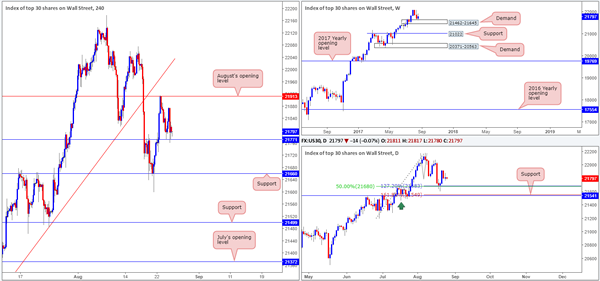
Recent action on the H4 timeframe shows how powerful monthly open levels can be! August’s opening level at 21913 has held price lower since Wednesday. In spite of this, 21771 has also provided the market with adequate support.
Up on the weekly timeframe, demand at 21462-21645 has, as you can see, managed to bolster price action this week. This should not really come as too much of a surprise as it is a WEEKLY demand, and it is positioned within an incredibly strong uptrend. Daily price on the other hand is seen lurking just ahead of an interesting support comprised of a 127.2% Fib ext. point at 21683, and a daily 50% support line at 21680 drawn from the low 21192.
Our suggestions: Buying from the current H4 support could be an option today. However, despite weekly price trading from demand, we still believe a buy from here may be too risky. The reason being is simply due to daily price showing room to trade lower, which could end up sending price back down to the H4 support lodged at 21660.
Data points to consider: US Core durable goods orders at 1.30pm, Fed Chair Yellen speaks at 5pm GMT+1. US Jackson Hole symposium (all day).
Levels to watch/live orders:
- Buys: Flat (stop loss: N/A).
- Sells: Flat (stop loss: N/A).
GOLD:
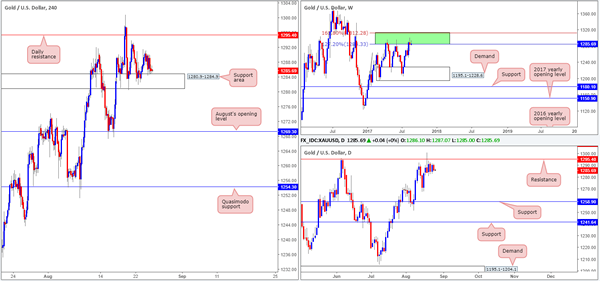
Beginning with the weekly timeframe this morning, it is clear to see that the bears are making an effort to bring price action lower. As you can see, weekly price is currently located within a green weekly resistance area comprised of two weekly Fibonacci extensions 161.8/127.2% at 1312.2/1284.3 taken from the low 1188.1.
The story on the daily chart, nevertheless, shows price trading from a resistance level at 1295.4. Ever since price struck this line back on the 18th August, the daily candles have been trading within a tight consolidation.
Bouncing across to the H4 chart, the support area at 1280.9-1284.9 continues to bolster price. Therefore, for those who are looking to short based on the weekly and daily structures in play right now, we would advise waiting for the current support area to be engulfed. This would not only confirm seller strength from the higher-timeframe structures, but also open the path south down to August’s opening level at 1269.3.
Our suggestions: Watch for the current H4 support area to be engulfed before considering selling this market. A H4 close beyond this area, followed up with a retest and a H4 bearish rotation candle (preferably a full, or near-full-bodied candle) would, in our view, be enough to justify a short, targeting August’s opening level at 1269.3.
Levels to watch/live orders:
- Buys: Flat (stop loss: N/A).
- Sells: Watch for H4 price to engulf 1280.9-1284.9 and then look to trade any retest seen thereafter ([waiting for a H4 bearish rotation candle to form following the retest is advised] stop loss: dependent on where one confirms this area).
Daily Technical Analysis: GBP/USD Challenges Resistance Of Downtrend Channel After 1.2775 Bounce
Currency pair GBP/USD
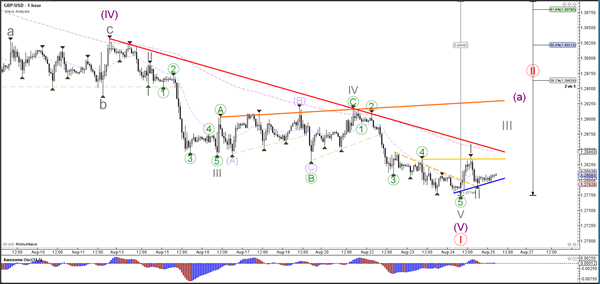
The GBP/USD is testing the resistance line of the downtrend channel (red) after indeed bouncing near the round quarter support level of 1.2750. A bullish breakout could start wave A (purple) of a larger wave 2 (red) correction. A bearish break below support (blue) and the 1.2750 support could restart the downtrend within the channel.
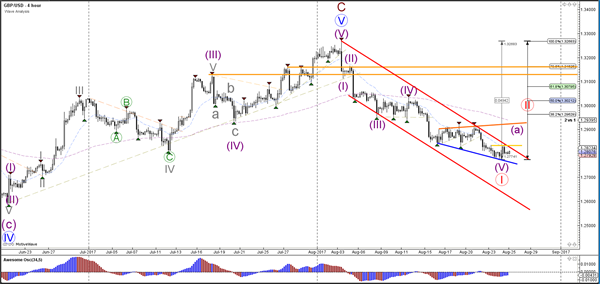
The GBP/USD broke above the resistance trend line (dotted orange) and could be starting a wave A (purple) correction if price manages to break above the next resistance trend lines and stay above support (blue).
Currency pair EUR/USD
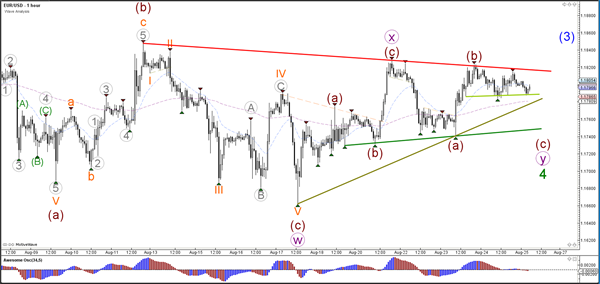
The EUR/USD is building an extended and complex correction within wave 4 (green). Price is still challenging the resistance trend line (red) of the triangle chart pattern and the next breakout above resistance (red) should see the continuation of wave 3 (blue). Price could also retest the support trend lines (green/blue) within wave Y (purple).

The EUR/USD is building a sideways correction and has both support (green) and resistance (red) nearby. There is the possibility of an ABC (brown) correction before wave 4 (green) is ready but a break above the major resistance (red) would indicate a potential bullish breakout.
Currency pair USD/JPY
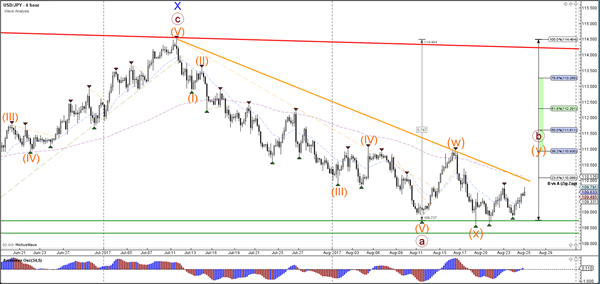
The USD/JPY is again bouncing at the support zone (green lines). A bounce could see price move higher towards the Fib levels of wave B vs A whereas a bearish break could indicate a downtrend continuation.
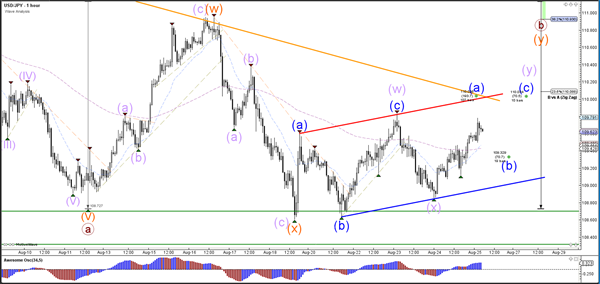
The USD/JPY is building a channel (red/blue lines) at the support zone (green).
Elliott Wave View: USDJPY Double Correction
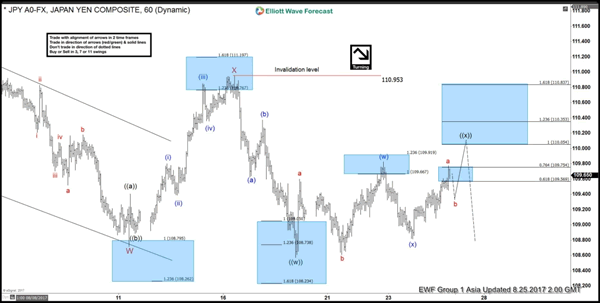
Short term USDJPY Elliott wave view suggests the decline from 7/11 peak is unfolding as a double three Elliott wave structure. Decline to 108.71 low ended Minor wave W and Minor wave X bounce ended at 110.95 peak. Subdivision of Minor wave Y is unfolding as another double three structure of a lesser degree. Minute wave ((w)) of ((Y) ended at 108.59 low and revised view suggests Minute wave ((x)) of (Y) bounce remains in progress to correct cycle from 8/16 peak towards 110.05 – 110.35 before pair turns lower. We don’t like buying the proposed bounce, and as far as pivot at 110.95 remains intact, expect sellers to appear at 110.05 – 110.35 for a new low or at least pullback in 3 waves.
USDJPY 1 Hour Elliott Wave Chart
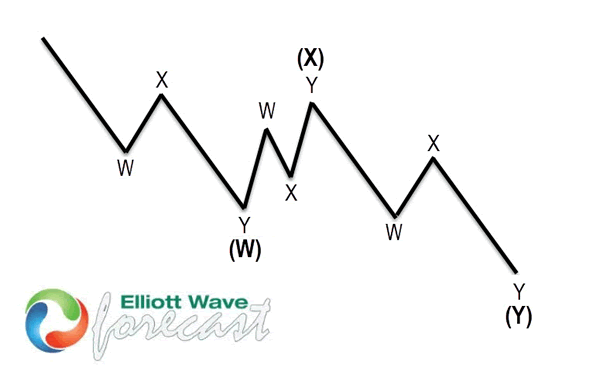
Double three ( 7 swings) is the most important pattern in Elliott wave’s new theory. It is also probably the most common pattern in the market these days. Double three is also known as a 7-swing structure. It is a very reliable pattern that gives traders a good opportunity to trade with a well-defined level of risk and target areas. The image below shows what Elliott Wave Double Three looks like. It has labels (W), (X), (Y) and an internal structure of 3-3-3. This means that all 3 legs has corrective sequences. Each (W) and (Y) is formed by 3 wave oscillations and has a structure of A, B, C or W, X, Y of smaller degrees.
Markets Sit Tight Awaiting Jackson Hole Speeches
Jackson Hole Symposium kicks off. The highly anticipated Jackson Hole Symposium is off to a good start, but traders appear to be holding off any huge positions until ECB head Mario Draghi and Fed Chairperson Janet Yellen deliver their key speeches later in the day. Investors are waiting for any clues on further U.S. rates rises, the timing of its balance sheet tapering and if Europe is still looking to rein in stimulus.
More Infighting In Washington. U.S. President Donald Trump threw shade on his fellow Republicans for putting the government on the brink of a shutdown due to the looming debt ceiling deadline. He said on Twitter on Thursday that Republican congressional leaders could avoid a legislative “mess” if followed his advice to tie debt ceiling legislation a few weeks back.
Downbeat Medium-Tier U.S. Data. Stronger-than-expected data on U.S. initial jobless claims on Thursday helped the dollar stay positive on the day. The dollar edged higher against the other major currencies, but gains were capped by the release of disappointing U.S. housing sector data and as investors shifted focus to an upcoming global central bankers’ meeting.
Yen Awaiting Jackson Hole Key Speeches. The yen slipped further against the dollar on Friday with consumer prices data in Japan meeting expectations and a pair of speeches by the Fed chair and ECB president highly awaited.
Mixed Day For Commodities. Gold was trading mostly sideways for the day as investors seemed to be saving their moves until after Mario Draghi and Janet Yellen have delivered their testimonies.
Crude Oil Is Down. Crude oil took a hit on speculations that Hurricane Harvey could lead refineries to shore up stockpiles before shutting down when the storm hits. The U.S. National Hurricane Center predicted that Harvey will turn into a major hurricane by Friday as it approaches Texas, likely leading to outages along the U.S. Gulf Coast. Nearly half of the country’s petroleum refining capacity is located along the Gulf Coast, along with roughly 51% of U.S. natural gas processing plants.
Watch Out Today For:
- 12:30 pm GMT: USD Durable Goods Orders
- 14:00 pm GMT: USD Federal Reserve Chairperson Janet Yellen Speaks
- 19:00 pm GMT: EUR ECB President Mario Draghi Speaks