

Sample Category Title
Trade Idea : GBP/USD – Stand aside
GBP/USD - 1.3081
Most recent candlesticks pattern : N/A
Trend : Near term up
Tenkan-Sen level : 1.3079
Kijun-Sen level : 1.3106
Ichimoku cloud top : 1.3105
Ichimoku cloud bottom : 1.3079
Original strategy :
Exit long entered at 1.3085
Position : - Long at 1.3085
Target : -
Stop : -
New strategy :
Stand aside
Position : -
Target : -
Stop : -
Despite yesterday’s marginal rise to 1.3159, the subsequent sharp retreat suggests top has possibly been formed there and downside risk has increased for retracement of recent upmove to 1.3035-40, however, only break of support at 1.2999 would confirm recent upmove has ended, bring further fall to 1.2980 and later towards 1.2955-60.
In view of this, would be prudent to stand aside in the meantime. Above 1.3110-20 would bring recovery to 1.3140 but only break of said resistance at 1.3159 would revive bullishness and signal recent upmove has resumed for headway to 1.3185-90 and then 1.3210-20.
AU PPI Hits 1.7Pct, AUD In Hands Of The Greenback
Eyes remain on the 80c level ahead of the weekend as traders try to decipher if the USD correction higher could hold or fold.
PPI data gave a nice boost to inflation's potential today despite missing expectations on a quarterly basis. Whilst the QoQ read of 0.5% missed the 0.6% forecast, it has expanded at this rate for three quarters which helped the annual rate to expand at 1.7%, its highest level since Q4 '15.
Inflation earlier this week received mixed reviews with some disappointed CPI didn't pick up and other, like ourselves, see it as part of the basing period required before inflation picks up. Yes, broad CPI disappointed yet this also includes food and energy. The preferred RBA reads hit consensus and continue to suggest a base may be forming and today's PPI data provides inflationary hope.
For the expansion to continue, we need to see the underlying index close the gap from its own long-term trend. The rate of expansion has slowed since Q1 2014 which doesn't bode well for the longer-term trend. But near-term there is potential for PPI and inflation to move higher from its current base.
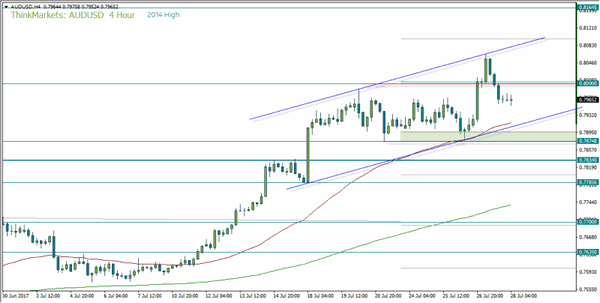
The narrow candles presented don't really provide a directional clue as to which way it could move or spike at London open. If we had to take a punt, we'd prefer to use a sll-limit below 80c with a view to catch any spikes and profit from an eventual downside move. Yet note that this is counter to the preceding trend and potential sport awaits at the 50 eMA and bullish channel. If we are correct to assume a bullish extension for USD ahead of the weekend, we ay find the bullish channel tested to the downside, yet if Q2 GDP disappoints then we may find ourselves closer to 80c
To be confidence a break above 80c is genuine, we would prefer to see USD broad weakness as opposed to AUD in isolation. For bullish setups we can consider AUDCHF, as this is been the more bullish story of the week for AUD after SNB's Jordon reiterated that the Swiss Franc is “significantly overvalued” Technically the cross points higher and could be headed for 0.78 next week.
The RBA will be in focus against next week to see if wording of their statement becomes more aggressive in light of the stronger currency. The trouble the RBA now face is there's really little they can do if the US Dollar continues to unravel the way it has recently. Thankfully for them, we think USD is due a correction as multiple FX crosses have hesitated at key levels, which may tempt bears to close out ahead of the weekend.
Trade Idea : EUR/USD – Stand aside
EUR/USD - 1.1702
Most recent candlesticks pattern : N/A
Trend : Near term up
Tenkan-Sen level : 1.1698
Kijun-Sen level : 1.1700
Ichimoku cloud top : 1.1663
Ichimoku cloud bottom : 1.1649
New strategy :
Stand aside
Position : -
Target : -
Stop : -
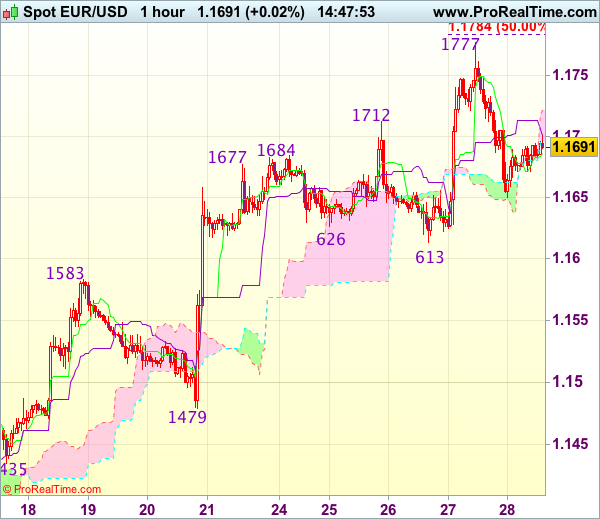
As the single currency found support at 1.1650 and has recovered, suggesting further recovery to 1.1725-30 cannot be ruled out, however, break of this week’s high at 1.1777 is needed to signal recent upmove has once again resumed and extend gain to 1.1784-85 (50% projection of 1.1370-1.1712 measuring from 1.1613). then 1.1800 but loss of near term upward momentum should prevent sharp move beyond 1.1820-25 (61.8% projection), risk from there has increased for a retreat later.
As near term outlook is mixed, would be prudent to stand aside in the meantime. Below 1.1670-75 would bring test of said support at 1.1650 but break there is needed to signal a temporary top is possibly formed, bring further weakness towards support at 1.1613, having said that, price should stay well above previous resistance at 1.1583 (now support), bring another rise later.
The Week Ahead: 28th July 2017
USD: The US Dollar continues dive in freefall fashion as soft data, negative Whitehouse sentiment and technicals point lower. Next week provides a broad look at the US economy as it includes inflation, employment and business sentiment. NFP will continue to be a day traders favourite although with the employment data remaining firm overall and strongly hinting maximum employment has been achieved, it is debatable as to whether a strong NFP will support the Greenback. Yet as sentiment is very negative, traders may see more opportunity with a bad NFP print. Monday may be the bigger event as it includes personal consumption data. Core PCE is the Fed's preferred CPI gauge although it also gives a peak into consumer sentiment and spending. If ISM and Markit PMIs are to move higher it suggests support for growth in late H2, yet we doubt this would turn the Dollar's trend and is likely more of a stock market play.
CAD: The Canadian Dollar has been on a tear these past few weeks as the USD unravels to lift commodities whilst hawks continue to bid CAD. This makes CAD biased to good data over bad, particularly if it is inflation related. CPI data showed signs of stability according to their three preferred inflationary measures. In fact, by taking an average of the three we see inflation ticked higher to 1.4%. Raw prices have softened recently and an extension of this trend may take some of the fun out of the bullish CAD story. If we are treated to a recovery though we expect it to support.
PMI data remains supportive of growth overall, with the composite (manufacturing and services) sitting at a very healthy 61.6 to suggest support for growth in the months ahead. Within the indices there has been a softening of employment in recent months, and if we are to see prices move lower than this suggest less of an inflationary pressure. Overall the figures remain healthy though.
Employment remains a mixed picture. Whilst it has picked up in recent months, the unemployment has moved lower as the participation rate has dropped with it. Ideally we should see participation move higher.
EUR: Whilst unemployment continues to make headway and currently sits at 15mn, its lowest level since May 2009, the employment rate is also on the decline. Annually employment growth is -1.5%, its lowest since 2008 whilst the quarterly read is also historically low at 0.4%. Whilst economic data is good overall, the employment sector is one which may undermine some inflationary pressures which are building up elsewhere.
The rate of broad inflation has softened to 1.3% YoY, its slowest rate since January and is moving in line with the UK and US to suggest this may be more of a global trend than one solely related to Europe. The monthly read has scraped by at 0% and -0.1% prior, so be on guard for further softening which may make another dent in the Euro.
GBP: The softness of CPI in June has helped to reduce calls for an immediate hike and we'll get to see if this is reflected in the MPC votes. Last meeting, we saw 3 votes to hike which had moved up from the original one. If we are to see one of those votes change their mind then we'd expect a bearish follow-through on GBP, although we'd be more surprised if we were to see 4 members vote for a hike which could send Sterling higher.
CNY: China's manufacturing PMI gave economists a scare in May when it dipped below 50 to denote industry contraction. Yet after recovering to 50.4 we await to see if the contraction was an outlier.
The NBS reads remain the more optimistic data sets, although employment has contracted faster and input prices (inflation) appears ready to cross below 50. Input prices are a slight concern as they have now moved to 50.4, denoting only a slight expansion. If we contract from here it brings down inflationary pressures further down the supply chain.
Trade Idea : USD/JPY – Hold short entered at 111.45
USD/JPY - 111.03
Most recent candlesticks pattern : N/A
Trend : Near term down
Tenkan-Sen level : 111.10
Kijun-Sen level : 111.29
Ichimoku cloud top : 111.49
Ichimoku cloud bottom : 111.26
Original strategy :
Sold at 111.45, Target: 110.45, Stop: 111.80
Position : - Short at 111.45
Target : - 110.45
Stop : - 111.80
New strategy :
Hold short entered at 111.45, Target: 110.45, Stop: 111.75
Position : - Short at 111.45
Target : - 110.45
Stop : - 111.75
Although the greenback staged a rebound from 110.78 to 111.71, the subsequent retreat has retained our bearishness for a retest of this week’s low at 110.62, however, break there is needed to confirm recent decline has resumed and extend further weakness to 110.30-35 but reckon 110.00-05 would hold from here.
In view of this, we are holding on to our short position entered at 111.45. Above said resistance at 111.71 would defer and prolong choppy trading, however, price should still falter below said resistance at 112.20, bring retreat later.

Beware Profit Takers
On Thursday US durable goods orders were released showing a 6.5% increase, which was the biggest gain in 3 years, resulting in USD clawing back some of its recent losses. The continued signs of global economic growth have helped US equity markets with over 75% of S&P companies delivering earnings that have beaten forecasts. US30 (Dow) gained 0.45% on the day to set a record closing high on Thursday of 21,794.70. Many market participants are wary and expect these “heady” levels to likely attract profit taking at some point. Today sees the release of US GDP, with expectations of a healthy 2.6% annualized pace because of improved consumer spending that was somewhat absent in Q1.
A series of Japanese economic data released on Friday came in stronger than expected, with household spending rising more than forecast and the jobless rate unexpectedly falling to 2.8% in June from 3.1% in May. However, regardless of this strong data, it is unlikely that the Bank of Japan will be inclined to dial back monetary stimulus anytime soon.
EURUSD hit a 30-month high of 1.1777 on Thursday but has retreated to currently trade around 1.1695.
USDJPY is trading slightly above its recent 5 week low. Currently trading around 111.00.
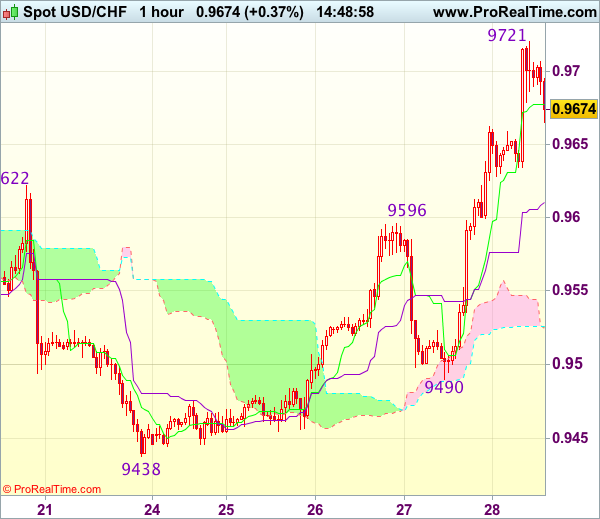
CHF (Swiss Franc) fell 0.5% against USD and 0.6% against EUR on Thursday, as the market believes that the Swiss National Bank will maintain an “easy monetary policy” as, conversely, the ECB looks to dial back its stimulus. USDCHF is currently trading around 0.9680 and EURCHF is currently trading around 1.1320.
Gold is steady in early Friday trading after retreating from 6-week highs but is still on track for a 3rd weekly gain. Gold is currently trading around $1,260.
Oil is up nearly 7% for the week, its best performance in a month, as falling US inventories and signs of stronger demand raise speculation of a supply glut in the world’s biggest consumer may ease. WTI is currently trading around $49.05.
At 10:00 BST the European Commission will release; Services Sentiment, Consumer Confidence (Jul), Economic Sentiment Indicator (Jul), Business Climate (Jul) and Industrial Confidence (Jul). The consensus is for these data releases to be lower than their previous releases, but that should not unduly affect EUR as the Eurozone economy is growing.
At 13:30 the US Bureau of Economic Analysis will release Gross Domestic Product Annualized (Q2). The consensus calls for a healthy 2.6% bettering the previous 1.4%. The release should help USD although, regardless of GDP, US monetary policy is focused on inflation and reducing the sizable holdings they have in bonds, so any increase in GDP will likely have a “knee jerk” reaction for USD that will be short lived.
At the same time, US Employment Cost Index (Q2) and Personal & Core Consumption Expenditures Prices (QoQ) (Q2) will also be released. Markets will be looking to see if US consumers are spending and pushing inflation higher. A key indicator for any future rate hikes.
Currencies: EUR/USD Rally Took A Breather, But Upside Test Ongoing
Sunrise Market Commentary
- Rates: Positive intraday bias US Treasuries
The end of the US supply operation and end-of-month buying are technical elements that could prove positive for US Treasuries in an intraday perspective ahead of the weekend. Risk sentiment on stock markets is a wildcard. If yesterday's correction persists, it's an additional positive for US Treasuries. Eco data include US Q2 core PCE and German CPI. - Currencies: EUR/USD rally took a breather, but upside test ongoing
The dollar sell-off slowed yesterday. However, the overall technical picture remains very fragile. Global eco data probably won't give a strong enough signal to safe the dollar today. A pick-up in volatility is often supportive for the USD (ex USD/JPY ), but we are not convinced that the dollar will be able to take up its safe haven role today
The Sunrise Headlines
- Asian stocks declined as disappointing earnings from Amazon weighed on sentiment that had already been dented by Thursday's sudden selloff in US technology shares (Nasdaq -0.63%).
- The US Senate voted down the latest plan, the 'skinny heath care plan', this morning as three Republicans broke rank and voted with a unified Democratic caucus against the last proposal. Majority leader said it is now time to move on.
- Japan's jobless rate declined from 3.1% to 2.8% in June (consensus 3.0%). Despite the tightening labour market, the CPI's stabilised in June. The headline figure was 0.4% Y/Y (as expected) and the core was 0.0% Y/Y.
- Japanese retail sales rose a weaker than expected 0.2% M/M and 2.1% Y/Y, while household spending exceeded expectations, rising 2.3% Y/Y in June from -0.1% Y/Y previously.
- The US Senate gave final approval to legislation strengthening sanctions on Russia, North Korea and Iran and giving Congress the power to block President Trump from lifting them, setting up a possible clash with the White House.
- US Republican lawmakers have set aside the plans for a controversial border-adjusted tax in hopes of smoothing the way for comprehensive tax overhaul.
- Today's eco-calendar for the US contains the first Q2 GDP & PCE deflators, the Employment Cost Index and the July Michigan sentiment index (final). In Europe, focus will be on the July EMU economic confidence indicator, French/Spanish GDP and the German CPI inflation.
Currencies: EUR/USD Rally Took A Breather, But Upside Test Ongoing
Dollar sell-off slows, but jury is still out
The decline of the dollar slowed yesterday. US data painted a mixed picture and gave no guidance. USD/EUR and USD/JPY reversed a big part of Wednesday's post-FOMC USD decline. A spike in equity volatility later in US trading pushed EUR/USD to the 111 area. The impact on EUR/USD was limited. EUR/USD closed the session at 1.1677. USD/JPY at 111.26.
Overnight, the decline in equities/rise in volatility in the US spilled over into Asian markets. Losses range from roughly 0.5% to about 2%. Japan household spending was strong and the jobless rate (2.8%) matched the multi-year lows seen earlier this year. Japanese inflation held at low levels, close to the 0% mark. There was again little direct impact on the yen. USD/JPY held up quite well given the pick-up in volatility. Remarkable, the Swiss France cedes further ground. EUR/USD doesn't show a clear trend and trades in the 1.1680 area.
In Europe, we see mostly upside risks for the EMU activity/confidence data (see Fixed Income section). German July HICP inflation is expected to have slowed to 1.4% Y/Y (0.3% M/M) from 1.5% Y/Y. We have no reasons to distance us from consensus. In the US, Q2 GDP is expected at 2.5% Q/Qa versus a dismal 1.6% Q/Qa in Q1. We side with consensus. The PCE deflator is expected to have slowed sharply to 1.3% Q/Qa from 1.9% Q/Qa in Q1, while the core PCE deflator should have come down to 0.7% Q/Qa from 2% Q/Qa previously. The slowing inflation in Q2 is already well documented, but markets may still reel when these figures are published. EMU activity data might be slightly supportive for the euro, but the inflation data are a wild card. The focus for USD trading will be on the US GDP report. Expectations for growth look reasonable, but the decline in the price indicators remains a risk for the dollar. Given expected good EMU data and potentially low US deflators, today's day will likely data fail to support a sustained USD rebound. Aside from the eco data, the tentative rise in volatility might be the harbinger of a more pronounced equity correction. What does this will mean for the dollar? Higher volatility is normally positive for the USD (excluding USD/JPY). However, we are convinced that the dollar will be able to fully play it's safe haven roll in the current environment. We wouldn't be surprise to see the euro partially taking over this role. So, we don't preposition for a major USD comeback.
EUR/USD topside test not over yet
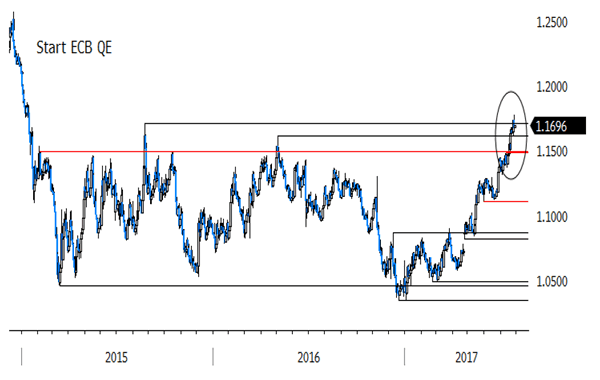
Over the previous two months, EUR/USD cleared several intermediate resistance levels. Yesterday it extensively tested the 1.1714/36 resistance. The level was temporary broken, but a clean break didn't occur. A sustained break would end the long consolidation that followed the sharp decline of EUR/USD in 2014/early 2015 and change the broader picture for the dollar. EUR/USD is clearly moving into overbought territory but this is no guaranty the up-move will stop. The break still needs to be confirmed, but if the pair doesn't return below 1.16 soon, the way to 1.20 is open. We wait for a technical sign before adding USD long exposure.
EUR/USD: top MT consolidation pattern under heavy strain
EUR/GBP
EUR/GBP fails to break below 0.89 barrier
Sterling initially performed yesterday rather well given the overall USD weakness. There was only a modest and temporary spill-over effect of the EUR/USD rally into EUR/GBP. In technical trading, EUR/GBP drifted lower in the lower in the 0.89 big figure. The CBI July retail data were stronger than expected and were temporary as slight additional sterling support. EUR/GBP dropped temporary below 0.89, but later on EUR/USD outperformed cable as volatility picked up. EUR/GBP closed the session at 0.8935. Cable finished the day at 1.3066.
Overnight, the GFK consumer confidence, the only UK indicator published today, was marginally weaker than expected at -12 from -10. It had no impact on sterling. In a short-term perspective, sterling entered a consolidation pattern (against the euro). The market largely priced out the chances of an August UK rate hike. Brexit is also temporary off the radar. Over the previous days, EUR/GBP didn't rise much further despite the EUR/USD rally. This suggested some relative sterling strength short-term. However, a rise in overall volatility usually is sterling negative. So, we are neutral on EUR/GBP today.
From a technical point of view, EUR/GBP broke above the 0.8854/66 resistance (2017 top) to set a new correction high north of 0.89, but the rally slowed at the end of last week. A break below 0.8720 would suggest that upside momentum is easing. For now, we don't see a trigger for a sustained rebound of sterling against the euro. We still look to buy EUR/GBP on more pronounced dips. For that to happen, EUR/GBP probably needs some help from a correction in EUR/USD
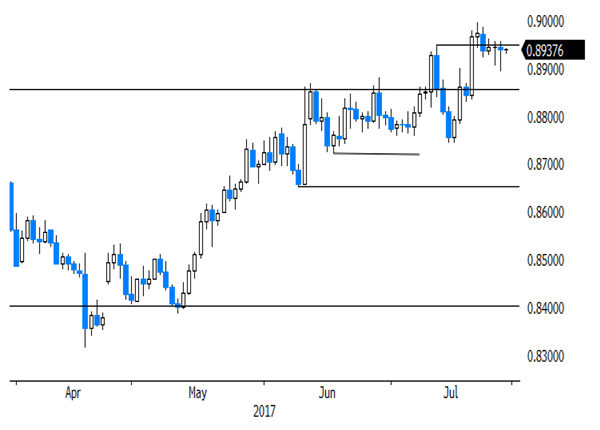
EUR/GBP: consolidation near recent top
Elliott Wave View: Dow Futures Extending Higher
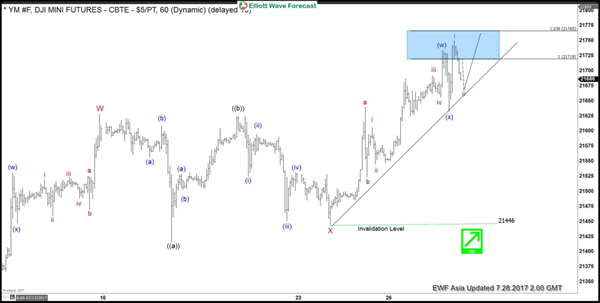
Short term YM_F (Dow E-Mini Future) Elliott Wave view suggests the rally from 6/29 low is unfolding as a double three Elliott wave structure and ended with Minor wave W at 21628. Down from there, Minor wave X pullback unfolded as a running Elliott Wave flat. Minute wave ((a)) ended at 21457, Minute wave ((b)) ended at 21624, and Minute wave ((c)) of X ended at 21446. Index has since made a new high suggesting the next leg higher has started. Up from 21444 low, Minutte wave (w) ended at 21734 and Minutte wave (x) pullback ended at 21632. Near term, Index is pulling back in Sub Minutte wave ii to correct cycle from 7/27 low (2163) then it should turn higher again.
We don't like selling the Index and favors buying the dips against 21446 low in the first degree. If pivot at 21446 low fails, then the move higher from 6/29 (21138) can be seen as a 5 waves diagonal. In this case, Index should pullback in 3, 7, or 11 swing to correct cycle from 6/29 low before the rally resumes.
Dow E-Mini Future 1 Hour Elliott Wave View
ECB’s Inflation Projection Seems Optimistic
Market Movers Today
The first inflation figures in the euro area for July are due for release with the German, French and Spanish figures. The euro appreciation during July should not yet result in lower inflation, but we look for the German HICP inflation figure to go lower as package tours should be less supportive.
We will also get information about economic growth in the euro area in Q2 with the French and Spanish GDP growth figures due for release.
US GDP growth is also due for release and we have a below-consensus forecast of 2.3% q/q AR, reflecting slower growth in private consumption and less contribution from fixed investments than expected when entering the quarter.
In Scandinavia, focus is on the Norwegian labour market figures and Swedish GDP growth for Q2 where we look for a pickup in economic activity to 3.0% y/y from 2.2% y/y in Q1. Finally, Norwegian and Swedish retail sales are due for release.
We expect Russia's central bank to cut its policy rate by 25bp to 8.75%. See CBR rate decision preview: we pencil in a cautious cut, 24 July 2017.
Selected Market News
Asian stock markets declined this morning after US tech shares retreated from recent rallies. A string of Japanese economic data came in stronger than expected, with household spending rising more than expected and the jobless rate falling to 2.8%, although inflation at 0.4% y/y in June remains way off the Bank of Japan's target .
The US Senate voted to impose new sanctions on Russia, putting President Donald Trump in a tight spot by either forcing him to take a hard line on Moscow or veto the legislation and infuriate his own Republican Party. EUR/USD retreated yesterday from the highs reached following Wednesday's FOMC meeting, and is currently trading at 1.1688. In effective terms, the euro is now 4% stronger compared to the assumption in the ECB's project ion from June 2017 and we believe that the recent euro appreciation will be a headwind to inflation in coming years, especially as the ECB's inflation projection seems optimistic already. We st ill expect the ECB to continue its QE purchases but at a reduced pace of EUR40bn per month in H1 18, and that it will announce this at the October meeting with some signalling of it in September.
The UK FCA announced that Libor will be phased out by the end of 2021, saying that the rate is not sustainable due to a lack of t ransact ion and volume. Uncertainty abounds on how the t ransit ion to more t ransact ion-based fixing can take place both in the UK and the euro area.
Politics in Sweden also continues to be in focus following Prime Minister Stefan Löfven's decision to replace the infrastructure and interior ministers over an IT scandal, while avoiding the more drastic opt ion of calling an early elect ion. Löfven st ill retained the Defence Minister, defying calls for a dismissal of all three ministers. Opposition parties are expected to press for a confidence vote on the Defence Minister after the summer recess and if passed, it could st ill bring down Löfven's minority government . So far, EUR/SEK remains unperturbed and unless the government is brought down and a polit ical crisis erupts, we expect the market impact to be only modestly SEK negative as economic data in Sweden remains strong.
Market Update – Asian Session: Nasdaq Futures Decline Over 0.5%
Asia Summary
Asian equity markets have traded generally lower ahead of the later today release of US Q2 advance GDP data. Australia’s ASX 200 has underperformed and declined by over 1.4% amid weakness in mining shares and banks. Shares of Samsung Electronics have declined by over 3% amid its recent financial guidance
In Japan, shares of Nissan (-3.5%), Tokyo Electron (-6%) and Daiwa Securities (-4%) are all declining following their respective earnings reports and outlooks. Toshiba has declined by over 8% after a US judge ruled that his court has the authority to consider Western Digital’s request to temporarily block the sale of the Japanese company’s chip unit. There has also been press speculation that numerous parties are said to be encouraging Toshiba to file for bankruptcy.
The session was heavy in terms of Japanese data releases, which included the June Jobless rate, CPI and Retail Sales. Further, June overall household spending saw its biggest rise since Aug 2015.
Nasdaq futures have declined by over 0.6%, as shares of Amazon fell over 2.5% after its earnings report. On the US health care front, the Senate released the text of their ‘Health-care Freedom Act’ and the US House conference is expected to hold a meeting on Friday at 9 AM EST.
Key economic data
(AU) AUSTRALIA Q2 PPI Q/Q: 0.5% V 0.5% PRIOR; Y/Y: 1.7% V 1.3% PRIOR
(CN) China Q2 Registered Urban Jobless Rate: 3.95% v 4.05% y/y
(JP) JAPAN JUN NATIONAL CPI Y/Y: 0.4% V 0.4%E ; CPI EX FRESH FOOD (CORE) Y/Y: 0.4% v 0.4%e; CPI Ex Food, Energy (core-core) Y/Y: 0.0% v -0.1%e
(JP) JAPAN JUL TOKYO CPI Y/Y: 0.1% V 0.1%E; CPI EX-FRESH FOOD Y/Y: 0.2% V 0.1%E
(JP) JAPAN JUN OVERALL HOUSEHOLD SPENDING Y/Y: 2.3% V 0.5%E (largest rise since Aug 2015)
(JP) JAPAN JUN RETAIL SALES M/M: 0.2% V 0.4%E;RETAIL TRADE Y/Y: 2.1% V 2.4%E
(JP) JAPAN JUN JOBLESS RATE: 2.8% V 3.0%E; Job to applicant: 1.51 v 1.50e
(JP) Bank of Japan (BOJ) Summary of Opinions for the July 19-20 policy meeting: Reiterates CPI likely to approach 2% around FY19; Repeated delays in price target could undermine BoJ's credibility
(KR) SOUTH KOREA JUN INDUSTRIAL PRODUCTION M/M: -0.2% V 1.6%E; Y/Y: -0.3% V 1.1%E
(KR) South Korea Aug Business Manufacturing Survey: 78 v 80 prior; Non-Manufacturing Survey: 77 v 76 prior
(KR) South Korea June Cyclical Leading Index +0.3 pt m/m
(SG) Singapore Q2 Unemployment Rate: 2.2% v 2.3%e
(UK) JUL GFK CONSUMER CONFIDENCE: -12 V -11E
Speakers and Press
China
(CN) China fx regulator SAFE: Will safeguard and increase value of forex reserves
(CN) China banks said to be increasing rates on mortgages - Economic Information Daily
(CN) China National Energy Administration: Will not encourage solar power projects that require high subsidies and will discourage low-tech projects
Japan
(JP) Japan Chief Cabinet Sec Suga: Japan to impose additional sanctions on North Korea
(JP) Japan Defense Min Inada: Confirms resignation
(JP) Japan Foreign Minister Kishida expected to also take on role of Defense Minster - Japanese Media
Other
(NZ) RBNZ said its review found that the central bank’s mandate is realistic about what monetary policy can achieve
(US) US Senate Majority Leader McConnell: 'Skinny Repeal' healthcare plan would end individual mandate, provide flexibility to states; Says time to send Healthcare bill to President Trump.
(US) DoubleLine's Gundlach purchased 5-month put options on the S&P 500 a couple of days ago - financial press
Asian Equity Indices/Futures (00:30ET)
Nikkei -0.7%, Hang Seng -0.6%, Shanghai Composite flat, ASX200 -1.5%, Kospi -1.4%
Equity Futures: S&P500 -0.4%; Nasdaq -0.6% , Dax -0.5% , FTSE100 -0.5%
FX ranges/Commodities/Fixed Income (00:30ET)
EUR 1.1671-1.1694; JPY 110.79-111.71; AUD 7953-7980; NZD 0.7475-0.7508
EUR/CHF: Rises over 0.6% to highest since Jan 2015
Aug Gold -0.1% at 1,258/oz; Aug Crude Oil -0.2% at $48.94/brl; Sept Copper -0.4% at $2.86/lb
(AU) Australia sells A$700M of May 2028 bonds, avg yield 2.7266% v 2.7747% prior, bid to cover 3.84x v 2.82x prior
(AU) Australia to sell A$900M of 2.75% Nov 2028 bonds on Aug 2 and A$500M in 1.75% Nov 2020 bonds on Aug 4th
(CN) PBOC SETS YUAN REFERENCE RATE AT: 6.7373 V 6.7307 PRIOR
(CN) China PBOC OMO injects CNY140B in 7-day and 14-day reverse repos v CNY60B prior in 7-day
Equities notable movers
Japan
Daiwa Securities, 8601.JP Q1 profits declined; -4%
Nissan, 7201.JP Q1 profits below ests; -3.5%
US markets on close: Dow +0.4%, S&P500 -0.1%, Nasdaq -0.6%, Russell -0.6%
Best Sector in S&P500: Energy +1%
Worst Sector in S&P500: Health Care -0.7%
At the close: VIX 10.11 (+0.51pts); Treasuries: 2-yr 1.37% (+2bps), 10-yr 2.33% (+4bps), 30-yr 2.94% (+5bps)
US Market Summary
The broad stock market and tech sector lost some high ground today, with transport and technology weighing on S&P and Nasdaq. The Dow outperformed again, setting another all-time high, with some help from the rally in Verizon +7.7%. The blue chip index touched a record high at 21,798. Focus turns to tomorrow, with more earnings reports and key GDP data in the morning.
US Afterhours Movers
SAM Reports Q2 $2.35 v $1.29e, Rev $247.9M v $229Me; Narrows higher FY17 $5.00-6.20 v $4.86e (prior FY17 $4.20-6.20); +13.4% afterhours
FSLR Reports Q2 $0.64 v -$0.05e, Rev $623M v $536Me; Raises FY17 Gross Margin 17-18% (prior 12.5-14.5%); +9.6% afterhours
BIDU Reports Q2 $2.36 adj v $1.42e, Rev $3.08B v $2.78Be; Guides Q3 Rev $3.41-3.50B v $3.17Be; +7.5% afterhours
LOGM Reports Q2 $1.01 v $0.93e, Rev $267M v $265Me; Guides Q3 $1.10-1.12 v $1.01e, R$271-273M v $268Me, Adjusted EBITDA $100-102M y/y ; +3.4% afterhours
SBUX Reports Q3 $0.55 v $0.55e, Rev $5.66B v $5.74Be; +0.9% afterhours
MAT Reports Q2 -$0.14 v -$0.08e, Rev $947.5M v $1.00Be; -2.8% afterhours
AMZN Reports Q2 $0.40 v $1.40e, Rev $38.0B v $37.2Be; Guides Q3 Rev $39.5-41.8B v $40.0Be ; -2.8% afterhours
FLEX Reports Q1 $0.24 v $0.26e, Rev $6.01B v $5.90Be; Guides Q2 $0.24-0.28 v $0.28e, R$5.9-6.3B v $6.19Be ; -7.8% afterhours
ELLI Reports Q2 $0.52 v $0.52e, Rev $104.1M v $110Me; -24.6% afterhours