

Sample Category Title
USD/CAD Daily Outlook
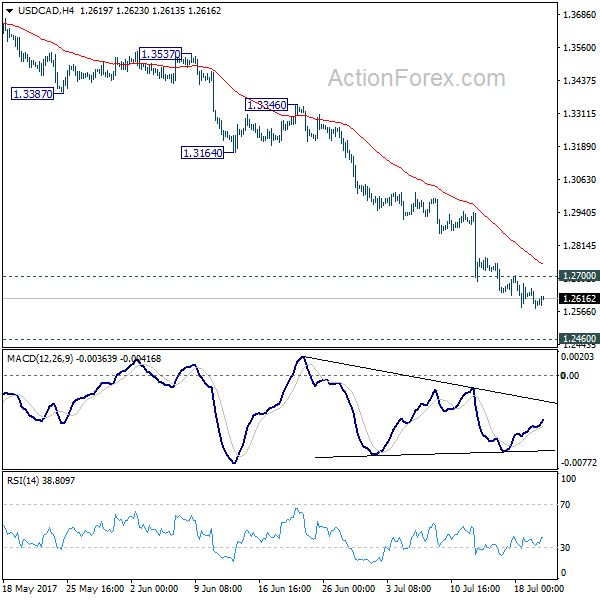
Daily Pivots: (S1) 1.2570; (P) 1.2611; (R1) 1.2644; More....
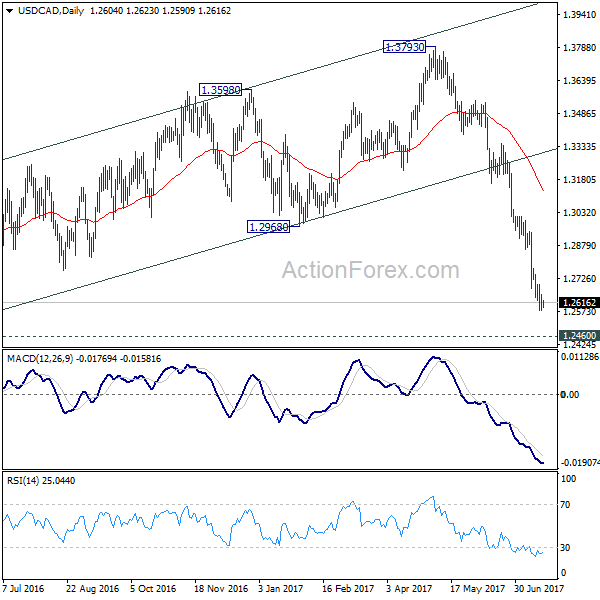
With 1.2700 minor resistance intact, intraday bias stays on the downside. Current fall from 1.3793 should extend to retest 1.2460 low. Meanwhile, considering bullish convergence condition in 4 hour MACD, break of 1.2700 will indicate short term bottoming In such case, there will be lengthier consolidation before staging another decline.
In the bigger picture, price actions from 1.4689 medium term top are seen as a correction pattern. Fall from 1.3793 is seen as the third leg and should target 50% retracement of 0.9406 to 1.4869 at 1.2048. At this point, we'd look for strong support from there to contain downside and bring rebound. However, firm break there will target 100% projection of 1.4689 to 1.2460 from 1.3793 at 1.1564.
USD/JPY And EUR/JPY Are Slightly Higher
Market Movers Today
The main event today is the meeting at the ECB with an announcement on the policy rate and quantitative easing (QE) due at 13:45 CET followed by President Mario Draghi's press conference, due to start at 14:30 CET. We expect the ECB to remove its readiness to increase QE in size (but to keep the flexibility in terms of duration) and to discuss tapering. In our view, a tapering discussion would be in line with the latest communication from Draghi, that in a situation where the economy continues to recover, monetary policy tightening could be needed in order to keep the policy stance ‘broadly unchanged'. However, the risk is that Draghi will express some dovishness due to the latest EUR appreciation and surge in bond yields.
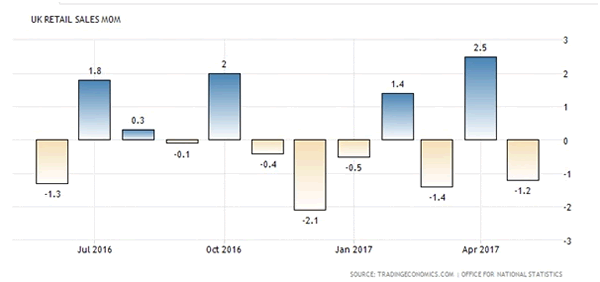
The euro area preliminary consumer confidence for July is due for release today and is expected to have continued to improve. Last month it rose to the highest level since 2001, signalling continued growth in consumer spending. In the UK, the June retail sales figures will be scrutinised for any impact of negative real wage growth. See Research UK: Negative real wage growth has slowed GDP growth, 18 July.
In the US, the Philly Fed index for July will be in focus after Empire manufacturing dropped in July. If the Philly Fed has also weakened, it will be another signal of some payback in ISM manufacturing after it rose sharply by close to three index points from May to June.
The South African central bank is apparently due to make an announcement on monetary policy today. Consensus expects the central bank to keep its key policy rate unchanged at 7.00%, but the risk is that it will deliver a 25-50bp cut.
Selected Market News
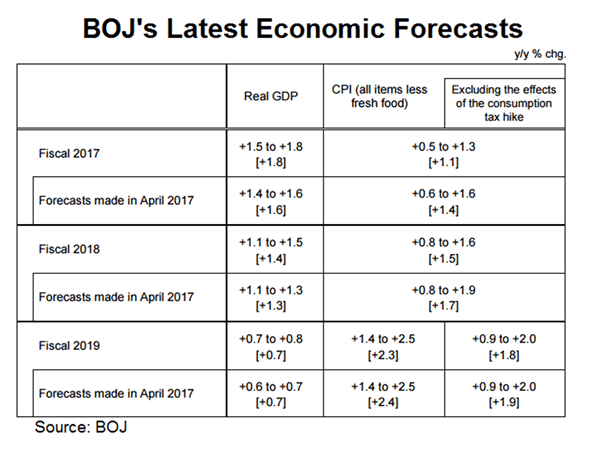
The Bank of Japan kept monetary policy unchanged as expected this morning. It has maintained its easing bias, saying it will conduct accommodative monetary policy until inflation and inflation expectations are above 2% in a stable manner. However, it now expects to hit its 2% inflation target around April 2019 – a year later than the previous projection. USD/JPY and EUR/JPY are slightly higher this morning, but price actions have been muted overall following the announcement, indicating that today's decision to keep policy unchanged was expected.
The oil market focused on the large crude and gasoline inventory draw in the weekly inventory report from the US Energy Information Administration yesterday, sending oil prices higher with the price on Brent crude notching USD49.7/bbl. However, the report also pointed to a fall in implied gasoline demand and higher US crude production – two negative factors for prices.
On the political front, US President Trump asked Republican senators to delay recess and continue working to get a deal done on the repeal of Obamacare. Talks between US and Chinese officials on a trade deal failed to deliver a joint statement on the matter and the US and the UK are said to have proposed a road map to help resolve the conflict between Qatar and Saudi Arabia.
Draghi Comments Eyed For Tapering Hints
- Will ECB drop any tapering hints ahead of September meeting?
- BoJ in no rush to tighten as inflation target continues to elude it;
- AUD buoyed by full-time employment numbers before profit taking sets in;
- UK retail sales and US data still to come today.
It's been a busy start to trading in Asia on Thursday and that's not expected to ease up, as we get the ECB monetary policy decision this afternoon followed by what could be a very interesting press conference shortly after.
While we're not expecting any changes from the ECB today, it's €60 billion a month asset program expires at the end of the year and traders are looking for clues regarding what comes next. An announcement on this is unlikely until September when it releases its new macro-economic projections but Mario Draghi may offer some insight into what we can expect during the press conference.
The most likely decision, despite the central bank still falling well short of its inflation target, will be to cut its purchases by another €20 billion as it did in April and extend by another six months. There has been a lot of speculation about a more explicit phasing out but I think the ECB want to be more careful given the fragile nature of the recovery. The result will likely be the same though with the central bank ending its quantitative easing program either at the end of 2018 or early 2019.
The risk today comes if Draghi puts his dovish hat on and suggests the program could simply be extended in its current form. Traders seem so convinced of further reductions that the euro could be vulnerable to the downside if the central bank doesn't follow through. We could be a lot clearer on its plans after today's press conference.
The Bank of Japan won't be in such a rush to end its bond buying, with inflation continuing to elude them as the timeline for when its 2% target will be achieved was pushed back yet again, this time to fiscal 2019. Given what they've anticipated in the past we can only take this with a pinch of salt and assume they'll be planning to keep the 10-year JGB around 0% for the foreseeable future. Still, despite the unsurprising announcement on inflation, the yen only weakened slightly with the trade data – imports and exports exceeding expectations – supporting the currency.
The Aussie dollar is trading a little lower today, despite employment numbers having earlier in the session pushed the currency to a two year high against the greenback. The pair fell just below 80 before profit taking set in, with full-time employment more than offsetting the drop in part-time numbers to give a net change of +14,000.
While the ECB event will undoubtedly be the headline today, we will also get retail sales data from the UK as well as jobless claims and manufacturing and consumer surveys from the US.
BOJ Left Rates and Asset Purchases Unchanged. Pushed Back Timing to Reach +2% Inflation
As expected, BOJ left its monetary stance unchanged in July. The central bank voted 7-2 to keep its target for 10-year JGBs at around 0% and its short-term deposit rate at -0.1% as expected. It also maintained the measure to buy government bonds at an annual rate of 80 trillion yen. What is more dovish is that the central bank now forecasts it would take longer than previously anticipated for the economy to achieve the +2% inflation target. It is the 6th time that the central bank pushed back the projected timing for achieving the inflation target. USDJPY has rebounded +0.23% since the announcement.
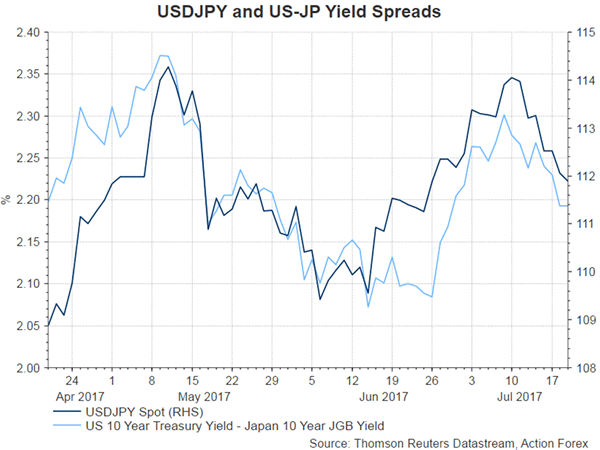
As noted in the accompanying outlook statement, policymakers acknowledged that continuous economic expansion, thanks to the highly accommodative monetary policies. However, they remained concerned over the inflation developments, suggesting that 'The recent developments in the consumer price index (CPI, all items less fresh food) have been relatively weak, excluding the effects of a rise in energy prices, mainly against the background that firms' wage- and price-setting stance has remained cautious'. As such, a rise in medium- to long-term inflation expectations has been 'lagging behind'. BOJ indicated that 'the year-on-year rate of change in the CPI is likely to continue on an uptrend and increase toward +2%'. While the central bank believed that the +2% target is achievable, the momentum is 'not yet sufficiently firm, and thus developments in prices continue to warrant careful attention'.
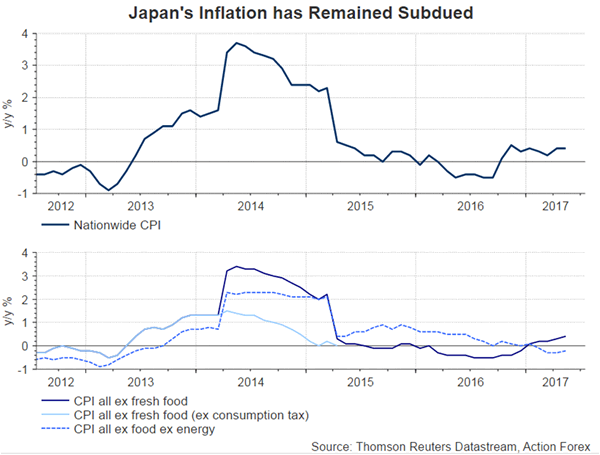
The latest economic projections by BOJ unveiled that the timing for achieving its +2% inflation target has been delayed to sometime during fiscal 2019, from fiscal 2018 previously. Note that BOJ has turned more confident over the GDP growth outlook. At the accompanying statement, BOJ noted that the economy is 'expanding moderately', compared with June's reference that economy was 'turning toward a moderate expansion'.
Daily Technical Analysis: EUR/USD Pullback To 1.15 Before Euro Zone Interest Rate Decision
Currency pair EUR/USD
The EUR/USD retraces back to the broken resistance of 1.15 within the bullish trend which could turn out to become a support level. However, there is an interest rate decision today for the Euro zone by the European Central Bank (ECB) plus a follow-up press conference. These events will probably cause increased volatility and could heavily impact price action too.
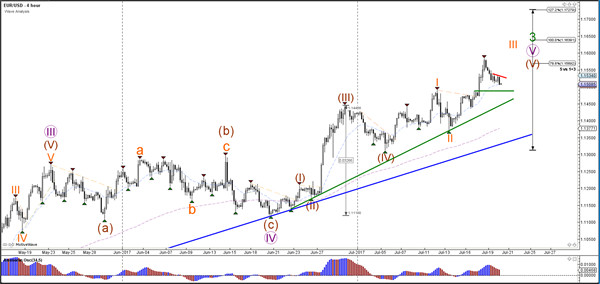
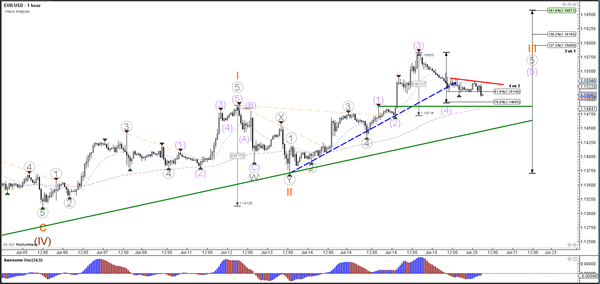
The EUR/USD could still be completing a potential wave 4 (purple) as long as price stays above 1.15. A break below it will however invalidate this wave structure and could retrace deeper.
Currency pair USD/JPY
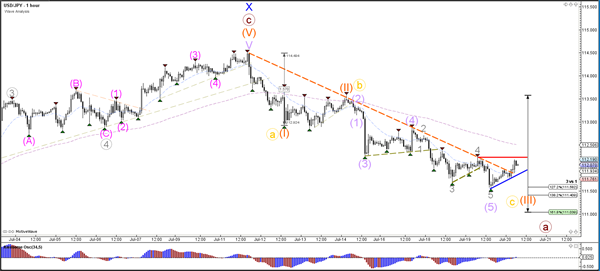
The USD/JPY has broken above the resistance trend line (dotted orange) before reaching the 161.8% Fibonacci target. This could indicate that an ABC (yellow) is taking place rather than a 123 impulse. One of the key resistance levels is the previous top and bottom (red) and round level of 112.50.
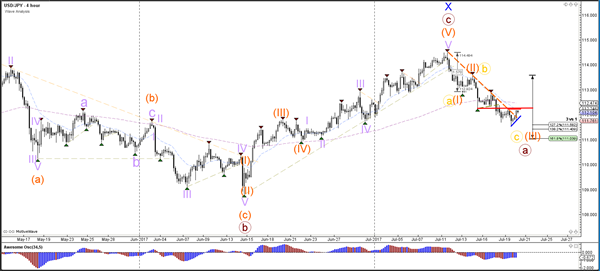
The USD/JPY seems to have completed wave 5 (grey). The retracement could be a pullback with the downtrend or the first bullish swing of a reversal. The support (blue) and resistance (red) levels could help with understanding the breakout direction.
Currency pair GBP/USD
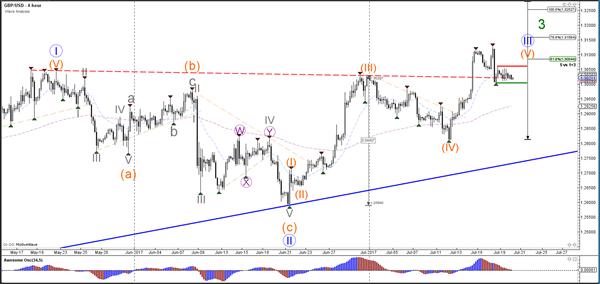
The GBP/USD has retraced back to the broken 1.30 resistance level, which could become a potential support level within the larger uptrend.
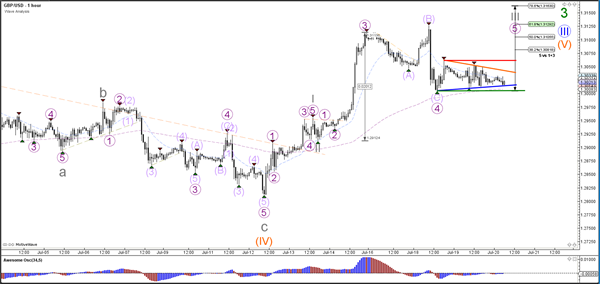
The GBP/USD is building a contracting triangle which is indicated by the various trend lines. A break above resistance could see the continuation of the uptrend whereas a break below support could indicate a change of the current wave structure and bearish pressure.
Daily Technical Outlook And Review: EUR/USD, GBP/USD, USD/JPY, AUD/USD, NZD/USD, USD/CAD, XAU/USD, WTI
EUR/USD
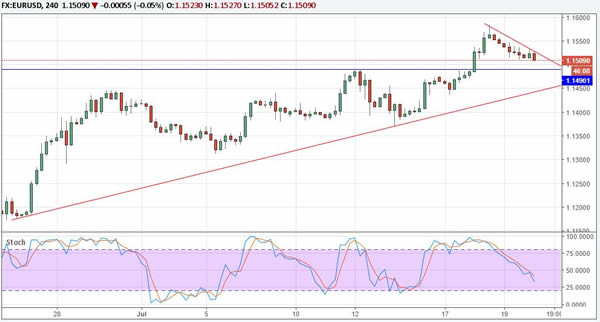
Price has lost momentum in the recent two trading days. Key support is seen at 1.1490, and at the rising trendline from the June low. A break below 1.1490 would suggest a larger correction towards 1.14 could follow.
However, the overall technical outlook remains positive, and EUR/USD is likely to catch a bid again on a larger retracement.
GBP/USD
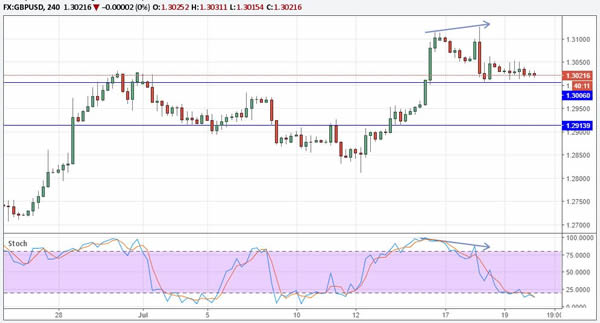
Cable is consolidating around the 1.30 support level. The Stochastic indicator is suggesting that the pair is somewhat oversold in the short-term. However, resistance above 1.31 has proven to be tough, and GBP/USD will have difficulties clearing that area of resistance.
A break below 1.30 will likely trigger further momentum selling and push the pair towards 1.2913 support. There, it should find solid support.
USD/JPY
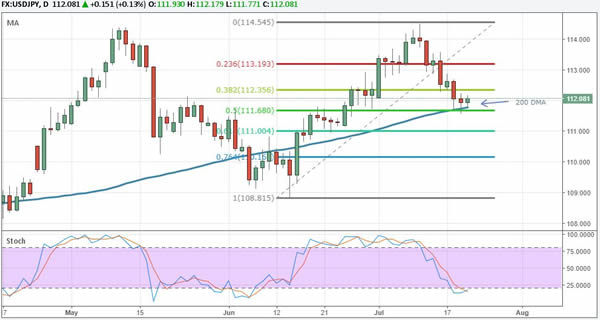
The charts are suggesting USD/JPY could have a bounce soon. It tested the 200 DMA and 50 % Fibonacci support (June rally) twice, and managed to recover from there. A break above 112.35 resistance would confirm the low there, and signal a rally towards 113.20 resistance.
Further, the Stochastic indicator shows that the pair is oversold in the near-term.
AUD/USD
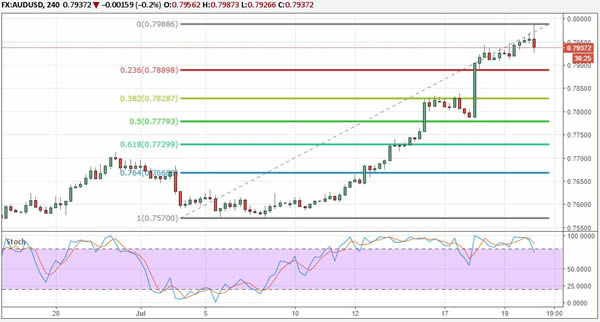
The Aussie had a strong rally in the recent days, and almost reached 0.80 today. It is likely to breach that resistance level soon, but the Stochastic is suggesting the pair is heavily overbought in the near-term. A retracement is likely, and would be healthy for a sustainable trend as well. Initial support is seen at 0.7890, followed by strong support at the former key resistance level near 0.7830 (also 38.2 % Fibonacci of the recent rally).
Overall, buying dips is still the favoured strategy in AUD/USD.
NZD/USD
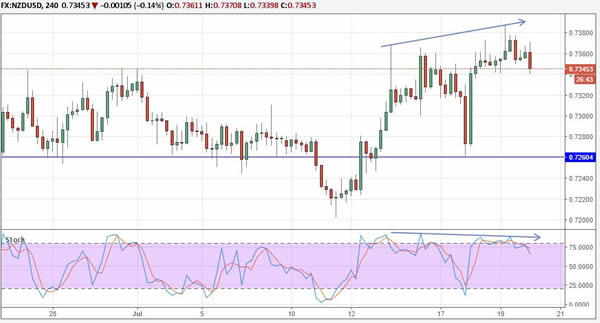
Negative Stochastic divergence and overbought conditions suggest that a retracement could follow in NZD/USD as well. Key support is seen at 0.7260, from where the pair could bounce in the near-term.
Resistance is heavy above 0.7380, and the New Zealand Dollar seems to lack the momentum to have a clear breakout above 0.74.
USD/CAD
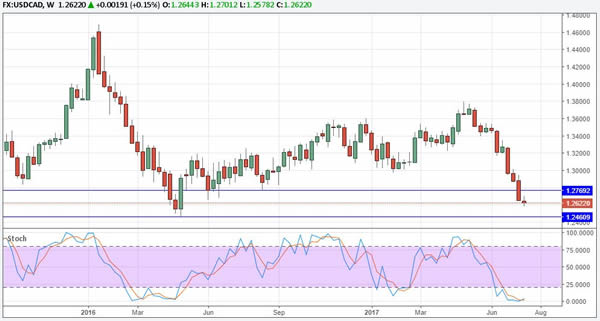
The loonie is looking heavily oversold on the Daily & Weekly chart, but the trend is strong and the bottom doesn't seem to be near.
The next major support level lies at 1.2460, and it is possible that USD/CAD will test that level before any larger recovery occurs. To the topside, resistance is noted at 1.2770 and 1.2820.
XAU/USD
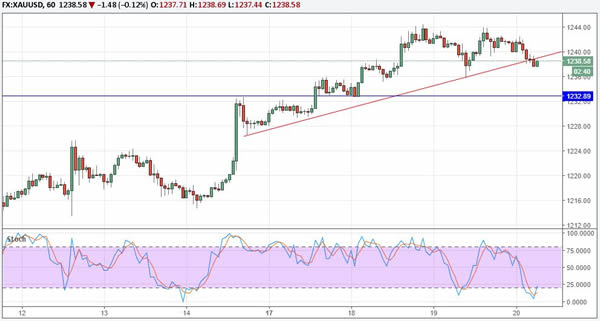
Gold broke below short-term trendline support and could test the $1230/1232 support area soon. Support needs to hold for Gold to sustain the positive momentum.
A break below would confirm the false breakout and signal another retracement towards $1220. Should Gold be able to bounce from there, a rally towards $1250 is likely to follow.
WTI
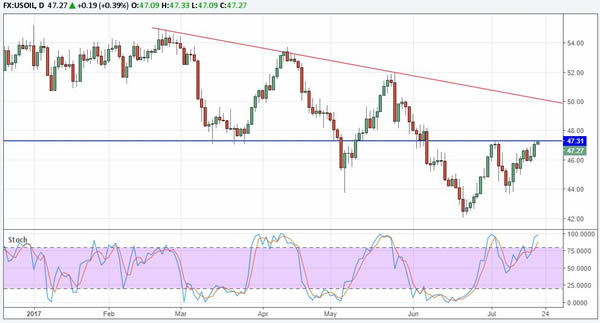
Oil is currently testing a major resistance level at $47.30. The commodity is overbought in the short-term, but a clear breakout would pave the way for a rally towards $50.
Keep an eye on the falling trendline from the March high, as strong resistance can be expected there.
European Open Briefing: The Australian Dollar Almost Reached 0.80 Overnight
Global Markets:
- Asian stock markets: Nikkei up 0.55 %, Shanghai Composite gained 0.20 %, Hang Seng rose 0.30 %, ASX 200 rallied 0.65 %
- Commodities: Gold at $1237 (-0.35 %), Silver at $16.20 (-0.50 %), WTI Oil at $47.25 (-0.10 %), Brent Oil at $49.65 (-0.10 %)
- Rates: US 10-year yield at 2.27, UK 10-year yield at 1.19, German 10-year yield at 0.55
News & Data:
- Bank of Japan Interest Rate -0.10 % vs -0.10 % expected
- Australia Employment Change 14k vs 15k expected
- Australia Unemployment Rate 5.6 % vs 5.6 % expected
- Australia Participation Rate 65.0 % vs 64.9 % expected
- Australia NAB Business Confidence 7.0 vs 7.0 previous
- Japan Trade Balance JPY440bln vs JPY485bln expected
- Japan Exports 9.7 % vs 9.5 % expected
- Japan Imports 15.5 % vs 14.6 % expected
- BOJ keeps policy steady, pushes back timing to hit price target – RTRS
- BOJ to cut inflation forecasts but stand pat on policy as economy picks up – RTRS
Markets Update:
The Australian Dollar almost reached 0.80 overnight, but fell back to 0.7930 following mixed employment data. The employment change arrived slightly below expectations. However, the outlook for AUD/USD remains positive and it is likely to test 0.80 soon.
The Bank of Japan left interest rates unchanged, as expected. Further, the central bank cut its inflation forecasts, which suggests that the QE programme will continue for a while. USD/JPY rallied from 111.80 to 112.20 post-BoJ, and the Yen is likely to remain under pressure in the near-term.
The Euro is slightly weaker ahead of the ECB meeting today. The central bank will keep rates unchanged, but the focus will be on the press conference 45 minutes later. The market is expecting that the ECB will signal a shift in monetary policy soon, but Draghi might disappoint EUR longs. Should the ECB lean more towards the dovish side, EUR/USD will come under pressure and likely test 1.14.
Upcoming Events:
- 07:00 BST – German PPI
- 07:00 BST – Swiss Trade Balance
- 07:30 BST – BoJ Press Conference
- 09:30 BST – UK Retail Sales
- 12:45 BST – ECB Rate Decision
- 13:30 BST – ECB Press Conference
- 13:30 BST – US Philadelphia Fed Manufacturing Index
- 13:30 BST – US Initial Jobless Claims
AUDCAD Poised To Falter Moving Forward
Key Points:
- Both the AUD and the CAD have been performing well recently.
- The AUDCAD seems to be on the cusp of taking a tumble.
- Losses could extend to 0.9929 and beyond.
Both the AUD and the CAD have been outperforming the greenback recently, surging to long-term highs in only a matter of weeks. Whilst a large portion of this momentum can be chalked up to the anaemic USD, much of the shift in bias has been on the AUD and CAD side of the quotes – a sign that the two currencies are substantially more bullish than it might at first appear. Therefore, it could be interesting to take a look at how the two currencies are faring relative to one another and what could be next for the AUDCAD.
As shown on the below daily chart, its fast becoming apparent that not only is the CAD winning the tug-of-war in the long-term but it is likely to strike another blow against the AUD in the immediate future. Indeed, even the AUD's potent rally over the past week or so seems to be having trouble breaking through a robust technical zone of resistance. What's more, if this level holds, the rather bearish technical outlook could slam the pair hard – potentially sparking a major rout.
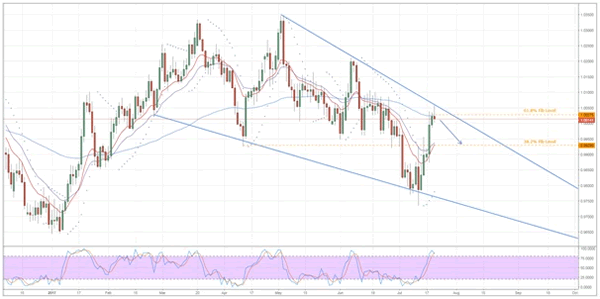
Taking a closer look this technical outlook, it becomes clear that pushing past resistance is going to prove rather difficult. Firstly, the AUDCAD's proximity to the upside of the falling wedge and the presence of the 61.8% Fibonacci level are providing a decent cap on upsides going forward. Moreover, this zone of resistance is reinforced by the placement of the 100 day EMA just above current price action. However, whilst these readings provide a fairly solid argument for a cap on upsides, they don't necessarily mean a substantial downtrend is on the way.
Nevertheless, numerous other signals are being given that the bears are likely to be on the offensive in days to come. For one thing, the overall EMA bias is highly bearish and likely to be putting pressure on the pair moving ahead. In addition, the surge higher over the past week or so has pushed the AUDCAD into overbought territory which could cause all but the most aggressive of bulls to ease up on the gas – leaving the pair exposed to a counter attack from the bears. Ultimately, we expect this to result in at least a slump back to 0.9929 in the near-term before the 38.2% Fibonacci level provides some support.
Overall, the outlook is looking rather grim for the AUDCAD and a retreat is definitely looking likely within the next week or so. Of course, a fundamental upset could help the pair to remain afloat but it's worth remembering that it has the room to meander sideways without seriously endangering the technical forecast.
Cable Prepares To Mount A Move Higher As The Oscillators Climb
Key Points:
- Price action continues to trend within a tightening wedge pattern.
- RSI Oscillator is diverging higher and away from price action.
- Watch for aupward breakout in the coming week as momentum builds.
The past few days have been relatively volatile for the Cable as the pair has been beset by the softer than expected UK inflation figures. This has caused a relatively rapid depreciation from the recent highs that saw price action collapse from its recent high of 1.3125 all the way back to the 1.30 handle. However, some interesting technical factors are now suggesting that the pair is likely to see an upward trajectory in the coming few days.
In particular, price action has entered a liquidity zone around the 1.30 handle and is presently taking a decidedly sideways direction which happens to also coincide with the 38.2% Fibonacci retracement level. In addition, it has also formed a relatively clear wedge pattern and the pressure is currently building towards a breakout. Given that price action is currently within the liquidity zone an upside move appears to be the most likely directional bias. In fact, the RSI Oscillator is already cautiously demonstrating some buoyancy and has been trending slowly higher over the past few days which curiously is divergent from price action's current direction.
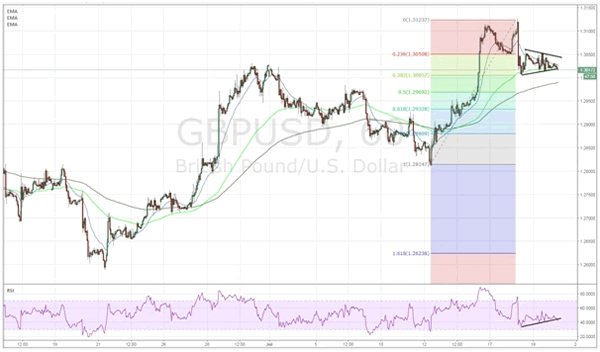
However, the fundamental factors that sent the pair reeling, namely a relatively softer than expected CPI result of 2.6% y/y, still exists and is still impacting sentiment. Indeed, the broader economic trend within the UK of late has been slightly flat and this is largely unsurprising given the rising risks around the lack of a Brexit deal. The full impact of a hard separation is still to be quantified but the short term impacts might finally become apparent as the political situation appears to have stabilised. Regardless, as the UK Retail Sales results loom, the market will be watching closely for a fundamental near term trend change.
Ultimately, the coming week is likely to see some significant gains for the pair as pressure builds and the wedge formation subsequently fails.In addition, the RSI Oscillator might already be signalling price action's forward direction given that the indicator is presently showing some divergence. At this point, the most likely scenario is a relatively rapid rally back towards the recent highs formed around the 1.3100 handle and then a probable period of moderation. However, as mentioned, monitor the UK Retail Sales results closely as they could cause volatility for the pair.
Australia’s Unemployment Rate Remained Steady In June
For the 24 hours to 23:00 GMT, the AUD rose 0.57% against the USD and closed at 0.7958.
LME Copper prices rose 0.3% or $15.5/MT to $5956.0/MT. Aluminium prices rose 1.1% or $20.0/MT to $1907.0/MT.
In the Asian session, at GMT0300, the pair is trading at 0.7940, with the AUD trading 0.23% lower against the USD from yesterday's close.
Earlier today, data indicated that Australia's seasonally adjusted unemployment rate remained steady at 5.6% in June, meeting market expectations. In the previous month, the unemployment rate was revised higher to 5.6%. Moreover, the nation's NAB business confidence index remained steady at a level of 7.0 in the second quarter of 2017.
The pair is expected to find support at 0.7905, and a fall through could take it to the next support level of 0.7870. The pair is expected to find its first resistance at 0.7982, and a rise through could take it to the next resistance level of 0.8024.
The currency pair is showing convergence with its 20 Hr moving average and trading above its 50 Hr moving average.
