Sample Category Title
Eco Data 6/22/17
[php_everywhere] [/php_everywhere]
Eco Data 6/21/17
[php_everywhere] [/php_everywhere]
Eco Data 6/20/17
[php_everywhere] [/php_everywhere]
Eco Data 6/19/17
[php_everywhere] [/php_everywhere]
Eco Data 6/23/17
[php_everywhere] [/php_everywhere]
Summary 6/19 – 6/23
Monday, Jun 19, 2017
[php_everywhere] [/php_everywhere]
Tuesday, Jun 20, 2017
[php_everywhere] [/php_everywhere]
Wednesday, Jun 21, 2017
[php_everywhere] [/php_everywhere]
Thursday, Jun 22, 2017
[php_everywhere] [/php_everywhere]
Friday, Jun 23, 2017
[php_everywhere] [/php_everywhere].
Weekly Economic and Financial Commentary
U.S. Review
Monetary Policy in a Less Data-Dependent World
- The FOMC raised its short-term target rate 25 basis points at its June meeting to 1.0–1.25 percent, and published an addendum to lay the foundation for normalizing the Fed's balance sheet despite a recent weakening trend in inflation.
- Headline and core consumer prices came in weaker than expected in May, further bringing into question an additional rate hike this year. The Fed views the recent inflation data as being driven by "one-off" components. Other economic data released during the week including industrial production, retail sales and housing starts also came in below consensus estimates.
Is the Fed Still Data Dependent?
The FOMC raised its short-term target rate 25 basis points at its June meeting to 1.0–1.25 percent, and published an addendum to lay the foundation for normalizing the Fed's balance sheet, with the caveat economic activity "evolves broadly as anticipated." It is that "anticipation" that is causing the latest divergence in views between the Fed and financial markets on current and future economic conditions and whether the outlook substantiates an additional rate hike this year, and the start of the balance sheet reduction program, especially given the recent weakening trend in inflation.
Indeed, the May Consumer Price Index (CPI) was released on the morning of the FOMC meeting with headline and core prices coming in weaker than expected. On the back of weak energy prices, headline CPI slipped 0.1 percent from the month before, pulling the year-over-year reading down to 1.9 percent. Core CPI, which excludes food and energy, rose just 0.1 percent monthover- month, with the three-month annualized rate coming in flat during the month further underscoring the softening trend.
During the opening statement of the press conference, Fed Chair Yellen described recent sluggish inflation prints as "one-off reductions," pointing to lower readings in wireless telephone services and prescription drugs. The recent rate hike in light of these soft readings has brought into question the committee's stance on data dependence, where the Fed has historically relied on labor market conditions and rising inflation, as a yardstick to raise rates further. The implied probability of a third rate hike this year fell markedly. That said, we continue to expect one more rate hike this year, but the additional increase will be highly dependent on the recent trend in inflation reversing course and moving closer to the Fed's 2 percent target.
In other news this week, we received a heavy dose of economic data releases, including industrial production, retail sales and housing starts. The headline print for industrial production was unchanged in May but manufacturing output fell during the month. The pulse on the consumer also showed anemic monthly growth with the headline slipping 0.3 percent in May. A silver lining in the report was the so-called control group, which feeds directly into the calculation of real GDP, being revised up sharply, highlighting the overall positive trend in spending.
Also coming in below expectations, housing starts fell 5.5 percent in May to a 1.09 million-unit pace with single-family and multifamily tumbling during the month. We continue to believe milder-than-usual weather in the beginning of the year brought construction activity forward; however, multifamily starts registered its fifth straight monthly decline underscoring the shift to single-family construction. This trend is also evident in apartment operating fundamentals where the occupancy rate peaked in mid-2014 and asking rent growth is moderating. Permits, which are less sensitive to weather fluctuations, also came in below expectations, falling 4.9 percent. All of these economic indicators warrant watching in the coming months, especially as further tightening in monetary policy is expected.


U.S. Outlook
Existing Home Sales • Wednesday
Resales declined 2.3 percent in April to a 5.57 million unit annualized rate—down from March's cycle-high pace of 5.7 million units. Tight inventory is increasingly apparent, as the median home sold in April was on the market for less than a month, the shortest reported since the series began in 2011. Price pressures have been relatively tame, though the distribution of homes sold remains skewed toward higher-priced homes.
Lean inventories should continue to place an upper limit on existing home sales in May. Pending home sales, which tend to lead existing home sales by six to eight weeks, declined 1.3 percent in April, suggesting resales may also soften in May. Demand is strong, however, as continued job and income gains put homeownership in reach of more households.
Previous: 5.57M Wells Fargo: 5.55M Consensus: 5.51M

Leading Indicators • Thursday
The Leading Economic Index (LEI) has pointed to economic growth continuously in recent months, with April marking its eighth consecutive monthly gain. The measure is now at its highest point of the series, buoyed by continued gains in the stock market and persistently low unemployment claims. The interest rate spread has also been a continued source of strength, most recently accounting for half of April's monthly growth of 0.32 percent. ISM new orders have also lifted the leading index in 2017, a trend that should continue in May as the measure has kept much of its recent strength. Unemployment claims remain near their lowest levels in more than 40 years, and average weekly claims fell even further in May, suggesting this component will likely boost the index in May as well. The stock market is also likely to provide a boost to the index in May after having a neutral impact in April when the stock market was essentially flat.
Previous: 0.3% Wells Fargo: 0.4% Consensus: 0.4% (Month-over-Month)

New Home Sales • Friday
New home sales fell 11.4 percent in April to a 569,000-unit pace, but the decline was tempered slightly by upward revisions to the previous three months of data. Mild winter weather likely pulled some new home sales forward in the year, resulting in a smaller than usual April gain. On a year-to-date basis, new home sales were up 11.3 percent from the first four months of last year. All four regions of the nation posted stronger sales of new homes through April 2017 than the previous year, particularly in the Northeast and Midwest, which were most affected by the mild winter.
We are optimistic about new home sales going forward in 2017. Our view is based on strong demand fundamentals coupled with lean inventory of available homes. The NAHB homebuilder optimism survey rose in May, which supports our call for a rebound in May. Builder optimism faded slightly in June but remains elevated near cycle-highs.
Previous: 567K Wells Fargo: 615K Consensus: 599K

Global Review
Summer of Discontent
- It has been a tough stretch for the United Kingdom and its economy. After last week's unsettling election, the flow of economic data this week did little to calm already unsettled nerves. May retail sales figures showed an even bigger retrenchment than expected and CPI inflation climbed to its fastest rate in four years. The high inflation is adding to the growing dissent reflected at this week's meeting of the Bank of England which voted 5-3 to hold rates steady.
- In other global economic news, the great moderation in China continues and Australia's economy has a hot job market.
Chinese Moderation Continues
China's industrial production (IP) held steady at 6.5 percent on a year-over-year basis in May. The outturn was a tenth of a percentage point better than expected with double-digit gains in categories like general purpose equipment, telecommunications & computer as well as electrical equipment and machinery contributing to the increase.
We also learned that retail sales in China also held steady at 10.7 percent in May and fixed asset investment slowed to 8.6 percent in May from 8.9 percent in the prior month. Muted domestic demand is keeping a lid on the pace of sales growth. Fixed investment growth remains a shadow of its former self. Taken together, the data out of China this week suggest ongoing moderation in the pace of growth in China.
Collectively these figures also offer perspective on the approach of China's central bank, the Peoples Bank of China, which made no change to monetary policy and its liquidity operations, in contrast to March when it increased borrowing costs. The determination to remain on hold was notable as it occurred in the same week that the Federal Reserve delivered a rate hike and adopted what most market-watchers considered to be a more hawkish bias at its meeting this week.
Growing Dissent at the Bank of England
It was a busy week for central bank meetings. The Bank of England (BoE) held rates steady again at its June meeting held earlier this week. What was notable was that rather than only one member of the Monetary Policy Committee voting to raise rates, the dissent climbed to three. So, it was a 5-3 decision to leave its main policy rate steady at 0.25 percent, despite rising inflation in the United Kingdom.
It is a time of pronounced uncertainty in the United Kingdom where market-watchers are still coming to grips with last week's snap election in which Prime Minister May lost the Conservative parliamentary majority that she had hoped to extend. It is unclear what the implications of the outcome mean for the Brexit negotiations, which is evident in the volatility of British pound sterling. Making matters worse and adding to the confusion, a deadly fire in London this week postponed a speech from BoE Governor Carney, which was supposed to elucidate markets on monetary policy.
May figures for core retail sales in the United Kingdom were also released this week, showing a larger-than-expected decline of 1.6 percent on the month and now up just 0.9 percent over the past year. Meanwhile, in a separate report, yearly CPI inflation rose to 2.9 percent, the fastest rate in five years.
Australian Labor Market
The Australian economy added a net 42,000 new jobs in May as the unemployment rate fell to its lowest level since 2013. The second largest monthly increase in full-time jobs in Australia was tempered slightly by a 10,100 reduction in part-time payrolls. The participation rate climbed to 64.9 percent.


Global Outlook
Taiwan Export Orders • Tuesday
On Tuesday of next week, Taiwan is slated to release data on export orders for May. The consensus forecast is calling for 7.6 percent growth, year over year. If global growth continues to show signs of improvement, then Taiwanese export orders should follow suit–a crucial ingredient to a healthy Taiwanese economy, which is heavily dependent on trade. We look for global GDP growth to strengthen a bit this year. Taiwanese export volumes have been trending upward, and were up 8.5 percent in April on a year-0ver-year basis.
Taiwan has extensive trade ties with mainland China. Final spending on the mainland accounts for about 10 percent of value added in Taiwan. Although we forecast that GDP growth in China will slow a bit in 2017 relative to the 6.7 percent rate that was registered last year, an implosion of the Chinese economy does not look very likely, at least not in the foreseeable future.
Previous: 7.4% Consensus: 7.6% (Year-over-Year)

Argentina GDP • Wednesday
The Argentine economy contracted 2.1 percent year over year in Q4-2016, after a 3.7 percent decline in Q3-2016. The lack of growth can be linked to weaker government and consumer spending and business investment. The recovery in exports and imports, up 7.7 percent and 2.1 percent year over year, respectively, was not enough to offset overall Q1 weakness. Moreover, industrial output fell 2.3 percent year over year in April—marking 15 straight months of annual declines. Furthermore, Argentina's unemployment rate jumped to 9.2 percent in Q1 from a 7.6 percent rate in Q4, reviving concerns in the labor market.
The Macri administration, in our view, needs to generate economic growth quickly or face an increasingly difficult political environment as mid-term elections near. For now, the economy is not showing much progress, although officials continue to argue that the recovery is close.
Previous: -2.1% (Year-over-Year)

Canada Retail Sales • Thursday
Next Thursday, Canada is set to release retail sales data for April. Year over year, retail sales have been trending upwards, thanks to Canadian households continuing to spend. Households were one of the largest contributors to growth in Q1-2017 with increases in consumer spending and vehicle purchases. Consumer spending has been so strong that Canadians' personal savings rate has taken a hit, falling to 4.3 percent in Q1. Additionally, the household debt service ratio has started to increase, rising to 14.2 percent over the quarter—a course not sustainable in the long term.
Canada is also slated to release inflationary figures for May next week. The CPI was up 1.6 percent in April, year over year, but is unable to stay above 2 percent for any meaningful amount of time. Sliding oil prices may put further downward prices on Canadian prices.
Previous: 0.7% (Month-over-Month)

Point of View
Interest Rate Watch
Movable Model
Since 2012, the long-run unemployment rate projection from the FOMC has continually moved down, as illustrated in the top graph.
One model-based approach to monetary policy would be to set the federal funds rate as a function of the deviation of the current pace of inflation and the level of the unemployment rate from their respective a priori longer-run equilibrium levels. For example, for the unemployment rate, if that rate is above the long-run target then policymakers should lower the funds rate.
The problem illustrated in the top graph is that the benchmark for policy, the long-run unemployment rate, keeps moving and so then does our model for policy action.
Growth, Inflation Drives Policy Rate
Since 2012, the long-run GDP projections by the FOMC have consistently been lowered. In addition, the measured pace of inflation has been less than the target 2 percent pace set by the FOMC. As a result, the median dot projection of the fed funds policy rate for end of year 2018 has also been lowered on a consistent basis until very recently. This series of auto correlated errors has meant a policy drift in that whatever the model the FOMC is using to set policy, as well we suspect the private market, the net result has been a consistent overestimation of the equilibrium policy interest rate. Moreover, the consensus also overestimated the benchmark 10-year rate for 2016 and the prior two years.
The Result: Accommodative Policy Persists
As illustrated in bottom graph, accommodative policy, as measured by the real interest rate on the two-year Treasury and the funds rate, remains very much in place. For the real economy, this is a plus, but for savers, this form of financial repression has meant negative real returns. Finally, the lack of real punch in fields such as housing starts and business investment that one would expect to be interest rate sensitive leads us to be cautious on how much restraint the FOMC can impose going forward.


Credit Market Insights
Refis Drive Mortgage Applications
The Mortgage Bankers Association's (MBA) Weekly Mortgage Applications Survey showed that for the week-ended June 9, applications volume was down 11.6 percent year-over-year. At 4.13 percent (including points and fees), mortgage rates are currently at the lowest rate since November. However, increased demand from mortgage applications for refinancing has driven the total market index level up. Refinancing mortgages accounted for 45.4 percent of total loan volume on the week, up from 42.1 percent the week prior. This figure is down both over the year and year-to-date. It remains to be seen if the recent pick up in mortgages for refinancing relative to mortgages for purchase is simply a byproduct of homeowners locking in the preferable low mortgage rates and not indicative of a reversal of the extremely low rate of refinancing, or if the longer run decline in volume of mortgages for refinancing could be coming to an end. The year-to-date drop in refinancing mortgages could signal that an increase in both existing and pending home sales may be on the horizon, each of which have been held back due to low inventories.
The average mortgage loan for purchase size has been steadily increasing in conjunction with home prices, with the average mortgage size up 3.6 percent on a year-over-year basis. In the current housing market, with tight supply and perceptibly elevated prices, it is worth keeping an eye on mortgage volume and size as a leading indicator of home sales.
Topic of the Week
Debt Ceiling Concerns Mount
In the coming weeks, we expect the discussion over how and when to lift the debt ceiling to come to the forefront. With tax collections coming in below expectations and, by our estimate, the federal budget deficit exceeding last year's level, all signs point to the need for Congress to lift the debt ceiling by the first or second week in September. This estimate, however, is subject to change depending on tax and spending data in the coming months. While it is true that the deadline is some way off, the complication stems from the fact that Congress is not in session the entire month of August and does not return until September 5. Thus, we expect that Congress will act before the August recess to alleviate the need to rapidly address the issue upon their return.
It is important to note that, if Congress fails to lift the debt limit before they leave for recess, it does not automatically spell disaster. We suspect there will at least be a few days upon their return to lift the borrowing limit. This roll-of-the-dice approach would carry a high-level of risk, however, which we expect Congress will strive to avoid. In our view, Congress will pass a "clean" debt ceiling suspension given that bipartisan support will be needed in the Senate and most likely in the House of Representatives.
Beyond the debt ceiling debate, the Senate continues its work on a framework to repeal and replace the Affordable Care Act, which is eating into the legislative timeline for a number of other tasks that need to be completed. Congress still needs to pass a fiscal year 2018 budget resolution, but this can only be accomplished after they have finished work on the Affordable Care Act replacement, which is tied to the FY 2017 budget resolution. There are multiple other issues that need to be addressed before September 30, including a bill to fund the government beyond the end of September, which is a separate but related process from the FY 2018 budget resolution. The point is that once Congress returns from August recess, the timeline will be tight and policy uncertainty should remain in place.


The Weekly Bottom Line
HIGHLIGHTS OF THE WEEK
United States
- Markets were mixed on the week, seemingly undecided on how to score continued headlines from Washington, disappointing U.S. economic data, and the Fed's confident tone accompanying its rate hike.
- The Fed anticipates that the recent softness in inflation to prove temporary. Its outlook for future rate hikes remained unchanged. We expect the process of reducing its balance sheet will begin in the fall, with a modest pace of rate hikes continuing thereafter.
- Other economic data this week was a tad on the soft side. But our outlook for the U.S. economy to post solid growth of 2.2% this year, and 2.1% next year has not changed, as a fundamentally strong consumer and better global growth help support the U.S. economy.
Canada
- Despite falling oil prices and soft equity markets, the loonie saw robust gains this week as investors digested a marked change in tone from the Bank of Canada.
- Bank of Canada communications this week suggested that the era of emergency level interest rates may end earlier than expected. It now appears likely that the first policy interest rate increase in more than six years will take place in October.
- Robust growth in recent quarters and a constructive outlook suggest that inflation is at or near a bottom, justifying the removal of some monetary accommodation. Only a gradual pace of policy rate increases is expected thereafter, reflecting the challenges still facing the Canadian economy.

UNITED STATES - FED CASTS VOTE OF CONFIDENCE ON US ECONOMY
Markets weakened on the week, focusing on some disappointing U.S. economic data instead of the Fed's confident tone accompanying its rate hike. The 25 basis-point increase in the fed funds rate was widely expected. More important was the vote of confidence cast by the Fed in its economic and inflation outlook. It left the number of rate hikes penciled in unchanged despite the loss of inflation momentum in recent months. The Fed also revealed more detailed plans for scaling back its holdings of Treasuries and MBS securities, describing the process for paring back the monthly amount of principal repayments it reinvests. We expect an announcement this September signaling this process to start in October. After that, the Fed is likely to next raise rates in December, and continue its gradual pace through 2018, provided the economy progresses as outlined in our latest forecast.
This was not a unanimous decision. President of the Minneapolis Fed, Neel Kashkari, dissented. He has written in the past that he is concerned about the Fed consistently missing on its inflation mandate, and would prefer to see more evidence that inflation pressures are building before hiking rates. He is not alone in this view. Many analysts suggest the Fed should wait to see greater evidence of inflation before acting to slow the economy. Financial markets aren't totally convinced either (Chart 1). Given that inflation has fallen short of the Fed's 2% target for the past five years, the skepticism is understandable.
Like many things in the post-financial crisis recovery, inflation pressures are proving slow to materialize. This phenomenon is not confined to the United States either. As discussed in our new Quarterly Economic Forecast, inflation readings across the G7 and key emerging markets have come in below expectations. Some of this reflects a pull-back in oil prices, but underlying core inflation measures have also undershot forecasts.
May's CPI report provided further sustenance for the doves. Core inflation posted its lowest reading in two years, at 1.7% y/y. There was an encouraging firming in core services price pressures, ending the cooling in the prior two month but core goods prices remained in deflationary territory.
There is evidence that goods price pressures are building further up the supply chain. Producer and import prices are both pointing to higher prices for consumer goods in the coming months, as the effect of past U.S. dollar appreciation starts to wane. Moreover, domestic wage pressures have picked up over the past two years as the labor market has tightened (Chart 2). With job growth continuing to put downward pressure on unemployment, this is likely to continue. Eventually rising wages will squeeze profit margins and put upward pressure on inflation.
At this stage in the cycle we expect consumer spending growth to be increasingly driven by income gains. As such, real consumer spending growth should run at a solid 2-2.5% pace over the next two years. Although the May retail data was a bit soft, this was in part due to weak inflation. It does not derail the Q2 real consumer spending rebound. Nor does it change our expectation that, barring an unforeseen shock, the U.S. expansion is set to continue.


CANADA - BRIGHTER OUTLOOKS SETS STAGE FOR MONETARY TIGHTENING
It was a somewhat volatile week for Canadian markets, with declining oil prices helping lead the S&P/TSX index lower. Still, the loonie shook off the oil softness, and stood out as the star of the show. It climbed nearly half a cent vs the greenback Monday afternoon, and strengthened as the week went on, up nearly one cent by mid-morning Friday.
The key driver for the loonie's strength was a marked shift in the tone of the Bank of Canada communications that served to bring forward market expectations of a policy rate increase, pushing longer-term interest rates modestly higher. The key trigger was a speech by Senior Deputy Governor Carolyn Wilkins (See our commentary). She suggested that the adjustment of the Canadian economy to lower oil prices was in the rear-view, and that despite persisting uncertainty "decisions must be taken" - marking a change in thinking.
Wilkins' speech nevertheless appeared to leave a bit of ambiguity around just how quickly the Bank of Canada may begin to remove stimulus. This was quickly erased the next day when Governor Stephen Poloz appeared on CBC Radio, stating that "...people need to be thinking about what their finances would look like were interest rates to be a little higher when they renew their mortgage." The rapid change in communication tone, coupled with the unusual clarity in Poloz's comments, points to a Bank that is getting ready to increase interest rates in the near future.
Is an increase in borrowing costs warranted? And if so, when and how quickly? The answer to the first question is a qualified "yes". The Canadian economy has been on a tear recently, posting 3.5% growth on average over the last three quarters. As outlined in the June edition of our Quarterly Economic Forecast, we expect growth to moderate slightly, but remain well above-trend through the remainder of this year. Clearly this is no longer an economy that requires emergency-level interest rates.
The qualification to the "yes" is related to inflation - not an unimportant detail given it is the sole monetary policy objective of the Bank. Despite robust growth, inflation remains stubbornly low, with the Bank of Canada's measures of core or "underlying" inflation ticking lower recently. Still, this is likely to be more of a backward-looking measure as history suggests that these tend to lag output (Chart 1). From this standpoint, inflation appears close to turning the corner. Given that monetary policy is set not for the economy of 'today', but rather that of 'tomorrow', it is only logical the Bank of Canada will want to get ahead of any inflationary pressures to ensure that inflation remains as near the 2% target as possible. The first step towards this goal will be to bring their policy interest rate off its recent lows, likely at the October monetary policy announcement.
Even if Poloz and company are taking a more aggressive near-term approach, it remains likely that caution will rule the day for subsequent policy increases. Business investment has only begun to come back in any meaningful sense, while the adjustment process in the key Ontario/Toronto housing markets has only just begun. As a result, we expect any future hikes to be only gradual, with the policy rate reaching just 1.25% by the end of next year (Chart 2).


Week Ahead Dollar Struggles Despite Fed Rate Hike Boost
Political risk to drag US dollar lower
The US dollar will end the week down against most major pairs even after the U.S. Federal Reserve hiked rates by 25 basis points and the plan to keep tightening via more rate hikes and a reduction of the central bank's balance sheet was part of the communication on Wednesday. Economic data released this week has the market questioning how serious the Fed is about its economic forecasts as inflation, retail sales and building permits all came in lower than expected this week. The Trump administration continues to be caught in the turmoil of the Russian connection investigation and it now appears the President will be under investigation doing the dollar no favors.
Central banks dominated headlines this week even if they did not feature a policy statement. The Bank of Canada (BoC) surprised markets when during a routing speech the Deputy Governor Carolyn Wilkins said that the central bank would be assessing its monetary policy if the current pace of growth continues. A second endorsement for reducing stimulus came a day later from Governor Stephen Poloz when he said the rate cuts from two years ago had done their job. The Fed was the only central bank to modify its monetary policy but the Bank of England (BoE) delivered a hawkish vote count in their 5–3 decision to keep rates unchanged. The three votes for a rate hike came despite the uncertain waters the economy must transverse during the upcoming Brexit negotiations.
The Bank of Japan (BOJ) kept interest rates no hold and after the European Central Bank (ECB) and BoE have changed their tune about ultra easing monetary policy Japan could be the last major economy without a tighter monetary policy. The week will bring few scheduled economic events, the highlight being the Reserve Bank of New Zealand (RBNZ) rate statement on Wednesday, June 21 at 4:00 pm EDT. The optimism resulting form the BoC comments will be put to the test on Thursday, June 22 with the release of Canadian retail sales and again on Friday, June 23 at 8:30 am EDT when Canadian inflation data is published.

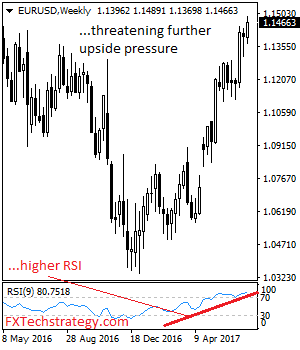
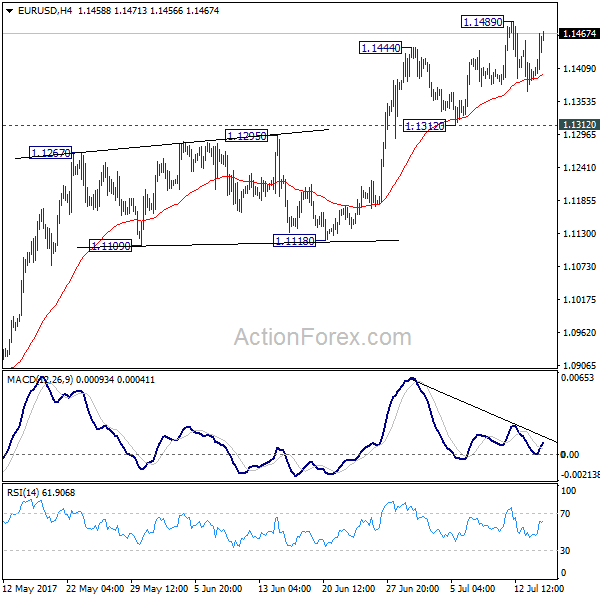
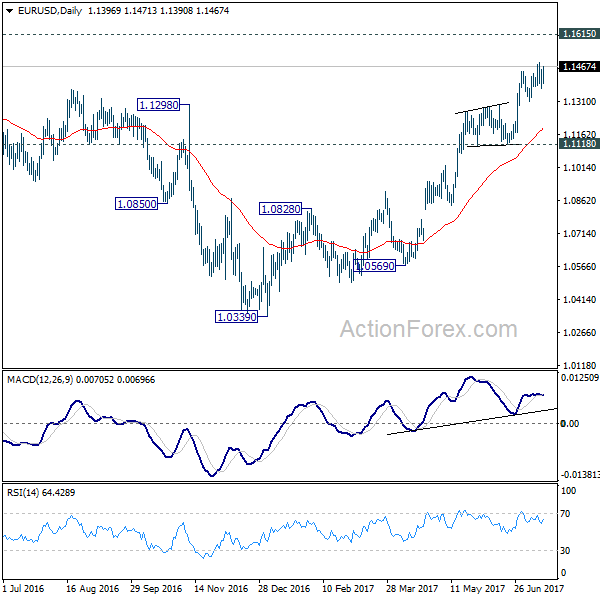
The EUR/USD gained 0.047 percent this week. The single pair is trading at 1.1188 after softer economic data out of the US offset the actions of the Fed. The monetary policy divergence that had the USD on the path to appreciate further has been hindered by political drama despite the Fed sticking to the script by hiking two times this year with the possibility of another rate raise before the end of the year and outlining their plans to reduce their massive balance sheet.
The EUR/USD will end nearly flat and all the Fed could do was bring the pair to just below the 1.12 price level. The high of the week was 1.1296 just before the Fed release its June statement.
The economic calendar for the week of June 19 to 23 will provide little guidance for investors with news of US President Donald Trump under possible investigation for obstruction of justice to provide further volatility. The probability of impeachment is low and if anything all investigations could drag on for years. The market is now starting to price in the reality of the end of the Trump trade with no solid timelines on what kickstarted the strength of the dollar after the US presidential elections. Infrastructure spending and tax reform are now tougher sells as the President does not have the full support of his party, even if they hold the majority.

The USD/CAD lost 1.411 percent in the last five days. The currency pair is trading at 1.3241 after comments from the Bank of Canada (BoC) Deputy governor put a rate hike firmly on the table. Governor Stephen Poloz followed up on the comments the next day and confirmed the optimism on the growth of the economy and the possible reduction of stimulus going forward. The loonie rallied until the U.S. Federal Reserve delivered its own optimistic view on the American economy while hiking rates for the second time this year. The hike was not enough to offset the negative indicators delivered this week that contradict the picture painted by the Fed's forecasts.
The CAD advanced despite little support from oil prices who suffered from another surprise buildup, this time in gasoline stocks. The battle to stabilize crude prices between the Organization of the Petroleum Exporting Countries (OPEC) and US producers continues to show the glut of energy products remain.
The biggest risk for the Canadian dollar remains a political one. The renegotiation of the NAFTA is scheduled for late August and a negative outcome could reshape the Canadian economy for the worse. The turmoil in the Trump Administration has taken some of the pressure off, but the consultation process needed before renegotiation was initiated as anticipated and the soft lumber tariffs to Canadian producers sent a strong message ahead of sitting down at the negotiation table.
Market events to watch this week:
Monday, June 19
- 9:30pm AUD Monetary Policy Meeting Minutes
Tuesday, June 20
- 2:30 am CHF SNB Chairman Jordan Speaks
- 4:45 am CHF SNB Chairman Jordan Speaks
Wednesday, June 21
- 10:30 am USD Crude Oil Inventories
- 4:00 pm NZD RBNZ Rate Statement
- 5:00 pm NZD Official Cash Rate
Thursday, June 22
- 8:30 am CAD Core Retail Sales m/m
- 8:30 am USD Unemployment Claims
Friday, June 23
- 8:30 am CAD CPI m/m
*All times EDT
As Other Banks Take Punchbowl, BoJ Says: The Night Is Young
In recent weeks, the message from the major central banks has been - get ready for a return to more normal policy. The Bank of Japan is prioritizing its inflation target even at the risk of being too accommodative.
Bucking the Trend
This week has been broadly consequential in terms of major central bank meetings. The Fed raised rates for the second time this year and offered some specifics on how it would begin winding down its balance sheet. The Bank of England (BoE) held rates steady but only by a 5-3 vote. The fastest pace of inflation since 2013 in the United Kingdom has some policymakers thinking the time is right for the BoE to join the Fed in raising rates. Finally, the European Central Bank (ECB) in its meeting last week dropped a reference to a future rate cut, and markets are expecting a communication later this year about a tapering of the ECB's asset purchase program.
That was the backdrop leading into this week's meeting of the Bank of Japan (BoJ). While other major central banks are moving to normalize policy, the BoJ is steadfast in its commitment to achieving what has been a fleeting objective for a generation: sustained CPI inflation of 2.0 percent.
For the sixth consecutive meeting, policymakers in Tokyo made no change to the broad set of stimulative monetary policies that it has labeled "Quantitative and Qualitative Monetary Easing (QQE) with Yield Curve Control."
In specific terms that means it will maintain: (1) a negative policy rate of -0.10 percent, (2) a pace of Japanese Government Bond (JGB) purchases sufficient to keep the yield on the 10-year JGB "around zero percent" at an annual pace of roughly ¥80 trillion yen, (3) purchases of exchange-traded mutual funds at an annual pace of ¥6 trillion, (4) purchases of real estate investment trusts at an annual pace of ¥90 billion and (5) commercial paper and corporate bond holdings at their present values of ¥2.2 trillion and ¥3.2 trillion, respectively.
In a press conference following the meeting, Governor Kuroda articulated the Bank's position on the growing pressure to join in the normalization trend among other central banks. "Achieving and maintaining stable prices and avoiding a return to deflation are far more important than the problems of the prolonged period of easing."
Effectiveness and Growth Outlook
Kuroda is now in the last year of his five-year term. The avant-garde approach to monetary policy during his governorship has had mixed results. The BoJ has been successful in arresting what had been a four-year pattern of deflation when he took over. However, achieving the price stability target of 2.0 percent has been an elusive goal.
Arguably, the accommodative policy is helping with growth. If Japanese GDP growth is positive in the current quarter, as we expect it will be, it will extend the streak of consecutive quarters of GDP growth to five - a feat not matched at any point in the current expansion.