

Sample Category Title
06 – Types of Forex Charts: Line Chart v Bar Chart v Candle Chart
Forex traders use charts to determine market direction and identify possible buying and selling opportunities. There are three types of charts commonly used in forex that you can flick between on MT4:
- Line chart;
- Bar chart;
- Candlestick chart.
Line Chart:
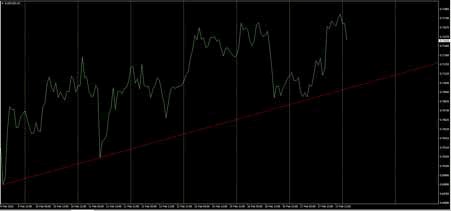
These charts are handy for quickly determining the trend - only the current/close price is graphed - as such these charts should not be used for placing stop loss or take profit orders.
Bar Chart:
The chart is created with the use of bars where each bar has a high (top) and a low (bottom) with a line on either side; right side being the opening price and the left side being the closing price for the selected time period
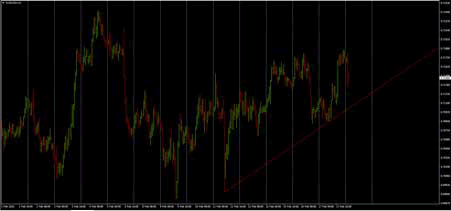
Different colours can be used to identify bars that close higher than the open (bull or up bars) or lower than the open (bear or down bars). The example above has green lines for up bars and red bars for down bars. These charts show all the information you need but most traders and analysts tend to favour the third option - Candlestick charts.
Candlestick Chart:
This chart is created much like bar charts, with the only difference being that candlesticks add dimension and colour to the Bar Chart by depicting the area of the bar between the open and close as a two dimensional real body.
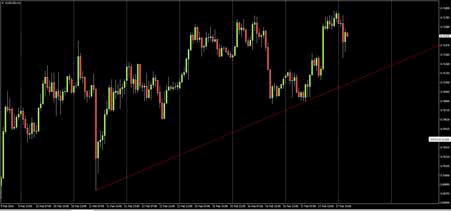
Candlesticks are comprised of a body which represents the difference between the open and close prices. An up candlestick occurs when the close is higher than the open - and down candlesticks occurs when the close is lower than the high. In the chart example above, up candlesticks are green whilst down candlesticks are red. If the open is equal to the close there will not be a body, just a line - this type of candle is referred to as a "Doji".
The thinner lines extending beyond the body are called 'Wicks' - above the body is the high and below the body is the low for the selected time period. A large wick (relative to the body), indicates a potential turning point (support/resistance).
05 – Technical Analysis Overview
Technical Analysis is the use of charts, such as those found on the Vantage FX MetaTrader 4 (MT4) platform, to study historical price movement to determine the possible future direction of price. The idea behind technical analysis is that everything you need to know, has been reflected in price. That means that if everything you need to know is in price, then price action is the only thing you need to know or understand to trade.
Studying price off charts is very subjective but for the most part, trading off technical analysis is a self-fulfilling prophecy if you will. Humans look for patterns and past signals to try to predict the future. And because everyone starts to look at the same patterns and behaviour, price reacts!
Vantage FX allows traders to trade directly off the charts using the most popular online forex trading terminal in the world, MT4. Traders using the Vantage FX MT4 platform are gaining an edge on global forex markets with substantial improvements in execution speed and a transparent price feed across all asset classes.
04 – Trading Event Risk: Trading Headlines
After going through the highly organised data releases and central bank decisions, there is one last piece of fundamental analysis that you need to be aware of. Event risk is anything that will move markets, but that you can't see coming.
News Headlines:
- There are just so many different types of headlines that come from a whole range of different places. Some credible and some not. Funnily enough, it is often the least credible headlines that get the most attention from markets!
- Keep an eye on the News Terminal for streamed news headlines that have the potential to move forex markets. These could be central banker or politician comments, unexpected good or bad economic news or even something as wacky as a new life changing invention! If it's something confronting flashing up on trader's screens, so often they hit the buy/sell button first and ask questions later.
Natural disasters:
- Natural disasters are one headline that nobody wants to read, but unfortunately for all of us, they are a fact of life. I'm sure you all remember the devastating Japanese earthquakes that rocked the island and triggered multiple tsunamis? This saw USD/JPY instantly shoot up as traders exited their Japanese Yen exposure and sought the safety of US Dollars.
- Natural disasters aren't something that the people can plan for, but they are reported instantly on social media wherever they happen in the world. You have no excuses if you let yourself get caught out by a natural disaster headline.
Terrorist attacks:
- Terrorist attacks, declarations of war and political tensions all have an effect on forex markets. In our recent memory we of course have the devastating attacks in the French capital of Paris. This saw money leave the Euro, as fears over what sort of an impact this would happen on consumer confidence and spending in the Eurozone, as well as a flight to US Dollars in the risk-off market.
- It is almost a sad reflection on where human society is at right now, that a terrorist attack actually might not move markets at all due to the frequency that they occur and are now reported. If North Korea reporting the successful test of a hydrogen bomb can't move markets, then really what will?
The question of whether being able to profit from events that often see such widespread loss of property and even life comes up here and isn't something that we can ever answer. We do however say that these events are a fact of life in the world we live in today and first and foremost, you must manage your risk around them at the very least.
03 – Trading Central Bank Decisions: Hawkish v Dovish Monetary Policy
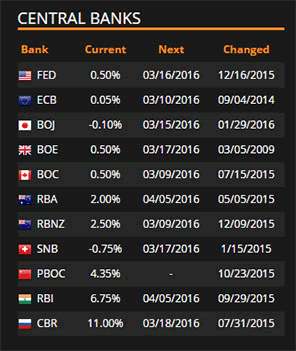
To achieve certain economic mandates or goals, a country's most potent weapon is monetary policy. Monetary policy is determined by a country's central bank acting independent from government (unless you're China of course!).
Monetary Policy is the process of setting the interest rate and controlling the supply of money.
There are three main goals that monetary policy helps a central bank achieve. Those being:
- Economic growth targets.
- Inflation in the target band.
- Low unemployment.
Now we have gone through what monetary policy is, let's go one step further. Have you ever heard monetary policy referred to as being Hawkish or Dovish? No, economists aren't watching birds or performing magic tricks, they're actually describing the types of monetary policy that central banks have at their disposal.
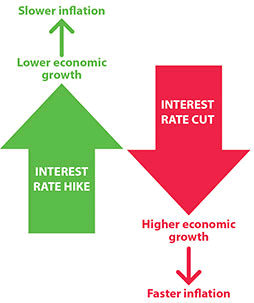
Hawkish monetary policy is indicative of rising interest rates. It is sometimes referred to as tightening because essentially the central bank is looking to tighten the economy and slow it down in the wake of higher inflation.
Under a hawkish scenario where interest rates are rising, the borrowing of money by both business and consumers becomes more expensive (due to higher interest repayments) so spending and investment decreases as a result.
Dovish monetary policy is the opposite, and indicative of falling interest rates. A central bank may decide to loosen monetary policy by cutting interest rates with the goal of stimulating a stagnating economy in mind.
Under a dovish scenario where interest rates are falling, money is being made cheaper and more accessible to business and consumers which encourages them to invest or spend. This spending then stimulates a stagnant economy.
By using the different types of monetary policy, a central bank can somewhat control, and in the end smooth the wild swings between the good and bad times experienced by an economy. Both economies and markets want stability and there is no point in experiencing huge booms if they are followed by equally as devastating busts in a regular business cycle.
02 – Trading Economic Data Releases: News Trading
The biggest and most obvious part of fundamental analysis is trading economic data releases, or more simply as traders call it: News trading.
So that everyone in the market has a level playing field when it comes to market sensitive news, each economic data release has a set time and date that it must be released. This means that at this particular time EVERYONE is watching and trading that particular forex market. All this attention leads to volatile market conditions as everyone tries to outwit each other in the race to best position themselves.
There are literally hundreds of economic data releases every single day. Think about it. Every single country in the world releasing data such as unemployment, retail sales, GDP, trade balance. The list goes on forever. But just because a piece of economic data is released, doesn't mean that it is relevant to you and your trade!
The Vantage FX economic calendar allows you to filter news releases by both country and expected market impact, making sure you're only focusing on the news that is most relevant to you and your particular forex trade.
If you are trading EUR/USD, then the GDP of South Africa contracting shouldn't really have too much of an effect on either the Euro or the US Dollar, should it? Of course not.
But on the other hand, a big and unexpected drop in the tier 1 US unemployment rate could have catastrophic effects on not only USD forex pairs, but across the entire forex market. This is because the US economy is still the biggest and weakness at the top of today's interconnected world so easily sends shockwaves through the entire world. Do you remember the GFC?
Did you know:
"The US Non-Farm Payroll report is one of the most significant pieces of economic news on the forex calendar. NFP, as traders refer to the release, is the monthly change in the number of employed people in the US economy with farming excluded. It is a major barometer for the health of the US economy and in term the globe."
So where can you stay up to date with the most important economic data releases?
The Vantage FX Forex Economic Calendar.
- Our forex economic calendar should be the first point of call for all traders starting their morning routine. As outlined above, the calendar can be fully customised and filtered to only show you the scheduled forex data releases most important to you and your trades.
Don't be caught out by increased volatility during economic data releases. Mark them on the calendar and manage your risk accordingly.
The News Terminal.
- A new addition to the Vantage FX suite of trading tools**link, the News Terminal allows traders to get instant, real time access to economic data releases. Think of the News Terminal as an evolution of the forex economic calendar and your bridge between the world of institutional trading and your own trading. No longer do retail traders have to be 1 step behind the professionals when it comes to economic releases and market moving headlines.
Twitter and social media.
- Twitter is an amazing source of real time news. We share all types of market moving news every single day on @VantageFX. The morning starts with the Daily Forex Market Update while you are warned of every upcoming tier 1 news release followed by an overview of the forex market's reaction. Don't forget to also follow Vantage FX Market Analyst,
01 – Fundamental Analysis Overview
As you have already read, Fundamental analysis is studying the economic fundamentals of a currency, country, or economy. Economic fundamentals really is a very broad term and gives you a huge amount of information to draw upon when conducting your analysis.
But why are economic news releases of this type so important to the value of a country's currency? Well, it all comes down to simple supply and demand.
- If a country's economic outlook is healthy, then this will mean that the investment that businesses will put into the economy should see demand for the currency rise.
- This is then exaggerated by the country's central bank being forced to raise interest rates to control inflation and stop the economy from overheating too quickly.
- When interest rates go up, foreign investors gain more value by investing in assets of that country, creating more demand for the currency and having it's value rise in the process.
As you can see, Fundamental analysis can be very powerful. If you can predict the future health of a country's economy, then you can actually go a long way in predicting the future health of a country's currency!
Don't worry too much if you weren't an economics major at school because funnily enough, the actual numbers or news releases aren't the most important part of fundamental analysis to forex traders. The most important part of any change in fundamentals is how the market EXPECTS it to react.
It's not uncommon for good news to send a country's currency falling like a stone. This may sound strange after reading our definition of fundamental analysis above, but because changes in an economy's fundamentals can take many months to flow through the entire economy, forex markets actually price in these moves before they actually happen.
Forex traders are always trying to stay one step ahead of their competition so market sentiment, or where the market thinks that the fundamentals are going to send price, is actually much more important than the release itself!
The main fundamentals that you as a trader should focus on are explained from here:
- Economic data releases
- Central Bank Decisions
- News Headlines
Bank of Canada Hikes, With More Likely to Come
The Bank of Canada met market expectations, raising its key monetary policy interest rate by 25 basis points, to 0.75%.
The outlook for growth was upgraded again, with an economic expansion of 2.8% forecast for this year (up from 2.6% in April). 2018 was also upgraded a tick, to 2.0%, while the forecast for 2019 was revised lower, to 1.6%(from 1.8%) on the back of softer expectations for government spending and net trade. Consistent with the upgrade, the Bank of Canada again pulled forward its estimate of when the output gap will close, to "around the end of 2017".
In the text accompanying the decision, a relatively upbeat tone was struck, pointing to the absorption of a 'significant' amount of economic slack, a broadened base of economic growth, and an expectation of rising wages and employment. The statement was however careful to note that although the current outlook warranted the remove of some monetary stimulus, future rate adjustments will be data-dependent.
Inflation was the missing piece of the puzzle ahead of today's decision. While acknowledging the lack of inflation, the Bank views recent softness as mostly temporary, pointing to food price competition, Ontario's electricity rebates, and other factors as holding back overall price growth. The Bank expects that as these effects fade, inflation will return to 'close to' 2% by the middle of next year.
The areas of the economic expected to drive growth this year have shifted. Consumption is expected to play a larger role, while net trade is now expected to act as a drag on the economy. The Bank continues to expect housing activity to support overall growth this year, with a softer performance expected thereafter.
As always, the risks to the inflation outlook were discussed. Top of mind for the Bank of Canada is the potential for softer than expected inflation, both globally and in Canada. Also flagged were the possibility of weaker exports and business investment than expected, stronger consumption and rising household debt, a better than expected U.S. growth path, and a house price correction in key Canadian markets.
Key Implications
A sudden and dramatic change in the tone of the Bank's communications early last month had markets expecting a rate hike, and the Bank delivered today. While the Bank rightly sees a stronger near-term growth outlook, it also sees a meaningful turn-around in inflation over the coming quarters. The statement pointed to temporary factors that are seen as holding back inflation, as recent statements suggesting that the current softness in price growth was a reflection of past economic setbacks were downplayed somewhat. This explanation is somewhat curious given the weakness in the Bank's 3 measures of 'core' inflation, which should by definition remove the impact of temporary and/or idiosyncratic influences.
Indeed, the path for inflation is likely to be the key risk for the Bank, underscored by both the introduction of weak inflation as a risk to the outlook, and its placement at the top of the list. That said, Governor Poloz has made it clear that barring a materialization of this risk, Canadians can expect more rate increases to come.
TD Economics view was that while the macroeconomic backdrop supported a tightening of monetary policy, the inflation outlook did not. Clearly the Bank of Canada is placing more weight on the growth side of things.
In the press conference this morning, Governor Poloz suggested that the Bank's thinking regarding the path forward cannot be slotted into the categories of either removing the 2015 stimulus, or striving to normalize interest rates. As such, we believe that another rate hike is likely at the Bank of Canada's October monetary policy decision, but a slightly slower pace of one 25bp hike every six months or so is likely thereafter.
Gold Steady as Yellen Says Fed Will Move on Rates, Balance Sheet
Gold has posted slight gains in the Wednesday session. In North American trade, spot gold is trading at $1221.34 per ounce, up 0.32% on the day. In economic news, Janet Yellen testified before the House Financial Services Committee. On Thursday, the US releases PPI and unemployment claims. As well, Janet Yellen will testify before the Senate Banking Committee.
Janet Yellen played it safe in front of a congressional committee, as her message to the markets didn't contain any surprises. Yellen reiterated that the Fed planned to raise rates "gradually", and added that the Fed would begin trimming its balance sheet before the end of the year. The Fed chair was careful not to provide any timelines, but many analysts are circling September for a balance sheet reduction, with a rate hike to follow in December. However, despite Yellen's assurances, the markets remain lukewarm about a rate hike before the end of the year, given a slower US economy and stubbornly low inflation. The CME Group has pegged a December rate increase at just 47%, while other forecasts are pointing to odds as low as 40%. Hints from the Fed will not suffice to bring investors on board – unless growth and inflation numbers move higher, the markets are likely to remain lukewarm about the likelihood of a third rate hike in 2017.
Gold prices are inversely linked to interest rate hikes, so recent developments involving central banks (aside from the Fed, which continues to talk about a December rate hike) could have a significant impact on the metal. At the recent ECB forum, the heads of the ECB and Bank of England made hawkish statements about tightening monetary policy, and the euro and pound reacted with sharp gains. As well, the Bank of Canada has sent out messages that it will raise rates, and the markets are expecting a quarter-point hike on Wednesday, which would mark the first rate increase in two years. The trend towards tighter policy should not be a complete surprise, as the global economy has been improving in recent months. The ECB and BoE have yet to make any rate moves, but the fact that policymakers are deliberating over tightening policy could lead to expectations in the markets of rate hikes, which in turn would send gold prices lower.
BOC Hikes Rate to 0.75%, First in Seven Years
As the market had widely anticipated, BOC has increased the overnight rate target, for the first time in 7 years, to 0.75%, from the historical low of 0.5%. The Bank Rate and the deposit rate rose to 1% and 0.5% respectively. Policymakers acknowledged the improvement in macroeconomic data, noting that the central bank's confidence in its outlook for above-potential growth and the absorption of excess capacity in the economy had been improved. Although inflation has remained soft, BOC judged that it is temporary and would reach the target by the middle of 2018.
Canadian GDP expanded +3.7% q/q in 1Q17, accelerating from +2.6% a quarter ago. BOC forecast real would expand to +2.8% this year, +2% in 2018 and +1.6% in 2019. The Bank estimates real GDP growth will moderate further over the projection horizon, from 2.8 per cent in 2017 to 2.0 per cent in 2018 and 1.6 per cent in 2019. On inflation, BOC noted that it has "eased in recent months" and its three measures of core inflation all remained below +2%. Policymakers attributed the weakness to "heightened food price competition, electricity rebates in Ontario, and changes in automobile pricing". They believed these factors would only temporarily affect the general price levels. BOC expects inflation to return to about +3% by mid-2018, as "the effects of these relative price movements fade and excess capacity is absorbed".
The employment market has also improved of late. Released last Friday, the June employment report shows that the number of payrolls increased +45K, lowering the unemployment rate to 6.5%. Yet, most of the addition was part-time jobs (up +37K). In the accompanying report, BOC suggested that, given the fact that participation rate in Canada does not decline as much as that in the US, the "scope for drawing more prime-age workers in the Canadian labour force is more limited than it is in the United States".
On the monetary policy outlook, BOC affirmed that "future adjustments to the target for the overnight rate will be guided by incoming data as they inform the Bank's inflation outlook, keeping in mind continued uncertainty and financial system vulnerabilities". We expect today's rate hike marks the beginning of BOC's monetary normalization path, though any further increase would be gradual and data-dependent.
US Dollar Plunges on Yellen’s Dovish Talk; Loonie Up on BOC Interest Rate Hike
The US dollar plunged against the yen and other major peers following the release of Federal Reserve Chair Janet Yellen's monetary policy report to Congress. The loonie gained against the greenback after the Bank of Canada announced an interest rate increase at its monetary policy meeting today.
The Fed Chair Janet Yellen in her opening remarks to Congress took a positive stance on the labor market and the US economy. She said job gains were above the bank's estimate and that the economy picked up in the second quarter on a rebound in household spending and stronger overseas demand helping US manufacturers. However, she acknowledged that the Fed was uncertain about when US inflation would pick up as a response to the strengthening economy. Further to this, the Fed Chair said how she saw "roughly equal odds that the U.S. economy's performance will be somewhat stronger or somewhat less strong than we currently project". This was perceived as less confident and more dovish than in the recent past. Odds for additional hike this year are now close to 40%. The dollar plummeted against the yen following the release of the monetary policy report. Dollar/yen breached the 113 handle immediately following the release, but managed to recover slightly as the Fed Chair started her testimony and was last trading at 113.17.
The BoC raised its benchmark interest rate by a quarter of a percentage point to 0.75% during today's policy meeting as expected. The bank cited recent strong data that bolstered confidence in stronger growth. At the same time, the BoC expressed the need to look through recent soft inflation. However, it did not commit to a path of interest rate hikes as the bank wants to keep a close-eye on future economic developments. Even though this decision was widely expected, the Canadian dollar gained significantly against the US counterpart. Dollar/loonie fell to 1.2788 following the release of the decision from 1.2905 before, for a daily loss of 0.94%.
Unemployment in the UK fell to a 42-year low in the three months to May, figures out today showed. At 4.5%, the ILO measure of unemployment is below the forecasted level of 4.6%. In the three months to May, average weekly earnings, excluding bonuses, rose by 2.0% year-on-year, above consensus estimates of 1.9% and above the 1.7% recorded in August. Including bonuses, earnings grew 1.8%, in line with consensus, but below the prior month's 2.1%.
Looking at the forex market reaction, sterling firmed against the dollar amid the string of upbeat data today. The pound rose 0.3% to $1.2880 as the European session was about to close. However, real wage growth is declining as it is being outpaced inflation, signalling a strain on household spending and future economic growth. UK pay including bonuses, adjusted for inflation, fell 0.7% in the three months to May – the sharpest drop since mid-2014. This may induce a more dovish-tone among the Bank of England Monetary Policy Committee members.
The euro weakened against the dollar linked to the fall in Germany's 10-year bund yield during the day. Euro/dollar was last trading at $1.1412.
Looking at commodities, oil prices continued to gain following the report showing that the US crude and gas stockpiles as of July 7, fell more than expected. The US Energy Information Administration report showed that crude oil inventories fell by 7.6 million barrels, more than the forecasted draw of 2.9 million. Following the release, WTI was trading at $46.48 a barrel and Brent was at $48.29.
Gold prices rose on the back of dollar weakness, with the precious metal last trading at $1,222.30 an ounce as the European session was about to close.