Sample Category Title

GBP/JPY Daily Outlook

Daily Pivots: (S1) 198.08; (P) 198.82; (R1) 199.31; More...

GBP/JPY dips notably today as consolidation from 199.79 extends. Intraday bias remains neutral first. Further rally is expected as long as 55 D EMA (now at 194.79) holds. Above 199.79 will resume the rebound from 180.00 to retest 208.09 high. However, sustained break of 55 D EMA will argue that the corrective rise has completed already, and turn near term outlook bearish for 180.00/183.70 support zone.

In the bigger picture, price actions from 208.09 are seen as a correction to whole rally from 123.94 (2020 low). The range of consolidation should be set between 38.2% retracement of 123.94 to 208.09 at 175.94 and 208.09. However, decisive break of 175.94 will argue that deeper correction is underway.

EUR/JPY Daily Outlook

Daily Pivots: (S1) 164.80; (P) 165.39; (R1) 165.79; More....

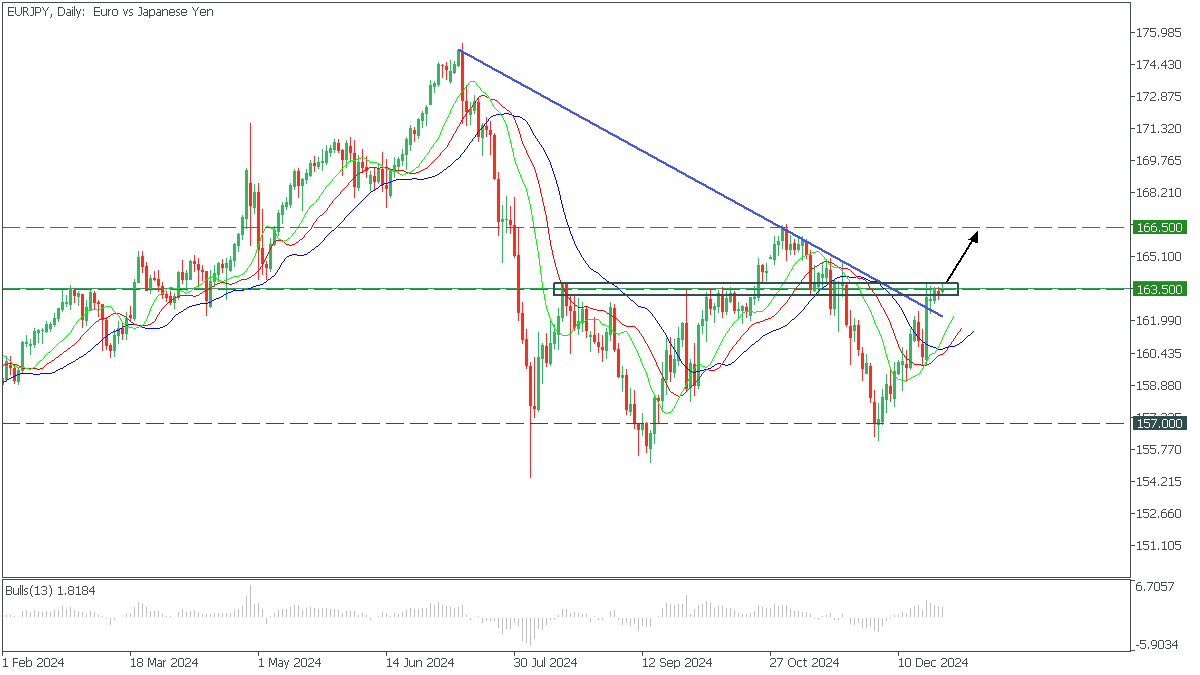
EUR/JPY's retreat from 166.67 extends lower today but stays above 164.25 minor support. Intraday bias remains neutral for the moment, and further rally is in favor. On the upside, Sustained break of 61.8% retracement of 175.41 to 154.40 at 167.38 will pave the way to retest 175.41 high. However, considering bearish divergence condition in 4H MACD, firm break of 164.25 will indicate short term topping, and turn bias to the downside for 55 D EMA (now at 163.36).

In the bigger picture, price actions from 175.41 are seen as correction to rally from 114.42 (2020 low). The range of consolidation should have been set between 38.2% retracement of 114.42 to 175.41 at 152.11 and 175.41 high. However, decisive break of 152.11 would argue that deeper correction is underway.

Yen Rebounds as Japan and South Korea Signal Readiness to the Region’s Currency Markets

Yen jumps broadly in Asian trading today, boosted by heightened government warnings against the recent selloff on the currency. Japanese Finance Minister Katsunobu Kato issued a strong statement addressing the “one-sided and drastic moves” in Yen, confirming that the government is monitoring the situation with the “utmost sense of urgency.” He emphasized Japan’s commitment to take “appropriate actions” to counter what it considers excessive volatility.

Supporting this stance, Japanese Ministry of Finance released quarterly data revealing substantial interventions earlier last quarter. On July 11, Japan spent JPY 3.168T on dollar-selling intervention, followed by an additional JPY 2.367T on July 12. These efforts successfully lifted the Yen from a low of 161.76 to 157.30 within two days, effectively defending the critical 160 psychological level.

Adding a broader regional perspective, South Korea’s Finance Minister, Choi Sang-mok, also announced an expanded 24-hour monitoring framework that will now include financial markets and foreign exchange alongside ongoing concerns related to the Middle East. Minister Choi assured markets that South Korean authorities are prepared to act swiftly if volatility spikes in the currency or financial markets.

The coordinated messages from both Japan and South Korea suggest the possibility of regional intervention should depreciation pressures on Yen and South Korean Won intensify, highlighting a collective commitment to maintaining currency stability in the face of global economic uncertainties.

Overall in the currency markets, Aussie is currently as the strongest performer of the week, followed by Kiwi and Loonie. Aussie is bolstered by robust risk-on sentiment emanating from the US, RBA's vigilance on inflation, and the notable rebound in copper prices. Conversely, Euro is currently the weakest, followed by Swiss Franc and Dollar. Sterling and Yen are positioned in the middle of the performance spectrum.

Technically, focus is now back on 4.4715 resistance in Copper after the strong rebound from 4.2075. Firm break there will argue that corrective fall from 4.6904 has completed as a three-wave corrective move. In this case, stronger rise would be seen back to 4.6904. If realized, this would provide extra lift to AUD/USD towards 0.6941 high.

In Asia, at the time of writing, Nikkei is up 0.22%. Hong Kong HSI is down -0.58%. China Shanghai SSE is down -0.33%. Singapore Strait Times is up 1.55%. Japan 10-year JGB yield is down -0.0056 at 1.001. Overnight, DOW fell -0.00%. S&P 500 rose 0.74%. NASDAQ rose 1.51%. 10-year yield fell -0.085 to 4.341.

US 10-yr yield retreats after Fed holds rates steady; Powell highlights fiscal risks

US 10-year Treasury yield eased back notably overnight following Fed's decision to keep interest rates steady. Chair Jerome Powell's balanced commentary offered a calm counterpoint to the election-fueled rally in yields seen earlier this week.

During the press conference, Powell downplayed the immediate impact of the election on monetary policy, stating that it "will have no effect on our policy decisions" in the near term. He emphasized that Fed's current policy stance is "well positioned" to manage risks and uncertainties, and that the central bank can adjust its policy restraints "more slowly" or "more quickly" depending on how economic developments unfold.

Addressing recent inflation data, Powell noted that it "wasn't terrible," but was "a little higher than expected." He highlighted that by December, the FOMC will have additional data to consider, including one more employment report and two more inflation reports. "We’ll make a decision as we get to December," Powell said.

However, he issued a stark warning about the US fiscal situation, asserting that fiscal policy is "on an unsustainable path." Powell elaborated: “The federal government’s fiscal path, fiscal policy, is on an unsustainable path. The level of our debt relative to the economy is not unsustainable, the path is unsustainable." He added, “We see that in a very large deficit, you’re at full employment that’s expected to continue, so it’s important that be dealt with. It is ultimately a threat to the economy.”

More on FOMC:

Technically, 10-year yield has encountered notable resistance from medium term falling trend line and 61.8% retracement of 4.997 to 3.603 at 4.464. Some consolidations would be seen first, but such consolidations should be relatively brief as long as 4.223 support holds. Rise from 3.603 is expected to resume sooner rather than later. Sustained trading above 4.464 will pave the way to retest 4.997 high. Nevertheless, break of 4.223 will argue that deeper correction is underway back to 55 D EMA (now at 4.075).

Looking ahead

France trade balance, Swiss SECO consumer climate will be featured in European session. Later in the day, Canada employment and US U of Michigan consumer sentiment will be released.

EUR/JPY Daily Outlook

Daily Pivots: (S1) 164.80; (P) 165.39; (R1) 165.79; More....

EUR/JPY's retreat from 166.67 extends lower today but stays above 164.25 minor support. Intraday bias remains neutral for the moment, and further rally is in favor. On the upside, Sustained break of 61.8% retracement of 175.41 to 154.40 at 167.38 will pave the way to retest 175.41 high. However, considering bearish divergence condition in 4H MACD, firm break of 164.25 will indicate short term topping, and turn bias to the downside for 55 D EMA (now at 163.36).

In the bigger picture, price actions from 175.41 are seen as correction to rally from 114.42 (2020 low). The range of consolidation should have been set between 38.2% retracement of 114.42 to 175.41 at 152.11 and 175.41 high. However, decisive break of 152.11 would argue that deeper correction is underway.

Economic Indicators Update

GMT CCY EVENTS ACT F/C PP REV
23:30 JPY Household Spending Y/Y Sep -1.10% -1.80% -1.90%
05:00 JPY Leading Economic Index Sep P 109.4 108.9 106.9
07:45 EUR France Trade Balance (EUR) Sep -7.0B -7.4B
08:00 CHF SECO Consumer Climate Q4 -33 -34
13:30 CAD Net Change in Employment Oct 33.2K 46.7K
13:30 CAD Unemployment Rate Oct 6.60% 6.50%
15:00 USD Michigan Consumer Sentiment Index Nov P 70 70.5


Cliff Notes: An Event-Filled Week

Key insights from the week that was.

Domestically, the main event was the RBA’s November policy meeting, where the Board decided once again to leave the cash rate unchanged at 4.35%. Communications on the day – via the decision statement, press conference, and Statement on Monetary Policy – provided more colour around changes to the RBA’s forecasts. Most notable were a near-term downgrade to consumer spending and the edging down of underlying inflation in 2026, while the outlook for employment growth was revised up.

On balance, developments since the last policy meeting have not materially altered the RBA’s perspective, a mixed picture on the domestic economy reinforcing the Board’s patient approach of “not ruling anything in or out” for the time being. Echoing this point, the Board’s policy discussion in November considered the balance of risks around the central case of remaining on hold versus actively considering a rate hike or cut – similar to September.

In a video update midweek, Chief Economist Luci Ellis explained the key takeaways from the RBA’s decision in more detail. In our view, the RBA’s interpretation of the recent data flow is slightly more hawkish than our own, offering greater certainty the RBA Board will not change their stance this year. However, we remain of the view that the first rate cut will be delivered in February 2025 and easing will continue at a measured pace of 25bps per quarter from there until 3.35% in Q4 2025, a rate we consider to be broadly neutral for the economy.

Offshore, the medium-term settings and consequences of fiscal policy are becoming less certain, but the immediate path for monetary policy is clear.

Throughout the week, markets were squarely focussed on the US Presidential and Congressional elections. Donald Trump comfortably surpassed the 270 Electoral College votes needed to serve a second term as President. While some Congressional contests are still to be confirmed, the Republican party looks to be on track to hold a majority in both the Senate and House of Representatives. These results should give President-elect Trump considerable scope to enact mooted policy reform across tax, regulation, spending and trade. While specific policy detail won’t be known until after inauguration on 20 January, the net result for the deficit is expected to be expansionary, steepening the uptrend in Federal Government debt on issue over the coming decade. Market participants are likely to continue to front-run fiscal decision making, holding Treasury yields around their current level, almost 75bps above September’s low.

The immediate outlook for monetary policy is certainly not behind the lift in yields. This week the FOMC followed up September’s 50bp cut with a 25bp reduction, taking the mid-point of the fed funds range to 4.625%. Chair Powell was clear in the press conference that the Committee expect inflation to continue to abate to target, with non-housing services and goods inflation already consistent with headline inflation of 2.0%yr, and strength in housing inflation a consequence of past agreements not current market dynamics. While positive on the outlook for activity and employment, it is clear the FOMC are now more concerned with downside risks for the labour market than upside price risks. Any further deterioration in the labour market would be unwanted.

On this week’s election specifically, Chair Powell made clear that the outcome will have no effect on monetary policy in the near term. It is only over time, as policy is committed to and implemented, that the economic implications become clear and any monetary policy response can be decided upon. The December FOMC meeting will be the first opportunity for Committee members to update their forecasts; however, this will be more than a month before the new administration takes office, let alone when the President-elect and new Congress begin to debate policy. By late-2026 however, we believe the FOMC will see a need to tighten policy to counteract the cumulative inflationary consequences of more expansionary fiscal policy, which is likely to focus on supporting demand versus supply. With much of the expected fiscal policy effects already priced in, term interest rates are likely to hold near current levels over the coming year, then edge higher from late-2025, pre-empting monetary policy tightening.

Across the pond, the Bank of England also cut rates by 25bp to 4.75% this week. The Committee provided its assessment of the new government budget, nudging the GDP profile higher by ¾% at its peak in Q4 2025. A rise in employment costs from an increase in the National Living Wage and changes in the employers' National Insurance contribution will also influence wages and profits margins, and ultimately inflation. The inflation outlook was nudged up from Q3 2025, with headline inflation not expected to be sustainably at target until Q2 2027, a year later than in the prior set of forecasts. The BoE's central case is that further economic slack is needed to normalise inflation and wage dynamics, warranting a 'gradual approach' to removing restrictive policy. The exact pace of rate cuts from here will depend on the data flow, meeting by meeting. The closer Bank Rate gets to its neutral level, the greater the justification for prudence.

USD/JPY Rebounds With New Traction: Can It Sustain Rise?

Key Highlights

  • USD/JPY started a fresh increase above the 153.50 resistance zone.
  • A connecting bullish trend line is forming with support at 152.20 on the 4-hour chart.
  • EUR/USD is attempting a recovery wave from the 1.0700 zone.
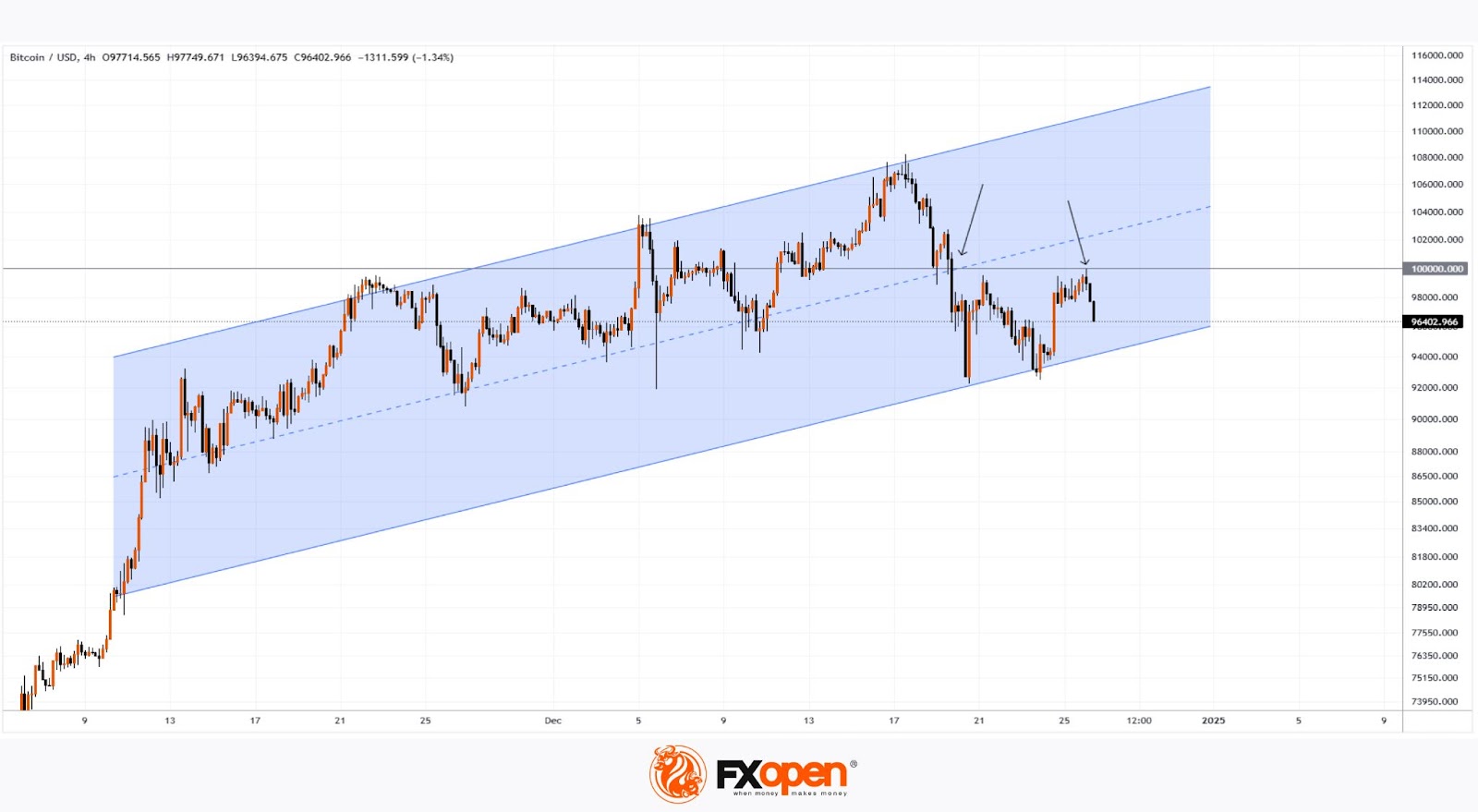
  • Bitcoin rallied to a new record high above $76,000 before it saw a consolidation phase.

USD/JPY Technical Analysis

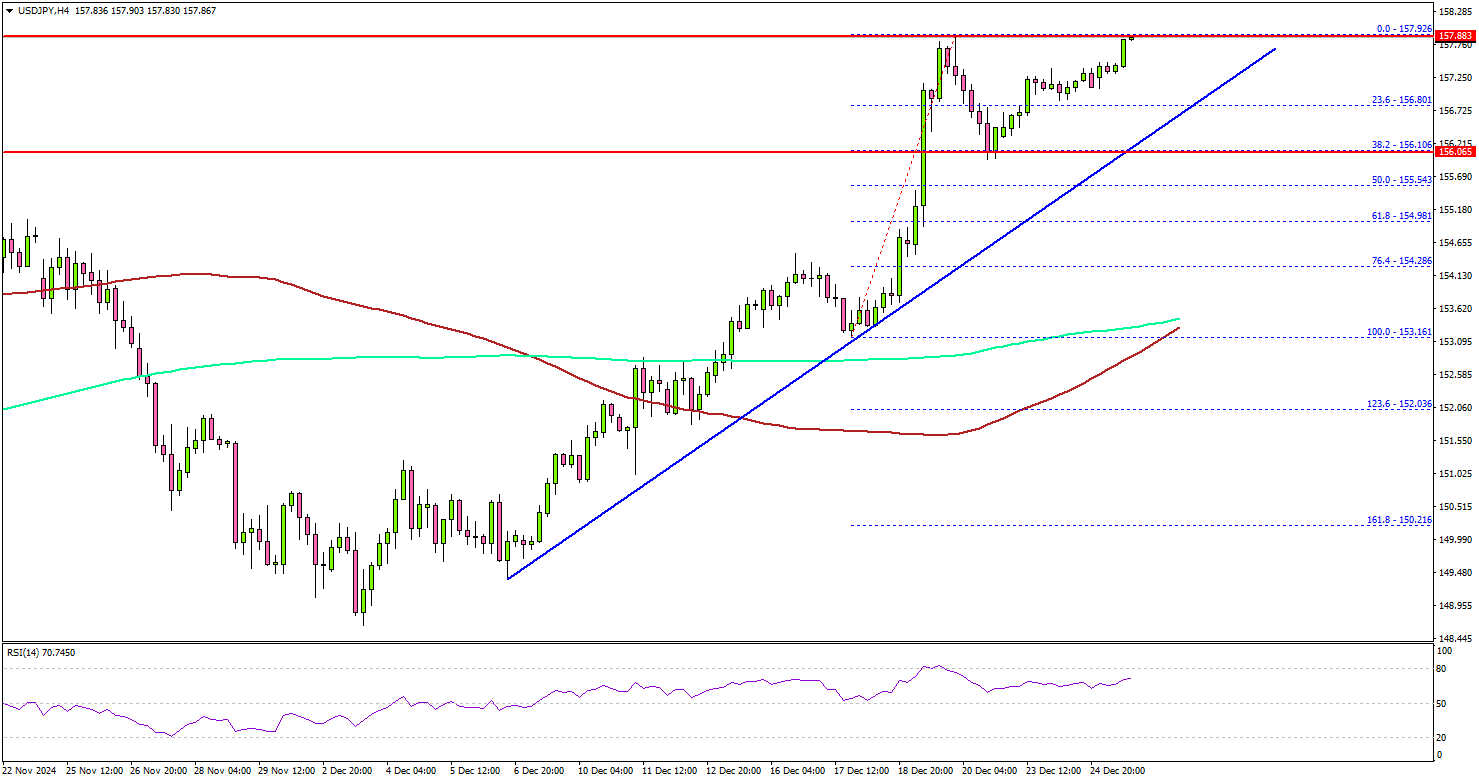
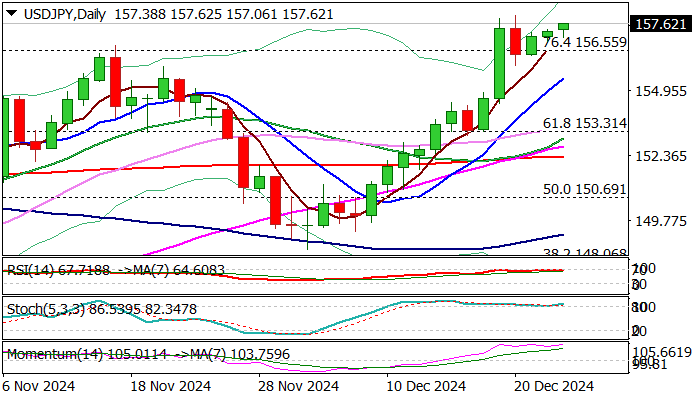
The US Dollar started a fresh increase above the 152.50 resistance zone against the Japanese Yen. USD/JPY cleared the 153.50 level to move into a positive zone.

Looking at the 4-hour chart, the pair settled well above the 153.00 level, the 100 simple moving average (red, 4-hour), and the 200 simple moving average (green, 4-hour). A high was formed at 154.71 before there was a downside correction.

The pair dipped below the 154.00 level. It broke the 23.6% Fib retracement level of the upward move from the 151.28 swing low to the 154.71 high.

On the downside, immediate support sits near the 152.60 level. The next key support sits near the 152.20 level. There is also a connecting bullish trend line forming with support at 152.20 on the same chart.

Any more losses could send the pair toward the 151.50 level. On the upside, the pair could face resistance near the 154.50 level. The first key resistance is near the 155.00 level.

A close above the 155.00 level could set the tone for another increase. The next major resistance could be 151.20, above which the price could accelerate higher toward the 152.00 resistance.

Looking at EUR/USD, the pair started a recovery wave and the bulls now aim for a move above the 1.0820 resistance.

Upcoming Economic Events:

  • Canada’s employment Change payrolls for Oct 2024 – Forecast 25K, versus 46.7K previous.
  • Canada’s Unemployment Rate for Oct 2024 - Forecast 6.6%, versus 6.5% previous.

US 10-yr yield retreats after Fed holds rates steady; Powell highlights fiscal risks

US 10-year Treasury yield eased back notably overnight following Fed's decision to keep interest rates steady. Chair Jerome Powell's balanced commentary offered a calm counterpoint to the election-fueled rally in yields seen earlier this week.

During the press conference, Powell downplayed the immediate impact of the election on monetary policy, stating that it "will have no effect on our policy decisions" in the near term. He emphasized that Fed's current policy stance is "well positioned" to manage risks and uncertainties, and that the central bank can adjust its policy restraints "more slowly" or "more quickly" depending on how economic developments unfold.

Addressing recent inflation data, Powell noted that it "wasn't terrible," but was "a little higher than expected." He highlighted that by December, the FOMC will have additional data to consider, including one more employment report and two more inflation reports. "We’ll make a decision as we get to December," Powell said.

However, he issued a stark warning about the US fiscal situation, asserting that fiscal policy is "on an unsustainable path." Powell elaborated: “The federal government’s fiscal path, fiscal policy, is on an unsustainable path. The level of our debt relative to the economy is not unsustainable, the path is unsustainable." He added, “We see that in a very large deficit, you’re at full employment that’s expected to continue, so it’s important that be dealt with. It is ultimately a threat to the economy.”

More on FOMC:

Technically, 10-year yield has encountered notable resistance from medium term falling trend line and 61.8% retracement of 4.997 to 3.603 at 4.464. Some consolidations would be seen first, but such consolidations should be relatively brief as long as 4.223 support holds. Rise from 3.603 is expected to resume sooner rather than later. Sustained trading above 4.464 will pave the way to retest 4.997 high. Nevertheless, break of 4.223 will argue that deeper correction is underway back to 55 D EMA (now at 4.075).

(FED) Federal Reserve Issues FOMC Statement

Recent indicators suggest that economic activity has continued to expand at a solid pace. Since earlier in the year, labor market conditions have generally eased, and the unemployment rate has moved up but remains low. Inflation has made progress toward the Committee's 2 percent objective but remains somewhat elevated.

The Committee seeks to achieve maximum employment and inflation at the rate of 2 percent over the longer run. The Committee judges that the risks to achieving its employment and inflation goals are roughly in balance. The economic outlook is uncertain, and the Committee is attentive to the risks to both sides of its dual mandate.

In support of its goals, the Committee decided to lower the target range for the federal funds rate by 1/4 percentage point to 4-1/2 to 4-3/4 percent. In considering additional adjustments to the target range for the federal funds rate, the Committee will carefully assess incoming data, the evolving outlook, and the balance of risks. The Committee will continue reducing its holdings of Treasury securities and agency debt and agency mortgage‑backed securities. The Committee is strongly committed to supporting maximum employment and returning inflation to its 2 percent objective.

In assessing the appropriate stance of monetary policy, the Committee will continue to monitor the implications of incoming information for the economic outlook. The Committee would be prepared to adjust the stance of monetary policy as appropriate if risks emerge that could impede the attainment of the Committee's goals. The Committee's assessments will take into account a wide range of information, including readings on labor market conditions, inflation pressures and inflation expectations, and financial and international developments.

Voting for the monetary policy action were Jerome H. Powell, Chair; John C. Williams, Vice Chair; Thomas I. Barkin; Michael S. Barr; Raphael W. Bostic; Michelle W. Bowman; Lisa D. Cook; Mary C. Daly; Beth M. Hammack; Philip N. Jefferson; Adriana D. Kugler; and Christopher J. Waller.

The Red Fork in the Road

We were already expecting loose US fiscal policy and higher interest rates across the curve on average than pre-pandemic. This week’s US election results push our view further in that direction.

It is the nature of event risk that, when it is finally realised, it closes off some potential futures and narrows down the remaining possibilities. As we flagged back in July, elections can be such an event risk. Schrödinger’s November box has been opened, and we now know that, not only did the cat turn out to be red, but it seems to be accompanied by two little red kittens called ‘Senate’ and ‘House of Representatives’.

We do not yet know exactly what the incoming Trump administration’s fiscal and trade policies will be, but we have a sense of the direction. Relative to the superposition of red and blue possible futures, fiscal policy will be at least a bit more expansionary. It will also be skewed more to tax cuts than spending, meaning that more of the extra demand will be private sector not public sector. Recall, though, that both parties were promising a continuation of the current large fiscal deficits. Fiscal consolidation was not on either side’s agenda. So the now-likely future is a difference at the margin from our earlier view, not a complete departure from it.

In addition, the proposed tariffs will lift the price level in the United States, boosting measured inflation for a time and raising the relative price of traded goods relative to non-tradeables.

We were already expecting that the global interest rate structure would be higher in the future than it had been in the period between the GFC and the pandemic. This has been a core part of our house view for some time. The large US fiscal deficits, which would have continued regardless of the election result, were among the factors underlying this view.

With one fork in the road now closed off, though, some further evolution of that view is in order.

At the margin, the expected demand impulse from the next Trump administration’s likely fiscal policy will be larger, and more inflationary, than our existing base case. Bond markets are already adjusting to this. The result is higher bond yields across the whole US curve. The US bond market’s dominant position globally means that most of this uplift also flows through to our view on Australian bond yields. Because Australia’s fiscal position is stronger than in the United States, we continue to expect the spread between Australian and US long yields to be narrower than historical norms.

Trump’s tax cuts and tariffs push the US inflation outlook up. This will take a while to come through, though, given that it will likely be well into 2025 before they are enacted. We have therefore not shifted our view of near-term path for the Fed funds rate. The Fed cut rates by 25 basis points at this week’s meeting as expected, and we continue to expect the Fed funds rate to reach its low point of 3.375% (midpoint) in the third quarter of 2025.

In contrast, we do think the outlook further out has shifted from our earlier expectations. Recall that we already expected the Fed funds rate to bottom out at a higher rate than implied by the FOMC ‘dot plot’, consistent with our view about the longer-run global interest rate structure. That view seems even more likely given recent developments. Further, we now think it likely that the Fed will start hiking rates in the second half of 2026, in response to rising inflationary pressures. While it is too soon to know what Trump’s immigration policies imply for US population and labour supply, and so the domestic cost base, a shift here is likely to reinforce the inflationary implications of Trump’s other signature policies.

We do not see the same inflationary impulses in Australia, especially given that rising labour force participation here has been a positive for labour supply and is likely to remain so for a while. In addition, the impact of tariffs on China could be indirectly negative for Australia, given its importance as a destination for our exports. Against that, though, we need to be mindful that China is likely to respond to any negative external shock with additional stimulus targeting the consumer and residential investment, lifting commodity demand. We would also see Australia as one likely destination for all those cheaper manufactured goods that a tariff-bound United States no longer demands. This implies some downside risk for the relative price of goods relative to services in Australia, and to inflation more broadly. We have therefore not revised our view on the RBA cash rate in light of Trump’s victory.

The relative shift in rates suggests a stronger US dollar, and so we have flattened the slope of the expected appreciation of the AUD (and NZD) against the USD accordingly. Relative purchasing power tends to be the centre of gravity that exchange rates revert to over the 3–5 year horizon, but it now seems that this will take longer than we previously assumed.

FOMC Focused on Health of Labour Market and Success with Inflation

Unsurprisingly, the FOMC made clear it was too early to assess the economic implications of this week’s US election. Activity and prices meanwhile justify a gradual withdrawal of policy tightness.

The US FOMC delivered a 25bp cut at its November meeting as expected, taking the mid-point of the fed funds range to 4.625%. Overall, the Committee's view on the outlook remains constructive. Labour market conditions "have generally eased, and the unemployment rate has moved up" but it "remains low". Economic activity has also “continued to expand at a solid pace”. On inflation, progress has been made towards “the Committee's 2 percent objective though [it still] remains somewhat elevated."

Risks to the outlook are seen as being "roughly in balance"; however, the Committee made clear they intend to continue "carefully assess[ing] incoming data, the evolving outlook, and the balance of risks". Clearly it is too early to assess, let alone react to, the policy/ economic developments that may ensue from this week’s US election – more below.

In the press conference, Chair Powell reiterated the statement’s key messages, in particular noting that the labour market is now less tight than it was prior to the pandemic despite continued job gains. The labour market is consequently not seen as a concern for inflation, while supply across the economy is also assessed to have improved over the past year. These developments allow the FOMC to reduce their restrictiveness at a measured pace even as GDP growth remains above trend.

On this week’s election specifically, Chair Powell made clear that, in the near term, the outcome will have no effect on monetary policy. It is only over time, as policy is committed to and implemented, that the economic implications become clear and any monetary policy response can be decided upon. The December FOMC meeting will be the first opportunity for Committee members to update their forecasts; however, this will be more than a month before even inauguration takes place, let alone when the President-elect and new Congress begin to debate policy.

Regarding financial conditions, while assessed continually, for monetary policy it is the materiality and persistence of any change that matters. Reading between the lines of Chair Powell’s remarks, with several points of uncertainty affecting markets and the economy, it is too early to assess the sustainability, let alone the consequences, of recent fluctuations in interest rates and equity prices.

A few comments were also made in response to questions on inflation’s progress to target. Chair Powell was clear that non-housing services inflation and goods inflation were currently consistent with headline inflation at target. Further, housing inflation was being held up by past agreements not current market dynamics, with rent increases agreed for new contracts instead negligible. A continuation of these trends will see headline inflation sustainably at target within the forecast horizon, particularly given the labour market is not currently inflationary and is susceptible to softening further.

All told, the FOMC is mindful of evolving risks, but feels justified to continue reducing the restrictiveness of monetary policy at a measured pace into 2025. Arguably their net assessment of economic risks is now modestly skewed down given the confidence the Committee have in the inflation outlook and reason for caution over labour market momentum. We see these views as consistent with our forecast for 25bp rate cuts at the December, January and March meetings, followed by one cut per quarter to September 2025. That would leave the fed funds rate at 3.375%, modestly above the FOMC’s longer-run neutral rate forecast of 2.9% but broadly in line with our own view of this metric. Inflationary risks related to this week’s election are instead likely to become apparent in late-2025 and 2026, assuming policy mooted by President-elect Trump is passed and implemented.

Fed Continues To Dial Back Policy Restraint via 25 bps Rate Cut

Summary

  • As widely expected, the FOMC cut rates by 25 bps at today's policy meeting. The decision was unanimous.
  • The Committee noted that progress has been made in returning inflation to its target of 2% and that the risks of achieving its goals of price stability and full employment are roughly balanced.
  • Despite 75 bps of rate cuts since the September 18 policy meeting, the stance of monetary policy remains restrictive. That is, the real fed funds rate remains above most estimates of "neutral." Therefore, we look for the FOMC to ease policy further at upcoming meetings.
  • In our view, the FOMC will not react to potential policy changes that could be implemented by the incoming Trump administration until those policies are more fully formed. If, however, tariffs or other fiscal policies were to cause inflation to move higher next year, then we believe the nominal fed funds rate would not fall all the way toward 3%, as we had forecasted prior to the election.

Progress on Inflation and Balanced Risks Lead to Rate Cut

As widely expected, the Federal Open Market Committee (FOMC) decided at its policy meeting today to reduce the target range for the federal funds rate by 25 bps to 4.50%-4.75%. After peaking at a range of 5.25%-5.50%, the FOMC has now cut rates by 75 bps since September (chart). The decision to cut rates by 25 bps today was unanimously supported by all 12 voting members of the Committee. Federal Reserve Governor Michelle Bowman dissented at the September 18 meeting when the FOMC reduced the target range for the fed funds rate by 50 bps. Governor Bowman preferred a rate cut of only 25 bps at that meeting.

The statement that the FOMC released after its meeting today is similar to the one that it released on September 18. That is, the Committee noted in today's statement that "inflation has made progress toward the Committee's 2 percent objective." In that regard, the PCE deflator, which is the Fed's preferred measure of the rate of consumer price inflation, was up only 2.1% on a year-ago basis in September (chart). Furthermore, the FOMC judges "that the risks to achieving" its dual mandate of price stability and full employment "are roughly in balance." Therefore, "in support of its goals" the FOMC decided to cut rates by 25 bps today.

Stance of Policy Remains Restrictive Despite Recent Rate Cuts

Recently released data show that real GDP was up at a solid rate of 2.7% on a year-ago basis in Q3-2024 and that the unemployment rate was only 4.1% in October. If the economy is doing so well, why cut rates at all? The reason is that the stance of monetary policy, as measured by the real fed funds rate (i.e., the nominal rate minus the underlying rate of inflation) is restrictive at present. Indeed, Chair Powell noted the restrictive stance of policy in his post-meeting press conference. The "neutral" real fed funds rate, which is the real interest rate that neither stimulates the economy nor restrains it, is unobservable. However, most analysts estimate that the neutral real rate is somewhat around 1%. With the real fed funds rate currently above 2% (chart), Federal Reserve policymakers apparently judged that they needed to dial back the degree of policy restraint via a cut to the nominal fed funds rate. Otherwise, they risk a significant deceleration in economic activity, which could push up the unemployment rate by more than most Fed officials would feel comfortable.

The final FOMC meeting of 2024 will be held on December 18, and our current forecast looks for another 25 bps rate cut at that meeting as the FOMC "feels" its way back toward neutral. As we noted in a recent report, however, the sharp increase in tariff rates that the incoming Trump administration may levy on many of America's trading partners could lead inflation to move higher after their implementation. In our view, the FOMC will not make a policy decision at its upcoming meeting based on what it thinks the incoming administration may do. Rather, the Committee will wait until policies are more fully formed and their effects better understood before reacting, if appropriate, with its own response. Our most recent forecast, which was compiled before the election, looked for the FOMC to cut its target range for the fed funds rate to 3.00%-3.25% by the end of 2025. (We do not make assumptions about the outcomes of elections until the ballots are counted). But if the incoming Trump administration does indeed levy significant tariffs or adopt other inflationary policies, then we believe the fed funds rate may bottom out next year closer to 4% than to 3%.