Sample Category Title
Market Update – European Session: UK Wages At 2-Year Low As Accelerating Inflation Squeezes British Wallets
Notes/Observations
Focus on FOMC rate decision. Few are anticipating the central bank will accelerate its projected pace of rate increases given modest inflation and planned the reduction of bond reinvestment
UK wages register lower reading for the 2ns straight month to 2-year lows as accelerating inflation squeezes British wallets
IEA Reports saw expected non-OPEC 2018 production to grow by 1.5M bpd which is slightly more than the expected increase in global demand
Overnight
Asia:
China May Retail Sales Y/Y: 10.7% v 10.7%e; YTD Y/Y: 10.3% v 10.3%e
China May Industrial Production Y/Y: 6.5% v 6.4%e; YTD Y/Y: 6.7% v 6.6%e
China National Bureau of Stats (NBS): China economy remains stable in May with improvement in momentum
South Korea May Unemployment Rate: 3.6% v 3.9%e
Europe:
Agreement between PM May and Democratic Unionist Party (DUP) for minority govt expected to be signed on Wed, Jun 14th
PM May: Timetable for Brexit negotiations remains on course and will begin next week
France President Macron: hopes Brexit talks begin as soon as possible and are led by European Commission
EU official: disagreements remain between EU and IMF on Greek debt sustainability
EU's Moscovici reiterated view that expects Greece and lenders to reach compromise deal on new loans this week;3rd aid tranche would be last for Greece
Americas:
Attorney Gen Sessions testimony: Have never met with foreign officials, Russian included, to discuss interfering in US elections
White House spokesperson: President Trump has the right but no intention to fire Special Counsel Mueller
Energy:
Weekly API Oil Inventories: Crude: +2.8M v -4.6M prior (first build in 4 weeks)
Economic Data
(DE) Germany May Final CPI M/M: -0.2% v -0.2%; Y/Y: 1.5% v 1.5%e
(DE) Germany May Final CPI EU Harmonized M/M: -0.2% v -0.2%e; Y/Y: 1.4% v 1.4%e
(FI) Finland May CPI M/M: -0.2% v +0.3% prior; Y/Y: 0.7% v 0.8% prior
(IN) India May Wholesale Prices (WPI) Y/Y: 2.2% v 2.9%e
(UK) May Jobless Claims Change: +7.3K v +22.0 prior; Claimant Count Rate: 2.3% v 2.3%prior
(UK) Apr Average Weekly Earnings 3M/Y: 2.1% v 2.4%e; Weekly Earnings (ex bonus) 3M/Y: 1.7% v 2.0%e (slowest pace in two years)
(UK) Apr ILO Unemployment Rate 3M/3M: 4.6% v 4.6%e, Employment Change 3M/3M: +109K v +125Ke
(IS) Iceland Central Bank (Sedabanki) cuts 7-day Term Deposit rate by 25bps to 4.50% (2nd straight rate cut since removing capital controls)
(EU) Euro Zone Apr Industrial Production M/M: 0.5% v 0.5%e; Y/Y: 1.4% v 1.4%e
(EU) Euro Zone Q1 Employment Q/Q: 0.4% v 0.4% prior; Y/Y: 1.5 v 1.4% prior
(CH) China May M2 Money Supply Y/Y: 9.6% v 10.4 %e; M1 Money Supply Y/Y: 17.0% v 17.6 %e; M0 Money Supply Y/Y: 7.3% v 6.0%e
(CH) China May New Yuan Loans (CNY): 1.11T v 1.00T e
(CH) China May Aggregate Financing (CNY): 1.06T v 1.19Te
Fixed Income Issuance:
(IN) India sold total INR140B vs. INR140B indicated in 3-month and 6-month Bills
(DK) Denmark sold total DKK2.56B in 3-month and 6-month Bills
(SE) Sweden sold total SEK2.5B vs. SEK2.5B indicated in 2025 and 2026 Bonds
(GR) Greece Debt Agency (PDMA) sold €1.3B vs. €1.0B indicated in 13-Week Bills; Avg Yield: 2.70% v 2.70% prior; Bid-to-cover: 1.30x v 1.30x prior
(CH) Switzerland sold total CHF443.6M in 2026 and 2045 bonds
SPEAKERS/FIXED INCOME/FX/COMMODITIES/ERRATUM
Equities
Indices [Stoxx50 +0.6% at 3578, FTSE +0.3% at 7527, DAX +0.4% at 12820, CAC-40 +0.9% at 5306, IBEX-35 +0.1% at 10896, FTSE MIB +0.1% at 21107, SMI +0.3% at 8897, S&P 500 Futures flat]
Market Focal Points/Key Themes European Indices trade modestly higher following on from a rebound in the US overnight. The French CAC is the out performer this morning whilst the FTSE MIB lags. Spanish retail giant Inditex trades lower after Q1 results which were mostly inline. Hexagon trades sharply higher in Sweden on potential take over talks with a potential deal in the region of SEK130B. US Futures are slightly higher reversing earlier declines tracking the gains in Europe.
Equities
Consumer discretionary [ Inditex [ITX.ES] -0.5% (Q1 earnings), Mulberry [MUL.UK] -2% (Earnings)]
Materials: [Gemfields [GEM.UK] +12.7% (Raised offer from Fosun Gold)]
Industrials: [Bossard [BOSN.CH] +8.7% (Trading update), Hexagon [HEXAB.SE] +14% (Take over speculation)]
Financials: [Bellway [BWY.UK] +4.3% (Trading update), Euronext [ENX.FR] -2% (Placement)]
Technology: [Wandisco [WAND.UK] +10% (Contract win)]
Healthcare: [Gensight [SIGHT.FR] +3.0% (long-term positive safety and visual acuity results)]
Speakers
ECB's Weidmann (Germany) stated that he saw the risk of ECB coming under political pressure to keep monetary policy loose
ECB's Constancio (Portugal): Banks needed to strengthen their solvency. Bank profitability might not reach sustainable targets over the next 3-5 years even under a benign scenario . Saw consolidation in Italy's banking sector
ECB's Hansson (Estonia) stated that all talking about incremental approaches to normalization; issue is about calibrating
ECB's Knot (Netherlands): Effect of ECB policy on inflation has been disappointing
German Bundesbank's Dombret (ECB SSM member): Seen 1st applications from banks seeking to move due to Brexit
Netherlands Bureau for Economic Policy Analysis (CPB) raised 2017 GDP growth forecast from 2.1% to 2.4%
German Chancellor Merkel's conservatives to form a three-way coalition with Free Democrats (FDP) and the pro-environment Greens in the northern state of Schleswig-Holstein. Merkel might be able to forge a similar three-way coalition on the federal level after elections in September, ending her party's current link with the centre-left Social Democrats
UK Chancellor of Exchequer Hammond said to be preparing bid within govt to soften Brexit and keep Britain inside EU customs union
UK Government deal with DUP might be delayed until next week (press report)
Bank of Italy (BOI) again raised its 2017 GDP growth forecast from 1.0% to 1.3% (**Note: 2md hike in a week)
Sweden Central Bank (Riksbank) May Business Survey: Strong economic situation to continue in the months ahead. Export companies are encountering ever-stronger demand from abroad
Norway sold NOK3.0B vs. NOK3.0B indicated in 3.0% 2024 bonds; Avg Yield: 1.25% v 2.12% prior; Bid-to-cover: 2.02x v 2.3x prior
IMF raised China GDP growth forecast from 6.6% to 6.7%. Noted that reform progress needed to accelerate and address risk of sharp economic adjustment
IEA Monthly Report noted that Growth in oil supply in 2018 was expected to outpace an anticipated pick-up in demand that would push global consumption above 100M barrels per day (bpd) for the first time. In 2018, we expected non-OPEC production to grow by 1.5 million bpd which is slightly more than the expected increase in global demand
Currencies
FX markets were steady and quiet ahead of the expected interest rate hike by the Fed. The main focus will be on for clues regarding Federal Reserve policy for the rest of the year
GBP saw its session gains erode. Pound currency was supported PM May seemed to have secured the support of the DUP to form a working govt. Howvere, UK wage data registered a lower reading for the 2nd straight month to 2-year lows as accelerating inflation squeezed British wallets. The price action was mainly in the Gilts as the 10-year yield dipped below the 1.00% level. GBP/USD was lower by 0.2% just ahead of the NY morning at 1.2725 area.
Fixed Income
Bund futures trade at 164.99 down 2 ticks, remaining tight ahead of FOMC rate decision. Resistance lies near the 165.25 level followed by 165.95. A break of the 164.65 support level could see lows target 163.70 followed by 160.30.
Gilt futures trade at 129.46 higher by 48 ticks, extending to session highs after UK weekly earnings data missed expectations and jobless claims changed declined. Gilts are trading in the middle of the trading range seen in June. Price still finds initial support at the 129.14 level, with key support at the 128.27 support level. An acceleration lower could test the 127.43 region. Resistance remains the 129.75 level followed by 130.28.
Wednesday's liquidity report showed Tuesday's excess liquidity rose to €1.6785T a slight gain of €13.5B from €1.6650T prior. Use of the marginal lending facility rose to €178M from €85M prior.
Corporate issuance saw over $1.8B come to market via 3 issues headlined by Apple's $1B senior unsecured green note offering and American Equity Investment Life Holding Company $500M in senior unsecured note offering
Looking Ahead
(PT) Bank of Portugal reports May financing to Portuguese Banks: No est v €23.4B prior
05:30 (DE) Germany to sell €3.0B in 0.25% 2027 Bunds
05:30 (PT) Portugal Debt Agency (IGCP) to sell €1.0-1.25B in 2022 and 2027 OT bonds
06:00 (IL) Israel Q1 Current Account: No est v $3.3B prior
06:00 (ZA) South Africa Q2 BER Business Confidence: 39.8e v 40.0 prior
06:00 (CZ) Czech Rep. to sell Bonds
06:00 (RU) Russia to sell combined RUB40B in 2020 and 2026 OFZ bonds
06:45 (US) Daily Libor Fixing
07:00 (US) MBA Mortgage Applications w/e Jun 9th: No est v 7.1% prior
07:00 (ZA) South Africa Apr Retail Sales M/M: -0.9%e v +0.3% prior; Y/Y: 0.5%e v 0.8% prior
07:00 (BR) Brazil Jun FGV Inflation IGP-10 M/M: -0.5%e v -1.1% prior
07:00 (UK) Prime Minister's Question Time in House of Commons
07:30 (CL) Chile Central Bank's Traders Survey
08:00 (PL) Poland May M3 Money Supply M/M: 0.8%e v 0.2% prior; Y/Y: 6.5%e v 6.6% prior
08:00 (BR) Brazil Apr IBGE Services Sector Volume Y/Y: -5.8%e v -5.0% prior
08:15 (UK) Baltic Dry Bulk Index
08:15 (IT) ECB's Visco (Italy) in Rome
08:30 (US) May CPI M/M: 0.0%e v 0.2% prior; Y/Y: 2.0%e v 2.2% prior
08:30 (US) May CPI Ex Food and Energy M/M: 0.2%e v +0.1% prior; Y/Y: 1.9%e v 1.9% prior
08:30 (US) May CPI Index NSA: 251.580e v 244.524 prior; CPI Core Index: 244.891 v 251.172 prior
08:30 (US) May Advance Retail Sales M/M: 0.0%e v 0.4% prior; Retail Sales Ex Auto M/M: 0.2%e v 0.3% prior; Retail Sales Ex Auto and Gas: 0.3%e v 0.3% prior; Retail Sales Control Group: 0.3%e v 0.2 prior
08:30 (US) May Real Avg Weekly Earnings Y/Y: No est v 0.3% prior; Real Avg Hourly Earning Y/Y: No est v 0.4% prior
08:30 (CA) Canada May Teranet/National Bank HPI M/M: No est v 1.2% prior; Y/Y: No est v 13.4% prior, House Price Index: No est v 206.41 prior
10:00 (US) Apr Business Inventories: -0.2%e v +0.2% prior
10:30 (US) Weekly DOE Crude Oil Inventories
11:00 (BR) Brazil to sell 2023 LFT
11:00 (BR) Brazil to sell 2018, 2019 and 2020 LTN Bills
13:30 (LT) ECB's Rimsevics (Latvia) in London
14:00 (US) FOMC Interest Rate Decision: Expected to Target Range by 25bs
14:30 (US) Fed Chair Yellen post rate decision press conference
Euro Unchanged Ahead Of Fed, US Consumer Reports
The euro continues to have a quiet week, as EUR/USD is trading at the 1.12 line in the Wednesday session. In Germany, Final CPI declined 0.2%, well off the forecast of a 0.5% gain. Employment Change climbed 0.4%, edging above the estimate of 0.3%. Eurozone Industrial Production climbed 0.5%, matching the estimate. There are a number of key events in the US, highlighted by the Federal Reserve rate announcement. As well, the US will release retail sales and CPI. The markets are prepared for a busy day, and traders should be prepared volatility from EUR/USD. On Thursday, the major event is US unemployment claims.
The markets are awaiting the Federal Reserve rate announcement later on Wednesday. The markets have priced in a rate hike at close to 100%, so it’s a given that the Fed will increase rates by 25 basis points, to 1.25%. What is less clear, however, is what the Fed has planned in the second half of 2017. Analysts are expecting a 'dovish hike', meaning that together with the rate increase, the Fed rate statement will be cautious in tone, and dovish regarding additional rate hikes. Earlier in the year, three rate hikes in 2017 seemed almost a given, but currently, the odds of a September move are just 28%. There are two items which could affect the movement of the dollar. First, the Fed Economic Projections will detail forecasts of inflation, growth and unemployment, and most importantly, the rate hike path. With the US economy performing better in the second quarter, there’s a strong likelihood that the Fed will not moderate its rate hike projections,which is good news for the dollar. Secondly, the markets will be looking for details regarding its plan to lower the $4.2 trillion balance sheet. If the Fed outlines a plan to reduce its holding in H2, the dollar could respond positively. Another variable is the political paralysis which has engulfed Washington. With the Trump administration spending most of its energy on damage control, little progress is being made with regard to Trump’s agenda of tax reform and major spending on infrastructure. The markets are becoming more skeptical about Trump’s ability to work with Congress, and if this sentiment is shared by the Fed, it is likely to sound dovish regarding rate hikes in September or December.
Almost overshadowed by the Fed’s rate announcement, the US will release key consumer numbers later on Wednesday. Retail Sales, the key gauge of consumer spending, is expected to drop to 0.1%. On the inflation front, CPI is projected to remain at 0.2%. On Tuesday, PPI dropped to a flat 0.00%, down from 0.5% a month earlier. Will CPI follow suit and lose ground in the May report? If so, the dollar could lose ground against major rivals, such as the euro.
Daily Technical Analysis: EUR/USD Still Kept In A Very Tight Range
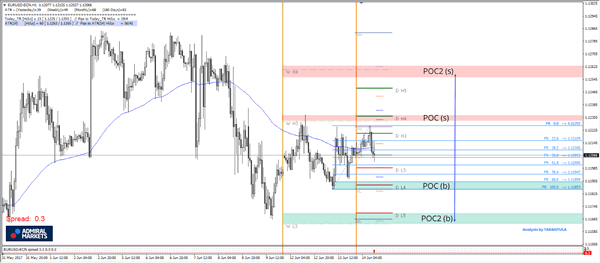
The EUR/USD has been acting exactly as we planned it and traded it on Weekly Recap webinar. The situation hasn't changed a lot. In the top left corner you can see the ATR of the pair that is 60 pips(!). That indicates a slow moving low volatile price. On top of that, the pair is moving in a well defined, two-way range. We always need to adapt to current market conditions, so we have 4 possible zones. Two for buying and two for selling. 1.1185-90 POC (b) ( double bottom, historical buyers, YL, D L4, ATR pivot) is the first zone where now moment buyers might wait and push the price up. Deeper retracement to the downside suggests POC2 (b) 1.1160-70 ( W L3, ATR low, WL, D L5, historical buyers). Sellers reside at the first POC (s) 1.1230-40 (D H4, YH, ATR high, W H3, historical sellers). If the price proceeds above 1.1240, we might be looking for POC2 (s) 1.1255-65 (W H4, ATR top, historical sellers).
GOLD Trading Lower Within Uptrend Channel, SILVER Pausing Within Short-Term Bearish Move, CRUDE OIL Starting To Bounce Back.
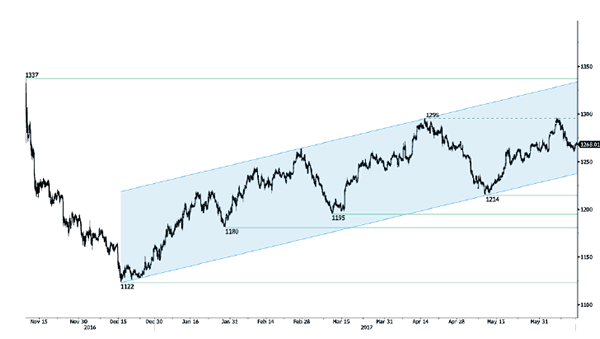
GOLD Trading lower within uptrend channel.
Gold is consolidating within uptrend channel. Hourly support is located at 1246 (18/05/2017 low). Stronger support is given at 1195 (10/03/2017 low). Expected to show renewed upside pressures.
In the long-term, the technical structure suggests that there is a growing upside momentum. A break of 1392 (17/03/2014) is necessary ton confirm it, A major support can be found at 1045 (05/02/2010 low).
SILVER Pausing within short-term bearish move.
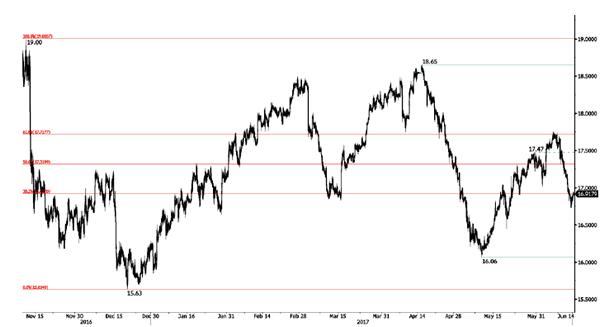
Silver declines. Closest support is given at 16.44 (18/05/2017 low). Strong support is given at 16.06 (09/05/2017 low). Key resistance is given at a distance at 19.00 (09/11/2017 high). The road seems wide open for further decline.
In the long-term, the death cross indicates that further downsides are very likely. Resistance is located at 25.11 (28/08/2013 high). Strong support can be found at 11.75 (20/04/2009).
CRUDE OIL Starting to bounce back.
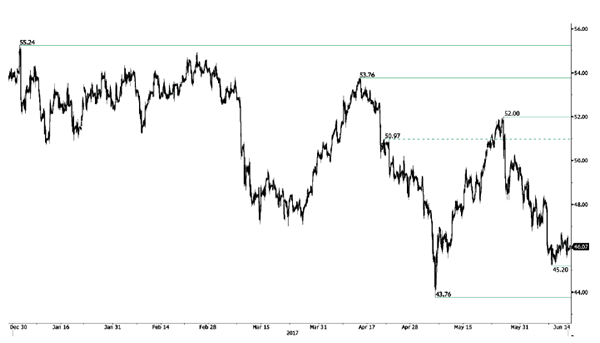
Crude oil's decline is stopping since the recent collapse from $52. Support is given at a distance 43.76 (05/05/2017 low). The technical structure suggests further strengthening.
•n the long-term, crude Oil has recovered after its sharp decline last year. However, we consider that further weakness are very likely. Strong support lies at 24.82 (13/11/2002) while resistance can now be found at 55.24 (03/01/2017 high).
EUR/JPY Weakening Towards Support At 122.56, EUR/GBP Profit-Taking, EUR/CHF Volatility Declines.
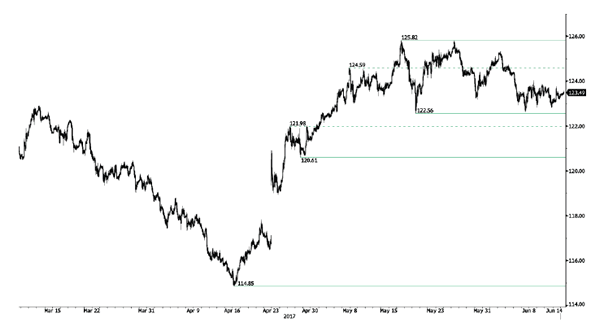
EUR/JPY Weakening towards support at 122.56.
EUR/JPY is trading lower. Hourly support is given at 122.56 (18/05/2017 low). Hourly resistance can be found at 125.82 (16/05/2017 high). Major support is given at 114.90 (18/04/2017 low).
In the longer term, the technical structure validates a medium-term succession of lower highs and lower lows. As a result, the resistance at 149.78 (08/12/2014 high) has likely marked the end of the rise that started in July 2012. Strong support at 94.12 (24/07/2012 low) looks nonetheless far away.
EUR/GBP Profit-taking.
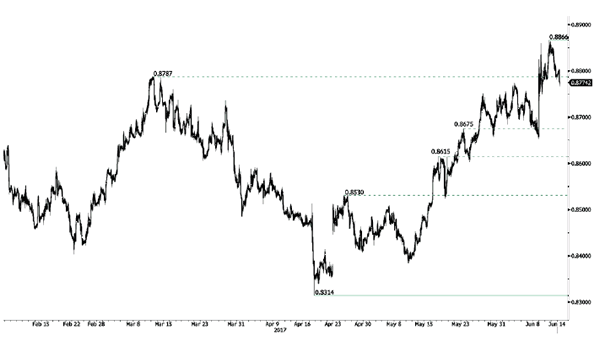
EUR/GBP is back below former support given at 0.8787 (13/03/2017 high). The pair keeps on going higher. Strong support can be found at 0.8304 (05/12/2017 low). Expected to reach 0.8900.
In the long-term, the pair has largely recovered from recent lows in 2015. The technical structure suggests a growing upside momentum. The pair is trading above from its 200 DMA. Strong resistance can be found at 0.9500 psychological level.
EUR/CHF Volatility declines.
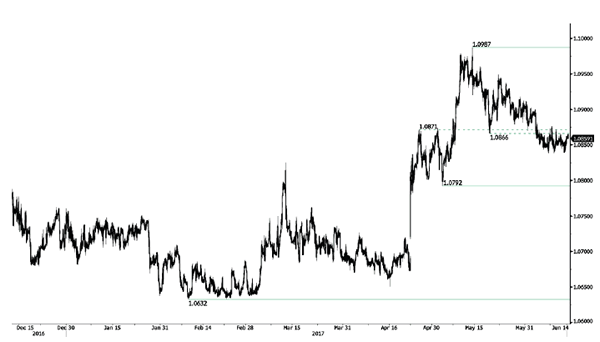
EUR/CHF is trading lower, even though very slightly. The pair has broken support given at 1.0866 (18/05/2017 low). We believe that the medium-term pattern suggests us to see continued bearish pressures towards hourly support that can be found at 1.0792 (03/05/2017 low).
In the longer term, the technical structure is mixed. Resistance can be found at 1.1200 (04/02/2015 high). Yet,the ECB's QE programme is likely to cause persistent selling pressures on the euro, which should weigh on EUR/CHF. Supports can be found at 1.0184 (28/01/2015 low) and 1.0082 (27/01/2015 low
USD/CHF Trading Mixed, USD/CAD Bearish Breakout, AUD/USD Monitoring Resistance Area.
USD/CHF Trading mixed.
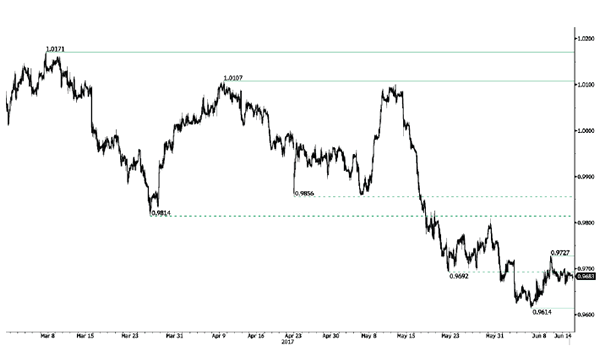
USD/CHF continues its decline despite some ongoing consolidation. Hourly resistance can be found at 0.9727 (09/06/2017 high). Strong resistance is given at 1.0107 (10/04/2017 high). Expected to show continued weakness towards hourly support at 0.9614 (06/06/2017 low).
In the long-term, the pair is still trading in range since 2011 despite some turmoil when the SNB unpegged the CHF. Key support can be found 0.8986 (30/01/2015 low). The technical structure favours nonetheless a long term bullish bias since the unpeg in January 2015.
USD/CAD Bearish breakout.
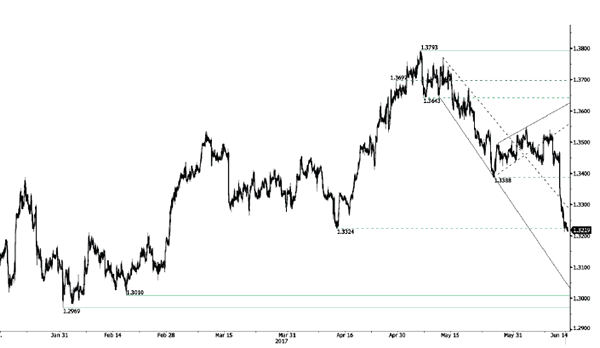
USDCAD has strongly declined. Hourly support found at 1.3324 (13/04/2017 high) has been broken. Expected to show continued weakness.
In the longer term, there is now a death cross with the 50 dma crossing below the 200 dma indicating further downside pressures. Strong resistance is given at 1.4690 (22/01/2016 high). Long-term support can be found at 1.2461 (16/03/2015 low).
AUD/USD Monitoring resistance area.
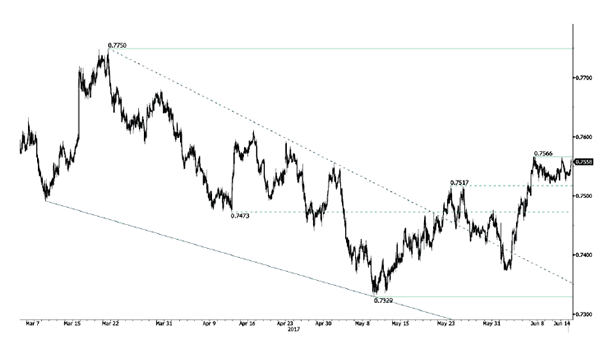
AUD/USD is pushing higher since the pair has failed to reach hourly support given at 0.7329 (09/05/2017 low). As long as prices remain below resistance at 0.7608 (17/04/2017 high), there are nonetheless strong downside risks.
In the long-term, we are waiting for further signs that the current downtrend is ending. Key supports stand at 0.6009 (31/10/2008 low) . A break of the key resistance at 0.8295 (15/01/2015 high) is needed to invalidate our long-term bearish view.
EUR/USD Sideways Price Action, GBP/USD Short-Term Bullish Pressures, USD/JPY Ready For Another Leg Lower.
EUR/USD Sideways price action.
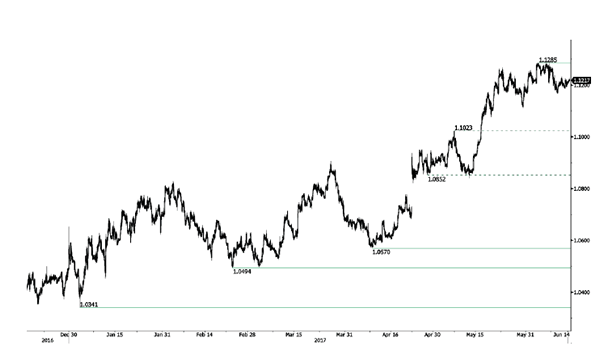
EUR/USD continus to trade below strong resistance given at 1.1300 (09/11/2017 high). Hourly support is given at 1.1110 (22/05/2017 low) has been broken. Stronger support lies at 1.0842 (11/05/2017 low) and key support is given at 1.0494 (22/02/2017 low). Expected to show renewed bullish pressures.
In the longer term, the death cross late October indicated a further bearish bias. The pair has broken key support given at 1.0458 (16/03/2015 low). Key resistance holds at 1.1714 (24/08/2015 high). Expected to head towards parity.
GBP/USD Short-term bullish pressures.
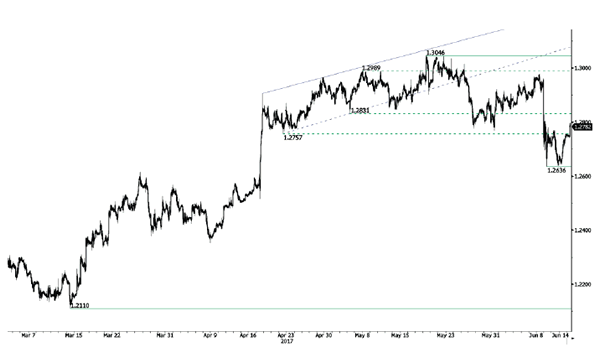
GBP/USD is now pushing higher below around former hourly support given at 1.2757 (21/04/2017 low). Hourly resistance lies at 1.3046 (18/05/2017 high). Expected to show further decline.
The long-term technical pattern is even more negative since the Brexit vote has paved the way for further decline. Long-term support given at 1.0520 (01/03/85) represents a decent target. Long-term resistance is given at 1.5018 (24/06/2015) and would indicate a long-term reversal in the negative trend. Yet, it is very unlikely at the moment.
USD/JPY Ready for another leg lower.
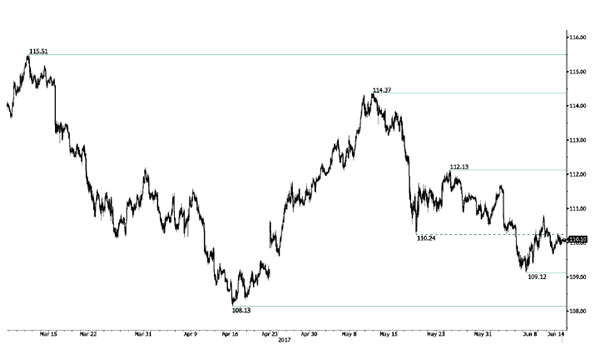
USD/JPY's short-term bearish pressures are back. The pair is bouncing lower. Hourly support can be found at 109.12 (07/06/2017 high). Strong support is located at 108.13 (17/04/2017 low). Hourly resistance is given at 110.81 (09/06/2017 high). Other key supports lie at a distance 106.04 (11/11/2016 low). Wide-open for further decline.
We favor a long-term bearish bias. Support is now given at 96.57 (10/08/2013 low). A gradual rise towards the major resistance at 135.15 (01/02/2002 high) seems absolutely unlikely. Expected to decline further support at 93.79 (13/06/2013 low).
Technical Outlook: Oil Price Remains Under Pressure On Crude Stocks, Production Rise
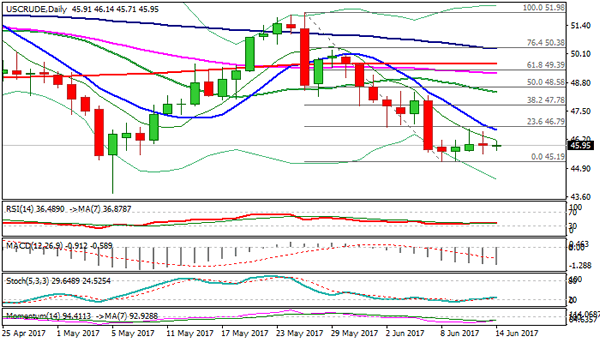
US oil is consolidating around $46 handle in early European trading after falling in late Tuesday on disappointing crude inventories data.
American Petroleum Institute (API) report, released on Tuesday, showed unexpected rise in US crude stocks by 2.8 million barrels against forecast for 2.7 million barrels draw.
Oil remains under strong pressure on global oversupply and slowdown in demand.
The price is holding in a consolidation range after last week's sharp fall with repeated upside rejections on Mon/Tue signaling limited recovery action and persisting downside risk, despite bullish signal on reversal of oversold slow stochastic on daily chart.
Oil is looking for firm break below cracked Fibo 76.4% support at $45.68 to open way for final push towards key support at $43.74 (05 May low).
Bearish technicals are supporting scenario.
Initial resistance, falling 10SMA ($46.62) stays intact for now and maintains bearish pressure.
Release of Energy Information Administration (EIA) weekly crude stocks report, due later today, is in focus for fresh signals. Draw in crude inventories by 2.7 million barrels is forecasted against last week's unexpected build of 3.2 million barrels.
Res: 46.14, 46.62, 47.00, 47.78
Sup: 45.71, 45.55, 45.19, 44.62
Technical Outlook: EURUSD Is Directionless Ahead Of FOMC
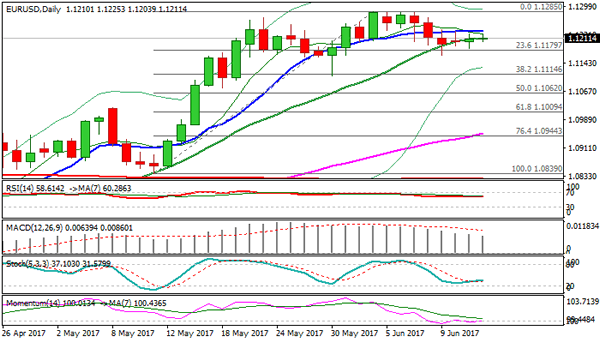
Double Doji in past two days signals that the Euro's near-term action is directionless and awaiting Fed for stronger signals. The price is moving within tight range around 1.1200 handle and capped by 10SMA in past few sessions.
Daily technicals maintain overall bullish structure, however, risk of deeper pullback is in play and could be triggered on loss of 1.1166 pivot (Friday's low) which would expose next strong support and breakpoint at 1.1109 (30 May higher low / near Fibo 38.2% of 1.0839/1.1285 upleg).
Conversely, firm break above daily Tenkan-sen / 10SMA (1.1225/31) would generate bullish signal for renewed attempt towards 1.1300 target (08 Nov 2016 high) and extension of broader uptrend from 2017 low at 1.0340.
Res: 1.1225, 1.1231, 1.1285, 1.1300
Sup: 1.1185, 1.1166, 1.1109, 1.1062
EUR/USD Analysis: Breaks Out Of Channel
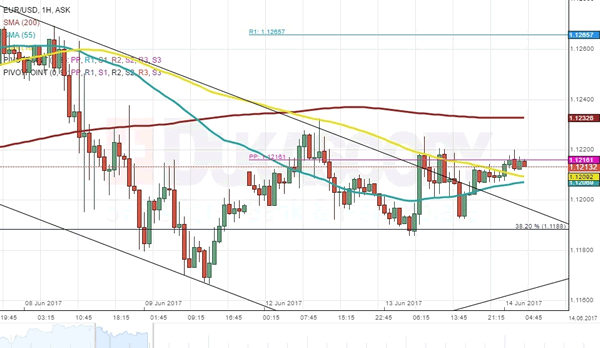
The common European currency gained enough strength from the support of the 38.20% Fibonacci retracement level to break the descending pattern, in which it traded against the US Dollar. However, the surge was stopped on Wednesday morning by the weekly PP, which is located at the 1.1216 mark. If the resistance is broken during the day's trading session, it is most likely that the currency exchange rate will ascend to the 200-hour SMA at the 1.1233 level. On the other hand the pair might begin a decline. However, it is highly unlikely as the 55 and 100-hour SMAs are providing support to the currency exchange rate near the 1.1210 level. Meanwhile, as it can be observed on the right, the daily technical indicators are forecasting a surge on a daily timeframe.