

Sample Category Title
Aussie Trading A Tad Lower In The Asian Session
For the 24 hours to 23:00 GMT, the AUD declined 0.07% against the USD and closed at 0.7529 on Friday.
LME Copper prices rose 1.6% or $91.5/MT to $5739.0/MT. Aluminium prices declined 0.05% or $1.0/MT to $1901.5/MT.
In the Asian session, at GMT0300, the pair is trading at 0.7525, with the AUD trading slightly lower against the USD from Friday’s close.
The pair is expected to find support at 0.7516, and a fall through could take it to the next support level of 0.7507. The pair is expected to find its first resistance at 0.7538, and a rise through could take it to the next resistance level of 0.7551.
With a public holiday being observed in Australia today, investor sentiment would be governed by global macroeconomic factors.
The currency pair is showing convergence with its 20 Hr and 50 Hr moving averages.

German Trade Surplus Narrowed In April
For the 24 hours to 23:00 GMT, the EUR slightly declined against the USD and closed at 1.1196 on Friday.
On the economic front, Germany’s seasonally adjusted trade surplus narrowed more-than-expected to a level of €18.1 billion in April, as growth in imports outpaced that of exports. The nation had posted a revised surplus of €25.3 billion in the prior month, while markets anticipated it to narrow to a level of €23.0 billion.
In the US, data revealed that the seasonally adjusted final wholesale inventories dropped more-than-expected by 0.5% on a monthly basis in April, while the preliminary print had indicated a fall of 0.3%. In the previous month, the wholesale inventories had climbed 0.2%.
In the Asian session, at GMT0300, the pair is trading at 1.1208, with the EUR trading 0.11% higher against the USD from Friday’s close.
The pair is expected to find support at 1.1177, and a fall through could take it to the next support level of 1.1147. The pair is expected to find its first resistance at 1.1227, and a rise through could take it to the next resistance level of 1.1247.
With no major economic releases in the Euro-zone today, investors will look forward to the US monthly budget statement for May, slated to release later in the day.
The currency pair is trading above its 20 Hr moving average and showing convergence with its 50 Hr moving average.

Theresa May’s Election Gamble Backfires, As Voters Delivered A Hung Parliament
For the 24 hours to 23:00 GMT, the GBP declined 0.34% against the USD and closed at 1.2732 on Friday, after results of UK's general election showed that British voters have dealt a devastating blow to the UK Prime Minister, Theresa May, wiping out her parliamentary majority and sparking fears that the political turmoil could delay talks on leaving the European Union.
On the macro front, Britain's industrial production rebounded less-than-expected by 0.2% on a monthly basis in April, compared to a fall of 0.5% in the prior month, while market participants had anticipated it to climb 0.7%. Moreover, the nation's manufacturing production recorded a less-than-expected rise of 0.2% MoM in April, compared to market consensus for a gain of 0.8%. In the preceding month, manufacturing production had registered a fall of 0.6%. Meanwhile, the nation's total trade deficit sharply narrowed to a level of £2.1 billion in April, compared to market expectation for the nation's total trade deficit to fall to a level of £3.5 billion and following a revised deficit of £3.9 billion in the previous month.
Other economic data showed that NIESR, a leading think tank, estimated that UK's gross domestic product (GDP) advanced 0.2% in the three months ended May 2017. In the February-April 2017 period, NIESR estimated GDP had registered a similar rise. On the other hand, the nation's construction output unexpectedly declined 1.6% MoM in April, defying market expectations for a rise of 0.4%. In the prior month, construction output had climbed by a revised 0.7%.
In the Asian session, at GMT0300, the pair is trading at 1.2761, with the GBP trading 0.23% higher against the USD from Friday's close.
The pair is expected to find support at 1.2669, and a fall through could take it to the next support level of 1.2576. The pair is expected to find its first resistance at 1.2821, and a rise through could take it to the next resistance level of 1.2880.
Going ahead, investors will keep a close watch on UK's inflation report hearings, set to be released in a few hours.
The currency pair is trading between its 20 Hr and 50 Hr moving averages.

Japan’s Machinery Orders Surprisingly Fell In April
For the 24 hours to 23:00 GMT, the USD rose 0.24% against the JPY and closed at 110.26 on Friday.
In the Asian session, at GMT0300, the pair is trading at 110.25, with the USD trading a tad lower against the JPY from Friday's close.
Overnight data revealed that Japan's machinery orders unexpectedly dropped 3.1% on a monthly basis in April, confounding market expectations for an advance of 0.5%. In the previous month, machinery orders had registered a revised rise of 1.4%.
The pair is expected to find support at 109.96, and a fall through could take it to the next support level of 109.66. The pair is expected to find its first resistance at 110.68, and a rise through could take it to the next resistance level of 111.10.
Going ahead, traders will focus on Japan's flash machine tool orders data for May, scheduled to be released in a while.
The currency pair is trading between its 20 Hr and 50 Hr moving averages.

Swiss Franc Trading Marginally Higher This Morning
For the 24 hours to 23:00 GMT, the USD rose 0.07% against the CHF and closed at 0.9691 on Friday.
In the Asian session, at GMT0300, the pair is trading at 0.9686, with the USD trading slightly lower against the CHF from Friday’s close.
The pair is expected to find support at 0.9665, and a fall through could take it to the next support level of 0.9643. The pair is expected to find its first resistance at 0.9718, and a rise through could take it to the next resistance level of 0.9749.
Amid a lack of major economic releases in Switzerland today, trading trend in the CHF is expected to be determined by global macroeconomic events.
The currency pair is trading below its 20 Hr moving average and showing convergence with its 50 Hr moving average.

Canadian Unemployment Rate Hits 6.6% In May
For the 24 hours to 23:00 GMT, the USD declined 0.36% against the CAD and closed at 1.3466 on Friday.
Macroeconomic data revealed that Canada’s unemployment rate rose to 6.6% in May, meeting market expectations. In the previous month, the unemployment rate had recorded a reading of 6.5%. Nevertheless, the nation’s net number of people employed climbed more-than-expected by 54.5K in May, rising by the most in eight months and following an increase of 3.2K in the previous month.
In the Asian session, at GMT0300, the pair is trading at 1.3448, with the USD trading 0.13% lower against the CAD from Friday’s close.
The pair is expected to find support at 1.3405, and a fall through could take it to the next support level of 1.3361. The pair is expected to find its first resistance at 1.3510, and a rise through could take it to the next resistance level of 1.3571.
The currency pair is trading below its 20 Hr and 50 Hr moving averages.

Market Update – Asian Session: Macron Gets The Mandate To Govern France With Strong Parliament Election Showinges
Asia Mid-Session Market Update: Macron gets the mandate to govern France with strong Parliament election showing; Japan economic data disappoint
Friday US Session Highlights
(US) APR FINAL WHOLESALE INVENTORIES M/M: -0.5% V -0.3%E
(US) House Dem Leader Pelosi: hopes there will be no debate on whether to raise the debt ceiling; hopes for vote by end of July
(UK) PM May: I will now form a government; Brexit talks to start in 10 days as expected; to govern with support of Democratic Unionist Party (DUP) (as speculated)
(UK) Scottish Min Sturgeon (SNP): PM May has lost all credibility and authority following election results
Weekend corporate activity
NOBL.SG: Said to receive approaches for oil business - FT
WDC: Reportedly to make a new offer at over $18B for Toshiba's chip business in final effort to win the assets - press
Politics
(US) Sen Graham (R-SC): Senate will vote on a new round of Russia sanctions this week; Warns Pres Trump not to veto it - press
(RU) Russian opposition leader Navalny organizing protest marches on Monday; Thousands of people expected to take part - press
Key economic data:
(JP) JAPAN APR MACHINE ORDERS M/M: -3.1% (first decline in 3 months) V 0.5%E; Y/Y: 2.7% V 7.3%E
(JP) JAPAN MAY PPI (CGPI) M/M: 0.0% (7-month low) V 0.1%E; Y/Y: 2.1% V 2.2%E
(NZ) NEW ZEALAND MAY CARD SPENDING RETAIL M/M: -0.4% V 0.2%E; TOTAL M/M: -0.2% V +0.4% PRIOR
(NZ) ANZ: New Zealand May non-tradable inflation m/m 0.2% v 0.0% prior, y/y: 2.3% v 2.2% prior
Asia Session Notable Observations
Investors are alarmed going into this week's key Fed meeting this Thursday, with expectations of a rate hike overshadowed by heightened volatility in the tech space on Friday when the Nasdaq plunged over 100 points. Ahead of Monday open, US equity futures are slightly lower while Asian indices start the week under pressure. Hang Seng is particularly vulnerable, falling over 1% to a 1-week low.
FX majors are in narrow range despite some constructive weekend developments overseas. Political risk has been dialed back to a simmer in Europe. French President Macron secured well over 400 seats in the first round of National Assembly elections - well above 330-360 expected - giving him the mandate to govern toward labor reform promised on campaign trail. In Italy too, the euroskeptic 5-Star faction was dealt a blow politically, failing to make the run-off vote in all 7 major cities holding local elections this weekend. Recall Italy presidential elections are expected early next year, but may be called sooner. EUR/USD firmed up marginally above 1.12. GBP/USD was also slightly higher as PM May has survived the first few days of her election disappointment, though there were more reports of Conservative lawmakers looking at a No Confidence vote coup. NZD/USD was down some 20 pips from the highs below $0.72 after NZIER cut New Zealand FY16/17 GDP forecast from 3.4% to 3.0%.
Even though South Korea's new president Moon is increasingly looking more conciliatory with China on the issue of North Korea, Pyongyang's KCNA threatened that it wasn’t far away from test-firing an ICBM w/the potential of hitting the continental US. President Trump has long maintained a test of this magnitude threat would represent crossing a red line.
Ahead of this Friday's BOJ meeting, Japan's 2nd tier data continues to give little justification for rumored discussion about QE exit process. Forward-looking Machine Orders registered its first decline in 3 months, while the corporate goods index did not rise m/m for the first time in 7 months.
Speakers and Press
China
(CN) China Financial News: Slower IPO pace will improve investor sentiment
(CN) China Commerce Ministry reportedly to "substantially" reduce restrictions on foreign access to China market - Chinese press
Australia/New Zealand
(NZ) NZ Institute of Economic Research (NZIER) cuts New Zealand FY16/17 GDP forecast from 3.4% to 3.0%
Korea
(KR) North Korea is close to test-firing an ICBM with potential of reaching US - KCNA (update)
(KR) South Korea Finance Ministry said to submit a 2018 budget plan to Parliament by Sept 1st; Estimated to see 6% increase in spending from 2017 - Korean press
(KR) Bank of Korea Gov Lee: Monetary policy needs to stay accommodative to support the economy, but adjustments should be reviewed if growth remains strong - speech for Bank of Korea's 67th anniversary
Asian Equity Indices/Futures (23:30ET)
Nikkei -0.4%, Hang Seng -1.2%, Shanghai -0.5%, ASX200 closed, Kospi -0.9%
Equity Futures: S&P500 -0.2%; Nasdaq -0.3%, Dax -0.1%, FTSE100 -0.4%
FX ranges/Commodities/Fixed Income (23:30ET)
EUR 1.1195-1.1215; JPY 110.15-110.45; AUD 0.7520-0.7535; NZD 0.7195-0.7215; GBP 1.2725-1.2765
Aug Gold -0.2% at 1,269/oz; July Crude Oil +0.3% at $46.09/brl; July Copper -0.4% at $2.64/lb
(CN) PBOC SETS YUAN MID POINT AT 6.7948 V 6.7971 PRIOR
(US) Weekly Baker Hughes US Rig Count: 927 v 916 w/w (+1.2%) (21st straight weekly rise)
(CN) PBOC to inject combined CNY40B v CNY60B prior
(KR) South Korea sells 5-yr Govt bonds; avg yield 1.885% v 1.925% prior
Asia equities / Notables / movers
Hong Kong
Evergrande (3333) -0.2%; Vanke +0.7%; Evergrade to sell its 14% stake in China Vanke to Shenzhen Motor Group for CNY29.2B
China Resources Land (1109) -1.7%; May sales
Japan
Toshiba (6502) +7.0%; Western Digital to make a new offer at over $18B for Toshiba's chip business in final effort to win the assets - press
FujiFilm (4901) +1.7%; Reports FY17 Net profit ¥131.5B vs ¥112B prior forecast, Op profit ¥172B v ¥192B prior forecast
Palladium Puts Oil And Gold To Shame
Incredible scenes in the Palladium market on Friday with a massive squeeze overshadowing continued anaemic price action on precious metals and crude oil.
OIL
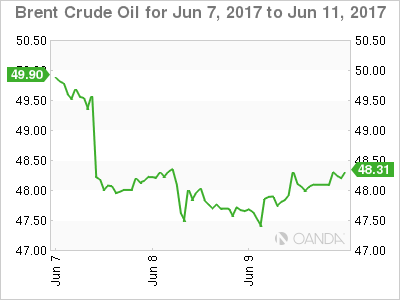
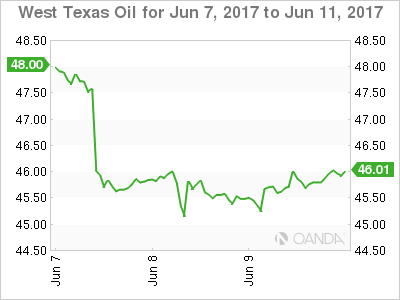
Crude paused for breath on Friday after a tumultuous week, with both Brent and WTI closing 20 cents higher, even as the Baker Hughes Rig Count showed its mandatory rise by another 11 rigs to 927.
Over the weekend both the Saudi and Russian energy ministers stated they saw no need to revisit the size of the cuts from the OPEC/Non-OPEC production deal. The Saudi’s also went so far as to say the surge in inventories was transitory and that the data should start to see a clear run down sooner rather than later. Hopefully much sooner from OPEC’s point of view, one would think.
It has given both crude contracts a positive start this morning with Brent spot trading 48.25 and WTI spot 45.95.
Brent spot has resistance at 48.50 and then 48.80 with support at 47.25.
WTI spot has resistance at 46.10 and then 46.50 with support at 45.00.
Precious Metals
Gold
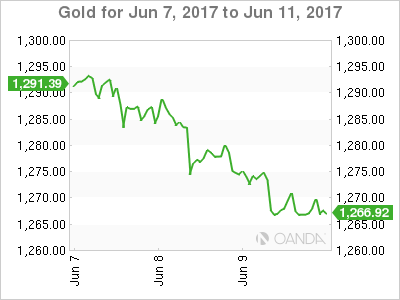
The weak price action in gold continued into the weeks end with Friday marking the 3rd consecutive lower close of the week. The expected weekend risk hedging did not materialise with gold closing around its lows at 1266.25.
With the U.K. event risk successfully negotiated, it would appear the market is putting more emphasis on this week’s FOMC rate hike, with the street having priced this as an almost 100% certainty. The key to gold’s performance will be the updated Summary of Economic Projections and the long run equilibrium of unemployment. The market will be anxiously watching to see if the Federal Reserve has become more dovish in its outlook. It should support gold, although if the Fed stays on its weaker data is transitory track; this will likely weigh on the yellow metal.
Asia has started the week’s session quietly with gold trading at 1269.40. Gold has resistance at 1271.40 and then 1289.00 with support at 1266.25 and then 1259.00.
Silver
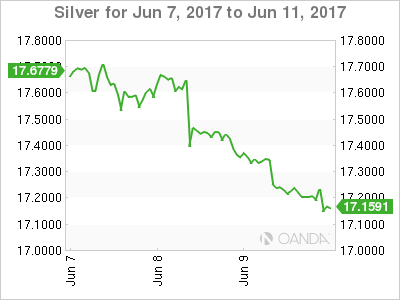
Silver has continued its negative price action having lead gold lower last week. It is trading at 17.1600 in Asia with the important 17.0000 psychological support in sight. A break of this level could see more stop-losses come to the market.
Meanwhile, resistance remains robust above at the 17.5000/17.5500 region. It contains Friday’s pre-sell-off high and the 100 and 200-day moving averages.
Palladium
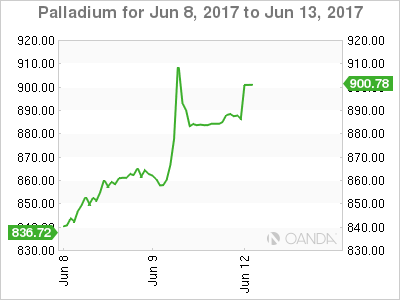
Palladium was the star of the show on Friday. Exploding higher by 7.30 % to 918.00 at one stage before finishing at 884.00 for a still very respectable gain of 3.35 %.
The emotional scenes play to Palladium’s industrial uses rather than as a pure precious metal play. The futures curve has moved into and aggressive backwardation, meaning that the spot price is much higher than the futures prices. It implies that supplies for immediate delivery are very tight.
The price action itself had the look of panic stop-loss buying by industrial users who had waited for it to follow gold, silver and platinum lower.
Palladium trades quietly at 888.50 this morning in Asia with the region mostly likely awaiting direction from Europe.
Resistance is Friday’s highs around 918.00 with support at 854.00 and 830.00.
Daily Technical Analysis: GBP/USD Awaits S&R Breakout After UK Election 2017
Currency pair GBP/USD
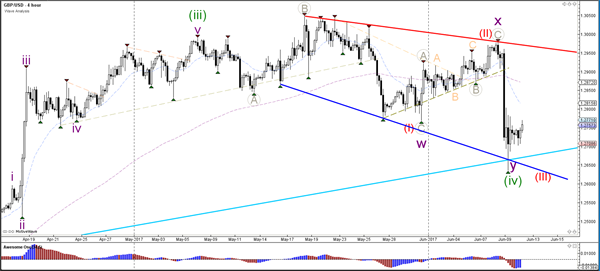
The GBP/USD has two likely wave scenarios after last week's general parliamentary election in the UK. One variant is bullish where the Cable is completing a retracement within wave 4 (green). The alternative is a bearish reversal as indicated by the impulsive wave 123 (red). A breakout above the solid support and resistance (S&R) trend lines would indicate which direction is more likely.
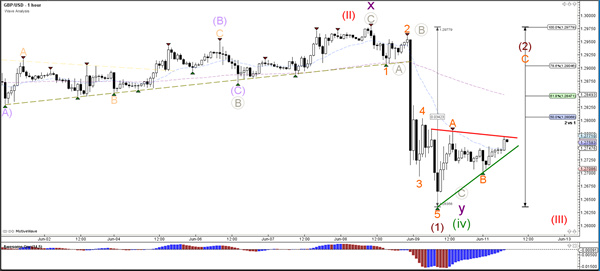
The GBP/USD could be building an ABC (orange) correction but a break above the 100% level invalidates the bearish wave 2 (brown).
Currency pair EUR/USD
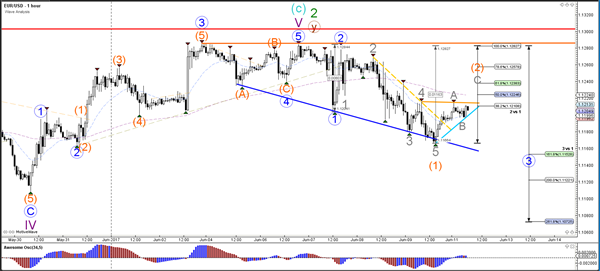
The EUR/USD was unable to break the 100% Fib resistance level at 1.13 (red line) and the failure to break the 1.13 invalidation level keeps the current wave structure intact. A break below support (blue) would increase the chance of a wave 3 (blue).
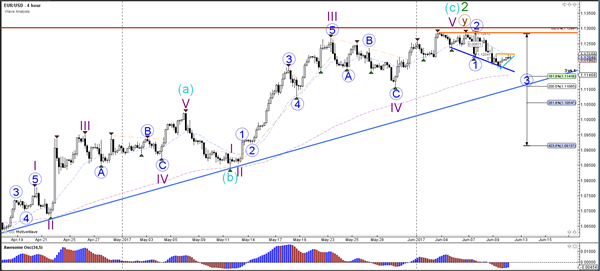
The EUR/USD invalidates wave 2 (orange) if price manages to break above the 100% Fib level.
Currency pair USD/JPY
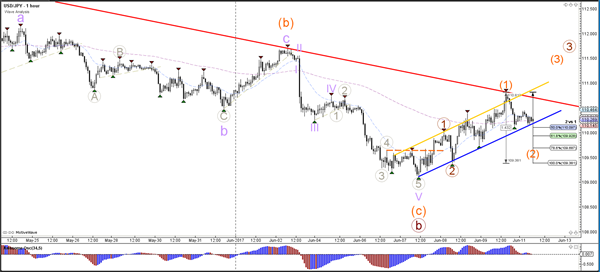
The USD/JPY is testing both support (blue) and resistance (red) trend lines. A break above resistance could see price challenge the Fibs of wave 3 (brown).
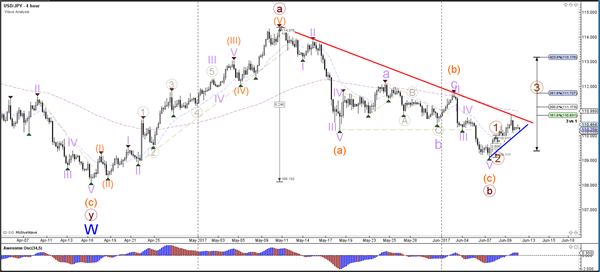
The USD/JPY would invalidate the wave 2 (orange) if price breaks below the 100% Fibonacci level.
European Open Briefing: Markets Had A Relatively Quiet Start Into The New Trading Week
Global Markets:
- Asian stock markets: Nikkei down 0.60 %, Shanghai Composite fell 0.45 %, Hang Seng declined 1.05 %
- Commodities: Gold at $1269 (-0.20 %), Silver at $17.12 (-0.60 %), WTI Oil at $46.05 (+0.50 %), Brent Oil at $48.40 (+0.50 %)
- Rates: US 10-year yield at 2.22, UK 10-year yield at 1.00, German 10-year yield at 0.26
News & Data:
- Japan Core Machinery Orders m/m -3.1 % vs 0.5 % expected
- Japan Core Machinery Orders y/y 2.7 % vs 7.3 % expected
- Japan PPI m/m 0.0 % vs 0.1 % expected
- Japan PPI y/y 2.1 % vs 2.2 % expected
- Sterling steadies as British PM scrambles after poll shock, dollar awaits Fed – RTRS
CFTC Positioning Data:
- EUR long 74K vs 73K long last week. Longs increased 1K. Largest long position since 2007
- GBP short 37K vs 30K short last week. Shorts increased by 7K
- JPY short 55K vs 52K short last week. Shorts increased by 3K.
- CHF short 17K vs 19K short last week. Shorts trimmed by 2K
- CAD short 94K vs 98K short. Shorts trimmed by 4K. Near record levels still.
- AUD square vs 3K long. Shorts trimmed 3K
- NZD short 2K vs 5K short last week. Shorts trimmed 3K
Markets Update:
Markets had a relatively quiet start into the new trading week. The Euro consolidated in a 1.1200-10 range, while GBP/USD traded between 1.2710 and 1.2770. The Pound is likely to suffer from the political uncertainty in the near-term, and selling interest on larger rallies will be high. Strong resistance is seen at 1.2820 and ahead of 1.29.
USD/JPY is slightly lower amid a decline in Asian stock markets. The pair fell from 110.45 to 110.15 in Asia. The short-term outlook is mixed. Should USD/JPY fail to break above 111 resistance soon, a retest of 109 seems likely.
AUD/USD consolidated in a 10 pips range overnight. Important support lies at 0.75. A break below would suggest that momentum is still too weak, and that a return to 0.7380 support is likely.
Overall, volatility in the FX market is likely to remain low ahead of the Fed meeting on Wednesday. The central bank is expected to increase interest rates, but the focus will be on the FOMC projections and statement. A cautious Fed could bring the Dollar under additional pressure.
Upcoming Events:
- 09:00 BST – Italian Industrial Production
- 09:30 BST – RBA Assistant Governor Debelle speaks
The Week Ahead:
Tuesday, June 13th
- 02:30 BST – Australian NAB Business Confidence
- 07:00 BST – German WPI
- 09:30 BST – UK CPI
- 10:00 BST – German ZEW Economic Sentiment
- 10:00 BST – Euro Zone ZEW Economic Sentiment
- 13:30 BST – US PPI
- 23:45 BST – New Zealand Current Account
Wednesday, June 14th
- 01:30 BST – Australian Westpac Consumer Sentiment
- 03:00 BST – Chinese Industrial Production
- 03:00 BST – Chinese Retail Sales
- 07:00 BST – German CPI
- 09:30 BST – UK Unemployment Rate
- 09:30 BST – UK Average Earnings
- 09:30 BST – UK Claimant Count Change
- 10:00 BST – Euro Zone Industrial Production
- 13:30 BST – US CPI
- 13:30 BST – US Retail Sales
- 19:00 BST – Fed Interest Rate Decision
- 19:30 BST – FOMC Press Conference
- 23:45 BST – New Zealand GDP
Thursday, June 15th
- 02:30 BST – Australian Employment Change
- 02:30 BST – Australian Unemployment Rate
- 07:45 BST – French CPI
- 08:15 BST – Swiss CPI
- 08:30 BST – SNB Rate Decision
- 08:30 BST – SNB Press Conference
- 09:00 BST – Italian CPI
- 09:30 BST – UK Retail Sales
- 10:00 BST – Euro Zone Trade Balance
- 12:00 BST – Bank of England Rate Decision
- 12:00 BST – Bank of England Meeting Minutes
- 13:30 BST – US Philadelphia Fed Manufacturing Index
- 14:15 BST – US Industrial Production
- 14:15 BST – US Manufacturing Production
- 15:00 BST – US NAHB Housing Market Index
Friday, June 16th
- 07:30 BST – Bank of Japan Press Conference
- 10:00 BST – Euro Zone CPI
- 13:30 BST – US Housing Starts
- 13:30 BST – US Building Permits
- 15:00 BST – US Michigan Consumer Sentiment