

Sample Category Title
EUR/USD Candlesticks and Ichimoku Analysis
Weekly
• Last Candlesticks pattern: Shooting star
• Time of formation: 03 May 2016
• Trend bias: Down
Daily
• Last Candlesticks pattern: Shooting star
• Time of formation: 3 May 2016
• Trend bias: Sideways
EUR/USD – 1.1208
As the single currency has retreated after faltering below resistance at 1.1285 (this month’s high), suggesting consolidation below this level would be seen, however, as long as support at 1.1109 holds, bullishness remains for recent upmove to resume after initial sideways trading, break of said resistance at 1.1285 would extend recent upmove from 1.0340 low to previous resistance at 1.1300, then 1.1327, however, near term overbought condition should limit upside to previous chart resistance at 1.1366 and reckon 1.1440-50 would hold from here, risk from there is seen for a retreat later.
On the downside, whilst initial pullback to 1.1160-65 cannot be ruled out, as long as support at 1.1109 holds, prospect of another rally remains. A daily close below said support at 1.1109 would defer and risk test of the Kijun-Sen (now at 1.1062) but a sustained breach below there is needed to suggest a temporary top is possibly formed instead, risk correction to 1.1025 (previous resistance now support), break there would add credence to this view, then correction to 1.0950-60 would follow, having said that, support at 1.0839 should remain intact.
Recommendation: Hold long entered at 1.1120 for 1.1320 with stop below 1.1105.

On the weekly chart, as euro has eased after rising to 1.1285 earlier this month, suggesting consolidation below this level would be seen and pullback to 1.1160-65 cannot be ruled out, however, reckon support at 1.1109 would limit downside and bring another rise later, above said resistance at 1.1285 would signal the rise from 1.0340 low is still in progress and bring a test of previous resistance at 1.1300 but a break of another previous resistance at 1.1366 is needed to signal early downtrend has ended at 1.0340, bring further subsequent rise to 1.1428, then towards 1.1500, having said that, price should falter well below another previous chart resistance at 1.1616.
On the downside, expect pullback to be limited to 1.1160-65 and bring another rise later to aforesaid upside targets. Below said support at 1.1109 would defer and risk weakness to the upper Kumo (now at 1.1091), then test of 1.1025 (previous resistance now support) but break there is needed to signal top is formed instead, bring further fall to 1.0965-70, however, 1.0922-28 (previous support and current level of the Tenkan-Sen) should remain intact, price should stay well above another previous support at 1.0839, bring another rise later.

Currencies: Tentative USD Rebound Slows As Tech Stocks Fall Off A Cliff
Sunrise Market Commentary
- Rates: Risk sentiment key, but FOMC can keep investors at bay
Today's eco calendar is empty. Risk sentiment could be key for trading, especially if European stocks pick up signals from WS. A correction lower is positive for core bonds via safe haven flows, but we don't expect big moves ahead of Wednesday's FOMC meeting. - Currencies: Tentative USD rebound slows as tech stocks fall off a cliff
On Friday, the dollar failed to maintain cautious intraday gains as US tech stocks nosedived later in the session. This morning, the euro doesn't profit from the Macron victory in France. A negative risk sentiment might be negative for USD/JPY, but neutral for EUR/USD as investors look forward to the Fed policy's decision on Wednesday
The Sunrise Headlines
- Nasdaq was hard hit on Friday (-1.8%) as heavy profit taking in the hugely overbought tech universe took place. Other US markets closed little changed. Asian equities are mostly lower (till about 1.2%) with a few positive outsiders.
- En Marche!, the party of president Macron is on track for a sweeping majority in the National Assembly. The party got 31.5% of the votes in the 1st round which should lead to a huge/absolute majority in the 2nd round a.
- UK PM May's office backtracked on a statement that a deal was reached with the Democratic Unionist Party (N-Ir), adding to a sense of chaos around her government after last week's disastrous election, and 8 days before Brexit talks.
- PM May could face a leadership challenge as soon as Tuesday if she fails to rally a meeting of her lawmakers that day, while five cabinet ministers are urging Johnson to oust her, the Sunday Times reported.
- Moody's downgraded South Africa's rating from Baa2 to Baa3, negative outlook, citing weakening of the institutional framework, reduced growth prospects and continued erosion of fiscal strength. It is now close to junk status, which is already the case at S&P and Fitch.
- The anti-establishment party Five Star Movement was brace for a setback in Italian municipal elections, as it failed to make run-off contests in many cities.
- Today's eco calendar is empty. Attention goes to the results of the French parliamentary and Italian local elections, UK PM May's struggle to safeguard her premiership and Friday's sell-off in Nasdaq
Currencies: Tentative USD Rebound Slows As Tech Stocks Fall Off A Cliff
Dollar rebound slows at Tech stocks tumble
On Friday, the swings in the major cross rates, excluding sterling, were modest. In a session deprived of important eco data, the dollar initially continued Thursday's gradual comeback. At the same time, Thursday's cautious ECB approach capped the topside of the euro. Later in the session, the dollar returned most of the intra-day gains, partially driven by a correction of US Tech stocks. EUR/USD closed the session at 1.1195. USD/JPY touched an intraday top in the 110.81 area, but closed the day at 110.32.
Overnight, there is little high profile economic news. Most Asian equity markets are feeling some fall-out from the tech correction in the US on Friday. For now, the impact on the major FX cross rates is modest. USD/JPY hovers sideways in the lower half of the 110 big figure. In France, Macron succeeded a major victory in the first round of the French parliamentary elections and will secure a comfortable majority in the second round. At least on the Asian markets, the French election doesn't support further euro gains. EUR/USD stabilises in the 1.1210 area.
There are no eco releases of interest. The political after-shocks from the UK election probably also won't be important for the major euro and USD cross rates. The convincing Macron victory is/was a potential positive for French/European equities and for the euro. However, in Asia the focus is on the US tech correction and this might also be the case at the European opening. Investors will also look forward to the FOMC meeting (Wedn). At the end of last week, the dollar started a bottoming out process as event risks (Comey, UK election, ECB) were out of the way, but the USD momentum petered out late on Friday. More technical trading ahead of the Fed policy decision is likely. If the Tech correction would continue or spread to other markets, USD/JPY remains most vulnerable. The picture for EUR/USD is neutral going into the Fed policy decision. We still favour the view that further EUR/USD gains will be difficult if sentiment on risk turns outright negative (negative pressure from EUR/JPY).
Technical picture
The USD/JPY rally ran into resistance in early May. A mini sell-off pushed the pair below the previous top (112.20), making the short-term picture negative. The post-payrolls USD sell-off below 110 deteriorated the picture further. The pair declined further in the 108.13/114.37 range. At the end of last week the USD/JPY decline slowed, but there is no convincing sign of a U-turn yet.
Earlier in May, EUR/USD failed to break below the 1.0821/1.0778 support (gap). Poor US data and US political upheaval propelled EUR/USD north of the 1.1023 range top. The pair initially reached a short-term correction top at 1.1268. There was a minor break after disappointing US payrolls, but no sustained followthrough gains occurred. The Trump top/correction top at 1.1300/1.1366 is next resistance. USD sentiment will have to be quite negative to clear this hurdle short-term. A return below 1.1023 would indicate that the upside momentum has eased.
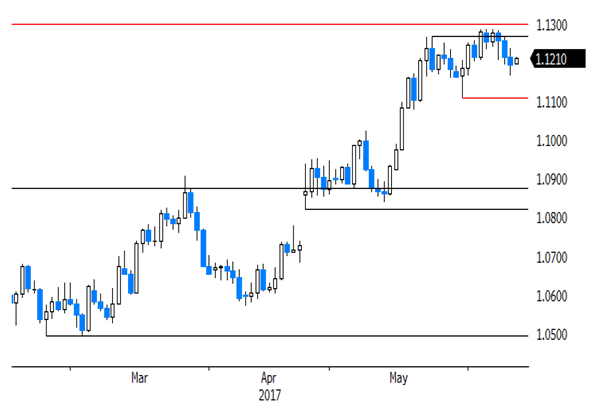
EUR/USD: Off the recent highs, but no follow-through losses
EUR/GBP
Sterling sell-off slows, but uncertainty continues to weigh
On Friday morning, investors adapted positions as UK PM May's conservative party lost its majority in Parliament. Sterling selling started in Asia as soon as it became clear that the UK was heading for a hung Parliament and reaccelerated early in Europe. EUR/GBP tested the 2017 top in the 0.8855 area. However, no sustained break occurred. On the contrary, the UK currency gradually found its composure and rebounded. Markets pondered whether the new political context could lead to a softer Brexit. Such a scenario could be less negative for sterling. The jury is still out on this issue as UK PM May wants to join forces with the Northern Ireland's DUP. EUR/GBP closed the session at 0.8682. Cable finished the week at 1.2746.
There are a gain no important eco data in the UK today. The focus will be on the political scene. Today and tomorrow May will face plenty political opposition in her own conservative party. It's unsure if this will lead to a resignation of May in the very short-term, but the pressure will remain. At the same time, there is a lot of speculation whether the new political context will lead to a softer Brexit. In theory this might be supportive/less negative for sterling, but it's too early to play this card already. For now we assume that political risk will prevail and that there is no trigger for a sustained sterling rebound yet.
From a technical point of view, EUR/GBP broke above the 0.8774 resistance and tested the 0.8854 area(2017 top) on Friday. A real break didn't occur. A retest of that area is possible. A break beyond would open the way to the 0.90 area. A return below the 0.8655 correction low would be an indication that the pressure on, sterling is easing
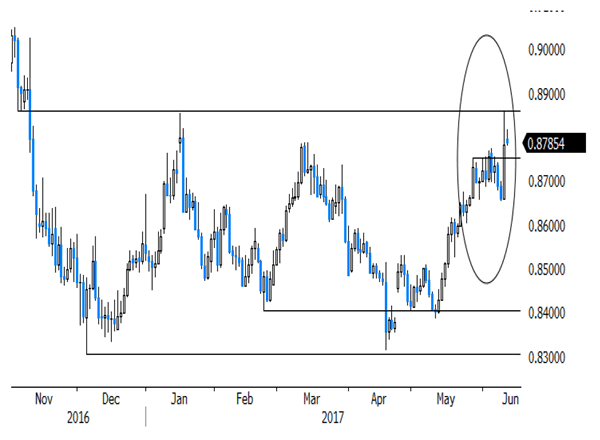
EUR/GBP: first test of 2017 top rejected, but sterling remains in the defensive
USD/JPY Candlesticks and Ichimoku Analysis
Weekly
• Last Candlesticks pattern: Marubozu
• Time of formation: 14 Nov 2016
• Trend bias: Down
Daily
• Last Candlesticks pattern: Shooting star
• Time of formation: 15 Feb 2017
• Trend bias: Down
USD/JPY – 110.29
As dollar has recovered after falling to 109.11, suggesting consolidation above this level would be seen and corrective bounce to 110.90-00 cannot be ruled out, however, reckon resistance at 111.71 (this month’s high) would hold from here and bring another decline later, below said support at 109.11 would extend the fall from 114.37 to minor support at 108.88 but loss of near term downward momentum should prevent sharp fall below recent low at 108.13, risk from there is seen for another rebound later.
On the upside, whilst initial recovery to 110.90-00 is likely, reckon upside would be limited to 111.50-55 and bring another decline later. A daily close above 111.71-74 (previous resistance and current level of the Kijun-Sen) would defer and suggest low is possibly formed, bring a strong recovery to resistance at 112.13 but reckon upside would be limited to 112.45-50 but price should falter below 113.12 and the greenback shall head south again later this month.
Recommendation : Sell at 111.50 for 109.50 with stop above 112.50.

On the weekly chart, despite last week’s fall to 109.11, lack of follow through selling and the subsequent rebound formed a doji star, hence consolidation above this level would be seen and test of the Tenkan-Sen (now at 111.25) cannot be ruled out, however, reckon upside would be limited to resistance at 111.71 and bring another decline later, below the lower Kumo (now at 109.38) would bring retest of 109.11, break there would extend the fall from 114.37 to 108.65-70 but reckon previous chart support at 108.13 would hold on first testing. In the event dollar drops below said support at 108.13, this would signal the fall from 118.66 top has resumed and extend weakness towards previous resistance at 107.49.
On the upside, expect recovery to be limited to 111.50 and resistance at 111.71 should hold, bring another decliner. Above said resistance at 111.71 would bring test of previous resistance at 112.13 but only break there would defer and risk a stronger rebound to 112.45-50, then 112.70-75, break there would suggest the retreat from 114.37 has ended instead, bring test of 113.10-15, then towards the Kijun-Sen (now at 113.37) but break of 113.85 is needed to signal another leg of rebound from 110.24 is underway for a retest of 114.37 later. Looking ahead, only break of said resistance at 114.37 would extend the rise from 108.13 to 114.60-65 (61.8% Fibonacci retracement of 118.66-108.13), then towards resistance at 115.51 which is likely to hold from here.

Trade Idea : USD/CHF – Hold short entered at 0.9720
USD/CHF - 0.9679
Most recent candlesticks pattern : N/A
Trend : Near term down
Tenkan-Sen level : 0.9686
Kijun-Sen level : 0.9703
Ichimoku cloud top : 0.9678
Ichimoku cloud bottom : 0.9660
Original strategy :
Sold at 0.9720, Target: 0.9620, Stop: 0.9755
Position : - Short at 0.9720
Target : - 0.9620
Stop : - 0.9755
New strategy :
Hold short entered at 0.9720, Target: 0.9620, Stop: 0.9720
Position : - Short at 0.9720
Target : - 0.9620
Stop : - 0.9720
Although dollar staged a strong rebound from last week’s low of 0.9613 to 0.9728 (last week’s high), the subsequent retreat has retained our bearishness and consolidation with mild downside bias remains for weakness to 0.9657 support, however, break of 0.9640 is needed to signal the rebound from 0.9613 has ended, bring retest of this level first. A break below this level would extend recent decline to 0.9600-05 (50% projection of 1.0100-0.9692 measuring from 0.9808) later.
In view of this, we are holding on to our short position entered at 0.9720. Above said resistance at 0.9728 would abort and signal a temporary low has been formed at 0.9613 last week instead, bring a stronger rebound to 0.9761 resistance but price should falter below resistance at 0.9808.

Trade Idea : GBP/USD – Hold short entered at 1.2760
GBP/USD - 1.2743
Most recent candlesticks pattern : N/A
Trend : Near term down
Tenkan-Sen level : 1.2750
Kijun-Sen level : 1.2722
Ichimoku cloud top : 1.2807
Ichimoku cloud bottom : 1.2769
Original strategy :
Sold at 1.2760, Target: 1.2630, Stop: 1.2795
Position : - Short at 1.2760
Target : - 1.2630
Stop : - 1.2795
New strategy :
Hold short entered at 1.2760, Target: 1.2660, Stop: 1.2785
Position : - Short at 1.2760
Target : - 1.2660
Stop : - 1.2785
Although the British pound rebounded after falling to 1.2635 on Friday, as long as resistance at 1.2780 holds, bearishness remains for recent decline to resume after consolidation, below 1.2695-00 would suggest the rebound from 1.2635 has ended, bring further fall to 1.2660-70, however, reckon said last week’s low at 1.2635 would hold on first testing. A break below this level would extend weakness to 1.2616 (previous resistance turned support) and possibly towards 1.2575-80 but reckon downside would be limited to 1.2550.
In view of this, we are holding on to our short position entered at 1.2760. Above 1.2780 would defer and risk a stronger rebound to 1.2800-05 but break there is needed to signal a temporary low has been formed, bring further gain to 1.2830-35 but price should falter below 1.2870-75 and bring another decline later.

Research UK: Minority Government Is Weak From The Beginning
Theresa May stays for now but is clearly weakened
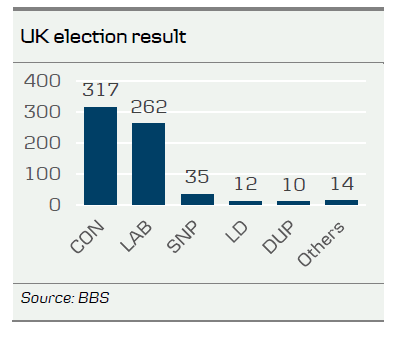
Final result. Conservative 317 seats, Labour 262 seats, Scottish National Party 35 seats, Liberal Democrats 12 seats, Democratic Unionist Party 10, Sinn Fein 7, Others 7.
While, as expected, PM Theresa May is forming a minority government supported by the Democratic Unionist Party (DUP), the bigger question is whether she is a 'dead woman walking', as previous Chancellor of the Exchequer George Osborne put it. PM Theresa May called for a snap election in order to consolidate power within the Conservative Party and House of Commons, as she was greatly ahead in opinion polls at that time. As it failed, Theresa May's position is clearly weakened and she had to let her two Chiefs of Staff (Nick Timothy and Fiona Hill) go. Gavin Barwell (moderate Conservative) has been appointed new Chief of Staff. The Telegraph writes that almost two-thirds of Conservative Party members want Theresa May to resign.
Still, it is not easy for the Conservatives to get rid of Theresa May now, as the Brexit negotiations are set to start soon and a leadership contest will only increase uncertainty. Note a leadership can be triggered in two ways: (1) If 15% of Conservative MPs lose confidence with the leader and (2) the leader resigns
Boris Johnson, seen by many as a candidate for succeeding Theresa May, has urged Conservatives to back Theresa May (reasons: (1) she won the most Conservative votes since Margaret Thatcher, (2) the government must focus on Brexit, (3) the people do not want a new election).
A likely scenario is that Theresa May stays for now but is replaced at a later point in time. Theresa May refused to answer yes when asked if she will stay a full term.
Minority government is weak from the beginning
Regarding the corporation between the Conservatives and DUP, we got some different messages over the weekend, not least since Downing Street's No 10 issued a statement saying a 'confidence and supply' deal was reached, which the DUP later rejected. Downing Street later said the statement was issued in error. The conclusion is that negotiations between Theresa May and the DUP are not concluded and are set to continue this week. Notice that the Conservatives have rejected a more formal agreement due to the DUP's views on same sex marriage, death penalty and abortion.
The Queen's speech, a speech held by the Queen, written by the government and which sets out the government's agenda for the coming year, is due to take place on 19 June.
Irish Prime Minister Enda Kenny wrote on Twitter that he has told PM Theresa May he is concerned about her relying on support from the DUP, as it may put the Good Friday agreement at risk.
Brexit: Theresa May challenged by both Brexiters and Remainers
On Brexit, PM Theresa May is being challenged by both Brexiters and Remainers. Most noticeable is Ruth Davidson, leader of the Scottish Conservative Party (who won 13 out of 59 Scottish seats, up from just one in 2015), has threatened to break away from the Conservatives to form a separate organisation, see The Telegraph.
Ms. Davidson has vowed to use the Scottish votes to prioritise the single market over curbing immigration, thus rejecting Theresa May's hard Brexit.
Sky News Sources say cabinet ministers are 'privately lobbying the PM to alter the Brexit plan from 'ideologically driven' approach to a 'pragmatic Brexit'.
Also, the EU seems to be taking advantage of the weak Prime Minister. See The Guardian. EU sources say it will take 12 months for the EU to change negotiating guidelines about the phased negotiations (first divorce bill, citizens' rights and Irish border, second future relationship), which PM Theresa May has rejected, as she wants the talks about the withdrawal agreement and the future relationship conducted simultaneously.
You can find an overview of the DUP's view on Brexit in a tweet from Open Europe here. The DUP wants to maintain the Common Travel Area and a frictionless border (and hence remain in the Customs Union), which indicates a softer Brexit, However the DUP's desire to have an 'effective immigration policy which meets the skills, labour and security needs of the UK' may imply a harder Brexit. The EU will be against this.
Theresa May has told Angela Merkel that the Brexit negotiations will start this month, see POLITICO.
Theresa May reappoints most important Cabinet members
Theresa May did not reshuffle the most important positions in her new cabinet. Philip Hammond is still Chancellor of the Exchequer (finance minister), which may surprise some given the conflicts between the two, but media reports indicate that she is too weak. Boris Johnson remains as Foreign Secretary, Amber Rudd as Home Secretary and David Davis is Brexit Secretary. Liam Fox is not among the most important cabinet members but continues as Trade Secretary. Michael Gove, who was sacked as Justice Secretary by Theresa May last year after he ran in the Conservative leadership contest after David Cameron resigned, has been appointed as Environment Secretary.
Damian Green (Remainer) is named Deputy Prime Minister, which may be an indication of a softer Brexit. Green will play an important role in the Brexit negotiations but his softer Brexit approach is likely to only be behind the scenes. See The Guardian.
Trump may not visit the UK after all
Sources say US President Trump has told PM Theresa May he refuses to visit the UK if there are public protests, see The Guardian. While both US and UK officials deny the story, it seems unlikely in our view that a US-UK free trade deal will be reached anytime soon, also given Trump is busy with many other things.
Trade Idea : EUR/USD – Sell at 1.1230
EUR/USD - 1.1206
Most recent candlesticks pattern : N/A
Trend : Up
Tenkan-Sen level : 1.1207
Kijun-Sen level : 1.1192
Ichimoku cloud top : 1.1231
Ichimoku cloud bottom : 1.1211
New strategy :
Sell at 1.1230, Target: 1.1130, Stop: 1.1265
Position : -
Target : -
Stop : -
Although the single currency rebounded after falling to 1.1166 on Friday and initial upside risk is seen for this rebound to extend gain towards 1.1231-37 (current level of the upper Kumo and previous resistance), however, reckon 1.1250 would hold, bring retreat later, below 1.1180 would bring retest of 1.1166 but break there is needed to extend the fall from 1.1285 top for retracement of early upmove to 1.1145-50 and then towards 1.1120 but support at 1.1109 should hold from here.
In view of this, we are inclined to sell euro on further subsequent recovery. Above 1.1265-70 would abort and bring retest of 1.1285, only break there would revive bullishness and confirm recent upmove has resumed and extend further gain to previous chart resistance at 1.1300, break there would encourage for headway to 1.1340-45 and later towards chart point at 1.1366.

Stock Markets Finished On A Strong Note On Friday
Market movers today
Today is a very quiet day in terms of economic data releases. We get Danish CPI for May, which we expect fall to 0.9% y/y from 1.1% in April due to a reversion of package holiday prices after the surge in April (Easter effect ), lower fuel prices and base effects from food prices.
Focus on the outcome of the UK and French elections. See below and our update on the UK election: Research UK: Hung parliament adds government risk premium to GBP, 9 June 2017.
The main event this week is the Fed meeting on Wednesday where in contrast to the consensus expectation and market pricing we think the Fed will stay on hold and instead make an announcement on balance sheet reduction.
Selected market news
Emmanuel Macon and his party La Republique en Marche won a sweeping victory in the first round of the French parliamentary election yesterday . According to polls Macron's party is on the way to win a clear majority in the French parliament with 70% of the seats when the second round of the election is held on Sunday. The Socialist party of Francois Hollande faced a humiliating defeat getting only 10 to 14% of the votes, which is likely to give them only 15-25 seats down from 284 seats currently. The National Front led by Marine Le Pen also suffered a poor election with only 13.5% of the vote, which would only add a couple of seats compared to today.
The result will give Macron a strong mandate for reforms in France and will put France in a role to strengthen the EU in alliance with Germany's Angela Merkel, who is again leading polls for the German election on 22 September. The latest German polls show a 14 -15 point lead for CDU/CSU over SPD. Macron's first test will be his proposed labour market reforms, which will encourage flexible company-based agreements between businesses and employees instead of industry-based deals. The reforms are likely to face strong resistance from the unions, which will be weakened by such a move.
In the UK some of The resa May's key ministers are working for a softer Brexit. With May clearly weakened after the UK election her vision of a 'clean break' is no longer on the table.
Stock markets finished on a strong note on Friday apart from US tech stocks (Nasdaq down close to 2%). Asian stock markets have traded mostly lower overnight , though.
The bearish tone in bond markets on Friday continued overnight in Asia ahead of the Fed meet ing this week. While the market is pricing a high probability of a Fed hike this week (around 90%) the rate path priced after that has become very subdued with the next hike not fully priced until mid-2018. We look for the Fed to skip hiking this week (and instead announce a plan for balance sheet reduction) but to hike in both July and December, see also Weekly Focus.
Trade Idea : USD/JPY – Stand aside
USD/JPY - 110.30
Most recent candlesticks pattern : N/A
Trend : Down
Tenkan-Sen level : 110.27
Kijun-Sen level : 110.47
Ichimoku cloud top : 110.04
Ichimoku cloud bottom : 109.80
Original strategy :
Sold at 110.20, stopped at 110.55
Position : - Short at 110.20
Target : -
Stop : - 110.55
New strategy :
Stand aside
Position : -
Target : -
Stop : -
Although the greenback jumped to as high as 110.81, lack of follow through buying on break of previous resistance at 110.73 and the subsequent retreat suggest consolidation below 110.81 would be seen and pullback to 110.00 cannot be ruled out, however, break of 109.75 support is needed to signal top is formed, bring further fall towards 109.38 but only break there would indicate the rebound from 109.11 has ended at 110.81, bring retest of this level later.
On the upside, above 110.50-60 would bring test of 110.81 but break there is needed to signal the erratic rise from 109.11 low is still in progress for further gain to 111.00 and possibly 111.20-30 but price should falter well below resistance at 111.71, bring retreat later. As near term outlook is mixed, would be prudent to stand aside in the meantime.

GBP Pares Losses But Huge Uncertainty Remains
- FTSE lower but GBP weakness remains supportive;
- GBP vulnerable as May’s weak and unstable government prepares for talks;
- Fed, BoE and BoJ to come later in the week.
Equity markets in Europe are expected to start the week a little softer, with the FTSE leading the losses as the UK index pares Friday’s gains and is weighed down by small gains in the pound.
The UK index came under some early pressure in futures markets on Friday as it became clear that we were headed for a hung parliament but as has now become the norm, it quickly rebounded to end the day more than 1% higher. While the negative knee jerk reaction to these results continues to be happen, the time taken to recover is getting shorter and shorter, with traders perhaps learning from past experience and capitalising on any dips.
Sterling’s sell-off on Friday clearly aided the bounce, ending the day more than 1.5% lower against the dollar and vulnerable to further downside. With Theresa May scrambling to repair the self-inflicted damage suffered as a result of the election, there remains a huge amount of uncertainty around her position and with only a week to go before Brexit talks with the EU begin, I feel there may be a few more twists to come yet. May has not delivered the strong and stable government she wanted and instead looks weak and vulnerable. I find it hard to see how she recovers from this.
While the election result and upcoming Brexit talks will likely remain a key talking point this week, there’s also a number of other events that markets will be very focused on. The start of the week may be quiet but we’ll get monetary policy decisions from the Federal Reserve, Bank of England and Bank of Japan on Wednesday, Thursday and Friday, respectively. The Fed will be of particular interest with markets now fully pricing in a rate hike and instead more concerned with whether they’ll signal another this year or focus more on balance sheet reduction.