

Sample Category Title
Research US: Trump’s Budget Seems Dead On Arrival In Congress – Do Not Expect Too Much Of Trumponomics
Yesterday, the Trump administration released the long-awaited budget for the fiscal year 2018 and the administration's priorities for the next 10 years. The Trump administration expects to eliminate the government deficit by 2027 due to a combination of higher GDP growth (3% per year) and large welfare spending cuts.
We think it is unlikely the supply-side effects from Trump's economic policy (deregulation, tax reform,infrastructure investments) will increase GDP growth to 3% even if fully implemented.
The budget reflects the Trump administration's expectation of full implementation of its policy proposals,which we think is unlikely given the disagreement within the Republican Party. Although all Republicansshare the same goal to cut and simplify taxes, they disagree on the financing. While moderate Republicansdo not want to make big cuts in other parts of the budget, fiscal hawks do not want to increase thegovernment budget deficit/debt to finance this. Thus, we may see a repetition of the Republicans'difficulties to change Obamacare.
We do not expect the US Congress to pass a new budget before the fiscal year starts on 1 October, henceCongress likely needs to pass a short-term funding bill to keep the US government running. This alsomeans there is a risk of a government shutdown by 1 October –also note that the US Treasury exhausts itsextraordinary measures during the autumn and Congress has still not found a solution to the debt limitissue.
We maintain our long-held view that Trumponomicswill come later and be smaller than pledged. We do notexpect a deal on tax reform before end of the year, at the earliest.
The G7 Summit In Italy Will Be Held On Friday And Saturday
Market movers today
US durable goods orders will include the core capital goods orders, which is a good proxy for corporate investments. Core orders have moved higher since the middle of last year. The past months have shown somewhat slower momentum. The numbers today will show whether this was just a small pause or whether the loss of momentum is real. We expect investment growth to be robust this year based on strong earnings growth from the beginning of the year and improved sentiment among companies.
The US is due to release revised figures for Q1 GDP as well as for May consumer confidence from the University of Michigan. We do not expect any big revisions to these numbers.
The G7 Summit in Italy will be held on Friday and Saturday. It will be the first summit for US President Donald Trump, Brit ish Prime Minster Theresa May, French President Emmanuel Macron and Italian Prime Minister Paolo Gent iloni. The summit will among other things focus on the global economy and foreign policy. Issues such as protectionism, North Korea, the fight on terror and climate change are likely to be on the agenda.
In Norway, the important Q2 oil investment survey is due out (please see Scandi sect ion for more details).
Selected market news
This morning, emerging Asian currencies and stocks are trading on cautious note following the Moody's downgrade of China's credit rating, which hurt the out look for the region's t radedependent economies. Moody's cut China's rating to A1 from Aa3, citing a worsening out look for the nation's financial strength. We have in recent months pointed to the increasing stress symptoms in the Chinese financial markets and an imminent slowdown in the economy as the Chinese authorities seek to rein in the debt problems in the economy.
Yesterday, the Trump administ ration released its long-awaited budget for the fiscal year 2018 and the administ ration's priorit ies for the next 10 years. The Trump administ ration expects to eliminate the government deficit by 2027 due to a combination of higher GDP growth (3% per year) and large welfare spending cuts. The budget does not contain significant new details on tax reforms than the already known overall principles. We think it is going to be very difficult for the Trump administ ration to get the budget through the US Congress given the divisions in the Republican party and more generally we maintain our longheld view that Trumponomics will come later and be smaller than pledged. See Research US: Trump's budget seem s dead on arrival in Congress –do not expect too much of Trumponomics, 24 May 2017.
Aussie Dollar Trading Lower In The Asian Session
For the 24 hours to 23:00 GMT, the AUD rose 0.38% against the USD and closed at 0.7481.
On the economic front, Australia’s Westpac leading index declined 0.12% in April, from an increase of 0.08% reported in March. Additionally, the nation’s Q1 construction work done showed a bigger than expected fall, compared to revised 0.6% rise in the previous quarter.
LME Copper prices declined 0.29% or $16.5/MT to $ 5660.5/MT. Aluminium prices declined 0.87% or $17.0/MT to $ 1926.0/MT.
In the Asian session, at GMT0300, the pair is trading at 0.7452, with the AUD trading 0.39% lower against the USD from yesterday’s close.
The pair is expected to find support at 0.7427, and a fall through could take it to the next support level of 0.7402. The pair is expected to find its first resistance at 0.7497, and a rise through could take it to the next resistance level of 0.7542.
The currency pair is trading below its 20 Hr and 50 Hr moving averages.

Euro Trading Slightly Lower, Ahead Of Mario Draghi’s Speech
For the 24 hours to 23:00 GMT, the EUR declined 0.48% against the USD and closed at 1.1186.
Macroeconomic data showed that manufacturing PMI recorded an unexpected rise to a level of 57.0 in May in the Eurozone, against market expectations for the index to drop to 56.5, following a reading of 56.7 in the previous month. However, the services activity in the region eased to a two-month low of 56.2 from 56.4 reported in April, compared to expectations for an unchanged reading.
Elsewhere, in Germany, the region's powerhouse economy, the seasonally adjusted final gross domestic product (GDP) rose 0.6% on a quarterly basis in 1Q 2017, in line with market expectations. The preliminary figures had also indicated a rise of 0.6%, following an advance of 0.4% in the prior quarter.
Moreover, the manufacturing PMI in Germany unexpectedly rose to 59.4 in May, compared to a reading of 58.2 in the last month. Markets were anticipating manufacturing PMI to decline to a level of 58.0. Additionally, the nation's services activity unexpectedly slid to a level of 55.2 in May, from a reading of 55.4 reported in the previous month. Market anticipation was for services PMI to climb to a level of 55.5.
In other news, the German Ifo business climate index reached to a level of 114.6 in May from a revised prior reading of 113.0. Investors were expecting the index to climb to 113.1. Also, the Ifo current assessment index in the nation advanced unexpectedly to a level of 123.2 in the same month, compared to market expectations of a fall to a level of 121.0, after a revised reading of 121.4 in the previous month.
The greenback traded higher against its peers, after the nation's services PMI climbed to a four-month high in May with a reading of 54.0, which was above market forecasts of 53.2. In the prior month, the index had reported a level of 53.1. On the other hand, Markit flash manufacturing PMI surprisingly declined to 52.5 in May from 52.8 recorded in April, slipping to its lowest level in eight months. Markets were expecting the index to rise to 53.0.
Separately, sales of newly constructed homes fell 11.4% on a monthly basis in April to a seasonally adjusted annual rate of 569.0k, which was below analysts' estimates of a drop to 610.0k. In the previous month, news home sales had posted a reading of 642.0k.
In the Asian session, at GMT0300, the pair is trading at 1.1183, with the EUR trading a tad lower against the USD from yesterday's close.
The pair is expected to find support at 1.1149, and a fall through could take it to the next support level of 1.1116. The pair is expected to find its first resistance at 1.1242, and a rise through could take it to the next resistance level of 1.1302.
Going forward, investors will await a speech by the ECB President, Mario Draghi, scheduled later in the day, to get his insights into the Eurozone economy. Also, in the US, the FOMC meeting minutes along with weekly mortgage applications and existing home sales data for April, all due to release today, will garner a lot of market attention.
The currency pair is trading below its 20 Hr and 50 Hr moving averages.

UK Public Sector Net Borrowing Rose In April
For the 24 hours to 23:00 GMT, the GBP declined 0.32% against the USD and closed at 1.2961, after a suspected terrorist attack in UK's Manchester city killed at least 22 people and left around 60 people injured.
On macro front, UK's public sector net borrowing reported a deficit £9.6 billion in April, from a revised deficit of £2.3 billion in the previous month. Markets were expecting public sector net borrowing to show a deficit of £8.0 billion.
In the Asian session, at GMT0300, the pair is trading at 1.2967, with the GBP trading 0.05% higher against the USD from yesterday's close.
The pair is expected to find support at 1.2935, and a fall through could take it to the next support level of 1.2904. The pair is expected to find its first resistance at 1.3016, and a rise through could take it to the next resistance level of 1.3066.
With no economic release in the UK today, investors will look forward to global macroeconomic data for further direction in Pound.
The currency pair is trading below its 20 Hr and 50 Hr moving averages.

Japanese Yen Trading Lower This Morning
For the 24 hours to 23:00 GMT, the USD rose 0.43% against the JPY and closed at 111.80.
On macro front, Japan's final machine tool orders rose 34.7% YoY in April, meeting the initial estimates.
In the Asian session, at GMT0300, the pair is trading at 111.89, with the USD trading 0.08% higher against the JPY from yesterday's close.
Meanwhile, Bank of Japan (BoJ) Governor, Haruhiko Kuroda, stated that uncertainty about the natural interest rate is making it difficult for central bankers to steer policy. He further commented that the natural rate of interest has been falling globally, which has led central banks to adopt unconventional economic policies.
The pair is expected to find support at 111.2, and a fall through could take it to the next support level of 110.52. The pair is expected to find its first resistance at 112.28, and a rise through could take it to the next resistance level of 112.68.
The currency pair is trading above its 20 Hr and 50 Hr moving averages.

Switzerland’s Trade Surplus Narrowed In April
For the 24 hours to 23:00 GMT, the USD rose 0.18% against the CHF and closed at 0.9757.
Meanwhile, data showed that Swiss trade surplus dropped to CHF 1.97 billion in April, from a revised trade surplus of CHF 3.04 billion in the previous month, as its industrial sector continued to struggle with the strong currency and pharmaceuticals exports slowed. Additionally, the nation's exports fell 2.5% in April, compared to a revised rise of 1.8% last month. On the other hand, imports climbed 2.6% on a MoM basis, from a revised 0.6% rise in the prior month.
In the Asian session, at GMT0300, the pair is trading at 0.9759, with the USD trading marginally higher against the CHF from yesterday's close.
The pair is expected to find support at 0.9719, and a fall through could take it to the next support level of 0.968. The pair is expected to find its first resistance at 0.9781, and a rise through could take it to the next resistance level of 0.9804.
The currency pair is trading above its 20 Hr and 50 Hr moving averages.

Canadian Dollar Trading Lower, Ahead Of BoC’s Interest Rate Decision
For the 24 hours to 23:00 GMT, the USD declined 0.03% against the CAD and closed at 1.3515.
In economic news, wholesales sales rose less than expected by 0.9% in March, compared to a revised gain of 0.3% in the previous month. Investors had anticipated a 1.0% rise.
In the Asian session, at GMT0300, the pair is trading at 1.3531, with the USD trading 0.12% higher against the CAD from yesterday's close.
The pair is expected to find support at 1.3481, and a fall through could take it to the next support level of 1.343. The pair is expected to find its first resistance at 1.3557, and a rise through could take it to the next resistance level of 1.3582.
Moving forward, all eyes would be on the Bank of Canada's (BoC) monetary policy meeting, scheduled later in the day.
The currency pair is trading above its 20 Hr and 50 Hr moving averages.

Daily Technical Analysis: EUR/USD Reversal Or Correction After Rising Wedge Break
Currency pair EUR/USD
The EUR/USD failed to break above the 1.1250-1.13 resistance zone and showed a bearish reversal or correction. Price also broke below the rising wedge chart pattern which is indicated by the broken support (dotted green) and resistance (red).
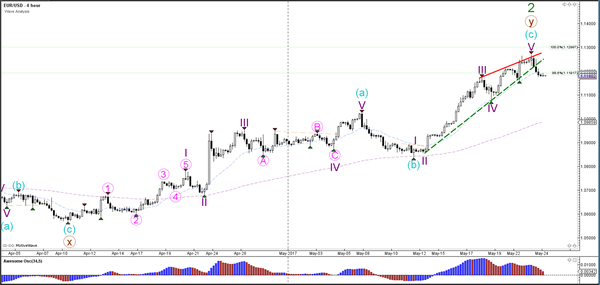
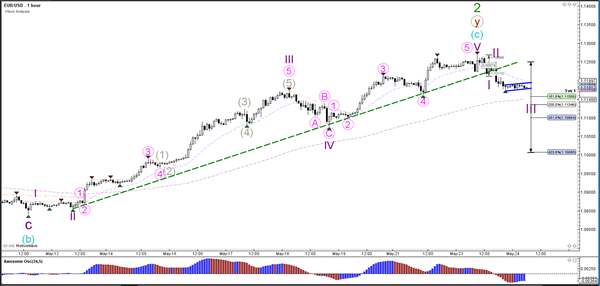
The EUR/USD seems to have completed the 5th waves (pink/purple) and price could either be retracing within the uptrend or starting a new downtrend. The wave count is showing a bearish 123 (purple) wave pattern, which would become more likely if price manages to break the bear flag (blue lines) and fall towards 1.11-1.1130. Otherwise the bearish price action runs the risk of being a correction which becomes likely if price manages to push above 1.1250.
Currency pair USD/JPY
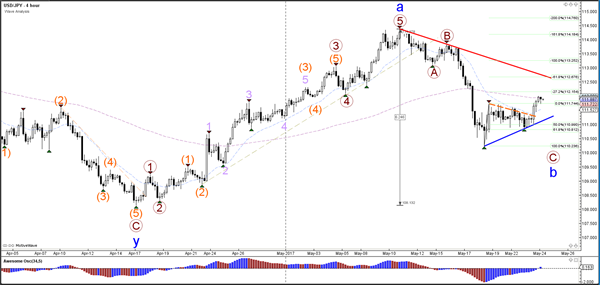
The USD/JPY broke the resistance trend line (dotted orange) and is approaching the -27.2% Fibonacci target. A bearish bounce could indicate a continuation of the downtrend but a break above 112-112.50 would indicate that the wave C (brown) of wave B (blue) is completed at the recent low.
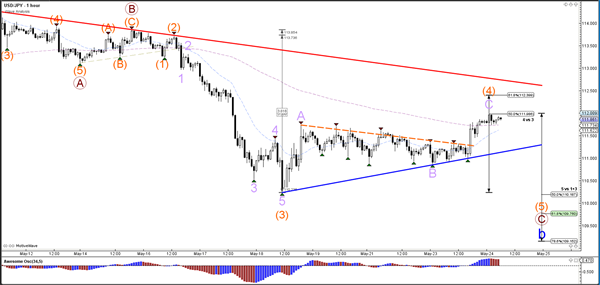
The USD/JPY is building a potential wave 4 (orange) correction and a wave 5 (orange) continuation before completing wave C (brown). However if price breaks above the 61.8% Fibonacci level of wave 4 (orange), then a different wave structure seems likely.
Currency pair GBP/USD
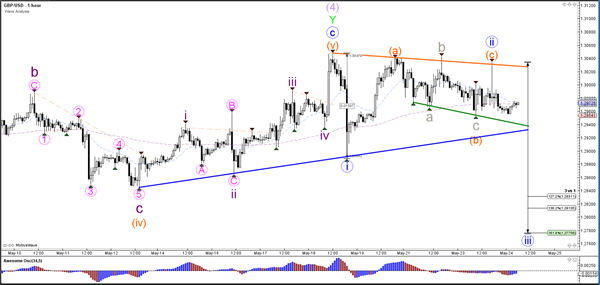
The GBP/USD has been unable to break above resistance (red/orange) levels which could mean that the Cable is still in a wave 1-2 (blue). A break above the orange trend line indicates the invalidation of wave 2 and the potential for an uptrend continuation whereas but a break below the channel support (green/blue) could see a reversal take place.
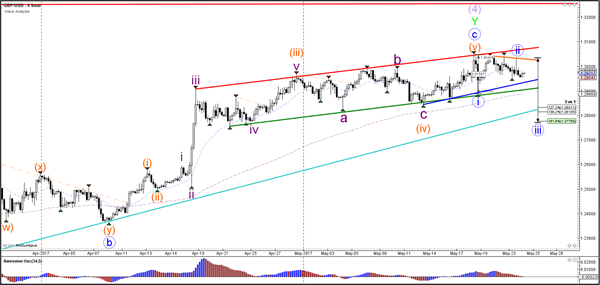
The GBP/USD has been unable to break above resistance (red/orange) levels which could mean that the Cable is still in a wave 1-2 (blue). A break above the orange trend line indicates the invalidation of wave 2 and the potential for an uptrend continuation whereas but a break below the channel support (green/blue) could see a reversal take place.
Daily Technical Outlook And Review: EUR/USD, GBP/USD, AUD/USD, USD/JPY, USD/CAD, USD/CHF, DOW 30, GOLD
A note on lower timeframe confirming price action...
Waiting for lower timeframe confirmation is our main tool to confirm strength within higher timeframe zones, and has really been the key to our trading success. It takes a little time to understand the subtle nuances, however, as each trade is never the same, but once you master the rhythm so to speak, you will be saved from countless unnecessary losing trades. The following is a list of what we look for:
- A break/retest of supply or demand dependent on which way you're trading.
- A trendline break/retest.
- Buying/selling tails ... essentially we look for a cluster of very obvious spikes off of lower timeframe support and resistance levels within the higher timeframe zone.
- Candlestick patterns. We tend to only stick with pin bars and engulfing bars as these have proven to be the most effective.
We typically search for lower-timeframe confirmation between the M15 and H1 timeframes, since most of our higher-timeframe areas begin with the H4. Stops are usually placed 1-3 pips beyond confirming structures.
EUR/USD
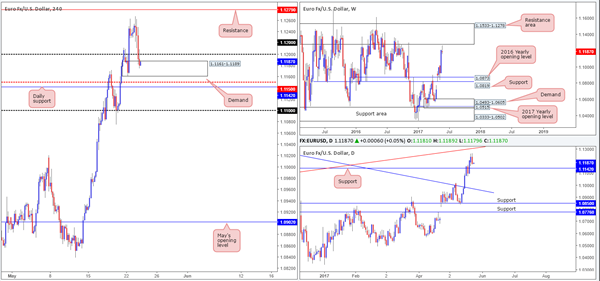
Kicking this morning's report off with a look at the weekly timeframe reveals that price recently came within striking distance of a formidable resistance area coming in at 1.1533-1.1278. As you can see, the pair responded bearishly and has, at the time of writing, chalked up a reasonably strong selling wick.
Moving down to the daily timeframe, the single currency was unable to challenge the trendline resistance etched from the low 1.0711, before turning south yesterday. This has placed the EUR nearby a neighboring support penciled in at 1.1142, which boasts strong historical significance noted all the way back to early 2015!
Looking over to the H4 timeframe, the recent selloff saw the market surpass the 1.12 handle going into yesterday's London close, which left price free to test demand at 1.1161-1.1189. We find this demand appealing due to the robust momentum seen from the base. However, buying from here is risky for several reasons. Firstly, the 1.12 handle could be a potentially troublesome resistance barrier to overcome. Secondly, not only do we have the H4 mid-level support at 1.1150 plotted a few pips below; we also have the said daily support lurking just below that. In addition to this, let's remember where weekly price is trading FROM (see above)!
Our suggestions: From our perspective, we do not see a lot to hang our hat on at the moment. Entering long is not really something we would advise for reasons stated above. And playing this market short, knowing that we're trading within H4 demand that sits above a daily support, is also just as risky we believe.
Therefore, we feel remaining on the sidelines may very well be the better path to take for the moment.
Data points to consider: ECB President Draghi speaks at 1.45pm. FOMC meeting minutes at 7pm, FOMC member Kaplan speaks at 11pm GMT+1.
Levels to watch/live orders:
- Buys: Flat (stop loss: N/A).
- Sells: Flat (stop loss: N/A).
GBP/USD
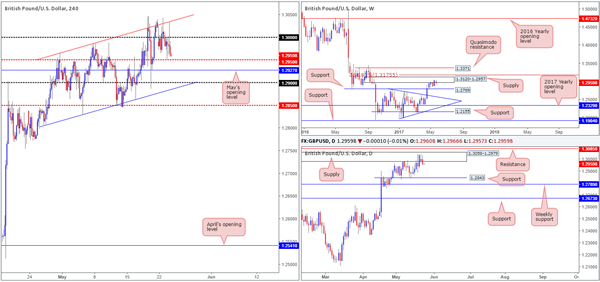
In recent trading, the GBP/USD crossed below the large psychological handle 1.30 and is now seen within shouting distance of the H4 mid-level support at 1.2950. The UK Prime Minister Theresa May recently came out and stated that the UK's terror threat level has been raised to critical, which undoubtedly helped push the GBP lower. With that being said though, we can also see that the technical landscape indicates further selling could be on the cards. The pair remains trading within the walls of a weekly supply base drawn from 1.3120-1.2957, and daily action continues to trade around supply seen within the said weekly supply at 1.3058-1.2979.
Our suggestions: While we believe the bears will continue to drive lower, selling knowing that price is lurking just ahead of 1.2950, followed closely by May's opening level at 1.2927, is just too risky for our liking.
The nearest support target seen on the higher timeframes at the moment is the daily support coming in at 1.2843. This sits just below the H4 mid-level support at 1.2850. In the event that price reaches the H4 channel support etched from the low 1.2804, there's a good chance that we'll witness a rotation from here. At the same time though, one should also expect a possible fakeout down to 1.2850 given its connection with the said daily support before we see serious buyers step in here.
Data points to consider: FOMC meeting minutes at 7pm, FOMC member Kaplan speaks at 11pm GMT+1.
Levels to watch/live orders:
- Buys: Currently have our eye on longs around the H4 channel support taken from the low 1.2804.
- Sells: Flat (stop loss: N/A).
AUD/USD
(Trade update: Stopped out for a loss at 0.7490).
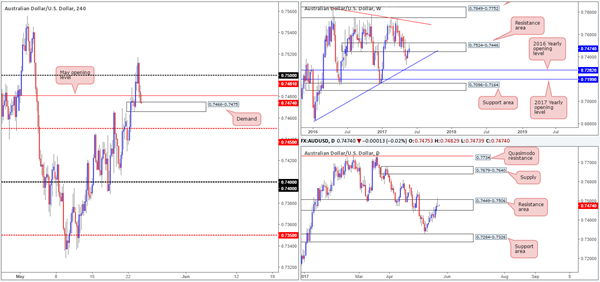
Unable to sustain gains beyond the 0.75 handle yesterday, the commodity currency turned lower and ended the day closing below May's opening level at 0.7481. What's also notable from a technical perspective is that H4 price is now seen trading within the confines of a small demand base drawn from 0.7466-0.7475.
Over on the bigger picture, the weekly resistance area at 0.7524-0.7446 remains in play, as does the daily resistance zone which is seen housed within the said weekly area at 0.7449-0.7506. Also of interest here is the daily selling wick printed during yesterday's segment.
Our suggestions: Entering long from the current H4 demand is not really something our desk would be comfortable with in light of the higher-timeframe structure. So, with that in mind, we are expecting this H4 area to give way at some point during the day and see price challenge the H4 mid-level support pegged at 0.7450. It would only be upon seeing a decisive H4 close beyond 0.7450 would the team become interested in shorts.
While there are two H4 demands located below this number seen marked with green circles around 0.7440/0.7416, we believe these areas will easily be consumed and price will at least achieve the 0.74 handle, as let's not forget that we have higher-timeframe sellers currently in the game!
As a result, a close below 0.7450 and a retest as resistance, followed by a reasonably sized H4 bearish candle (preferably a full-bodied candle), would have us looking to short, targeting 0.74.
Data points to consider: FOMC meeting minutes at 7pm, FOMC member Kaplan speaks at 11pm GMT+1.
Levels to watch/live orders:
- Buys: Flat (stop loss: N/A).
- Sells: Watch for H4 price to engulf 0.7450 and then look to trade any retest seen thereafter ([waiting for a H4 bearish candle to form following the retest is advised] stop loss: ideally beyond the candle's wick).
USD/JPY
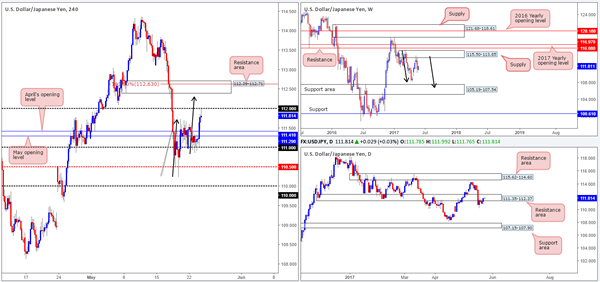
With US bond yields advancing, we saw the USD/JPY bulls go on the offensive yesterday from the 111 handle. The move took out May/April's opening levels at 111.29/111.41 and has recently seen the pair challenge the 112 handle. Although the bulls do look incredibly strong at the moment, it might be worth noting that daily price is seen trading within a resistance area at 111.35-112.37. In addition to this, there's a H4 AB=CD pattern that terminates between 112 and a H4 resistance area coming in at 112.39-112.71.
Our suggestions: Given that this H4 resistance area converges closely with the AB=CD pattern, we are interested in shorting from here. More specifically, we are interested in selling from the H4 AB=CD 161.8% Fib ext. at 112.63, with stops planted at 112.81 (this gives us 10 pips breathing space above the current H4 area).
Data points to consider: FOMC meeting minutes at 7pm, FOMC member Kaplan speaks at 11pm GMT+1.
Levels to watch/live orders:
- Buys: Flat (stop loss: N/A).
- Sells: 112.63 ([pending order] stop loss: 112.81).
USD/CAD
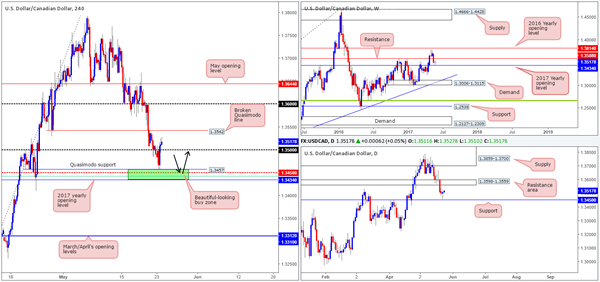
For those who read Tuesday's report you may recall our desk highlighting that a pending buy order was placed at 1.3548 with a stop set at 1.3408. Our rationale behind setting this order was due to a very appealing H4 buy zone seen marked in green at 1.3434/1.3457. This area boasted a H4 Quasimodo support at 1.3457, a H4 61.8% Fib support at 1.3441 taken from the low 1.3223 (green line), a H4 mid-level support at 1.3450 which also happens to represent daily support and the 2017 yearly opening level seen on the weekly chart at 1.3434.
As you can see, our order was filled yesterday and price has rallied beyond the 1.35 handle. We took 50% off the table around 1.35 and reduced risk to breakeven, so we're effectively in a free trade right now. Our next port of call is 1.3542: a H4 broken Quasimodo line. And then beyond here we have our eye on the 1.36 handle. Price, however, may struggle to reach 1.36, since before this number we have to contend with a daily resistance area at 1.3598-1.3559 and a weekly resistance level at 1.3588.
Well done to any of our readers who managed to join us on this trade.
Data points to consider: FOMC meeting minutes at 7pm, FOMC member Kaplan speaks at 11pm GMT+1. BoC Rate statement at 3pm, Crude oil inventories at 3.30pm GMT+1.
Levels to watch/live orders:
- Buys: 1.3458 ([pending order] stop loss: Breakeven).
- Sells: Flat (stop loss: N/A).
USD/CHF
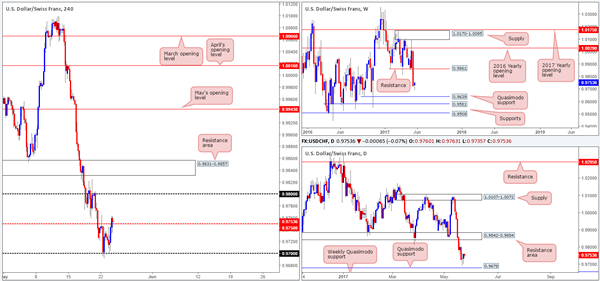
With the EUR/USD selling off during yesterday's segment, USD/CHF bulls found another pocket of bids around the 0.97 handle. Rallying to a high of 0.9763 and closing above the H4 mid-level resistance at 0.9750, the pair now looks poised to continue north and test the 0.98 handle. The bigger picture also indicates that there's room to advance north, with the closest resistance not coming into view until 0.9842-0.9884: a daily resistance area that houses a weekly resistance level at 0.9861.Should 0.9750 hold firm as support today, this could be a reasonably logical platform in which to look for a long setup from, targeting 0.98, followed closely by the H4 resistance area at 0.9831-0.9857.
Our suggestions: Personally, we'll need to see not only H4 price hold firm around 0.9750, but we'd also like to see a lower-timeframe buy setup (see the top of this report) before pulling the trigger.
Data points to consider: FOMC meeting minutes at 7pm, FOMC member Kaplan speaks at 11pm GMT+1.
Levels to watch/live orders:
- Buys: 0.9750 region ([waiting for a lower-timeframe buy signal to form before pulling the trigger is advised] stop loss: dependent on where one confirms the area).
- Sells: Flat (stop loss: N/A).
DOW 30
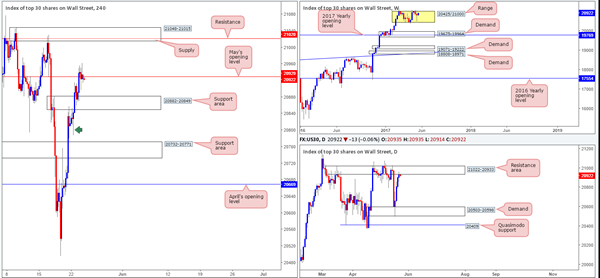
As can be seen from the H4 chart, US equities were slightly more subdued on Tuesday as price spent the day seesawing around May's opening level at 20929. With daily price now teasing the underside of a resistance area at 21022-20933, and weekly action heading towards the top edge of its current range at 20425 (yellow area), we believe the bears may make an appearance soon. While this may be the case, shorting is risky seeing as how there's a H4 support area plotted nearby at 20882-20849.
Our suggestions: Wait for H4 price to close below the current H4 support area. Once/if this occurs, then we see little stopping price from trading down to the H4 support area coming in at 20732-20771, followed by April's opening level at 20669. The reason for not including the H4 demand base seen below around the 20816ish area simply comes down to the large H4 demand consumption tail seen marked with a green arrow at 20788.
Data points to consider: Several FOMC members set to take the stage at different times today.
Levels to watch/live orders:
- Buys: Flat (stop loss: N/A).
- Sells: Watch for H4 price to engulf 20882-20849 and then look to trade any retest seen thereafter ([waiting for a H4 bearish candle to form following the retest is advised] stop loss: ideally beyond the candle's wick).
GOLD
(Trade update: Closed the remainder of our long position at 1257.8).
Gold prices pulled back yesterday as the dollar recovered from lows of 96.80. Leaving the H4 61.8% Fib resistance at 1264.5 (green line) extended from the high 1295.4 unchallenged, the yellow metal sold off from H4 supply at 1268.3-1262.7. The move, as you can see, brought bullion down to within striking distance of March/April's opening levels at 1245.9/1248.0. Whether these lines can hold the market higher for a second time is difficult to judge, since there are daily sellers likely in play now from the resistance area drawn from 1265.2-1252.1. Also noteworthy here is the daily bearish engulfing candle printed yesterday!
Our suggestions: With the above information in mind, where does this leave us in terms of potential setups? Well, we do not really favor a second bounce from the above said H4 monthly levels knowing that daily sellers could drag price below here. And selling would be highly risky without a decisive H4 close seen beyond these two monthly levels. But even then, the bears would have to contend with the H4 trendline support etched from the high 1278.0.
Therefore, opting to stand on the sidelines here may very well be the better path to take today.

Levels to watch/live orders:
- Buys: Flat (stop loss: N/A).
- Sells: Flat (stop loss: N/A).