

Sample Category Title
AUD/USD Daily Outlook
Daily Pivots: (S1) 0.7456; (P) 0.7486; (R1) 0.7507; More...
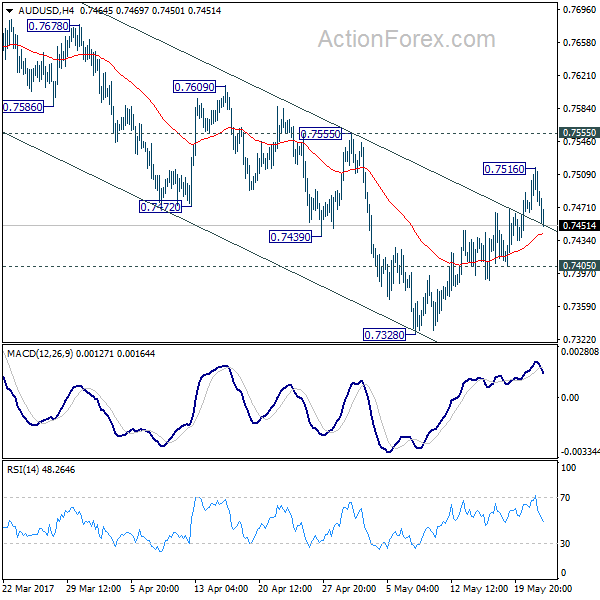
A temporary top is in place at 0.7516 and intraday bias is turned neutral first. With 0.7555 resistance intact, fall from 0.7748 is still expected to continue. Below 0.7405 minor support will turn bias to the downside for 0.7382. Break there will target 0.7144/7158 support zone. However, firm break of 0.7555 will argue that fall from 0.7748 is completed and turn bias back to the upside.
In the bigger picture, we're still treating price actions from 0.6826 low as a corrective pattern. And, as long as 38.2% retracement of 0.9504 to 0.6826 at 0.7849 holds, long term down trend from 1.1079 is expected to resume sooner or later. Break of 0.6826 low will target 0.6008 key support level. However, firm break of 0.7849 will indicate that rise from 0.6826 is developing into a medium term rebound, rather than a sideway pattern. In such case, stronger rise should be seen to 55 month EMA (now at 0.8115) and above.

Commodities Diverge In Asian Trading
Commodities diverge as Oil settles near its recent highs ahead of tomorrow's OPEC meeting, while Gold feels the pain of a stronger U.S. Dollar.
Crude recovered from its early losses overnight with both Brent and WTI finishing roughly unchanged as both contracts head into a pre-OPEC meeting holding pattern. President Trump's proposal to sell half of the United States' Strategic Petroleum Reserve had only a transitory effect, with guidance from various OPEC Ministers pointing to the likelihood of a six, and possibly nine-month extension, to the production cut arrangement.
As we head into tomorrow's meeting, it does feel as if this has been priced into the both contracts for now raising the possibility of some profit taking once OPEC announces its decision. Attention will then turn to the rather forgotten U.S. Crude Inventory numbers out very late in the New York session.
Brent spot has opened at the top of its recent range in Asia at 54.15 but faces initial resistance just above, at 54.30 followed by 55.50. It is comfortably above its 100-day moving average and first support at 53.40 followed by 52.50.
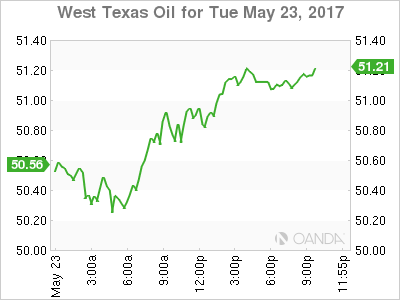
WTI spot trades at 51.25 near its overnight highs and initial resistance at 51.45. It is followed by the rather more formidable 52.00 level. More importantly, WTI has finally closed above its 100-day moving average and first support at 50.75 with the next support below this at 50.00.
GOLD
Gold fell some 14 dollars overnight giving up all of Monday's gains to finish rather bearishly near its lows around 1251 where it trades in Asia this morning. A resurgent U.S. Dollar and equity markets along with dovish comments on the Euro by various ECB members seem to have taken the wind out of gold's sails for now.
Gold could face more pain if tonight's FOMC minutes shows that the Federal Reserve is still on course for two to three more rate hikes this year and a start to the balance sheet reduction. Any combination of the above most likely being bullish for U.S. Dollars, especially as post a June hike, the market has not priced this possibility in on its forward indicators.
Gold narrowly avoided breaking support overnight at 1250 followed by 1245, a daily double bottom and the 200-day moving average. This average has been a crucial pivot point in gold's price action this year, a daily close below could signal a deeper correction.
Gold has resistance at the 1265 area initially followed by the more important 1271.25 double top.

USD/CAD Daily Outlook
Daily Pivots: (S1) 1.3469; (P) 1.3497; (R1) 1.3538; More....
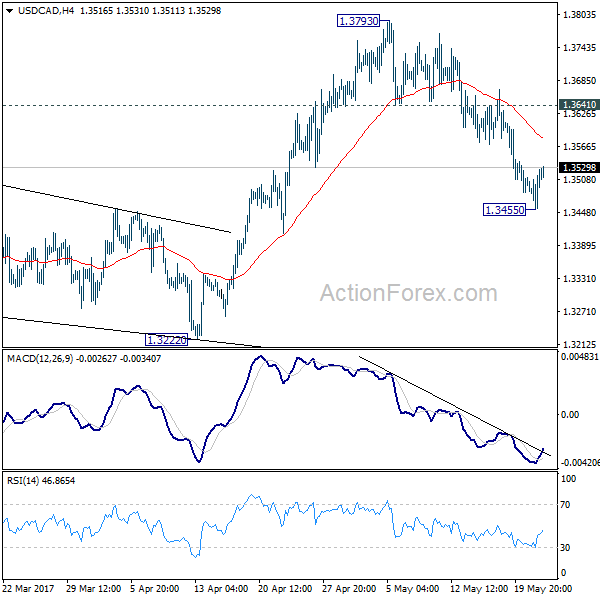
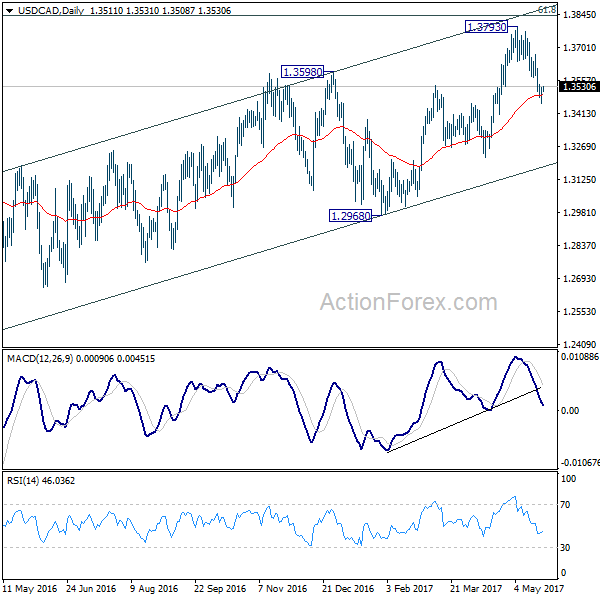
Intraday bias in USD/CAD is turned neutral with a temporary low in place at 1.3455. Some consolidation would be seen but recovery should be limited by 1.3641 support turned resistance and bring another decline. Below 1.3455 will target 1.3222 support next. As noted before, corrective rally from 1.2460 could have finished ahead of 1.3838 fibonacci level. Break of 1.3222 will affirm this case and target 1.2968 key support level for confirmation
In the bigger picture, price actions from 1.4689 medium term top are seen as a correction pattern. The first leg has completed at 1.2460. Rise from 1.2460 is seen as the second leg and would end at around 61.8% retracement of 1.4689 to 1.2460 at 1.3838. Break of 1.3222 should indicate the start of the third leg while further break of 1.2968 should confirm. Nonetheless, sustained trading above 1.3838 would pave the way to retest 1.4689 high.
EUR/USD Daily Outlook
Daily Pivots: (S1) 1.1148; (P) 1.1208 (R1) 1.1241; More....
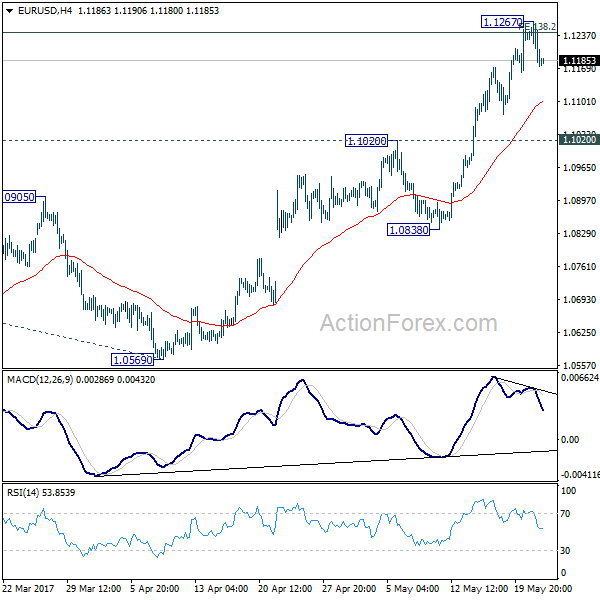
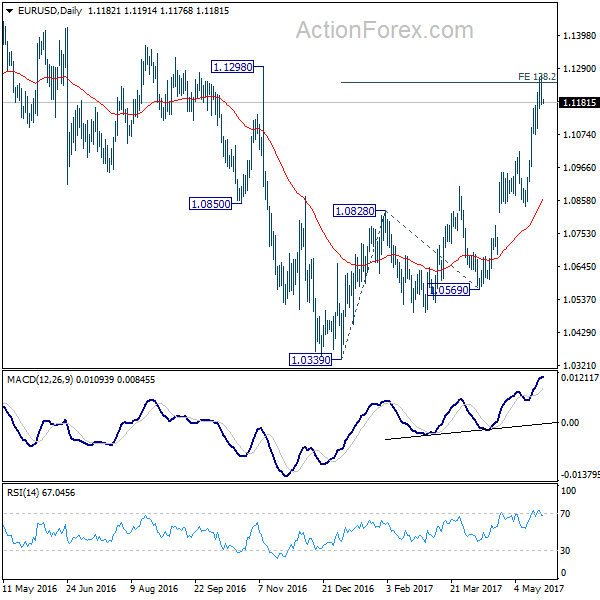
A temporary top is in place at 1.1267 and intraday bias is turned neutral first. Overall, we'd stay cautious on strong resistance from 1.1245/98 (138.2% projection of 1.0339 to 1.0828 from 1.0569 at 1.1245) resistance zone to limit upside and bring reversal. But decisive break of 1.1298 will carry larger bullish implication and target 1.1615 resistance next. On the downside, though, break of 1.1020 resistance turned support will indicate rejection from 1.1245/98 and turn bias to the downside for 1.0838 support first.
In the bigger picture, the case for medium term reversal continues to build up with EUR/USD now far above 55 week EMA. Also, bullish convergence condition is seen in weekly MACD. Focus will now be on 1.1298 key resistance. Rejection from there will maintain medium term bearishness and would extend the whole down trend from 1.6039 (2008 high). However, firm break of 1.1298 will indicate reversal. In such case, further rally would be seen back to 1.2042 support turned resistance next.
GBP/USD Daily Outlook
Daily Pivots: (S1) 1.2931; (P) 1.2982; (R1) 1.3012; More...
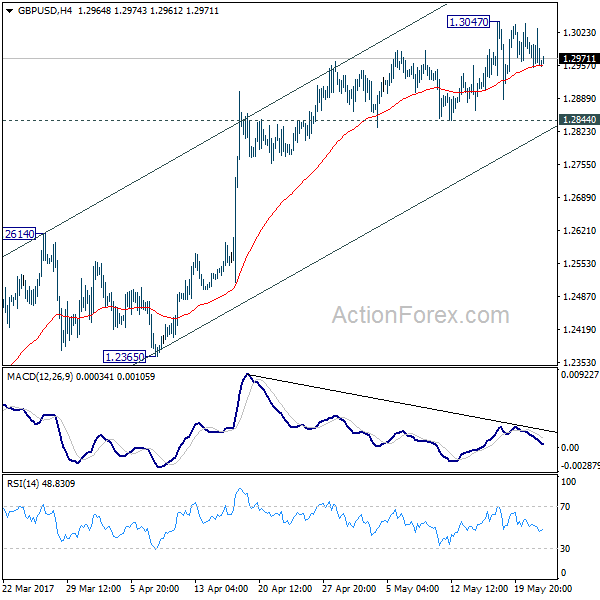
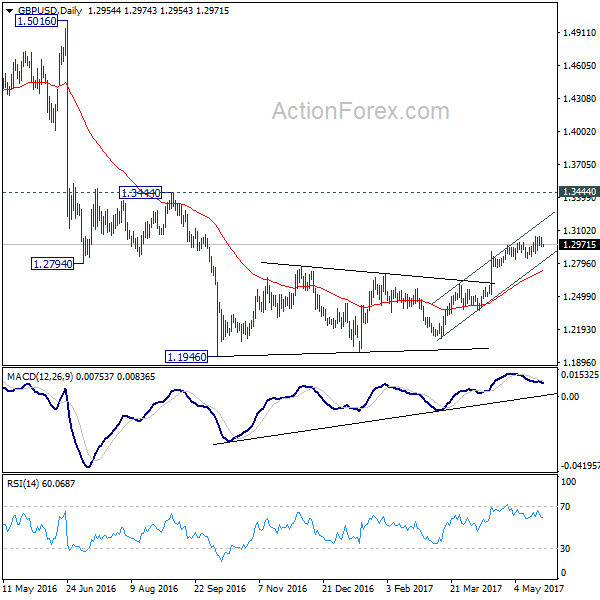
Intraday bias in GBP/USD remains neutral as consolidation from 1.3047 continues. As long as 1.2844 minor support holds, further rise remains mildly in favor. Nonetheless, as we are still viewing price actions from 1.1946 as a corrective move, we'd expect upside to be limited below 1.3444 resistance to bring near term reversal. On the downside, break of 1.2844 will indicate short term topping and turn bias back to the downside for 1.2614 resistance turned support first.
In the bigger picture, fall from 1.7190 is seen as part of the down trend from 2.1161. There are signs of reversal, like breaking of 55 week EMA, weekly MACD turned positive, and monthly MACD crossed above signal line. But still, break of 1.3444 resistance is need to confirm medium term bottoming. Otherwise, outlook will remains bearish for extend the down trend through 1.1946 low.
USD/JPY Daily Outlook
Daily Pivots: (S1) 111.14; (P) 111.49; (R1) 112.13; More...
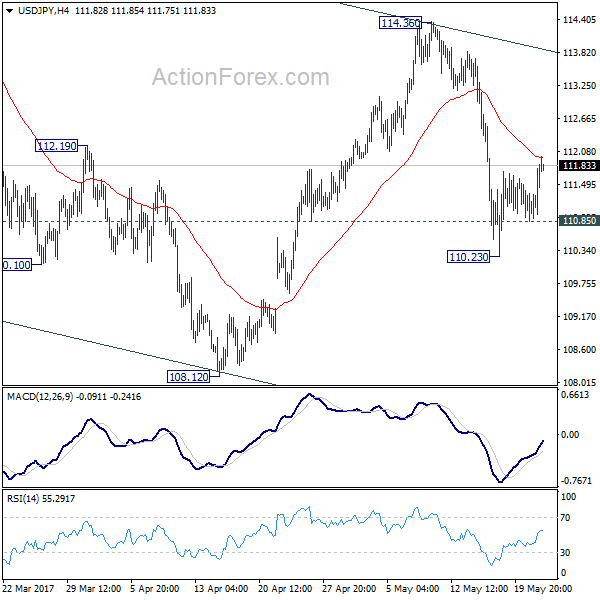
USD/JPY's rebound from 110.23 extended higher today and is pressing 4 hour 55 EMA. There is no change in the view that rise from 110.23 is a corrective move. Below 110.85 minor support will turn bias to the downside to extend the fall from 114.36 to 108.12 low. Break there will resume the whole decline from 118.65. In that case, we'll look for bottoming signal again at 61.8% retracement of 98.97 to 118.65 at 106.48.
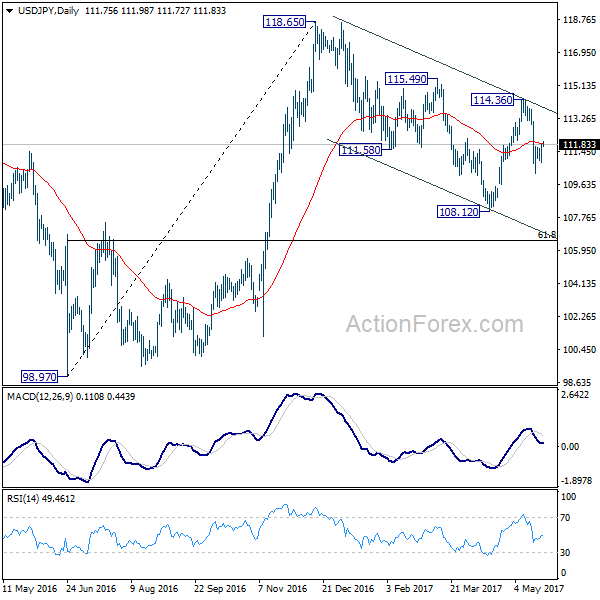
In the bigger picture, price actions from 125.85 high are seen as a corrective pattern. It's uncertain whether it's completed yet. But in case of another fall, downside should be contained by 61.8% retracement of 75.56 to 125.85 at 94.77 to bring rebound. Overall, rise from 75.56 is still expected to resume later after the correction from 125.85 completes.
USD/CHF Daily Outlook
Daily Pivots: (S1) 0.9719; (P) 0.9741; (R1) 0.9780; More.....
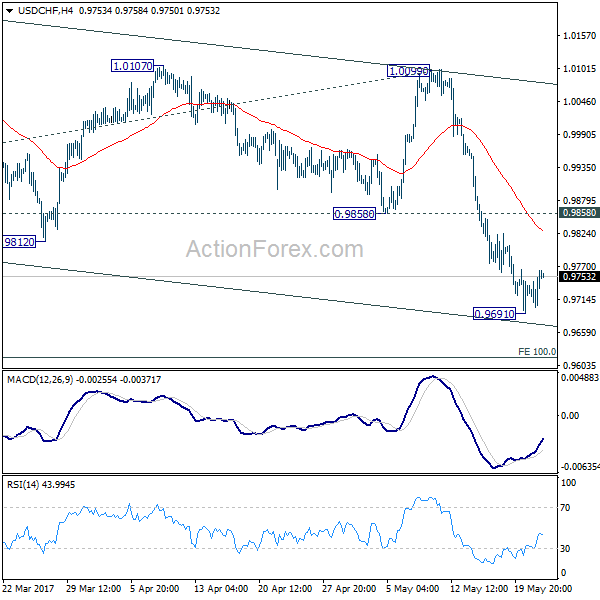
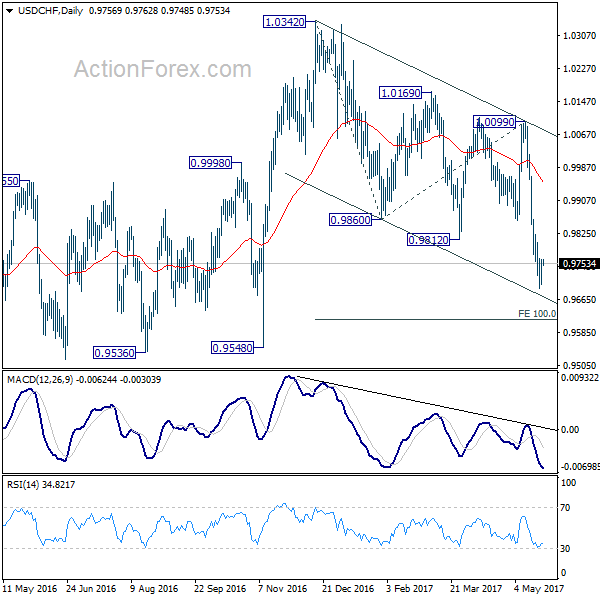
A temporary low is in place at 0.9691 in USD/CHF and intraday bias is turned neutral first. Some consolidations would be seen but upside of recovery is expected to be limited by 0.9858 support turned resistance to bring another decline. Whole fall from 1.0342 is still in progress and below 0.9691 will target 100% projection of 1.0342 to 0.9860 from 1.0099 at 0.9617. We'll start to look for reversal signal below there.
In the bigger picture, USD/CHF is bounded in medium term range of 0.9443/1.0342 for the moment. Consolidative trading would likely continue and medium term outlook remains neutral. Break of 1.0342 key resistance is needed to confirm underlying bullish momentum in the pair. Meanwhile, downside attempts should be contained by 0.9443 key support level.
Dollar Recovered as Markets Firmed Up June Fed Hike Expectations, FOMC Minutes and BoC Awaited
US markets closed mildly higher overnight as investors were relieved that US President Donald Trump's first budget plan contained no surprise. DJIA closed up 43.08 pts, or 0.21% at 20937.91. S&P 500 gained 4.4 pts or 0.18% to close at 2398.42. Nikkei follows in Asian session and is trading up 100 pts at the time of writing. US 10 year yield also ended up 0.031 at 2.285. Dollar recovered as markets firmed up their expectation of a June Fed hike. Fed fund futures are pricing in 83.1% chance of that. In other markets, gold dips mildly but is holding above 1250 handle for the moment. WTI crude oil's recent surge is still in progress and is holding above 51.50. Focus will turn to FOMC minutes and BoC rate decision today.
Philadelphia Fed Harker: June Hike is a distinct possibility
Philadelphia Fed President Patrick Harker said that June hike is a "distinct possibility ... quite possible". And he also noted that "a month or two in the wrong direction isn't enough to make me lose faith." Harker reiterated his support for two more rate hike this years. Regarding Fed's plan to shrink its balance sheet, he pointed out the two questions of "when" and "how". For the "when" part, Harker didn't give a specific date but he did think "we'll start sometime this year". And, for the "how" part", he said it will be "predictable, slow and as boring as possible".
Minneapolis Fed President Neel Kashkari expressed some of his concerns on the economy. He noted that the US is "closer" to full employment but he cautioned that "we don't know how far the shore is". Also, he said that "right now inflation is going in the wrong direction". Kashkari is a known dove who was the sole dissenter against Fed's rate hike back in March.
BoC to stand pat today
BoC rate decision will be a focus today too and the central bank is widely expected to keep interest rate unchanged at 0.50%. Recent economic data from Canada have been solid with job gains for six straight month. Consumer spending grew at healthy pace with support from rising home values. But BoC Governor Stephen Poloz has been reluctant to turn more upbeat on the economy and maintained that it's still playing catch up to the US.
UK raised threat level to "critical"
In UK, Prime Minister Theresa May raised the nation's threat level and warned that another terrorist attack "may be imminent". Alert level was lifted from "severe" to its highest "critical". May announced the mover after an emergency meeting of the security cabinet, with conclusion that the attacker of Monday's bombing in Manchester could be part of a larger network. And May warned that the prospect of of wider plot was "a possibility we cannot ignore".
On the data front...
Released in Asian session today, New Zealand trade surplus widened to NZD 578m in April, larger than expectation of NZD 267m. That's also the larger trade surplus since 2015. Exports jumped 9.8% yoy to NZD 4.8b. Imports rose 4.9% yoy to NZD 4.2b. Australia Westpac leading index dropped -0.1% mom in April. Looking ahead, German Gfk consumer sentiment, US house price index and existing home sales will be featured.
USD/CHF Daily Outlook
Daily Pivots: (S1) 0.9719; (P) 0.9741; (R1) 0.9780; More.....
A temporary low is in place at 0.9691 in USD/CHF and intraday bias is turned neutral first. Some consolidations would be seen but upside of recovery is expected to be limited by 0.9858 support turned resistance to bring another decline. Whole fall from 1.0342 is still in progress and below 0.9691 will target 100% projection of 1.0342 to 0.9860 from 1.0099 at 0.9617. We'll start to look for reversal signal below there.
In the bigger picture, USD/CHF is bounded in medium term range of 0.9443/1.0342 for the moment. Consolidative trading would likely continue and medium term outlook remains neutral. Break of 1.0342 key resistance is needed to confirm underlying bullish momentum in the pair. Meanwhile, downside attempts should be contained by 0.9443 key support level.
Economic Indicators Update
| GMT | Ccy | Events | Actual | Forecast | Previous | Revised |
|---|---|---|---|---|---|---|
| 22:45 | NZD | Trade Balance (NZD) Apr | 578M | 267M | 332M | 277M |
| 00:30 | AUD | Westpac Leading Index M/M Apr | -0.10% | 0.10% | ||
| 06:00 | EUR | German GfK Consumer Sentiment Jun | 10.2 | 10.2 | ||
| 13:00 | USD | House Price Index M/M Mar | 0.60% | 0.80% | ||
| 14:00 | CAD | BoC Rate Decision | 0.50% | 0.50% | ||
| 14:00 | USD | Existing Home Sales Apr | 5.65M | 5.71M | ||
| 14:30 | USD | Crude Oil Inventories | -1.8M | |||
| 18:00 | USD | FOMC Minutes May 3 Meeting |
USD/CAD Canadian Dollar Lower After USD Rebound Ahead Of BoC
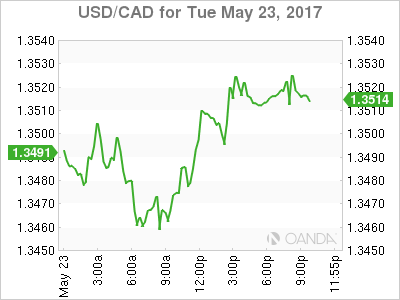
The Canadian dollar is trading lower at 1.3523 after the USD erased all loses versus the loonie on Tuesday. The greenback regained traction ahead of the release of the U.S. Federal Reserve minutes from the monetary policy meeting earlier in May. The Fed is heavily anticipated to hike rates in the next meeting with the market searching for insights on the document released on Wednesday.
Building materials and supplies drove Canadian wholesale trade 0.9 percent higher in March. There sales figures were the lone economic data release on Tuesday following the Victory day holiday. Investors will be awaiting the rate decision by the Bank of Canada (BoC). The Canadian central bank will release its rate statement on Wednesday, May 24 at 10:00 am EDT. The BoC is heavily expected to hold rates unchanged despite growing pressure from a hot house market in major cities. The CAD has been caught between a falling loonie and the more aggressive tone of the US regarding the NAFTA renegotiation. The US has set in motion the process needed to renegotiate the deal in late August. BoC Governor Stephen Poloz is expected to address the household debt and real estate market with mentions about the upcoming trade negotiations.
The release of weekly US oil inventories at 10:30 am EDT will impact the USD/CAD pair given the high correlation between crude prices and the loonie. The tone of the rhetoric from the Canadian central bank and the actual change in the American oil inventory will be a preamble for the release of the Fed minutes at 2:00 pm EDT. The Fed did not update its benchmark rate from its 75 to 100 basis points range and offered little clues on the brief statement released after the FOMC meeting ended. The notes from the monetary policy meeting will shed some light on the different opinions from members on the current rate hike path and a long shot but also the possibility of a time frame for its plans to reduce its massive balance sheet.
The USD/CAD gained 0.105 percent in the last 24 hours. The currency pair is trading at 1.3523 after the USD staged a comeback in the North American trading session. The pair went from a daily low of 1.3456 and quickly went above the 1.35 price level to near daily highs where it is currently trading. Oil prices boosted the loonie on Monday and early trading Tuesday coupled with a strong wholesale trade data in Canada but as traders booked their profits on a weak USD and repositioned for a slightly hawkish Fed minutes the greenback bounced back.
The Bank of Canada is forecasted to hold as the economy is still struggling to regain the momentum is lost with the drop in oil prices two years ago. With the Fed all set to hike rates in June, this will widen the interest rate gap between the two economies. Trade disputes and the more aggressive tactics by the US to solve them are also a concern as Canada exports two-thirds of exports to its southern neighbour.
The price of oil gained 0.926 percent on Tuesday. The West Texas Intermediate is trading at $51.14 ahead of Wednesday's release of the weekly US crude inventories. Another drawdown is awaited, marking 7 contractions in a row in US inventories. The US President Donald Trump proposed to sell half of the strategic oil reserve starting in October. Ironically the fund was started in 1975 to avoid a repeat of gas price surges during the Arab oil embargo. The Organization of the Petroleum Exporting Countries (OPEC) is now once again cutting production, but even with all the members and other influential producers such as Russia they can only keep the price stable. US production has grown to the point where it could justify the sale of the emergency stocks stored in Louisiana and Texas. Although it is hard for this to be approved by congress, specially now, but it does send a signal to OPEC ahead of Thursday's meeting on their cut production agreement extension.
Market events to watch this week:
Wednesday, May 24
- 8:45am EUR ECB President Draghi Speaks
- 10:00 am CAD BOC Rate Statement
- 10:00 am CAD Overnight Rate
- 10:30 am USD Crude Oil Inventories
- 2:00 pm USD FOMC Meeting Minutes
- 10:00pm NZD Annual Budget Release
Thursday, May 25
- 4:30 am GBP Second Estimate GDP q/q
- All Day ALL OPEC Meetings
- 8:30 am USD Unemployment Claims
Friday, May 26
- 8:30 am USD Core Durable Goods Orders m/m
- 8:30 am USD Prelim GDP q/q
Dollar Rebounds Awaiting Fed Minutes
US oil inventories, Bank of Canada and FOMC minutes to drive markets
The US dollar is higher against most major pairs after staging a recovery ahead of the release of the Federal Open Market Committee (FOMC) May meeting minutes on Wednesday, May 24 at 2:00 pm. The Fed hosted no press conference in May, leaving the market to wait for the minutes to gather insights into the views of the central bank on the path of rates for the reminder of the year. The CME FedWatch tool is showing a 83.1 percent probability of a rate hike based on futures fed funds prices. Fed speakers have issued mix rhetoric, but so far the rate hike remains firmly on the table for the meeting to be held on June 13 and 14.
The Bank of Canada (BoC) will release its rate statement on Wednesday, May 24 at 10:00 am EDT. The central bank is heavily expected to hold rates unchanged despite growing pressure from a heating up house market in major cities. The CAD has been caught between a falling loonie and the more aggressive tone of the US regarding the NAFTA renegotiation. The US has set in motion the process needed to renegotiate the deal in late August. BoC Governor Stephen Poloz is expected to address the household debt and real estate market with mentions about the upcoming trade negotiations.
US weekly oil inventories will be release at 10:30 am EDT by the Energy Information Administration (EIA). The forecast calls for a 2.4 million barrel drawdown to make it 7 contractions in a row. Oil prices have been caught between the efforts of the Organization of the Petroleum Exporting Countries (OPEC) to limit global production with their production cut agreement and the US shale producers ramping up operations to take advantage of stable prices. The release of the weekly inventories one day before the OPEC meeting in Vienna anticipated to end with the announcement of a 6 to 9 month extension will impact commodity currencies.
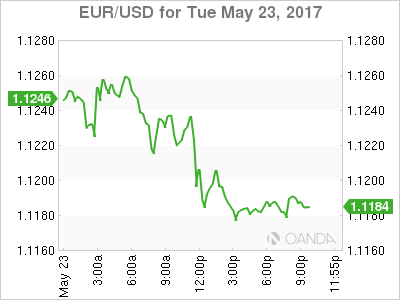
The EUR/USD lost 0.396 percent in the last 24 hours. The single pair is trading at 1.1197 after the USD rebounded ahead of the release of the May’s FOMC meeting minutes. The turmoil the Trump Administration has found itself into after the firing of FBI Director James Comey has put downward pressure on the USD. The pro-growth policies expected at the beginning of Trump’s term have hit another wall as further divisions within the Republican party could emerge delaying them until the last quarter of the year, or maybe well into 2018.
Monetary policy divergence still favours the dollar. The U.S. Federal Reserve is set to hike in June to leave the benchmark rate in a range of 100 to 125 basis points. Investors will be looking at the notes from the central bank meeting to look for more details on the balance sheet wind down which is forecasted to take place in the second half of the year.
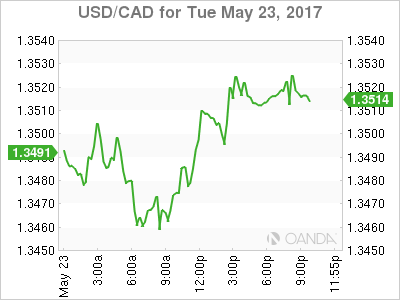
The USD/CAD gained 0.072 percent in the last 24 hours. The currency pair is trading at 1.3518 after the USD staged a comeback in the North American trading session. The pair went from a daily low of 1.3456 and quickly went above the 1.35 price level where it is currently trading. Oil prices boosted the loonie on Monday and early trading Tuesday coupled with a strong wholesale trade data in Canada but as traders booked their profits on a weak USD and repositioned for a slightly hawkish Fed minutes the greenback bounced back.
The Bank of Canada is forecasted to hold as the economy is still struggling to regain the momentum is lost with the drop in oil prices two years ago. With the Fed all set to hike rates in June, this will widen the interest rate gap between the two economies. Trade disputes and the more aggressive tactics by the US to solve them are also a concern as Canada exports two thirds of exports to its southern neighbour.
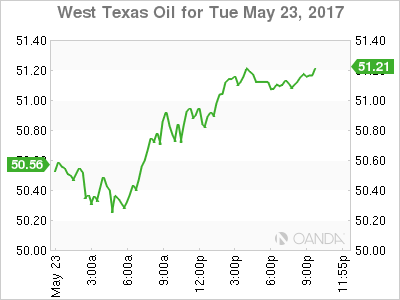
The price of oil gained 0.926 percent on Tuesday. The West Texas Intermediate is trading at $51.14 ahead of Wednesday’s release of the weekly US crude inventories. Another drawdown is awaited, marking 7 contractions in a row in US inventories. The US President Donald Trump proposed to sell half of the strategic oil reserve starting in October. Ironically the fund was started in 1975 to avoid a repeat of gas price surges during the Arab oil embargo. The Organization of the Petroleum Exporting Countries (OPEC) is now once again cutting production, but even with all the members and other influential producers such as Russia they can only keep the price stable. US production has grown to the point where it could justify the sale of the emergency stocks stored in Louisiana and Texas. Although it is hard for this to be approved by congress, specially now, but it does send a signal to OPEC ahead of their meeting on Thursday to extend their agreement to cut production.
Market events to watch this week:
Wednesday, May 24
- 8:45am EUR ECB President Draghi Speaks
- 10:00 am CAD BOC Rate Statement
- 10:00 am CAD Overnight Rate
- 10:30 am USD Crude Oil Inventories
- 2:00 pm USD FOMC Meeting Minutes
- 10:00pm NZD Annual Budget Release
Thursday, May 25
- 4:30 am GBP Second Estimate GDP q/q
- All Day ALL OPEC Meetings
- 8:30 am USD Unemployment Claims
Friday, May 26
- 8:30 am USD Core Durable Goods Orders m/m
- 8:30 am USD Prelim GDP q/q