

Sample Category Title
CRUDE OIL – Extends Bullish Offensive On Correction
CRUDE OIL - With the commodity continuing to retain its recovery threats to close higher on Wednesday, more strength is expected in the days ahead. On the downside, support resides at the 47.00 level where a break will expose the 46.50 level. A cut through here will set the stage for a run at the 46.00 level. Further down, support resides at the 45.50 level. On the upside, resistance resides at the 48.00 level. Further out, resistance comes in at the 48.50 level. A break above here will aim at the 49.00 level and then the 49.50 level followed by the 50.00 level. All in all, CRUDE OIL remains biased to the upside on correction
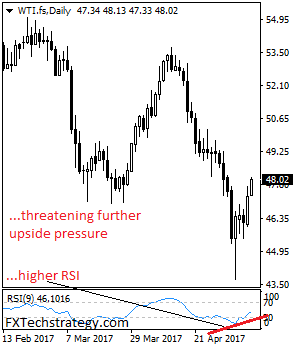
GOLD Weakening, SILVER Weakening Towards $16.00, CRUDE OIL Bouncing Back.
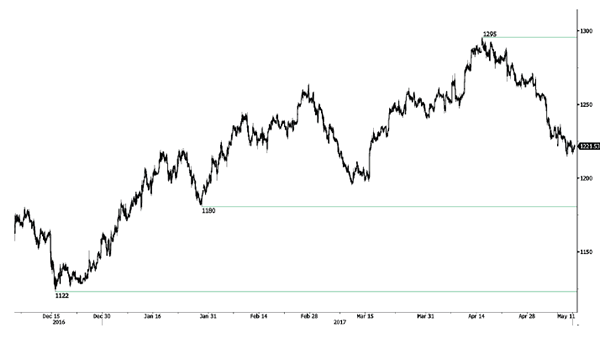
GOLD Weakening.
Gold continues its decline after the yellow metal has faded near the hourly resistance at 1295 (18/04/2017 high). Hourly support is now located at 1195 (10/03/2017 low). The road is wide-open for further decline.
In the long-term, the technical structure suggests that there is a growing upside momentum. A break of 1392 (17/03/2014) is necessary ton confirm it, A major support can be found at 1045 (05/02/2010 low).
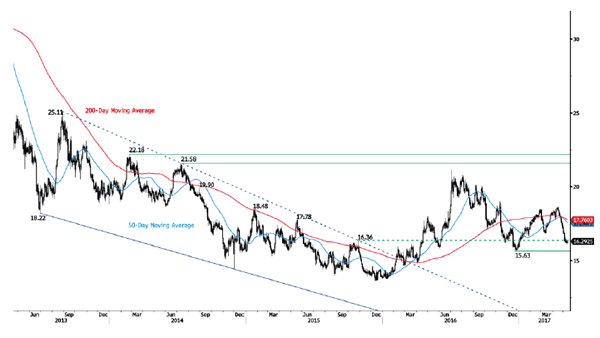
SILVER Weakening towards $16.00.
Silver's bearish pressures are still lively. Strong support is given at 15.63 (20/12/2017 low). Closest support is given at 16.20 (04/05/2017 low). Key resistance is given at a distance at 19.00 (09/11/2017 high). Expected to see continued bearish pressures until at least $16.
In the long-term, the death cross indicates that further downsides are very likely. Resistance is located at 25.11 (28/08/2013 high). Strong support can be found at 11.75 (20/04/2009).
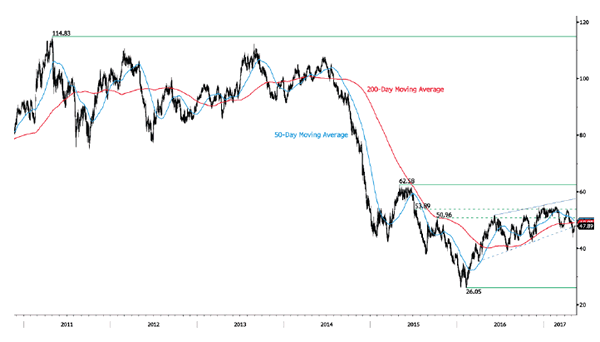
CRUDE OIL Bouncing back.
Crude oil is bouncing back on short-squeeze move. The commodity has bounced from a level below $44. Strong support is given at 42.20 (14/11/2017 low). Expected to see renewed bearish pressures.
In the long-term, crude oil has recovered after its sharp decline last year. However, we consider that further weakness are very likely. Strong support lies at 24.82 (13/11/2002) while resistance can now be found at 55.24 (03/01/2017 high).
Market Update – European Session: Focus On BOE Rate Decision And Whether More Dissenters Climb On Board
Notes/Observations
BOE expected to keep policy steady but the big question is whether more dissenters will join MPC member Forbes?
UK Mar Industrial and Manufacturing data misses; registers wider-than-expected trade deficits
EU Commission raises its GDP growth forecasts of euro zone for both 2017 and 2018
Overnight:
Asia:
New Zealand Central Bank (RBNZ) left its Official Cash Rate (OCR) unchanged at 1.75% (as expected). Monetary policy to remain accommodative for a considerable period. Numerous uncertainties remain and policy might need to adjust accordingly. Headline inflation to reach to midpoint of their target band over the medium term while growth overall remained positive. The Overall Cash Rate (OCR) seen steady at 1.8% over the two-year horizon period
RBNZ Gov Wheeler: Lack of inflation pressure is the main reason for maintaining neutral stance. Have not seen acceleration of wage pressures.
RBNZ's McDermott: RBNZ saw as much chance of a rate cut as a hike adding that markets were ignoring downside risks
Europe:
UK Apr RICS House Price Balance beats expectations but still matched its 7-month low (22% v 20%e)
Americas:
Treasury official: Treasury Sec Mnuchin will discuss Russia and Iran sanctions issues with G7 as well as discuss Trump administration's tax and regulatory reform efforts
Energy:
Saudis to inform OPEC that Saudi April output raised to 9.95M bpd (prior 9.90M bpd in March)
Economic Data
(JP) Japan Apr Eco Watchers Current Survey: 48.1 v 47.8e; Outlook Survey: 48.8 v 48.2e
(DE) Germany Apr Wholesale Price Index M/M: 0.3% v 0.0% prior; Y/Y: 4.7% v 4.7% prior
(TR) Turkey Mar Current Account Balance: -$3.1B v -$3.2Be
(CH) Swiss Apr CPI M/M: 0.2% v 0.2%e; Y/Y: 0.4% v 0.5%e
(CH) Swiss Apr CPI EU Harmonized M/M: 0.5% v 0.1% prior; Y/Y: 0.7% v 0.5% prior
(SE) Sweden Apr CPI M/M: 0.6% v 0.4%e; Y/Y: 1.9% v 1.7%e
(SE) Sweden Apr CPI CPIF M/M: 0.6% v 0.4%e; Y/Y: 2.0% v 1.8%e
(PH) Philippines Central Bank (BSP) left its Overnight Borrowing Rate unchanged at 3.00% (as expected)
(UK) Mar Industrial Production M/M: -0.5% v -0.4%e; Y/Y: 1.4% v 2.0%e
(UK) Mar Manufacturing Production M/M: -0.6% v -0.2%e; Y/Y: 2.3% v 3.0%e
(UK) Mar Visible Trade Balance: -£13.4B v -£11.6Be; Overall Trade Balance: -£4.9B v -£3.0Be; Trade Balance Non EU: -£4.7B v -£3.3Be
Fixed Income Issuance:
(SE) Sweden sold SEK750M vs. SEK750M indicated in 0.125% I/L 2027 bond; Avg Yield: -1.0527% v -1.0657% prior; Bid-to-cover: 1.92x v 1.46x prior
(IT) Italy Debt Agency (Tesoro) sold total €2.5B vs.€1.75-2.5B indicated range in 2044 and 2047 BTP Bonds
SPEAKERS/FIXED INCOME/FX/COMMODITIES/ERRATUM
Indices [Stoxx50 -0.1% at 3641, FTSE flat at 7386, DAX flat at 12763, CAC-40 +0.1% at 5404, IBEX-35 -0.7% at 10961, FTSE MIB +0.2% at 21603, SMI +0.2% at 9107, S&P 500 Futures -0.1%]
Equities
Consumer discretionary [ SuperGroup [SGP.UK] -7.0% (Earnings)]
Industrials: [ Deutsche Post [DPW.DE] -3.5% (Earnings)]
Financials: [Unicredit [UCG.IT] +3.7% (Earnings), Credit Agricole [ACA.FR] -1% (Earnings), Aegon [AGN.NL] -5.2% (Earnings)]
Telecom: [BT [BT.UK] -3.2% (Earnings), Telefonica [TEF.ES] -2.8% (Earnings),
Healthcare: [Hikma Pharma [HIK.UK] -7.8%, Vectura [VEC.UK] -89.4% (update on the status of its ANDA for generic Advair Diskus, low likelihood of approval this year)]
Energy: [SolarWorld [SWVK.DE] -79% (Files for insolvency)]
Speakers
ECB publishes Economic Bulletin which reiterated the Draghi press conference that it would maintain a very substantial monetary accommodation. If the outlook became less favorable, the Governing Council stood ready to increase the asset purchase program in terms of size and/or duration.
EU Commission Spring Economic Forecast raised its GDP growth forecasts of euro zone for both 2017 and 2018. Raised Euro Zone 2017 GDP growth from 1.6% to 1.9% and 2018 GDP growth from 1.8% to 1.9%. On inflation the EU raised 2017 Euro Area inflation (HICP) from 1.7% to 2.0% and maintained 2018 Euro Area inflation (HICP) at 1.4%
Norway revised its 2017 budget and maintains 2017 Mainland GDP growth forecast at 1.6%. Cut 2017 Core CPI forecast from 2.1% to 1.7%
Philippines Central Bank Policy Statement noted that inflation risks were tilted to the upside and would remain vigilant against CPI risks. It would adjust policy as needed
Iraq Oil Min Al-Luaibi: Iraq raising oil output to 5M bpd will not conflict with OPEC's cuts; Reiterated OPEC view that OPEC and non-OPEC consensus view was to extend cuts for 6-months
Currencies
The focus was on the BOE rate decision and whether more hawks will show their feathers. With a vacancy on the MPC analyst foresee a 7-1 vote for unchanged rates instead of 8-1 (Dep Gov Hogg resigned a few weeks ago). Updated economic projections contained within the May BoE QIR will likely show modest downside revisions to both growth and inflation. If more hawks appear the GBP/USD could see another attempt on the $1.3000 level. The GBP was weaker following data misses for Mar production data and wider trade deficits and hovering just above its 1-week low of 1.2902
During Asia the NZD currency (Kiwi) saw volatility following the RBNZ rate decision which was viewed more neutral than anticipated. RBNZ was looking past the rising inflation with its neutral stance given the recent cooling in Auckland housing market, and its latest projections only see the next rate hike in late 2019 compared to analyst projections of late 2018. The NZD/USD pair fell to 10month lows below 0.6820 on the decision before recovering slightly
Fixed Income
Bund futures trade at 160.17 down 16 ticks, breaking through trend support at the 160.22 region. A break of 160.01 support level could see lows target 159.01 followed by 157.50. Resistance lies at 160.81 level followed by 162.10.
Gilt futures trade at 127.18 modestly lower by 3 ticks, after initially trade much lower ahead of the Industrial data, which disappointed across the board. The focus will remain on the BOE rate decision later today. A continuation of the pullback from the 129.14 April 18th high has price eyeing the 126.41 support level. An acceleration lower could test the 125.80 region. Resistance stands at 128.01 then 128.51 followed by 129.14.
Thursday’s liquidity report showed Wednesday’s excess liquidity ticked lower to €1.6537T a decline of €0.3B from €1.6540T prior. Use of the marginal lending facility fell to €232M from €342M prior.
Corporate issuance saw over $4.4B come to market via 4 issues headlined by RBS $3.2B in a 2-part senior unsecured note offering
Looking Ahead
(IT) Italy Debt Agency (Tesoro) to sell €3.75-4.75B in 2020 and 2024 BTP Bonds
05:30 (ZA) South Africa Mar Total Mining Production M/M: No est v 2.9% prior ; Y/Y: 4.7%e v 4.6% prior; Gold Production Y/Y: No est v -16.8% prior; Platinum Production Y/Y: No est v 47.2% prior
05:30 (DE) German Chancellor Merkel with NATO Sec Gen Stoltenberg in Berlin
05:30 (HU) Hungary Debt Agency (AKK) to sell Bonds (3 tranches)
06:00 (PT) Portugal Apr CPI M/M: No est v % prior; Y/Y: No est v % prior
06:00 (PT) Portugal Apr CPI Harmonized M/M: No est v % prior; Y/Y: No est v % prior
06:00 (IE) Ireland Apr CPI M/M: No est v 0.6% prior; Y/Y: No est v 0.7%prior
06:00 (IE) Ireland Apr CPI EU Harmonized M/M: No est v 0.6% prior; Y/Y: No est v 0.6%prior
06:25 (US) Fed’s Dudley (voter, dove) in India
06:30 (IS) Iceland to sell Bills
06:45 (US) Daily Libor Fixing
07:00 (UK) Bank of England Bank (BOE) Interest Rate Decision: Expected to leave Interest Rates unchanged at 0.25%; maintain Asset Purchase Target (AFT) at £435B
07:00 (UK) Bank of England Bank (BOE) May Minutes
07:00 (UK) Bank of England Bank (BOE) Quarterly Inflation Report (QIR)
07:00 (ZA) South Africa Mar Manufacturing Production M/M: +0.5%e v -0.4% prior; Y/Y: -2.4%e v -3.6% prior
07:00 (BR) Brazil May IGP-M Inflation (1st Preview): -0.6%e v -0.7% prior
07:30 (UK) BOE Gov Carney QIR press conference
08:00 (UK) Apr NIESR GDP Estimate: 0.4%e v 0.5% prior
08:00 (BR) Brazil CONAB Report
08:00 (BR) Brazil Mar Retail Sales M/M: -0.6%e v -0.2% prior; Y/Y: -1.8%e v -3.2% prior
08:00 (BR) Brazil Mar Broad Retail Sales M/M: -0.1%e v +1.4% prior; Y/Y: +0.4%e v -4.2% prior
08:15 (UK) Baltic Dry Bulk Index
08:30 (US) Initial Jobless Claims: 245Ke v 238K prior; Continuing Claims: 1.98Me v 1.964M prior
08:30 (US) Apr PPI Final Demand M/M: +0.2%e v -0.1% prior; Y/Y: 2.2%e v 2.3% prior
08:30 (US) Apr PPI Ex-Food&Energy M/M: 0.2%e v 0.0% prior; Y/Y: 1.6%e v 1.6% prior
08:30 (US) Apr PPI Ex-Food, Energy & Trade M/M: 0.2%e v 0.1% prior; Y/Y: No est v 1.7% prior
08:30 (CA) Canada Mar New Housing Price Index M/M: 0.2%e v 0.4% prior; Y/Y: No est v 3.3% prior
08:30 (US) Weekly USDA Net Export Sales
09:00 (RU) Russia Gold and Forex Reserve w/e May 5th: No est v $401.1B prior
10:30 (US) Weekly EIA Natural Gas Inventories
11:00 (US) Treasury announces issuance for upcoming 10-year Tips auctions for May 18th
11:00 (BR) Brazil to sell Fixed Rate 2023 and 2027 Bonds
11:00 (BR) Brazil to sell 2019, 2020, 2027 LTN Bills
12:30 (CH) IMF's Obstfeld speaks in Geneva
13:00 (US) Treasury to sell 30-Year Bonds
EUR/JPY Bullish Pause, EUR/GBP Weakening, EUR/CHF Fading Below 1.1000.
EUR/JPY Bullish pause.
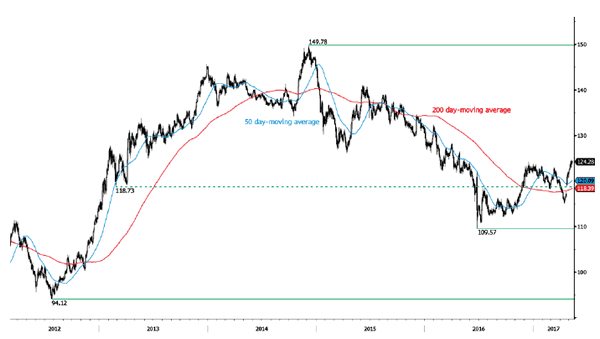
EUR/JPY's bullish run has stalled below range resistance at 124.59 (07/05/2017 high), Hourly resistance can be located at 124.43 (intraday low). Major support is given at 114.90 (18/04/2017low). Expected to see further renewed buying pressures towards 125.00.
In the longer term, the technical structure validates a medium-term succession of lower highs and lower lows. As a result, the resistance at 149.78 (08/12/2014 high) has likely marked the end of the rise that started in July 2012. Strong support at 94.12 (24/07/2012 low) looks nonetheless far away.
EUR/GBP Weakening.
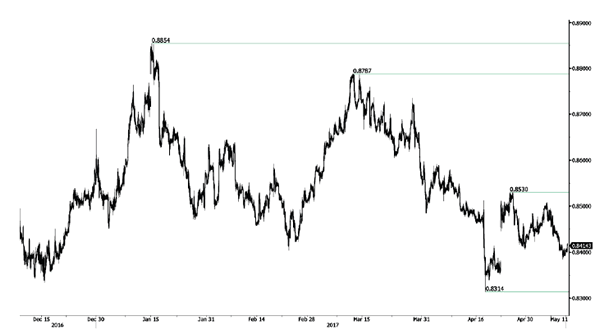
EUR/GBP is trading lower. The technical structure remains negative as long as the resistance at 0.8530 (25/04/2017 low) holds. Expected to show continued weakness until support given at 0.8304 (05/12/2017 low).
In the long-term, the pair has largely recovered from recent lows in 2015. The technical structure suggests a growing upside momentum. The pair is trading above from its 200 DMA. Strong resistance can be found at 0.9500 psychological level.
EUR/CHF Fading below 1.1000.
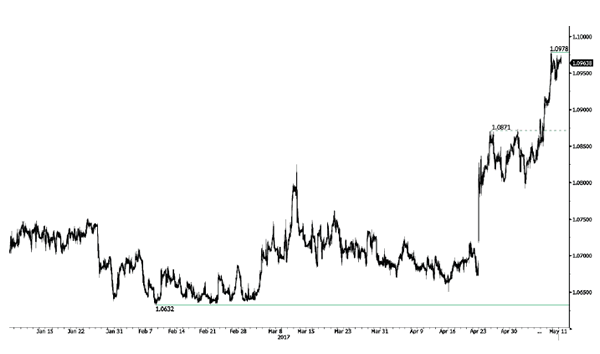
EUR/CHF's volatility is getting stronger. Resistance given at has been broken 1.0898 (08/12/2017 high). Despite the sharp increase and the recent bullish breakout which is very likely psychological, we believe that the medium-term pattern suggests us to see at some point renewed bearish pressures towards key support that can be found at 1.0623 (24/06/2016 low).
In the longer term, the technical structure is mixed. Resistance can be found at 1.1200 (04/02/2015 high). Yet,the ECB's QE programme is likely to cause persistent selling pressures on the euro, which should weigh on EUR/CHF. Supports can be found at 1.0184 (28/01/2015 low) and 1.0082 (27/01/2015 low).
USD/CHF Bullish Pause, USD/CAD Range Bound, AUD/USD Bearish Pause.
USD/CHF Bullish pause.
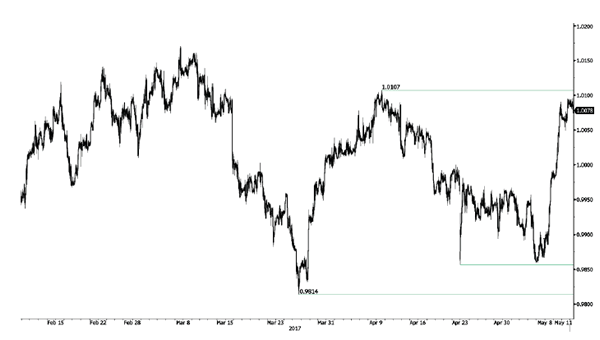
USD/CHF has paused after sharp reversal off 0.9864 low. The technical structure has invalidated the short-term negative momentum. Hourly resistance is given at 1.0107 (10/04/2017 high). Support can be located at 1.0049 (10/05/2017 low).
In the long-term, the pair is still trading in range since 2011 despite some turmoil when the SNB unpegged the CHF. Key support can be found 0.8986 (30/01/2015 low). The technical structure favours nonetheless a long term bullish bias since the unpeg in January 2015.
USD/CAD Range bound.
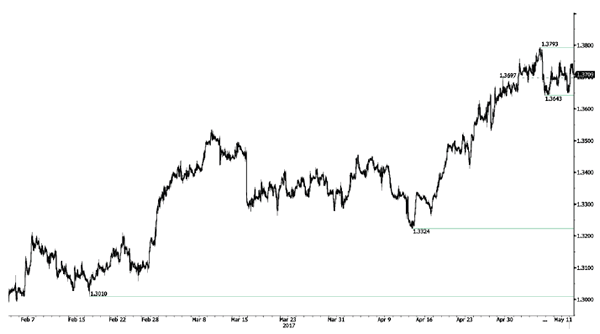
USD/CAD has declined after failing to reach 1.3800 before bouncing back. Hourly support can be found at 1.3411 (24/04/2017 high) then 1.3353 (20/01/2017 high). Expected to show renewed bullish pressures as long as the pair remains above 1.3530 (27/04/2017 low).
In the longer term, there is a golden cross with the 50 dma crossing the 200 dma indicating further upside pressures. Strong resistance is given at 1.4690 (22/01/2016 high). Long-term support can be found at 1.2461 (16/03/2015 low).
AUD/USD Bearish pause.
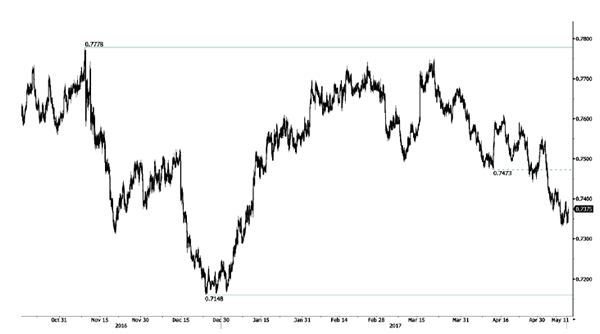
AUD/USD has paused above key support at 0.7339 (intraday low). As long as prices remain below the resistance at 0.7608 (17/04/2017 high), the short-term technical structure is negative. Key resistance stands at 0.7681 (30/03/2017 high). Expected to show further weakness.
In the long-term, we are waiting for further signs that the current downtrend is ending. Key supports stand at 0.6009 (31/10/2008 low) . A break of the key resistance at 0.8295 (15/01/2015 high) is needed to invalidate our long-term bearish view.
EUR/USD Short-Term Weakness, GBP/USD Pushing Higher Towards 1.3000, USD/JPY Bullish!!
EUR/USD Short-term weakness.
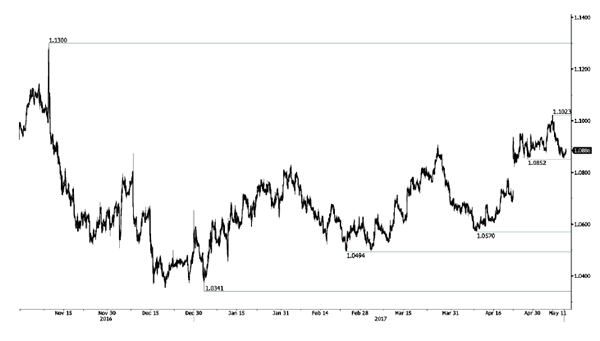
EUR/USD is trading lower. Hourly support is given at 1.0852 (27/04/2017 low) then 1.0682 (21/04/2017 base). Stronger support can be found at 1.0494 (22/02/2017 low). Expected to show another leg higher towards 1.10.
In the longer term, the death cross late October indicated a further bearish bias. The pair has broken key support given at 1.0458 (16/03/2015 low). Key resistance holds at 1.1714 (24/08/2015 high). Expected to head towards parity.
GBP/USD Pushing higher towards 1.3000.
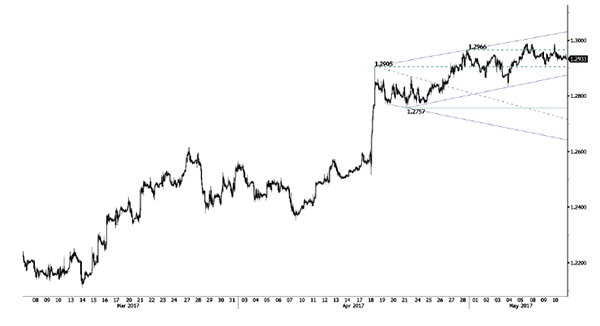
GBP/USD is trading mixed. The pair is trading around former hourly resistance given at 1.2966 (30/04/2017 high). Hourly support can be found at 1.2757 (21/04/2017 low). An unlikely break of this support would indicate further weakness. Expected to push higher.
The long-term technical pattern is even more negative since the Brexit vote has paved the way for further decline. Long-term support given at 1.0520 (01/03/85) represents a decent target. Long-term resistance is given at 1.5018 (24/06/2015) and would indicate a long-term reversal in the negative trend. Yet, it is very unlikely at the moment.
USD/JPY Bullish!!
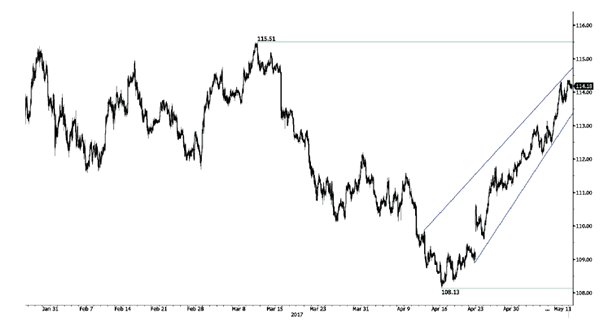
USD/JPY is pushing higher since the pair broke resistance given at 112.20 (31/03/2017 high). Hourly support can be found at 110.88 (26/04/2017 low). Stronger support is located at 108.13 (17/04/2017 low). Other key supports lie at a distant 106.04 (11/11/2016 low). Expected to show continued bullish pressures.
We favor a long-term bearish bias. Support is now given at 96.57 (10/08/2013 low). A gradual rise towards the major resistance at 135.15 (01/02/2002 high) seems absolutely unlikely. Expected to decline further support at 93.79 (13/06/2013 low).
BoE Inflation Forecasts Could Signal Earlier Rate Hike
- June election makes rate hike even less likely today;
- Higher inflation forecasts and consumer expectations could tempt hawks to favour hike;
- Oil climbing again after inventory data but gains may be limited.
It's been a relatively calm start to trading on Thursday, as we await the latest monetary policy decision, inflation report and press conference from the Bank of England in what has become known as "Super Thursday".
The monetary policy decision itself is unlikely to offer up any surprises, especially given its proximity to the UK election next month with the central bank not wanting to have any influence on the result. Of course, even in the absence of this, it's unlikely that policy makers would have voted to reverse any of the measures taken after the EU referendum last June. There was one vote for a rate hike from Kristin Forbes last month but the market clearly doesn't anticipate that support for this will gather much momentum.
That said, should the BoE upgrade its inflation forecasts in its inflation report today then it may tempt some of the more hawkish policy makers at the central bank to lean towards voting for a hike. The BoE previously claimed that inflation would peak at 2.8% in the first half of 2018 before falling gradually to 2.4% in three years but with the CPI measure rising quickly and already reaching 2.3%, it may be forced to upgrade these. What could be key is what impact the surge in inflation has had on consumer inflation expectations, which is likely a greater concern for policy makers. Any inclination that this is also rising could tempt one or two policy makers to vote for a hike.
As far as today is concerned, traders appear more focused on the possible path of interest rates going forward, rather than the prospect of one today or even in the near future. There is a belief among many that the BoE will refrain if possible from raising interest rates prior to the end of the two years of Brexit negotiations in an effort to avoid rocking the boat when the economy is already very vulnerable, regardless of what the data since June would suggest.
While many markets appear to be in wait and see mode today, oil is rising once again, up more than 1.5% in response to Wednesday's inventory data. The decline in inventories was much larger than had been anticipated, even if the warning signs were there on Tuesday when API released its own figures. Still, it's early to say whether this move has lifted oil from a lower range that it appeared to have entered into or provided the opportunity for temporary reprieve. Brent and WTI are both finding some resistance around $51 and $48, respectively, and a move above here could signal a sharper move to the upside. If it holds, it may suggest that momentum remains to the downside.
Technical Outlook: AUDUSD – Consolidation Above Weekly Cloud Base Remains Limited
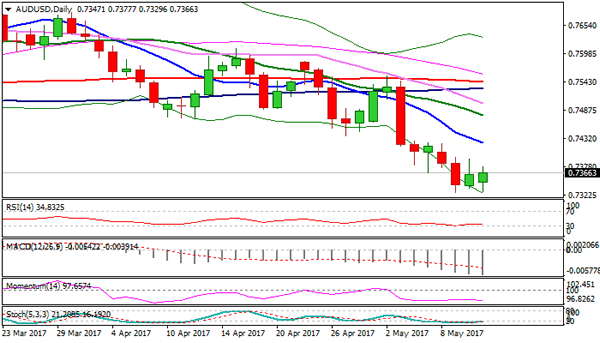
The Aussie extends consolidation above fresh low at 0.7329, where weekly cloud base offered solid support and so far contained steep descend of past three weeks.
Upside attempts were limited under 0.7400 barrier for now, with Wednesday's daily candle with long upper wick weighing on near-term action.
Extended consolidation could be expected while pivots at 0.7413/23 (Fibo 38.2% of 0.7554/0.7327 downleg/falling 10SMA) stay intact. Slow stochastic is attempting to break out of oversold zone which may signal stronger correction.
Break above 0.7413/23 pivots is needed for bullish extension towards to open falling 20SMA barrier at 0.7477.
Strong bearish setup of daily studies suggests limited upside before larger bears resume, Firm break below weekly cloud will be seen as strong bearish signal.
Res: 0.7392, 0.7413, 0.7423, 0.7477
Sup: 0.7329, 0.7298, 0.7250, 0.7200
Technical Outlook: USDJPY – Bulls Keep 114.62 Fibo Barrier In Focus, Stops Raised To 113.60
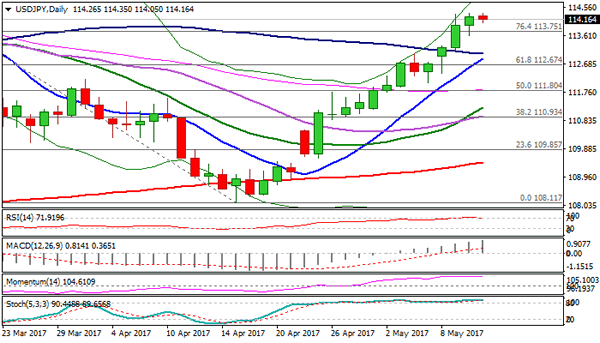
The pair posted marginally higher high at 114.36 on Wednesday with early Thursday's narrow consolidation being capped here. Bulls remain firmly in play and focus target at 114.62 (Fibo 61.8% of 118.65/108.11 descend).
Overbought daily RSI and slow stochastic so far did not impact bulls, however, further easing cannot be ruled out.
Yesterday's correction low at 113.60 marks strong support and lower pivot, break of which would complete hourly double top and risk deeper pullback.
Plethora of strong supports consisting of 100SMA/rising 10SMA and daily cloud top, lies at 113.06/112.79 zone and should contain stronger dips.
Res: 114.36, 114.62, 114.87, 115.18
Sup: 114.05, 113.60, 113.48, 113.06
Downside Risks To China – And What It Means For Markets
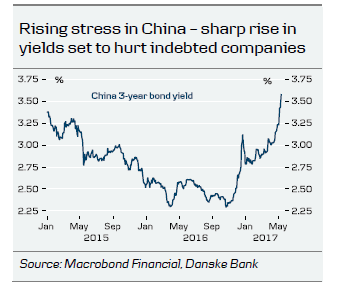
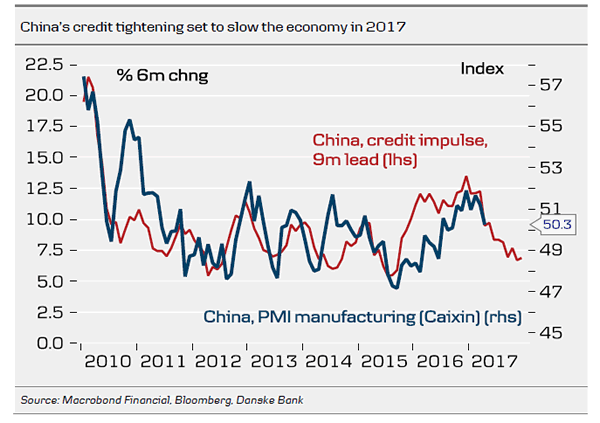
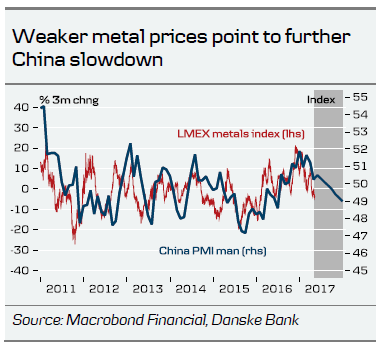
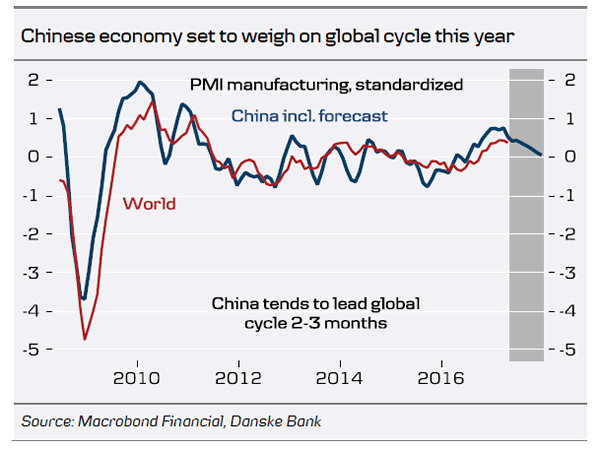
Since January, we have highlighted that a China slowdown was brewing in 2017 (see Why China's Growth is Strong Now – and Why it Will Slow in 2017, 5 January). We are now seeing increasing evidence of this taking place: PMI decreased sharply in April, commodity prices for oil and metals have lost momentum and the Chinese stock market has fallen over the past month to the lowest level in four months
As we have argued for some time, Chinese tightening measures to reign in soaring house prices are set to slow growth in 2017. A 'normalisation' of infrastructure investments after the big boost in 2016 is also set to drive lower activity this year.
While we have been looking for the slowdown to be moderate, an increase in financial stress lately poses a clear downside risk to China's growth this year (see Research China: Financial stress on the rise again, 4 May). In China Daily on 5 May, an editorial started out 'China is in the midst of what proponents are heralding as its harshest crackdown on financial risks in history: a campaign that is by no means a fleeting gesture'. China Daily is state media and tends to represent the views of the leadership. While tackling financial risks in China is important, there is a clear danger that this is taking place when China was already set to slow down and that it is exacerbating the downturn. It comes on top of the risk of protective trade measures from US President Donald Trump in H2, once his trade investigation and steel probe are finished around mid-year. This could hurt Chinese exports.
Boost to global reflation reverses – rising risk for global markets
So, how should a weaker Chinese economy affect the global economy and markets?
1. Lift to global growth reverses: China is by far the biggest contributor to the global economy, driving one-third of global growth. The country was a major driver behind the global recovery in 2016. Commodity exporting emerging markets benefited strongly from both higher volumes and prices and developed markets saw a lift to exports to China and other emerging markets countries. With China slowing in 2017, the lift to the global economy reverses and this is a big reason why we look for a peak in the PMI cycle in H1.
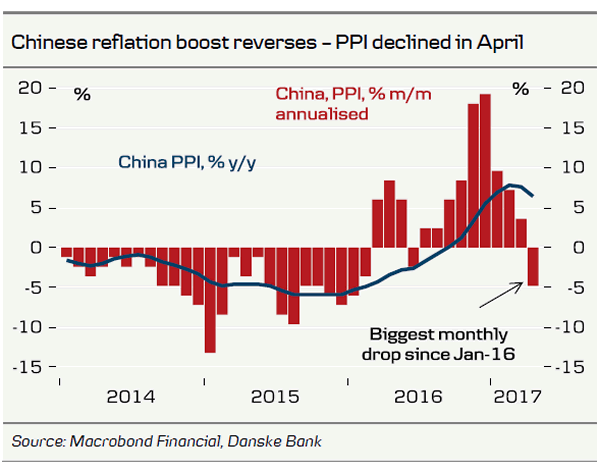
2. From reflationary to disinflationary force: The sharp rise in commodity prices seen in 2016 was pulled largely by higher Chinese activity. With Chinese companies consuming 50% of global metals, China is a major driver of commodity prices. In the past few months, both metal prices and oil prices have declined, which in our view is linked partly to the softer Chinese economy. With the commodity price boost turning into a drag on global inflation, we believe global central banks will lose an important pillar in their mission to push inflation higher on a sustained basis; not least in the euro area, where slack is still ample and wage pressures low (see Research: Euro area wage growth should stay subdued, not supporting core inflation significantly, 5 May).
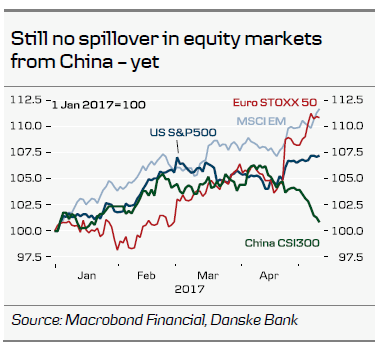
3. Less support to risk sentiment: A softer global cycle and rising downside risks from China have already had an impact on Chinese stocks, commodity prices and inflation markets, where euro area 5Y5Y breakeven inflation is back at 1.6% – the level reached when the ECB initiated its asset purchase programme in January 2015. So far, though, risk sentiment in the US, Europe and emerging markets has stayed upbeat on the back of strong profit growth and relief that political uncertainty is reduced following the election of Emmanuel Macron as the new French President. We recently turned neutral on equities on a short- to medium-term horizon.
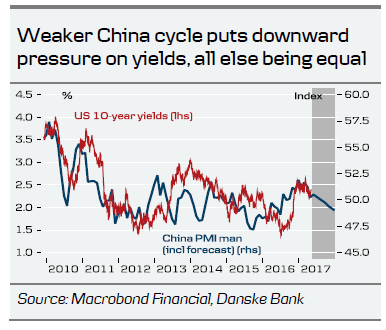
4. Downside pressure on long bond yields: While Fed hikes and a possible change of forward guidance from the ECB are putting upward pressure on bond yields, the disinflationary force from China will put a downward pressure on yields. We believe these two forces will even each other out and expect range-trading markets for some time. Hence, we recommend investors take a tactical approach to acting in the bond market, trading the range rather than having a clear directional bias
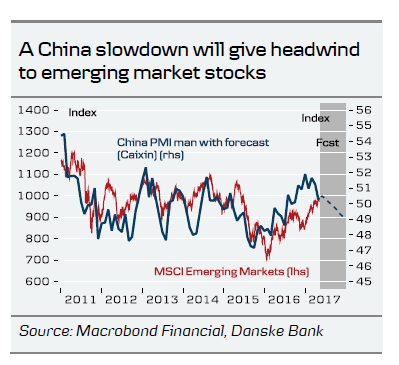
5. Headwind for emerging markets assets: So far, there has been very little impact on emerging markets outside of China. Emerging market equities have continued higher despite lower commodity prices and rising stress in China. However, if we are right that the China slowdown will continue this year, emerging market assets will start to face some headwind from this angle. Emerging markets are still a popular carry game among investors, though. Therefore, we stick to our overweight on emerging markets versus developed markets for now, as the carry from higher yields and lower valuation in stocks is attractive and drives flows into emerging markets. However, any sign of spillover from China to other emerging markets should be on the radar screen.
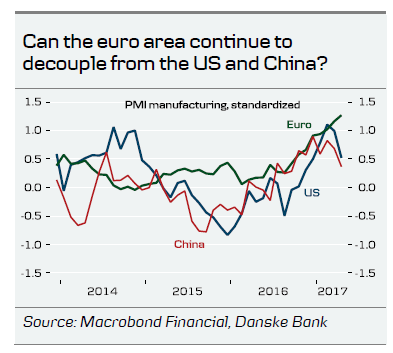
Can the euro area decouple? We don't think so
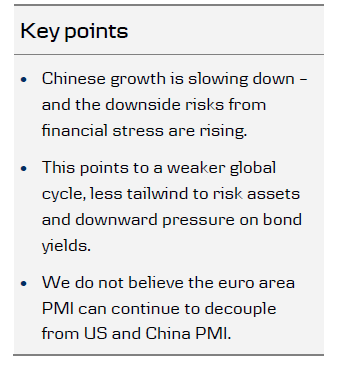
So far, we have yet to see the same signs of a peak in euro business cycle indicators that we are witnessing in the US and China. Euro PMI has continued to move higher and points to robust growth. The economic surprise index in the euro area is also still high. This stands in sharp contrast to the steep fall that has taken place in the US. This raises the question whether the euro area PMI can continue to decouple.
We doubt this is the case. Part of the impetus for euro area manufacturing is currently coming from the export sector. This factor is likely to fade, with China slowing down. Euro area private consumption has also faced headwinds from a decline in real wage growth moving into negative territory (due to the rise in inflation) after a period of a decent increases in purchasing power when inflation was 1.5 percentage points lower than wage growth. Overall, we look for euro PMI to peak soon and follow the US and China lower. We do not expect a big setback or the recovery to derail but simply believe that the pace will slow a bit. However, in combination with a weaker global backdrop, this means the current very positive picture of the euro area will be less upbeat when we get to the end of the year. With inflation set to decline to around 1.0-1.5% in early 2018, we still believe the ECB will extend asset purchases into the new year but reduce our estimate of the pace to EUR40bn per month