

Sample Category Title
EM Asia-Don’t Lose The Plot
EM Asia
Reflationary trades have hit a speed bump. But while the latest headlines from the Foggy Dew are negatively impacting, the issue has more to do with the fact that the commodity-linked currencies failed to capitalise on the dovish Fed. At the same time, the confluence of political risk on both sides of the pond weighed and I suspect it is more to do with the recent commodity supply concerns stemming from the oil glut that has commodity traders parked temporarily in neutral.
In the meantime, Asia EM will be held ransom to the ebb and flow in risk appetite and overall commodity market conviction. But if we consider the softer outlook for the USD on the back of the dovish Fed hike, local EMs are unlikely to yield even more so that institutional and retail positioning isn't especially thick, which suggests there will be no sudden rush for the exits due to overweight books.
We've witnessed moderate sell-off in KRW, INR suggests that both pairs will have a high beta correlation to the sell-off in global equities and should reap the rewards on the anticipated return of risk.
The MYR is in a similar position but as we near the apparent bottom of oil prices, I expect the Ringgit to be more sensitive to volatile oil prices.
The pullback in commodity prices was anticipated, as we all know nothing goes up forever, even more so if we consider over extended positioning in both Copper and Iron Ore. But the Trump reflationary trade is far KO'd. Oil prices could conceivably move lower, but given the hawkish rhetoric from OPEC and the anticipated bounce in global growth, vis a vis US tax and fiscal reform, it's far too early to give up the plot. Don't let this wave of risk-off muddy the big picture as commodity traders are likely waiting in earnest to fade any further capitulation.
I still view the eventual move higher in US fixed income Yields as the most significant headwind for regional EM, and while US 10 year yields are expected to move higher throughout 2017, I suspect the undervalued regional equity markets and the higher yields on offer from local capital markets will keep the regional currencies in check.
AUD/USD Daily Outlook
Daily Pivots: (S1) 0.7647; (P) 0.7668; (R1) 0.7697; More...
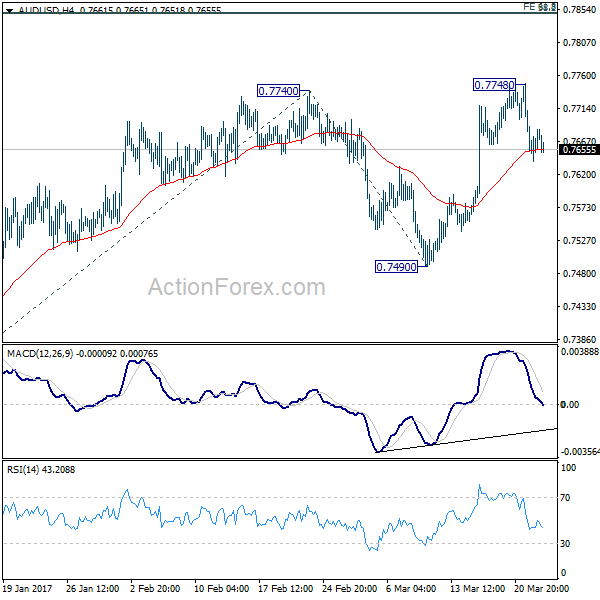
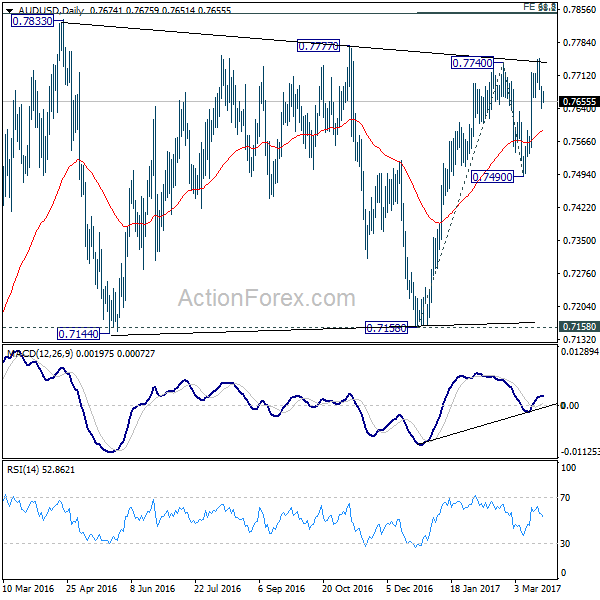
AUD/USD is trying to draw support from 4 hour 55 EMA for the moment but recovery is weak. Intraday bias stays on the downside first. As noted before, rebound from 0.7490 should have completed. Deeper fall would be seen back to 0.7490 support. Break there will confirm completion of whole rise from 0.7158. On the upside, above 0.7748 will resume the rise from 0.7158. But in that case, we'd expect upside to be limited by 0.7849/50 cluster resistance to bring reversal. That level represents 61.8% projection of 0.7158 to 0.7740 from 0.7490 at 0.7850 and key long term retracement level at 0.7849.
In the bigger picture, we're still treating price actions from 0.6826 low as a correction. And, as long as 38.2% retracement of 0.9504 to 0.6826 at 0.7849 holds, long term down trend from 1.1079 is expected to resume sooner or later. Break of 0.6826 low will target 0.6008 key support level. However, firm break of 0.7849 will indicate that rise from 0.6826 is developing into a medium term rebound, rather than a sideway pattern. In such case, stronger rise should be seek to 55 month EMA (now at 0.8169) and above.
Kiwi Steady as RBNZ Stands Pat, Vote on Trump’s Health Care Act Watched
New Zealand dollar is steadily in range after RBNZ stands pat as widely expected. The central bank left the Official Cash Rate unchanged at record low of 1.75% and maintained a neutral stance. Governor Graeme Wheeler reiterated in the statement that "monetary policy will remain accommodative for a considerable period." And, "numerous uncertainties remain, particularly in respect of the international outlook, and policy may need to adjust accordingly." RBNZ acknowledged that the "trade-weighted exchange rate has fallen 4 percent since February, partly in response to weaker dairy prices and reduced interest rate differentials." While this seen as an "encouraging move" by the central bank, it reiterated that "further depreciation is needed to achieve more balanced growth."
RBNZ said that "quarterly GDP was weaker than expected in the December quarter, but some of this is considered to be due to temporary factors. The growth outlook remains positive, supported by on-going accommodative monetary policy, strong population growth, and high levels of household spending and construction activity." Regarding inflation, RBNZ noted that "headline CPI will be variable over the next 12 months due to one-off effects from recent food and import price movements, but is expected to return to the midpoint of the target band over the medium term."
Canada budget: Stay the course
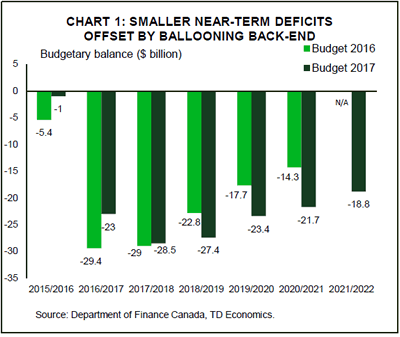
Canadian dollar recovered as selloff in risk markets stabilized. WTI crude oil also recovered mildly and is back above 48 handle. The Canadian government unveiled a "stay-the-course" federal budget with few surprises. It's perceived that the government would like to wait-and-see what US president Donald Trump would deliver on his policies first. The budget deficit is at CAD 23.0b in fiscal 2016/27 comparing to CAD 25.1b indicated last fall. But the government expects higher deficit onwards, at CAD 28.5b in fiscal 2017/18. Deficit is projected to trend low to CAD 18.8b by fiscal 2021/22.
More on Canada budget
- Canada 2017 Federal Budget: Stay the Course Budget - Expected and Delivered
- Canada 2017 Federal Budget - Back to Business as Usual
House to vote on Trump's AHCA
In US, stocks stabilized after the steep selloff on Tuesday. DJIA dipped to 20578.95 but pared back some losses to close at 20661.30, down -0.03% only. S&P 500 gained 0.19% to close at 2348.45, after hitting as low as 2336.45. NASDAQ was relatively stronger and closed up 0.48% at 5821.64. The major focus today is the vote on US president Donald Trump's American Health Care Act in House. Ahead of the vote, the Congressional Budget Office released a report noting that the AHCA will release in 24 million people losing coverage over the next decade. And the costs for those insured could skyrocket, including the elderly. But nonetheless, the vote is seen as a litmus test for Trump as markets are getting more doubtful in his ability to push through economic policies.
Elsewhere...
Germany will release Gfk consumer sentiment while UK will release retail sales and CBI reported sales. Eurozone will release consumer confidence. US will release jobless claims as usual on Thursday, as well as new home sales.
AUD/USD Daily Outlook
Daily Pivots: (S1) 0.7647; (P) 0.7668; (R1) 0.7697; More...
AUD/USD is trying to draw support from 4 hour 55 EMA for the moment but recovery is weak. Intraday bias stays on the downside first. As noted before, rebound from 0.7490 should have completed. Deeper fall would be seen back to 0.7490 support. Break there will confirm completion of whole rise from 0.7158. On the upside, above 0.7748 will resume the rise from 0.7158. But in that case, we'd expect upside to be limited by 0.7849/50 cluster resistance to bring reversal. That level represents 61.8% projection of 0.7158 to 0.7740 from 0.7490 at 0.7850 and key long term retracement level at 0.7849.
In the bigger picture, we're still treating price actions from 0.6826 low as a correction. And, as long as 38.2% retracement of 0.9504 to 0.6826 at 0.7849 holds, long term down trend from 1.1079 is expected to resume sooner or later. Break of 0.6826 low will target 0.6008 key support level. However, firm break of 0.7849 will indicate that rise from 0.6826 is developing into a medium term rebound, rather than a sideway pattern. In such case, stronger rise should be seek to 55 month EMA (now at 0.8169) and above.
Economic Indicators Update
| GMT | Ccy | Events | Actual | Forecast | Previous | Revised |
|---|---|---|---|---|---|---|
| 20:00 | NZD | RBNZ Rate Decision | 1.75% | 1.75% | 1.75% | |
| 7:00 | EUR | German GfK Consumer Confidence Apr | 10 | 10 | ||
| 9:00 | EUR | ECB Economic Bulletin | ||||
| 9:30 | GBP | Retail Sales M/M Feb | 0.40% | -0.30% | ||
| 11:00 | GBP | CBI Retailing Reported Sales Mar | 4 | 9 | ||
| 12:30 | USD | Initial Jobless Claims (MAR 18) | 240k | 241k | ||
| 14:00 | USD | New Home Sales Feb | 566k | 555k | ||
| 14:30 | USD | Natural Gas Storage | -53B | |||
| 15:00 | EUR | Eurozone Consumer Confidence Mar A | -5.8 | -6.2 |
Market Morning Briefing
STOCKS
Equity indices may test immediate support levels which could attempt to produce some bounce in the near term.
Dow (20661.30, -0.03%) has taken support on the daily candles near 20578 and in case this holds, we could see an attempt to move higher towards 21000 in the next few sessions but in case the support breaks on the downside, we would have to get ready to see levels near 20400 or even lower in the medium term.
Dax (11904.12, -0.48%) is headed towards support near 11700 and if that holds, we could see a rise to levels near 12000 again.
Nikkei (19068.22, +0.14%) is trading within the 19600-18600 region. No major movement expected just now and we could possibly see another 1-2 sessions with small or stable movements. Note important 21-week MA that could possibly act as an immediate support.
The channel support on the daily candle is holding well on Shanghai (3257.14, +0.37%). If it continues to holds in the near term, we could see a bounce towards 3275 and higher in the coming sessions.
Nifty (9030.45, -1.0%) could possibly get some support near 8990-9000 from where a bounce could be expected (a max low of 8970/60 is possible on a break of 8990, if seen) towards 9100.
COMMODITIES
Gold (1245) found resistance at 1250 and trading within a narrow range of 1240-1250. A break on either side could be decisive.
Silver (17.54) still shows no sign of direction as it is hovering around its pivot at 17.45 of its trading range of 16.82-18.00.
Copper (2.62) found support at 2.57 levels. While 2.57 hold, a bounce to the interim resistance 2.68-70 can be seen. Only above 2.70, higher resistances of 2.80 can come into consideration. In the medium term 2.55-57 are going to be a strong support now and the chances of a close above 2.70 have increased.
With a 5.0M barrel surplus in U.S. weekly crude inventory, both Brent (50.93) and WTI (47.34) has fallen in line with our expectation. We are bearish on Brent and WTI since 8th March, 17 . Considering the short term oversold sate, we may see some profit taking rally towards their respective resistances of 52-53 for Brent and 48.50-49.80 for WTI respectively. But the trend is still bearish in the near to medium term time frame. Any corrective bounce may face selling pressure at the higher levels.
FOREX
The markets are very quiet, waiting for the Fed Chair Yellen’s speech and the Republican attempt to pass a health-care bill tonight.
It is just another session for Dollar Index (99.82) below 100 with little activity seen in the markets. Upside remains limited to 100.50 in the near term. Repeat – the narrow band of 99.00-98.50 is a very significant support zone which may be tested in the coming days
Euro (1.0785) is consolidating at the higher levels not too far away from the major resistance of 1.0830-50.As discussed yesterday, though the upside possibilities must be considered more now, we prefer to wait and watch till a clean break above 1.0850 is seen.
Dollar-Yen (111.44) may face selling pressure near 111.70-112.00 and 113.00, if it manages to rise that high, in any bounce with greater chances of seeing 110 in the near term.
Pound (1.2482) has tested the support of 1.2440-20 and bounced back strongly, indicating its intention to rise higher towards 1.2650-1.2700.
Aussie (0.7654) is stable inside the band of 0.7600-0.7750 as expected and this range may continue for a few sessions more with a downward bias in the medium term.
Dollar Rupee (65.44) moved little in the last session as it closed exactly at the midpoint of our expected range of 65.20-70. As stated before, the sideways consolidation is expected to continue.
INTEREST RATES
The US yields have paused. The 5yr (1.95%), 10YR (2.42%) and the 30Yr (3.03%) are stable and could see a slight bounce in the next couple of sessions.
The US 10-5yr (0.46%) is down 1bps and could head towards 0.45% in the near term.
The US-Japan 10YR (2.35%) could bounce from support at current levels indicating that the strength I Yen could be limited in the near term. While the support holds, the near term looks potentially bullish for the yield spread and Dollar-Yen. 9refer FOREX section above for specific view on Yen)
The German-US 10Yr (-2.01%) is testing resistance near current levels which if holds could bring it down towards -2.05% or lower in the near term. This could coincide with the 1.0830 resistance on euro indicating that a corrective dip is on its way for the coming sessions.
GOLD – Bullish, Risk Remains Higher On Further Strength
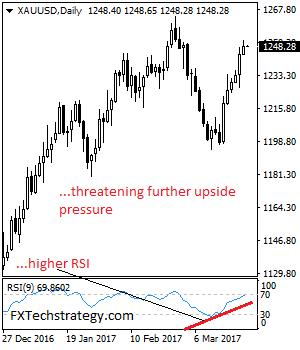
GOLD - The commodity looks to recover further higher. On the downside, support comes in at the 1,240.00 level where a break will turn attention to the 1,230.00 level. Further down, a cut through here will open the door for a move lower towards the 1,220.00 level. Below here if seen could trigger further downside pressure targeting the 1,210.00 level. Conversely, resistance resides at the 1,260.00 level where a break will aim at the 1,270.00 level. A turn above there will expose the 1,280.00 level. Further out, resistance stands at the 1,290.00 level. All in all, GOLD looks to strengthen further.
Why the House Health Care Vote Matters
The current version of Trump's healthcare plan will be dead-on-arrival in the Senate yet Thursday's vote in the House is a blockbuster. We explain why. The yen was the top performer on Wednesday while the Australian dollar lagged. A new Premium trade has been issued ahead of the House vote, backed by 4 technical reasons and 4 charts. 5 out of the 7 existing Premium trades are currently in the green.
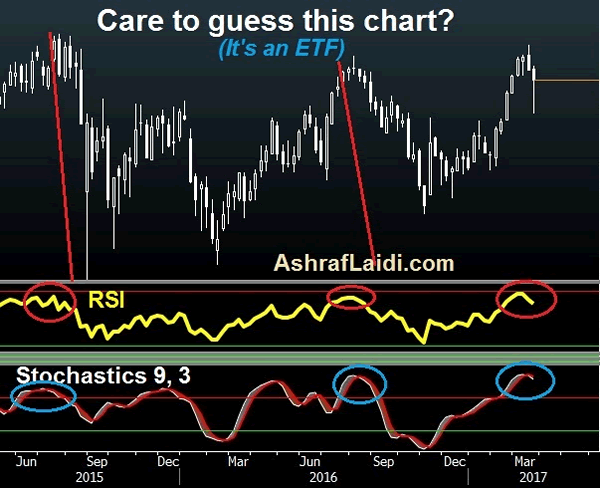
The risk aversion in markets stopped on Wednesday but a more-accurate description was that it was on pause. The market is trying to figure out if the House vote on Thursday on the bill to replace Obamacare will pass or fail.
The bill itself isn't so much what's at stake. The market is increasingly viewing it as a test of Republican leadership. It's a barometer on whether Paul Ryan and Donald Trump can whip the House into supporting its agenda.
So what's at stake isn't necessarily this bill. It's the tough fights on tax reform, infrastructure and regulation that are ahead. The mantra of 'repeal and replace' Obamacare was the one thing seemingly every Republican agreed upon but exactly how that would work is proving to be a problem.
A risk we see here is that the market is overstating the problem. This isn't a Republican vote on Trump, his leadership or team unity. It's a vote on a specific piece of legislation and some Congressmen want it changed.
In that sense, buying something like USD/JPY or equities could have limited downside risks. If it passes, it's all upside. If the vote fails or is postponed, there will be selling but Republicans will quickly regroup and move forward. Markets will recognize that sooner than some think.
Changing gears to central banking, the RBNZ held rates at 1.75%, as expected. The anti-NZD jawboning continued and the message was largely unchanged. One small shift was language saying inflation will return to target in the medium-term, rather than 'gradually'. NZD initially dipped but is back to pre-RBNZ levels.
The rest of the Asia-Pacific calendar is light but it will pick up later with UK retail sales and Yellen on the agenda.
Canada 2017 Federal Budget: Stay the Course Budget – Expected and Delivered
Overview
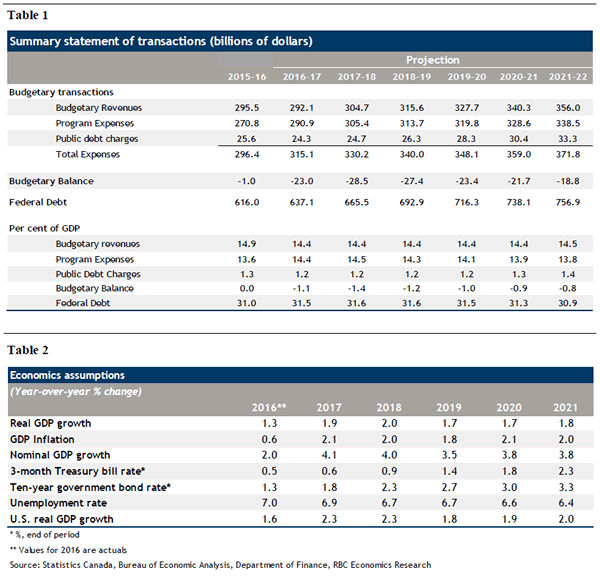
Today's Heading into Budget 2017 expectations were for a stay-the-course budget with little in the way of new initiatives. In the event, this is largely what the government delivered with a few more details announced around their spending plans and a couple of modest initiatives aimed at spurring innovation in the economy. This 'restraint' largely reflects their stretched fiscal position. Following substantial spending initiatives announced in last year's budget and the ensuing fall statement, the fiscal path is now one of deficits as far as the eye can see. Earlier talk of balancing the budget has been long forgotten and had been replaced by a goal of reducing the debt-to-GDP ratio which is a much less stringent goal. Unfortunately this trend of a weakening fiscal resolve continued as today's budget dropped the debt-to-GDP target altogether. Over the next 6 years the debt-to-GDP ratio is expected to move sideways, ending at 30.9% of GDP and an additional $141 billion in federal debt.
This unchecked spending had prompted concerns within the federal government of revenue shortfalls seemingly missing the point that it is of their own doing. Thankfully no major tax increases were announced in today's budget. However, this good fortune could be temporary as any disappointing surprises in the economic outlook could derail the government's fiscal plan necessitating higher taxes to fill a deepening fiscal hole.
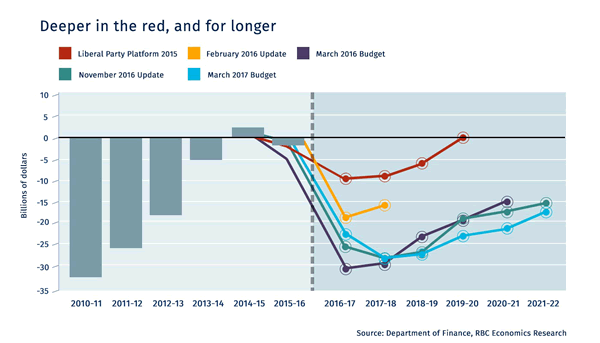
Fiscal Balance Projections
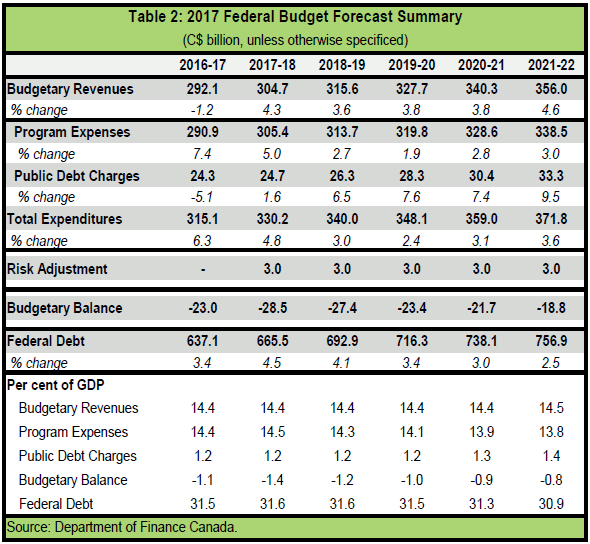
The deficit profile indicated in Budget 2017 is little changed from what was indicated in the 2016 fall statement. The deficit is marginally lower in fiscal 2016/17 at $23.0B relative to $25.1B indicated last fall. The smaller deficit reflects both lower program spending and public debt charges and higher revenues. Beyond fiscal 2016/2017, the deficits are generally higher. The fiscal 2017/18 deficit rises to $28.5B and compares to $27.8B in the fall statement. The deficit then steadily trends lower through the medium term dropping to $18.8B by fiscal 2021/22. However, the profile is consistently above the profile indicated in the fall. Cumulatively the deficit is higher by $13.3B over the next six fiscal years. This higher profile could be attributed to the reintroduction of a $3.0B 'adjustment for risk' over the five fiscal years from 2017/18 to 2021/22. The budget did indicate increased infrastructure spending though this has largely been financed by reallocating funds that had previously been allocated for infrastructure in Budget 2016 but not spent. The federal government is still of the view that this spending will contribute to a sizeable 0.4 percentage point lift to Canadian growth in fiscal 2016/17. Budget 2016 had talked about a ½ per-centage point lift over each of the next two fiscal years. Budget 2017 did not opt for any major tax changes. There was no change to the capital gains tax that had been widely speculated upon as a tax rate that could be raised. The prospect of potential tax cuts in the U.S. possi-bly stayed the federal government's hand as it opted not to unduly hamper the ability of the Canadian economy to attract and retain workers.
Initiatives
Increased infrastructure spending was most evident in spending for community building which saw spending boosted $20.6B over the next six years. This included various housing initiatives that will see increased spending of $5.3B. The lion's share of this spend-ing is for expanding and/or improving the housing stock. (This total also included a welcome, albeit small $40 million over five years, increase in funding to Statistics Canada to establish a Housing Statistics Framework that will better identify factors driving housing market dynamics and thus facilitate designing the appropriate policy response.) Another major initiative was increased spending of $8.3B over the medium term for enhancing skills development of Canadian workers. The other major area of increased spending of $8.2B was largely focussed on improving health care for Canadians. Within these spending areas the federal government stressed it was trying to address various gender imbalances by allocating, over the next 11 years, $7B towards "early learning and child care and over $11.2B towards a National Housing Strategy."
Fiscal Savings
A lion's share of these new initiatives were largely financed by reallocating funds that had been previously been budgeted but not spent. Over the next six years this represented a freeing up of a cumulative $27.1B. Another $4.7B in savings was projected to be sourced by increasing tax fairness via measures such as closing tax loopholes and better policing of tax evasion (although the public transit tax credit will also be eliminated). Budget 2017 did not propose any major tax changes.
Fiscal Overview
The downward trend in the deficit from the projected peak in fiscal 2017/18 of $28.5B to $18.8b in fiscal 2021/22 is the result of revenues rising 4.0% per-year while program expenses increase by a lesser 2.6%. To some extent spending over these four years is restrained by front end loading a sizeable 7.4% surge in 2016/17 program spending. The rise in revenues over the forecast period is facilitated by nominal GDP growth projected to almost double over the period 2017 through 2021 to 4.3% from the 2.3% achieved in 2016. The rise in this growth rate in large part reflects the recovery oil prices over the forecast. RBC's near-term nominal GDP growth outlook assumes an even stronger 4.8% over the next two years. Stronger nominal GDP growth would imply an even faster pace of revenue growth. This issue left unanswered in Budget 2017 is whether any fiscal savings will be used to pay down the debt more quickly as opposed to providing scope to raise expenditures further.
Financing Requirements
Financial requirements are set to rise to C$38.7bn in FY17/18 from a downwardly revised C$21.0bn in FY16/17, with the latter largely due to a smaller deficit than in the FES and a higher gain in the non-budgetary category "Pensions and other accounts" than previously projected. In terms of GoC bond issuance, we should see a record C$142bn in issuance (~C$7bn more than in FY16/17), though with very few changes to the program and continued emphasis on short- and medium-term bond (83% in maturities 5-years and under). Looking ahead, the Government is projecting C$167.4bn in financial requirements from FY17/18 through FY21/22. This, along with rising bond maturities, will prompt a decision from the DoF/BoC on whether to further increase short-term bond issuance or term out somewhat (or a combination of the two).
Canada 2017 Federal Budget – Back to Business as Usual
Highlights
- The government expects to run a deficit of $28.5 billion (about 1.3% of GDP) in the coming fiscal year, roughly in line with 2016 budget projections.
- Deficits continue over the forecast horizon, declining somewhat in size. The result is a level of federal debt expected to settle around 31% of GDP by fiscal 2021.
- Digging into the details revealed a largely business as usual budget, focused on continuing to implement the sizeable promises made in Budget 2016. Only $4.4 billion in net new spending is planned over a five year horizon.
- Notable by their absence were any major changes to the tax system. Small tweaks were made around the edges, but the capital gains inclusion rate was left untouched, as were other major tax rates.
- While some might have been hoping for significant changes in policy, the cautious approach shown today appears warranted. Big spending measures from last year still need to be implemented, while global and domestic economic uncertainty remains elevated.
Last year's budget was a big bang on tax and spend initiatives. This year, not so much. The government announced a net $4.4 billion in new initiatives over a five year period. For comparison, this is roughly one-fifth the amount announced last year, spread over a longer timeframe. Hot-button issues, such as changes to the capital gains tax and the potential sale of airports, were not acted upon. This budget was more about trimming the edges on labour market and tax inefficiencies. By applying conservative assumptions on economic growth, the government shows a debt-to-GDP ratio that holds steady, edging down only modestly from 31.5% to 30.9% by 2021/22. This is a market-neutral budget, with nothing of note to rattle financial markets.
Just a bit more borrowing
The near term outlook for the federal deficit has improved (Chart 1), with a budgetary balance of -$23 billion forecast for the current fiscal year. Relative to what was presented in last year's 5-year plan, slightly wider deficits are projected in Budget 2017, resulting in a modest $6.4 billion in net additional borrowing over the 2015/16 to 2020/21 period.
Underpinning these projections are more conservative assumptions on the future pace of economic growth. This stems from the use of a somewhat outdated survey (from December 2016; Table 1), which doesn't capture the significant improvement in the near-term economic outlook, and thus likely overstates the near-term deficit outlook. Conversely, the December survey does appear to better reflect the medium-term growth headwinds facing Canada, presenting a lower long-term growth profile than that used in Budget 2016.
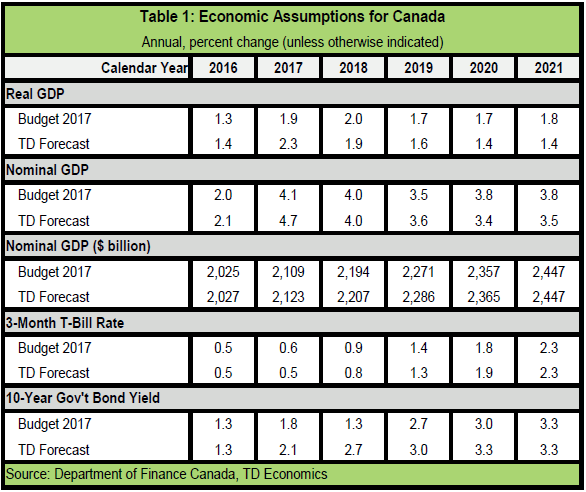
Even this slower profile does not fully reflect the longerterm headwinds facing Canada. TD Economics remains of the view that growth is likely to trend closer to 1.4% in coming years, creating a potential fiscal headwind. Perhaps reflecting this, the government has reintroduced a 'risk adjustment', adding $3 billion per year to the projected deficit from fiscal 2017/18 onwards. This, in combination with the government's growth outlook, suggests that near-term deficits may come in smaller than what has been indicated today.
Persistent deficits
A largely unchanged deficit outlook means that there remains nothing but red ink on the horizon. The size of the deficits are fairly small in the grand scheme of things, and the federal debt-to-GDP ratio is set to stabilize through time, settling at around 31% of GDP by fiscal 2021-22 (Table 2). Despite this, gone from today's budget are explicit references to a target level of the debt ratio. While the best fiscal anchor could be debated (we would suggest a modestly declining debt-to-GDP ratio as a reasonable target), having a fiscal anchor, whatever it may be, provides reassurances to markets that some form of fiscal restraint is in place. A return to an explicit anchor would thus be a welcome development.
Spending what was planned
Today's budget is largely focused on implementing existing promises. The government made significant spending commitments in key areas such as housing, but the bulk of the funds allocated are back-end-loaded. The rubber hits the road over the five year fiscal horizon, where only $5.2 billion in net new spending was introduced in today's budget, as the impact of newly announced measures were offset by shifting funds from other areas. For instance, the government announced $6.6 billion in planned spending to support skills and innovation. But, once the reshuffling of pre-existing commitments is taken into account, the net impact on the deficit is expected to be $2.9 billion. In some areas, the government has actually reduced its planned spending (on net) over the near-term horizon. These include what the government calls "Communities Built for Change", such as infrastructure spending, early learning and childcare initiatives, and indigenous communities.
When it comes to existing spending commitments, the government provided an indication of progress to date. Most major areas are reported to be largely on track (in terms of Budget 2016 commitments), with the exception of infrastructure spending, where only 50% to 75% of projects are reported to be on track. From an economic growth perspective, even this statistic may be somewhat misleading, as it tracks cash disbursements, not shovels in the ground. Indeed, data from Infrastructure Canada indicates that only a small fraction of projects approved since the time of last year's budget have actually begun construction. Thus TD Economics remains of the view that the majority of the growth impact from existing spending commitments is yet to come, and will extend into 2018 given delays already observed.
Nothing comprehensive, but some tax tweaks in the offing
The federal government had been planning a comprehensive tax expenditure review, but it was not to be found in today's budget. Nor were changes to the inclusion rate for capital gains, or the treatment of stock option compensation. Still, many tweaks around the edges were brought into play. Key among these:
- Elimination of the public transit tax credit
- The tax credit for oil and gas exploration is being tweaked to gradually decline over time, rather than deducted immediately
- The alcohol tax will be nudged up immediately, and continue to increase in line with the pace of consumer inflation.
- The definition of a taxi service is to be changed such that ridesharing services such as Uber are taxed in the same way as traditional taxi services.
- Last year's increase in CRA vigilance will be met with a further budget increase aimed at cracking down on tax evasion.
The cautious approach to the tax system shown today is likely warranted in light of the significant uncertainty emanating from south of the border. Discussions and negotiations are underway that could result in significant reductions in U.S. corporate tax burdens, impacting Canada's current competitive advantage. At the same time, it would have been unusual to see significant changes around capital gains or stock options as part of a budget focused on innovation. Ultimately though, while caution was today's watchword, this is not the end of the story. It would hardly be surprising to see the tax system revisited once there is more certainty around Canada's relative competitiveness on this front.
Innovation a focus
As was communicated heading into the budget, a significant portion of the document was devoted to Canadian innovation. Measures included funds aimed at supporting innovation "superclusters", the creation of a "Strategic Innovation Fund" that consolidates and expands a number of existing funds and initiatives, and spending to support Clean- Tech and AgTech development. A focus was also placed on support for skills training. A welcome development is a change to the EI qualification system, allowing EI recipients to pursue education without losing their EI payments.
Potential market reaction
Ahead of the budget, rumours were swirling around potential tax changes - particularly the treatment of capital gains. In the event, no major changes were in the offing, with the changes that were put in place generally consisting of minor tweaks. As a result, it is unlikely that today's budget will have any meaningful market impact.
The theme of minor tweaks extends to the debt management strategy. Reflecting the modest spending commitments, gross bond issuance is expected to reach $142 billion in fiscal 2017-18, an increase of $7 billion from the year prior. The focus is likely to remain again on shorter-term debt (2-, 3-, and 5-year bonds), and no changes to the target maturity pattern or benchmark sizes are planned. There is no explicit plan, but the government again indicated a willingness to issue ultra-long maturity bonds on a 'tactical' basis.
Bottom Line
Ultimately, what the government delivered felt more like a fiscal update than a budget. Little was on offer in terms of new spending, while at the same time much of the concern around significant tax changes proved misplaced. This lack of excitement may not be a bad thing. The economic landscape remains shrouded by uncertainty, presenting a strong case for today's wait and see approach.
Still The SPI200 Top Holds
It's exactly one month ago we looked at this SPI200 double top:
SPI200 Daily:
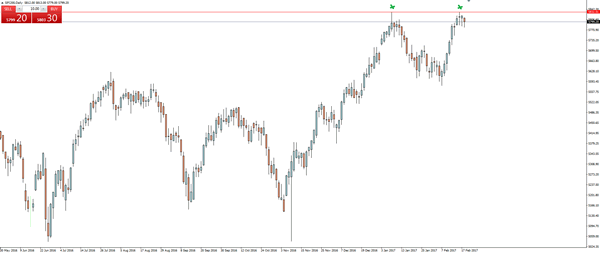
Daily resistance that you can see has held for now, printing a pretty obvious double top in the process.
I'll let you zoom out a little further yourself to see the previous price action at this level back in 2015, but price is most definitely also pushing into a larger zone of interest in any case.
Fast forward into the present and you can see we're back up to the level for the 3rd time recently.
Still the level holds!
SPI200 Daily:
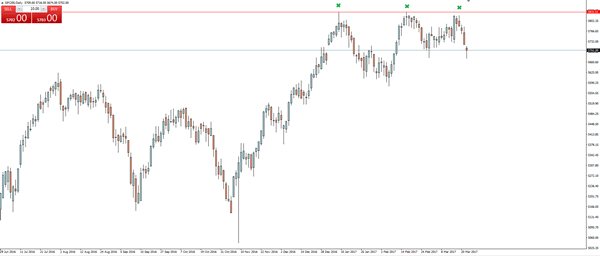
It has been a couple of days since the 3rd touch and with the latest bout of global turmoil we are waking up to here in Asia, stocks could well come under further pressure.
When technical levels hold, fundamental events or releases always compound the move.
Preparing For The Trump Tantrum
Preparing for the Trump Tantrum
US equities recovered moderately after the sharp decline yesterday; investors were in buy the dip mode during a rare US equities market pull back. Despite the amount of ink spilt over the health care vote, fundamentally the US economic landscape looks bright, and investors were quick to snap up bargains. However, news of the deplorable terrorist attack in London held the upward momentum in check. US Congress will vote on the AHCA tonight, and with Republicans still approximated to be lacking the need votes, the Trump administration’s backroom negotiation skills will be put to the test whipping up the required tally to secure the 216 votes to pass. However, 12 hours is a decade in political time, and things can change in a heartbeat IN other markets, JPY has been the biggest beneficiary of the haven rally while Industrial commodities had another weak session led by declines in both Copper and Iron Ore
Handy Tool from the New York Times to monitor the House vote on Obamacare Replacement
Australian Dollar
The Aussie dollar has opened firmer at .7675 this morning after plummeting to .7640 overnight as investors were more than willing to buy the long-awaited dip in US stocks, supporting risk appetite. On the surface, it would appear that the Aussie dollar has been doing little more than been echoing broader risk appetite.But the Aussie was also the beneficiary of the weaker US housing data as, despite two rate hikes since December, the market still views the Fed as dovish and the weaker than expected housing data supported this bias.
On the Iron ore front, prices were dealt another blow when Chinese press reported 16 Beijing Banks had raised their mortgage rates.
Japanese Yen
USDJPY teased with 111.00 level on Haven flow. With the weak US housing data, along with a sagging USD, it took little more than a feather duster sweep to take out support. This triggering stops on the way to 110.80 before the pair regained some composure and for risk appetite to re-emerge.
The USDJPY has opened bid in APAC with convictions apparently tied to the emerging news out of the Whitehouse that the Team Trump is considering some concession to the AHCA that would appeal to the House Freedom Caucus.
Worth keeping an eye on the headlines as so far only USDJPY desks have taken the bait, but the tail is for broader risk appeal
New Zealand Dollar
RBNZ released its policy rate (the OCR) will remain at 1.75%, as was widely expected by the market. IN typical knee-jerk fashion, and one can never be sure why the Kiwi sold off 20 pips before pulling back. After glossing over the accompanying statement, there is nothing to suggest a change in the Bank’s neutral bias. Inflation is still expected a return to the midpoint of the Bank’s target range over the medium term, but the release was far from a game changer and failed to surprise the market one way or the other.
EURO
The market continues to consolidate at the top of the recent ranges as dealer remains on edge ahead of Thursday healthcare vote. With little on the economic calendar, traders remain glued to the shifting tides of the health care negotiations and how that parlays into risk appetite.
China
US healthcare headlines are hogging the headline overshadowing the biggest l storyline. The seven-day repo fixing rates in China have spiked higher but small lenders are reported to have missed payments in the interbank market early in the week, and shadow banks are having difficulty in receiving funding promoting the Pboc temporary liquidity injections
The increase in Repo rates can be explained away as the Pboc attempting to control financial asset bubbles and perhaps influence the Yuan However if there are ongoing issues with shadow banks missing payments red flags will go up indicating something deeper rooted is amiss. I suspect this will present considerable regional headwinds if steamrolls.