Sample Category Title
Trade Idea Wrap-up: USD/CHF – Buy at 1.0005
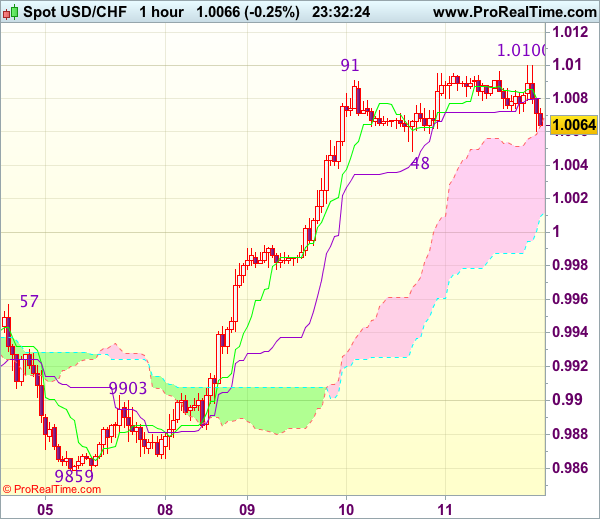
USD/CHF - 1.0088
Most recent candlesticks pattern : N/A
Trend : Near term up
Tenkan-Sen level : 1.0085
Kijun-Sen level : 1.0072
Ichimoku cloud top : 1.0054
Ichimoku cloud bottom : 0.9987
Original strategy :
Buy at 1.0015, Target: 1.0115, Stop: 0.9980
Position : -
Target : -
Stop : -
New strategy :
Buy at 1.0005, Target: 1.0105, Stop: 0.9970
Position : -
Target : -
Stop : -
As the greenback has retreated after marginal rise to 1.0100, suggesting recent upmove is not ready to resume yet and further consolidation below previous resistance at 1.0108 would be seen, hence consolidation with initial downside risk is seen for test of 1.0048, however, reckon 1.0000-10 (38.2% Fibonacci retracement of 0.9859-1.0100) would limit downside and bring another rise later, above said resistance at 1.0108 would confirm resumption of early rise to 1.0130 and then 1.0150-55 which is likely to hold from here due to loss of near term upward momentum.
In view of this, would not chase this rise here and we are looking to buy dollar on pullback as 1.0000-10 should limit downside. Below 0.9980 (50% Fibonacci retracement of 0.9859-1.0100) would defer and suggest top is possibly formed but break of previous resistance at 0.9957 is needed to signal top is formed, bring further fall to 0.9920-25, however, previous resistance at 0.9903 should remain intact.
BoE Review: Maintains Hawkish Twist to Neutral Stance
In line with our expectation, the Bank of England (BoE) made no policy changes at its May meeting and reiterated its neutral stance by repeating it could move 'in either direction'.
However, against our expectation, the BoE also maintained its hawkish twist. First, Kristin Forbes (a known hawk) still voted for a hike (note, though, that she is leaving the BoE on 30 June 2017, which makes her hawkish stance less important). Second, some members still think that '…it would take relatively little further upside news…for them to consider that a more immediate reduction in policy support might be warranted'. The meeting summary also states that the BoE thinks the current market pricing of BoE hikes is a bit too soft if the economy lives up to the expectations. Still, markets had expected an even more hawkish Bank of England.
We still expect the BoE to remain on hold for the next 12 months. While we think it is unlikely the BoE will tighten monetary policy in a time of elevated political uncertainty, we think we would need to see substantially slower growth and/or higher unemployment before easing becomes likely again.
Note that the BoE reaction function has changed since the financial crisis: the BoE puts more weight on growth/unemployment relative to inflation (see also a speech by former Monetary Policy Committee member Martin Weale here, 18 July 2016). In our view, the BoE seems to be more worried about slower growth than too-high inflation if this is only temporary.
EUR/GBP remains trapped in the 0.84-0.85 range ahead of the UK election
Despite some hawkish comments on the BoE view on rate hike prospects relative to the market's pricing, EUR/GBP traded higher following the BoE announcement.
As such, there are probably three reasons the EUR/GBP has bounced today.
- We think many investors expected a tighter voting split, with one or more members joining Forbes' vote in favour of a rate increase.
- 2. The BoE revised its CPI inflation projection lower, which does not support the case for a rate hike any time soon.
- The BoE's fairly optimistic outlook for growth is conditioned on the assumption of a smooth Brexit, which remains highly uncertain.
We still expect EUR/GBP to remain trapped in the 0.84-0.85 range ahead of the general election on 8 June.
We target 0.84 in 1M and would still look to sell EUR/GBP (preferably via options) if spot goes up to 0.8550.
Longer term, the outlook for EUR/GBP depends largely on the outcome of the general election.
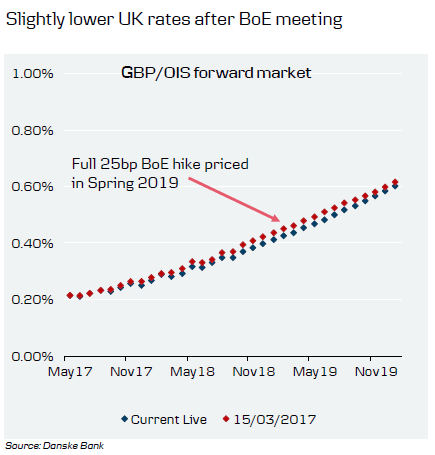
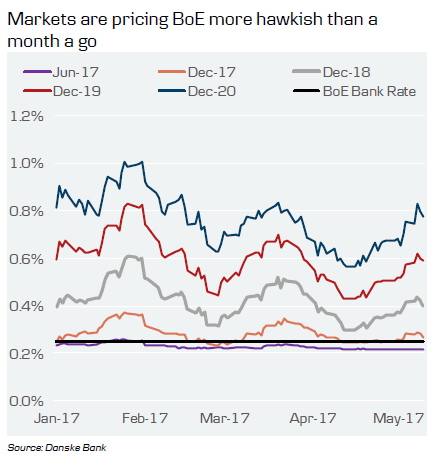
Too hawkish BoE pricing, in our view
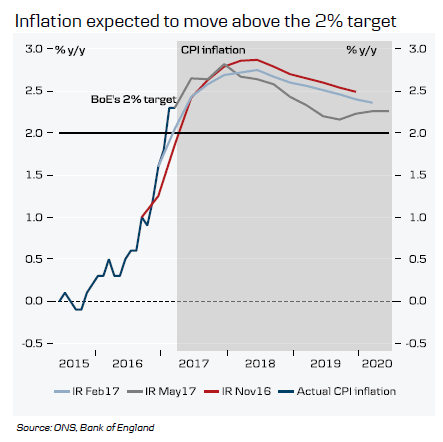
BoE has lowered its CPI inflation projections
The BoE has lowered its CPI inflation projections due mainly to the appreciation of GBP since the latest inflation report in February.
The BoE still expects CPI inflation to move higher, as 'the ef fects of the fall in sterling and rising foreign export prices continue to feed through'.
The BoE says that 'the projected overshoot entirely ref lects' the GBP depreciation since November 2015 and that 'although domestically generated inflation had been rising, it was currently below the level broadly consistent with the inf lation target'.
This supports our view that the BoE will see through higher inflation if it is only temporary due to currency changes. In our view, a trigger for a more hawkish BoE would be higher domestically generated inflation.
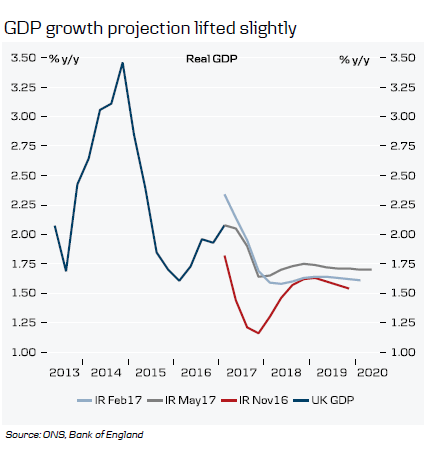
BoE expects GDP growth of around 1.75% in coming years
The UK grew 0.3% q/q in Q1, lower than the BoE expected back in February. Note though that the BoE expects this to be revised up.
The BoE expects the economy to grow around 0.4% q/q in coming quarters.
The BoE expects a smooth Brexit.
The BoE expects private consumption growth to recover 'in the latter part of the forecast period as real income picks up', so higher nominal wage growth is an important underlying assumption.
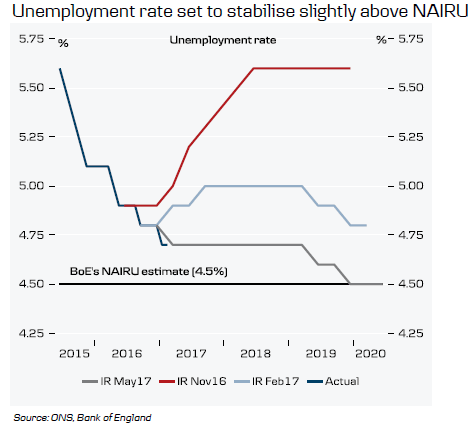
BoE expects unemployment to stabilise at 4.7%
The BoE has lowered its projection for the unemployment rate, as it has lifted its projection for GDP growth.
The BoE now expects the unemployment rate to stabilise around the current level of 4.7%, slightly above the NAIRU estimate of 4.5%, implying there is still slack left in the labour market.
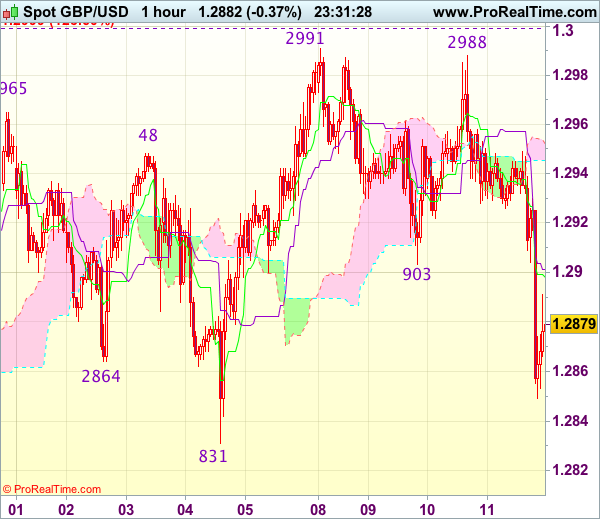
Trade Idea Wrap-up: GBP/USD – Sell at 1.2900
GBP/USD - 1.2879
Most recent candlesticks pattern : N/A
Trend : Near term up
Tenkan-Sen level : 1.2898
Kijun-Sen level : 1.2901
Ichimoku cloud top : 1.2952
Ichimoku cloud bottom : 1.2946
Original strategy :
Sell at 1.2900, Target: 1.2800, Stop: 1.2935
Position : -
Target : -
Stop : -
New strategy :
Sell at 1.2900, Target: 1.2800, Stop: 1.2935
Position : -
Target : -
Stop : -
As cable has dropped below support at 1.2903 (now resistance) on dovish BOE, signaling top is formed at 1.2991 earlier and consolidation with downside bias is seen for further fall to 1.2831 support, break there would add credence to this view and extend the fall from 1.2991 top to 1.2805 and later towards 1.2770 but reckon previous support at 1.2757 would hold from here.
In view of this, we are looking to sell cable on recovery as said resistance at 1.2903 should limit upside and bring another decline. Above 1.2930-35 would risk test of 1.2950-60 but break there is needed to signal low is formed, bring another bounce towards 1.2988-91 resistance but break of 1.2999-00 (1.236 times projection of 1.2109-1.2616 measuring from 1.2365 and psychological resistance) is needed to revive bullishness.
Trade Idea Wrap-up: EUR/USD – Sell at 1.0955
EUR/USD - 1.0871
Most recent candlesticks pattern : N/A
Trend : Near term down
Tenkan-Sen level : 1.0866
Kijun-Sen level : 1.0866
Ichimoku cloud top : 1.0908
Ichimoku cloud bottom : 1.0880
Original strategy :
Sell at 1.0930, Target: 1.0820, Stop: 1.0965
Position : -
Target : -
Stop : -
New strategy :
Sell at 1.0955, Target: 1.0840, Stop: 1.0990
Position : -
Target : -
Stop : -
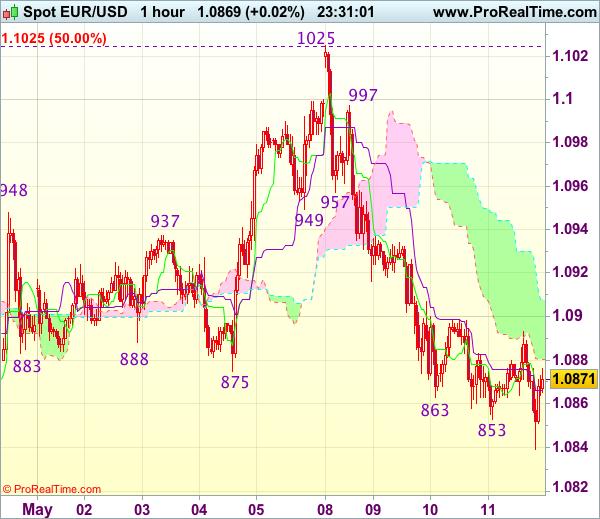
As the single currency has recovered after falling briefly to 1.0839, suggesting consolidation above this level would be seen and corrective bounce to 1.0895-00 is likely, however, reckon upside would be limited to 1.0930-35 and renewed selling interest should emerge around 1.0955-60, bring another decline later. A break of said support at 1.0839 would extend the fall from 1.1025 top for at least a strong retracement of early upmove towards 1.0800 but reckon 1.0770-75 would hold from here.
In view of this, we are looking to sell euro on recovery as 1.0955-60 should limit upside. Above 1.0970 would defer and risk a stronger rebound but a break above resistance at 1.0997 is needed to signal pullback from 1.1025 has ended, bring retest of this level later.
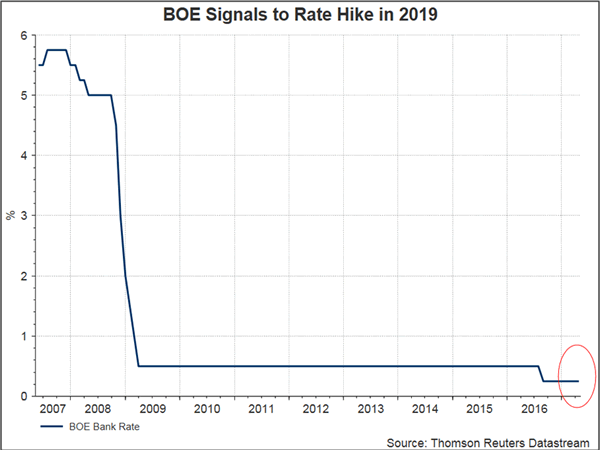
Dovish BoE Sent British Pound Lower
BOE left the Bank rate unchanged at 0.25% and the QE program at 435B pound. While this had been widely anticipated, BOE's downgrade of GDP growth outlook was disappointing. Policymakers also raised its inflation forecast for this year, warning that rising inflation begins to hurt consumers, but lowered the forecasts for 2018 and 2019. Expectations of a "smooth" Brexit led members to believe that interest rate may need to go up around the time the UK leaves the EU in 2019.
The market viewed the downgrade of GDP growth this year and inflation outlook in 2018 and 2019 as dovish. We were a bit surprised by the 7-1 vote (Kristin Forbes the only dissenter) to maintain the monetary policy status quo. We had expected a more divided committee with one more member joining the rate hike camp.
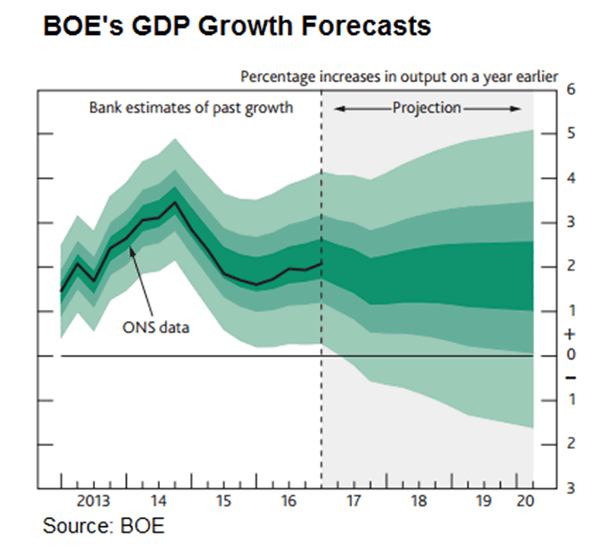
Consumption growth will be slower in the near term
On the economic outlook, BOE revised lower its GDP growth forecast to +1.9% for this year, from +2% projected in February. It also anticipated that 1Q17 growth would be revised lower to +0.4% q/q.. Yet, GDP growth was revised higher to +1.7% (February: +1.6) for 2018 and to +1.8% (February: +1.7%) for 2019. The quarterly Inflation Report suggested that "consumption growth will be slower in the near term than previously anticipated before recovering in the latter part of the forecast period as real income picks up". The central bank projected wage to grow +3.5% and +3.75% in 2018 and 2019, respeictlvely. As suggested in the statement, "with unemployment falling to its estimated equilibrium rate, wage growth is expected to recover significantly, and the drag from domestic costs to lessen, over the same period".
2018, 2019 CPI forecast revised lower
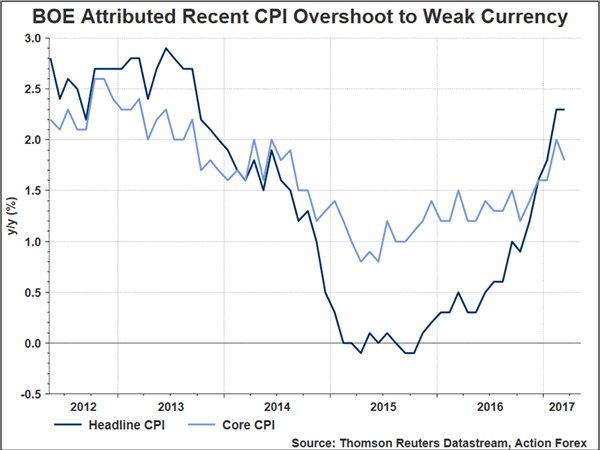
On inflation, BOE revised higher its CPI forecast to +2.7% from 2.4% for 2017, probably driven by the fall in market rate from February. Inflation forecasts for 2018 and 2019 were, however, revised down to 2.4% (from +2.6%) and to +2.2% (from +2.4%), respectively. Exceeding BOE's target, headline CPI rose to +2.3% in February and steadied at that level in March.
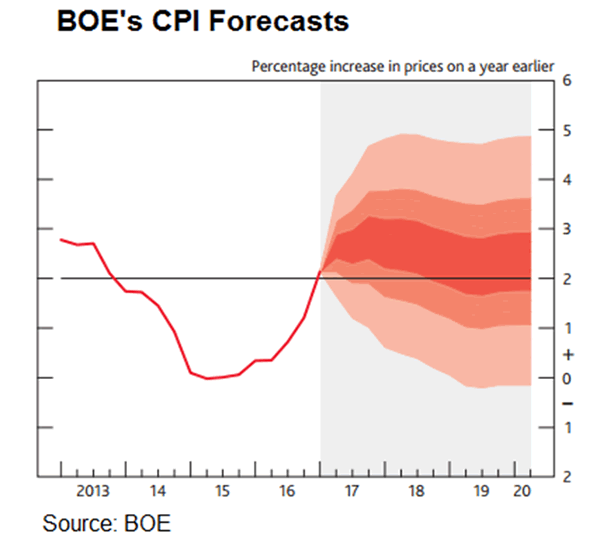
The central bank attributed this phenomenon to sterling's weakness, noting that "the projected overshoot (of the inflation target) entirely reflects the effects of the falls in sterling since late November 2015 on import prices".
Projections hinged on a "smooth" Brexit
The central bank's projections hinged on a "smooth" Brexit prospect. As noted in the statement, the "latest projections there is such a trade-off through most of the forecast period, with a degree of spare capacity and inflation remaining above the 2% target. In the final year of the forecast, however, the output gap closes and inflation rises slightly further above the target. This is conditioned on the assumptions that the adjustment to the United Kingdom's new relationship with the European Union is smooth, and that Bank Rate follows the market-implied path for interest rates".
The BOE has not modeled for a disorderly Brexit. Yet, it stressed that monetary policy would not "prevent either the necessary real adjustments as the U.K. moves towards its new international trading arrangements or the weaker real income growth that's likely to accompany that adjustment over the next few years".
Trade Idea Wrap-up: USD/JPY – Buy at 113.15
USD/JPY - 113.75
Most recent candlesticks pattern : N/A
Trend : Near term up
Tenkan-Sen level : 113.85
Kijun-Sen level : 113.92
Ichimoku cloud top : 113.94
Ichimoku cloud bottom : 113.36
Original strategy :
Buy at 113.40, Target: 114.45, Stop: 113.05
Position : -
Target : -
Stop : -
New strategy :
Buy at 113.15, Target: 114.25, Stop: 112.80
Position : -
Target : -
Stop : -
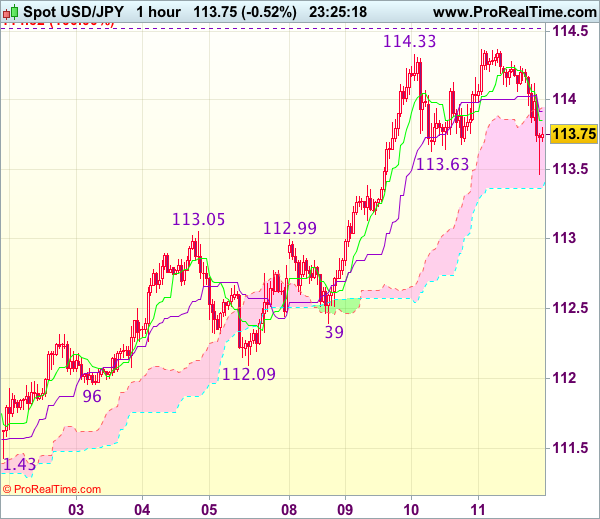
As the greenback has retreated after marginal rise to 114.37, suggesting minor consolidation below this level would be seen and pullback to the lower Kumo (now at 113.36) is likely, however, still reckon previous resistance at 113.05 (now support) would contain downside and bring another rise later to 114.50-55 (100% projection of 108.13-111.78 measuring from 110.87) but overbought condition should limit upside to 114.75-80 and price should falter below 115.00.
In view of this, would not chase this rise here and would be prudent to buy dollar on pullback as 113.15-20 should contain downside. A firm break below previous resistance at 112.99-05 would defer and suggest top is formed, bring correction of recent upmove to 112.65-70 but reckon support at 112.39 would remain intact.
Trade Idea: EUR/GBP – Stand aside
EUR/GBP - 0.8435
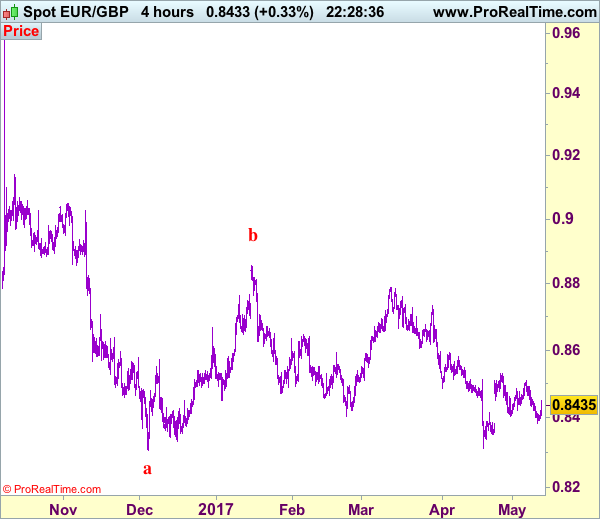
Recent wave: Major double three (A)-(B)-(C)-(X)-(A)-(B)-(C) is unfolding and 2nd (A) has possibly ended at 0.6936.
Trend: Near term down
New strategy :
Stand aside
Position : -
Target : -
Stop : -
Despite falling to 0.8384 yesterday, the subsequent rebound has retained our view that further consolidation would be seen and recovery to 0.8455-60 cannot be ruled out, however, reckon upside would be limited to 0.8490 and resistance at 0.8509 would hold from here, bring further choppy trading. Above resistance at 0.8509 would bring test of another previous resistance at 0.8531 but only break of this level would add credence to our view that a temporary low has been formed at 0.8312 last month and extend the rebound from there for retracement of recent decline to 0.8550
On the downside, below said support at 0.8384 would extend weakness to support at 0.8351 but break there is needed to signal the rebound from 0.8312 low has ended at 0.8531 and bring further fall towards this support at 0.8312 which is likely to hold from here. As near term outlook is still mixed, would be prudent to stand aside for now.
Our preferred count is that, after forming a major top at 0.9805 (wave V), (A)-(B)-(C) correction is unfolding with (A) leg ended at 0.8400 (A: 0.8637, B: 0.9491 and 5-waver C ended at 0.8400. Wave (B) has ended at 0.9413 and impulsive wave (C) has either ended at 0.8067 or may extend one more fall to 0.8000 before prospect of another rally. Current breach of indicated resistance at 0.9043 confirms our view that the (C) leg has ended and bring stronger rebound towards 0.9150/54, then towards 0.9240/50.
Trade Idea: USD/CAD – Buy at 1.3570
USD/CAD - 1.3727
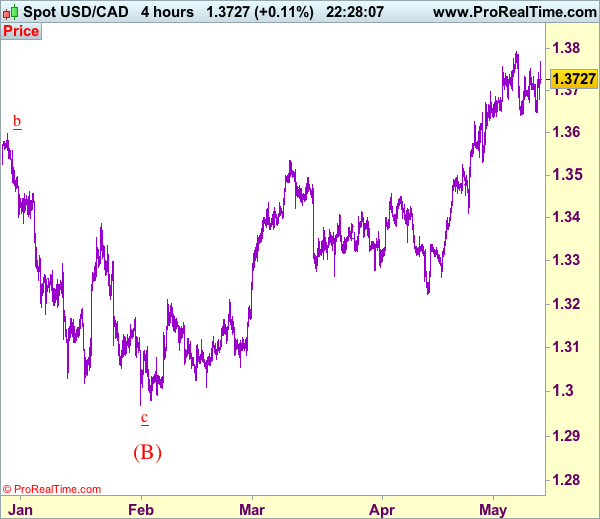
Recent wave: Only wave v of c has ended at 0.9407 and wave C of major A-B-C correction is underway for headway to 1.4700
Trend: Near term up
Original strategy :
Buy at 1.3570, Target: 1.3770, Stop: 1.3510
Position: -
Target: -
Stop: -
New strategy :
Buy at 1.3570, Target: 1.3770, Stop: 1.3510
Position: -
Target: -
Stop:-
Although the greenback rebounded after holding above support at 1.3642, break of last week’s high at 1.3794 is needed to confirm recent upmove has resumed and extend further gain to 1.3840-50 but overbought condition should prevent sharp move beyond 1.3890-00 and price should falter below 1.3950. If said resistance continues to hold, then further consolidation is in store and another corrective fall to 1.3642 cannot be ruled out, however, reckon downside would be limited to 1.3570 and bring another rise later.
In view of this, would not chase this rise here and would be prudent to buy again on pullback as 1.3570 should limit downside and bring another rise later. Below 1.3530 would abort and suggest a temporary top is formed, bring retracement of recent upmove to 1.3500 and later towards 1.3450-60 but support at 1.3411 should remain intact, bring another upmove later.
To recap, wave B from 1.3066 is unfolding as an a-b-c and is sub-divided as a: 1.2192, b: 1.2716 and wave c is a 5-waver with i: 1.1983, ii: 1.2506, extended wave iii with minor iii at 1.0206, wave iv ended at 1.0781 and wave v as well as wave iii has ended at 0.9931, hence the subsequent choppy trading is the wave iv which is unfolding as (a)-(b)-(c) with (a) leg of iv ended at 1.0854, followed by (b) leg at 1.0108 and (c) leg as well as the wave iv ended at 1.0674. The wave v is sub-divided by minor wave (i): 0.9980, (ii): 1.0374, (iii): 0.9446, (iv): 0.9913 and (v) as well as v has possibly ended at 0.9407, therefore, consolidation with upside bias is seen for major correction, indicated target at 1.3700 and 1.4000 had been met and further gain to 1.4700 would be seen later.
Yen Moves Higher on US Political Firestorm
USD/JPY has posted losses on Thursday, erasing the gains recorded in the Wednesday session. In North American trade, the pair is trading at 113.60. In economic news, Japan's current account surplus dropped to JPY 1.73 trillion, shy of the estimate of JPY 1.75 trillion. In the US, PPI climbed to 0.5%, above the estimate of 0.2%. Unemployment claims ticked down to 236 thousand, below the forecast of 245 of thousand. On Friday, we could see further movement from USD/JPY, as the US releases retail sales, CPI and consumer confidence.
It's been a rough ride for the Japanese yen, which has managed just one winning daily session since April 25. The yen has reversed this trend on Thursday following the firing of FBI director James Comey. The ensuing crisis has hurt the US dollar as investors have flocked to the safe-haven Japanese yen. On Wednesday, the BoJ released its summary of opinions from its April policy meeting. BoJ board members recommended that the central bank maintain its ultra-loose accommodative policy due to global downside risks. At the same time, policymakers noted that the economy has improved, boosted by stronger exports and production. The summary stated that the BoJ should upgrade its economic assessment to state that the economy "has been turning towards a moderate expansion". On the inflation front, policymakers predicted that inflationary pressures would increase, but that the inflation target of 2 percent would not be attained before 2018. The summary reiterates the cautious optimism that characterized the BoJ rate statement in April – global demand has boosted the economy, but the BOJ feels that it's too early too make any changes to the current quantitative easing program.
Washington is gripped in a major political crisis, following Trump's firing of FBI director James Comey on Tuesday. Comey, who has been conducting an investigation into possible collusion between Trump and Russia during the presidential campaign, clearly has been a thorn in Trump's side. The White House has claimed that it fired Comey over his handling of an email scandal involving Hillary Clinton, but the move has been roundly condemned by the Democrats, and some key Republicans have also voiced opposition as well. The firestorm could heat up further, with calls in Congress to appoint an independent investigator into Trump's connections with Russia. Has Trump gone one step to far? This latest controversy shows no signs of fading away anytime soon, and could delay Trump agenda of tax reform and increased fiscal spending.
Currencies: Sterling Ceding Ground Post-BoE Decision
Headlines
European equity markets corrected lower today with the telecom sector underperforming. US stock markets opened around 0.25% in the red.
NY Fed Dudley said that the Fed will probably begin shrinking its balance sheet sometime later this year or in 2018 if economy stays on track. They will allow both MBS and Treasuries to run off. He added that there's no great urgency for the Fed to tighten aggressively though.
The BoE kept its policy unchanged with one member again voting in favour of an immediate rate hike. The BoE suggested interest rates could rise towards more normal levels over the next three years if Brexit negotiations go smoothly, but said it had been overoptimistic about economic performance for the first half of this year.
US shale oil output is growing at a faster than expected rate, keeping pressure on prices despite steep supply curbs from some of the world's biggest producers, Opec said in its monthly market report.
The European Commission revised upward its forecasts of euro zone economic growth this year and projected a lower unemployment rate, in new signs that the bloc's recovery is gathering pace. The 19-country currency bloc is expected to expand by 1.7% this year and 1.8% in 2018.
Banks' "unconstrained" ability to generate credit by pledging the same assets as collateral multiple times needs to be curbed or risks creating a new financial bubble, ECB vice president Constancio said. His remarks underscored the ECB's concerns about the prospect of a new boom in lending between financial firms
British industrial output shrank for a third month in a row in March (-0.5% M/M) underscoring how the impact of last year's Brexit vote has begun to weigh on the economy. The ONS also said Britain's trade deficit widened by more than expected, a further setback for hopes that sterling's fall would help rebalance the economy.
US weekly jobless claims stabilized around historical lows (236k) while markets expected a small setback to 245k. Continuing claims declined to a 28-yr low at 1918k. The bigger-than-forecast rebound in April producer prices indicates inflation pressures continue to build in the US economy and that March's decline was short-lived.
Rates
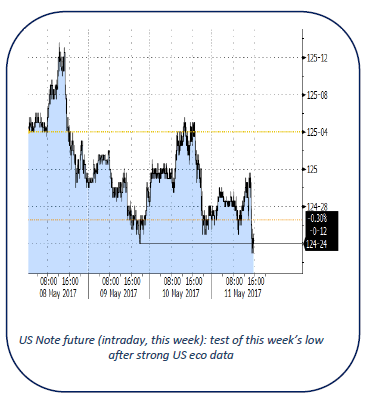
US Note future tests this week's low after strong data
Global core bonds continued to trade choppy. The Bund faced immediate selling pressure, but equity weakness came to the rescue and prevented losses. The EC only marginally upgraded its 2017 growth forecast, while keeping it unchanged in 2018 which avoid more ECB exit speculation. Heavyweight NY Fed governor Dudley suggested that the Fed will allow both MBS and US Treasuries to run-off, starting at the end of this year or the beginning of next. He added that there's no hurry to tighten policy though. His comments fell on deaf ears. US eco data, even if they were second-tier, managed to change the intraday tide. Weekly jobless claims remained near historically low levels while producer prices rose faster than forecast. US Treasuries recorded new intraday lows while German Bunds lost ground as well. Brent crude managed to hold above the key $50/barrel mark.
At the time of writing, the German yield curve bear steepens with yield 1 bp (2- yr) to 3.1 bps (30-yr) higher. Changes on the US yield curve range between +0.3 bps (10-yr) and +1.3 bps (30-yr). On intra-EMU bond markets, 10-yr yield spreads changes versus Germany range between -1 bps and +2 bps with Portugal (-3 bps) and Greece (-5 bps) outperforming.
The Italian debt agency tapped the on the run 3-yr BTP (€2.44B 0.35% Jun2020), 7-yr BTP (€2.25B 1.85% May2024), 30-yr BTP (€1.25B 2.7% Mar2047) and the off the run BTP (€1.25B 4.75% Sep2044). The combined amount sold (€7.19B) was near the upper end of the €5.5-7.25B target range. The auction bid cover was 1.51 which is rather strong for Italian standards. Tonight, the Treasury ends its refinancing operation with a $15B 30-yr Bond auction. Currently, the WI trades around 3.05%.
Currencies
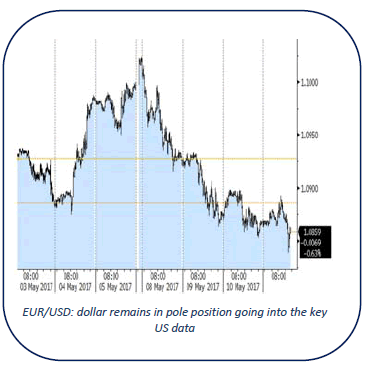
Dollar maintains most of recent gains ahead of key data
Today, EUR/USD and USD/JPY initially drifted sideways. Both cross rates lost ground as equities finally fell prey to modest profit taking. The US eco data (PPI and claims) were better than expected. Core yields rose slightly, but were not able to trigger more USD gains. The focus for USD trading is on tomorrow's US CPI and retail sales. EUR/USD trades in the 1.0855/60 area. USD/JPY struggles not to fall below 114.
Overnight, most Asian equity indices gained ground with the Nikkei and the Korean indices at multi-month highs. Mainland China equities initially underperformed but staged a remarkable rebound towards the close. Until now the Chinese underperformance had little impact on other markets, but the issue deserves close monitory. USD/JPY (114.20) remained in risk-on modus, holding within reach of the recent highs. EUR/USD stabilized the 1.0865 area.
Early in Europe, there was again no clear directional momentum in European equities nor in EUR/USD and USD/JPY. The EU commission forecasts were revised only marginally higher and no market mover. At the onset of the US trading session, sentiment on risk gradually faltered. The correction weighed on EUR/JPY, EUR/USD and, to a lesser extent USD/JPY. The US PPI and jobless claims were stronger than expected and triggered some modest gains of the dollar against the euro. EUR/USD trades currently in the 1.0850/60 area. So, the price action in the cross rate was both due a pinch of risk-off and a small piece of USD strength. The US eco data also help to prevent a further USD/JPY decline. The pair stabilizes near 114. However, some further topping out might be on the cards if sentiment on risk would worsen more on China or for whatever other reason including simple profit taking.
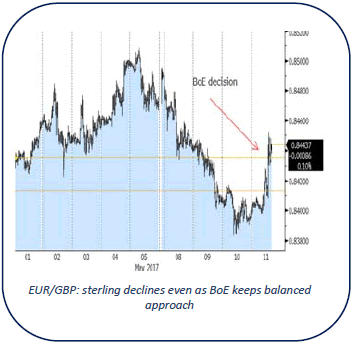
Sterling ceding ground post-BoE decision.
Today, UK March production data and the trade balance were substantially weaker than expected. Sterling lost temporary ground upon their publication, but EUR/GBP drifted back to the low 0.84 area going into the BoE policy decision and inflation report. The Bank of England kept a balanced approach as it said that 'Monetary policy cannot prevent either the necessary real adjustment as the United Kingdom moves towards its new international trading arrangements or the weaker real income growth that is likely to accompany that adjustment over the next few years'. The Bank indicated that an earlier rate hike might be needed in case of a smooth Brexit,. However, what are the chances for this scenario? The moves in sterling remained modest, but the market apparently concluded that the BoE will give slightly more weight to supporting growth rather than fighting inflation. The vote was again 7-1 for an unchanged decision. There was no additional support for a rate hike, what some apparently expected. EUR/GBP trades currently in the 0.8445/50 area. Cable is drifting further away from the 1.30 resistance and trades currently in the 1.2860 area.