Sample Category Title
RBNZ To Leave Rates Unchanged Until 2020, Downplayed Rising CPI And NZD Weakness
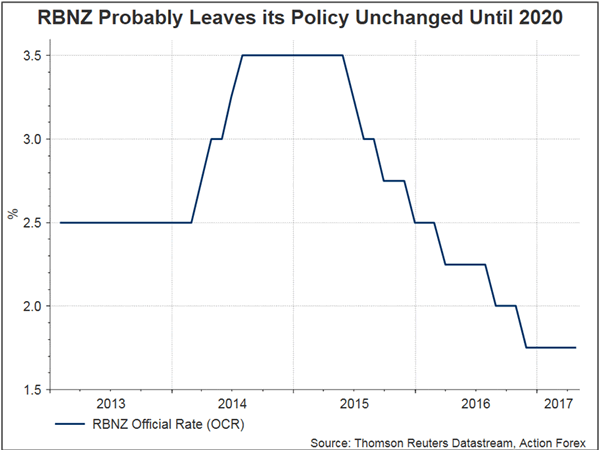
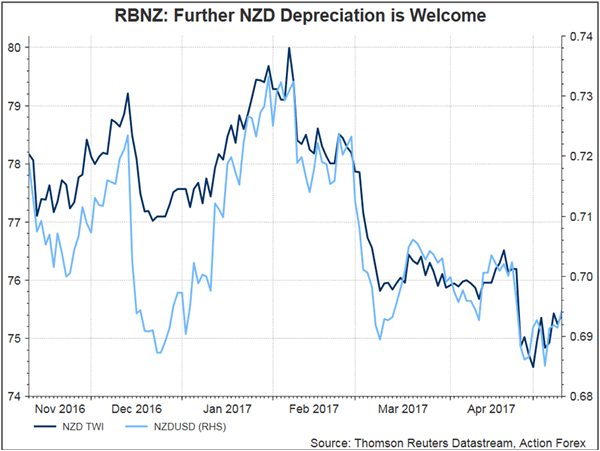
RBNZ left the OCR unchanged at 1.75% in May. Policymakers shrugged off the recent NZD depreciation and the rise in inflation, indicating that the monetary policy would likely stay unchanged for the rest of the year and probably until 2020 before tightening. The market was disappointed by the lack of hawkish comments and the unchanged forward guidance. Down -1.85, NZDUSD slumped to an 11-month low of 0.6816 after the announcement.
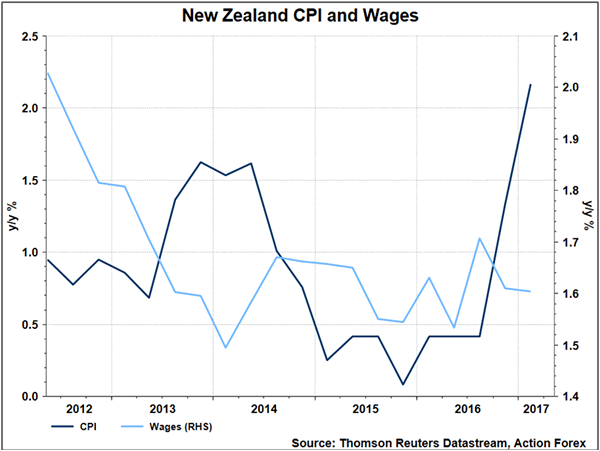
As noted in the statement, RBNZ acknowledged that global economic growth has 'increased and become more broad-based over recent months'. Yet, it remained cautious over the 'surplus capacity' and 'extensive political uncertainty'. Meanwhile, the central bank reminded the 'weaker than expected' domestic growth in 2H16. RBNZ also acknowledged the increase in New Zealand’s headline inflation in the March quarter, attributing the improvement to 'higher tradables inflation, particularly petrol and food prices'. However, they judged that the effects are 'temporary' and 'may lead to some variability in headline inflation over the year ahead'. It added that 'non-tradables and wage inflation remain moderate but are expected to increase gradually. Overall, policymakers believed that headline inflation would reach the midpoint of the target band over the medium term. They maintained the longer-term inflation expectations at around +2%.
Policymakers were also aware of the depreciation in New Zealand dollar, attributing that -5% decline in the trade-weighted exchange rate since February to 'reduced interest rate differentials' and a response to the global developments. They added that further weakness in the currency would 'help to rebalance the growth outlook towards the tradables sector'. On the housing market, Governor Graeme Wheeler noted at the press conference that 'the slowing in house price inflation partly reflects loan-to-value ratio restrictions and tighter lending conditions'. He expected the moderation to continue, despite that 'risk of resurgence given the continuing imbalance between supply and demand'.
While the market had anticipated tighter policy guidance as a result of rising inflation and NZD weakness, the RBNZ noted that 'developments since the February Monetary Policy Statement on balance are considered to be neutral for the stance of monetary policy'. The RBNZ has kept its expected OCR track unchanged from the one in February, with the forecast at 1.8% through to September 2019, before rising to 2.0% in March 2020, where it now remains through June 2020.
NZD/USD Breaks December Support
This morning we saw the Reserve Bank of New Zealand (the RBNZ), keep its benchmark interest rate on hold at 1.75%.
In doing so, we saw Wheeler and his men reiterate that they would look to keep interest rates in New Zealand on hold heading forward.
'Numerous uncertainties remain and policy may need to adjust accordingly.'
'Recent falls in the exchange rate were encouraging and would encourage the growth outlook if sustained.'
While all 26 economists that Reuters polled before the release expected no change, the Kiwi took a bit of a beating, sending it through the NZD/USD daily support level that we have been watching since last year.
The NZD/USD daily chart shows this touch of support from back in December 2016:
NZD/USD Daily:
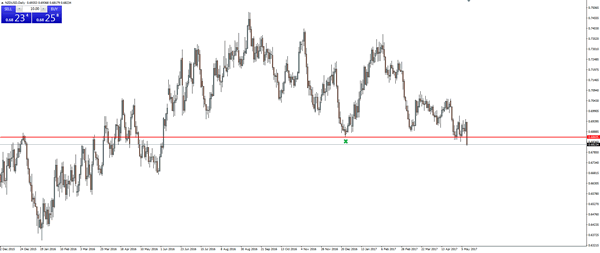
While price had been exploring below the level, its inability to make any sort of meaningful close saw it recently hold on. But after the RBNZ decision and statement, support finally broke.
What I really wanted to highlight here on the NZD/USD 5 minute chart is the way that price pulled back and retested the higher time frame level that was created 5 months ago:
NZD/USD 5 Minute:
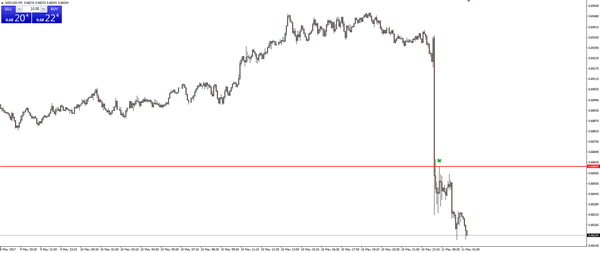
Come on, that's pretty cool. And most importantly, was a nice entry level for a savvy forex day trader if you were at your charts this morning!
Oil Prices To Conspiracy Theories
Oil Prices to Conspiracy Theories
On the surface, making sense of the latest Trump conspiracy theory while searching for a Nixon-esque smoking gun can be challenging. But under the surface, it brings into question Trump's political agenda, and it raises some doubt in investors minds, more so given that market scepticism is very high concerning Trump policy. The advancing noise around this debate saw equity market trade with a very high degree of caution as fear of this latest political storm cloud that could delay tax reform.
Currency markets looked past the political noise consumed by material facts surrounding Wednesday's Fed speak and resurgent oil prices.
The Energy Information Administration's weekly crude stocks change report greased a 2.2% rally in WTI. The much larger than expected crude inventory drawdown reported by the EIA confirmed Tuesday's API data and sparked a meteoric move higher in oil prices, cheered on by the commodity bloc of currencies, which explains the bounce in Emerging Market FX appeal.
On Fedspeak, Fed Rosengren continues to roost with the Hawks, advocating starting to shrink the central bank's balance sheet after their next hike to avoid creating an 'over-hot economy.' While the comments lit a fire under USDJPY traders, EURUSD desks are still facing the Euro conundrum.
Australian dollar
While commodity currencies cheered the latest EIA report, the Aussie dollar was picking up support throughout yesterday's APAC session on speculation the commodity rout was basing, causing a short Aussie unwind after everyone, and their dog jumped on the Aussie momentum trade on a break of .7400.
In early APAC trading, the Aussie is stuck in the middle of the road, tugged in one direction by resurgent oil but pulled in the other by Fed speak with a bit of help from this morning's blow out on the NZD. A very tentative RBNZ Monetary Policy Statement sent Long Kiwi specs running for the exit while dragging the Aussie lower on its coattail.
It's still too early to confirm that the low is in for commodities, but with a good portion of the recent unwind likely attributed to a tightening of China financial regulation, bargain hunters will probably return sooner than later. Supporting the view that the worst of the commodity rout may be behind us.
Sticking with the commodity block, this morning's move of the Canadian dollar above 1.3700 is due to the Moody's downgrade of Canada's six major banks. This downgrade will present some real concerns about the Canadian dollar and will have other developed market countries with high levels of private sector debt looking over their shoulders.
Euro
The EURUSD riddle continues to unfold, but with the pair unable to regain the 1.09 level despite the decrease in political risk, Euro bulls are certainly getting nervous. Overnight the currency did little more that zigzag dance trading in Limbo awaiting the next major catalyst, which will likely come in the form of Friday's US economic data (Retail Sales and CPI). But it does feel that the Euro bulls are hanging on by a thread as the market looks primed to test 1.0850-25 levels.
For those expecting some policy clarity from ECB President Mario Draghi when addressing the Dutch parliament, he stuck to scripts inferring that it will be time to taper once inflation is self-sustained across the whole of Europe.
One sticky item Euro longs need to be cognizant about is a likely pivot to France's elections for the National Assembly next month, which could shift political risk premiums again.
USD/CAD Canadian Dollar Higher After Oil Surges On Huge Inventory Drawdown
The Canadian dollar appreciated on Wednesday with the bigger than expected drawdown in weekly US crude inventories reported by the Energy Information Administration (EIA). The loonie alongside other commodity currencies were the biggest winners against the USD.
The high correlation between the CAD and the price of oil meant that as the market was unsure of how much an extension to the Organization of the Petroleum Exporting Countries (OPEC) production cut agreement would boost prices the currency had no support while battling on up to three different fronts. The Trump administration had increased the combative rhetoric and sprung into action with tariffs against the Canadian lumber industry in the preamble of the NAFTA renegotiation talks. U.S. President Donald Trump made good on his campaign promise to take the US out of the Trans Pacific Pact (TPP) and put NAFTA on notice back in his inauguration.
Weak economic fundamentals after an impressive first quarter had the loonie under pressure and alongside increasing political risk around the globe the currency was one of the worst performers this year. The more than 4 percent rise in oil prices today will help the CAD regain some of the ground lost, but is still too early to know if this price move represents a new phase for the Canadian dollar or just a temporary move.
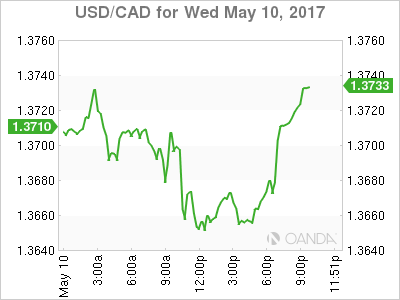
The USD/CAD lost 0.598 percent in the last 24 hours. The currency is trading at 1.3656 after the impressive recovery of oil prices after the US oil inventories showed a bigger drawdown than expected. Commodity currencies were boosted by the fall in US crude inventories.
The Group of Seven (G7) Finance summit meets in Italy later this week. Trade is not front and center in the agenda, despite the rise of protectionist measures around the world. Finance ministers and central bank governor will focus on inequality, international tax rules, cyber security and blocking the funding of terrorism. Canadian officials will be sure to approach their US counterparts about trade while it is also expected EU and UK counterparts discuss the impact of Brexit not only in their economies but its effect for the G7 at large.
The Canadian economic calendar is slim this week. Already housing starts and building permits have disappointed and up next is the New Housing Price Index (NHPI) to be released on Thursday, May 11 at 8:30. Prices are expected to have growth by 0.20 percent. New regulations in the hottest markets appear to have cooled prices as anxiety around the country’s largest non-bank lender has subsided. Home Trust Capital has indicated that the withdrawal rate it had experienced is slowing down after the initial run on deposits in late April.
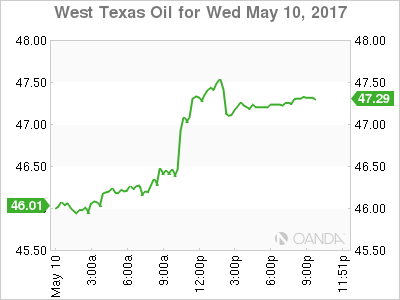
Oil prices surged by 3.754 percent on Wednesday. The price of West Texas is trading at $47.46 after the release of the US crude oil inventories showed a sharp drawdown of 5.2 million barrels last week. This is the largest drawdown in 2017 and managed to move the needle on prices. The OPEC has tried to reassure the market that an extension to their production cut agreement is coming but with doubts around the overall effect prices kept dropping. Lower inventories managed to break the stalemate. Again supply disruptions, this time caused by the weather in the Gulf of Mexico, are driving prices higher despite the sluggish growth in demand.
The inventory data also hints at a slowdown in US production. The growth in shale drilling had offset the OPEC and major producer pact effect on prices. The OPEC and other major producers will meet on May 25 to discuss the terms of an extension to their agreement. While Saudi Arabia has said that it will do whatever it takes to rebalance the oil market other producers might not share that level of commitment
Market events to watch this week:
Thursday, May 11
4:30am GBP Manufacturing Production m/m
7:00am GBP BOE Inflation Report
7:00am GBP MPC Official Bank Rate Votes
7:00am GBP Monetary Policy Summary
7:00am GBP Official Bank Rate
8:30am USD PPI m/m
8:30am USD Unemployment Claims
Friday, May 12
All day G7 Meetings
8:30am USD CPI m/m
8:30am USD Core Retail Sales m/m
8:30am USD Retail Sales m/m
10:00am USD Prelim UoM Consumer Sentiment
Saturday, May 13
All day G7 Meetings
Know The Political Risk Framework
What political headlines matter and which ones don't? That's the question we look at today. The New Zealand dollar was the top performer while the yen lagged on Tuesday but after the RBNZ added guidance to its statement, the kiwi plunged.
Perhaps we were premature to expect that political risks would fade in the months ahead. Or maybe not, for all the hand-wringing about the Comey firing, markets didn't show any sign of caring. Theoretically, it could derail or delay the legislative agenda but Trump could also appoint someone new who buries the investigation and lets him move on.
Trump doesn't matter to markets as as he does to newspapers. Let's backup and look at the framework since election night. Markets rallied not because Trump became president, but due to Republicans' win in all three branches on an agenda of stimulus and tax cuts.
So what are the risks? Assume the longshot scenario of a Trump impeachment. Even then, Pence as president and Republicans would have control. So the real risk is disarray and disorganization within the Republican party. That's a genuine risk and is the factor to watch rather than troubles at the White House.
In the meantime, it was another light data day with more hawkish Fed talk. That led to another steady US dollar bid in North American trade – especially in USD/JPY. Also note that a Treasury auction was soft for the second day and that boosted the dollar late in the day. A long-bond sale is scheduled for Thursday.
In Asia-Pacific trading, the New Zealand dollar was hammered more than a cent lower. The RBNZ held rates unchanged as expected but said policy will remain accommodative for a considerable period. They said inflation was expected to moderate further and the fall in the kiwi since February was welcome. NZD/USD plunged through stops to the lowest since last June on the headlines.
(RBNZ) Official Cash Rate Unchanged at 1.75 percent
The Reserve Bank today left the Official Cash Rate (OCR) unchanged at 1.75 percent.
Global economic growth has increased and become more broad-based over recent months. However, major challenges remain with on-going surplus capacity and extensive political uncertainty.
Stronger global demand has helped to raise commodity prices over the past year, which has led to some increase in headline inflation across New Zealand's trading partners. However, the level of core inflation has generally remained low. Monetary policy is expected to remain stimulatory in the advanced economies, but less so going forward.
The trade-weighted exchange rate has fallen by around 5 percent since February, partly in response to global developments and reduced interest rate differentials. This is encouraging and, if sustained, will help to rebalance the growth outlook towards the tradables sector.
GDP growth in the second half of 2016 was weaker than expected. Nevertheless, the growth outlook remains positive, supported by on-going accommodative monetary policy, strong population growth, and high levels of household spending and construction activity.
House price inflation has moderated further, especially in Auckland. The slowing in house price inflation partly reflects loan-to-value ratio restrictions and tighter lending conditions. This moderation is projected to continue, although there is a risk of resurgence given the continuing imbalance between supply and demand.
The increase in headline inflation in the March quarter was mainly due to higher tradables inflation, particularly petrol and food prices. These effects are temporary and may lead to some variability in headline inflation over the year ahead. Non-tradables and wage inflation remain moderate but are expected to increase gradually. This will bring future headline inflation to the midpoint of the target band over the medium term. Longer-term inflation expectations remain well-anchored at around 2 percent.
Developments since the February Monetary Policy Statement on balance are considered to be neutral for the stance of monetary policy.
Monetary policy will remain accommodative for a considerable period. Numerous uncertainties remain and policy may need to adjust accordingly.
Will BoE Turn More Hawkish Ahead of UK Election?
With Inflation Rising Fast, Could the BoE Be Forced to Consider Raising Interest Rates?
The Bank of England finds itself in another tight spot when it meets on Thursday – or Super Thursday as it's become known since the addition once a quarter of the inflation report and Governor Mark Carney's press conference.
It seems that policy makers at the central bank have found themselves in a permanent tight spot since last June's referendum. The constant balancing act of trying to manage the UK through a highly uncertain period of higher inflation and lower growth while try to maintain accurate forecasts is a rather unenviable position. On top of this, the bank has faced constant fierce criticism regarding it pre-referendum position on what Brexit would mean for the economy and the fact that the impact has so far been more muted.
To complicate matters even further this month, the central bank must make its latest decision – which is likely to be a straightforward "no change" – and provide new forecasts less than a month before the UK once again heads to the polls to vote in a snap general election, called by Theresa May in an attempt to solidify her position as she prepares for Brexit negotiations with the EU. Needless to say, I think Carney and other policy makers will keep their opinions firmly to themselves on this occasion.
What traders will be most interested in though is the BoEs expectations for inflation and interest rates. One policy maker – Kristin Forbes – has already voted for a rate hike and is likely to again on Thursday. Whether any other policy makers follow will likely depend on whether inflation forecasts have risen, by how much and what impact this has had on consumer inflation expectations. The latter would be the greatest concern for the central bank as it could result in temporary above target inflation becoming permanent.
Inflation has been on the rise since the June referendum and with CPI inflation currently at 2.3% and core CPI inflation at 1.8% (BoE target is 2%), the forecasts will be key. The BoE previously claimed that it expected inflation to rise to 2.8% in the first half of 2018 before gradually falling back to 2.4% in 2018. Should the latest forecasts point to higher inflation expectations, this could convince more policy makers to join Forbes in voting for a hike at an upcoming meeting.
The timing of the report tomorrow is clearly not ideal, coming less than a month before the election. It will therefore be interesting to see just how far the central bank deviates from its previous message on both inflation and interest rates, or whether it actively seeks to avoid changing course given the proximity to the election. A rate hike seems extremely unlikely tomorrow but should expectations rise and more policy makers vote for a hike, then rate hike expectations would likely be brought forward which could be bullish for sterling and UK yields.
Whatever happens, given the sheer volume of information coming from the BoE tomorrow, I would expect UK markets to be volatile.
Pound Subdued Ahead of BoE Rate Decision, Manufacturing Production
GBP/USD is almost unchanged in the Wednesday session. In North American trade, GBP/USD is trading at 1.2950. On the release front, there are no major events in the UK or the US. Thursday will be busy on both sides of the pond. The BoE will set its benchmark rate and release the inflation report, and the UK releases Manufacturing Production. In the US, there are two key releases – PPI and unemployment claims.
The British consumer continues to spend, as underscored by a report that showed retail sales in BRC stores jumped 5.6% in April compared to a year ago. The sharp increase underscores that consumer spending remains resilient, but there are growing concerns that this trend will change in 2017. Analysts point to two major areas of concern. First, the weak British pound means that consumer purchasing power has decreased, since imported goods have become more expensive. Second, the triggering of Article 50 and the upcoming negotiations with the EU over Brexit is causing uncertainty about the economy and jobs, and this means that consumers will be holding back on buying major items. If consumer spending, a key driver of economic growth, weakens, the pound could follow suit and lose ground.
President Donald Trump is no stranger to controversy, but the political earthquake he has now stirred could become political quicksand for the new president. Trump abruptly fired FBI director James Comey on Tuesday, stunning lawmakers on both sides of the aisle. Comey, who has been conducting an investigation into possible collusion between Trump and Russia during the presidential campaign, clearly has been a thorn in Trump's side. The White House has claimed that it fired Comey over his handling of an email scandal involving Hillary Clinton, but the move has been roundly condemned by the Democrats, and some key Republicans have also voiced opposition as well. The firestorm could heat up further, with calls in Congress to appoint a special prosecutor into Trump's connections with Russia. Has Trump gone one step to far? This latest controversy could cause some jitters among investors and send the greenback to lower levels.
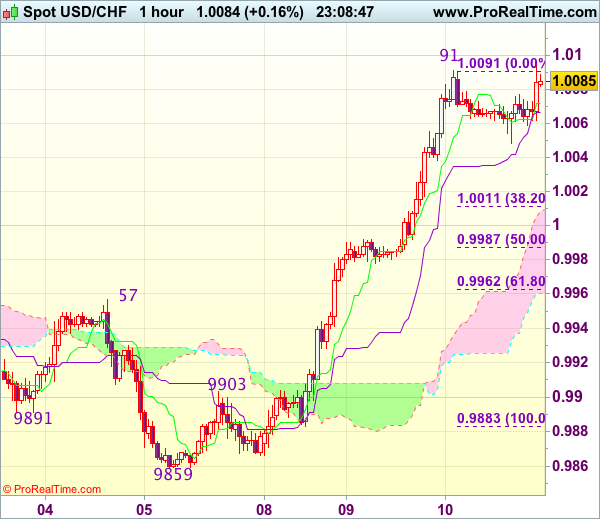
Trade Idea Wrap-up: USD/CHF – Buy at 1.0015
USD/CHF - 1.0080
Most recent candlesticks pattern : N/A
Trend : Near term up
Tenkan-Sen level : 1.0072
Kijun-Sen level : 1.0067
Ichimoku cloud top : 1.0009
Ichimoku cloud bottom : 0.9961
Original strategy :
Buy at 1.0005, Target: 1.0105, Stop: 0.9970
Position : -
Target : -
Stop : -
New strategy :
Buy at 1.0015, Target: 1.0115, Stop: 0.9980
Position : -
Target : -
Stop : -
As the greenback has maintained a firm undertone after this week’s rally, adding credence to our view that recent upmove is still in progress and may extend further gain to previous resistance at 1.0108, break there would confirm resumption of early rise and encourage for headway to 1.0130 and then 1.0150-55 which is likely to hold from here due to loss of near term upward momentum.
In view of this, would not chase this rise here and we are looking to buy dollar on pullback as 1.0010-15 should limit downside. Only below previous resistance at 0.9957 would defer and suggest top is possibly formed, bring test of 0.9920-25 but break of previous resistance at 0.9903 is needed to add credence to this view, bring further fall to 0.9880-85.
Trade Idea Wrap-up: GBP/USD – Stand aside
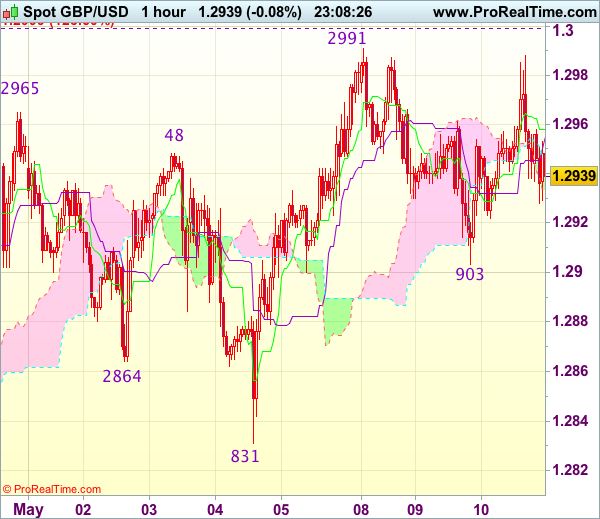
GBP/USD - 1.2943
Most recent candlesticks pattern : N/A
Trend : Near term up
Tenkan-Sen level : 1.2958
Kijun-Sen level : 1.2955
Ichimoku cloud top : 1.2947
Ichimoku cloud bottom : 1.2933
New strategy :
Stand aside
Position : -
Target : -
Stop : -
Although cable rebounded to 1.2988 in London morning, the subsequent retreat has retained our view that further consolidation below resistance at 1.2991 would be seen and weakness to 1.2920 cannot be ruled out, however, reckon downside would be limited to support at 1.2903 and bring another rise to 1.2999-00 (1.236 times projection of 1.2109-1.2616 measuring from 1.2365 and psychological resistance), break there would signal recent upmove has resumed and extend further rise to 1.3040-50, then towards 1.3075-80 which is likely to hold from here due to near term overbought condition.
In view of this, would be prudent to stand aside in the meantime. Below said support at 1.2903 would revive near term bearishness and suggest a temporary top has been formed at 1.2991, bring correction to 1.2875-80 but price should stay well above last week’s low at 1.2831.