Sample Category Title
CAC Quiet As Eurozone, French Mfg. Reports Within Expectations
The CAC is almost unchanged in the Tuesday session, after the Paris stock exchange was closed on Monday for a holiday. Currently, the index is trading at 5,283.00. On the economic front, there was positive news from the Eurozone and French manufacturing sectors, as Eurozone and French Manufacturing PMIs pointed to expansion. The Eurozone report came in at 56.8, edging above the forecast of 56.7, while the French release of 55.1 matched the estimate. The Eurozone unemployment rate remained unchanged at 9.5%, just above the estimate of 9.4%. On Wednesday, the Eurozone releases Preliminary Flash GDP,with an estimate of 0.5% for the first quarter. In the US, the Federal Reserve is expected to maintain the benchmark rate at 0.75%.
French voters will head back to the ballot box on Sunday, in the second round and final round of the presidential election. The two candidates, centrist Emmanuel Macron and far-right candidate Marie Le Pen have very different views of France’s role in Europe. Macron is pro-European Union, while Le Pen has pledged to take France out of the bloc and even revert back to the French franc, although she has toned down her anti-European rhetoric in the final stages of the campaign. Recent opinion polls show Macron with 60%-65% of the vote, so a Le Pen victory would be a huge upset and would shake up the French stock market, which is having an uneventful week. The markets have priced in a Macron victory, although a tighter finish than predicted could cause some volatility in the stock market.
Eurozone growth numbers have pointed upwards in 2017, and more growth has meant more jobs and lower unemployment figures. Just a year ago, the eurozone unemployment rate was at 10.3%, but the rate has been steadily decreasing since then. In February, the rate dropped to 9.5%, and the March release is expected at 9.4%. Germany, the largest economy in Europe has led the way, with the unemployment rate dropping to 5.9% in February. A stronger Eurozone economy has buoyed European stock markets, and the CEC has jumped on the bandwagon, as the index continues to trade at levels last seen in February 2008.
President Donald Trump marked 100 days in office over the weekend, but his administration has been plagued by problems and has little to show for itself. Trump’s popularity is at record lows for a new president, but he managed to avoid the embarrassment of a government shutdown, as lawmakers reached an agreement on the weekend. The short-term spending deal, which has bipartisan support, provides funding for government services until September 30th. The deal does not include any funding for a border wall with Mexico, marking a clear concession on the part of Trump. The White House is hoping that this small victory will be the prelude to more cooperation between the Republicans and Democrats on Capitol Hill, as Trump will need some support from the Democrats in order to pass key legislation such as tax reform, one of Trump’s major campaign planks.
US Purchasing Managers’ Index Unexpectedly Falls To 54.8
'Price pressures have meanwhile risen to a two-and-a-half year high, which is likely to feed through to final prices paid for goods consumers in coming months.' - Chris Williamson, IHS Markit
The Purchasing Managers' Index for the US manufacturing sector grew less than analysts estimated. According to the Institute for Supply Management, the PMI lost 2.4% compared to the previous month and tumbled to 54.8%, while experts anticipated only a slight decrease of 0.6%. Although in April the PMI rose at the slowest pace this year so far, it still remained above the 12-month average of 53.6%. The ISM report showed that the New Orders, Employment and Supplier Deliveries Indices dropped 7.0%, 6.9% and 0.8%, accordingly. Meanwhile, both Inventories and Prices Indices posted a 2% advance, which indicated that manufacturing companies stockpiled more raw materials than in the previous month and their costs increased. Nevertheless, all 18 manufacturing industries, excluding the apparel, leather and allied products industry, reported growth in April. In addition, all 15 commodities included in the report rose in price. Rising prices confirmed the view that inflation growth remained solid. Overall, all Indices remained above the 50% threshold and, thus, confirmed the general, long-term upward trend. Even though GDP figures released on Friday last week missed forecasts, analysts suggest that the US economy will likely regain momentum in the upcoming quarters.
RBA On Hold, Traders Get Ready For FOMC Meeting
AUD consolidates as RBA keeps a low profile
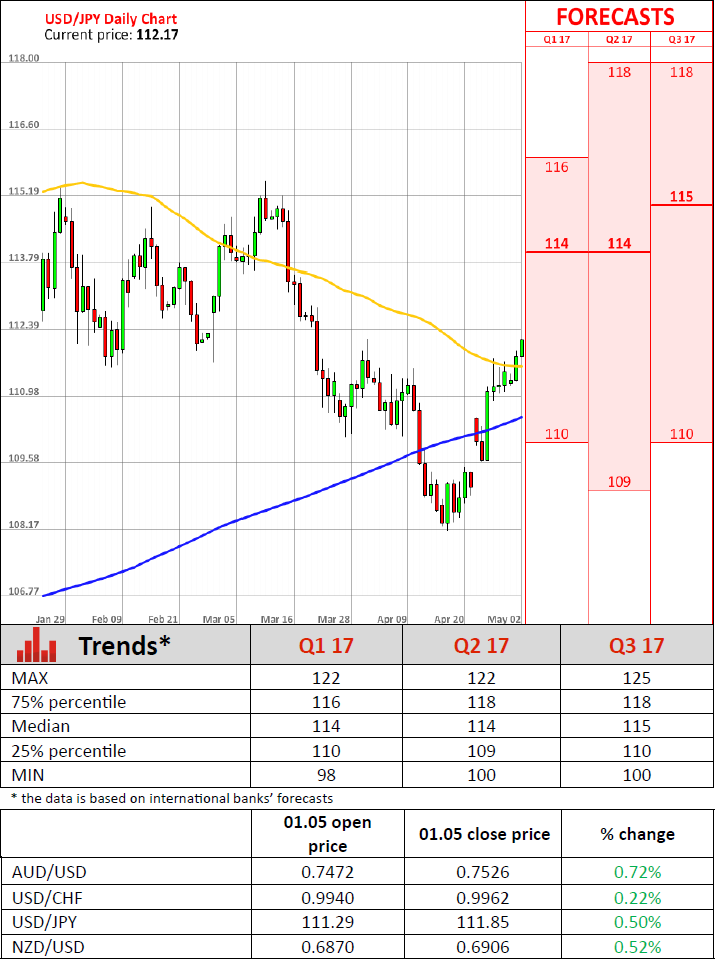
As broadly expected, the Reserve Bank of Australia held unchanged the official cash rate target at a record low 1.50%. The tone of the statement was slightly more positive than a month ago as Governor Lowe highlighted the positive trend in employment growth. Despite a pick-up in headline inflation in the first quarter (+2.1% y/y compared to 1.5% in the previous one), the central bank reiterated its cautious stance as core inflation is still running low and has shown little sign of improvement recently (core gauge printed at 1.5% y/y versus 1.3% in the previous quarter).
All in all, the RBA wants to avoid as much as possible to appear hawkish - mostly to prevent a sharp appreciation of the Aussie - even though it cannot turn a blind eye to the recent improvements, even minor ones. AUD/USD was treading water this morning at around 0.7530. The market is still heavily positioned for further appreciation of the Aussie. Indeed, net long speculative positioning, as reported by the CFTC, reached 39% of total open interest last week, suggesting that the risk is mostly to the downside.
Still bullish on the UK on Brexit
The market continues to make speculative negative bets on the eventual effect of Brexit on the UK economy. This has only heated up since PM May called for snap elections. We remain optimistic, based on Europe and UK mutual beneficial relationships, that the end-result will be significantly less severe than a “hard” Brexit. Within a historical context, the Europe-UK relationship has always had ups-and-downs but interactions have always been a constant. That will not change now. Secondly, both parties benefit from equality from the relationship (including bilateral trade), so threats are really meaningless.
UK domestic demand has slowed (annual retail sales ex auto fuel rose 2.6% vs. 3.8% exp from 4.1%) after a strong rally post-Brexit with many pointing to fears over punitive relocation in the financial sectors and its low productivity growth as the culprit. In addition, the rally in the GBP has removed some currency advantage for exporters and lure for foreign buyers.
We agree that uncertainty will clearly keep investment subdued yet the outright collapse or relocation of the UK's vital financial sectors is overblown. Also, other key fundamentals remain healthy. The UK economy rose faster than many G10 nations, as Q1 GDP expanded 0.3% (pessimists point to the fact that pace was the slowest since before the referendum) with the annual rate at 2.1%. The breakdown was still optimistic with manufacturing sectors rising 0.5%, construction grew by 0.2% and even the service sector increased by 0.3%. We remain optimists that the final outcome will be a “soft” Brexit and the effect to the UK economy will be manageable.
Strangeness in US Q1 GDP data
The recent US Q1 GDP taken at the headline level suggests a significant slowdown in the economy. However, for years now the Q1 datapoint has under reported the actual fundamental health. This fact is not lost on officials but does get diluted when filtered into the mainstream.
This anomaly has been acknowledged by the Bureau of Economic Analysis, the agency that constructs gross domestic product data. In 2016, BEA statisticians recognized that their efforts to prepare for seasonality had problems, particularly for Q1. We are ill equipped to measure the methodologies but we understand that the markets are seemingly under-pricing the steepness of the Fed's hiking cycle. This is partially due to the weak GDP read.
While leading data has been disappointing, we still see the US economy as healthy and warranting higher interest rates. Domestic consumption has fallen but after the very strong Q4 read. Perhaps most importantly, the Employment Cost Index (ECI), measuring wages and benefits, jumped 0.8% over the prior quarter. Friday's NFP is expected to support the rise by increasing by 225k. Given our views on the US economy, we anticipate the Fed will signal a rate hike in June. Until the Fed's announcement, expect the USD to stabilise around the current policy, but with a hawkish Fed anticipate USD buying on the under-positioning.
Pulpit Trump is making us dizzy
The machine gun-like frequency of US President Donald Trump's policy creation and reversing is making our head spin. Whether it is his administration's unbridled comments on currency, foreign affairs, healthcare, tax or trade policy, the lack of continuity is shocking but also extremely difficult to trade.
At this point we could not tell you if Trump favours a “strong” or “weak” US dollar. We remain consistent that fading the Trump hype and staying focused on fundamentals is the best FX trading strategy. In this regard, global fundamentals [despite China PMI falling to 50.3 for the 4th straight month of decline, it remains in expansion territory] and risk sentiments are supportive. US solid earnings, clearer US fiscal policy and lower European political risk only furthers our view to buy risky assets. We are bullish on Emerging Markets currencies, especially nations with solid domestic consumptions and commodity importers. The current weakness in commodity prices are a function of supply glut rather than demand issues. The breakdown of correlations with equities supports this thinking.
The low volatility environment should support INR, IDR, BRL and PLN despite some marginal idiosyncratic risk. For trades that embrace the volatility, KRW should have further upside but the trade might make your guts turn. The underperformance of high beta currencies in the last two weeks indicates additional upside. We suspect the JPY would provide to be a smarter funding currency due to its additional yields but also the expectation of yield steeping in the US driving JPY lower.
Euro Unchanged As Eurozone, German Mfg. PMIs Within Expectations
The euro continues to have a quiet week, as EUR/USD trades just above the 1.09 line. On the release front, Eurozone and German Manufacturing PMIs pointed to expansion. The Eurozone report came in at 56.8, edging above the forecast of 56.7, while the German reading of 58.2 matched the estimate. There are no major US events on the schedule. On Wednesday, we'll get a look at the German unemployment rate and Eurozone Preliminary Flash GDP. In the US, the Federal Reserve will release its policy statement. The other key releases are ADP Nonfarm Payrolls and ISM Non-Manufacturing PMI.
The eurozone economy continues to expand, and more growth has meant more jobs and lower unemployment figures. Just a year ago, the eurozone unemployment rate was at 10.3%, but the rate has been steadily decreasing since then. In February, the rate dropped to 9.5%, and the March release is expected at 9.4%. Germany has led the way, with the unemployment rate dropping to 5.9% in February. Unemployment rolls continue to shrink in Germany, and the decline of 30,000 unemployed persons in February easily beat expectations. The March reading is expected to show another decline of 10,000. The markets will also be monitoring US employment numbers, which kick off on Wednesday with the release of ADP Nonfarm Payrolls. The indicator is expected to drop sharply to 178 thousand in March compared to 263 thousand a month earlier.
It's been a rocky start for President Donald Trump, who just marked the 100-day milestone of his term in office. Trump's popularity is at record lows for a new president, but he managed to avoid the embarrassment of a government shutdown, as lawmakers reached an agreement on the weekend. The short-term spending deal, which has bipartisan support, provides funding for government services until September 30th. The deal does not include any funding for a border wall with Mexico, marking a clear concession on the part of Trump. The White House is hoping that this small victory will be the prelude to more cooperation between the Republicans and Democrats on Capitol Hill, as Trump will need some support from the Democrats in order to pass tax reform legislation, one of Trump's major campaign planks.
CBR: Aggressive Cut, Improving Hopes For Economy
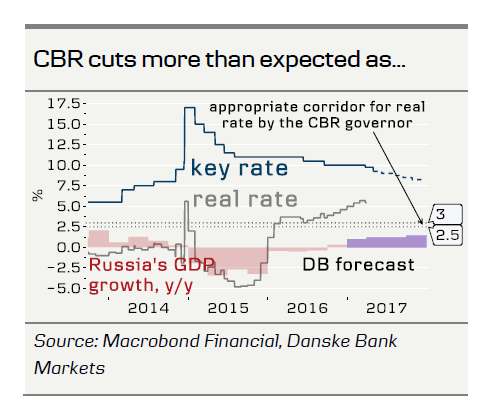
- Surprisingly, Russia's central bank (CBR) cut its key rate by 50bp to 9.25% on 28 April, as inflation is approaching its target faster than expected and RUB's excessive rally is a concern for economic authorities.
- We expect the CBR to cut to 8.00% by the end of 2017 (8.50% previously), while more aggressive cuts are possible if RUB's rally diverges further from the oil price.
- Aggressive monetary easing would add steam to economic growth in Russia, while the CBR's consistency in communication could be jeopardised
Assessment and outlook
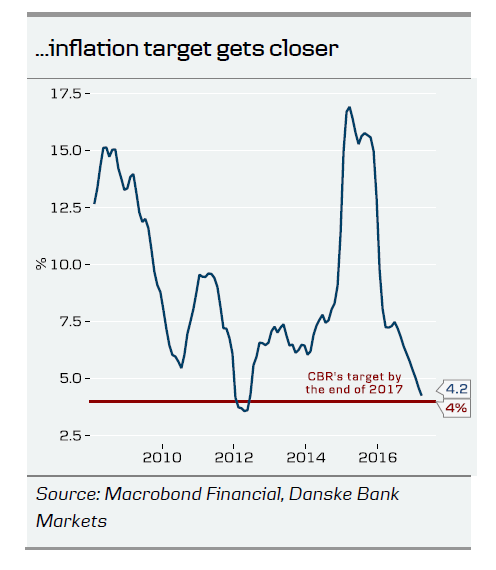
The CBR cut its key rate by 50bp to 9.25% on 28 April. Consensus expected a 25bp cut as did we. However, in our preview prior to the decision, we did not exclude a 50bp cut to restrain the RUB's excessive strengthening. CBR governor Elvira Nabiullina signalled last week that rate cuts of 25bp and 50bp may be discussed at the meeting as inflation hit 4.1% y/y as of 17 April. While inflation is getting closer to the target (i.e. 4% y/y by the end of 2017) and inflation expectations are decreasing, in its newest statement the CBR pointed out that 'at the same time, inflation risks remain in place'.
We see that the current aggressive cut was fuelled by concerns of economic authorities that RUB has become overvalued given the crude price levels. Previously, neither the Ministry of Finance's (Minfin) nor the Ministry for Economic Development succeeded in convincing the markets with their vocal interventions. On Tuesday 25 April 2017, President Vladimir Putin made a RUB comment to the effect that the government is looking for 'market-based measures' to affect the RUB, monitoring what he called the 'key' issue of its stability 'practically on a daily basis'. Actually, Putin did not take any view on RUB's direction at all, it was purely the market's interpretation.
Given CBR's dovish tone and the fact that CBR's 'assessment of the overall potential of the key rate reduction before the end of 2017 is unchanged', we reduce our key rate projection for the end of 2017 to 8.00% from 8.50% previously. More aggressive monetary easing on rising crude price and RUB's excessive appreciation would encourage fixed investment expansion and private consumers supporting economic growth. We continue to see GDP growing 1.2% y/y in 2017 and 1.4% y/y in 2018.
The main reasons behind today's decision and the CBR's tone
'Annual inflation has moved close to the target level.' Annual inflation is hovering around 4.2% as steady oil and strong demand for RUB support disinflation. The CBR mentions 'persistent interest in investment in Russian assets among external investors, and a drop in the sovereign risk premium'. The inflation target looks very realistic and the next question on the agenda will be how well the target could be anchored
'Positive real interest rates are held at the level which ensures demand for loans without increasing inflationary pressure'. The assumption stayed unchanged since the last decision in December 2016, and the CBR did not mention Minfin's FX operations mechanism impact this time.
The CBR saw economic expansion in Q1 17. Many industrial sectors in Russia continue to see positive dynamics, while manufacturing and services PMIs were at their three-year highs in early 2017. The CBR has become more positive on economic growth in 2017-19 'even if the conservative oil price scenario materialises'. In March 2017 in its monetary policy report, the CBR mentioned that its 'conservative approach suggests a decreasing trend in the Urals price close to USD40/bbl by the end of 2017. CBR's 'risky' scenario sees the oil price dropping to USD25/bbl by the end of 2017. Our models show that in current conditions, an average annual oil price lower than USD47/bbl would send Russia's GDP into negative territory.
Inflation risks would come from oil price fluctuations caused 'by negotiations between oil exporting countries to extend agreements on limiting oil production.' The CBR highlights the importance of 'legislative consolidation of a budget rule' in mitigating medium-term inflation risks.
This time, the CBR has not mentioned risks it has linked previously to greater-thanexpected rate hikes by the Fed on the back of President Donald Trump's potentially expansive fiscal policy, nor a slowdown in China's economy towards end-2017.
We expect the CBR to cut the key rate by 25bp at its monetary policy meeting on 16 June 2017.
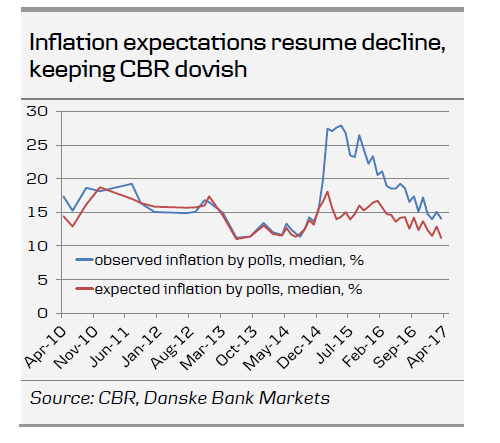
The RUB welcomes aggressive cut
First, the RUB reacted negatively to the CBR's 50bp cut, restarting an even stronger rally as demand for local bonds – OFZs – surged. It has been a tradition for the RUB market: as the economy has turned sluggish and real rates remain high, monetary easing has been interpreted as a 'buy' signal for a range of Russian assets on improving economic prospects as fixed investments and household lending are set to expand..
We keep our moderately bullish stance on the RUB based on our latest FX forecast update released in mid-April. See FX Forecast Update: Political risks in charge, 18 April 2017. We still expect the USD/RUB to hit 54.40 in 3M, 53.00 in 6M and 52.00 in 12M on a Brent crude price assumption of USD58/bl in Q4 17.
We remain bullish on OFZs, as surprisingly aggressive cuts to the key rate should not be excluded if the RUB rally seizes RUB's and oil correlation further.
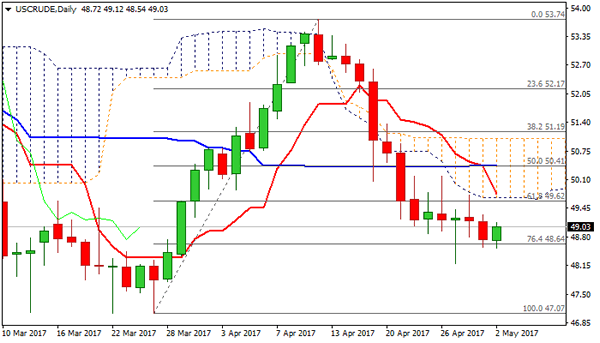
Technical Outlook: US Crude Oil – Consolidation Is Capped By 200SMA, Thick Daily Cloud Weighs
US oil price ticked higher on Tuesday but so far holds below 200SMA ($49.10) which was broken on Monday's acceleration to $48.57 low.
The price steadies as rising production in several countries balanced expectations of output cut extension for the next six months.
Technical studies remain firmly bearish on daily chart and see immediate downside risk while the price remains below 200SMA.
Extension below last week's low at $48.19 would risk return to key supports at $47.07.
Meantime, the price may hold in extended consolidation, with extended upticks to be capped by daily cloud base at $49.69, reinforced by falling Tenkan-sen.
Conversely, penetration into thick daily cloud and violation of psychological $50.00 barrier would sideline immediate downside risk.
Res: 49.10, 49.67, 50.00, 50.18
Sup: 48.54, 48.19, 47.79, 47.07
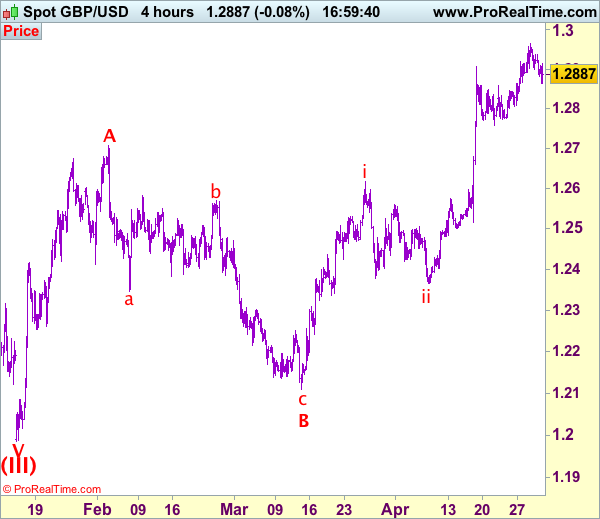
Trade Idea: GBP/USD – Buy at 1.2770
GBP/USD – 1.2892
Recent wave: Wave V of larger degree wave (III) has ended at 1.1986 and major correction has commenced from there for gain to 1.3000 and 1.3140-50
Trend: Near term up
Original strategy :
Buy at 1.2850, Target: 1.3000, Stop: 1.2790
Position: -
Target: -
Stop: -
New strategy :
Buy at 1.2770, Target: 1.2960, Stop: 1.2710
Position: -
Target: -
Stop:-
As cable has retreated after rising to 1.2965 late last week, suggesting a minor top is formed there and consolidation below this level would be seen with initial downside bias for correction to 1.2805-10, however, reckon support at 1.2757 would contain downside and bring another rise later, above said resistance at 1.2965 would confirm recent upmove has resumed and extend gain to psychological resistance at 1.3000 but overbought condition should limit upside and 1.3050 and price should falter below 1.3100. We are keeping our view that the wave c as well as larger degree wave B has ended at 1.2109, hence impulsive wave C has commenced from there with wave i of C ended at 1.2616, follow by a correction to 1.2365 (end of wave ii) and wave iii rally is unfolding, hence further gain to indicated upside targets would be seen.
Our preferred count on the daily chart is that cable's rebound from 1.3500 (wave (A) trough) is unfolding as a wave (B) with A ended at 1.7043, followed by triangle wave B and wave C as well as wave (B) has ended at 1.7192, the subsequent selloff is the larger degree wave (C) which is still unfolding with minor wave (III) of larger degree wave 3 ended at 1.1986, hence wave (IV) correction is in progress which could either be a triangle wave (IV) of a complex formation but upside should be limited to 1.3500 and price should falter well below 1.4000, bring another decline in wave (V) of 3 for weakness to 1.1500, then 1.1200.
On the downside, whilst initial pullback to 1.2845-55 and possibly support at 1.2805 cannot be ruled out, price should stay above support at 1.2757 and bring another rise later. A drop below this level would defer and signal a temporary top is formed instead, risk correction of recent upmove to 1.2700-10 later.
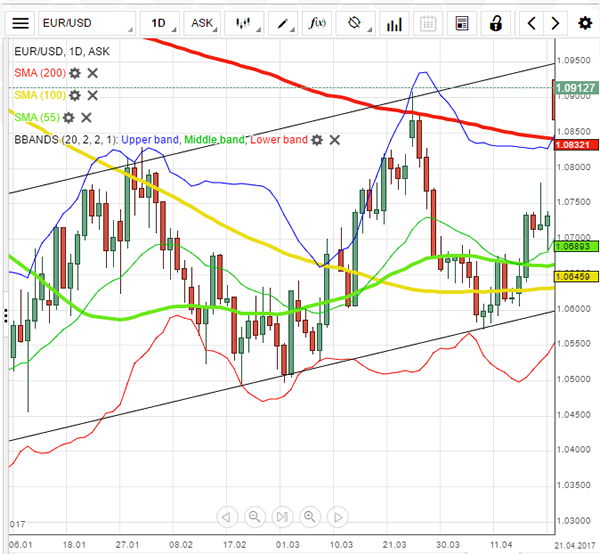
EUR/USD Analysis: Surges Above 1.09 Level
'Le Pen is trying to reassure people on the euro.' – Bruno Cautres, SciencesPo (based on Bloomberg)
Pair's Outlook
During the early hours of Tuesday's trading session the common European currency was scoring gains against the US Dollar, as the currency exchange rate passed the 1.09 mark. The pair faces no technical resistance up to the 1.0958 level, where the weekly R1 is located at. Moreover, just above that level of significance there are other levels, which are strengthening the weekly R1. On the other hand the currency pair might retreat by the end of the day, as the closest support is the weekly PP, which is a lone level at 1.0890.
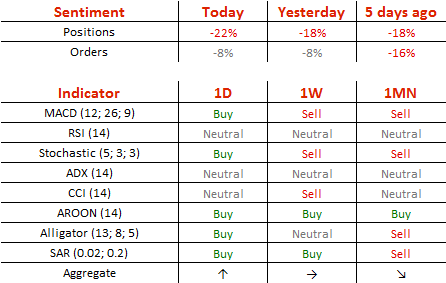
Traders' Sentiment
SWFX traders remain bearish on the pair, as 61% of open positions are short. In addition, 54% of trader set up orders are to sell.
GBP/USD Analysis: To Keep Sliding Down
'If this week's remaining U.S. indicators continue to be weak, such expectations that have supported the dollar could crumble easily.' – IG Securities (based on Business Recorder)
Pair's Outlook
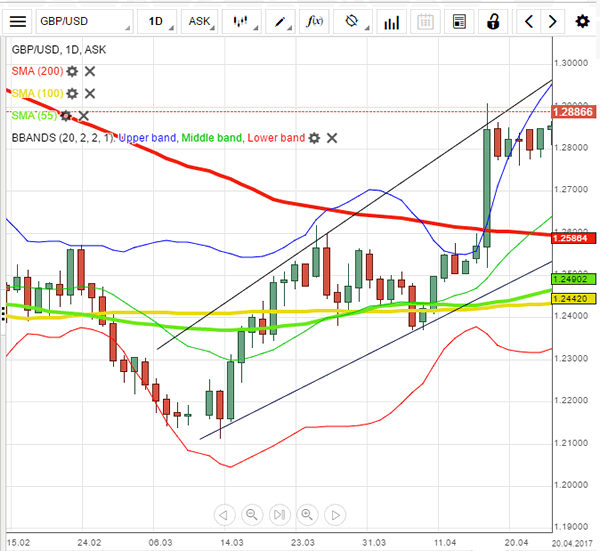
As was anticipated, the GBP/USD currency pair made a U-turn on Monday, falling back under the 1.29 mark. However, the second support, namely the weekly S1 at 1.2829, was not reached yesterday, but the Cable is likely to put that demand level to the test today. Technical indicators, on the other hand, are unable to confirm this outlook, but they are no longer giving distinctly bullish signals in the daily timeframe either. Ultimately, the Sterling should weaken through the week and find support around 1.27, but a number of fundamentals, especially the US NFP, could provide the given pair with a solid boost, in which case the 1.30 handle could easily be overcome.
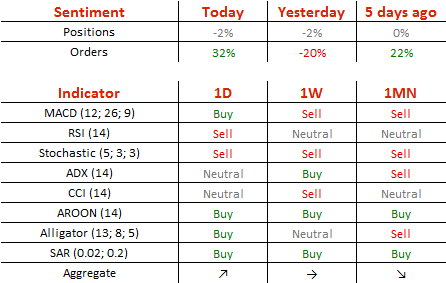
Traders' Sentiment
Traders retain a neutral outlook towards the Pound, as 51% of all open positions are short. The share of buy orders surged from 40 to 66%.
Trade Idea: GBP/JPY – Buy at 142.55
GBP/JPY - 144.55
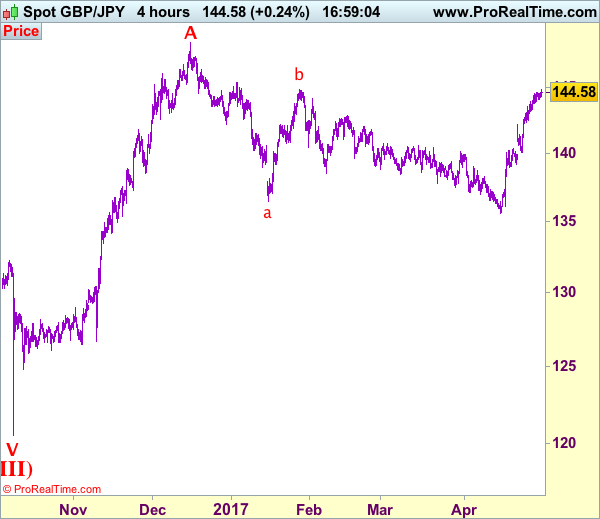
Recent wave: Medium term low formed at 120.50 and (A)-(B)-(C) major correction has commenced with (A) leg ended at 148.45, hence wave (B) is unfolding for retreat to 131.00-10.
Trend: Near term up
Original strategy:
Buy at 142.30, Target: 144.30, Stop: 141.70
Position: -
Target: -
Stop: -
New strategy :
Buy at 142.55, Target: 145.00, Stop: 141.95
Position: -
Target: -
Stop:-
As sterling has continued moving higher after last week’s rally, adding credence to our bullish count that recent upmove from 135.60 has resumed and upside bias remains for this move to extend further gain to 145.00-10, then 145.35-40, however, near term overbought condition should prevent sharp move beyond 146.00-10 and reckon 147.00-10 would hold, price should falter well below previous chart resistance at 148.45, bring retreat later.
In view of this, would not chase this rise here and would be prudent to buy sterling on pullback as 142.50-55 should limit downside. Below previous resistance at 142.10-15 would defer and suggest top is possibly formed, bring correction to 141.60-65, then 141.20-25, however, reckon downside would be limited to 140.55-60 and support at 140.10 should remain intact, bring another upmove later.
Our preferred count is that larger degree wave V with circle is unfolding from 251.12 with wave (I) 219.34, (II): 241.38 and wave (III) is subdivided into 1: 192.60, 2: 215.89 (23 Jul 2008) and wave 3 ended at 118.87 earlier in 2009. The correction from there to 162.60 is wave 4 which itself is a double three and is labeled as first a-b-c ended at 151.53, followed by wave x at 139.03, 2nd a ended at 162.60, 2nd b at 146.75 and 2nd c leg of wave 4 ended at 163.00. Therefore, the decline from 163.00 to 116.85 is now treated as wave 5 which also marked the end of larger degree wave (III), hence wave (IV) major correction has commenced for retracement of the wave (III) from 241.38 and upside target at 183.95-00 (50% Fibonacci retracement of the wave (II) from 241.38) had been met, a drop below 160.00 would suggest wave (IV) has ended at 195.85, bring decline in wave (V) for initial weakness to 130 (already met) and 120.