Tue, Feb 17, 2026 21:52 GMT
More

    Sample Category Title

    Pull Back in Treasury Yields Dragged Down Dollar

    The reversal in treasury yield dragged down the greenback again overnight. 10 year yield closed down -0.052 to 2.450 while 30 yield yield dropped -0040 to close at 3.051. The dollar index is now back at 100.50 after hitting as high as 101.76 earlier this week. Dollar is now trading as the third weakest major currency. The Japanese yen remains the weakest one on strong risk appetite. New Zealand dollar followed after weaker than expected economic data. On the other hand, Swiss Franc is the strongest major currency this week, partly due to political uncertainties in Eurozone and UK. In other markets, Gold rides on renewed weakness in dollar and is back pressing 1240. WTI crude oil is extending recent sideway trading.

    Treasury yield to drag down dollar in near term

    10 year yield's rebound was limited below 2.555 resistance and reversed. The development indicates that consolidation pattern from 2.621 is extending with another falling leg. Deeper decline would be seen back to 55 day EMA (now at 2.373). Such consolidation is seen as a triangle pattern. Hence, firstly, downside would be contained around 55 days EMA and bring rebound. More importantly, it's now possibly in the last leg and up trend from 1.336 is ready to resume soon. Break of 2.555 will indicate that it's finally breaking out. Development in yield would likely drag dollar in near term before sending it higher later.

    ECB minutes suggest no hurry to exit stimulus

    ECB minutes for the January meeting unveiled that policymakers were in no hurry to reduce stimulus. Indeed, to facilitate the asset purchase measures, the central bank signaled willingness to deviate from the capital key policy. As noted in the minutes, "there was some room for a trade-off between relative deviations from the capital key across jurisdictions and limiting the extent of purchases below the DFR... This baseline approach could be reconsidered by the Governing Council should undue market effects materialize". Originally, the purchases are based on the amount of capital each country has paid into the ECB. Recent improvement in inflation should not alter ECB stance. Policymakers acknowledged that "the recent increases in energy prices had thus far not translated into indirect or second-round effects on broader inflation... This suggested second-round effects would unfold rather slowly".

    On the data front, New Zealand business NZ manufacturing index dropped to 51.6 in January. Retail sales rose 0.8% yoy in Q4. Eurozone current account and UK retail sales are the main feature in European session. US will release leading indicator later in the day.

    USD/JPY Daily Outlook

    Daily Pivots: (S1) 112.77; (P) 113.53; (R1) 114.00; More...

    The breach of 113.24 minor support dampens the bullish case. Corrective fall from 118.65 could still be in progress. Intraday bias is turned back to the downside to 111.58 or possibly below. However, downside should be contained by 38.2% retracement of 98.97 to 118.65 at 111.13 and bring rebound. Meanwhile, break of 114.94 resistance should now confirm completion of the correction. And in that case, USD/JPY should target a retest on 118.65 high.

    In the bigger picture, price actions from 125.85 high are seen as a corrective pattern. The impulsive structure of the rise from 98.97 suggests that the correction is completed and larger up trend is resuming. Decisive break of 125.85 will confirm and target 61.8% projection of 75.56 to 125.85 from 98.97 at 130.04 and then 135.20 long term resistance. Rejection from 125.85 and below will extend the consolidation with another falling leg before up trend resumption.

    Economic Indicators Update

    GMT Ccy Events Actual Consensus Previous Revised
    21:30 NZD Business NZ Manufacturing Index Jan 51.6 54.5 54.2
    21:45 NZD Retail Sales Ex Inflation Q/Q Q/Q 0.80% 1.00% 0.90% 0.80%
    9:00 EUR Eurozone Current Account (EUR) Dec 36.1B
    9:30 GBP Retail Sales M/M Jan 1.00% -1.90%
    13:30 CAD International Securities Transactions (CAD) Dec 7.24B
    15:00 USD Leading Indicators Jan 0.50%

    Subscribe to our daily and mid-day newsletter to get this report delivered to your mail box

    Silver Ready To Rise But At A Reduced Pace

    Key Points:

    • Rally should remain intact but moderate slightly.
    • This would be an end to the long-term downtrend.
    • Fundamentals still driving the rally.

    Silver could be about to slow or even end its rather impressive rally as it approaches a fairly strong zone of resistance. However, given the metal'sapparent immunity to the influence of the bears,it could continue to surge strongly higher instead. As a result, it's worth taking a look at some of the technicals to see what's next for silver.

    From a technical perspective, the long-term downtrend is very much in danger of being ended. A push significantly beyond the 18.00 handle would finally free silver from the confines of that relentless bearish trend line that made its presence felt so keenly early on in the piece. If the metal does escape to the upside, the resulting surge higher could be strong indeed.

    Specifically, the EMA's are about as bullish as you can get and this is mirrored by the parabolic SAR reading. The combined effect of these technicals could produce a sizable amount of support for the metal which could extend its recent trend as is. However, there is some evidence suggesting that the uptrend could moderate or even stall temporarily.

    Indeed, the intersection of the 78.6% Fibonacci level and the declining trend line could prove a rather formidable impasse for silver. However, what is more likely given the strong fundamental forces driving silver prices higher, is that the rally moderates slightly as it seeks to test the 19.00 handle.

    This moderation is supported by the stochastics and RSI readings on the daily chart. More precisely, whilst stochastics are already heavily overbought, the RSI still has some more room to manoeuvre which should leave the metal with some ability to climb higher. As a result, we should see more gains but not at the pace that has been seen recently.

    Ultimately, keep an eye on Trump as well as if there is anything able to cause a spike in market fear and therefore a spike in silver, it's him. This being said, also keep an eye on any developments in the Brexit saga as we could start to see more details about the triggering of article 50 come out in the lead up to march.

    Market Morning Briefing

    STOCKS

    Dow (20619.77, +0.04%) closed slightly higher but is seeing a pause just now. We can expect a pause near 20800 from where a short dip is possible.

    Dax (11757.24, -0.31%) came down yesterday. But immediate support is visible near 11680 which is likely to produce a bounce in the near term. View remains bullish towards 11900.

    Nikkei (19242.11, -0.54%) is trading lower and could possibly re-test levels near 19080. Overall the broad 19000-19620 region holds for the near term.

    Shanghai (3225.15, -0.14%) has bounced back as expected and could move up towards 3250 in the next couple of sessions. Near term looks bullish.

    The support near 8700 seems to have held well on the Nifty (8778, +0.61%) yesterday, producing a bounce back to levels near 8800. An immediate break above 8800 today could turn bullish for the coming week.

    COMMODITIES

    Gold (1238.8) is about to test its resistance of 1248 for third time after 8th and 9th of Feb 2017 due to fresh weakness in Dollar (100.45). A close above 1248 could open up 1276. Immediate support poised at 1225 and 1219 respectively.

    We will remain bullish on Silver (18.05) as long it is trading above 18.00.But weakness in copper may trigger a sharper decline in Silver till 17.50.

    Copper (2.72) is trading quietly in the range of 2.70-85 due to lack of fresh buying momentum. A close below 2.70 may weaken copper till 2.60.

    Nothing has been changed for Brent (55.78) and WTI (53.36) in the last session. Both are hovering around their pivots of their respective ranges of 53-58 and 50-55 with no directional bias.

    FOREX

    Dollar has confirmed a near term corrective phase which may continue for the next 1-3 sessions. All the currencies may consolidate their recent gains/losses in this period.

    Dollar Index (100.51) failed to hold above the support of 100.85, confirming the corrective state. The decline has already corrected 50% of the February rise from 99.23 to 101.76 and may extend lower to 100.20-00 before demand emerges again.

    In an exact mirroring of Dollar, Euro (1.0672) has retraced 50% of the entire February decline from 1.0829 to 1.0519 but it may face hurdle at 1.0710 before the rise can extend higher towards 1.08.

    Dollar-Yen (113.35) has broken below the immediate support of 113.65 and may trade sideways in the range of 112.85-114.85 for the next few sessions.

    Pound (1.2502) remains unchanged in the narrow range of 1.2400-1.2600 but the early part of the next week may see a range expansion to 1.2350-1.2700.

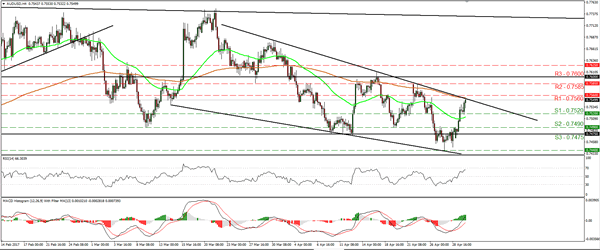
    Aussie (0.7703) has kept the trend up so far but as it stalls near the major resistance zone of 0.7750-0.7800, a failure to rise above 0.7800 soon may push it to 0.7650-30 or even lower levels.

    For the first time this week, Dollar Rupee (67.07) has shown some activity as it closed at the edge of the near term range of 66.80-67.07. However, it needs to sustain above 67.07 today to open up higher targets of 67.40-50.

    INTEREST RATES

    The US yields have come off slightly after facing rejection from resistance levels. . The 5YR (1.95%), 10Yr (2.46%) and the 30Yr (3.06%) are all trading lower from 1.98%, 2.49% and 3.08% respectively. Near term looks bearish.

    The US 10-5YR (0.51%) has bounced slightly instead of moving lower towards 0.48%. If the bounce continues, we may see a rise towards 0.525 in the near term.

    The German-US 2YR (-2.02%) has risen from levels near -2.05% and may move up towards -2% in the near term indicating a rise in Euro towards 1.0700-1.0710.

    A$, 7% Decline Near ?

    Nearer term a$ outlook:

    In the Feb 9th email, once again affirmed that long held view of gains toward the bearish trendline/ceiling of a potential triangle/pennant since Apr 2016 (currently at .7745/60), and before potentially completing a more important top (at least a few months). In the bigger picture, seen part of the very long discussed, extended period of wide ranging from that Apr high at .7835. Seen as a large correction but with scope for at least another few months of wide ranging first (see longer term below). Currently the market is turning lower from a slight new high at .7730, with lots of near term negatives increasing the likelihood of that more important topping. Note the quick reversal lower from the slight new high at .7730 (sign of underlying weakness), slowing upside momentum and deteriorating technicals (see bearish divergence/sell mode on the daily macd). At this point, there is still no confirmation of that more important top "pattern-wise" (5 waves down for example), but further upside would likely be limited/part of a larger topping on approach of that key bearish trendline from Apr (see "ideal" scenario in red on daily chart below). A final word...this is the "ideal" scenario but with no confirmation of even a shorter term peak so far, the confidence in a more significant top is not yet very high (larger tops generally begin with smaller ones). Nearby support is seen at the bullish trendline from Jan (currently at .7625/40). Bottom line : finally nearing that long discussed "ideal" area to form a more important top (at least a few months) at the bear trendline Apr (currently at .7745/60) but scope for a period of topping.

    Strategy/position:

    For now with a potentially important top nearing, would sell here (currently at .7700) and initially using a wide stop on a close above .7795 to allow for that further period of topping. Though there is still no confirmation of even a short term top so far (and therefore not yet overly confident of a more important top), the limited risk and large potential still makes for a good overall opportunity (good risk/reward, the main driver to positioning).

    Long term outlook:

    No change in that very long held view of an extended period of wide ranging from the Apr 2016 high at .7835, seen as a huge correction and with eventual new highs after. Note that the 5 wave rally from the Jan 2016 low at .6825 to that Apr high (longer term upside is not "complete") and messy/sloppy trade since that April peak (characteristic of a correction) add to the view of a large correction. However, may be forming a large triangle/pennant over that time, leaving open scope for another few months of wide ranging before finally resolving higher (see in red on weekly chart/2nd chart below). As discussed above, there is still no confirmation of even a shorter term top "pattern-wise" (so the confidence in this more major top is not yet very high) but the view in gold of an important topping (correlated market, see email from yesterday) does increase the likelihood. Bottom line : big picture correction since Apr with potential for large triangle, raises potential for more important topping in this area (bearish trendline from Apr peak).

    Strategy/position:

    With scope for more wide swings since the April peak (about 7-8%) would stay with that approach of fading the extremes. So would also switch that longer term bias to bearish here (currently at .7700) and using the same exit as the shorter term above.

    Current:

    Nearer term : short Feb 16th at .7700, scope for another week or 2 of topping.
    Last : short Feb 2nd at .7590, stopped Feb 9th at .7625.

    Longer term: bear bias Feb 16th at .7700, potential important topping near ceiling of triangle from Apr.
    Last : same as shorter term above.

    Foreign Exchange Market Commentary

    EUR/USD

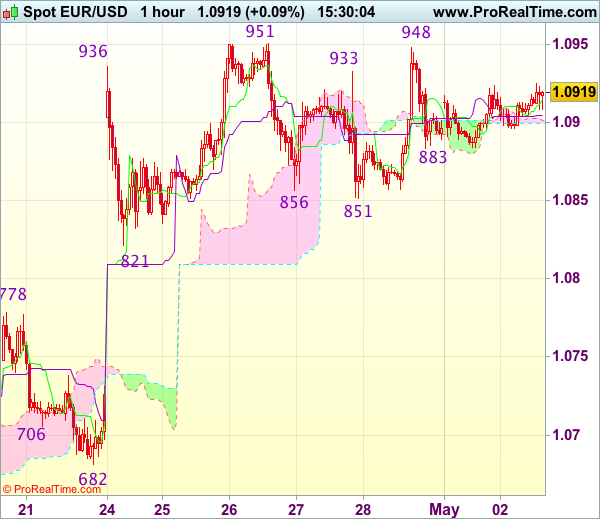
    The greenback closed the day mixed across the board, lower against the EUR and the JPY, as a decline in worldwide stocks added to the early downward correction of the American currency, despite the release of upbeat economic data and a hawkish Yellen. There was no fundamental trigger behind dollar's retracement, although it is a clear indication on how soft confidence on Trump´s promises is, and how willing investors are to take profits out on dollar's gains these days, after the US president complained about dollar's strength.

    There were no relevant news coming from the EU, while figures coming from the US were generally positive, as weekly unemployment claims for the week ending February 10 printed 239K, better than the 245K expected, although the 4-week average was 245,250, an increase of 500 from the previous week's revised average. Housing starts in December rose to 1.246M, while Building Permits reached 1.285M, both beating expectations and previously upwardly revised figures.

    The EUR/USD pair pared gains at 1.0678, and settled around 1.0660, and the 4 hours chart shows that the price is well above a flat 20 SMA for the first time in over a week and currently at 1.0600, but still below a modestly bearish 100 SMA around 1.0700. In the same chart, technical indicators have turned lower within positive territory, not enough to suggest a downward move for this Friday, but putting a cap to the upward move. The pair has a major resistance at 1.0700/20, the level to beat to confirm further dollar losses in this last day of the week.

    Support levels: 1.0620 1.0590 1.0565

    Resistance levels: 1.0710 1.0750 1.0795

    USD/JPY

    The Japanese yen is the best performer against the greenback daily basis, with the USD/JPY pair ending the day not far from a daily low of 113.12 achieved in the US afternoon. Helping the pair slide were US Treasury yields coming off highs, with the 10-year benchmark slipping to 2.44% after reaching 2.52% on Wednesday. The macroeconomic calendar will remain empty in Japan for the rest of the week, which means that the pair will remain tied to stocks and bond yields. The sharp retracement following the approach to the 115.00 threshold somehow indicates that yen's demand is still quite strong, and that chances are now supporting a steeper downward. In the 4 hours chart, technical indicators have entered negative territory, although with limited bearish strength, whilst the price has broken below its moving averages, after failing to rally beyond the 200 SMA. The 100 SMA lacks directional strength, now around 113.40, an immediate short term resistance. A downward acceleration below 113.00 will probably lead to a continued decline towards the 112.00/20 region.

    Support levels: 112.90 112.50 112.10

    Resistance levels: 113.40 113.85 114.20

    GBP/USD

    The Pound benefited from broad dollar's weakness, resulting in the GBP/USD pair rallying up to 1.2518, but once again, the pair was rejected from the critical resistance area around 1.2530/40, to close marginally higher around 1.2480. There were no macroeconomic releases in the UK, but the kingdom will release its January retail sales figures this Friday, expected to have risen by 0.9% in the month from a previous decline of 1.9%. Despite some wild swings, the pair has closed pretty much flat for a second consecutive day, indicating that investors are not sure on where to go next, after latest data coming from the UK proved less resilient to Brexit woes. Another negative reading will likely dent sentiment towards the Pound, although as long as the price remains above 1.2330/50, the downward potential will remain limited. Technical readings in the 4 hours chart maintain the neutral stance seen on previous updates, with the price hovering around flats 20 SMA and 200 EMA, the Momentum indicator holding directionless around its 100 level and the RSI now turning south around 48.

    Support levels: 1.2430 1.2380 1.2345

    Resistance levels: 1.2500 1.2535 1.2585

    GOLD

    Gold prices recovered ground and trade neared this year high of $1.244.67 a troy ounce before settling at 1,240.30, boosted by a decline in USD-related assets. Despite odds for a US FED March rate hike have increased after Yellen testimony before the Congress, gold has held on to gains and at multi-months' highs, suggesting further gains ahead for the commodity, and a fading correlation between it and the US Central Bank monetary bias. From a technical point of view, the daily chart shows that that the price recovered further above a bullish 20 DMA and the 50% retracement of the post-US election decline, while the RSI heads higher around 65, supporting the bullish case, despite the lack of Momentum. In the 4 hours chart, the 20 SMA turned higher around the mentioned Fibonacci support at 1,230.00, while the Momentum indicator heads north near overbought readings and the RSI indicator consolidates around 64, in line with the longer term perspective.

    Support levels: 1,230.00 1,221.80 1,210.10

    Resistance levels: 1,244.70 1,252.90 1,261.60

    WTI CRUDE

    Crude oil prices held within familiar ranges, with West Texas Intermediate futures closing the day marginally higher at $53.38 a barrel. A weaker dollar and news suggesting that the OPEC could extend its oil output cut and even apply deeper ones, was not enough to trigger demand for the commodity, with sentiment dented by large US stockpiles builds and increasing production. US light, sweet crude has made little progress, still neutral daily basis, with the price hovering around a flat 20 SMA and technical indicators lacking directional strength, stuck around their mid-lines. In the 4 hours chart, the moving averages converge in a tight 40 cents range, the Momentum indicator is flat at its 100 level, whilst the RSI indicator also consolidates around its mid-line. As commented on previous updates, the fundamental background favors a bearish extension, but it will take a break below 52.60 to confirm such move, with WTI then poised to test the key 50.00 figure.

    Support levels: 53.00 52.60 52.00

    Resistance levels: 53.70 54.40 55.20

    DJIA

    US indexes closed the day pretty much flat, although the Dow Jones Industrial Average managed to settle at a record high for sixth consecutive session, by adding roughly 8 points and closing at 20,619.77. The Nasdaq Composite closed at 5,814.90, down 4 points, whilst the S&P ended at 2,347.22, 2 points or 0.09% lower. Within the Dow, energy-related equities were the worst performers, with Chevron down 1.68%, followed by Exxon Mobil that lost 1.03%. Cisco Systems led winners' list, up 2.38%. In the DJIA daily chart, technical indicators are losing upward momentum, but remain within extreme overbought readings, whilst the index trimmed its daily loses and holds well above bullish moving averages, all of which maintains the risk towards the upside. In the 4 hours chart, the technical indicators have corrected partially within overbought territory before turning back higher, whilst the 20 SMA has accelerated its advance, approaching the current level, now at 20,524, in line with the longer term outlook.

    Support levels: 20,609 20,552 20,506

    Resistance levels: 20,652 20,700 20,750

    FTSE 100

    The FTSE 100 lost 24 points or 0.34%, to close the day at 7,277.92, weighed by companies going ex-dividend. Despite higher gold prices, mining related shares closed in the red, with Antofagasta down 3.47% and Anglo American shedding 1.55%. Royal Dutch Shell lost 2.24% as the energy-related sector also edged lower. A stronger Pound also weighed on the Footsie, as the GBP/USD pair recovered the 1.2500 level and closed the day not far below it. Daily basis, the index remains well above its moving averages, with the 100 and 200 DMAs maintaining bullish slopes, but the 20 DMA flat around 7,200, whilst technical indicators are losing upward strength, but still within positive territory. In the 4 hours chart, the index is stuck around a bullish 20 SMA, whilst technical indicators have retreated towards their mid-lines, failing to provide clues on what's next for the index.

    Support levels: 7,254 7,208 7,167

    Resistance levels: 7,291 7,354 7,390

    DAX

    The German DAX closed at 11,757.24, down 0.31%, as banking and energy-related equities weighed lower. Commerzbank was the worst performer, down 243%, followed by Deutsche bank that lost 1.66% and Volkswagen that shed 1.49%. Deutsche Lufthansa added 1.74% making it to the top of winners' list. The benchmark trimmed most its intraday losses for a second consecutive day, somehow indicating that the market is not ready to sell. In the daily chart, the 20 DMA remains as the main dynamic support at 11,681, the Momentum indicator continues consolidating around its 100 level, while the RSI indicator has turned modestly lower around 60, overall indicating a neutral stance. In the 4 hours chart, the index is holding above a bullish 20 SMA, while the RSI indicator bounced modestly from its mid-line, although the Momentum indicator heads sharply lower, entering bearish territory. The daily low was set at 11,728, with a break below it probably favoring a steeper decline for this Friday.

    Support levels: 11,728 11,694 11,640

    Resistance levels: 11,796 11,848 11,891

    The Song Remains The Same

    The Song Remains the Same

    That forex dealers are staying in no man’s land is very perplexing, as the Greenback is underperforming, despite a run of strong US economic data. The markets are in flux, yet globally, FX investors are doing little more than moving from one position event to the next, while keeping positions light in between to avoid getting sideswiped by all the political noise.

    Meanwhile, the current political landscape is unlikely to change soon, nor will the debates surrounding Tax, Fiscal and Fed policies. As such we should expect the markets to come under renewed pressure and to be severely tested in the weeks to come.

    Australian Dollar

    AUD remains very well supported as the reflation dynamics continue to run high, with both China and US inflation indexes printing higher than expected. Australia’s Jobs reports had a mixed reaction, as expectations were slightly elevated following the firm NAB business survey earlier in the week. However, the NAB has confirmed Governor Lowe’s optimism, expressed last week. Nonetheless, heading into the week’s end, the AUD is struggling to hold.77 despite broader US dollar weakness; hardly a strong bullish signal.But the Aussie has been in real demand this week on the back of the reflation trade and perhaps is a little overextended, so we may see further profit-taking and positions squaring as dealers opt to keep weekend risk nimble.

    Japanese Yen

    The song remains the same for the dollar bulls who are being thwarted by short rallies with limited follow through. As is so often the case this year, when top side dollar position appears stretched, it reverses hard, and we now find ourselves trading -160 pips off the weekly highs, precariously perched above the 113 level. It confirms the view that the market is in the midst of one continuous positioning event. However, the constant rebuff on dollar rallies is a worrying sign that the market may be favouring positioning for a sudden wave of risk aversion. Apparently, political jitters continue to override strong underlying economic sentiment in this current climate.

    Chinese Yuan

    The market is reticent, without much going through, and longs are getting nervous by the lack of broader USD follow through post-Dr Yellen’s hawkish speech, which ultimately failed to convince investors that a March rate hike was on the table.

    USD Asia

    These are the three top factors are driving Asian currency demand for USD/Asia:

    President Trump has been softening his rhetoric and toning down in hard-line approach on trade

    European political risk may keep the US Fed on hold, post-May

    Reflationary trade, as confirmed by high CPI prints in both US and China, are supportive for emerging market currencies

    Aussie Resistance Holds

    Yesterday we highlighted some key daily Aussie Dollar resistance levels.

    You can of course go through each of the forex pairs that were featured in that post on your own MT4 platform. Check out the daily resistance zones and then zoom in and look for areas that you could have shorted.

    But I'll just highlight one of the Aussie pairs featured, in AUD/JPY:

    AUD/JPY Daily:

    From here the safest play is to wait and see if the higher time frame level holds, and then to sell any short term pull backs.

    Sure, you could just blindly sell the higher time frame resistance. If you sold anywhere in that zone, your drawdown would have been minimal and you'd be sitting pretty in profit right now.

    But by waiting the pullback, you not only have confirmation that the higher time frame level has in fact held, but you are able to tighten your risk:reward ratio as tight as you possibly can.

    So zooming into an intra-day chart, you can see the pullbacks that I'm referencing:

    AUD/JPY 15 Minute:

    Certainly plenty of chances depending on what you constitute as confirmation.

    Now, conservative entries vs getting in early so as not to miss the boat as the old saying goes, is an age old question which you are never going to get a definitive answer to. It's cliche, but every person is different and their trading style has to match their personality.

    For me, I wait for that pullback. Too many times have I sold what I thought to be a resistance zone, only for momentum to take price right on through. I would say:

    'But it's resistance, price has to stop…'

    No, it really doesn't. The market doesn't care what I think is resistance. I don't know anything more than any other trader scrapping about for a few entries per day!

    Don't ever forget your place in this immense market that we trade. By being patient and conservative on my entries, I don't open myself up to those expectations not being met when a level doesn't hold.

    Housing Starts Beat Expectations at the Start of the Year

    The pace of homebuilding moderated slightly in January, falling by 33k units to 1,246k (annualized). But, this came on top of significant upward revisions of 100k in the prior two months, with January's pace still exceeding market expectations for a 1,226k print.

    The monthly decline was related to the volatile multifamily segment, which saw construction pull back (-48k), while the pace of single-family construction improved by 15k on the month.

    Building permits also beat market expectations for a 1,230k print, rising by 57k to 1,285k. The improvement was concentrated in the multifamily segment (+79k), while permitting activity for single-family homes fell 22k on the month - albeit coming off five consecutive gains.

    The monthly decline in homebuilding was concentrated in the West (-158k) and Midwest (-41k). Meanwhile, the pace of homebuilding improved in the South (+115k) and Northeast (+51k).

    Key Implications

    Despite the slower pace of homebuilding in January, this is still a very healthy report. Upward revisions to the prior two months suggest that homebuilding has been moving at a much faster pace than previously thought, with a warmer than usual November/December likely pulling forward some activity from January. Moreover, the healthy permitting activity across both the single and multifamily segments suggests continued progress in the pace of homebuilding in the coming months.

    The recent rise in mortgage rates has likely fueled some uptick in sales activity but does pose some downside risk for homebuilding. Still, solid fundamentals, including continued employment, wage gains, and rising household wealth - which are all encouraging more household formation - will help keep housing demand on a moderately positive course. This sentiment is also shared by builders, with the NAHB housing market index holding near its highest levels in more than a decade.

    Demand for new housing should also be supported by price pressures in the existing home market. However, supply side constraints, including land and labor shortages, will likely see only gradual uptick in new construction in the coming quarters. As such, residential investment should continue to provide a modest support to economic growth over the course of the year.

    US Housing Starts Surprise to the Upside to Start 2017

    • US housing starts were 20k above consensus at 1,246k annualized units in January, although that represented a decline relative to the upwardly revised 1,279k reading in December (was 1,226k).

    The decline in January housing starts was due to a 10% drop in the volatile multi-unit component, which came off of December's 1½-year high. The more stable single unit component recovered from the previous month's decline, rising to 823k annualized units. January's single-unit figure was slightly below the Q4/16 average with single unit starts having surged to a cycle high in October.

    Building permits rose for a second consecutive month to reach their highest level in more than a year (1,285k annualized units in January). With that solid increase, permit issuance has outpaced starts on balance in recent months, supporting a positive trend in starts in the near-term.

    Our Take:

    Housing starts were stronger than expected in January, and an average upward revision of 50k in the prior two months makes for an encouraging report overall, even if total starts moderated in the month. As well, the headline decline masked an increase in single unit starts that has a greater impact on residential investment. Today's report indicates modest upside risk to our forecast for housing investment to rise by around 4% in Q1/17, although an increase of closer to 6% would not impact our overall forecast for a 2.3% annualized increase in GDP in the quarter. We expect an ongoing recovery in housing, including increased homebuilding, will provide modest support to economic activity this year amid a strong labour market, still-easing lending conditions, and strong consumer and homebuilder confidence. Some offset should come from slight deterioration in affordability, particularly as rates rise from historically low levels, although we do not see that precluding a continuing upward trend in housing.

    USD/JPY Mid-Day Outlook

    Daily Pivots: (S1) 113.69; (P) 114.32; (R1) 114.80; More...

    Intraday bias in USD/JPY remains neutral for the moment and some more consolidations could be seen below 114.94 temporary top. With 113.24 minor support intact, further rise is still in favor. We're holding on to the view that correction from 118.65 has completed at 111.58. Break of 115.36 will confirm this bullish case and bring retest of 118.65 high. Meanwhile, below 113.24 minor support will dampen this bullish view and could extend the correction from 118.65. In that case, downside should be contained by 38.2% retracement of 98.97 to 118.65 at 111.13 and bring rebound.

    In the bigger picture, price actions from 125.85 high are seen as a corrective pattern. The impulsive structure of the rise from 98.97 suggests that the correction is completed and larger up trend is resuming. Decisive break of 125.85 will confirm and target 61.8% projection of 75.56 to 125.85 from 98.97 at 130.04 and then 135.20 long term resistance. Rejection from 125.85 and below will extend the consolidation with another falling leg before up trend resumption.

    Subscribe to our daily and mid-day newsletter to get this report delivered to your mail box