Sample Category Title
Trade Idea : USD/JPY – Buy at 110.45
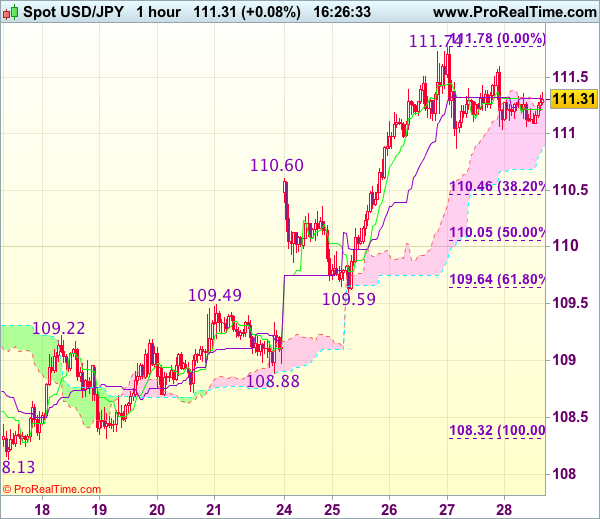
USD/JPY - 111.31
Most recent candlesticks pattern : N/A
Trend : Near term up
Tenkan-Sen level : 111.22
Kijun-Sen level : 111.32
Ichimoku cloud top : 111.28
Ichimoku cloud bottom : 110.88
Original strategy :
Buy at 110.45, Target: 111.55, Stop: 110.10
Position : -
Target : -
Stop : -
New strategy :
Buy at 110.45, Target: 111.55, Stop: 110.10
Position : -
Target : -
Stop : -
Dollar’s retreat after meeting resistance at 111.60 yesterday has retained our view that consolidation below this week’s high at 111.78 would be seen and pullback to 110.60-69 (previous resistance and 50% Fibonacci retracement of 109.59-111.78) cannot be ruled out, however, reckon downside would be limited and 110.40-45 (61.8% Fibonacci retracement) should hold, bring another rise later, above said resistance at 111.78 would signal recent rise from 108.13 low has resumed and extend further gain to 111.90-00 but overbought condition should prevent sharp move beyond another previous resistance at 112.20.
In view of this, would not chase this rise here and would be prudent to buy dollar on subsequent pullback as 110.40-45 (61.8% Fibonacci retracement of 109.59-111.78) should limit downside. Only break of 110.05-10 (50% Fibonacci retracement of 108.32-111.78) would defer and suggest top is possibly formed, risk weakness to 109.80 but break of support at 109.59 is needed to provide confirmation.
The Song Remains The Same, For Now
The ECB remained on hold yesterday, while the statement accompanying the decision contained no major changes from previously. The Bank kept intact its dovish forward guidance that the QE program can be extended or expanded if needed, and that rates will remain at present or lower levels for an extended period of time.
Draghi's press conference was more eventful. The euro gained initially, after the President indicated that even though the risks surrounding the outlook for growth are still tilted to the downside, they are moving closer to being broadly balanced. However, the currency quickly gave back all its gains to trade even lower, after he said the Governing Council did not discuss any strategy for exiting stimulus. He added that policymakers are still not sufficiently confident that inflation will converge back to their target. In our view, these signals call into question the recent media reports that the Bank is likely to sound more optimistic at upcoming meetings, perhaps as early as in June. Even though something like that will probably depend on how the data evolve until then, it would be rather odd for the ECB to communicate a completely different message in six weeks' time, in our view.
For the time being, investors are likely to turn their attention back to incoming economic data in order to assess whether the Bank will indeed shift towards a more upbeat bias in June. Eurozone's preliminary CPI data for April, due to be released today, could provide a first hint on this prospect (see below).
EUR/USD edged down as soon as Draghi poured cold water on speculation with regards to a more optimistic bias. The pair slid after it found resistance above 1.0915 (R1) to hit our support level of 1.0855 (S1). We still believe that the short-term path is to the upside and that buyers may take advantage of yesterday's setback and aim for another test near the 1.0915 (R1) barrier. A clear break above that resistance could target the next one at 1.0955 (R2), marked by Tuesday's and Wednesday's highs. A potential rise in Eurozone's CPI rates combined with the likelihood of a slowdown in US GDP could prove the catalyst for such a move today.
Riksbank keeps rates unchanged, extends QE duration
The Riksbank kept its key policy rate unchanged yesterday, but extended the duration of its QE program by 6 months to December 2017. It also pushed somewhat further out the timing for its first planned rate hike, and maintained an ultra-dovish tone in the statement accompanying the decision. SEK tumbled on the news and could remain under selling pressure for a while.
Today's highlights:
As we already noted, we get Eurozone's preliminary CPI data for April. The forecast is for both the headline and the core rates to have risen. The ECB has repeatedly noted that it places more emphasis on the core rate, where a potential increase today could amplify speculation that the Bank may appear more optimistic in coming months. This could help the euro to recover some of its ECB-related losses.
From Germany, Sweden, and Norway, we get retail sales figures, all for March.
From the UK, we get the 1st estimate of Q1 GDP. The forecast is for economic activity to have slowed, something supported by the notable slide in retail sales for March, the disappointing industrial production for January and February, and the weaker performance of the nation's PMIs compared to that seen at the turn of the year. A potential slowdown in GDP could confirm that the BoE will likely keep its accommodative policy stance intact in order to support growth and thereby, reverse some of the pound's recent gains.
EUR/GBP also traded south on Draghi's remarks, falling below the support (now turned into resistance) of 0.8450 (R1) to stop near 0.8410 (S1). Given that the rate is trading below the long-term uptrend line taken from the lows of November 2015, we consider the outlook to be cautiously negative. However, accelerating Eurozone CPIs combined with slowing UK GDP could cause a corrective bounce before the bears decide to take the reins again. A break back above 0.8450 (R1) may confirm that and could open the way for the next resistance of 0.8500 (R2).
We get the 1st estimate of Q1 GDP from the US as well. The forecast is for GDP growth to have slowed to +1.1% qoq SAAR from +2.1% qoq SAAR in Q4. Bearing in mind that the Atlanta Fed GDPNow model suggests that growth was a mere +0.2% qoq SAAR, we see the risks surrounding that forecast as tilted to the downside. Coming on top of the slowdown in the nation's CPIs for March, a weak Q1 growth rate could push back expectations regarding the timing of the next Fed rate hike, which may weigh on USD.
We have only one speaker on the agenda: SNB Chairman Thomas Jordan.
EUR/USD
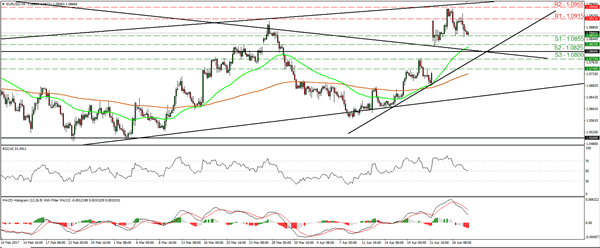
Support: 1.0855 (S1), 1.0825 (S2), 1.0800 (S3)
Resistance: 1.0915 (R1), 1.0955 (R2), 1.1000 (R3)
EUR/GBP
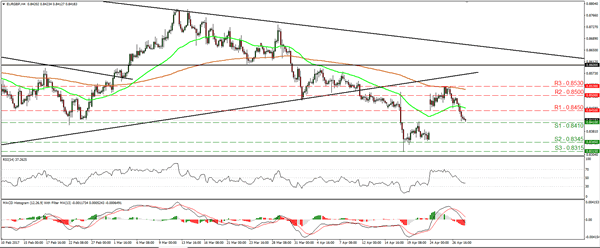
Support: 0.8410 (S1), 0.8345 (S2), 0.8315 (S3)
Resistance: 0.8450 (R1), 0.8500 (R2), 0.8530 (R3)
Will US Q1 GDP Growth Show A Slowdown ?
There are two crucial GDP figures to be released today; UK Q1 GDP initial reading will be released at 09:30 BST, followed by the US Q1 GDP annualized initial reading, Q1 PCE and Q1 core PCE inflation figures (QoQ) at 13:30 BST.
This will be the first US GDP figure reported after Trump took office. Presently the US economic condition remain sound – whereas, per the Q4 GDP annualized final reading, we saw a 2.1% growth showing a slowdown compared to a 3.5% growth in Q3. Market expectations for the upcoming Q1 GDP initial reading is 1.3%, which is lower than a 2.1% growth in Q4.
Growth around 2% is still sound however it shows a slowdown compared to the robust economic expansion over past decades. The reason for the recent slowdown is partially because of reduced consumer spending (especially on automobiles) caused by delayed tax returns and a warm winter. In addition; decreased corporate investment and government spending (Trump froze federal hiring ) also weighed on Q1 GDP growth.
However, the global economy is seeing a gradual recovery. Furthermore, the weakening of USD since the beginning of the year has boosted overseas demand for US products and US exports. In addition, the US job market is close to full employment which also provides Q1 GDP some support.
The US economic cycle is typically sluggish during the winter months then starts to see a revival in spring and summer. Therefore, the Q2 and Q3 GDP readings will likely see a better performance.
The dollar index saw a rebound over the past two days after hitting the lowest level of 98.55 since November 11. The current price is trading below the significant psychological level at 99.00.
Per the CME’s FedWatch tool the current probability for a rate hike in June is 67.6%. If the US Q1 GDP reading beats expectations, then we can expect an increase in the probability and further support to USD. Conversely, if Q1 GDP underperforms, it will likely weigh on USD and lower the probability of a rate hike in June.
Technical Outlook: EURUSD – Key 200SMA Support Is In Near-Term Focus
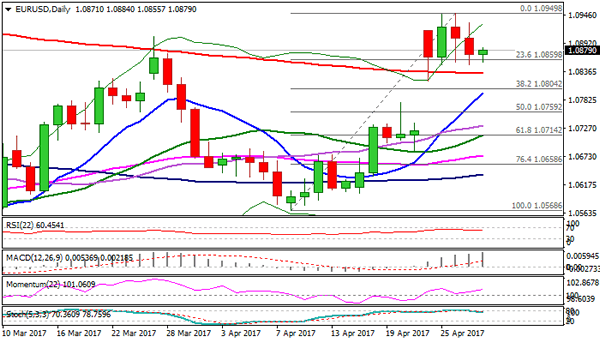
The Euro is softer on Friday following double upside rejection at 1.0950 and two consecutive days in red but is still holding above strong support at 1.0834, provided by 200SMA. Near-term risk is shifted lower after dovish ECB on Thursday and reversal of slow stochastic from overbought zone on daily chart. Focus is on 1.0834/19 pivots (200SMA/low of the week, reinforced by weekly Kijun-sen) as well as 1.0804 (Fibo 38.2% of 1.0568/1.0950 rally), violation of which is expected to generate strong bearish signal. Alternatively, the pair may hold in extended congestion while 200SMA support stays intact. Release of US GDP data due later today may give more clues about pair's near-term direction.
Res: 1.0900, 1.0935, 1.0950, 1.1000
Sup: 1.0855, 1.0834, 1.0819, 1.0804
Forex Technical Analysis: EUR/USD, USD/JPY, GBP/USD
EUR/USD
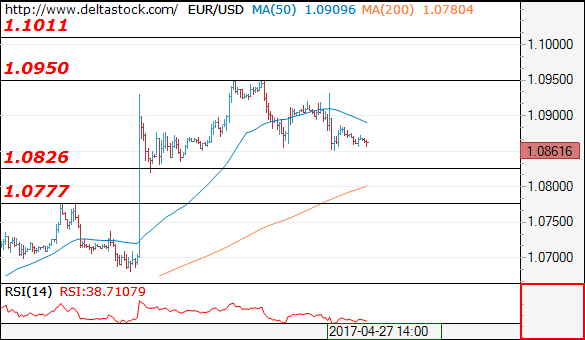
Current level - 10861
The overall bias remains neutral, but due to the fact, that the pair is currently close to the lower boundary of the trading range, an upmove is to be expected, towards 1.0950 peak. A break through the latter will challenge 1.1010 area. Key support lies at 1.0826.
| Resistance | Support | ||
| intraday | intraweek | intraday | intraweek |
| 1.0950 | 1.0950 | 1.0826 | 1.0780 |
| 1.1010 | 1.1010 | 1.0780 | 1.0676 |
USD/JPY
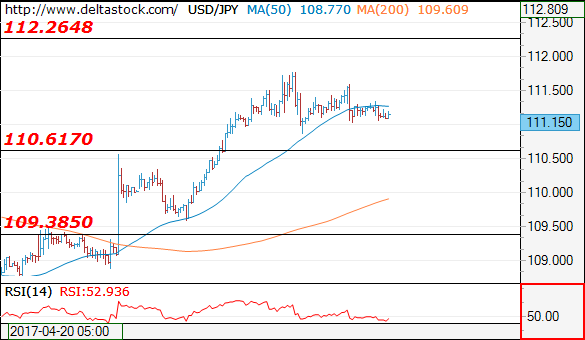
Current level - 111.15
The intraday outlook is negative, for a dip towards 110.50 support zone. Major resistance lies at 112.26.
| Resistance | Support | ||
| intraday | intraweek | intraday | intraweek |
| 111.75 | 112.26 | 110.50 | 109.40 |
| 112.26 | 113.50 | 109.40 | 108.12 |
GBP/USD
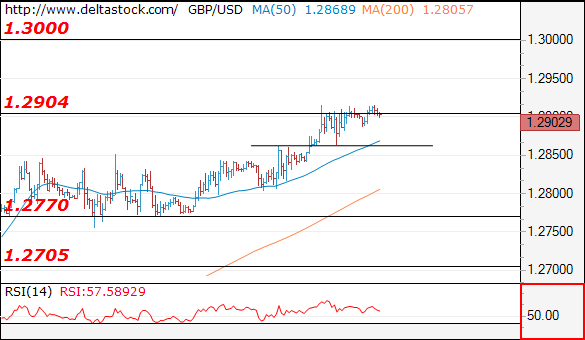
Current level - 1.2902
The intraday bias is bullish above 1.2860 minor support, for a rise towards 1.3000 sentiment area. Next major resistance is projected at 1.3120.
| Resistance | Support | ||
| intraday | intraweek | intraday | intraweek |
| 1.2904 | 1.3120 | 1.2860 | 1.2610 |
| 1.3000 | 1.3500 | 1.2770 | 1.2510 |
GBPUSD Trading In An Impulse
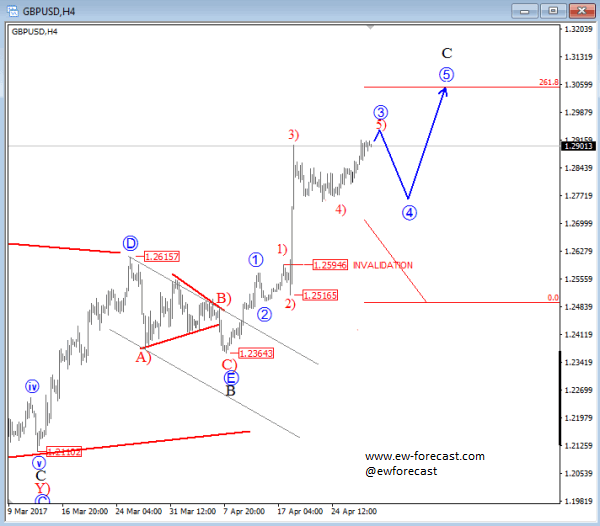
Cable is making a strong rise away from 1.2364, clearly in impulsive fashion which can see an extension up to 1.300-1.3140 area for wave C. That said, recent slow price activity was sub-wave 4), which may have already found a base and current intra-day rally may be sub-wave 5) of three.
GBPUSD, 4H
EUR/USD Analysis: Trades Below Resistance
'The ECB reiterated that rates will remain at current or lower levels for an extended period and that its asset purchase program will continue to the end of 2017 or beyond, if necessary.' – Alexandria Arnold and Dennis Pettit, Bloomberg
Pair's Outlook
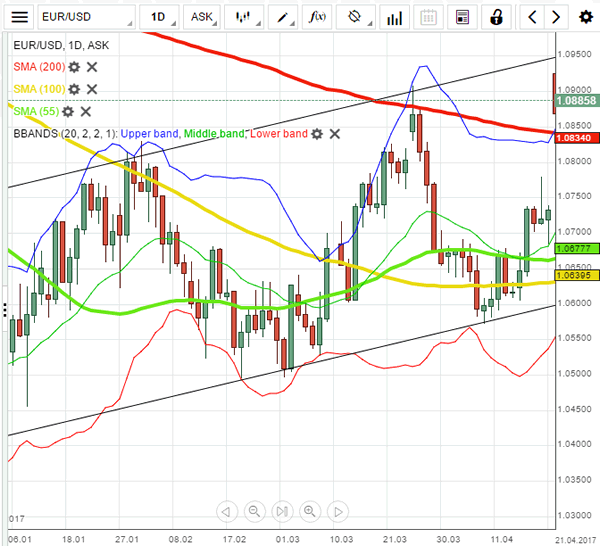
On Friday morning the common European currency had retreated below the combined resistance of the weekly R2 and monthly R1 near the 1.0880 level against the US Dollar. Due to the fact that the pair bounced off the long term resistance during this week, this can be considered the start of a medium term decline. The currency exchange rate is likely to decline by the end of the day to the combined support of the 200-day SMA, which is located at the 1.0837 mark, and the 38.20% Fibonacci retracement level at 1.0826.
Traders' Sentiment
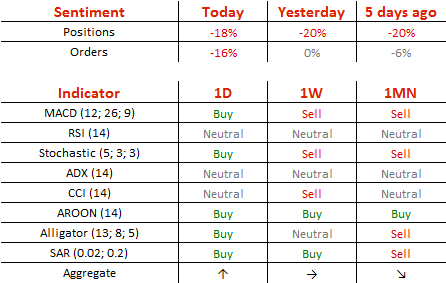
SWFX traders remain bearish, as 59% of open positions are short, and 58% of trader set up orders are to sell the Euro.
GBP/USD Analysis: Risks Skewed To The Downside
'GBP/USD should be capped in front of raised range resistance (1.30-32) and is likely to slide back towards the centre of its 1.20-1.32 rang.' – Westpac (based on FXStreet)
Pair's Outlook
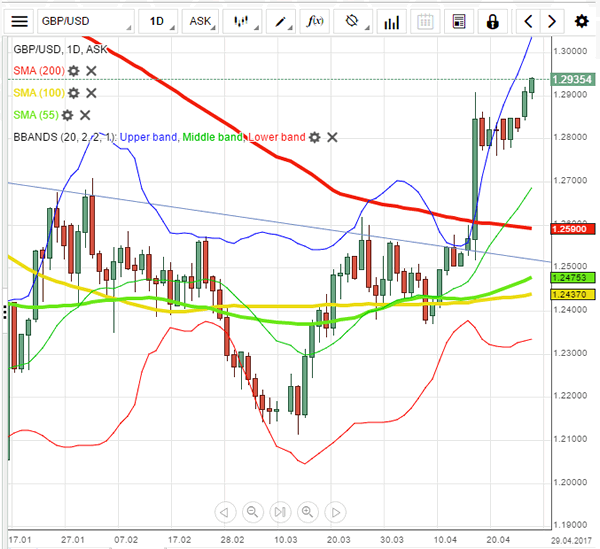
Downbeat US fundamental data caused the Cable to appreciate again and break out from its consolidation trend yesterday. Despite the breakout, the GBP/USD currency pair is still unlikely to keep posting gains, due to the monthly R2, the weekly R1 and the upper Bollinger band forming resistance just 50 pip from today's opening price. Furthermore, the still not fully confirmed broadening rising wedge's resistance line passes through that area, thus, providing additional resistance. Meanwhile, the nearest support lies only around 1.2745, but a drop that low is unlikely to occur, with the 1.28 mark expected to be the lowest possible level.
Traders' Sentiment
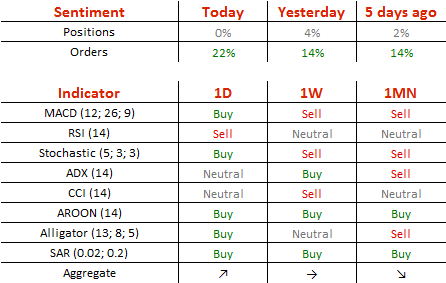
Market sentiment once again reached a perfect equilibrium, but the portion of orders to acquire the Sterling edged up from 57 to 61%.
USD/JPY Analysis: Still Hovers Over 111.00
'We don't expect any dollar downside risks on the back of any disappointments with respect to Trump.' – Credit Agricole (based on Business Recorder)
Pair's Outlook
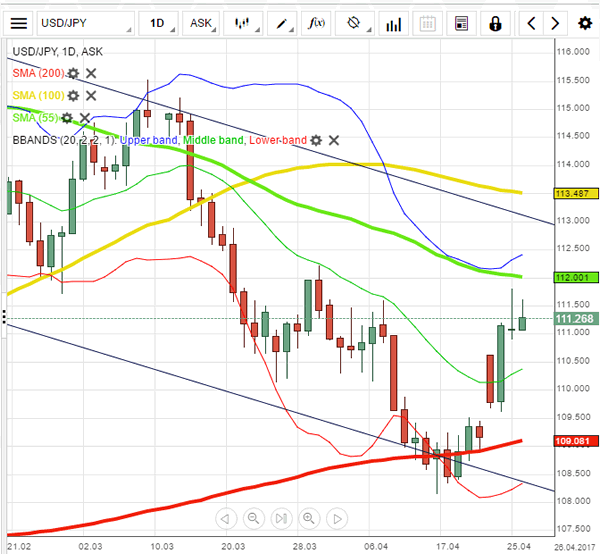
Wednesday ended with the US Dollar outperforming the Yen, therefore, leaving the 111.00 handle intact. The situation barely changed from yesterday, meaning that the USD/JPY pair still has sufficient room for another leg up, as the nearest resistance rests only circa 112.10. At the same time, the weekly R3 is unable to provide strong support, with the nearest significant demand area being only around 110.15. According to technical indicators, the exchange rate is unlikely to change significantly today.
Traders' Sentiment
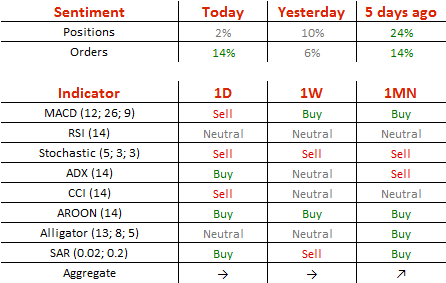
Bulls are now barely outnumbering the bears, as 51% of all open positions are long, compared to 55% previously. The number of orders to buy the Greenback returned to its Wednesday's level. The purchase orders now take up 57% of the market (yesterday 53%).
Gold Analysis: Remains Above Support
'People are probably going to buy gold around $1,250 and sell it around $1,280. There is nothing on the news to aggressively buy gold at this point of time.' – Anonymous trader (based on Reuters)
Pair's Outlook
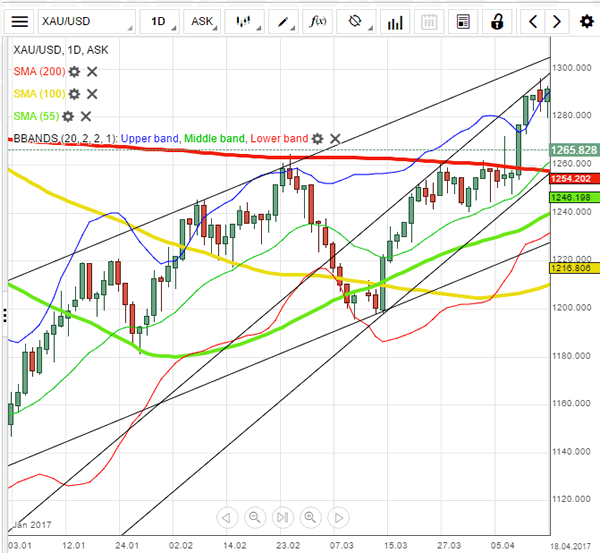
The yellow metal has not moved much since the fall, which was experienced on Tuesday. The commodity price remained above the support provided by the weekly S2 at 1,263.56. It is most likely that the markets are expecting the outcomes of various political situations, which are in the development, before making a decision. In the case of a decline the bullion would fall down to the 1,253 level, where close by starts a strong support cluster. However, if a surge occurs, the cluster near the 1,274 mark is likely to stop it.
Traders' Sentiment
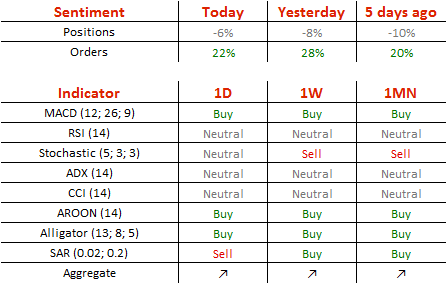
SWFX market sentiment remains bearish, as 47% of open positions are short. However, 61% of pending commands are to buy the bullion.