Sample Category Title
Canadian GDP Unchanged in February Following a 0.6% Jump in January
Highlights:
- Canadian GDP was unchanged in the month following the outsized 0.6% spike in January. The earlier strength points to Q1 GDP rising an annualized 3.8% despite the February pause.
- Goods-producing industries fell 0.3% reflecting relatively broad-based declines.
- Within goods-producing industries manufacturing output dropped 0.6% while mining and utilities both declined 0.2%. Some offset was provided by construction output rising 0.5% reflecting gains in both residential and engineering building activity.
- Service-producing industries rose 0.2% helped by strong housing activity sending the real estate component up 0.5% with finance and insurance also up a solid 0.7%. The main offsets were declines in wholesale trade (0.4%) and transportation and warehousing (0.3%).
Our Take:
February's flat monthly reading belied an acceleration in the annual pace of growth with real GDP output up 2.49% compared to a year earlier. This was the fastest pace of increase since July 2014 and reflects the recovery in the goods-producing sector. Mining production was up 6.4% in line with the recovery in commodity prices, which represents a marked turnaround after two years of decline. Growth in service-producing industries was steadier over the last two years though accelerated slightly in February. This broad based strengthening pumped the annual growth in overall GDP higher in February relative to January's 2.29% pace. This report confirmed that the economy continued to grow faster than the Bank of Canada's current estimate of potential of 1.3% for the past six months. Sustained above potential growth provides a strong argument for the central bank to start to withdraw some of the current stimulus in the system. However, recent comments by the Bank of Canada, though acknowledging the recent strength in growth, showed little indication to immediately start to tighten policy. A key restraining factor is concern about potential trade impediments being introduced by the U.S. government dampening both exports and business investment. The Trump Administration's imposition of tariffs on lumber exports announced earlier this week provide reason for the Bank of Canada to remain wary of this risk.
CAC Flat as French Data Disappoints, Eurozone CPI Climbs
The CAC has ticked higher in the Friday session. Currently, the index is trading at 5,280.50. On the release front, French indicators were a mixed bag. GDP for the first quarter came in at 0.3%, close to the estimate of 0.4%. Consumer Spending disappointed with a decline of 0.4% compared to an estimate of a 0.6% gain. Preliminary CPI came in at 0.1.%, shy of the forecast of 0.2%. There was better news out of the eurozone, as Eurozone CPI Flash Estimate improved to 1.9%, edging above the estimate of 1.8%. Later in the day, the US will release Advance GDP for Q1, with a forecast of 1.3%.
Inflation in the eurozone is again on the rise. The estimate for CPI in April improved 1.9% in April, up from 1.5% in March. Although inflation levels have moved higher, Mario Draghi stated on Thursday that the ECB was not changing its inflation forecast or making any changes to its asset-purchase program. The ECB held rates at a flat 0.00%, and the rate statement and comments from Mario Draghi were more dovish than the markets would have liked. The current ultra-loose policy, which includes a quantitative easing program of EUR 60 billion/mth, has been in place since 2008. Draghi acknowledged that the eurozone is in better shape, noting that economic conditions had improved and downside risks had decreased. There had been speculation that the ECB might taper or bring forward its asset-purchase program, which runs until December. The ECB holds its next meeting in June, and the markets will again be looking for some tightening from the ECB.
French voters will again have their say on May 7, when the winner of the presidential election will be decided. The two candidates left standing after the first round of voting are centrist Emmanuel Macron and National Front leader Marie Le Pen. European stock markets have been steady over the past few days, having priced in a victory by Macron. Opinions polls ahead of the first round were on target, forecasting that Macron and Le Pen would advance to the second round, with 24% and 22% of the vote, respectively. The markets are thus relying on the polls for the second round, which show Macron with a comfortable lead of 60-40. Le Pen is a heavy underdog, compounded by the fact that some candidates from the first round, as well as former President Francois Hollande, have publicly called for voters to support Macron. Still, a strong showing by Le Pen next Sunday would show that her strident anti-EU stance has wide popularity, and this could sour investor sentiment and send European stock markets lower.
One of President Trump's most important campaign platforms was a promise to reform the US tax code. Trump finally announced his long-awaited tax plan on Wednesday. The proposal calls for sharp reductions for both individuals and corporations. The plan calls for three tax brackets for individuals – 10%, 25% and 35%. The corporate sector would also see significant tax relief, with the corporate tax rate dropping from 35% to 15%, and the tax on multinationals' overseas profits lowered from 35% to 10%. However, any tax reform proposals from the White House will require a stamp of approval from Congress, so Trump's proposal should be viewed as a blueprint that is a long way off from becoming law. Trump's proposal was short on details, although government officials are praising it as one of the largest tax cuts and broadest overhauls of the tax system in history. There hasn't been much reaction from the CAC or other European stock markets, which have been subdued in Thursday trading.
Gold Nudges Up Ahead of US Q1 GDP
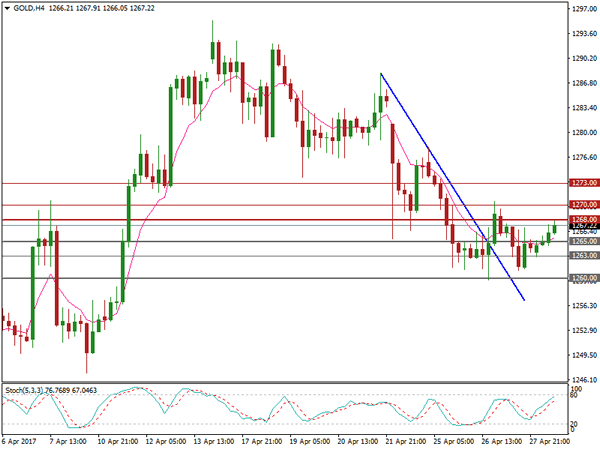
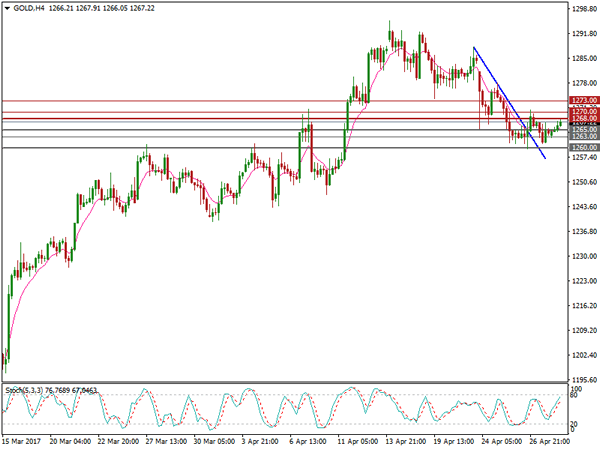
Spot gold has seen a 1.56% retracement over past two weeks after hitting its highest level of 1295.37 last seen on November 9th 2016. That said, this retracement has held above the support line at 1260 over the past two days.
On the 4-hourly chart, the price broke the downtrend line resistance on April 26, indicating bullish momentum has been increasing.
The daily Stochastic Oscillator reading is below 30 suggesting a rebound.
US Q1 GDP annualized initial reading, Q1 PCE and Q1 core PCE inflation figures (QoQ) will be released at 13:30 BST today. This will be the first US GDP figure reported since Trump took office.
During the early European session this morning USD has weakened ahead of the release of Q1 GDP as markets are expecting the figure will show an economic growth slowdown.
Spot gold has nudged up, helped by the weakening of USD.
Growth in the US economy has shown a slowdown since Q4. If Q1 GDP underperforms it will likely push gold prices higher and test resistances. Conversely, if the Q1 GDP reading beats expectations, then it will likely weigh on gold prices and test supports.
The resistance level is at 1268, followed by 1270 and 1273.
The support line is at 1265, followed by 1263 and 1260.
GBP/USD Mid-Day Outlook
Daily Pivots: (S1) 1.2855; (P) 1.2885; (R1) 1.2933; More...
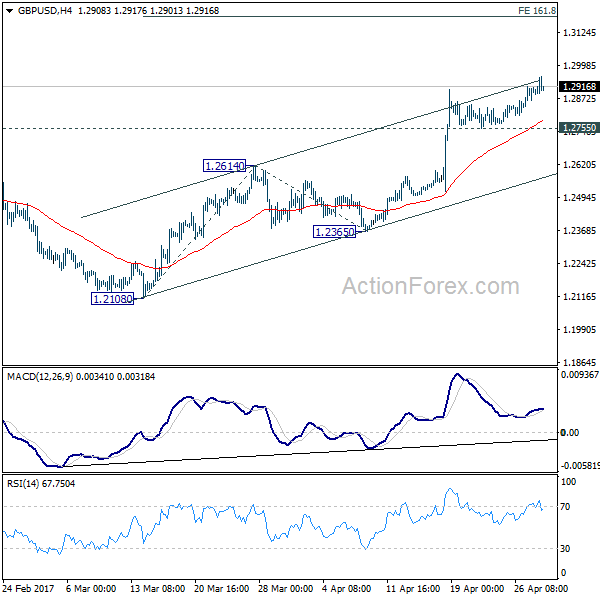
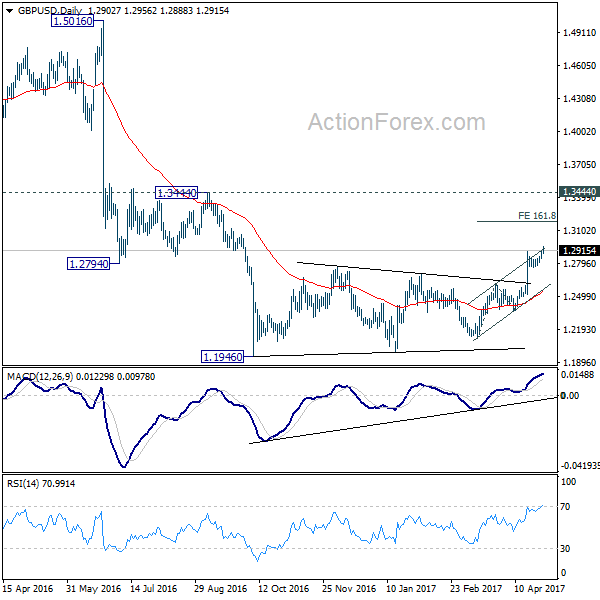
Intraday bias in GBP/USD remains on the upside and current rise from 1.2108 should target 161.8% projection of 1.2108 to 1.2614 from 1.2365 at 1.3184. At this point, price actions from 1.1946 are still interpreted as a correction pattern. Therefore, we'd expect strong resistance below 1.3444 to bring larger down trend resumption. On the downside, break of 1.2755 minor support will turn bias to the downside. Further break of 1.2614 resistance turned support will now indicate near term reversal.
In the bigger picture, fall from 1.7190 is seen as part of the down trend from 2.1161. There is no sign of medium term reversal yet. Sustained trading below 61.8% projection of 2.1161 to 1.3503 from 1.7190 at 1.2457 will target 100% projection at 0.9532. Overall, break of 1.3444 resistance is needed to confirm medium term bottoming. Otherwise, outlook will remain bearish.
Dollar Stays Mildly Pressured after GDP Miss, Eurozone Inflation Surged
Dollar is mild pressure against European majors in early US session after weaker than expected growth data. Q1 GDP in US grew 0.7% annualized, sharply lower than prior quarter's 2.1% and missed expectation of 1.1%. While it's common to have a soft first quarter in recent years, the miss could prompt some adjustment in market's expectation on overall growth for the year. GDP price index, on the other hand, rose 2.3%, up from prior quarter's 2.1% and beat expectation of 2.0%. Employment cost index rose 0.8% in Q1, above expectation of 0.6%. While the greenback stays weak against European majors, in particular Sterling, it's showing some strength against Aussie and Yen and stays firm against Canadian Dollar.
Canadian Dollar stays soft too
Taking about Canada, GDP rose 0.0% mom in February, below expectation of 0.1% yoy and down from January's 0.6% yoy. IPPI rose 0.8% mom in March, above expectation of 0.3%. But RMPI dropped -1.6% mom, below expectation of -0.4%. The loonie is sold off deeply this week and pressured on two fronts. Firstly, there was talk that US would pull out from NAFTA. US President Donald Trump then backtracked and said he won't withdraw for the moment. This lifted some weight on the Canadian Dollar. Secondly, it's dragged down by the fall in oil price. WTI hit as low as 48.20 yesterday, comparing to this month's high at 53.76. While WTI is back above 49 for the moment, it's struggling to find sustainable buying to pull it back above 50 handle.
EC Tusk: People, Money and Irealand first before talks on post-Brexit
European Council President Donald Tusk urged that UK must settle the issues of "people, money and Ireland" before negotiation on future relationship with EU. And, UK must honour it's financial obligations to EU before starting talks on trade agreements. And future relations could only start once "we have achieved sufficient progress" on these key issues. And he emphasized that it's "not only a matter of tactics, but - given the limited time-frame we have to conclude the talks - it is the only possible approach". German Chancellor Angel Merkel also insisted that "without progress on the many open questions of the exit, including the financial questions, it makes no sense to have parallel negotiations."
Released from UK, Q1 GDP grew 0.3% qoq, below expectation of 0.4% qoq, and down from prior quarter's 0.7% qoq. Index of services rose 0.5% 3mo3m in February, in line with consensus. BBA mortgage approvals dropped to 41.1k in March. Sterling is so far immune from bad economic data.
Eurozone inflation surged
From Eurozone, CPI surged to 1.9% yoy in April, up from prior month's 1.5% yoy and expectation of 1.8% yoy. Core CPI also jumped sharply to 1.2% yoy, up from 0.7% yoy and beat expectation of 1.0% yoy. Eurozone M3 money supply rose 5.3% yoy in March. Germany retail sales rose 0.1% mom in March, import price index dropped -0.5% mom. French GDP rose 0.3% qoq in Q1, below expectation of 0.4% qoq. Also from Europe, Swiss KOF leading indicator dropped to 106 in April.
Released from Japan, National CPI core was unchanged at 0.2% yoy in March. But Tokyo CPI core improved to -0.1% yoy in April. Retail sales rose 2.1 yoy in March. Household spending dropped -1.3%. Unemployment rate was unchanged at 2.8%. Industrial production dropped -2.1% mom. From Australia, PPI rose 0.5% qoq in Q1. New Zealand trade balance turned to NZD 332m surplus in March, building permits dropped -1.8% mom.
GBP/USD Mid-Day Outlook
Daily Pivots: (S1) 1.2855; (P) 1.2885; (R1) 1.2933; More...
Intraday bias in GBP/USD remains on the upside and current rise from 1.2108 should target 161.8% projection of 1.2108 to 1.2614 from 1.2365 at 1.3184. At this point, price actions from 1.1946 are still interpreted as a correction pattern. Therefore, we'd expect strong resistance below 1.3444 to bring larger down trend resumption. On the downside, break of 1.2755 minor support will turn bias to the downside. Further break of 1.2614 resistance turned support will now indicate near term reversal.
In the bigger picture, fall from 1.7190 is seen as part of the down trend from 2.1161. There is no sign of medium term reversal yet. Sustained trading below 61.8% projection of 2.1161 to 1.3503 from 1.7190 at 1.2457 will target 100% projection at 0.9532. Overall, break of 1.3444 resistance is needed to confirm medium term bottoming. Otherwise, outlook will remain bearish.
Economic Indicators Update
| GMT | Ccy | Events | Actual | Forecast | Previous | Revised |
|---|---|---|---|---|---|---|
| 22:45 | NZD | Building Permits M/M Mar | -1.80% | 14.00% | 17.20% | |
| 22:45 | NZD | Trade Balance (NZD) Mar | 332M | 375M | -18M | -50M |
| 23:01 | GBP | GfK Consumer Confidence Apr | -7 | -7 | -6 | |
| 23:30 | JPY | Jobless Rate Mar | 2.80% | 2.90% | 2.80% | |
| 23:30 | JPY | Household Spending Y/Y Mar | -1.30% | -0.50% | -3.80% | |
| 23:30 | JPY | National CPI Core Y/Y Mar | 0.20% | 0.20% | 0.20% | |
| 23:30 | JPY | Tokyo CPI Core Y/Y Apr | -0.10% | -0.20% | -0.40% | |
| 23:50 | JPY | Retail Trade Y/Y Mar | 2.10% | 1.50% | 0.10% | 0.20% |
| 23:50 | JPY | Industrial Production M/M Mar P | -2.10% | -0.80% | 3.20% | |
| 01:30 | AUD | PPI Q/Q Q1 | 0.50% | 0.30% | 0.50% | |
| 05:00 | JPY | Housing Starts Y/Y Mar | 0.20% | -2.60% | -2.60% | |
| 05:30 | EUR | French GDP Q/Q Q1 A | 0.30% | 0.40% | 0.40% | |
| 06:00 | EUR | German Retail Sales M/M Mar | 0.10% | 0.00% | 1.80% | 1.10% |
| 06:00 | EUR | German Import Price Index M/M Mar | -0.50% | -0.10% | 0.70% | |
| 07:00 | CHF | KOF Leading Indicator Apr | 106 | 107.5 | 107.6 | 107.2 |
| 08:00 | EUR | Eurozone M3 Y/Y Mar | 5.30% | 4.70% | 4.70% | |
| 08:30 | GBP | BBA Mortgage Approvals Mar | 41.1K | 42.1K | 42.6K | 42.2K |
| 08:30 | GBP | GDP Q/Q Q1 A | 0.30% | 0.40% | 0.70% | |
| 08:30 | GBP | Index of Services 3M/3M Feb | 0.50% | 0.50% | 0.60% | |
| 09:00 | EUR | Eurozone CPI Estimate Y/Y Apr | 1.90% | 1.80% | 1.50% | |
| 09:00 | EUR | Eurozone CPI - Core Y/Y Apr A | 1.20% | 1.00% | 0.70% | |
| 12:30 | CAD | GDP M/M Feb | 0.00% | 0.10% | 0.60% | |
| 12:30 | CAD | Industrial Product Price M/M Mar | 0.80% | 0.30% | 0.10% | 0.30% |
| 12:30 | CAD | Raw Materials Price Index M/M Mar | -1.60% | -0.40% | 1.20% | 1.30% |
| 12:30 | USD | GDP (Annualized) Q1 A | 0.70% | 1.10% | 2.10% | |
| 12:30 | USD | GDP Price Index Q1 A | 2.30% | 2.00% | 2.10% | |
| 12:30 | USD | Employment Cost Index Q1 | 0.80% | 0.60% | 0.50% | |
| 13:45 | USD | Chicago PMI Apr | 56.7 | 57.7 | ||
| 14:00 | USD | U. of Michigan Confidence Apr F | 98 | 98 |
Dollar Pressured ahead of US GDP
The Greenback was vulnerable to heavy losses on Friday, with prices tumbling towards 98.80 as the mixture of soft economic data from the US this week, and rising uncertainty over Trump's proposed tax reforms weighed on sentiment.
Much attention may be directed towards the pending Q1 2017 US GDP report that is being released later today and is widely expected to display a slowdown in economic momentum as accelerating inflation pressured consumer spending.
With a potential slowdown in first quarter US economic growth this year weighing on expectations of the Fed raising interest rates in June, the Dollar may be at threat of further depreciation. From a technical standpoint, the Dollar Index is heavily depressed on the daily charts. Persistent weakness below 98.80 could encourage a further decline towards 97.50.
Commodity spotlight – WTI Crude
Oil markets remain entangled in a fierce tug of war, with oversupply concerns and optimism over OPEC stabilizing the saturated markets. Although WTI Crude staged an impressive rebound during early trading on Friday amid a potential OPEC cut extension, the recent reports of Libya's biggest oil field reopening may compound oversupply fears, consequently capping upside gains.
The live threat of US Shale's incessant pumping undermining the OPEC production cut extension may expose oil prices to steeper losses. From a technical standpoint, WTI Crude remains bearish on the daily charts with bears potentially exploiting the technical bounce to drag prices lower. Previous support at $50 could transform into a solid resistance that opens a path towards $47.50. In an alternative scenario, a breakdown below $49.00 may open a similar route to $47.50.
USD Weaker as Trump Tears Through Proposals
- Sterling continues to strengthen in spite of election polls
- USD weaker as Trump tears through proposals
- CAD hit by US timber and NAFTA announcements
All eyes were on America as Donald Trump said he will renegotiate the North America Free Trade Agreement (NAFTA) or terminate it, but the agreement is safe for now. The US President also warned that "There is a chance that we could end up having a major, major conflict with North Korea," although he did say he would prefer to resolve the tension through diplomatic means. He went on to say he would like to scrap the 'Horrible Horrible', South Korean trade deal. I heard the president's first 100 days in office described as the 'Bonfire of the insanities' and his keenness to stir things up does kind of fit that moniker. The US Dollar is continuing to weaken ahead of this afternoon's Gross Domestic Product data. A sharp slowdown is forecast, so beware the USD.
As you might imagine, the Canadian Dollar weakened further on that announcement and GBP-CAD is pushing up to levels we haven't seen since before the Brexit vote. This recent announcement adds to concerns over US timber levies, which would severely damage Canada's exports to their southern neighbour. C$1.75 was a level at which GBP buyers filled their boots in the second half of 2014 and it proved an immovable object when the Pound bounced back after the Brexit vote. Sterling has pushed through that and is testing just below 1.77 right now. If that retracement level breaks, 1.83 is a distinct likelihood. This afternoon brings Canadian economic growth data and the forecasts are very mixed. Be ready for GBP-CAD volatility at 12.30 GMT.
In fact, the Pound is testing a number of significant technical levels as it strengthens. AUD 1.73 is significant, Sterling is pushing towards NZD 1.90 and is threatening to test USD 1.30. All are levels that mark a change of trading ranges and the Pound is battering at the doors of all. If this morning's preliminary GDP data for the UK is as bullish as some have suggested, the Pound could well flex its muscles again at the end of this week and this month.
The weakness in the NZD comes in spite of an upbeat business confidence report released overnight. A net 11% of businesses see positive activity ahead and that is in line with last month's report. The fact that businesses are still looking to recruit and invest is good news for the Reserve Bank of New Zealand (RBNZ) but probably won't cause a knee jerk rate hike at this stage.
Monday is a public holiday in many countries. In fact, Denmark is the only major European Market that will be open on the day. So, volatility is a very likely scenario. There are cost-free ways and means to take advantage of that and to protect yourself against the worst the market can throw at you. Have a word with your Halo Financial contact to find out how that could work for you.
Meanwhile, have a lovely long weekend.
Lecture
As he was walking unsteadily along at 3am, a very drunk man was stopped by a police officer.
"What are you doing out here at 3am?" said the officer.
"I'm on my way to a lecture about the evils of alcohol and the damage it does to a person's internal organs and to their family," said the man.
And who is giving a lecture like that in the middle of the night?" asked the copper.
"My wife!!!" said the man.
Daily Technical Analysis: USD/JPY Bullish Wolfe Wave Structure
As inflation numbers fail to impress in Japan, along with contracting household spending, unemployment numbers do improve, but this could all be symptomatic of a nation in population decline and a shrinking labour force. On the other hand, USD data was largely negative this week, but safe haven flows failed to make the JPY stronger than USD. In my opinion, with Macron likely to win the French Presidential elections, its likely to see a risk-on environment continue, and you should be going long on the dips on this pair.
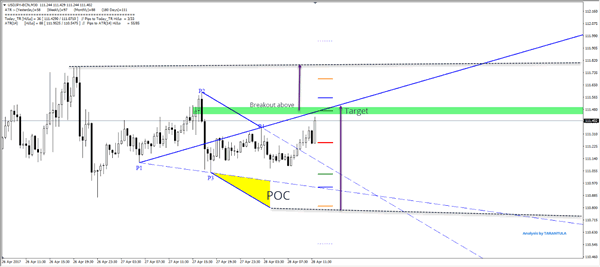
Technically, we see a bullish Wolfe Wave structure on USD/JPY where target for this move is 111.55. When 1-4 line is hit (target line) we should either see a breakout or rejection. Breakout above 111.55 should target 111.80 zone. However a rejection from 111.55 could drop the pair to POC zone 110.75-90 where new wave of buyers could appear targeting 111.50 and 111.80 again.
Dollar In Trouble Ahead Of May Day
Global equities are on the back foot; trimming their sixth consecutive monthly gain, as geopolitical worries intensifies ahead of today's U.S GDP report for Q1 (08:30 am).
U.S data is projected to show the domestic economy expanded at a +1.0% annualized rate in Q1, the weakest pace in a year.
Crude prices are again trading in the black, after tumbling on concern over a supply glut. The EUR is heading for a weekly gain, reclaiming most of yesterday's losses that came after the ECB signalled its commitment to stimulus even as the region's economy growth firms.
And in the U.S, congress is considering a continuing resolution to avoid a government shutdown.
1. Stocks trim monthly gains
Despite the North Korea situation, global stocks remain near a record high as investors bet on improving global economic growth and stronger earnings.
In Japan, the Nikkei share average ticked down -0.3% overnight as a relief rally driven by fading Euro political worries faded. Despite this, the benchmark still managed to print its largest weekly gain in five months. The broader Topix fell -0.3% – the gauge gained +2.9% this week, the best performance this year.
In South Korea, the Kospi slipped -0.2% from its highest level in six-years, while in Hong Kong, the Hang Seng dropped -0.4%, and the Shanghai Composite Index added +0.1% – the latter gauge is down -2.1% this month.
In Europe, equity indices are trading generally lower as market participants digest comments by ECB's Draghi that there is not enough evidence to change the inflation outlook. Financials are mixed in the Eurostoxx, while commodity and mining stocks are providing some support in the FTSE 100.
U.S stocks are set to open flat.
Indices: Stoxx50 flat at 3,562, FTSE -0.2% at 7,222, DAX flat at 12,445, CAC-40 +0.1% at 5,275, IBEX-35 +0.1% at 10,696, FTSE MIB +0.2% at 20,647, SMI -0.1% at 8,836, S&P 500 Futures flat.
2. Oil rebounds from one-month low on hopes for output cut extension
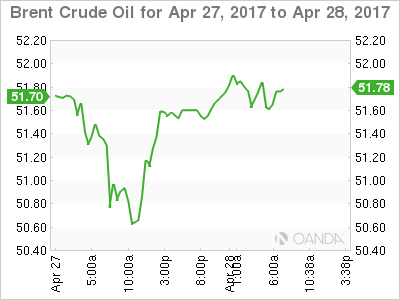
Oil prices have rebounded overnight after dropping to a one-month low yesterday. The ‘bulls' continue to buy product on dips believing that at next months OPEC meeting global producers will extend their output cuts for H2.
Crude prices are also getting some help from a weaker dollar and signs that non-OPEC member Russia was fully compliant with output limits agreed back in November.
Brent crude futures are trading up +33c at +$51.77 a barrel, while U.S light crude (WTI) is up +44c at +$49.41 a barrel.
The supply overhang is in part due to surging U.S production from shale producers – EIA data indicates that domestic output production has risen +10% since mid-2016 to +9.27m bpd.
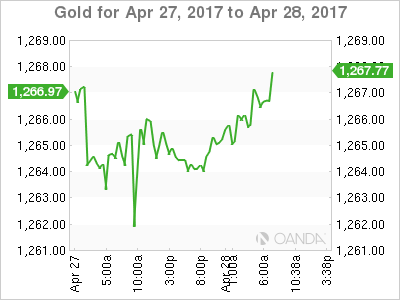
Gold is little changed ahead of the U.S open. Nevertheless, it's poised for the biggest weekly fall in nearly two-months as investors seek out higher returns. Spot gold is up +0.1% at +$1,264.86 per ounce.
Note: Gold is on track for a weekly drop of about -1.5%, the biggest weekly percentage fall since the week of March 10, but is heading towards a gain of about +1.3% for the month.
3. Yields remain contained
U.S 10-year yields closed out below +2.30% yesterday as a drop in oil to one month lows supported prices – lower energy prices tend to keep inflation intact.
Bonds have also found support from continuing scepticism over the prospects for U.S fiscal stimulus, as well as month-end demand as some investors adjusted their portfolios to match changing indexes.
Elsewhere, yesterday the ECB kept its main interest rate charged on regular loans at +0% while the rate on overnight deposits would stay at a -0.4%. It also maintained its bond-buying program (QE) at +€60B a month. Dealers are beginning to price in ECB tapering happening in early 2018. Euro inflation numbers this morning (see below) has backed up yields on 10-year German Bunds by +4 bps to +0.34%.
Down-under, Aussie benchmark 10-year yields lost -4 bps to +2.58%.
4. May Day Squaring
End-of-month and upcoming May-Day holiday on Monday is keeping FX flows at a minimum, but the USD is a tad softer ahead of the U.S open.
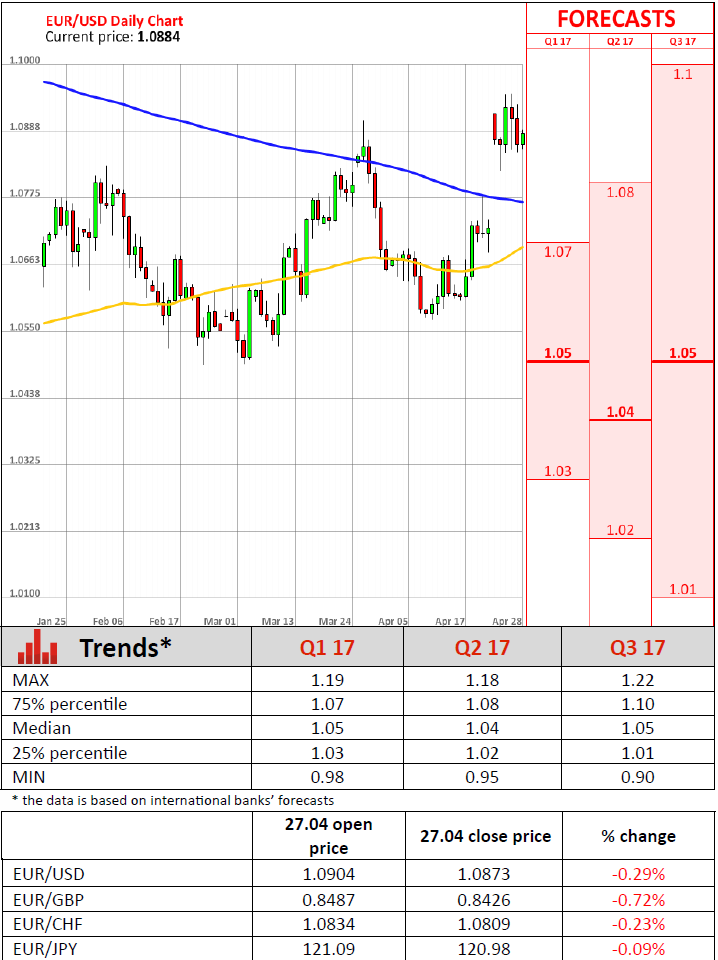
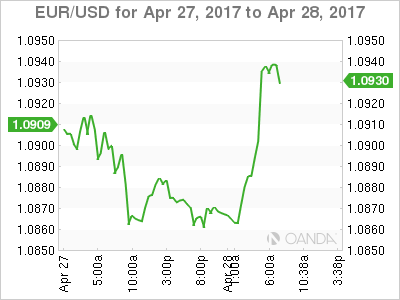
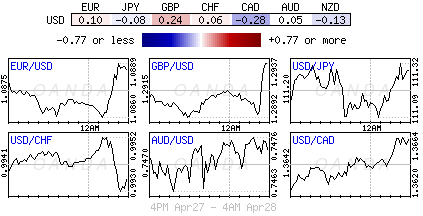
EUR/USD (€1.0936) is slightly higher; trading atop of this months high supported by this morning Eurozone data – April core-CPI finally broke out of its year-long trading range of +0.7-0.8% to surge to +1.2%
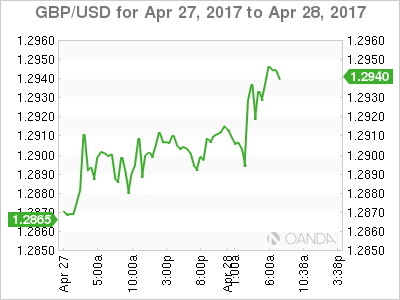
The pound is trading atop of its eight-month highs (£1.2945) and is threatening to test that psychological £1.3000 handle despite this morning disappointing data print – U.K Q1 Advance GDP data came in slightly below expectations (see below).
In Japan, a barrage of data overnight has failed to move the JPY currency much. USD/JPY is steady trading at ¥111.46 area in the session.
Expect dealers to take their cue from this morning U.S Advanced GDP headline print.
5. U.K data disappoints, Japan's mixed, and E.U has inflation
The U.K. economy slowed sharply in Q1 as rising inflation-crimped consumer spending. The economy grew +0.3% on the quarter, as a weakness in services more than offset a strong quarter for manufacturing. Analysts expect business investment and exports will need to do more of the heavy lifting in the months ahead to sustain growth.
In Japan a barrage of economic releases pointed towards economic growth, but with soft inflation- national CPI slowed to a five-month low (+0.2% vs. +0.3%e), while industrial output decline was the biggest in nine-months (-2.1% vs. -0.8%e m/m). The number for unemployment was better than expected (+2.8% vs. +2.9%), while retail trade reached a two-year high.
Finally, in Europe, the Eurozone CPI (+1.2% vs. +1%) was higher than expected as core inflation broke out of recent 12-month range. The headline inflation reached +1.9%, touching the ECB's target for close to, but slightly below +2%.
European Central Bank (ECB) Keeps Monetary Policy On Hold Amid Weak Inflation Growth
'There's enough from today to suggest that we might see a material change in policy in June. But no one should get ahead of themselves. There's clearly not enough consensus on the Governing Council.' - James Athey, Aberdeen Asset Management
As markets expected, the European Central Bank left its monetary policy unchanged at its meeting on Thursday as inflation remained below its 2% target. Although, the ECB acknowledged strong economic growth, with the economy showing the best growth rate since the global financial crisis. Nevertheless, the Central bank said that further rate cuts and an increase in asset purchases remained on the table despite Germany's calls for a stimulus reduction. The ECB President Mario Draghi stated that last month's data confirmed the view that the economy was in a good shape and downside risks continued to fall over the past several months. However, Draghi noted that underlying inflation growth remained subdued, driven by temporary factors, such as the change in crude oil prices. Therefore, policymakers voted to keep the Bank's main refinancing rate at 0.00%, the deposit rate at -0.4% and the pace of monthly asset purchases at 60B euros. Nevertheless, some analysts assumed that if Emmanuel Macron wins the final round of the French Presidential Election and the Euro zone's economy maintains a moderate yet stable pace of growth the ECB would likely reduce some of its stimulus at its next meeting in June. Furthermore, Draghi highlighted that deflation risks the risks of deflation 'largely disappeared''.