Tue, Feb 17, 2026 06:16 GMT
More

    Sample Category Title

    USD/JPY Mid-Day Outlook

    Daily Pivots: (S1) 112.19; (P) 112.76; (R1) 113.81; More...

    Intraday bias in USD/JPY remains mildly on the upside for the moment. Current developments suggests that correction from 118.65 has completed at 111.58 already, ahead of 38.2% retracement of 98.97 to 118.65 at 111.13. Further rise should be seen to 115.36 resistance next. Break will confirm this bullish case and target 118.65 high next. In that case, the larger rally from 98.97 could be resuming.

    In the bigger picture, price actions from 125.85 high are seen as a corrective pattern. The impulsive structure of the rise from 98.97 suggests that the correction is completed and larger up trend is resuming. Decisive break of 125.85 will confirm and target 61.8% projection of 75.56 to 125.85 from 98.97 at 130.04 and then 135.20 long term resistance. Rejection from 125.85 and below will extend the consolidation with another falling leg before up trend resumption.

    Subscribe to our daily and mid-day newsletter to get this report delivered to your mail box

    USD/CHF Mid-Day Outlook

    Daily Pivots: (S1) 0.9961; (P) 0.9990; (R1) 1.0043; More.....

    USD/CHF's rebound from 0.9860 extends today. Breach of 1.0043 minor resistance indicates short term bottoming. And, the fall from 1.0342 could have completed. Intraday bias is turned back to the upside for retesting 1.0342 resistance next. On the downside, below 0.9935 minor support will turn focus back to 0.9860 instead.

    In the bigger picture, prior rejection from 1.0327 resistance argues that USD/CHF is staying in a medium term sideway pattern. In any case, decisive break of 1.0342 resistance is needed to confirm underlying strength. Otherwise, we'll stay neutral in the pair first. In case of another fall, we'd expect strong support from 0.9443/9548 support zone. Meanwhile firm break of 1.0342 will target 38.2% retracement of 1.8305 to 0.7065 at 1.1359.

    USD/CHF 4 Hours Chart

    USD/CHF Daily Chart

    Subscribe to our daily and mid-day newsletter to get this report delivered to your mail box

    GBP/USD Mid-Day Outlook

    Daily Pivots: (S1) 1.2462; (P) 1.2522; (R1) 1.2553; More...

    GBP/USD dips mildly today but stays in range of 1.2346/2705. Intraday bias remains neutral for the moment. Price actions from 1.1946 are viewed as a consolidation, no change in this view. In case of another rise, we'd expect upside to be limited by 1.2774 to bring larger down trend resumption. On the downside, below 1.2346 will revive the case that such consolidation is completed at 1.2705 already. In that case, intraday bias will turn back to the downside for retesting 1.1946 low.

    In the bigger picture, fall from 1.7190 is seen as part of the down trend from 2.1161. There is no sign of medium term bottoming yet. Sustained trading below 61.8% projection of 2.1161 to 1.3503 from 1.7190 at 1.2457 will target 100% projection at 0.9532. Overall, break of 1.3444 resistance is needed to confirm medium term bottoming. Otherwise, outlook will remain bearish.

    GBP/USD 4 Hours Chart

    GBP/USD Daily Chart

    Subscribe to our daily and mid-day newsletter to get this report delivered to your mail box

    EUR/USD Mid-Day Outlook

    Daily Pivots: (S1) 1.0634; (P) 1.0671 (R1) 1.0693; More.....

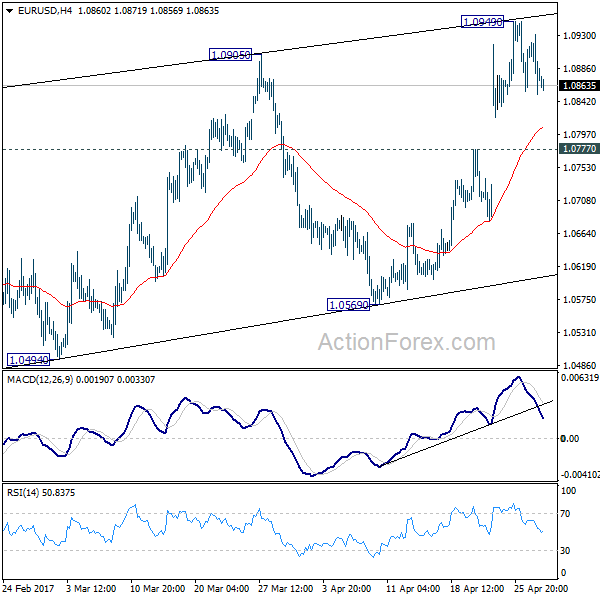
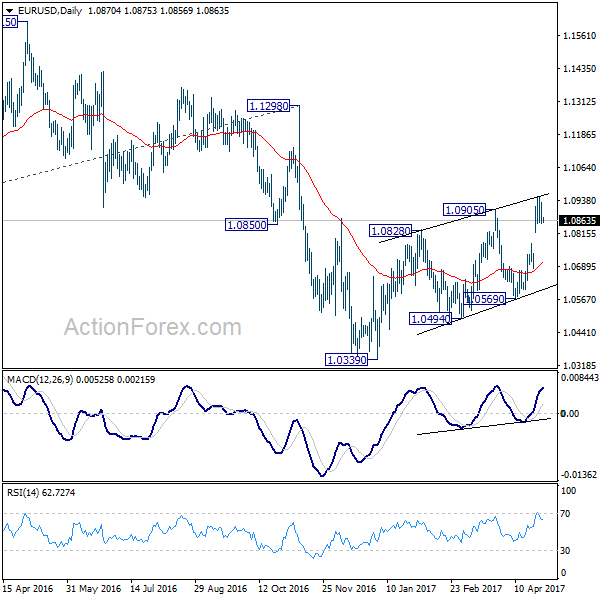
    EUR/USD's breach of 1.0619 minor support finally suggests that the corrective rise from 1.0339 is completed at 1.0828. Intraday bias is back on the downside for retesting 1.0339 low first. Decisive break there will confirm resumption of medium term down trend. On the upside, however, above 1.0713 minor resistance will delay the bearish case and turn bias neutral first.

    In the bigger picture, whole down trend from 1.6039 (2008 high) is in progress. Such down trend is expected to extend to 61.8% projection of 1.3993 to 1.0461 from 1.1298 at 0.9115. On the upside, break of 1.1298 resistance is needed to confirm medium term bottoming. Otherwise, outlook will stay bearish in case of rebound.

    EUR/USD 4 Hours Chart

    EUR/USD Daily Chart

    Subscribe to our daily and mid-day newsletter to get this report delivered to your mail box

    Loonie Jumps on Job Data, Dollar Firm as Trump Trade in Force

    Canadian dollar are lifted by solid job data and strength in oil prices today. The Canadian job market expanded by 48.3k in January, much better than expectation of 0.0k. Unemployment rate also dropped 0.1% to 6.8%. Meanwhile WTI crude oil is gaining 1.7% at the time of writing and is pressing 54 handle. It's possible that WTI is heading to retest recent resistance at 55.24 based on current momentum. On the other hand, the greenback is also strong, except versus Aussie and Loonie. Trump trades as back in force and Donald Trump said he will deliver a "phenomenal" tax overhaul within two or three weeks. From US, import price index rose 0.4% in January.

    ECB Mersch Urged to Take Rate Cuts off the Table

    ECB executive board member Yves Mersch said the central bank should take rate cuts off the table as the economy has been strong with inflation heading back to "comfort zone". And he urged to change the communication that "even lower rates" would be considered as a move, to maintain the central bank's credibility. Nonetheless, Mersch is in no support for ending the quantitative easing program. He said that "while the economic outlook for the euro area is steadily brightening, dark clouds are building up on the political horizon beyond the continent."

    Released from Europe, UK trade deficit narrowed to GBP -10.9b in December. UK industrial production rose 1.1% mom, 4.3% yoy in December. Manufacturing production rose 2.1% mom, 4.0% Yoy.

    RBA Lowe: Hard to Say Exchange Rate is Fundamentally High

    RBA Governor Philip Lowe suggested that "it's hard to say that the exchange rate is fundamentally too high". Moreover, "if the global outlooks were to change and the exchange rate/interest rate combination led to growth being downgraded, then you could make the case that the exchange rate was too high". He admitted that it is difficult to say "the configuration is leading to growth outcomes that aren't satisfactory". He forecast the economy to grow by around 3% over 2017 and 2018 while inflation will increase modestly.

    From Asian pacific, Australia home loans rose 0.4% in December. Japan tertiary industry index dropped -0.4% mom in December, domestic CGPI rose 0.5% yoy in January. China trade surplus widened to USD 51.4b in January, up from USD 40.8b, and beat expectation of USD 48.8b. In CNY terms, trade surplus widened to CNY 354.5b, up from CNY 275.4b, and beat expectation of CNY 295.3b.

    EUR/USD Mid-Day Outlook

    Daily Pivots: (S1) 1.0634; (P) 1.0671 (R1) 1.0693; More.....

    EUR/USD's breach of 1.0619 minor support finally suggests that the corrective rise from 1.0339 is completed at 1.0828. Intraday bias is back on the downside for retesting 1.0339 low first. Decisive break there will confirm resumption of medium term down trend. On the upside, however, above 1.0713 minor resistance will delay the bearish case and turn bias neutral first.

    In the bigger picture, whole down trend from 1.6039 (2008 high) is in progress. Such down trend is expected to extend to 61.8% projection of 1.3993 to 1.0461 from 1.1298 at 0.9115. On the upside, break of 1.1298 resistance is needed to confirm medium term bottoming. Otherwise, outlook will stay bearish in case of rebound.

    EUR/USD 4 Hours Chart

    EUR/USD Daily Chart

    Economic Indicators Update

    GMT Ccy Events Actual Consensus Previous Revised
    23:50 JPY Domestic CGPI Y/Y Jan 0.50% 0.00% -1.20%
    00:30 AUD Home Loans Dec 0.40% 1.00% 0.90% 1.30%
    00:30 AUD RBA Statement on Monetary Policy
    03:30 CNY Trade Balance (USD) Jan 51.4B 48.8B 40.8B
    03:30 CNY Trade Balance (CNY) Jan 354.5B 295.3B 275.4B
    04:30 JPY Tertiary Industry Index M/M Dec -0.40% -0.20% 0.20% 0.30%
    09:30 GBP Visible Trade Balance (GBP) Dec -10.9B -11.5B -12.1B -11.6B
    09:30 GBP Industrial Production M/M Dec 1.10% 0.20% 2.10% 2.00%
    09:30 GBP Industrial Production Y/Y Dec 4.30% 3.20% 2.00% 2.20%
    09:30 GBP Manufacturing Production M/M Dec 2.10% 0.50% 1.30% 1.40%
    09:30 GBP Manufacturing Production Y/Y Dec 4.00% 1.70% 1.20% 1.70%
    09:30 GBP Construction Output M/M Dec 1.80% 1.00% -0.20% 0.40%
    13:30 CAD Net Change in Employment Jan 48.3K 0.0k 53.7k
    13:30 CAD Unemployment Rate Jan 6.80% 6.90% 6.90%
    13:30 USD Import Price Index M/M Jan 0.40% 0.20% 0.40% 0.50%
    15:00 GBP NIESR GDP Estimate Jan 0.50%
    15:00 USD U. of Michigan Confidence Feb P 97.8 98.5

    Subscribe to our daily and mid-day newsletter to get this report delivered to your mail box

    Trump ‘Trade’ Back On

    Friday February 10: Five things the markets are talking about

    After some respite of late, the "Trump trade" is in vogue once again with investor flows returning to the market. Treasuries and gold trade down, while global indexes straddle atop of new highs.

    The 45th U.S President, with a couple of words yesterday - "phenomenal" tax breaks - has refocused on his pro-business agenda, promising significant tax announcement within a few weeks.

    This 'risk-on' trade has not even being dented by a U.S Court of Appeals upholding the suspension of Trump's travel ban.

    Helping the risk hungry bulls is the overnight China trade data. The world's second largest economy trade balance is "officially" at multi-month highs as imports and exports top estimates.

    Today, the market will focus on Japan's PM Abe 'meet and greet' with Trump. While POTUS may discuss his concerns over a 'strong' dollar with Abe, it's expected that whatever is said publicly will focus on trade and investment deals.

    Canada's employment report is out at 08:30am.

    Note: China's January Trade surplus hit a five-month high with both exports and imports exceeding expectations (+$51.4B vs. +$48.5Be); exports hit a ten-month high while imports hit 45-month high.

    1. Equities soar in Asia, flattish in Europe

    In Asia, regional bourses took the baton from Wall Street and pushed stocks to multi week and monthly highs.

    The MSCI Asia Pacific Index jumped +0.9%, to the highest level since July 2015. Japan's Topix rose +2.2%, the most since January 4, to bring it back above its average price for the past 50 days.

    In Australia, the S&P/ASX 200 Index climbed +1% for a fourth-straight gain and the best weekly performance since early December. Benchmarks in Singapore and Taiwan climbed +0.7% percent, while Malaysian shares rose to the highest level since April.

    In Hong Kong, the Hang Seng added +0.2%, while China's main stock indexes posted their biggest gains in three months.

    However, the Australasian euphoria has not been carried over to Europe. Indexes there are trading mixed as geopolitical uncertainties across the region continue to weigh on the markets. The FTSE 100 is outperforming as energy, commodity and mining stocks trade sharply higher after the IEA raised 2017 global oil demand in its monthly report. Financial stocks are weighing in the Eurostoxx, especially French banks.

    U.S stocks are set to open in the 'black' (+0.1%).

    Indices: Stoxx50 +0.1% at 3,283, FTSE +0.4% at 7,260, DAX +0.5% at 11,698, CAC-40 +0.3% at 4,840, IBEX-35 +0.1% at 9,450, FTSE MIB -0.2% at 18,903, SMI -0.2% at 8,423, S&P 500 Futures +0.1%

    2. Oil prices surge on compliance reports, gold prices lower

    This morning IEA monthly oil report is very bullish for crude oil price. The data highlights a +90% compliance rate from last Novembers OPEC production cut agreement - which is a record for OPEC.

    Brent crude futures are up +66c at +$56.29 a barrel, U.S West Texas Intermediate (WTI) crude futures have rallied +56c to +$56.56 a barrel.

    The IEA has also indicated that if the "current compliance levels are maintained, the global oil stocks overhang that has weighed on prices should fall by about -600k bpd in the next six-months.

    On Monday, investors will get the "official" OPEC compliance data.

    Crude 'bears' will take some comfort in the fact that the higher oil prices go should encourage more U.S producers (shale) to come back on line.

    Precious metals are trading under pressure from a firmer dollar. Spot gold is down -0.5% at +$1,223.93 per ounce ahead of the U.S open. On Wednesday, it touched its highest since November at +$1,244.67.

    3. Sovereign yields are on the rise

    U.S Treasury yields backed up +6bps yesterday, successfully halting a rally that took yields to the lowest level in three-weeks (+2.34%). Ahead of the U.S open, U.S 10's have rallied another +2bps to +2.42%.

    In Germany 10-year bond yields have increased +2bps to +0.33%, while French yields have increased +5bps to +1.03%.

    Note: The fear of "Frexit" - France's far-right candidate Marine Le Pen presented her program for such an exit yesterday - should continue to widen periphery/bund spreads.

    In Japan, the BoJ has acted in its QE operations to stem the rally in bond yields on the long end. Again, the bank has slightly increased its purchases of the 10 to 25-year debt basket in an effort to keep yields lower.

    While down-under, the Aussie and Kiwi bonds fell, sending 10-year yields up +5bps to +2.70% and +4bps to +3.20%.

    4. The 'Big' dollar gets the thumbs up

    Of all the asset classes, the FX market will be the first to react as dealers focus on results from today's discussions on trade and FX issues between Japan's PM Abe and President Trump in Washington.

    Note: Abe has previously suggested that currency discussions should be left to G20 or G7 meetings, but Trump and his Twitter account may be the outlier.

    At today's press conference, investors might only hear about Japan's message that the BoJ's monetary policy so far has been to raise inflation.

    The USD/JPY pair is higher (+0.4% to ¥113.34) overnight on yield differentials, while the EUR is little changed trading atop of €1.0645. The techies are still looking for lower levels for the single unit, believing a clear break of €1.0610 would suggest a new "bear" cycle.

    Note: Weak growth potential and political uncertainty (Frexit and Netherlands) will continue to pressure the ECB with "lower for longer" rate policy.

    The pound (£1.2492) is a tad higher after better trade and industrial production data (see below).

    5. U.K growth balanced in December

    Data this morning shows that the U.K.'s trade deficit with the rest of the world narrowed in December and that both manufacturing and construction output rose. This would suggest that the U.K economy ended Q4 more balanced rather than consumer-led growth.

    The deficit in trade in goods and services narrowed to -£3.3B from -£3.6B m/m - a weak pound has being supporting exports of aircraft, gold and oil.

    Manufacturing output rose +2.1% on the month, construction output grew +1.8%.

    Note: A faster inflation rate should squeeze consumer spending in 2017, thus making growth in other parts of the economy critical to maintaining economic momentum ahead of Brexit talks.

    New Highs Seen For US Stocks as Trump Calms Fears

    US equity markets are looking to build on Thursday's record highs in all three major indices, with futures indicating another higher open on Wall Street today.

    US President Donald Trump has started making the right noises again as far as markets are concerned, with Thursday's promise of a "phenomenal" tax announcement in the coming weeks certainly hitting all the right notes. Investors have become a little apprehensive in recent weeks due to the unpredictable nature of Trump's policies and the timing of the announcements which has taken the edge of moves we saw heading into year end.

    Of course, we're still seeing indices trading at record highs but the moves are lacking conviction. You get the feeling that investors aren't exactly ready to abandon ship just yet but they're not fully on board either. Trump's change of stance on the "One China" policy in a phone call with Xi Jinping is another welcome move from the President and it hopefully lays the groundwork for better relations between the world's two largest economies, something that has been far from guaranteed and still is. Hopefully this is a positive step forward.

    The next test for Trump will be his meeting today with Japanese Prime Minister Shinzo Abe. A number of topics are due to be discussed at the meeting, many of which Trump was critical of, when it comes to Japan, throughout his campaign and since. One of the major concerns with Trump's Presidency is his relationships with other leaders and whether it will damage trade and cooperation, something we'll hopefully have a better idea of after today's meeting.

    The economic calendar is once again looking a little bare, as has been the case for most of the week. UoM consumer sentiment stands out as being the key economic release today, with spending being such an important part of the US economy and crucial to the Fed sustainably hitting its 2% inflation target. We're expecting a small drop in the number today but even so, it is expected to remain around the same levels to those prior to the global financial crisis. We'll also get a UK GDP estimate for the three months to January from NIESR today, with growth in the period seen at around 0.5%, not bad at all under the circumstances.

    Markets Brace for Weak Canadian Employment Report

    USD/CAD is showing little movement in the Friday session. Currently, the pair is trading at 1.3140. On the release front, Canada releases employment change, which is expected to post a sharp decline of -10.1 thousand. In the US, today's highlight is Preliminary UoM Consumer Sentiment, with the markets expecting a strong reading of 97.9 points.

    US crude stockpiles continue to record surpluses. On Wednesday, Crude Oil Inventories made a splash, soaring 13.8 million barrels, according to the Energy Information Administration (EIA). The indicator has recorded five straight surpluses, easily exceeding forecasts on each occasion. The huge gain also marked the highest surplus since late October. Crude posted sharp losses on Tuesday, following the release of the API inventories report, which predicted a surplus of 14.2 million, compared to a forecast of 2.38 million. US crude prices are down 2.7 percent this week, as US oil production continues to increase. The EIA says that US production in 2017 will be the highest since 1970, so cuts from OPEC and Russia may not lead to higher oil prices, due to the steady increase in US crude production. The Canadian dollar is sensitive to crude fluctuations, and stronger oil prices would likely boost the Canadian dollar.

    Donald Trump didn't field much of an economic platform during the election campaign, but he did promise a significant fiscal boost through infrastructure spending and tax cuts. This led to a post-election euphoria in the markets and boosted the US dollar. Fast forward to February, and optimism has been replaced by caution and unease, as Trump continues to entangle himself in controversy, both with US trading partners and at home, with the media and Supreme Court. On Thursday, Trump said that the administration was working on a "phenomenal" tax plan, which would be released in a few weeks, although he gave no details. Trump's plan is expected to lower taxes for both corporations and individuals, although tax reform promises to be a slow and daunting task, as changes to the US tax code can only be made by Congress. Still, the markets are hungry for any movement in this direction, and the dollar could get a strong boost once Trump outlines his tax agenda.

    Dollar Climbs Close to 114 on Strong Jobless Claims

    The Japanese yen is almost unchanged in the Friday session. Currently, USD/JPY is trading at 113.60. On the release front, Japanese numbers were a mix. The PPI inflation indicator posted a gain of 0.5%, beating the estimate of 0.0%. However, Tertiary Industry Activity disappointed with a decline of 0.4%, shy of the forecast of -0.1%. In the US, today's highlight is Preliminary UoM Consumer Sentiment, with the markets expecting a strong reading of 97.9 points.

    US unemployment claims looked very sharp on Thursday, dropping to 235 thousand, well below the estimate of 249 thousand. The dollar responded with strong gains, as USD/JPY climbed 1.3 percent. On Friday, Japanese Prime Minister Shinzo Abe comes to Washington, where he will hold talks with President Trump. The meeting comes at an important time, as both sides will be hoping to smooth some ruffled feathers. One of Trump's first moves in office was to withdraw the US from the Trans-Pacific Partnership, a trade deal which Japan has strongly endorsed. Trump recently accused Japan of unfair trade practices in its ultra-loose monetary policy, which has kept the yen at low levels and helped boost Japanese exports. The Japanese have argued that they are not targeting the yen's value, but rather trying to combat deflation. Still, Abe will have his work cut out for in trying to assuage Trump, who has shown little patience with US trading partners and has repeatedly made protectionist statements. Japan is heavily reliant on its export sector, and the last thing it needs is a trade war with the United States. Abe is expected to defuse the currency spat by suggesting that the US and Japan discuss currency policy at the next G7 meeting.

    Donald Trump didn't field much of an economic platform during the election campaign, but he did promise a significant fiscal boost through infrastructure spending and tax cuts. This led to a post-election euphoria in the markets and boosted the US dollar. Fast forward to February, and optimism has been replaced by caution and unease, as Trump continues to entangle himself in controversy, both with US trading partners and at home, with the media and Supreme Court. On Thursday, Trump said that the administration was working on a "phenomenal" tax plan, which would be released in a few weeks, although he gave no details. Trump's plan is expected to lower taxes for both corporations and individuals, although tax reform promises to be a slow and daunting task, as changes to the US tax code can only be made by Congress. Still, the markets are hungry for any movement in this direction, and the dollar could get a strong boost once Trump outlines his tax agenda.

    Trump Announces He Will Announce Something on Taxes

    The US dollar and US equity indices soared yesterday following some comments from President Trump on taxes. Speaking to airline CEOs at the White House, Trump pledged to announce a "phenomenal" plan on tax reform within the next two or three weeks, in line with his pre-election promises to reduce taxes for American businesses. Although this was the only information we got, getting a timeline on the fiscal front was enough to reignite the market moves we saw following the election. We think that these movements could continue in the next few days, as the theme of tax and fiscal reform comes back under the market's microscope and expectations build up further.

    USD/JPY surged after it hit support once again near the 111.60 (S3) level to stop around 40 pips below the 114.00 (R1) hurdle. This is another sign that the decline started at the beginning of the year may have started to reverse and that the bulls could remain in the driver's seat in the days to come. A clear break above 114.00 (R1) is possible to set the stage for more extensions, perhaps towards our next resistance of 114.80 (R2).

    However, we would need to see the actual numbers with regards to tax cuts in order to determine whether we will see another USD rally similar to the post-election one, or whether investors discounted too much too soon. In the meantime, although our view for the greenback has shifted back to cautiously positive, there is still the risk of President Trump verbally intervening in USD, something he has done twice in the past few weeks. One occasion when he may deliver such comments is today, when he meets with Japanese Prime Minister Abe. Even though a US government official said that the issue of currency manipulation is not at the top of the meeting's agenda according to a recent Bloomberg report, we would still be mindful of any potential comments with regards to USD or trade policy, considering that the US leader tends to be unpredictable.

    As for the bigger picture of USD/JPY, we still believe that the slide from 118.60 is just a corrective phase of the prevailing medium-term upside path, but we would like to see a decisive close above 115.50 (R3) before we assume that the aforementioned uptrend is back in force.

    Today's highlights:

    During the European day, Norway's CPI data for January will take center stage. The forecast is for the headline rate to have declined to +3.0% yoy from +3.5% yoy previously, while the core rate is expected to have ticked up to +2.6% yoy from +2.5% yoy. Considering that both rates are expected to remain above the Norges Bank target of 2.5%, we do not think that such a decline in the headline CPI rate will be particularly worrisome for policymakers. In fact, such a decline in the headline rate, combined with Norway's very tight labor market may be a relatively welcome development for the Bank, as it could lead to higher real incomes for consumers, in our view. Bearing these into account, we believe that these data could support NOK overall.

    In the UK, industrial output data for December are due out and expectations are for a slowdown. Nevertheless, such a slowdown appears more than normal to us following the astonishing surge in November, and we do not expect something like that to hurt the pound too much. We also get the nation's trade data for December.

    In Canada, the employment report for January will take center stage. The forecast is for the unemployment rate to have remained unchanged and for the net change in employment to have turned slightly negative. However, we see upside risks to the employment change forecast, perhaps for a positive number. We base our reasoning on the nation's Markit manufacturing PMI for the month, which indicated that staffing numbers in the sector rose, and that the rate of job creation was the fastest since July. In case of a positive surprise, CAD could reverse some of its recent losses. Currently, USD/CAD is trading above the support barrier of 1.3100 (S1), but below the downside resistance line taken from the peak of the 28th of December. A positive employment report could bring the rate back below 1.3100 (S1), something that could open the way for our next support of 1.3050 (S2). Another dip below the latter obstacle could lead to a test near the psychological zone of 1.3000 (S3).

    Besides US President Trump and Japanese PM Abe, we have two more speakers scheduled for today: ECB Governing Council member Jens Weidmann and ECB Executive Board member Yves Mersch.