Sat, Apr 04, 2026 15:58 GMT
More

    Sample Category Title

    Euro Zone Flash PMI Jumps To 56.0 In February

    'The eurozone economy moved up a gear in February. The rise in the flash PMI to its highest since April 2011 means that GDP growth of 0.6% could be seen in the first quarter if this pace of expansion is sustained into March.' - Chris Williamson, IHS Markit

    Data released on Tuesday showed economic activity in the Euro zone perked up over the month of February, nearing a six-year high. The Markit flash PMI for the shared currency area hit the highest level in 70 months, surging to 56.0 in February from 54.4 registered in the preceding month and beating analysts' expectations for a 54.3 reading. Sufficient growth was registered in both services and manufacturing, with expansion in the latter sector outpacing services growth rate. More specifically, the manufacturing PMI climbed to 55.5 over the course of February compared with the previously reported 55.2, while experts penciled in a reading of 55.0. For the services industry, the purchasing managers' index rose to 55.6, up from 53.7 observed in January. The gain came in ahead of market expectations for the index to stay unchanged from the previous month. Separately, Germany and France released their business activity figures, with the composite PMIs in the abovementioned countries jumping to 56.2 and 56.1 respectively. Elsewhere in the common currency area, economic activity growth rate peaked to a 14-month high.

    UK Posts Highest Budget Surplus Since 2000

    'The weak result was mainly due to a change in the way that the ONS measures corporation tax revenue.' - Scott Bowman, Capital Economics

    Britain's public sector budget surplus expanded less than expected in January, official figures revealed on Tuesday. According to the Office for National Statistics, the UK public sector's net borrowing, which excludes state-owned banks, registered a budget surplus increase to £9.4B in the first month of 2017, the highest figure since 2000, compared to the £9.1B a year ago. Nonetheless, the January surplus growth was worse than analysts' expectations for a £14.7B hike. Moreover, borrowing requirements for the first 10 months of 2016-2017 fiscal year decreased to £49.3B from £62.9B. That was the lowest 10-month budget deficit in nearly nine years. Furthermore, the ONS said net debt rose to 85.3% of GDP from 83.4% recorded in the preceding year. Due to certain changes in methodology of the latest data release, the report also revealed there was a £2.1B transfer from the BoE Asset Purchase Facility Fund. Overall, the confidence in the near-term budget outlook is likely to appreciate due to solid revenue growth.

    Separately, the BoE Governor Mark Carney, speaking on the February inflation report, pointed out that inflation is entirely affected by the currency, while rates are set to rise more quickly than expected.

    EUR/GBP Tests 0.8450 Support


    Sunrise Market Commentary

    • Rates: Bund resistance should hold, underperformance US Treasuries?
      Risks for the German IFO are on the upside of expectations which should keep the Bund below key resistance (164.90). EMU markets remain sensitive to French election news, which is a wildcard. The FOMC Minutes aren't expected to reveal much new info after last week's Yellen testimony. We nevertheless think that US Treasuries will underperform Bunds.
    • Currencies: EUR/GBP tests 0.8450 support
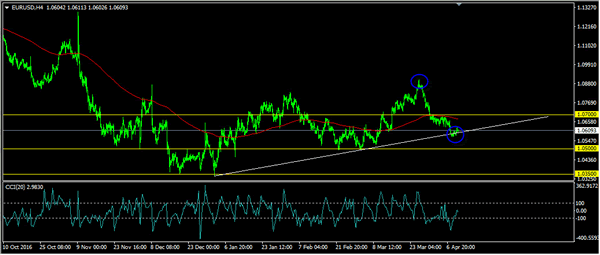
      The dollar remains in the drivers' seat as the reflation trade continues. EUR/USD tests the short-lows in the low 1.05 area, but this decline is also for an important part due to euro weakness. For now, this pattern might continue. Euro weakness also pushes EUR/GBP for a new test of the 0.8450 support area.

    The Sunrise Headlines

    • US stock markets extended their record race, gaining more than 0.5% after Monday's public holiday. Overnight, Asian equity sentiment is less bullish, with most indices recording small gains.
    • Shares in Fannie Mae and Freddie Max tumbled by more than a third on after a court struck a blow to a group of investors in their quest to overturn the government's decision to take all of the US mortgage giants' profits
    • China home prices increased last month in the fewest cities in a year, signalling property curbs to deflate a potential housing bubble are taking effect. New home prices, excl. subsidized housing, gained last month in 45 of the 70 cities
    • BoJ Governor Kuroda said the chance the central bank will deepen negative interest rates is low for now, backing market expectations that no additional monetary easing is forthcoming in the near future.
    • The head of Australia's central bank, Lowe, gave the clearest signal yet that further cuts in interest rates would not be in the national interest as the danger of a debt-fuelled boom and bust was just too severe.
    • Political uncertainty is slowing trade growth, a World Bank report has concluded, indicating that the rise of Donald Trump may already be casting a shadow over the global economy.
    • Cleveland Fed Mester said policy makers don't want to surprise the market on interest rates and they have to be “nimble” to adjust their outlook amid global and domestic risks.
    • Today's eco calendar contains German IFO, the second reading of UK Q2 GDP, finale EMU CPI data, US existing home sales and FOMC Minutes. Fed Powell speaks on the economic outlook and Germany and the US tap the market

    Currencies: EUR/GBP Tests 0.8450 Support

    By default' USD buying continues

    EMU PMI's were stronger than expected yesterday. Core (German and US) yields and equities rose after the PMI release, but didn't help the euro. France remained a euro negative and the resumption of the reflation trade supported the dollar. The rally slowed later in the session as US bond yields softened. Even so, the US currency still closed the session with decent gains. EUR/USD closed the session at 1.0536 (from the 1.0614) area. USD/JPY finished the day at 113.68 (from 113.10).

    Overnight, most Asian equities indices follow the rally from the US yesterday. Japanese equities struggle to avoid loses as USD/JPY lost modest ground. In a speech in Singapore, Fed Mester sounded a bit dovish as she said that the Fed doesn't want to surprise markets on interest rates. The dollar, especially USD/JPY, softened a bit. At the same time, US bond yields maintain a slightly upward bias. So, there is again a slight discrepancy across markets. USD/JPY is trading near 113.50. EUR/USD changes hands in the 1.0525 area. RBA's Lowe warned on the debt load of Australian households. At the margin, the risk of too high debt might make the RBA cautions to cut rates further. AUD/USD rises slightly overnight, currently trading in the 0.7690 area.

    Today, the German IFO is expected slightly softer at 109.6 (from 109.8). After strong German PMI's, an upward surprise is possible. In the US, the Minutes of the January FOMC meeting are in focus. They probably won't give us new insight in the timing of the next rate hike. However, since the meeting, economic data have been very strong and inflation surprised on the upside. Yellen was more hawkish at the testimony before Congress as she said “it would be unwise to wait too long before tightening”. Several governors pointed to the possibility of a March rate hike. A slightly hawkish tone in the Minutes shouldn't come as a surprise. Over the previous days, French election worries fuelled uncertainty on European markets (French spread widening). It weighed on the euro and supported USD/EUR gains, as the global/US reflation trade continues. Call it by default USD buying/euro selling. USD/JPY underperformed the USD/EUR gains. The political uncertainty in Europe will continue to play its role. At the same time, the focus in the US will turn to Trump's fiscal plan and Fed comments. The combination of both factors suggests further USD buying against a weak euro. We maintain a more cautious bias on USD/JPY. Selling pressure from EUR/JPY might continue to weigh.

    Global context. The dollar corrected lower since the start of January as the Trump reflation trade slowed down. Two weeks ago, the dollar bottomed out, supported by Trump's tax promise. Underlying euro weakness due to political uncertainty in the area is a factor too. We see 1.0874 as solid resistance and favour a sell EUR/USD on upticks approach. The downside test of USD/JPY is also rejected. USD/JPY 111.16 (38% retracement of the 99.02/118.66 rally) remains a key support. The comments of Yellen before Congress (and of other Fed members) were USD supportive, but had little lasting impact on yields. We keep a cautious USD positive bias, but remain more cautious on the upside potential of USD/JPY compared to USD/EUR.

    EUR/USD: testing recent low on euro softness and USD strength

    EUR/GBP

    EUR/GBP sliding below 0.8450 support.

    Yesterday, sterling gained ground against an overall weak euro, but stabilized against broadly strong dollar. At a hearing before Parliament, BoE's Carney defended the assessment of the February inflation report. The central bank raised its growth forecast, but kept its inflation forecast unchanged as the BoE said that unemployment could decline further before wages rise. Some BoE governors disputed Carney's assessment. Even so, sterling remained well bid. Especially, EUR/GBP was pressured by the decline of EUR/USD. The pair closed the session at 0.8448, testing the key 0.8450 support. Cable close the session at 1.2474 (from 1.2463).

    Overnight, EUR/GBP is extending its test beyond the 0.8450 support. Euro weakness remains the driver. The first stage of the Brexit debate in the House of Lords didn't bring any new roadblocks for PM May. The nest step is scheduled for early next week. The risk-on context is also a ST sterling supportive. Later today, the details of the UK GDP Q4 GDP will be published. A confirmation of the 0.6% Q/Q and 2.2% Y/Y growth is expected. We don't expect a lasting impact on sterling trading. EUR/GBP recently hovered in a tight range north of the 0.8450 support. Sterling sentiment softened slightly as the market feels that a BoE rate hike is still very far away. At the same time, euro softness weighed on EUR/GBP.

    Longer term, we have a sterling negative view as the Brexit still has to (negatively) impact the UK economy. However, this is no issue at this stage. Euro weakness prevails. A sustained break below the 0.8450 might trigger additional stop-loss selling. The EUR/GBP 0.8304 correction low is the next key support.

    EUR/GBP: 0.8450 support again under (heavy) pressure

    Download entire Sunrise Market Commentary

    GBPUSD Showing First Signs Of A Completed Correction, More Gains In View

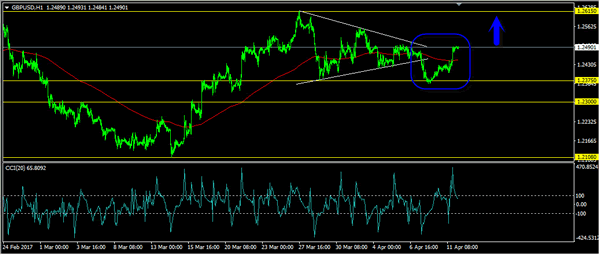
    GBPUSD has made five waves up from January low which we see it as an impulsive wave up in wave 1, followed by a recent corrective move that we see it as a double zig-zag pattern in wave 2. At the moment we see price trading higher, around the 1.2494 level, out of a probable minor triangle correction, which was found in wave Y). If that is the case and price really did unfold a triangle correction, then we can expect more strength to follow on the pair. That said, but if price continues to drop from current levels, then we could be trading within a more complex blue wave 2.

    GBPUSD, 4H

    The Oil Price Moved Higher

    Market movers today

    In the US, the FOMC minutes from the February meeting are due out. The statement did not contain much interesting news but the minutes may enlighten us on the different stances within the FOMC. We do not expect much news from the minutes either as the Fed is waiting for more news on Trumponomics. In addition, Fed Governor Jerome Powell (voter, neutral) is due to speak tonight on the economic outlook and monetary policy.

    German Ifo expectations fell from 105.5 in December to 103.2 in January and we expect it to decrease further in February to 102.5. Despite the high level in the survey in Q4 16, pointing towards very strong German GDP growth, actual economic activity was ‘just' 0.4% q/q in the first release. Overall, optimism about growth prospects for the start of 2017 could be on the decline.

    In the UK, the second estimate for GDP growth in Q4 is due out, which is somewhat interesting, as the expenditure components such as private consumption and investments in Q4 are included for the first time in this release. While growth continued at the same pace in H2 16 after the EU vote, we think GDP growth will slow down eventually this year.

    In Scandinavia, Norwegian LFS-unemployment data for December (November-January) will be published this morning, while the Swedish Debt Office will release its updated borrowing forecast. For more info see ‘Scandi Markets' on page 2.

    Selected market news

    US equity markets closed at a new record high last night as US investors returned to the market after Monday's holiday. In Asia, risk appetite appears more moderate this morning with mixed trading in the regional equity indices.

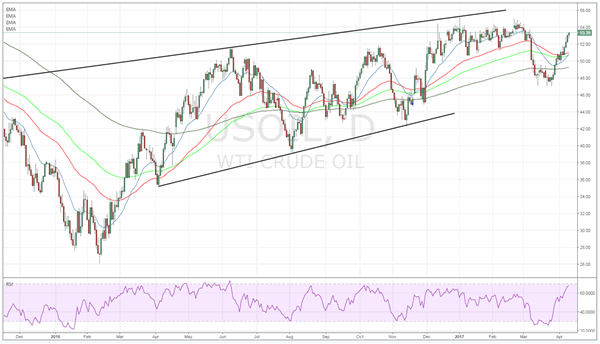
    The oil price moved higher yesterday and the price on Brent crude topped the USD57/bbl level for the first since the beginning of the month. Constructive risk sentiment during the European session and bullish comments from OPEC Secretary General Mohammad Barkindo contributed to the move higher. The higher oil price was a supporting factor the currencies of oil producing countries like the rouble and the Norwegian krone and EUR/NOK broke below the important technical level of 8.83-8.84 from the beginning of February, which may open up for further downside.

    In the UK, lawmakers in the House of Lords agreed without a vote last night, after two days debate, to let the government's Brexit move on to the ‘committee stage' starting on 27 February. Here, lawmakers will consider amendments and we are likely to see attempts to rewrite the bill. The government does not have a majority in the Upper House and could potentially lose votes on amendments. If wording in the bill is changed by the Upper House, it will be sent back to the Lower House (House of Commons) for another debate and voting.

    Data for Chinese property prices, released overnight, showed that house prices increased in January in the fewest cities in a year. New home prices, excluding government-subsidised housing, gained last month in 45 of the 70 cities tracked by the National Bureau of Statistics. Moreover, in the cities where house prices still go up, it seems that price inflation is moderating, indicating that recent tightening measures have worked to dampen house price inflation.

    EUR/USD Testing Fibonacci Support Levels Of Wave X

    Currency pair EUR/USD

    The EUR/USD is at the 100% Fibonacci level of wave X (blue) which could be a bouncing zone if price is building a complex WXY correction within a larger wave 2 (puple). A break below the 138.2% Fib level invalidates wave X (blue). The Fibonacci levels of wave 2 (purple) could also act as reversal spot and remains valid unless price breaks above the 100% level of wave 2 vs 1 (purple).

    The EUR/USD could be complete a bearish ABC (green) within wave X (blue). A break above the resistance trend line (red) confirms a larger wave 2 (purple) correction whereas a break below the channel (green) could price test the lower Fib levels.

    Currency pair GBP/USD

    The GBP/USD finally seems to be breaking the contracting triangle chart pattern. A 4 hour candle is breaking above the resistance trend line (dotted red) which indicates that the triangle was a bearish correction. Price could potentially retest the larger resistance trend line (brown) as part of wave C (blue).

    The GBP/USD finally seems to be breaking the contracting triangle chart pattern. A 4 hour candle is breaking above the resistance trend line (dotted red) which indicates that the triangle was a bearish correction. Price could potentially retest the larger resistance trend line (brown) as part of wave C (blue).

    Currency pair USD/JPY

    The USD/JPY is most likely building a wave 1-2 (blue) structure unless break below the 100% level of wave 2 vs 1. A breakout above resistance (red) and the round 115 psychological level could confirm and start wave 3 (blue). Wave 2 (blue) could expand potentially into a larger correction as well (see 1 hour chart) but should typically last between 100% and 161.8% of wave 1 (see bottom scale).

    The USD/JPY could be completing a bearish ABC (brown) zigzag within wave 2 (blue). A break above the red line invalidates wave B (brown). There could be another ABC zigzag (orange) within wave that wave B (brown).

    EUR/GBP Daily Outlook

    Daily Pivots: (S1) 0.8419; (P) 0.8467; (R1) 0.8493; More...

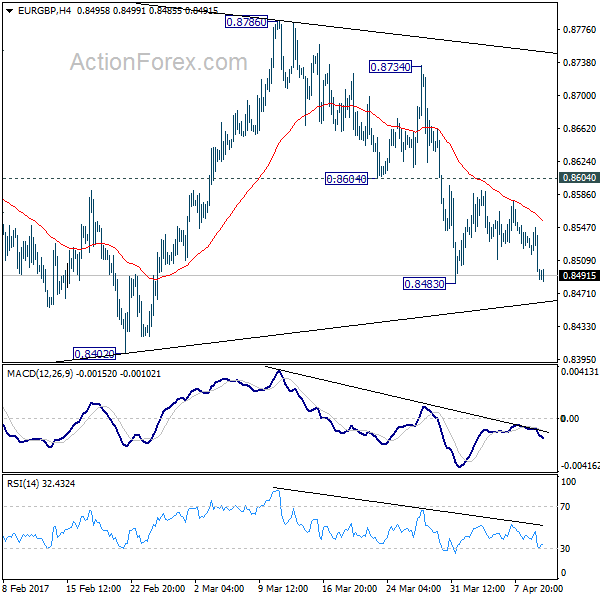
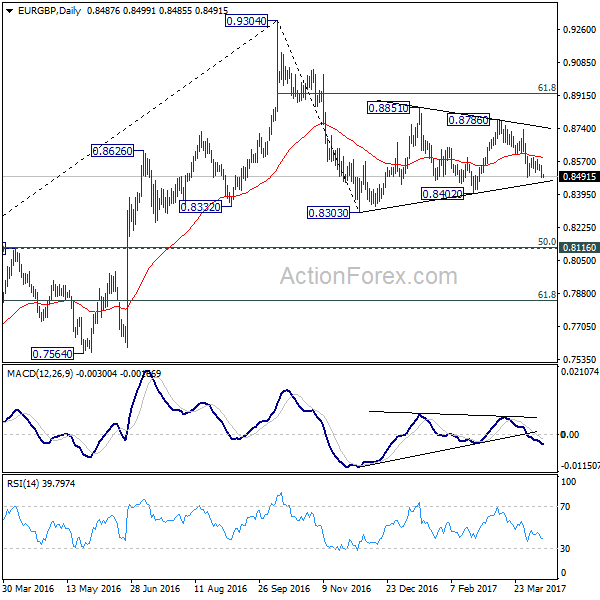
    EUR/GBP's break of 0.8455 indicates resumption of fall from 0.8851. Such decline is seen as the third leg of the corrective pattern from 0.9304. Intraday bias is back on the downside for 0.8303 support first. Break will confirm our view and target 0.8116 key cluster support level. On the upside, break of 0.8590 resistance is needed to indicate short term bottoming. Otherwise, outlook will stay cautiously bearish in case of recovery.

    In the bigger picture, price actions from 0.9304 are viewed as a medium term corrective pattern. Deeper fall cannot be ruled out yet. But we'd expect strong support from 0.8116 cluster support (50% retracement of 0.6935 to 0.9304 at 0.8120) to contain downside. Overall, the corrective pattern would take some time to complete before long term up trend resumes at a later stage. Break of 0.9304 will pave the way to 0.9799 (2008 high).

    EUR/GBP 4 Hours Chart

    EUR/GBP Daily Chart

    Subscribe to our daily and mid-day newsletter to get this report delivered to your mail box

    Dollar Yen Ready To Consolidate And Move Slightly Higher

    Key Points:

    • Long-term trend line should remain in place.
    • Parabolic SAR remains bullish.
    • Consolidation now looks likely.

    The Dollar-Yen should continue to consolidate moving forward which means further upsides could be on offer. Specifically, we have a bit of a loose pennant shaping up that should cap downside risk and a number of other technical readings are signalling that bullish momentum is tentatively returning.

    As is shown below, the long-term uptrend seems to be intact and this is now forming the lower constraint of a pennant pattern. Confirming that this consolidation phase is beginning is the current ADX reading which has finally slid below 20 and, therefore, heralds an end to the recent slew of losses. As a result of this pattern takinghold, we should see buying pressure begin to build moving ahead and this could see the pair as high as the 115 handle once again.

    Indeed, we are already seeing a number of technical readings come forward which support some near-term bullishness for the Dollar-Yen. Firstly, and probably most obviously, the 100 day moving average has been propping up the pair and doesn't look as though it is going relent anytime soon. Additionally, the parabolic SAR bias is bullish which will be helping to recruit buyers moving ahead.

    One of the less obvious signals of ongoing bullishness is the MACD oscillator. Specifically, the signal line crossover that occurred as the pair challenged the 100 day EMA is indicative of a change in momentum. This would typically infer that we are in little danger of the recent downtrend firing up again which significantly increases upside potential.

    As a result of all these technical readings, we should see the USDJPY ascend up to around the 115.16 level. Here, the 50.0% Fibonacci level will likely cap upsides and it could even encourage another reversal. However, it will pay to take another look at the technical bias as the pair approaches this point as we could instead see a breakout from the pennant and a subsequent uptrend.

    Ultimately, we can't ignore the fundamental side of things and should keep half an eye on the economic news feed moving forward. The only real news items to be aware of are on the US side of the equation and, of these results, only the Unemployment Claims and the Final Michigan Consumer Sentiment figures are worth monitoring closely. However, do watch out for any bombshells that could be dropped in Lockhart's scheduled remarks, despite there only being a rather slim chance of him deviating from the Fed's script.

    EUR/AUD Daily Outlook

    Daily Pivots: (S1) 1.3691; (P) 1.3752; (R1) 1.3785; More...

    EUR/AUD's decline resumed by taking out 1.3722 and intraday bias is back on the downside. Bullish convergence condition is seen in 4 hour MACD. Also, price actions from 1.6587 are seen as a corrective move. Hence, we'd expect strong support from 1.3671 key level to contain downside and bring rebound. Break of 1.3900 resistance will indicate near term reversal and turn bias back to the upside for 1.4025 resistance and above.

    In the bigger picture, price actions from 1.6587 medium term top are viewed as a corrective pattern. We'd expect strong support from 1.3671 key level to contain downside and bring rebound. Up trend from 1.1602 should not be finished and will resume later. Break of 1.4721 resistance will indicate completion of such correction and turn outlook bullish for retesting 1.6587 high. However, sustained break of 1.3671 will invalidate our bullish view and would turn focus back to 1.1602 long term bottom.

    Subscribe to our daily and mid-day newsletter to get this report delivered to your mail box

    Foreign Exchange Market Commentary

    EUR/USD

    The greenback started the day with a strong footing, but pared gains and retreated from its daily highs following disappointing US data. Markit flash PMIs came in below previous month readings, with the services activity index down to 53.9 from 55.6 in January, whilst the manufacturing sector contracted to 54.3 from previous 55.0, both at fresh 2-month lows. The flash Composite PMI stands at 54.3. The positive momentum of the US currency that lasted until after US opening, was triggered by comments coming from FED's Harker, who said that he will back a March rate hike should he see additional evidence of rising inflation.

    The common currency fell in spite of fresh evidence of an accelerating pace of economic recovery, undermined by political uncertainty. The EU composite PMI rose from 54.4 to 56.0 according to the Markit flash estimate for February, the highest since April 2011. Markit Services and Manufacturing indexes were well above market's expectations. Also, German's preliminary February Markit PMIs showed that the growth in the manufacturing sector expanded at the fastest rate in over three years, with the index up to 57 from previous 56.4. The services sector also grew at a solid pace, up to 54.4 from previous 53.4, leaving the Composite PMI at 56.1 from previous 54.8.

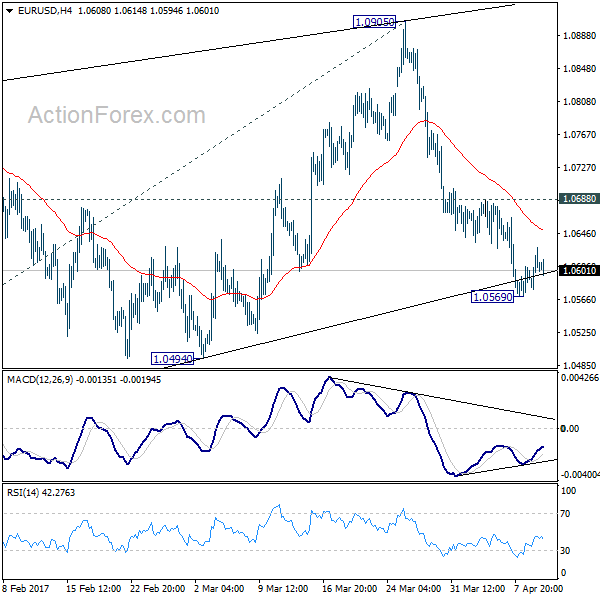
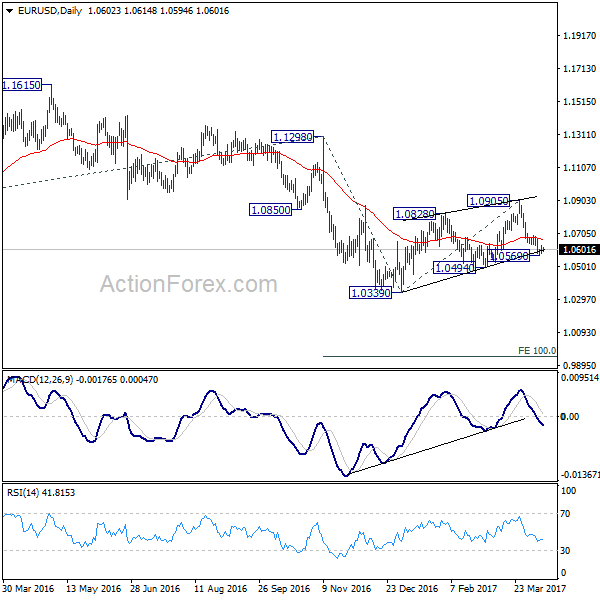
    The EUR/USD pair settled around 1.0550 after trading as low as 1.0525, below the 1.0565 Fibonacci resistance, as the level stands for the 23.6% retracement of the post-US election slump, and seems poised to extend its decline according to technical readings, given that in the 4 hours chart, the price is far below a bearish 20 SMA, whilst technical indicators have barely bounced from oversold readings. The pair has bounced twice from the 1.0520 region, reinforcing the strength of the static support, and therefore anticipating a strong bearish extension, once the level gives up.

    Support levels: 1.0520 1.0470 1.0440

    Resistance levels: 1.0565 1.0600 1.0635

    USD/JPY

    The USD/JPY pair closed the day marginally higher at 113.53, retreating from a daily high of 113.77, following the release of tepid US Markit PMIs, down to fresh 2-month lows. The figures were not enough to trigger concerns about US economic health, but given the underlying political uncertainty seems unlikely the safe-haven currency could ease much. US Treasury yields recovered some ground, with the 10-year note benchmark up to 2.458% intraday, before retreating back to the 2.42%, further limiting chances of a rally in the pair. In the data front, the Japanese flash Manufacturing PMI expanded to 53.5 in February from 52.7 in January, the highest reading in almost three years. The 4 hours chart shows that the pair stalled its recovery below a bearish 200 SMA, currently at 113.85 the immediate resistance, whilst technical indicators have lost upward momentum within positive territory, but are still far from confirming a downward move. The pair has met buying interest on retracements towards 113.40, now the immediate support, with a break below the level favoring a downward extension towards 112.50.

    Support levels: 113.40 113.00 112.50

    Resistance levels: 113.85 114.10 114.50

    GBP/USD

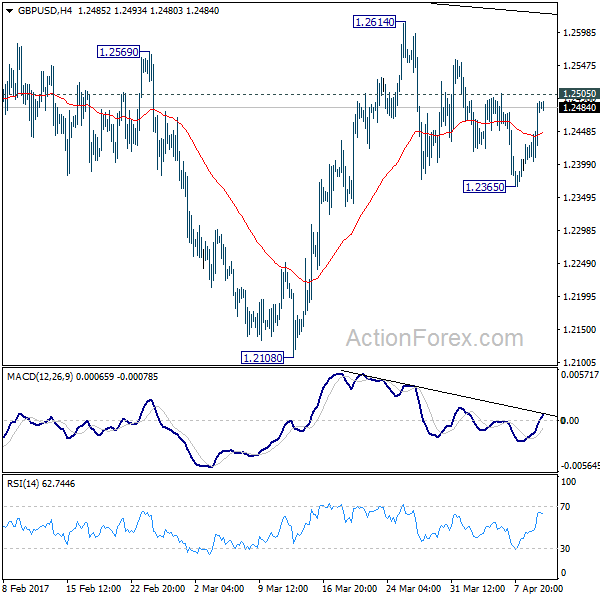
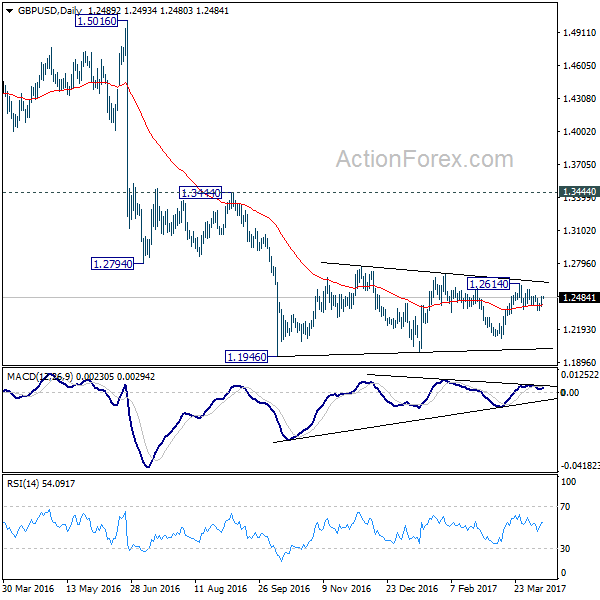
    The GBP/USD pair fell to a daily low of 1.2401 on the back of dollar's broad strength, but trimmed all of its daily loses and closed the day flat around 1.2460. Data coming from the UK showed that public sector net borrowing (excluding public sector banks) decreased by £13.6 billion to £49.3 billion in the current financial year-to-date (April 2016 to January 2017), compared with the same period in the previous financial year, being this is the lowest year-to-date borrowing since the financial year-to-date ending January 2008. Public sector net borrowing (excluding public sector banks) was in surplus by £9.4 billion in January 2017, a £0.3 billion larger surplus than in January 2016; this is the highest January surplus since 2000. Also, BOE´s Governor Carney testified before the Treasury Committee this morning, reiterating that the Bank is open to move rates one way or the other, if deemed appropriate. The technical picture maintains the neutral stance seen on previous updates, although lower highs, well below the 1.2540 region, increase the bearish potential. In the 4 hours chart, the price keeps moving back and forth around a horizontal 20 SMA while technical indicators barely entered positive territory before turning flat. At this point, the pair needs to break below 1.2345, February low, or above the mentioned 1.2540, the 23.6% retracement of its latest bullish run, to gain some directional traction.

    Support levels: 1.2430 1.2380 1.2345

    Resistance levels: 1.2480 1.2530 1.2565

    GOLD

    Spot gold trimmed its early losses and settled at $1,246.64 a troy ounce, as soft US data offset concerns of a soon-to-come US rate hike. The commodity fell down to 1,226.09 at the beginning of the day, weighed by FED's Harker comments, pledging for a March rate hike if inflation keeps rising, but recovered in the US afternoon, as investors wait for the FOMC Minutes to offer some hints on the pace of US rate hikes. As it is the case for the JPY, investors are reluctant to unwind their long positions in safe-haven assets. From a technical point of view, the daily chart shows that the price bounced sharply from a bullish 20 DMA, whilst the 100 DMA keeps losing downward strength, now consolidating around the 38.2% retracement of the post-US election decline. In the same chart, the Momentum indicator has lost its bearish strength, turning flat above its 100 level, whilst the RSI indicator consolidates around 62, keeping the downside well limited. In the 4 hours chart, the price is a few cents below a directionless 20 SMA, whilst technical indicators have bounced within negative territory, now aiming to enter positive territory, overall maintaining a neutral stance.

    Support levels: 1,233.90 1,226.10 1,216.60

    Resistance levels: 1,244.60 1,255.10 1,261.60

    WTI CRUDE

    Crude oil prices jumped to their highest levels since early January, with WTI futures printing $55.00 a barrel, to close around 54.53. Oil prices jumped after the OPEC reaffirmed its commitment to keep output cuts, and even do better than the 92% compliance achieved on January. US stockpiles reports will suffer a delay, with API reporting on Wednesday and the EIA on Thursday after the US holiday on Monday. The daily chart for the commodity shows that the price is firmly above an anyway horizontal 20 DMA, whilst the Momentum indicator holds flat around its 100 level, as WTI settled at the higher end of its latest range. The RSI indicator gained upward strength, currently around 58, enough at least to limit the downside this Wednesday. In the 4 hours chart, the price is well above a bullish 20 SMA, whilst technical indicators have retreated modestly within positive territory.

    Support levels: 54.00 53.40 53.00

    Resistance levels: 55.20 55.70 56.30

    DJIA

    Wall Street resumed its rally to record highs after Monday's holiday, with the three major indexes closing once again at all-time highs. The Dow Jones Industrial Average added 118 points or 0.57 %, to close at 20,742.11, up for eighth straight session, whilst the S&P finished at 2,365-38, up by 14 points or 0.60%. The Nasdaq Composite settled at 5,865.95 up by 0.47%. Within the Dow, Wal-Mart was the best performer, up 3.12% after the company reported fiscal earnings in Q4, and same-store sales that beat expectations. Caterpillar on the other hand, topped losers' list, down 0.74%. The DJIA traded as high as 20,757, and the daily chart shows that technical indicators have resumed their advances within extreme overbought readings, with the RSI now heading north at fresh monthly highs above 80. In the same chart, the 20 SMA has accelerated its advance, but remains well below the current level, reflecting the strength of the ongoing advance. Shorter term, and according to the 4 hours chart, a bullish 20 SMA provided intraday support at the beginning of the day, currently at 20,638, whilst technical indicators have turned flat in overbought territory, as the index was unable to surpass the early high.

    Support levels: 20,692 20,638 20,588

    Resistance levels: 20,757 20,800 20,845

    FTSE 100

    The FTSE 100 closed at 7,274.83, down 25 points or 0.34%, dragged lower by HSBC, as the lender bank reported a net loss of $4.22 billion for the fourth quarter of 2016. HSBC was the second worse performer, down 5.91% after Mediclinic International that shed 8.94%. Rolls Royce Holdings was the best performer, up 9.98%, followed by Antofagasta that added 3.76%. Adding pressure on the Footsie was the Pound that remained strong above the 1.2400 level against the greenback. The index seems to have entered a consolidative stage, and the daily chart shows that the index is still above a bullish 20 SMA, but technical indicators are losing upward strength, retreating within positive territory. Friday's low at 7,253 is the key, as the bearish potential will probably be limited as long as it holds above it. In the 4 hours chart, the index has settled below a horizontal 20 SMA, whilst technical indicators have turned flat around their mid-lines, confirming the neutral stance.

    Support levels: 7,253 7,212 7,162

    Resistance levels: 7,306 7,354 7,390

    DAX

    European equities benchmarks closed higher, with the German DAX adding 141 points or 1.18% to close at 11,967.49, its highest since April 2015, as much stronger-than-expected PMI growth figures boosted local confidence. Siemens was the best performer, up 2.78%, followed by Adidas that added 2.31%. Banks underperformed, with Commerzbank ending the day 0.42% lower as the sector was affected by the horrid earnings report of HSBC. From a technical point of view, the index maintains a clearly bullish stance, as in the daily chart, it rallied further above a now bullish 20 SMA, whilst technical indicators have extended their advances within positive territory, with the RSI now entering overbought territory. In the 4 hours chart, the index bounced sharply after testing a strongly bullish 20 SMA, whilst technical indicators maintain strong bullish slopes, despite being in overbought territory, in line with further gains, particularly on a break above 11,987 the intraday high.

    Support levels: 11,782 11,730 11,694

    Resistance levels: 11,848 11,891 11,930