

Sample Category Title
USD/JPY Daily Outlook
Daily Pivots: (S1) 110.33; (P) 110.89; (R1) 111.25; More....
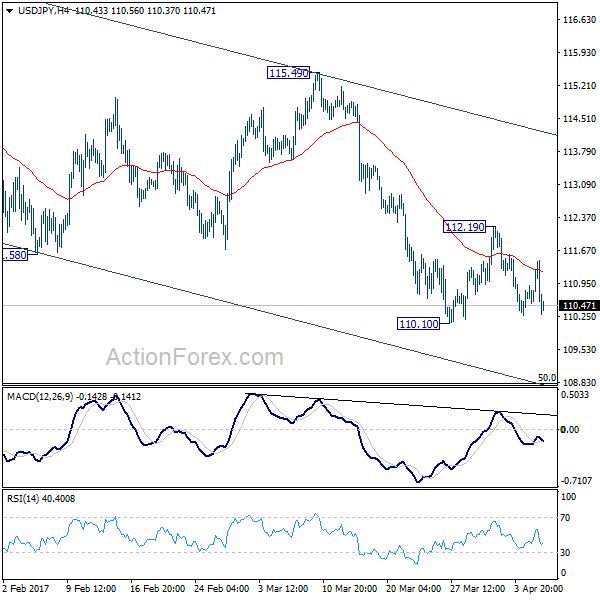
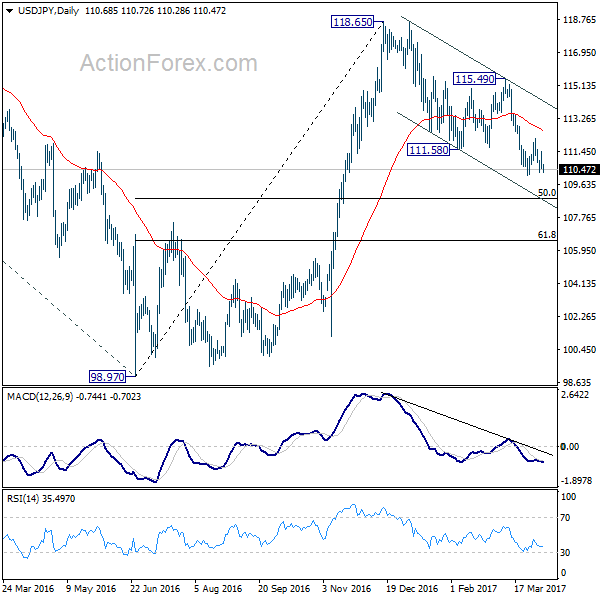
Intraday bias in USD/JPY remains neutral as consolidation continues between 110.10/112.19. On the downside, break of 110.10 will resume the whole corrective decline from 118.65 and target 50% retracement of 98.97 to 118.65 at 108.81. On the upside, however, break of 112.19 resistance will indicate short term reversal and turn bias back to the upside for 115.49 resistance.
In the bigger picture, price actions from 125.85 high are seen as a corrective pattern. The impulsive structure of the rise from 98.97 suggests that the correction is completed and larger up trend is resuming. Decisive break of 125.85 will confirm and target 61.8% projection of 75.56 to 125.85 from 98.97 at 130.04 and then 135.20 long term resistance. Nonetheless, sustained trading below 55 week EMA (now at 111.16) will extend the consolidation from 125.85 with another fall through 98.97 before completion.
USD/CHF Daily Outlook
Daily Pivots: (S1) 1.0011; (P) 1.0044; (R1) 1.0081; More.....
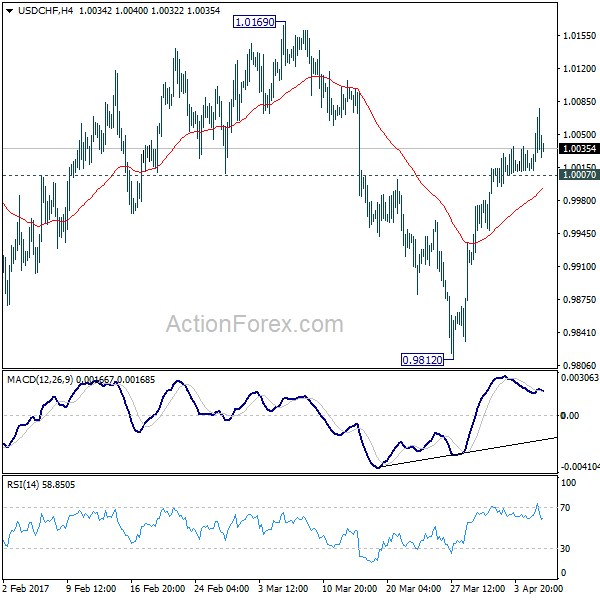
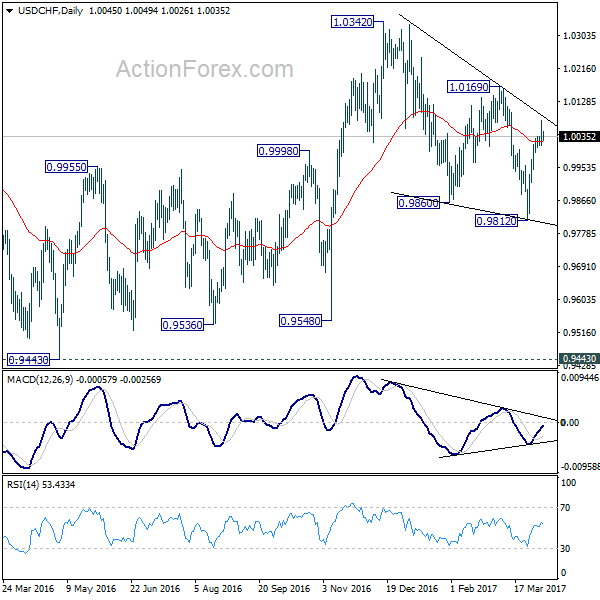
With 1.0007 minor support intact, intraday bias remains on the upside. Rise from 0.9812 should target 1.0169 resistance first. As noted before, corrective decline fall from 1.0342 should have finished with three waves down to 0.9812 already. Break of 1.0169 should confirm this bullish case and target a test on 1.0342 high. On the downside, below 1.0007 minor support will turn bias neutral and bring retreat before staging another rally.
In the bigger picture, USD/CHF is staying in medium term sideway pattern between 0.9443/1.0342. In any case, decisive break of 1.0342 resistance is needed to confirm underlying strength. Otherwise, we'll stay neutral in the pair first. In case of another fall, we'd expect strong support from 0.9443/9548 support zone.
GBP/USD Daily Outlook
Daily Pivots: (S1) 1.2438; (P) 1.2468; (R1) 1.2514; More...
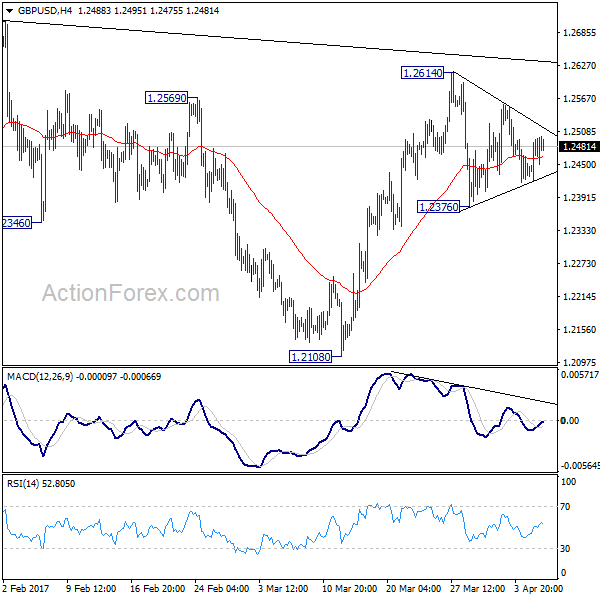
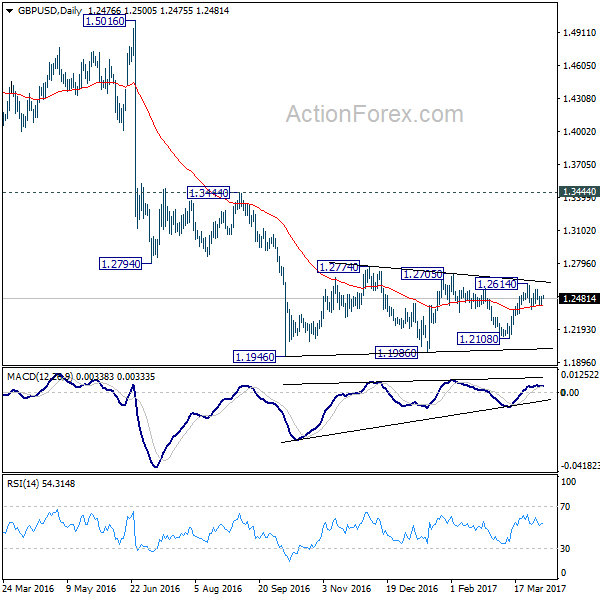
Intraday bias in GBP/USD stays neutral as range trading continues inside 1.2376/2614. Overall, price actions from 1.1946 are viewed as a consolidation pattern pattern. On the downside, break of 1.2376 will turn bias to the downside for 1.2108 support. Decisive break there will be an early sign of larger down trend resumption. On the upside, break of 1.2614 will extend the rise from 1.2108. But upside should be limited by 1.2705/2774 resistance zone to bring larger down trend resumption eventually.
In the bigger picture, fall from 1.7190 is seen as part of the down trend from 2.1161. There is no sign of medium term reversal yet. Sustained trading below 61.8% projection of 2.1161 to 1.3503 from 1.7190 at 1.2457 will target 100% projection at 0.9532. Overall, break of 1.3444 resistance is needed to confirm medium term bottoming. Otherwise, outlook will remain bearish.
EUR/USD Daily Outlook
Daily Pivots: (S1) 1.0635; (P) 1.0662 (R1) 1.0690; More....
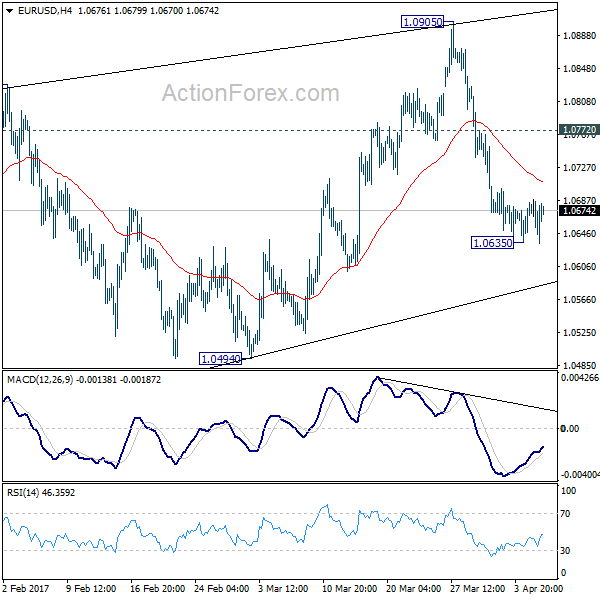
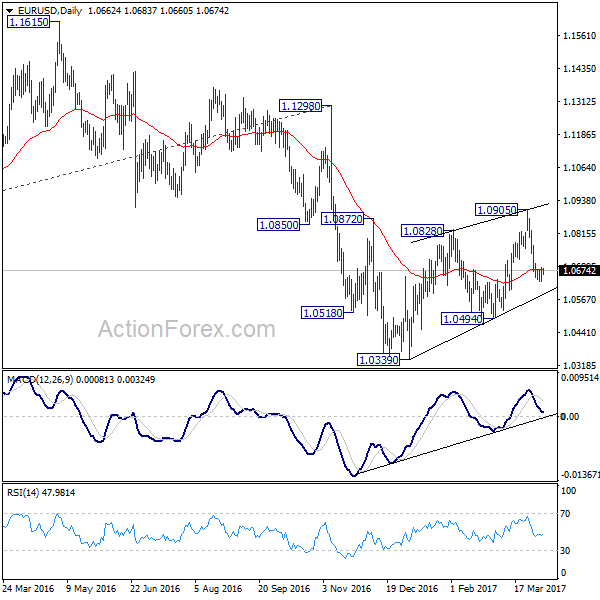
EUR/USD is staying in consolidation from 1.0635 temporary low and intraday bias remains neutral. Stronger recovery cannot be ruled out but upside should be limited by 1.0772 resistance and bring another fall. As noted before, corrective rise from 1.0339 is completed at 1.0905. And more importantly, larger down trend is probably resuming. Below 1.0635 will turn bias back to the downside for 1.0494. Break will confirm this bearish case and target 1.0339 low. However, above 1.0772 will delay this bearish case and bring another rise back to 1.0905 first.
In the bigger picture, as long as 1.1298 key resistance holds, whole down trend from 1.6039 (2008 high) is still expected to continue. Break of 1.0339 low will send EUR/USD through parity to 61.8% projection of 1.3993 to 1.0461 from 1.1298 at 0.9115. However, considering bullish convergence condition in weekly MACD, break of 1.1298 will indicate term reversal. this would also be supported by sustained trading above 55 week EMA.
Market Morning Briefing: The Fed Minutes Didn’t Have Any Impact
STOCKS
Minutes from the FED yesterday aided to losses on the US stocks. The unwinding of the $4.5 trln balance sheet indicated in the minutes may lead to more rate hikes this year. Sharp rise seen in Shanghai today while Nikkei seems to have set out on making fresh 4-month lows in the near term.
Dow (20648.15, -0.20%) rose to 20887 yesterday before coming off to close at 20648. As mentioned yesterday, it is trying to move above 20800 but is possibly unable to sustain at those levels. Broadly we may look at the 20980-20400 region to hold in the near term A break on either side would be crucial to decide on further direction. For now some sideways movement is expected.
Dax (12217.54, -0.53%) is trading just above immediate support near 12200. In case that holds, we may see a bounce back towards 12400-12500 levels else a further dip to 12100-12050 is possible before a bounce is seen. Note the resistance on the 3-day candle is holding well for now and indicates a sharp dip in the near term.
Nikkei (18597.51, -1.40%) has shown its very first break out on the downside from its broad sideways consolidation since Dec'16. The 4-month long sideways consolidation seems to have initiated a resolution on the downside by breaking the crucial support near 18650/18600 levels. In case the index sustains below 18600, we could see a fall towards 18200 in the coming sessions. We need to wait and watch for more confirmation.
Shanghai (3276.99, +0.20%) rose sharply nearing immediate resistance near 3300. It could come off from 3300 in the near term.
Nifty (9265.15, +0.30%) is rising as expected and could test 9280-9300 in the coming sessions.
COMMODITIES
Nothing new to add. Gold (1253) and Silver (18.27) are going nowhere as they keep trading in the narrow range of 1237-1263 and 17.94-18.50 respectively, which may continue for some days. Global cues are in favor of gold and silver too as the break below 99.70 for Dollar Index (100.37) could be resulted in good gains for bullion. We have been expecting 1237 for gold and 17.90 for silver to hold for now and gradual buying at lower levels can't be ruled as buyers are taking every dip as a further opportunity for buying.
Copper (2.66) found support at 2.65 levels in the near term. While 2.65 hold, a bounce to the interim resistance 2.70-72 can be seen. Only above 2.70-72, higher resistances of 2.80 can come into consideration. In the medium term 2.55-57 are going to be a strong support now and the chances of a close above 2.70 have increased.
According to EIA, U.S. weekly crude inventory rose by 1.6M barrels and as a result Brent (52.82) and WTI (50.86) has fallen from their resistance levels of 53.45 and 51.70 respectively. The trend is bearish in the near to medium term time frame. Any corrective bounce may face selling pressure at the higher levels. Increase in U.S. oil inventories is raising a concern whether the United States will remain the world's biggest oil importer, which is a price supporting indicator, or if its soaring production and bloated stocks lead to lower imports and trigger shipments to the rest of the world, which would weigh on oil markets.
FOREX
The Fed minutes didn't have any impact in the markets as Dollar continues its rest mode. The Indian markets may move after the RBI meet conclusion today, though no change in rates is expected. Need to see what the central bank says about liquidity and inflation outlook.
Dollar Index (100.50) has been closing exactly at the day's opening level for the last 4 sessions which indicate total indecision but the lack of selling pressure at the higher levels may push it higher towards 101.00-35 in the next few days.
Euro (1.0671) is in a consolidation mode after the sharp decline last week but the near downtrend may resume next week for the target of 1.0600-0580.
The downside resolution of Nikkei (18597.51, -1.40%) from its 4-month range (Check Equities section) indicates further possible weakness for Dollar-Yen (110.50) but the pair is still holding above our support of 110.10-109.90. These conflicting signals suggest wait and watch for 1-2 sessions though the major trend remains down.
Pound (1.2477) is forming Triangle pattern in the near term, signaling a major expansion of volatility coming by the end of the next week but for a significant trending move, a breakout from the range of 1.2350-1.2600 is required.
Aussie (0.7541) has now achieved our target of 0.7530 and as discussed yesterday, may bounce towards 0.7650-80 in the coming days if 0.7530-00 holds.
Our Resistance at 65.20 mentioned yesterday morning has held well and Dollar-Rupee (64.87) has indeed dipped below 65.00 again and has chances of falling further towards 64.80. Should that break, then levels of 64.60-40 would come into focus.
INTEREST RATES
The FED minutes released yesterday indicated that the officials want to start unwinding the central bank's massive $4.5 trillion balance sheet this year. This could possibly indicate some more rate hike on its way this year. The current probability of a 75bps rate hike in the 3rd May policy meet is at 96%. The US yields have dipped slightly but while the immediate support below current levels hold, we could see a bounce in the near term.
The US-Japan 10Yr (2.27%) is an a crucial point trading just near the previous low seen in end-Feb. If that holds and is able to produce a bounce, it could prevent further fall in Dollar-Yen and Nikkei but in case it breaks on the downside, we will have to look at further downside levels. Wait and watch for more confirmation.
The 10YR GOI (6.8724%) is holding above immediate support near 6.83% and while that holds, we could possibly see a rise back towards 7% in the near term. In that case some weakness in the Rupee could be expected in the near term.
USD/CAD Daily Outlook
Daily Pivots: (S1) 1.3397; (P) 1.3418; (R1) 1.3459; More....
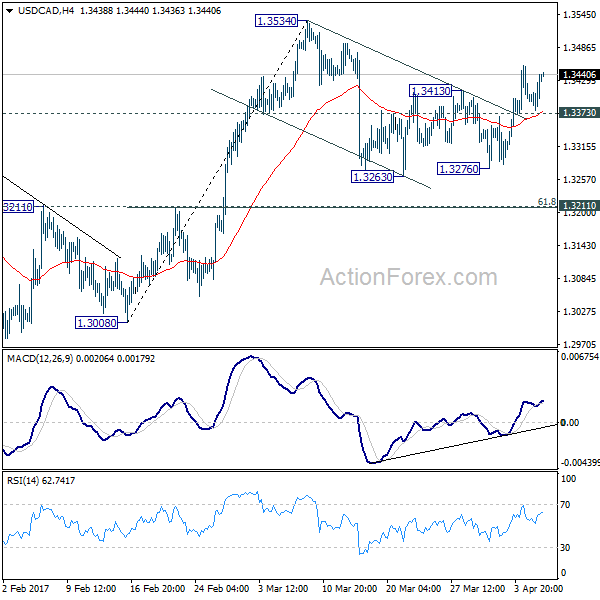
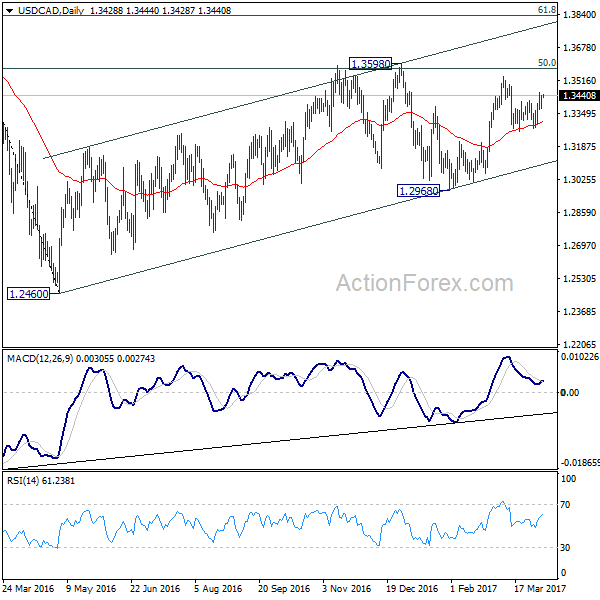
With 1.3373 minor support intact, intraday bias in USD/CAD remains on the upside for 1.3534 resistance. Break will extend whole rise from 1.2698 to 1.3598 resistance. On the downside, below 1.3373 minor support will turn bias back to the downside and could extend the correction from 1.3534 with another fall. But we'd expect strong support from 1.3211 cluster level (61.8% retracement of 1.3008 to 1.3534 at 1.3209) to contain downside and bring rebound. Overall, medium term rebound form 1.2460 is still expected to extend through 1.3598.
In the bigger picture, price actions from 1.4689 medium term top are seen as a correction pattern. The first leg has completed at 1.2460. The second leg from 1.2460 is likely still in progress and could target 61.8% retracement of 1.4689 to 1.2460 at 1.3838. We'd look for reversal signal there to start the third leg. Break of 1.2968 will argue that the third leg has already started and should at least bring at retest of 1.2460 low. However, sustained trading above 1.3838 would pave the way to retest 1.4689 high.
AUD/USD Daily Outlook
Daily Pivots: (S1) 0.7554; (P) 0.7570; (R1) 0.7584; More...
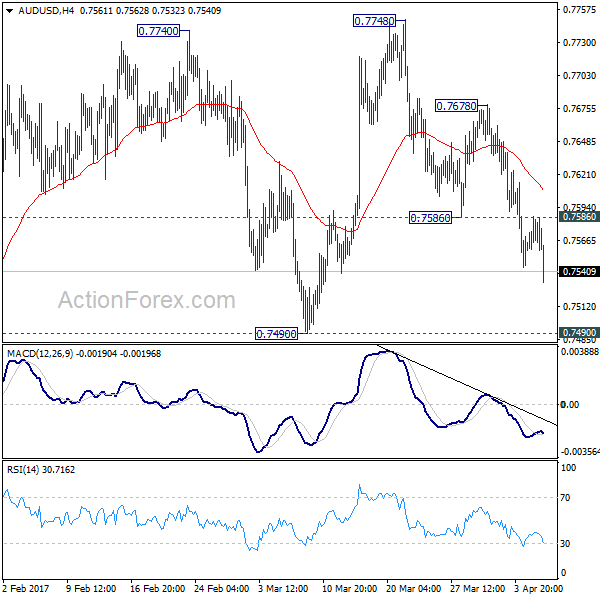
AUD/USD's fall from 0.7748 continues today and reaches as low as 0.7532 so far. Intraday bias remains on downside for 0.7490 support. Decisive break of 0.7490 will confirm completion of rise from 0.7158. In such case, near term outlook will be turned bearish for 0.7158 support. On the upside, above 0.7586 minor resistance will turn bias neutral first. And, break of 0.7678 minor resistance will turn bias back to the upside and could extend the rise fro 0.7158 through 0.7748 resistance.
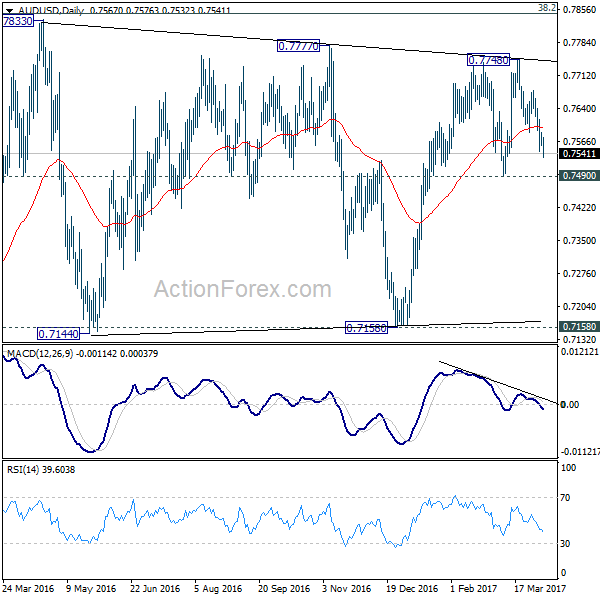
In the bigger picture, we're still treating price actions from 0.6826 low as a correction. And, as long as 38.2% retracement of 0.9504 to 0.6826 at 0.7849 holds, long term down trend from 1.1079 is expected to resume sooner or later. Break of 0.6826 low will target 0.6008 key support level. However, firm break of 0.7849 will indicate that rise from 0.6826 is developing into a medium term rebound, rather than a sideway pattern. In such case, stronger rise should be seen to 55 month EMA (now at 0.8165) and above.
Dow Reversed as Markets Lose Confidence on Trump’s Tax Reform, Japanese Yen Picks Up Strength
The tones in the financial markets remain unchanged for the week. US equities attempted for a rally overnight. DJIA surged initially on strong US ADP employment and reached as high as 20887.50. But the index then reversed to close down -0.20%, or -41.09 pts, at 20648.15. The hawkish FOMC minutes are seen as a factor weighing on sentiments. But more importantly, House speaker Paul Ryan's comments on tax reform further reduced market confidence on US President Donald Trump's ability to implement what he promised. 10 year yield closed mildly higher by -0.007 at 2.357 but it's kept in tight range well below 55 day EMA. In the currency markets, Japanese yen strengthens again on risk aversion is remains the strongest major currency for the week. Commodity currencies are suffering renewed selling in Asian session. Dollar and Euro are trading mixed.
FOMC Minutes: Shrinking of balance sheet to start later this year
The minutes of the March FOMC meeting was overall hawkish. They outlined the steps to shrink the USD 4.5T balance sheet. The minutes noted that the reduction has to be "gradual and predictable", accomplished by "phasing out" or reinvestment and such process could start "later this year". No detail is provided yet but the minutes said Fed will "its deliberations on reinvestment policy during upcoming meetings and would release additional information as it becomes available." Meanwhile, some officials are concerned that if unemployment falls further, it could pose "significant upside risk" of inflation. The minutes also showed "some participants viewed equity prices as quite high relative to standard valuation measures."
More on FOMC Minutes:
- FOMC Might Begin Shrinking Balance Sheet In Late-2017
- FOMC Mintues: Beginning the Long Process of Fed Balance Sheet Normalization Later This Year
- FOMC Minutes Go Against Dovish Interpretation of March's Meeting
House Speaker Ryan: Tax reforms takes longer than health care
The two day meeting of US President Donald Trump and China President Xi Jinping will start today. It's a closely watched event but we're not anticipating anything substantial to the markets coming out of the meeting. Again, we'd like to emphasize that direction stocks, yields, and Dollar will be heavily dependent on the confidence on Trump to deliver his election promises on fiscal policies. Such confidence was hurt much after the health care act flop. Now that hope is turned to tax reforms, House speaker Paul Ryan said yesterday that tax reform will take longer to accomplish than the health care act. He noted that "the House has a (tax reform) plan but the Senate doesn't quite have one yet. They're working on one. The White House hasn't nailed it down." And, "so even the three entities aren't on the same page yet on tax reform."
BoE Vliegh: Better late than premature
BoE policy maker Gertjan Vliegh warned that "a rate hike that turns out to be premature is a more serious mistake than one that turns out to be somewhat late." He explained that if "inflationary pressures are spreading beyond just exchange-rate pass-through", or there is "re-acceleration of indicators related to household spending and credit", then higher interest rate is warranted. But for now, "caution is warranted." Sterling has been resilient since Kristin Forbes voted for a rate hike last month. And it remains supported in spite of Brexit news since then.
EU Parliament: No parallel approach in Brexit negotiation
Talking about Brexit, the European Parliament voted 516-133, with 50 abstentions, for the phased approach of Brexit negotiation, rather than parallel. European Union chief negotiator Michel Barnier said yesterday that "parallel talks" on Brexit terms and future trade relationship is "a very risky approach". And, he emphasized that to succeed, "we need on the contrary to devote the first phase of negotiations exclusively to reaching an agreement on the principles of the exit."
BoJ Kuroda favorite to get second term
In Japan, it's reported that BoJ Governor Haruhiko Kuroda is Prime Minister Shinzo Abe's favorite for the job. And Kuroda will likely renew for another five year term next year. Reuters quoted unnamed source saying that Abe trusts Kuroda and believed he did a "very good job". Also, the it's believed that Abe's administration is happy with impact of BoJ's QQE program that keep government borrowing costs very low. The selection process for the next BoJ Governor will start in the second half of this year.
Separately, a former BoJ official Kazuo Momma said that the central bank will likely revise down inflation forecast soon, possibly as early as during the quarterly review this month. Momma noted that the BoJ's price forecasts are "too optimistic". Meanwhile, it's "hard to raise interest rates when you're cutting your inflation forecasts." Momma expects core inflation hover around 0.5% in the current fiscal year, and jump to 1.0% next. That's sharply lower than BoJ's expectation of core inflation hitting 1.5% by the end of fiscal 2017 and 1.7% by the end of fiscal 2018.
On the data front...
China Caixin PMI services dropped 0.4 to 52.2 in March. Japan will release consumer confidence today. Germany factory orders, Eurozone retail PMI and Swiss CPI will be featured in European session. In US session, US Challenger job cuts, jobless claims and Canada building permits will be featured.
AUD/USD Daily Outlook
Daily Pivots: (S1) 0.7554; (P) 0.7570; (R1) 0.7584; More...
AUD/USD's fall from 0.7748 continues today and reaches as low as 0.7532 so far. Intraday bias remains on downside for 0.7490 support. Decisive break of 0.7490 will confirm completion of rise from 0.7158. In such case, near term outlook will be turned bearish for 0.7158 support. On the upside, above 0.7586 minor resistance will turn bias neutral first. And, break of 0.7678 minor resistance will turn bias back to the upside and could extend the rise fro 0.7158 through 0.7748 resistance.
In the bigger picture, we're still treating price actions from 0.6826 low as a correction. And, as long as 38.2% retracement of 0.9504 to 0.6826 at 0.7849 holds, long term down trend from 1.1079 is expected to resume sooner or later. Break of 0.6826 low will target 0.6008 key support level. However, firm break of 0.7849 will indicate that rise from 0.6826 is developing into a medium term rebound, rather than a sideway pattern. In such case, stronger rise should be seen to 55 month EMA (now at 0.8165) and above.
Economic Indicators Update
| GMT | Ccy | Events | Actual | Forecast | Previous | Revised |
|---|---|---|---|---|---|---|
| 1:45 | CNY | Caixin PMI Services Mar | 52.2 | 53.2 | 52.6 | |
| 5:00 | JPY | Consumer Confidence Index Mar | 43.4 | 43.1 | ||
| 6:00 | EUR | German Factory Orders M/M Feb | 3.50% | -7.40% | ||
| 7:15 | CHF | CPI M/M Mar | 0.20% | 0.50% | ||
| 7:15 | CHF | CPI Y/Y Mar | 0.50% | 0.60% | ||
| 8:10 | EUR | Eurozone Retail PMI Mar | 49.9 | |||
| 11:30 | EUR | ECB Monetary Policy Meeting Accounts | ||||
| 11:30 | USD | Challenger Job Cuts Y/Y Mar | -40.00% | |||
| 12:30 | CAD | Building Permits M/M Feb | 5.40% | |||
| 12:30 | USD | Initial Jobless Claims (APR 01) | 250k | 258k | ||
| 14:30 | USD | Natural Gas Storage | -43B |
GBP/USD Wedge
We turn our attention back to the majors today with another look at GBP/USD.
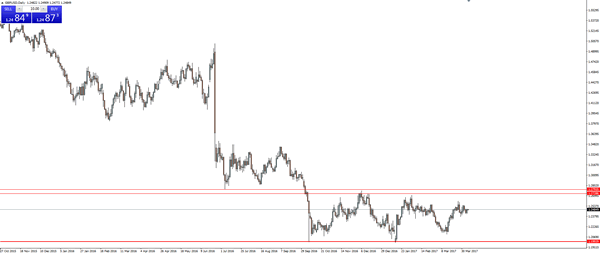
The majors haven't been doing a whole lot for a while now, highlighted by the Cable charts in this post, clearly stuck in higher time frame ranges.
You can see the daily range on GBP/USD in the chart below:
GBP/USD Daily:
Zooming into any of the intraday charts, you can see that price is coiling into a wedge pattern:
GBP/USD 4 Hourly:
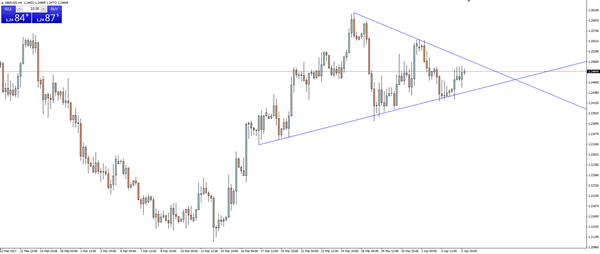
Seeing as though price is right smack bang in the middle of the daily range, the direction on which to trade this pattern isn't clear. Do you view it as a continuation pattern because price has rallied off support and this is merely a pause before a further push higher, or do you take the view that it is simply a turn as we get closer to the top of the range?
Price is very much in an area of indecision at the moment. Keep that in mind if you're taking a Cable position to end the week.
FOMC Might Begin Shrinking Balance Sheet In Late-2017
The FOMC members had quite extensive discussions on the balance sheet policies, the minutes revealed. US Treasury yields declined as the market interpreted Fed's phasing out of the reinvestment policy might be a de facto tightening measure, reducing the urgency to hike interest rates. We expect the Fed might begin balance reduction in as soon as December 2017. The minutes also unveiled that the rationale behind the March rate hike was the solid economic growth developments. The members acknowledged that the labor market strengthened further in January and February and that real GDP was continuing to expand in the first quarter. The moderation in growth from the fourth quarter was mainly driven by 'transitory factors'.
Regarding the balance sheet policy, the members reaffirmed the approach to balance sheet normalization articulated in the Committee's Policy Normalization Principles and Plans announced in September 2014. They agreed that any reduction in securities holdings should be 'gradual and predictable' and accomplished primarily by phasing out reinvestments of principal received from those holdings. The minutes also noted that nearly all participants preferred that the timing of a change in reinvestment policy depend on an assessment of economic and financial conditions, as opposed to a quantitative target on the level of the federal funds rate or a qualitative assessment of economic conditions and risks. Finally, most participants anticipated that a change to the Committee's reinvestment policy would likely be appropriate later this year if the Fed's outlook was realized.
There were also discussion over the usages of the balance sheet policy and interest rate policy, Most members agreed that the interest rate policy 'should be the primary means for adjusting the stance of monetary policy when the federal funds rate was above its effective lower bound'. 'A number of' participants noted that the asset purchases should be used 'if substantially adverse economic circumstances warranted greater monetary policy accommodation than could be provided by lowering the federal funds rate to the effective lower bound'. Meanwhile, 'some participants' believed it is appropriate to 'restart reinvestments' if the economy 'encountered significant adverse shocks that required a reduction in the target range for the federal funds rate'.
The members remained uncertain over the inflation outlook. As noted in the minutes, 'several' participants noticed that inflation had not picked up despite a strengthening in the labor market, while 'some other participants' were concerned that 'a substantial undershooting of the longer-run normal rate of unemployment, if it was to occur, posed a significant upside risk to inflation'. Regarding how the monetary policy should react to the uncertainty, 'a few members expressed the view that the Committee should avoid policy actions or communications that might be interpreted as suggesting that the Committee's 2% objective was actually a ceiling'.