Sample Category Title

USD/CHF Daily Outlook

Daily Pivots: (S1) 0.8753; (P) 0.8797; (R1) 0.8823; More

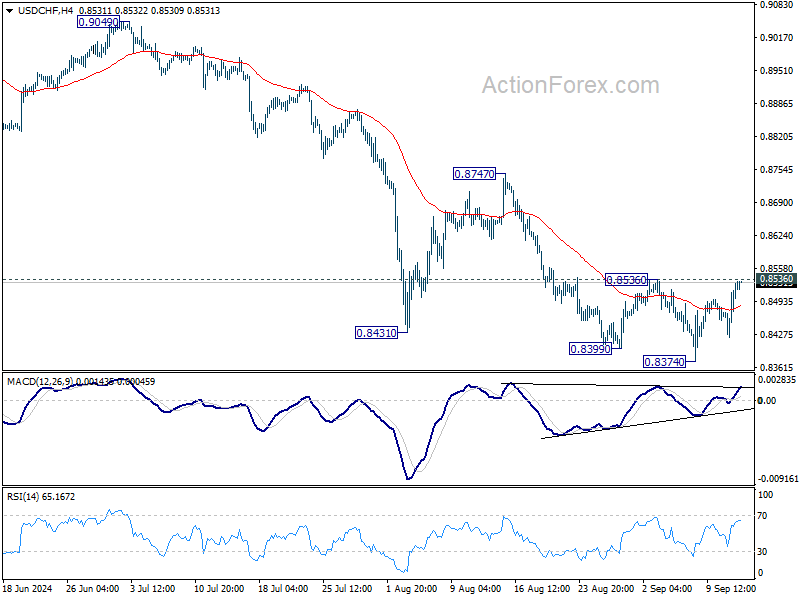
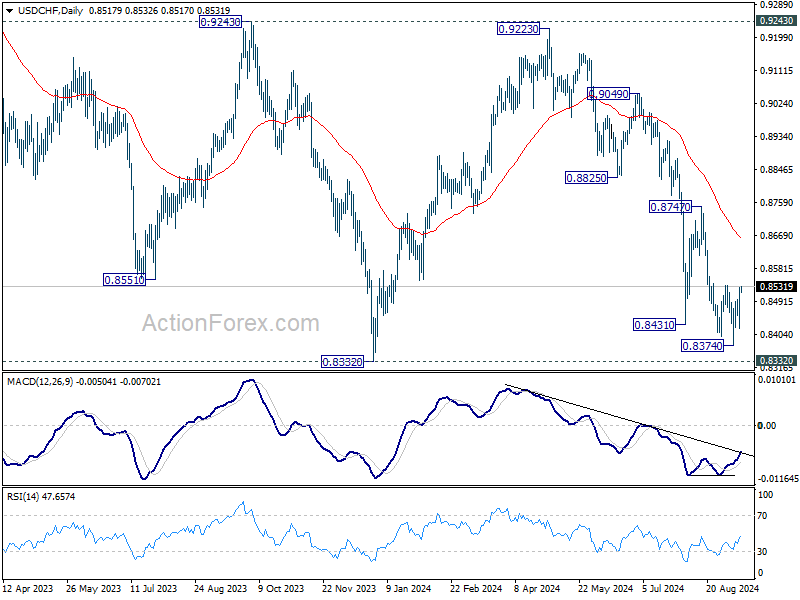
No change in USD/CHF's outlook as intraday bias stays on the downside. Current fall from 0.9223 is in progress for 61.8% retracement of 0.8332 to 0.9223 at 0.8672. Sustained break there will pave the way to retest 0.8332 low. For now, risk will stay on the downside as long as 0.8874 resistance holds, in case of recovery.

In the bigger picture, with 0.9243 resistance intact, medium term outlook in USD/CHF is neutral at best. For now, more sideway trading is likely between 0.8332/9243. However, firm break of 0.9243 will indicate larger bullish trend reversal.

USD/JPY Daily Outlook

Daily Pivots: (S1) 148.42; (P) 151.16; (R1) 152.72; More...

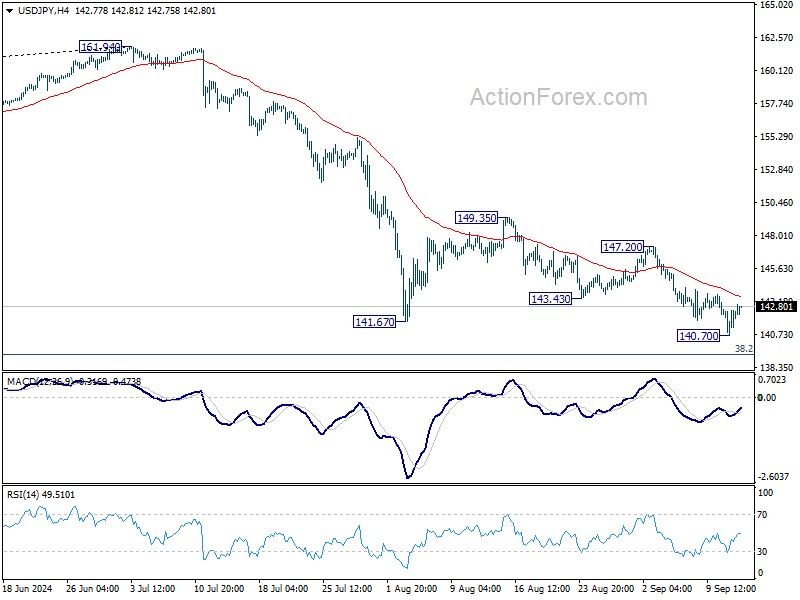
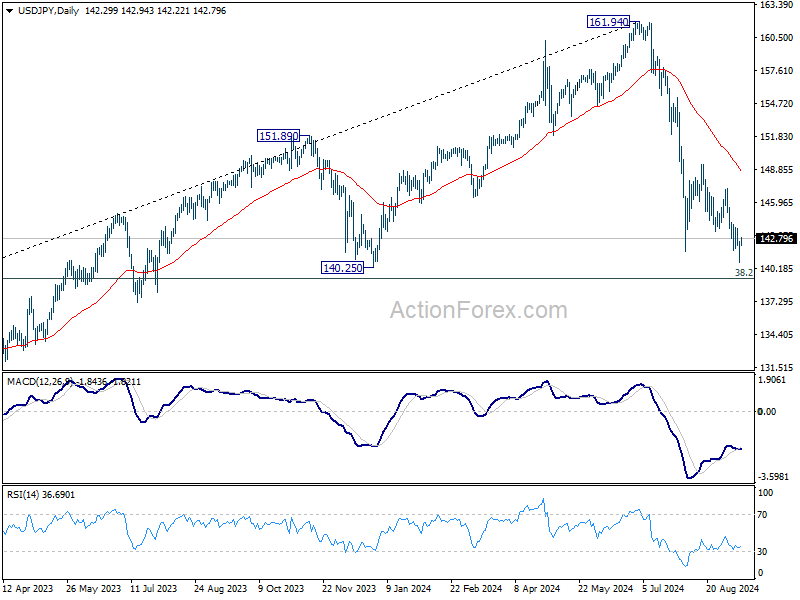
No change in USD/JPY's outlook and intraday bias stays on the downside at this point. Strong support could be seen from 148.66 fibonacci level to bring consolidations. On the upside, above 151.93 support turned resistance will turn bias back to the upside for stronger recovery. Nevertheless, sustained break of 148.66 will pave the way to next support at 140.25.

In the bigger picture, considering the depth and momentum of the current decline, 161.94 should be a medium term top already. Fall from there is seen as correcting the whole rise from 127.20 (2023 low) at least. Next target is 38.2% retracement of 127.20 to 161.94 at 148.66. Decisive break there will pave the way to 140.25 support next. Risk will now stay on the downside as long as 55 D EMA (now at 156.14) holds, in case of rebound.

AUD/USD Daily Report

Daily Pivots: (S1) 0.6496; (P) 0.6526; (R1) 0.6572; More...

Intraday bias in AUD/USD remains neutral as consolidations continue above 0.6479 temporary low. Outlook will stay bearish as long as 0.6609 minor resistance holds, and further decline is expected. On the downside, break of 0.6479 will resume the fall from 0.6798 to 0.6361 support first. Firm break there will target 0.6269 low.

In the bigger picture, overall, price actions from 0.6169 (2022 low) are seen as a medium term corrective pattern, with fall from 0.6798 as another falling leg. Deeper fall could be seen to the lower side of the range between 0.6169/6361. But strong support should be seen there to contain downside. For now, risk will stay on the downside as long as 0.6798 resistance holds, in case of rebound.

USD/CAD Daily Outlook

Daily Pivots: (S1) 1.3777; (P) 1.3818; (R1) 1.3849; More...

USD/CAD's rally resumed after brief consolidations and intraday bias is back on the upside. Current rise is part of the whole rally from 1.3176 and next target is 61.8% projection of 1.3176 to 1.3845 from 1.3588 at 1.4025. On the downside, break of 1.3786 support is needed to indicate short term topping. Otherwise, outlook will remain bullish in case of retreat.

In the bigger picture, price actions from 1.3976 (2022 high) are viewed as a corrective pattern, that might have completed at 1.3176 (2023 low) already. Firm break of 1.3976 will confirm resumption of whole up trend from 1.2005 (2021 low). Next target is 61.8% projection of 1.2401 to 1.3976 from 1.3176 at 1.4149. This will be the favored case as long as 1.3588 support holds, in case of pullback.

Market Turmoil Boosts Safe Haven Currencies ahead of NFP, GBP/CHF Under Pressure

Safe haven currencies are dominating the market as the steep selloff in the US extended into Asian trading, with Nikkei down more than -5%. Poor US manufacturing data released overnight has intensified investor concerns about an impending recession, overshadowing the benefits of monetary policy easing from Fed. The market's attention is now firmly on today's non-farm payroll data, with the potential for another significant selloff if the numbers disappoint.

GBP/CHF has been one of the most notable movers this week. The British Pound has been under pressure following BoE's decision to cut rates yesterday. Concurrently, Swiss Franc has strengthened due to increased risk aversion in stock markets and safe haven flows triggered by escalating tensions in the Middle East.

Technically, fall from 1.1675 resumed yesterday by breaking through 1.1216 support. Near term outlook will stay bearish as long as 1.1297 support turned resistance holds. Next target is 161.8% projection of 1.1675 to 1.1216 from 1.1631 at 1.0888. Decisive break there will argue that the whole medium term rise from 1.0183 is reversing. In this bearish case, deeper decline would be seen to 1.0634 support and even below.

In Asia, at the time of writing, Nikkei is down -5.45%. Hong Kong HSI is down -2.48%. China Shanghai SSE is down -0.59%. Singapore Strait Times is down -1.07%. Japan 10-year JGB yield is down -0.0616 at 0.973. Overnight, DOW fell -1.21%. S&P 500 fell -1.37%. NASDAQ fell -2.30%. 10-year yield fell -0.133 to 3.976.

Market anxiety drives US 10-year yield under 4%, eyes on crucial NFP

US benchmark 10-year yield plummeted overnight, breaking below 4% mark for the first time since February, signaling heightened investor anxiety. This sharp decline came amidst a broad market sell-off, with DOW dropping nearly -500 points, or -1.21%, and even the small-cap Russell 2000 index plunging -3%.

The rise in initial jobless claims to their highest level since August last year contributed to the risk-off sentiment. However, the more pressing concern for investors was the dismal ISM manufacturing report, with PMI falling deeper into contraction, and production and employment falling to their lowest levels since mid-2020.

The market's reaction to these reports has shifted expectations towards more aggressive monetary easing. Investors are now starting to bet on a 50bps rate cut by Fed in September, with the probability of such a cut now around 30%. However, rather than cheering the potential for fast monetary easing, investors seem more concerned about a looming recession.

This development heightens the importance of today's non-farm payroll report. Headline jobs are expected to grow by 176k in July, with the unemployment rate remaining unchanged at 4.1%. Meanwhile, average hourly earnings are anticipated to grow by 0.3% month-over-month.

Given the current sentiment, markets may react more strongly to any significant miss in the headline job growth number, which could signal a worse-than-expected slowdown in the employment market. In comparison, the unemployment rate and wage growth, which are more indicative of inflationary pressure, might take a back seat.

Technically, 10-year yield's (TNX) strong break of near term falling channel indicates downside acceleration. More importantly, the bearish case is strengthening that fall from 4.737 is the third leg of the pattern from 4.997 top. Near term outlook will stay bearish as long as 4.292 resistance holds. Next target is 3.785 low. Break there will target 100% projection of 4.997 to 3.785 from 4.737 at 3.525.

As for Russell 2000, yesterday's steep fall and breach of 2176.47 support suggests that a short term top is already in place at 2299.99. This came after just missing 61.8% projection of 1633.66 to 2135.45 from 1993.22 at 2303.32. Sustained break of 2176.47 would set the stage for deeper correction to 55 D EMA (now at 2116.13) and possibly further to 38.2% retracement of 1633.66 to 2299.99 at 2045.45.

Looking ahead

Swiss CPI and PMI manufacturing, France industrial production will be released in European session. Later in the day, in addition to NFP, US will release factory orders too.

USD/CAD Daily Outlook

Daily Pivots: (S1) 1.3777; (P) 1.3818; (R1) 1.3849; More...

USD/CAD's rally resumed after brief consolidations and intraday bias is back on the upside. Current rise is part of the whole rally from 1.3176 and next target is 61.8% projection of 1.3176 to 1.3845 from 1.3588 at 1.4025. On the downside, break of 1.3786 support is needed to indicate short term topping. Otherwise, outlook will remain bullish in case of retreat.

In the bigger picture, price actions from 1.3976 (2022 high) are viewed as a corrective pattern, that might have completed at 1.3176 (2023 low) already. Firm break of 1.3976 will confirm resumption of whole up trend from 1.2005 (2021 low). Next target is 61.8% projection of 1.2401 to 1.3976 from 1.3176 at 1.4149. This will be the favored case as long as 1.3588 support holds, in case of pullback.

Economic Indicators Update

GMT Ccy Events Actual Forecast Previous Revised
23:50 JPY Monetary Base Y/Y Jul 1.00% 0.90% 0.60%
01:30 AUD PPI Q/Q Q2 1.00% 1.00% 0.90%
01:30 AUD PPI Y/Y Q2 4.80% 4.30%
06:30 CHF CPI M/M Jul -0.20% 0.00%
06:30 CHF CPI Y/Y Jul 1.30% 1.30%
06:45 EUR France Industrial Output M/M Jun 0.90% -2.10%
07:30 CHF Manufacturing PMI Jul 44.6 43.9
08:00 EUR Italy Industrial Output M/M Jun -0.20% 0.50%
09:00 EUR Italy Retail Sales M/M Jun 0.20% 0.40%
12:30 USD Nonfarm Payrolls Jul 176K 206K
12:30 USD Unemployment Rate Jul 4.10% 4.10%
12:30 USD Average Hourly Earnings M/M Jul 0.30% 0.30%
14:00 USD Factory Orders M/M Jun 0.50% -0.50%

USD/JPY Dips Below 150.00 as Bears Take Over

Key Highlights

  • USD/JPY declined heavily and even traded below 150.00.
  • A connecting bearish trend line is forming with resistance at 151.80 on the 4-hour chart.
  • EUR/USD could extend losses below the 1.0820 level.
  • Gold gained pace and climbed above the $2,450 level.

USD/JPY Technical Analysis

The US Dollar started a fresh decline from well above 152.00 against the Japanese Yen. USD/JPY declined below the 150.50 and 150.00 levels to enter a bearish zone.

Looking at the 4-hour chart, the pair settled below the 150.00 zone, the 200 simple moving average (green, 4-hour), and the 100 simple moving average (red, 4-hour). A low is formed near 148.51 and the pair is now consolidating losses.

If there is a recovery wave, the pair could face resistance near the 151.00 level. The first major resistance is near the 151.85 level. It is close to the 50% Fib retracement of the downward move from the 155.65 swing high to the 148.51 low.

There is also a connecting bearish trend line with resistance at 151.80 on the same chart. The next resistance sits at 152.50. A clear move above the trend line resistance and then 152.50 could open the door to more gains.

Immediate support is near the 148.50 level. The next major support is near the 147.80 level. A downside break and close below the 147.80 support zone could open the doors for more losses. In the stated case, GBP/USD might decline toward the 146.50 level.

Looking at Gold, the bulls remained in action and were able to push the price above the $2,450 resistance zone.

Economic Releases

  • US nonfarm payrolls for July 2024 – Forecast 175K, versus 206K previous.
  • US Unemployment Rate April 2024 - Forecast 4.1%, versus 4.1% previous.

Market anxiety drives US 10-year yield under 4%, eyes on crucial NFP

US benchmark 10-year yield plummeted overnight, breaking below 4% mark for the first time since February, signaling heightened investor anxiety. This sharp decline came amidst a broad market sell-off, with DOW dropping nearly -500 points, or -1.21%, and even the small-cap Russell 2000 index plunging -3%.

The rise in initial jobless claims to their highest level since August last year contributed to the risk-off sentiment. However, the more pressing concern for investors was the dismal ISM manufacturing report, with PMI falling deeper into contraction, and production and employment falling to their lowest levels since mid-2020.

The market's reaction to these reports has shifted expectations towards more aggressive monetary easing. Investors are now starting to bet on a 50bps rate cut by Fed in September, with the probability of such a cut now around 30%. However, rather than cheering the potential for fast monetary easing, investors seem more concerned about a looming recession.

This development heightens the importance of today's non-farm payroll report. Headline jobs are expected to grow by 176k in July, with the unemployment rate remaining unchanged at 4.1%. Meanwhile, average hourly earnings are anticipated to grow by 0.3% month-over-month.

Given the current sentiment, markets may react more strongly to any significant miss in the headline job growth number, which could signal a worse-than-expected slowdown in the employment market. In comparison, the unemployment rate and wage growth, which are more indicative of inflationary pressure, might take a back seat.

Technically, 10-year yield's (TNX) strong break of near term falling channel indicates downside acceleration. More importantly, the bearish case is strengthening that fall from 4.737 is the third leg of the pattern from 4.997 top. Near term outlook will stay bearish as long as 4.292 resistance holds. Next target is 3.785 low. Break there will target 100% projection of 4.997 to 3.785 from 4.737 at 3.525.

As for Russell 2000, yesterday's steep fall and breach of 2176.47 support suggests that a short term top is already in place at 2299.99. This came after just missing 61.8% projection of 1633.66 to 2135.45 from 1993.22 at 2303.32. Sustained break of 2176.47 would set the stage for deeper correction to 55 D EMA (now at 2116.13) and possibly further to 38.2% retracement of 1633.66 to 2299.99 at 2045.45.

Cliff Notes: Message Received

Key insights from the week that was.

In Australia, the Q2 CPI reported a 1.0% (3.8%yr) gain in headline inflation and a 0.8% (3.9%yr) lift in underlying trimmed mean inflation, the latter a material downside surprise relative to consensus. The detail was nuanced, with some prices pressures continuing to abate as others showed persistence. Disinflation was most apparent in policy-sensitive sectors of the economy, discretionary inflation (ex tobacco) easing to just 2.1%yr, a low back to December 2021. However, stickiness in big-ticket non-discretionary items such as rents buoyed various measures of services inflation, offsetting the disinflationary impulse from other market services components and keeping services inflation elevated overall.

As detailed by Chief Economist Luci Ellis, the main takeaway is that Australia remains on the disinflation path, like many of its global peers; but there is still some way to go before policy can be normalised. We affirm our call that policy will remain on hold over the next few months, as the RBA Board closely monitors trends in underlying inflation to abstract from the temporary disinflationary impact of government energy rebates. Come November, we believe the RBA will begin reducing policy’s restrictiveness at a measured pace of 25bps per quarter, reaching a terminal rate of 3.10% by Q4 2025. Markets have removed what was a meaningful risk of a rate hike in 2024, and now price a circa 75% chance of a rate cut by year end.

Developments in economic activity will also prove critical to the RBA outlook. This week’s update on retail sales continued to point to a weak consumer, retail volumes declining –0.3% in Q2 following a –0.4% contraction in Q1. While we lack visibility around services consumption, this result, alongside other partial data, points to downside risk to total consumer spending in the June quarter. Externally, the goods trade surplus looks to have narrowed since the start of the year, the sharp decline in export earnings reflecting an uncomfortable mix of broadly stagnant volumes for key resource exports and declining prices. Services will prove crucial to the final wash-up for net exports, but are not reported on in this release.

Before moving offshore, a final note on housing. The latest CoreLogic home price data continued to highlight divergence across the states. In part this reflects variations in affordability, with prices little changed in the month in Sydney and Melbourne but still growing strongly across the smaller capital cities. The absence of momentum in dwelling approvals highlights a risk around residential construction activity once existing projects are worked through. This development does not bode well for supply or affordability dynamics in the medium to long-term.

Offshore, markets were kept busy this week by three central bank meetings, each one delivering a different outcome.

Most closely watched was the FOMC who kept rates steady in July but indicated that a cut could be delivered in September, if inflation continues its downtrend. The Committee continues to believe they have time on their side to gauge inflation’s pace and risks. In our view, there is already a strong justification to cut in September, with annual CPI ex-shelter inflation having held within a 0.8%–2.3% range and averaged less than 2.0% since June 2023. Shelter inflation is also now tracking lower and current market estimates of rent growth remain flat to down. On the labour market, the statement noted the “unemployment rate has moved up but remains low” and that current momentum is believed to be consistent with a rebalancing of labour demand and supply not an outright weakening. Increasingly though, the market is becoming concerned over downside risks for the labour market, particularly given persistent weakness in the employment indexes of the ISMs. While we have been highlighting downside risks to the labour market throughout 2024, inevitably we expect the US economy to prove resilient, warranting a steady but measured easing cycle beyond September – a cut per quarter taking the fed funds rate to a 3.375% terminal rate by mid-2026. Note, at that time policy would still be modestly contractionary. This terminal forecast highlights that we anticipate capacity constraints and trade policy to remain enduring inflation risks into the medium-term.

The Bank of Japan, in contrast, raised its policy rate by 15bps to 0.25% this week and announced a new tapering schedule of bond purchases. Policy and financial conditions remain ‘accommodative’, with the economy expected to grow above potential until fiscal 2025. However, their inflation forecasts were lowered for fiscal 2024 following the introduction of government energy subsidies for households, due in August and September. Enduring optimism over the virtuous cycle between wages and prices means that at-target inflation is still expected in the outer years. Risks around firms’ price and wage-setting behaviour remain though, particularly as small and medium-sized firms continue to report difficulty in passing on costs. Future hikes are on the table, with the BoJ noting, “…if the aforementioned outlook for economic activity and prices is realized, the Bank will accordingly continue to raise the policy interest rate and adjust the degree of monetary accommodation.” Increments are likely to be in 25bps, signalling the BoJ’s ‘normalization’ of policy and consistency with its peer central banks. Whether inflation can remain at or above target and wage growth endure remain open questions, however.

On the BoJ’s revised schedule for bond purchases, monthly purchases are set to decline from 5.7 trillion per month to 2.9 trillion by 2026, allowing short-term rates to increasingly be determined by the market. The stock of JGBs will remain high, but is expected to decline by 7-8% over the next two years. This plan will be reassessed in June 2025.

Finally, the Bank of England began its easing cycle overnight, cutting their policy rate by 25bps in a 5-4 decision. This follows annual CPI inflation hitting the 2.0% target in May and June, with "the Committee expecting the fall in headline inflation, and normalisation in many indicators of inflation expectations, to continue to feed through to weaker pay and price-setting dynamics." While growth has recently been stronger than anticipated, business surveys point to more modest gains. Nonetheless, "there is a risk that inflationary pressures from second-round effects will prove more enduring in the medium term."

As the vote shows, this was a finely balanced decision, with the Committee deeming it "appropriate to reduce slightly the degree of policy restrictiveness," recognizing that the stance would remain highly contractionary after the cut. The resurgence of inflation to 2.75% in the second half of 2024, as base effects become unfavourable, is therefore expected to be temporary, with the modal inflation forecast at 1.7% in two years and 1.5% the year after that—outcomes significantly below the 2.0% medium-term target. Note, this forecast assumes the market-implied path for interest rates which includes a series of rate cuts through to end-2025.

RBA Meets as Rate Hike Odds Fade, Aussie Sinks after CPI Data

  • RBA set to keep rates on hold despite elevated inflation
  • But latest CPI report raises hope that price pressures are easing
  • A dovish pivot on Tuesday (07:30 GMT) could further devastate the aussie

Lack of progress

The Reserve Bank of Australia has barely made any progress on getting inflation down in 2024, with the monthly CPI gauge standing higher in June than where it was in December. The last two policy decisions in May and June were a close call but each time policymakers opted to forego a rate hike, even as inflation edged higher.

The new monthly CPI measure, which is still in experimental stage, climbed from 3.4% y/y at the start of the year to 4.0% in May. On that data alone, it can be argued that the RBA should have raised interest rates by at least another 25 basis points. But policymakers have been fretting about the weak economy, worried that further tightening could tip it into recession.

Yet, the real data has so far not supported the gloomy views and the labour market remains reasonably tight. But even if the economy did go into recession, a mild contraction is the worst possible outcome, which would hardly be a catastrophe when considering that Australia has enjoyed one of the strongest recoveries from the pandemic.

Finally, some good news on inflation

With growth indicators being inconclusive, a lot was riding on the Q2 CPI report to guide the RBA with its decision making ahead of the July policy meeting. Another set of hotter-than-expected readings would probably have given policymakers little choice but to hike rates on Tuesday. But it appears that their caution was warranted.

Although the headline figure rose from 3.6% in Q1 to 3.8% y/y in the June quarter, this was in line with forecasts. More importantly, the closely watched trimmed mean and weighted mean CPI measures both came in slightly below expectations and were down on the prior quarter, easing fears of a flareup in underlying price pressures.

The monthly rate also moderated, printing at 3.8% y/y in June – the first decline this year.

From rate hike to rate cut

This much needed relief in inflation is a major boost for rate cut hopes and investors have already priced out any prospect of a rate hike this year and are instead assigning around a two-thirds probability of a 25-bps reduction by December. For the Australian dollar, which is having its worst month against the greenback since January, the rising rate cut expectations couldn’t have cut a worst time.

The risk-off sentiment on the back of the tech selloff on Wall Street and the increased political uncertainty ahead of the US elections, combined with sluggish growth in China, have taken their toll on the risk-sensitive aussie. If the RBA acknowledges that there’s been some progress on getting inflation down to within its 2-3% target band and its updated forecasts show that this can be achieved within the next couple of years, then some kind of a dovish tilt is likely next week.

Is the ausse’s selloff about to get worse?

The aussie could extend its latest slide in such a scenario, bringing the April low of $0.6360 into range.

A more dovish outcome is if the RBA were to go further and open the door to a rate cut at some point this year. But this is unlikely in July and a hawkish surprise could not be ruled out either. For example, policymakers might maintain a neutral tone for now and wait for more evidence that inflation has resumed its downward trajectory before changing their language.

Given the scale of the aussie’s tumble since mid-July, a not-so-dovish meeting could spur a rebound in the currency, with the bulls targeting the 200-day moving average at $0.6592.

The Fed and China matter too

In the bigger picture, the Fed is expected to start cutting rates in September, while even if the RBA follows suit towards the end of the year, its easing pace is unlikely to match the Fed’s, so the aussie’s latest woes could be temporary.  But as always, the economic outlook in China and global risk appetite will play a role as well, which at the moment, are acting more as headwinds than tailwinds for the aussie.

Elliott Wave Analysis: Oil (CL) Sets for Further Sell-off After Bounces

Hello traders, welcome to another blog post. Today, we will examine WTI Crude Oil Futures (CL). The commodity experienced a sell-off in July 2024. How much lower can it go? And how can traders find opportunities along the dominant path?

Looking back at the price action post-COVID, the commodity began a bullish cycle in April 2020. This bullish trend persisted throughout 2020 and 2021. Following the damage caused by COVID, the demand for energy products was strong, pushing the commodity to its second-highest price in history at $130.5 in March 2022. Structurally, the rally completed a 5-wave impulse pattern, the type generally expected in a proper trend. According to Elliott Wave theory, a 3-wave correction typically follows a 5-wave trend. This is exactly what occurred. Since the highs of March 2022, oil prices have been falling in a corrective manner. This has been the price action story for WTI Crude (CL) post-COVID. The key question now is: how far has the correction gone, and how far can it go? Using Elliott Wave theory, we provided answers for members of Elliottwave-Forecast on the price charts.

WTI Oil (CL) Weekly Chart – 07/27/2024

We shared the weekly chart above with members on 07/27/2024. This chart illustrates the commodity’s journey since COVID-19. The post-COVID impulse rally to the March 2022 high marked the supercycle degree wave (I). Since March 2022, prices have been correcting lower in supercycle wave (II). When we analyzed the sub-waves of (II), we examined the cycle degree waves within it. Cycle degree waves a and b of (II) completed in September 2022 and September 2023, respectively. From September 2023, cycle degree wave c of (II) began. Price already completed waves ((1)) and ((2)) of c and now favors the downside in wave ((3)). Within wave ((3)), price completed sub-waves (1) and (2), starting wave (3) of ((3)) in June 2024.

Thus, the current decline is wave (3) of ((3)), which could extend to at least $70 in the coming weeks. As long as the price remains below the June 2024 high of 84.57, our members understand why we favor staying on the sell-side. However, before looking for a SHORT opportunity, we would like to see the low of wave (1) breached. Afterward, we can sell bounces in 3, 7, or 11 swings.

WTI Oil (CL) 1-Hour Chart – 07/27/2024

On 07/27/2024, we shared the H1 chart above along with the weekly chart to narrow down the shorter cycles for our members. On the H1 chart, we saw that the price was declining in wave 1 of (3). A closer look revealed wave ((v)) of 1 nearing completion. This indicates that a corrective bounce would soon begin. Two days later, wave 2 began as expected.

WTI Oil (CL) 1-Hour Chart – 08/01/2024

On 08/01/2024, we updated the shorter cycles for our members with the chart above. Wave 1 had finished, and wave 2 had begun. Currently, the price has completed wave ((a)) of 2 and is now in ((b)) of 2. Wave ((b)) should be corrective and form a 3- or 7-swing structure. If the current decline stays above 74.55, then one more leg higher should occur for ((c)) of 2. At the extreme of wave ((c)) of 2, the decline should resume unless a breach of 84.57 happens. Traders can look for SHORT opportunities from this extreme. We always highlight the extreme for our members and reveal opportunities with the blue box.