

Sample Category Title
S&P 500, Nasdaq 100 – ‘Soft Landing’ Optimism Leads to Early Week Gains
- Major Wall Street indices started the week with gains, fueled by optimism for a “soft landing”.
- Concerns remain about the divergence between full and part-time workers, a potential recession indicator.
- Technical analysis suggests potential for further upside in the S&P 500 and Nasdaq 100, but historical trends and upcoming events warrant caution.
The major Wall Street Indexes have all started the week on the front foot, looking to recover some of Friday’s losses. There seems to be a fair bit of optimism today that a soft landing may be on the cards as US unemployment improved.
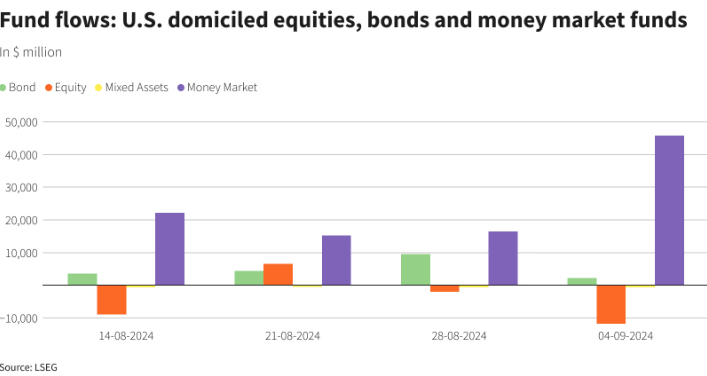
US equities experienced outflows last week which made it 3 out of the last 4 weeks. Money markets were the largest beneficiaries as fund flows and repositioning continue ahead of a busy couple of months.
Source: LSEG Workspace
Despite the optimism around jobs data there are some underlying concerns which may be overlooked. A key one being the divergence between full and part-time workers which is widening. This phenomenon usually precedes a recession as indicated in a research note by ING think.
However, for now market participants are pricing in a 25 bps cut by the Fed at the September meeting. Concerning inflation data from China this morning was shrugged off with tomorrow’s import and export numbers likely to play a bigger role in the overall market sentiment.
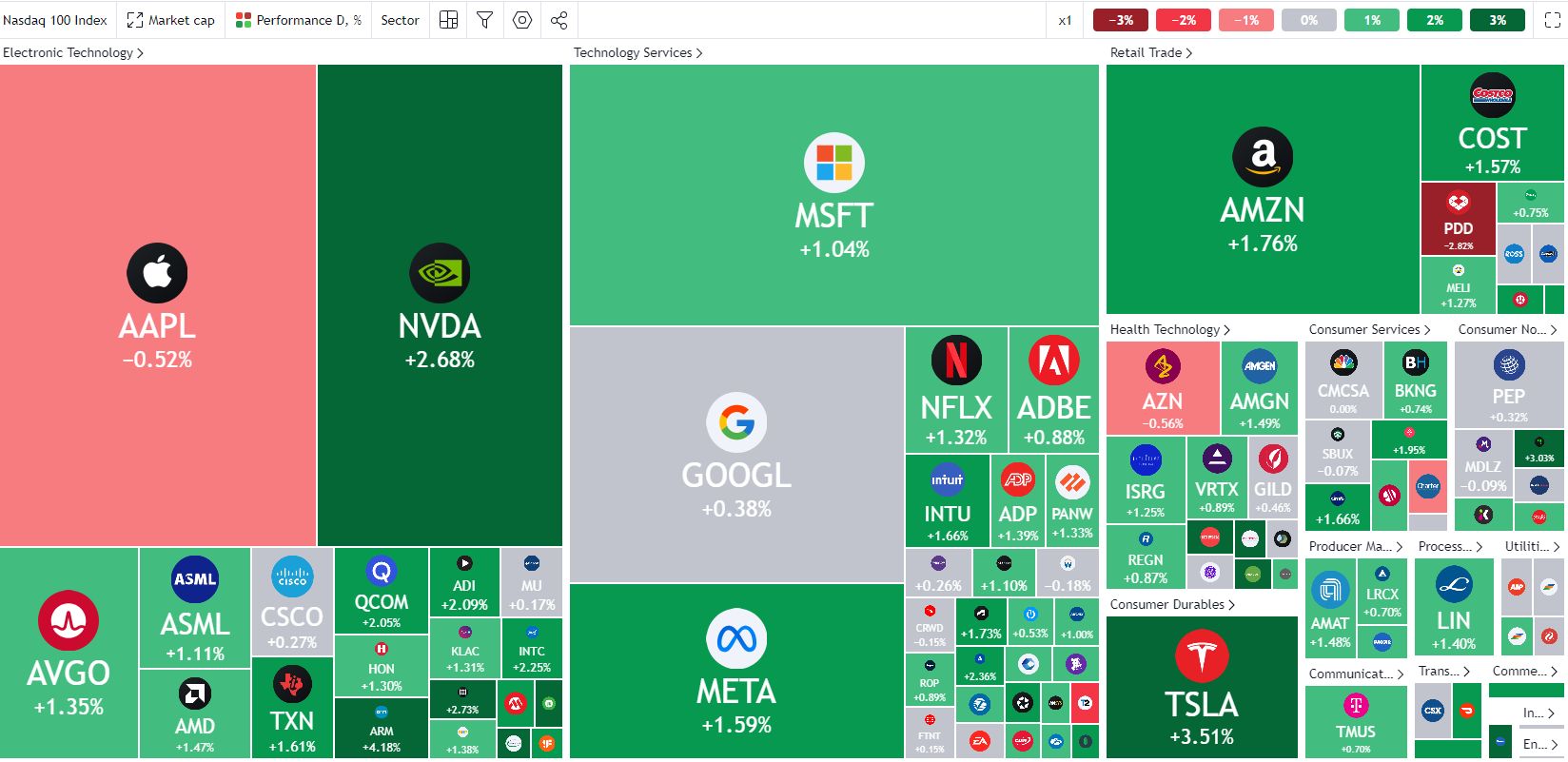
Some individual movers in early trade today include Boeing BA.N which is up 4.7% after reaching a tentative agreement with a US Pacific NorthWest union. As the threat of a critical strike looms, this may go some way in mitigating such a disaster and could explain the jump in the share price. The union does represent 32k workers.
Dell and Palantir also enjoyed positive starts with the latter up around 8%. Dell was up around 5.9% on the day.
Nasdaq 100 Early Session Heatmap
Source: TradingView
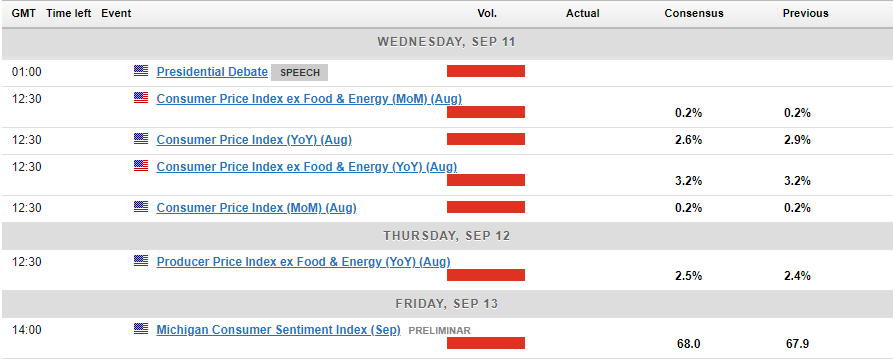
US PPI and CPI are ahead this week, however neither are likely to shake the needle where the Fed are concerned. Markets have for the time being at least pivoted toward labor data as the rate cut gauge rather than inflation.
Given the knowledge that September and part of October are historically bad for US stocks, was last week’s selloff as bad as it’s going to get? Or is there another selloff in store for market participants once the FOMC meeting concludes on September 18?
Technical Analysis
S&P 500
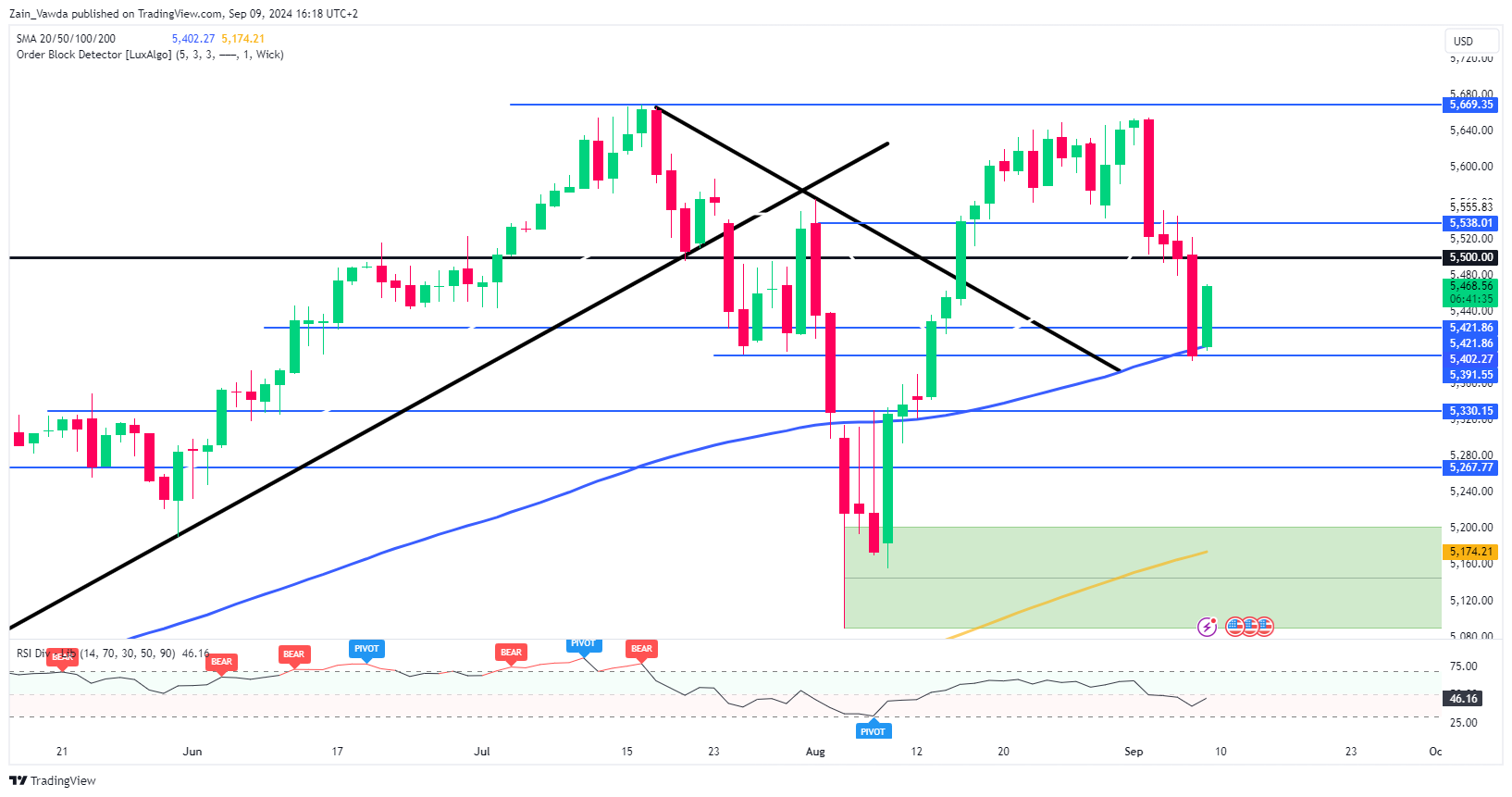
From a technical perspective, the S&P is coming off its worst week since March 2023 but has made an excellent start to the week. Finding support off a key level around 5390 (July 25 low), the index is on course for a bullish inside bar or engulfing candle close. Either of the two would hint at further upside ahead.
The headwinds presents are substantial however, and sentiment can always shift on a dime. Hence, marrying any bullish continuation bias at this stage may be premature. On the upside resistance is around the psychological 5500 before the 5538 handle comes into focus.
Immediate support rests at the 5390 mark before 5330 comes into focus. There is the 100-day MA that rests around the 5421 which could also provide some short-term support.
S&P 500 Daily Chart, September 9, 2024
Source: TradingView (click to enlarge)
Support
- 5421
- 5390
- 5330
Resistance
- 5500
- 5538
- 5635
Nasdaq 100
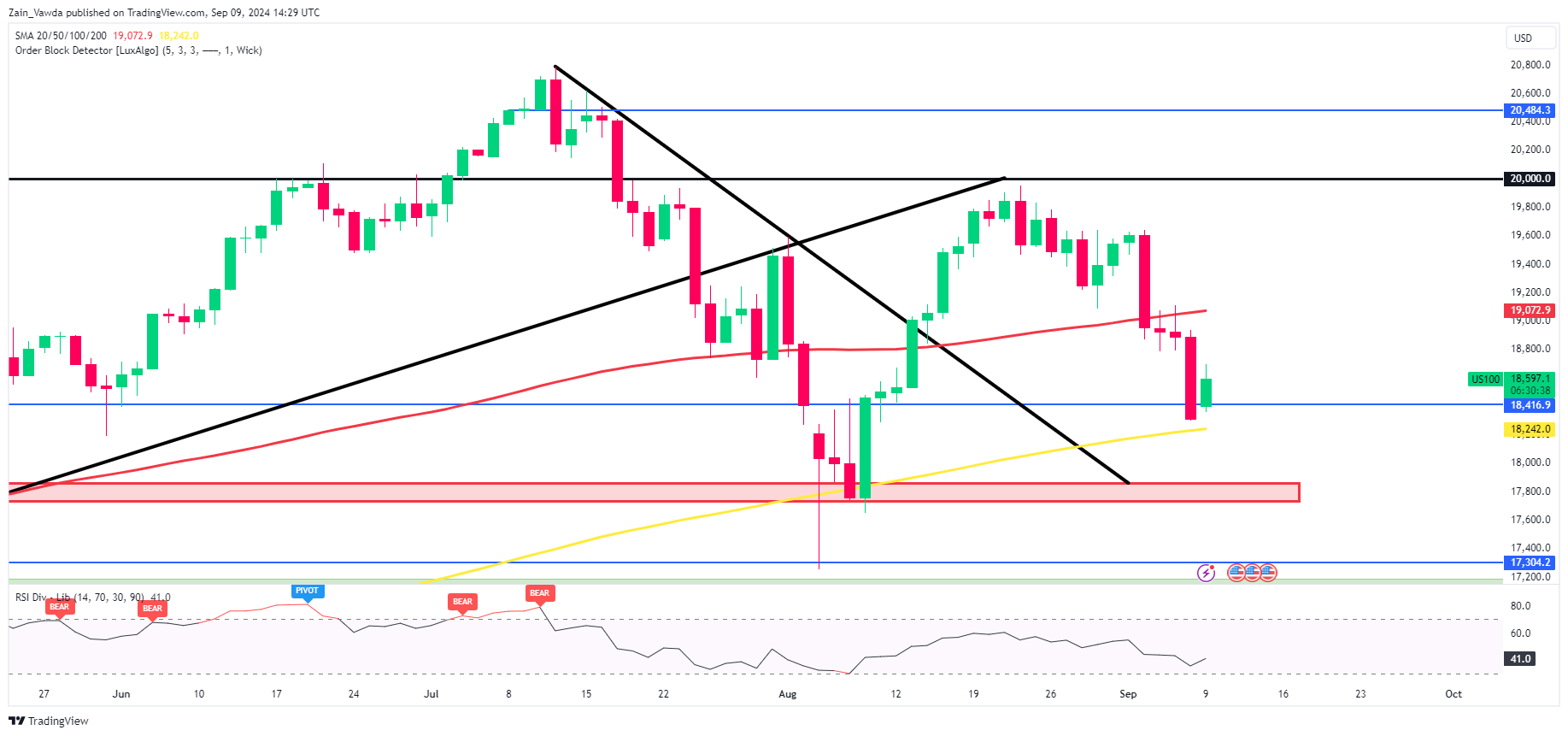
From a technical perspective, the Nasdaq 100 on a daily timeframe is similar to the S&P as it has rallied over 330 points since the market open. We are seeing a slight pullback at the time of writing and given that historically September is a poor month for equities, we could be in for a bumpy ride.
There is a chance that rallies to the upside may face selling pressure and that the recovery may not be as smooth as market participants may hope for. Barring a dramatic collapse however, the Nasdaq 100 is on course to record a inside bar bullish close which hints at further upside ahead.
Having found support last week in between a key level and the 200-day MA which rests at 18241, there is significant hurdles up ahead which the index failed to clear on Friday. The first point of interest will arrive at 18800 before the confluence area around 19000 (which houses the 100-day MA) comes into focus.
Conversely, a break back to the downside would need to navigate below the 200-day MA before eyeing the 18000 level. This opens the door for a retest of the August lows around 17800 and 17330.
Nasdaq 100 Daily Chart, September 9, 2024
Source: TradingView (click to enlarge)
Support
- 18241
- 18000
- 17800
Resistance
- 18800
- 19000
- 19610
Dollar Index Outlook: Dollar Regained Traction After Mixed US Labor Data
The dollar index rose on Monday after almost equal bets for 25 or 50 basis points Fed rate cut diverged in favor of less aggressive option, cooled by mixed US jobs data which point to orderly slowdown in US labor market.
Although the dollar benefited from more dovish signals, markets look for further information to complete the picture of possible Fed decisions in the policy meeting, due later this month.
Release of US August inflation report on Wednesday is expected to provide the last part of mosaic, which US policymakers look for.
However, rising concerns about the condition of the US economy, in light of the recent information that the economy is at the edge of recession, keep traders as well as the central bank cautious.
Consumer prices are expected to rise at unchanged pace of 0.2% month on month in August, while annualized inflation is expected to ease to 2.6% from 2.9% in July.
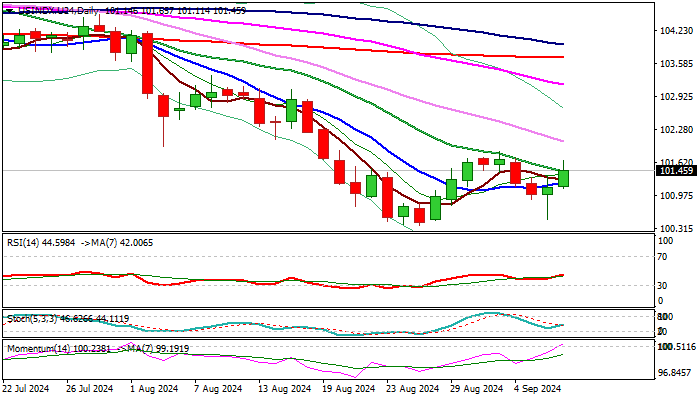
Technical picture improved on daily chart, as north-heading 14- momentum broke into positive territory and the price rose above converging 10/20DMA’s, with the action being underpinned by long-tailed Friday’s candlestick which points to strong bids.
However, signals still look for verification, with close above 20DMA (101.44) seen as minimum requirement with sustained break above 101.84 (Sep 3 lower top) needed to complete bullish failure swing pattern and confirm signal.
Res: 101.65; 101.84; 102.03; 102.64.
Sup: 101.23; 101.08; 100.49; 100.38.
Sunset Market Commentary
Markets
Friday’s payrolls were soft but not that weak for markets to be sure that the Fed will start its easing cycle with a 50 bps step next week. In final comments before the start of the blackout period for Fed-communication, Fed’s Waller rubberstamped a ‘series of rate cuts’, but said to remain ‘open minded about the size and pace of rate cuts’. Given recent sharp decline in yields, investors for now don’t push for an even more aggressive positioning. Yields ‘rebounded’ off recent lows late on Friday and tried to build on that ‘correction’ today. US yields currently are gaining between 3.5 bps (2-y) and 2.0 bps (30-y). German yields add 1.0 bp (2-y) to 2.5 bps (10 & 30-y). We don’t draw any firm conclusions. Today’s correction occurs in a session deprived of any important data and intraday momentum wasn’t convincing. Yields also found some support from a slightly better risk sentiment after Friday’s post-payrolls risk-off. (Eurostoxx50 + 0.70%, S&P 500 opened 0.75% higher after a loss of 1.73% on Friday). Still, the reaction function of equities to softer data is also far from unequivocal. Sometimes (e.g. early August and to some extent last week) recession fears are seen as a negative for equites. At other moments, investors tend to embrace a substantial easing of financial conditions. Again, an inclusive story line. It’s unlikely that markets will draw a clear directional conclusion before next week’s Fed decision/policy guidance. Wednesday’s US inflation figures probably won’t decide on this topic. The focus is on growth and on the labour market. Ongoing uncertainty on global demand (cf. poor Chinese price data this morning) prevents any stained rebound in oil (currently brent $71.8 p/b).
On FX, the dollar tries a technical rebound after testing key support levels on Friday. DXY trades near 101.6 after testing the 100.50/60 area. Idem for USD/JPY (143.1) as it tries to leave the 141.70/80 area. The euro already underperformed the likes of the dollar and the yen of late and continues trading in the defensive. Europe hasn’t much to offer in a context growing uncertainy on growth. At 1.1045, EUR/USD is nearing intermediate support (1.1026 ST low). Sterling (EUR/GBP 0.8437) regains part of Friday’s risk-off loss against the euro but isn’t able to join the USD rebound (cable 1.3095), looking forward to tomorrow’s UK labour data. Despite the rebound in equities, smaller commodity related currencies or currencies sensitive to the economic cycle mostly continue trading in the defensive (AUD, NZD, but also Norwegian and the Swedish krone).
News & Views
Mario Draghi released his highly anticipated report on the state of the European economy and competitiveness. Titled “The future of European competitiveness” the former ECB chief called for a “new industrial strategy” in which the bloc invests some €800bn annually to develop its advanced technologies, boost defense and security of critical raw materials as well as create a plan to meeting its climate targets. Draghi also recommended relaxing competition rules so that policy “does not become a barrier” to the bloc’s industrial goals. Calling it an “existential challenge”, he pushed Europe to boost investment by about 5 ppts of GDP in order to transform the economy so that it can keep up with other major players including the US and China. Doing so would bring the investment-to-GDP ratio to its highest level since the seventies. The ex-ECB president argued for integrating capital markets (by centralizing market supervision) but said that the private sector is unlikely to be able to finance the whole undertaking. Public sector support is needed and he repeated a call for a common safe asset and joint EU funding to back “European public goods” such as common energy infrastructure and joint defense procurement. Draghi also favoured new levies at the EU level to finance more spending through the common budget.
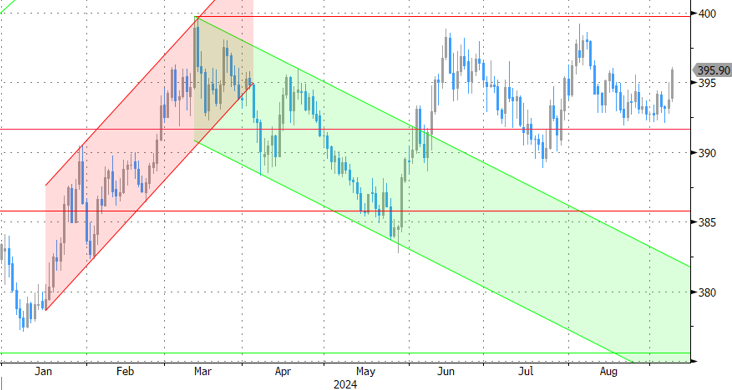
The Hungarian forint underperforms its regional peers today. EUR/HUF topped the 395 barrier in the slipstream of articles flagging prime minister Orban’s intention to raise spending ahead of the 2026 elections. First reports emerged last Friday on Bloomberg and Orban himself in comments on social media yesterday appeared to confirm this, adding that he aims to achieve it while keeping public finances stable. After missing budget deficit targets multiple times, markets are skeptical that this time would be any different. Meanwhile, Orban is scouting the field for a successor to Matolcsy as head of the central bank. Finance minister Varga and economy minister Nagy have come up over the weekend as potential candidates. But neither seem to instill confidence: the former’s track record is one of long-running high deficits despite his reputation as a technocratic defender of fiscal prudence. The latter openly favours interventionist policies (both fiscal and monetary).
Graphs
EUR/HUF: forint underperforms regional peers as government is backtracking on fiscal consolidation ‘commitment’.
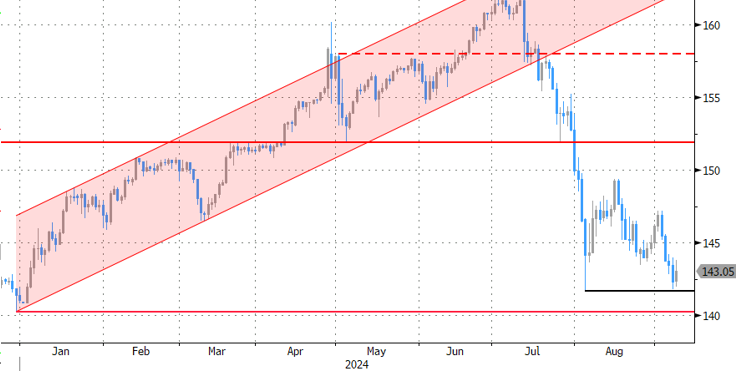
USD/JPY: dollar decline halts ahead of key support as markets ponder the amount and pace of Fed rate cuts.
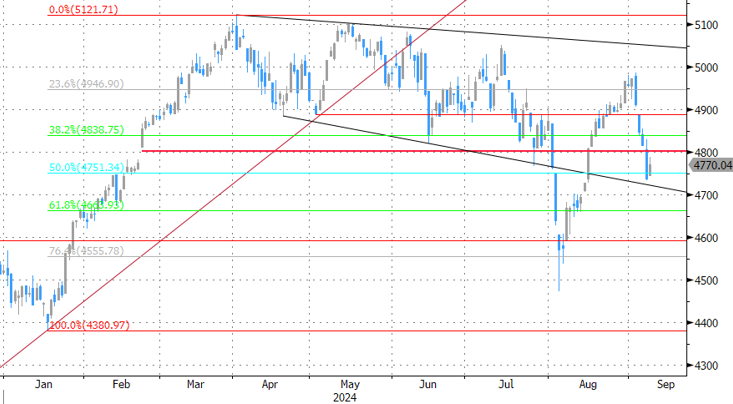
Eurostoxx 50: correction takes a breather. Technical picture remains unconvincing.
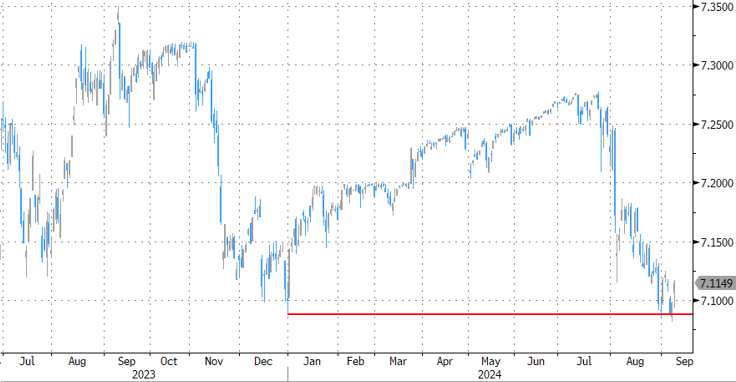
USD/CNY: yuan declines on broader USD rebound. China deflation risks suggest ongoing yuan softness too.
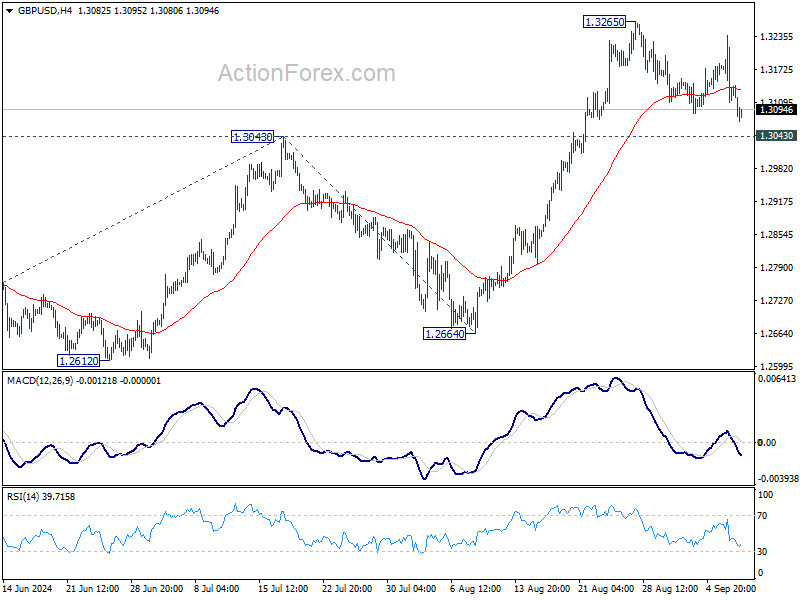
GBP/USD Mid-Day Outlook
Daily Pivots: (S1) 1.3078; (P) 1.3158; (R1) 1.3207; More...
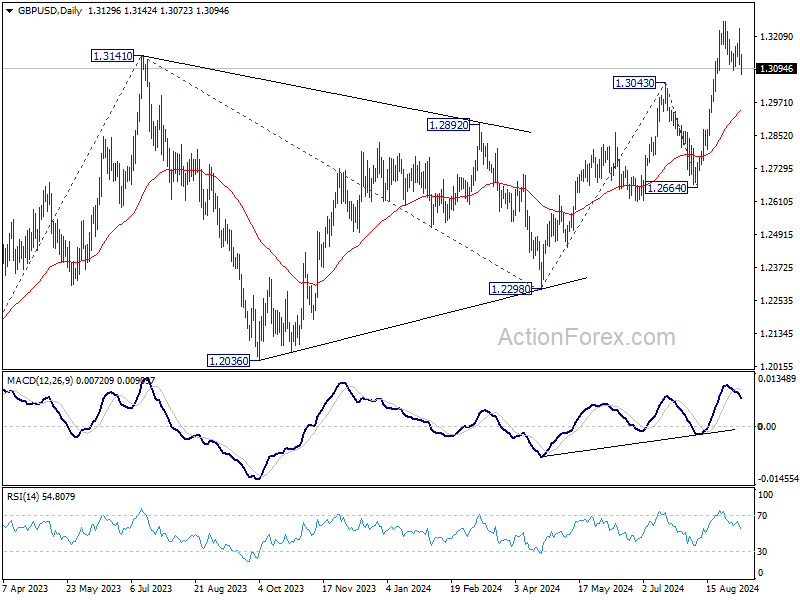
Outlook in GBP/USD is unchanged as range trading continues below 1.3265. Further rise is expected with 1.3043 resistance turned support intact. On the upside, firm break of 1.3265 will resume larger up trend to 100% projection of 1.2298 to 1.3043 from 1.2664 at 1.3409. However, firm break of 1.3043 will turn bias back to the downside for deeper pullback.
In the bigger picture, up trend from 1.0351 (2022 low) is in progress. Next target is 38.2% projection of 1.0351 to 1.3141 from 1.2298 at 1.3364. For now, outlook will stay bullish as long as 1.2664 support holds, even in case of deep pullback.
USD/CHF Mid-Day Outlook
Daily Pivots: (S1) 0.8379; (P) 0.8428; (R1) 0.8480; More…
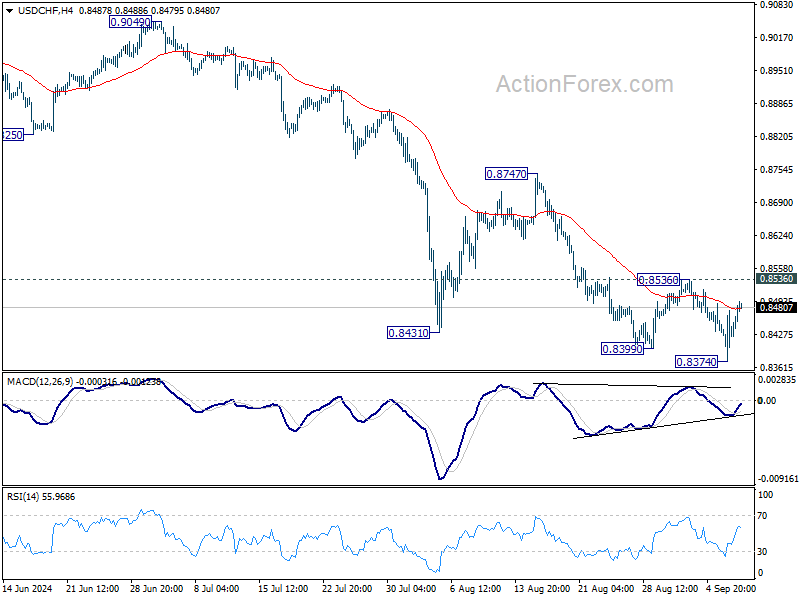
Intraday bias in USD/CHF remains neutral and further decline is expected as long as 0.8536 resistance holds. Below 0.8374 will resume the fall from 0.9223 to retest 0.8332 low. Decisive break there will indicate larger down trend resumption. However, considering bullish convergence condition in 4H MACD, break of 0.8536 resistance will now confirm short term bottoming, and turn bias back to the upside for 0.8747 resistance.
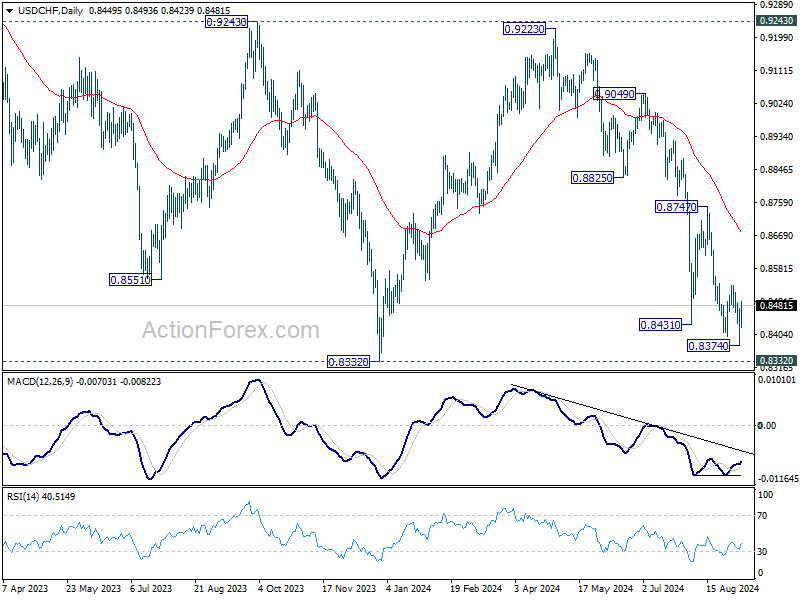
In the bigger picture, price actions from 0.8332 (2023 low) are currently seen as a medium term corrective pattern, with fall from 0.9223 as the second leg. Strong support could be seen from 0.8332 to bring rebound. Yet, overall outlook will continue to stay bearish as long as 0.9243 resistance holds. Firm break of 0.8332, however, will resume larger down trend from 1.0146 (2022 high).
USD/JPY Mid-Day Outlook
Daily Pivots: (S1) 141.42; (P) 142.66; (R1) 143.54; More...
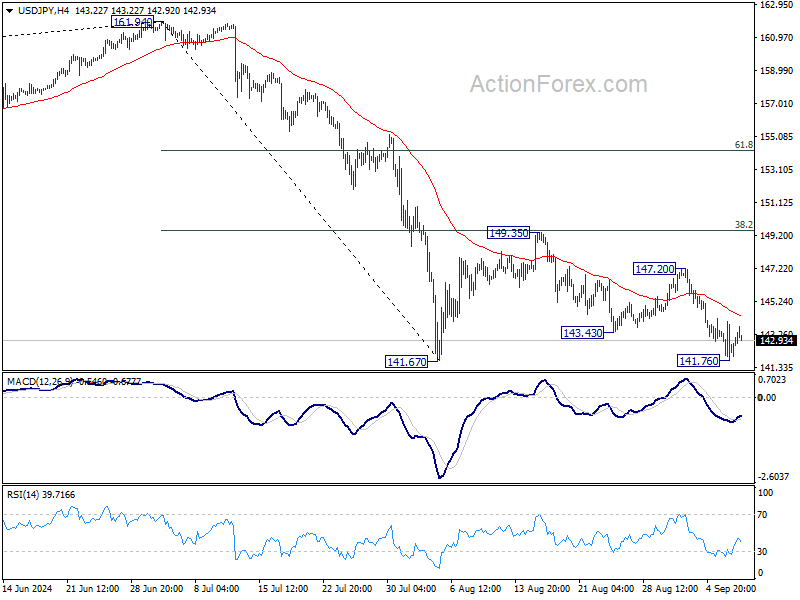
Intraday bias in USD/JPY is turned neutral with 4H MACD crossed above signal line. But further decline is expected as long as 147.20 resistance holds. Decisive break of 141.67 will resume whole decline from 161.95 high. Next target will be 140.25 support.
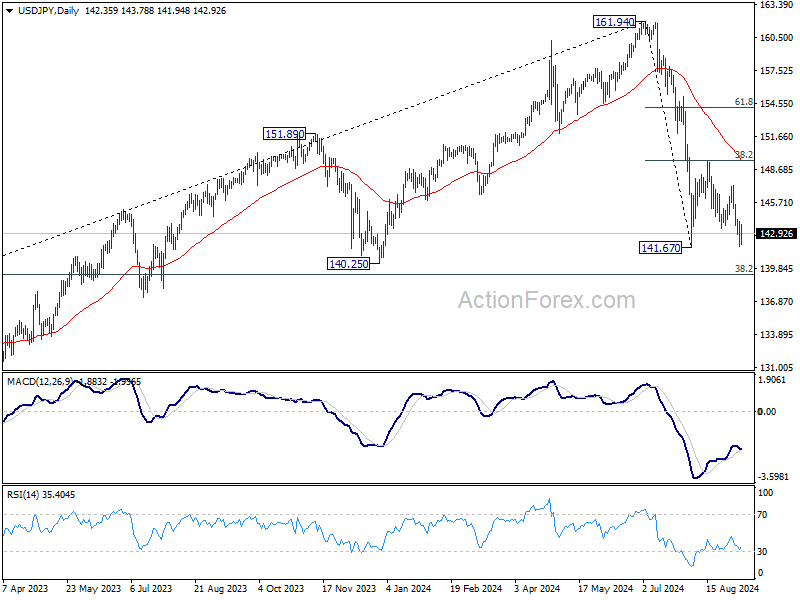
In the bigger picture, fall from 161.94 medium term top is seen as correcting whole up trend from 102.58 (2021 low). Deeper decline could be seen to 38.2% retracement of 102.58 to 161.94 at 139.26, which is close to 140.25 support. In any case, risk will stay on the downside as long as 55 W EMA (now at 149.21) holds. Nevertheless, firm break of 55 W EMA will suggest that the range for medium term corrective pattern is already set.
EUR/USD Mid-Day Outlook
Daily Pivots: (S1) 1.1049; (P) 1.1102; (R1) 1.1138; More....
EUR/USD dips notably today but stays in range above 1.1025. Intraday bias remains neutral for the moment. Consolidation from 1.1200 could extend with deeper pull back, but downside should be contained by 38.2% retracement of 1.0665 to 1.1200 at 1.0996 to bring rebound. Break of 1.1200 will resume larger rise towards 1.1274 high. However, sustained break of 1.0996 will indicate reversal and turn bias to the downside.
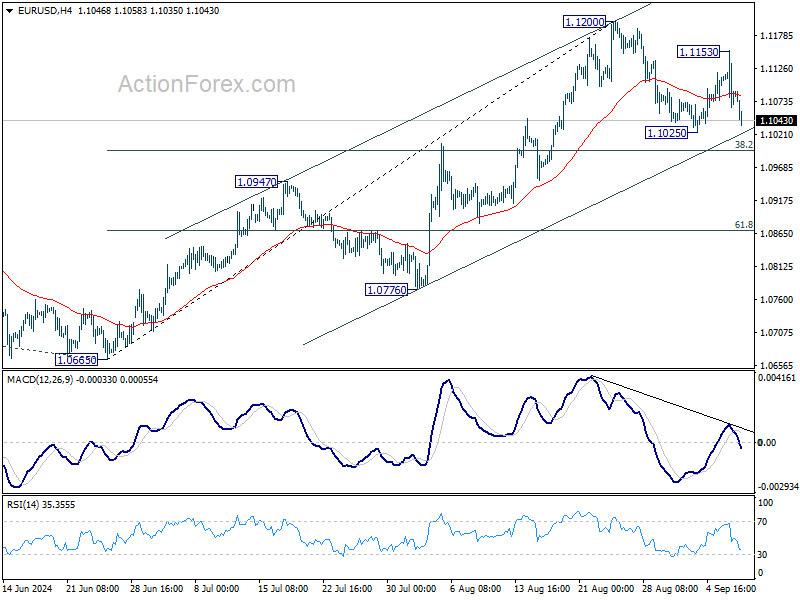
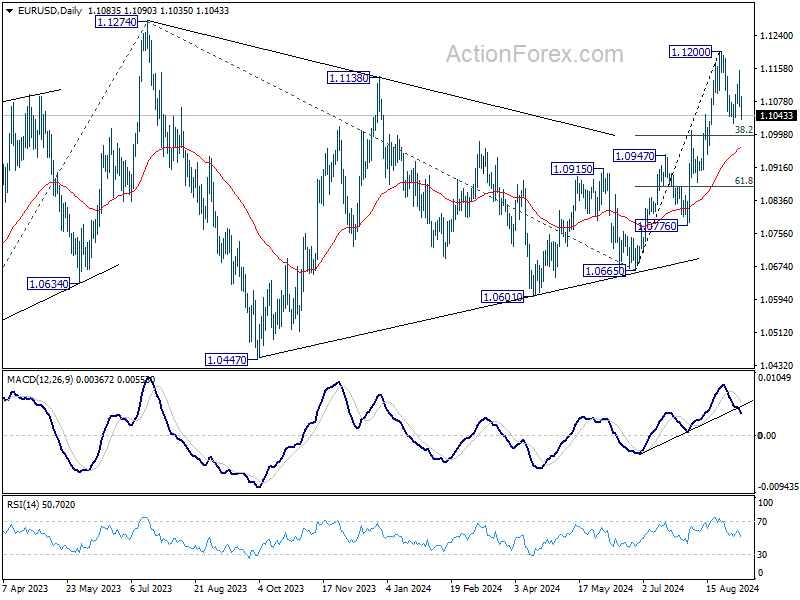
In the bigger picture, prior break of 1.1138 resistance indicates that corrective pattern from 1.1274 might have completed at 1.0665 already. Decisive break of 1.1274 (2023 high) will confirm whole up trend from 0.9534 (2022 low). Next target will be 61.8% projection of 0.9534 to 1.1274 from 1.0665 at 1.1740. This will now be the favored case as long as 1.0947 resistance turned support holds.
Euro Pressured by Weak Investor Confidence Sentiment, Dollar Edges Higher
Dollar strengthened modestly in today's quiet trading as market participants continued to scale back expectations for a more aggressive 50bps rate cut by Fed this month. However, the greenback's momentum remains modest as it awaits a crucial test from the upcoming US CPI data this week. Stabilizing risk sentiment is also keeping a lid on further gains for Dollar for now.
Euro, on the other hand, is on the defensive after Eurozone investor sentiment plummeted to its lowest level this year. Germany, the region's economic powerhouse, is at the center of the downturn, with data signaling that the country may already be in recession. Investor confidence continues to erode, with expectations index showing little sign of improvement, casting doubt on a near-term recovery for Germany and the broader Eurozone.
In terms of currency performance today, Yen and Swiss Franc have emerged as the weakest performers, with Kiwi trailing closely behind. Loonie leads the market, followed by Dollar and Aussie. Euro and British Pound are positioned in the middle of the pack. With no major data releases from the US and Fed in its blackout period ahead of its next meeting, market activity is expected to remain subdued through the remainder of the day.
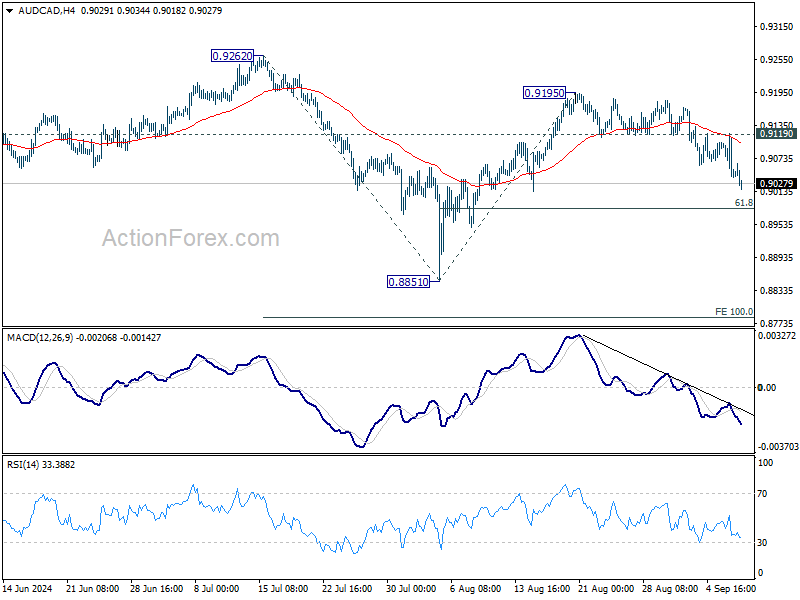
Technically, AUD/CAD's fall from 0.9195 extends lower today. Prior rejection by 55 4H EMA suggests that rebound from 0.8851 has completed already. Deeper fall is now expected as long as 0.9119 resistance holds, towards 61.8% retracement of 0.8851 to 0.9195 at 0.9064. Strong support could be seen there to bring rebound. However, decisive break of 0.9064 will raise the chance that fall from 0.9262 is resuming through 0.8851 to 100% projection of 0.9262 to 0.8851 from 0.9195 at 0.8784.
In Europe, at the time of writing, FTSE is up 0.55%. DAX is up 0.36%. CAC is up 0.52%. UK 10-year yield is up 0.0088 at 3.907. Germany 10-year yield is up 0.032 at 2.211. Earlier in Asia, Nikkei fell -1.42%. Hong Kong HSI fell -1.42%. China Shanghai SSE fell -1.06%. Singapore Strait Times rose 1.22%. Japan 10-year JGB yield rose 0.0449 to 0.895.
Eurozone Sentix investor confidence falls to -15.4, deepening German recession concerns,
Eurozone Sentix Investor Confidence fell sharply again in September, dropping from -13.9 to -15.4, significantly below the expected -11.7. This marks the third consecutive month of declines and the lowest reading since January. The Current Situation Index also weakened, falling to -22.5, its lowest point since December 2023. Meanwhile, the Expectations Index offered a slight improvement, rising from -8.8 to -8.0, but it remains deep in negative territory.
Germany's outlook painted an even bleaker picture. Investor confidence in Europe's largest economy plunged from -31.1 to -34.7, its lowest point since October 2022. Current Situation Index dropped significantly from -42.8 to -48.0, reaching levels not seen since June 2020. Meanwhile, Expectations Index dipped further from -18.5 to -20.3, hitting its lowest since October 2023.
Sentix analysts described the situation as increasingly dire, stating that the German economy is approaching a new "climax" in its deepening recession. The report emphasized that the recession is "raging ever stronger," with expectations continuing to fall, highlighting the "hopelessness" felt by investors.
The report also highlighted that the broader Eurozone is grappling with "dangerous recessionary tendencies," driven largely by Germany's economic struggles. The prospect of a more accommodative monetary policy is now the key hope for market participants, as the ECB is widely expected to announce another rate cut in its upcoming meeting this week.
China's CPI inches up to 0.6% yoy in Aug, but deflationary pressures persist as PPI declines again
China's inflation data for August showed a slight rise in consumer prices, but deflationary pressures continue to weigh on the economy. CPI increased from 0.5% yoy in July to 0.6% yoy, falling short of market expectations of 0.7% yoy.
Food prices saw a notable rise, jumping 2.8% yoy, driven by a 16.1% yoy surge in pork prices and a 21.8% yoy increase in vegetable prices. However, non-food inflation eased significantly, dropping from 0.7% yoy to just 0.2%. Core CPI also fell slightly, rising only 0.3% yoy compared to 0.4% yoy in July.
On a month-over-month basis, China's CPI rose by 0.4% mom , following a 0.5% mom increase in the prior month. While positive, this figure also came in below expectations of 0.5% mom.
Producer prices, on the other hand, extended their negative streak for the 23rd consecutive month. PPI fell from -0.8% yoy in July to -1.8% yoy in August, worse than the anticipated decline of -1.4% yoy.
This persistent deflation in factory-gate prices is being attributed to weak market demand and a continued decline in international commodity prices, according to NBS statistician Dong Lijuan.
Dong also noted that the slight rise in consumer prices in August was largely influenced by seasonal factors, such as high temperatures and rainfall, which boosted food prices.
However, the underlying weakness in both consumer and producer prices points to broader structural issues in China's economy. Economists warn that the ongoing deflationary pressures are a result of production outpacing demand, contributing to a growing surplus and continued challenges for the manufacturing sector.
EUR/USD Mid-Day Outlook
Daily Pivots: (S1) 1.1049; (P) 1.1102; (R1) 1.1138; More....
EUR/USD dips notably today but stays in range above 1.1025. Intraday bias remains neutral for the moment. Consolidation from 1.1200 could extend with deeper pull back, but downside should be contained by 38.2% retracement of 1.0665 to 1.1200 at 1.0996 to bring rebound. Break of 1.1200 will resume larger rise towards 1.1274 high. However, sustained break of 1.0996 will indicate reversal and turn bias to the downside.
In the bigger picture, prior break of 1.1138 resistance indicates that corrective pattern from 1.1274 might have completed at 1.0665 already. Decisive break of 1.1274 (2023 high) will confirm whole up trend from 0.9534 (2022 low). Next target will be 61.8% projection of 0.9534 to 1.1274 from 1.0665 at 1.1740. This will now be the favored case as long as 1.0947 resistance turned support holds.
Economic Indicators Update
| GMT | Ccy | Events | Actual | Forecast | Previous | Revised |
|---|---|---|---|---|---|---|
| 23:50 | JPY | Bank Lending Y/Y Aug | 3.00% | 3.20% | 3.20% | |
| 23:50 | JPY | Current Account (JPY) Jul | 2.80T | 2.10T | 1.78T | |
| 23:50 | JPY | GDP Q/Q Q2 F | 0.70% | 0.80% | 0.80% | |
| 23:50 | JPY | GDP Deflator Y/Y Q2 F | 3.20% | 3.00% | 3.00% | |
| 01:30 | CNY | CPI Y/Y Aug | 0.60% | 0.70% | 0.50% | |
| 01:30 | CNY | PPI Y/Y Aug | -1.80% | -1.40% | -0.80% | |
| 05:00 | JPY | Eco Watchers Survey: Current Aug | 49 | 47.6 | 47.5 | |
| 08:30 | EUR | Eurozone Sentix Investor Confidence Sep | -15.4 | -11.7 | -13.9 | |
| 14:00 | USD | Wholesale Inventories Jul F | 0.30% | 0.30% |
Could US CPI Tip the Balance in Favour of a 50bps Fed Rate Cut?
- Market is digesting last week’s US labour market data
- The August CPI report could fuel 50bps rate cut expectations
- Dollar weakness could continue if inflation surprises to the downside
- The US inflation report will be published at 12:30 GMT on Wednesday
Markets are preparing for the first Fed rate cut
At the recent Jackson Hole Symposium, Fed Chairman Powell indirectly pre-announced the September 18 rate cut and highlighted the importance of the labour market in the current decision process. As a result, last week's mixed jobs market data sealed the rate cut. However, last Friday’s non-farm payrolls figure also increased the market’s concern about the magnitude of the expected economic slowdown, forcing a negative reaction in most stock indices.
Ahead of the usual blackout period, a number of Fed members were on the wires on Friday, essentially confirming the worst kept secret and offering their support for the first, and usually most difficult, decision in an interest rate cycle. But most refrained from openly stating their preference for a 50bps rate move.
Could inflation produce a surprise?
The focus this week turns to inflation as the August report will be released on Wednesday. Powell was quite direct at Jackson Hole about his inflation assessment. He mentioned that inflation is now much closer to the Fed's objective and that "upside risks to inflation have diminished". As such, the importance of the inflation prints has dropped a bit, but this release still holds significant market-moving ability.
Interestingly, the recent inflation-related information is mixed. Last week’s prices paid sub-components for both the services and manufacturing ISM surveys managed to produce upside surprises, thus revealing renewed strength in inflation. Similarly, the mid-August University of Michigan consumer sentiment survey had 1-year expected inflation at 2.9%.
Economists are forecasting a slowdown in the headline figure to 2.6% from 2.9% recorded in July, with the core indicator, which excludes food and energy prices, expected to ease to 3.2%. These forecasts match the Cleveland Fed Nowcast models estimates.
However, there is considerable risk for a downside shift in the headline CPI figure when examining the performance of oil in both August 2023 and last month. In 2023, oil prices increased by 2.3% on a monthly basis, but a sizeable 7% drop was recorded last month. In layman terms, inflation could fall more aggressively and thus add to the Fed doves’ arguments for a more aggressive monetary policy decision next week.
Could a 50bps rate cut become the central scenario?
The market is currently pricing in a 25% probability for a 50bps rate cut on September 18, and a downside inflation surprise would most likely prop-up these expectations. On the flip side, an unsurprising release, which confirms forecasts or even shows a small pick up in inflationary pressures, won’t impact the Fed rate move expectations but could, on the margin, curtail the dovish commentary accompanying the much-expected rate move.
Yen’s outperformance might have legs
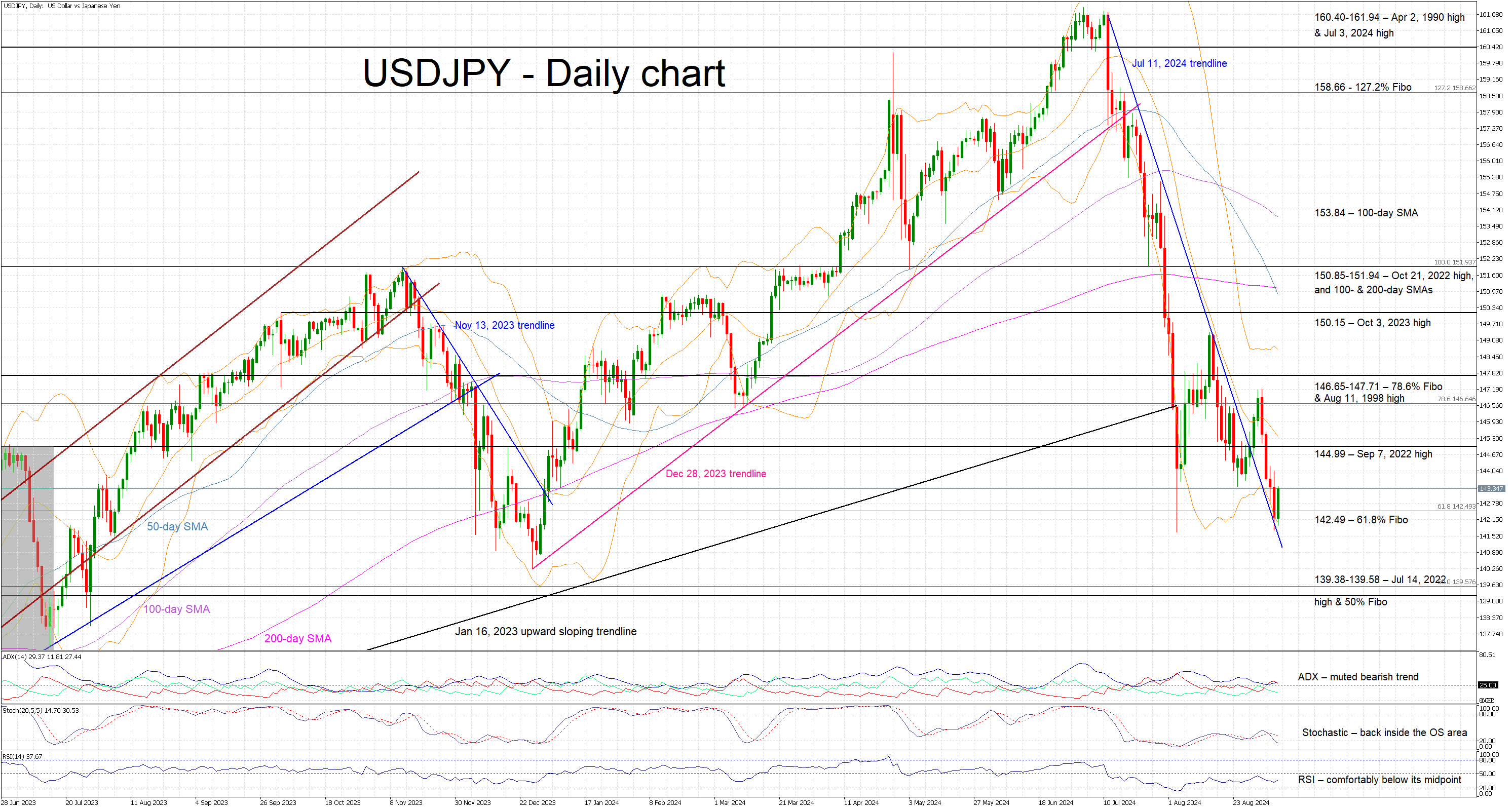
The yen has been consistently outperforming the dollar since July. After stalling in August, the move lower in dollar/yen appears to have started again as the Fed is preparing for its first rate cut. A downside surprise to Wednesday’s inflation report could further fuel the ongoing dollar weakness and could help the dollar/yen bears to finally overcome the 142.49 level.
EUR/CHF: Another Potential Downleg May Intensify After Weak China Inflation
- EUR/CHF has continued to exhibit a high direct correlation with France CAC and Germany DAX.
- China’s core inflation and producer prices for August have indicated a persistent trend of lackluster internal demand.
- Sluggish China’s consumer demand may hurt the profits of key European makers of luxury goods, cars, and machinery.
- Watch the key intermediate support of 0.9255 on the EUR/CHF.
Since the start of September, global benchmark stock indices wobbled where the MSCI All-Country World Index exchange-traded fund (ACWI) ended last Friday, 6 September with a weekly loss of 4%, its worst performance since the week of 6 March 2023 during the onset of the US regional banking crisis.
EUR/CHF continued to move in synch with European stock indices
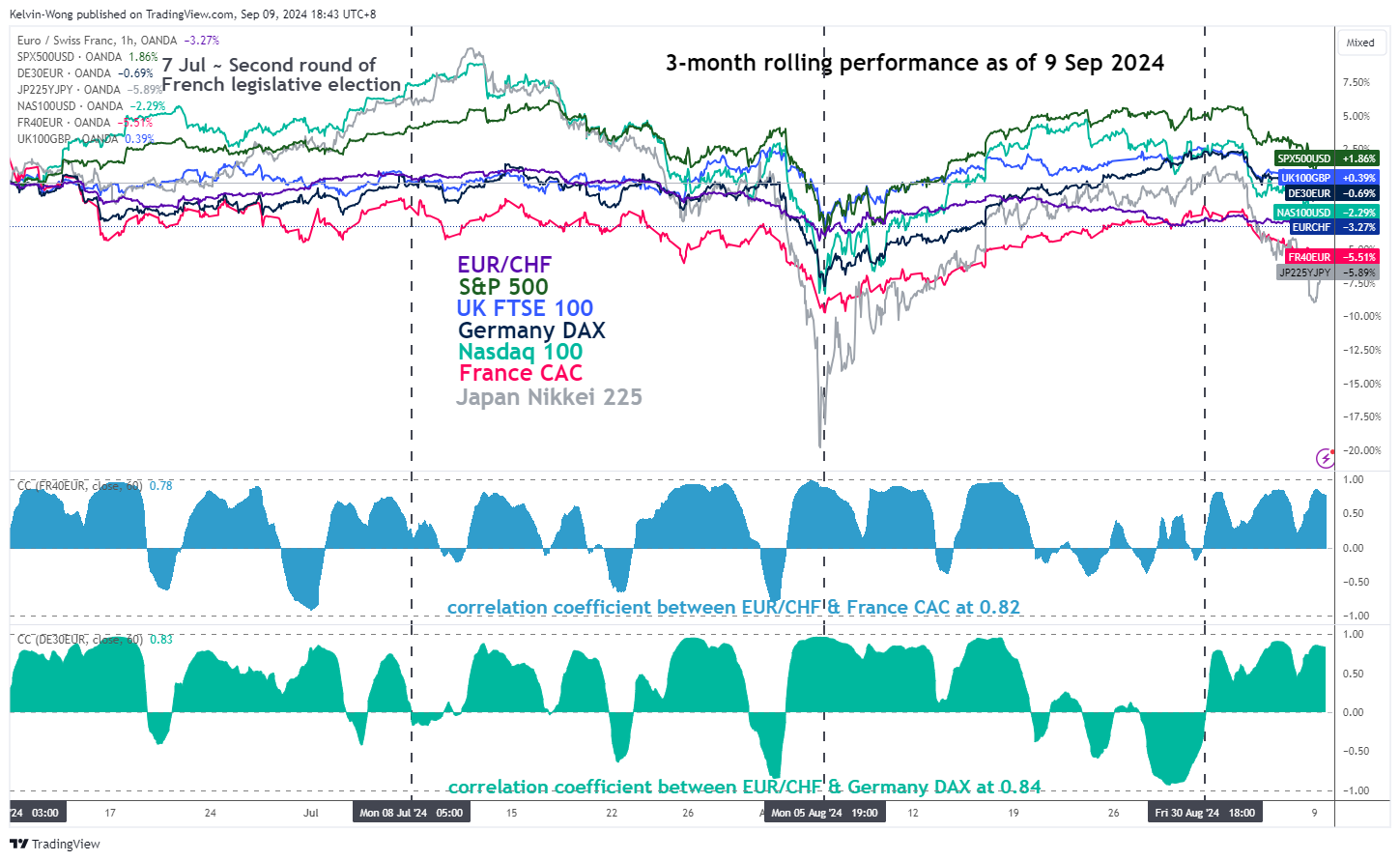
Fig 1: 3-month rolling performance CAC 40, DAX, EUR/CHF & other major stock indices (US, UK, Japan) as of 9 Sep 2024 (Source: TradingView, click to enlarge chart)
Last week’s risk-off episode, the EUR/CHF has moved in tandem with two key European benchmark stock indices; the France CAC and Germany DAX as their respective 60-period rolling correlation coefficients have remained at a high positive reading of 0.82 and 0.84 at this time of the writing (see Fig 1).
Weak China inflation may stoke further downside pressure in European equities
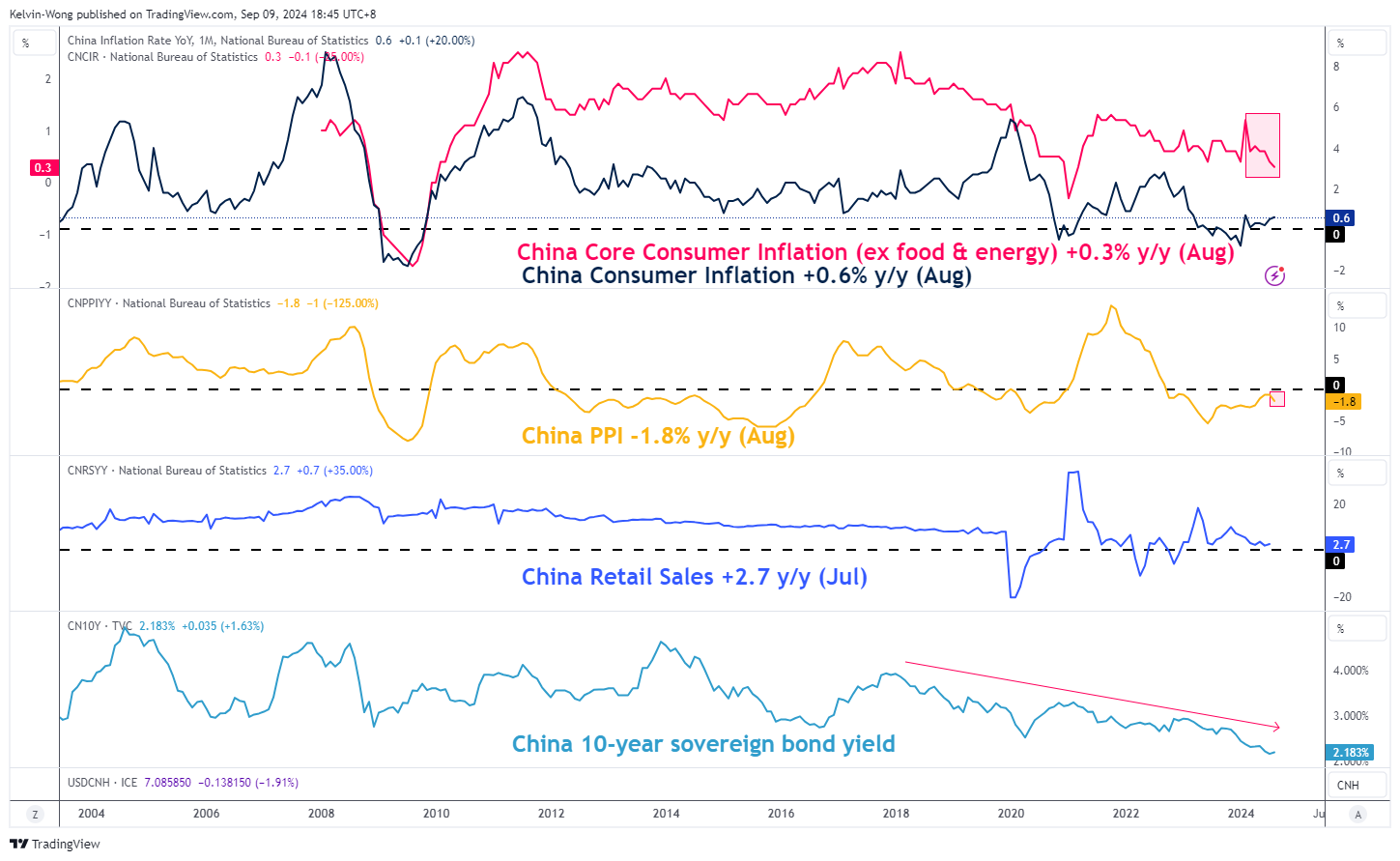
Fig 2: China’s consumer inflation & producer prices trends as of Aug 2024 (Source: TradingView, click to enlarge chart)
Today’s release of China inflation data for August suggests that the state of internal demand in China continued to languish and the deflationary risk spiral narrative is back at the forefront without any clear signals and or initiatives by China’s top policymakers to implement more forceful expansionary policies to drive up consumer and business confidence.
China’s core consumer inflation rate (excluding food and energy) continued to decline for four consecutive months as it fell to 0.3% y/y in August from 0.4% in July. Factory gate prices in China represented by produce prices shrank by 1.8% y/y in August, steeper than its 0.8% drop in the previous month and below expectations of a 1.4% fall (see Fig 2).
Hence, China’s persistent weak consumer demand, a key market for European makers of luxury goods, cars, and machinery is likely to trigger a further toll on these European firms’ profits, in turn, further potential downside on the France CAC and Germany DAX cannot be ruled out.
EUR/CHF is eying the intermediate key support at 0.9255
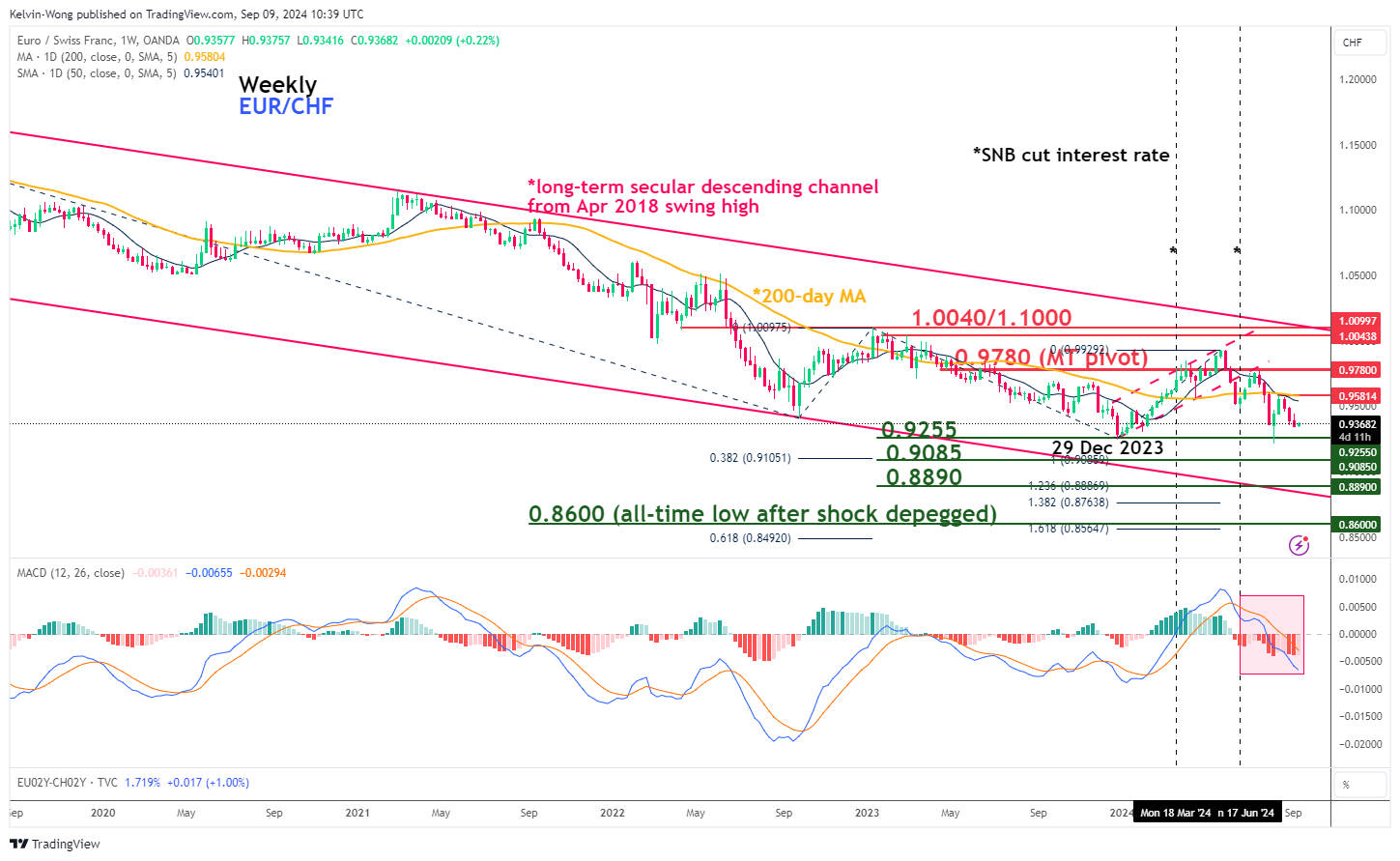
Fig 3: EUR/CHF medium-term & major trends as of 9 Sep 2024 (Source: TradingView, click to enlarge chart)
During the last synchronized global risk-off episode on 5 August, the EUR/CHF staged a decline but managed to “survive” at the 0.9255 level (29 December 2023 swing low).
However, its rebound from 5 August to 12 August has been capped by its 200-day moving average which has acted as a resistance at around 0.9580 (see Fig 3).
In addition, the weekly MACD trend indicator has now breached below its centreline which suggests that the major downtrend phase of the EUR/CHF is likely in the motion to stage lower lows.
If the 0.9780 key medium-term pivotal resistance is not surpassed to the upside and a break below 0.9255, the EUR/CHF may see further weakness for the next medium-term supports to come in at 0.9085 and 0.8890.
However, a clearance above 0.9780 negates the bearish tone for a potential rebound to expose the long-term pivotal resistance zone of 1.0040/1.1000 (also the upper boundary of the long-term secular descending channel from April 2018 high).