

Sample Category Title
Weekly Economic & Financial Commentary: Fishing in Jackson Hole for Clues About the Fed Rate Path
Summary
United States: Solid Activity Raises Questions About the Degree of Policy Easing
- Financial markets were volatile last week as they digested a troubling rise in the unemployment rate in July. The economic calendar this week was packed with solid data that helped quell recession jitters. Inflation continues its gradual descent, and small business optimism has trended higher amid cooler input price growth and steady consumer spending.
- Next week: Leading Economic Index (Mon.), Existing Home Sales (Thu.), New Home Sales (Fri.)
International: Steady U.K. Growth, Gradual Inflation Slowdown Mean Measured Central Bank Easing
- This week's U.K. data were mixed, which we believe keeps the Bank of England on track for a pause in September before resuming rate cuts in November. Q2 GDP grew a respectable 0.6% quarter-over-quarter, employment growth was solid and private sector regular pay growth slowed moderately. We think these factors will keep the Bank of England on hold next month, even as the July CPI showed services and core inflation decelerating a bit more than expected.
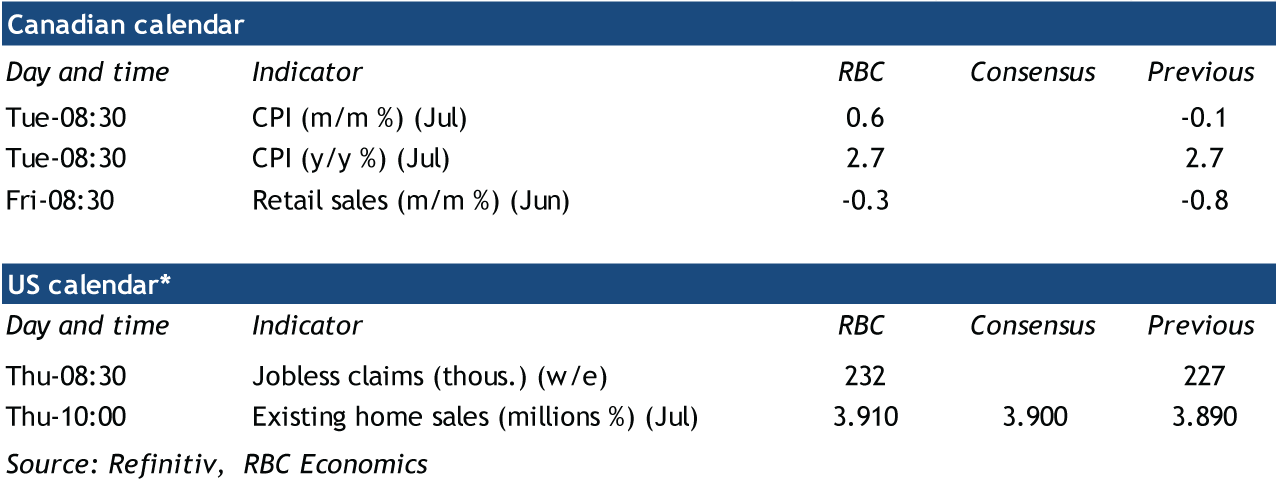
- Next week: Riksbank Policy Rate (Tue.), Canada CPI (Tue.), Eurozone PMIs (Thu.)
Interest Rate Watch: Fishing in Jackson Hole for Clues About the Fed Rate Path
- Chair Powell's highly-anticipated annual speech at Jackson Hole is likely to emphasize how much the inflation and labor market picture have changed in the year since the FOMC took the fed funds target range to 5.00%–5.25%, laying the groundwork for a rate cut at the FOMC's September meeting.
Topic of the Week: Lower Income Household Liquidity Crunch
- Amid a slowdown in the labor market, the staying power of the consumer is once again central to the economic outlook. However, consumer purchasing power may be dwindling for lower income households as they face an increasingly constrained availability of liquid assets.
Steady Inflation Shouldn’t Prevent Another BoC Rate Cut
The easing of Canadian inflation pressures has slowed in recent months. On Tuesday, we expect annual price growth for both the headline and excluding food & energy measures to hold steady at 2.7% and 2.9%, respectively, in July. Shelter inflation still accounts for a disproportionate share of the increase, but that has been slowing with lower interest rates leading to a deceleration in mortgage interest costs (MIC). Consumer price index readings, excluding MIC, have been trending around the 2% inflation target since January.
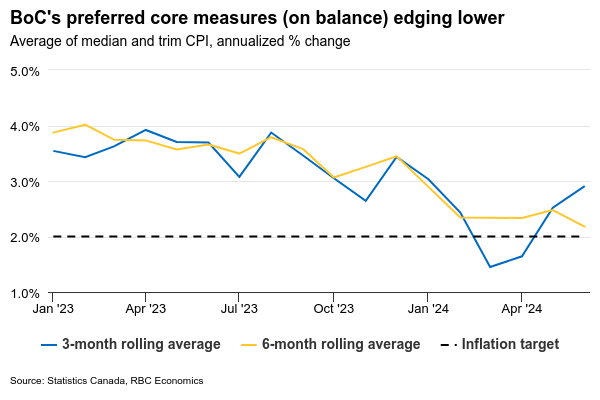
The Bank of Canada is focused on where inflation is going rather than where it has just been. The closely watched three-month rolling average in the BoC’s preferred median and trim core inflation measures (designed to look through monthly volatility and provide a better gauge of underlying price growth trends) likely ticked higher for a second straight month as a meagre monthly increase in April drops out of that calculation. But earlier softer readings mean that annual growth rates in those measures should continue to edge lower. There was concern that initial interest rate cuts from the BoC could reignite rapid house price growth, but the response in housing markets to the 25 basis point cuts in June and July has been muted with signs that rent price growth has also begun to slow.
More importantly, a still weakening economic and labour market backdrop should suggest inflation pressures in Canada will further unwind. Per-capita gross domestic product is continuing to decline in Q2 this year. The unemployment rate is up almost a percentage point from a year ago in July as job openings fall, and wage growth is easing as a result. BoC Governor Tiff Macklem reiterated that confidence has increased that inflation will continue to drift lower even if “there could be setbacks along the way” after cutting rates in July. That means a low hurdle against the BoC cutting rates from levels that are still sharply above what it views as normal in the long run. We think the BoC will cut rates by 25 bps in each of the upcoming meetings in September and October.
Week ahead data watch:
Canadian retail sales likely dropped by 0.3% in June, driven by a price-related sales decline at gas stations. That was partially offset by higher auto sales that edged higher by 0.7% on a seasonally adjusted basis.
A potential rail strike or lockout at both of Canada’s major rail companies could begin as early as August 22 if an agreement isn’t reached with the union. Historically, there have not been disruptions from both major rail companies at the same time. Rail shipping accounts for about 0.5% of GDP. Trucking activity would rise in the event of a strike, but it cannot replace rail shipments, particularly for products like grains. Relatively high levels of inventories in the manufacturing sector could blunt the immediate downstream impact of transportation disruptions, but a shutdown of any significant length (e.g., more than a week) could have a substantial impact on the broader macroeconomy.
Week Ahead – Jackson Hole and PMIs Enter the Spotlight
- As recession fears ease, investors lock gaze on Jackson Hole
- Eurozone and UK PMIs to affect ECB and BoE expectations
- Canadian inflation could back third consecutive BoC cut
- Japan’s Nationwide CPI data also on the agenda
Jackson Hole to test overly dovish Fed cut bets
Following the unjustified panic triggered by the weaker-than-expected NFP report for July, investors have taken a calmer stance, thereafter, reevaluating their aggressive Fed rate cut bets as the incoming data suggested that the US economy is not faring as badly as initially feared.
That said, from penciling as many as 125bps worth of rate cuts by the end of the year at the start of last week, investors lifted their implied path only slightly. They are now expecting rates to be lowered by closer to 100bps, which remains an overly dovish bet as it means a reduction at each of the remaining decisions for 2024, including a 50bps cut.
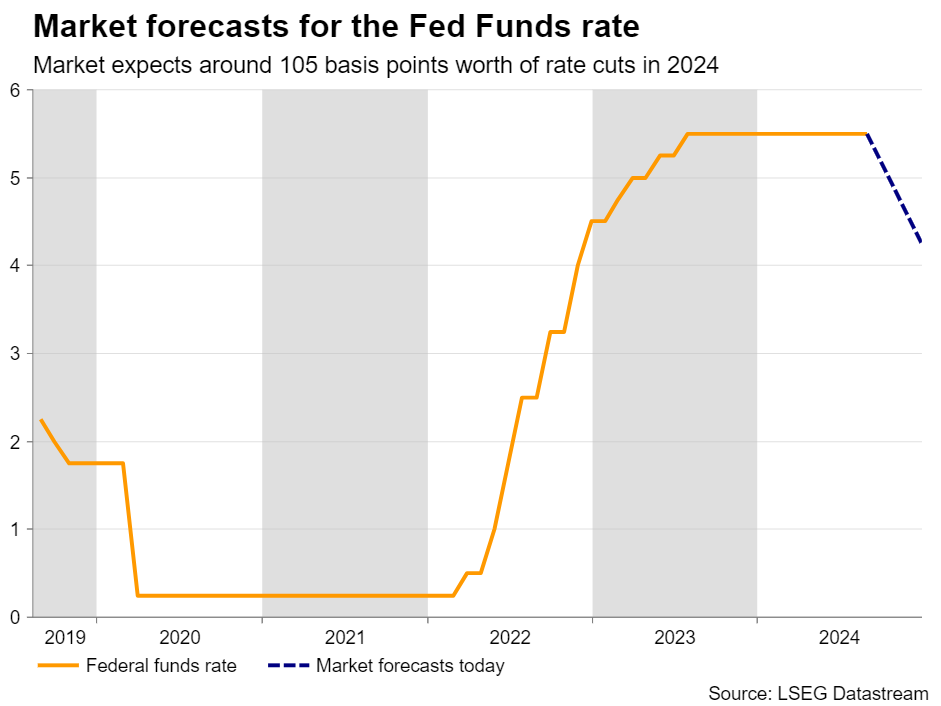
The probability of a double cut at the upcoming meeting in September currently stands at about 25%, while such action is almost fully priced in for December. With that in mind, next week, investors will lock their gaze on the Fed’s Jackson Hole Economic Symposium, which will be held on August 22-24.
The theme will be “Reassessing the Effectiveness and Transmission of Monetary Policy”, suggesting that investors may have to digest a lot of commentary, not only from Fed Chair Powell and his colleagues, but from other major central bankers as well.
With inflation remaining close to 3%, it will be interesting to see whether Powell and other Fed members maintained their confidence about a downward trajectory in price pressures, and if so, how they are planning to move forward. Even if Powell repeats that the door to a September cut remains open, he is unlikely to satisfy those expecting hints about a double rate cut, which means that Treasury yields and the US dollar could still edge up.
Equity traders may be more eager to hear Powell’s take on the US economy, especially after the latest turmoil. Further reassurance that the risk of a recession is not elevated may allow Wall Street to march further north, even if expectations of very low borrowing costs are scaled back.
The minutes of the latest meeting are due to be released on Wednesday, but investors may prefer to pay more attention to the Jackson Hole symposium for more updated information and signals. The preliminary S&P Global PMIs for August on Thursday may also attract attention as investors remain eager to find out how the world’s largest economy is faring.
PMIs also on the front page of investors’ agenda
The preliminary S&P Global PMIs from the Eurozone and the UK are also due to be released that day.
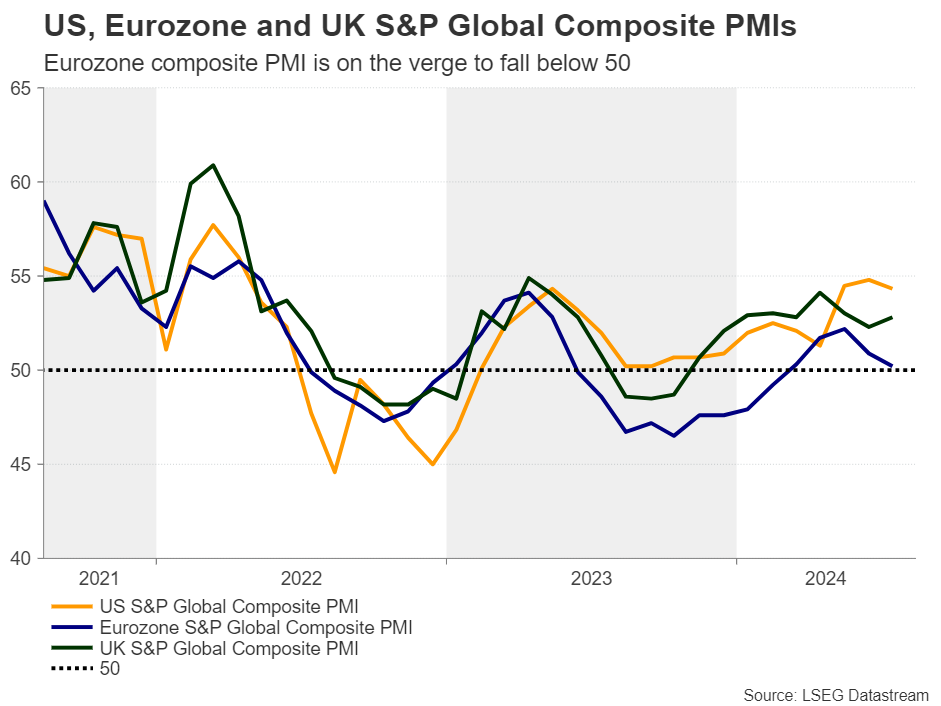
Getting the ball rolling with the Eurozone, at its latest meeting, the ECB decided to keep interest rates unchanged, and although President Lagarde did not commit to a September cut, she sounded downbeat about the Eurozone’s growth outlook.
This allowed investors to nearly fully price in another 25bps reduction in September, and a set of downbeat PMIs may validate that view. That said, market participants may also dig into the minutes of the latest decision, due out the same day, for hints on how policymakers are planning to move forward.
In the UK, the Bank of England lowered interest rates on August 1 but signaled it will be ‘careful’ about cutting again. This week’s data revealed that the unemployment rate dropped to 4.2% from 4.4%, and that headline inflation rebounded somewhat to 2.2% y/y from 2.0%, even though the core rate slipped to 3.3% from 3.5%.
The data corroborated the BoE’s view, but still, there is around a 30% chance that policymakers will opt for a back-to-back reduction on September 19. For that probability to go higher, the PMIs may need to point to a significant deterioration in business activity.
Will CPI data halt the loonie’s recovery?
The Canadian CPI figures are scheduled to be released on Tuesday and the nation’s retail sales on Friday. The BoC cut interest rates by 25bps at each of the last two decisions, keeping the door open for more action down the line.
Investors are convinced that the Bank will continue cutting at each of the remaining decisions of the year and a further slowdown in inflation may add credence to that view, thereby weighing on the loonie at the time of the release.
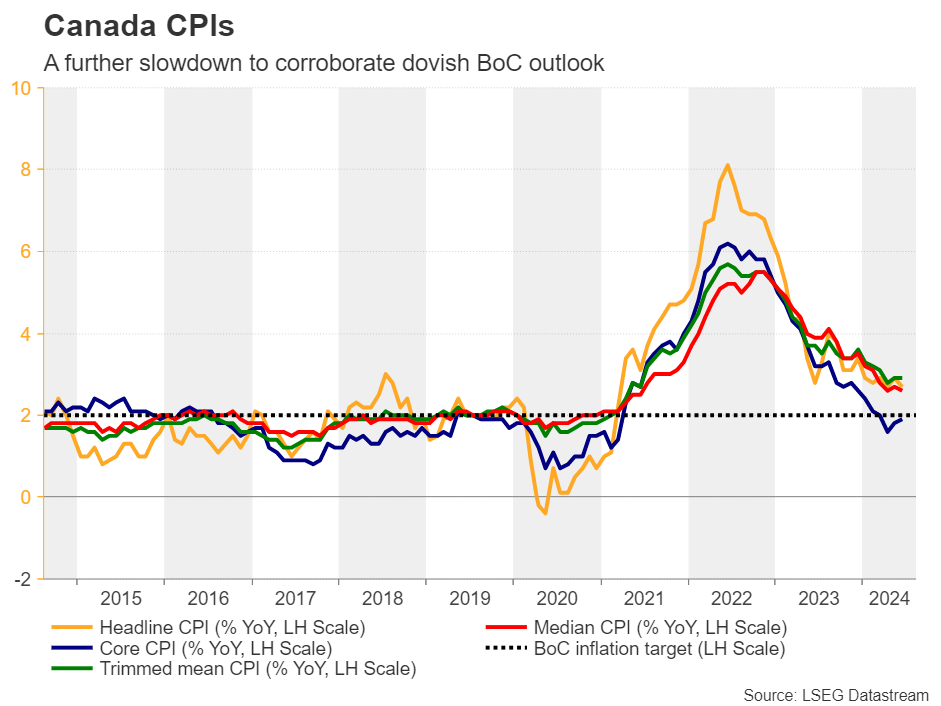
However, currently, the oil-linked currency seems to be mainly driven by the rebound in oil prices, which is the result of supply concerns due to the increasing tensions in the Middle East, as well as easing demand worries as recession fears abate. Therefore, given that a dovish path is already priced in for the BoC, a further slowdown in inflation is unlikely to alter much the current outlook.
Japan’s CPI inflation also on tap
Finally, during the Asian session Friday, Japan releases its own Nationwide CPI numbers for July and according to the Tokyo prints for the month, headline inflation slowed but underlying prices continued to accelerate. If this is reflected on the national prints, then the probability for another BoJ hike by the end of the year may increase.
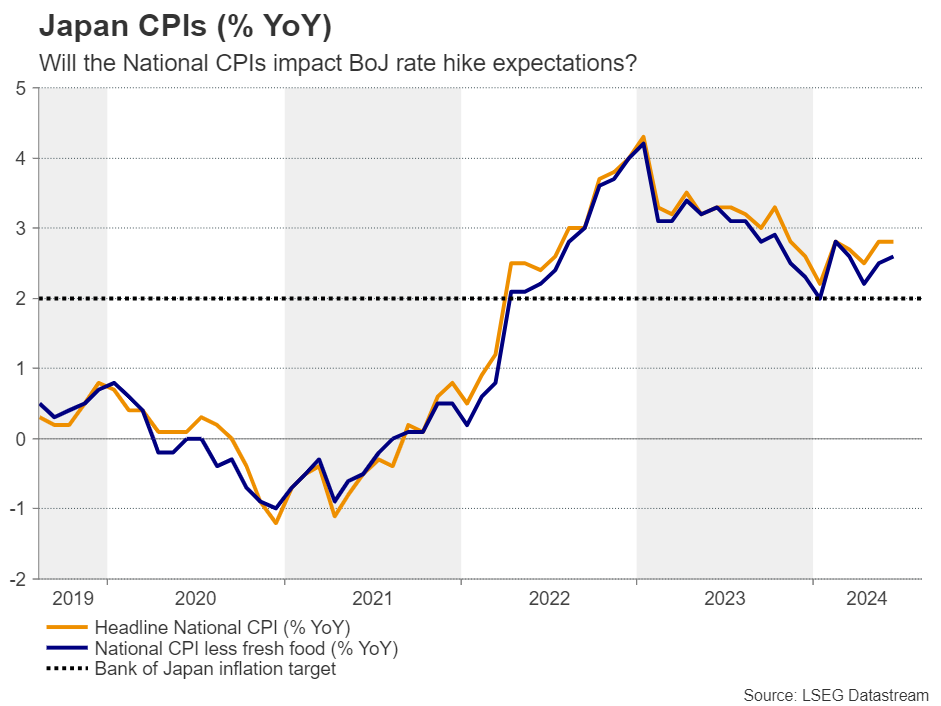
Nevertheless, even if this translates into a stronger yen, the latest relief in investors’ appetite is unlikely to allow the currency to stage a rally similar to that of the past few weeks. Interest rates in Japan remain very low compared to other major central banks, allowing some market participants to reuse the yen as a funding currency while increasing their risk exposures.
Weekly Focus – From Fear of Inflation to Fear of Slowdown
Over the summer, we have seen big moves in financial markets largely reflecting conflicting views of the US economy. During the first half of 2024, markets were often driven by concerns about persistently high US inflation and the implication that it would be difficult for the Fed to reduce interest rates. However, the last three inflation prints now show core inflation in line with or below the 2% annual target, making it much easier for the Fed to cut (although some concerns about service prices remain). Attention has instead shifted to whether there is not only room but also a need for rate cuts to support the economy. Not least a jump in the unemployment rate to 4.3% in July triggered fears that the US is nearing or already in recession, and market pricing shifted to include quite aggressive rate cuts this year. Earlier this year equity markets reacted very positively to prospects of rate cuts, but in early August, that was overshadowed by a negative reaction to fears of weakness in the economy.
Over the last two weeks, markets have calmed down and expectations for rate cuts have partially reversed. Even though unemployment and other indicators of slack in the US labour market have increased, many other indicators still point to robust economic growth, such as this week's retail sales data for July. Higher unemployment can also be largely explained by growth in the labour force due to immigration rather than by weak demand, which makes it less of an obvious trigger for recession dynamics. We agree that low inflation has cleared the path for "normalisation" of interest rates from current high levels and for the Fed to consider the labour market and not only inflation, but the process of rate cuts is still likely to be gradual and cautious, with large reactions in interest rate markets to economic news.
As often before, lower bond yields in the US have been reflected in Europe. However, euro area inflation is still clearly above target, and we have not really had signs of cooling labour markets. A lot depends on data, not least upcoming wage data for Q2, but it seems to us that the ECB is more likely than not to wait before cutting rates further.
The recovery in global manufacturing seems to have stalled somewhat, which is also part of the backdrop for increased economic concerns in markets. We continue to see signs of weak growth in China where it seems that initiatives to stimulate demand have not been very successful so far, and more is likely to be needed.
Japan delivered a surprisingly early rate hike in July, and we have seen a strong rally in the JPY in connection with the market turbulence over the last month. After three disappointing quarters, GDP increased 0.8% in Q2, and further rate hikes are likely.
We will get PMI data for most major economies in the coming week. If we see some reversal of weak indicators for manufacturing that we saw in July, that could further dampen recession fears in the market. It is also time for the annual Jackson Hole Economic Policy Symposium which has often been used by the Fed (and occasionally the ECB) in the past to influence market expectations.
XAUUSD: Formation of Bullish Pattern: Signs of Trend Continuation
- Bearish Scenario: Sell positions below 2470 with TP1: 2463, TP2: 2460, TP3: 2456 intraday, with a stop loss above 2473 or at least 1% of the account capital.
- Bullish Scenario: Buy positions after a pullback above 2460 with TP1: 2470, TP2: 2480, and TP3: 2490 in extension. Stop loss below 2450 or at least 1% of the account capital. Apply Trailing Stop.
Technical Analysis
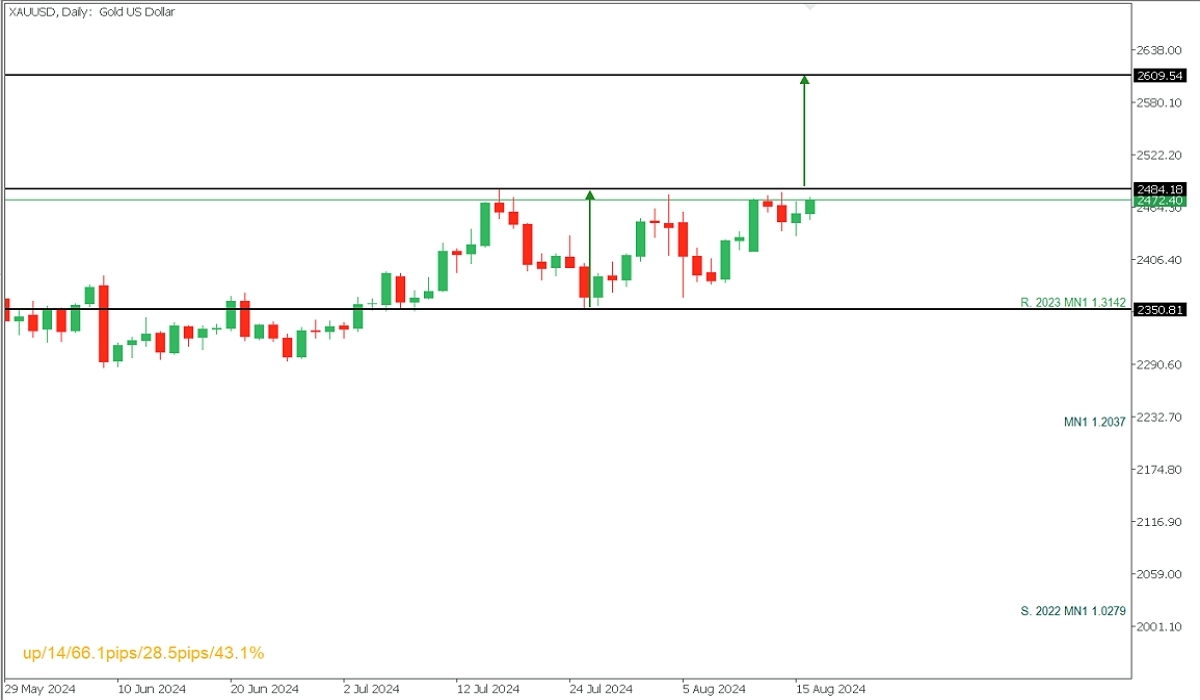
XAUUSD, Daily
On this timeframe, price consolidation is observed below the July resistance and current all-time high, forming a bullish cup and handle structure. This suggests a continuation of buying pressure in the short term with profit targets at 2500, 2600, and 2609 at 100%.
XAUUSD, H1
Supply Zones (Sell): 2473
Demand Zones (Buy): 2455.18, 2428.49, and 2423.80
The price shows signs of recovery after breaking local resistances at 2460 and 2470, suggesting a continuation of the macro bullish trend with a target at 2500 intraday and the potential for new all-time highs in the short term.
In this context, the breakout of a previous session’s resistance activates a corrective scenario, with targets at 2462, 2460, 2458, and 2456 in extension.
All these levels represent demand zones that could trigger buys towards 2473, 2480, 2483, and the average daily bullish range at 2492.81.
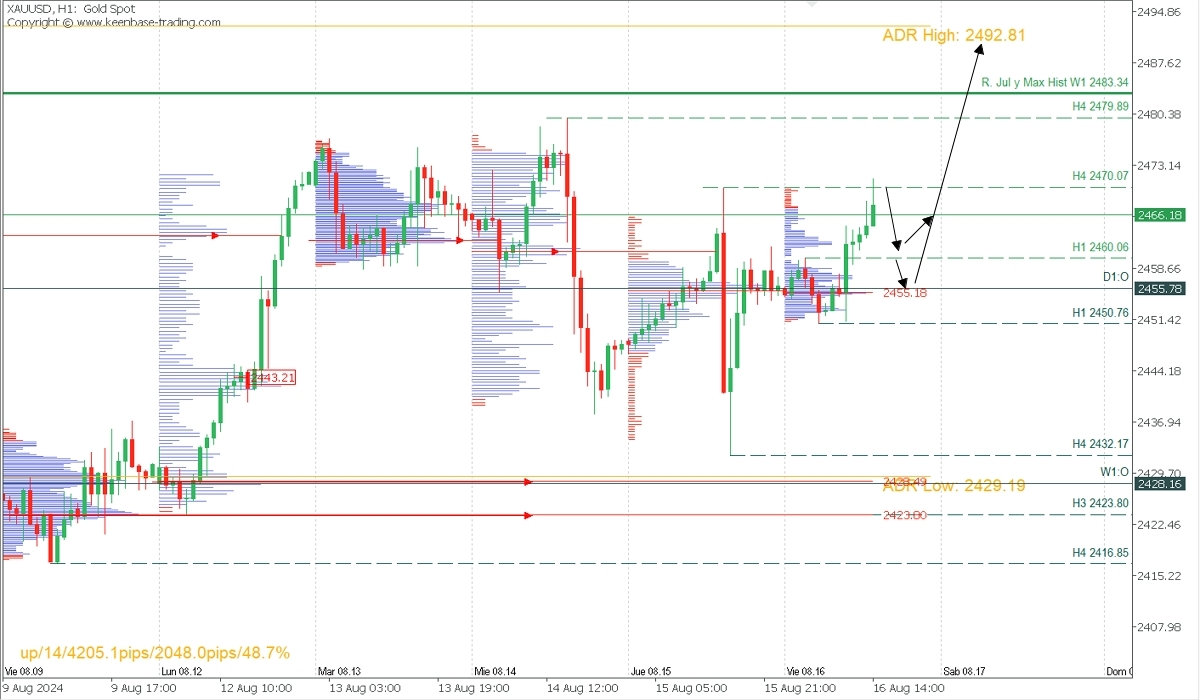
*Uncovered POC: POC = Point of Control: This is the level or zone where the highest volume concentration occurred. If a downward move follows this level, it is considered a sell zone and forms a resistance area. Conversely, if an upward move follows it, it is considered a buy zone, usually located at lows, forming support zones.
GBP/USD Mid-Day Outlook
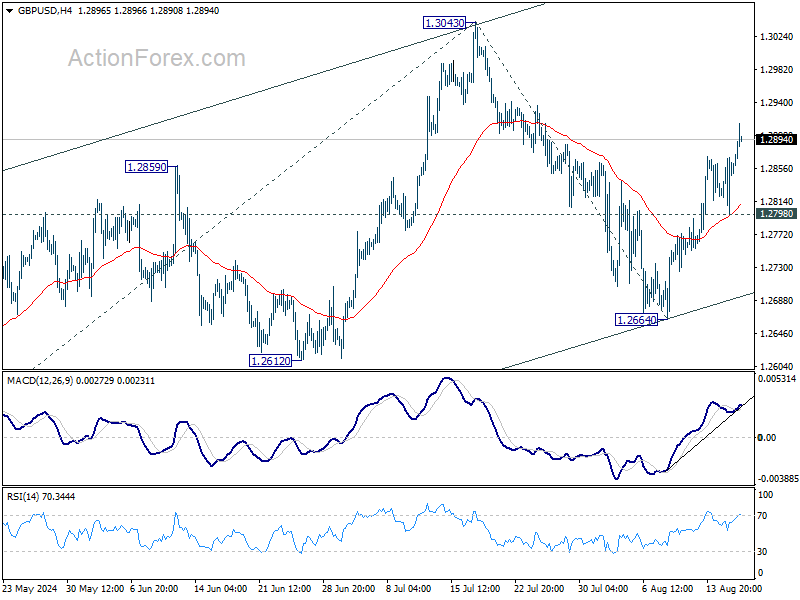
Daily Pivots: (S1) 1.2811; (P) 1.2841; (R1) 1.2884; More...
Intraday bias in GBP/USD remains on the upside for retesting 1.3043 high. Decisive break there will resume whole rally from 1.2998 to 61.8% projection of 1.2298 to 1.3043 from 1.2664 at 1.3124, which is close to 1.3141 high. On the downside, however, break of 1.2798 support will turn bias back to the downside for 1.2664 support instead.
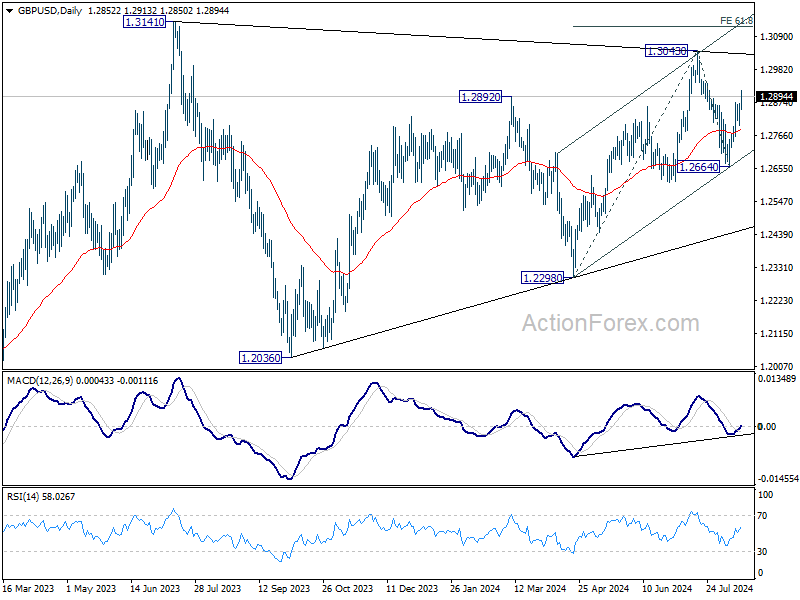
In the bigger picture, as long as 1.3141 resistance holds (2023 high), medium term corrective pattern from there could still extend with another falling leg. But even in that case, downside should be contained by 1.2036/2298 support zone. Meanwhile, decisive break of 1.3141 will confirm resumption of whole up trend from 1.0351 (2022 low).
EUR/USD Mid-Day Outlook
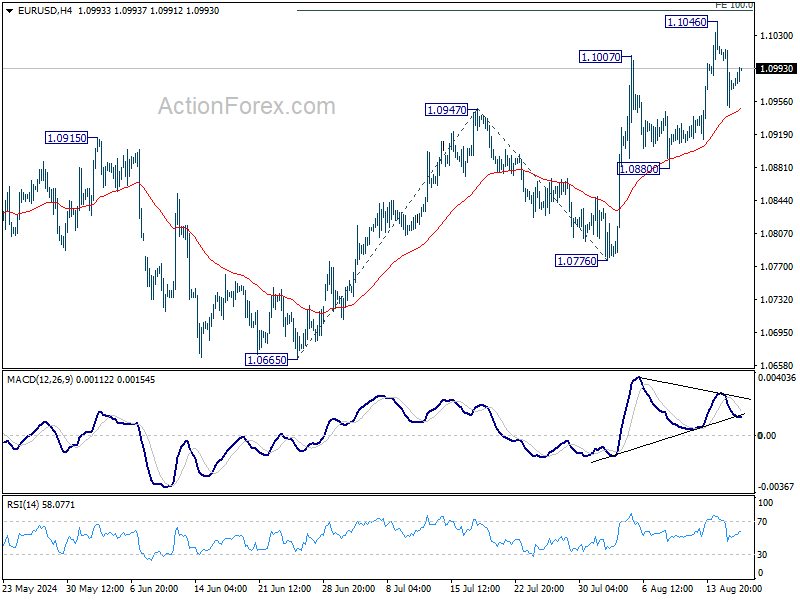
Daily Pivots: (S1) 1.0942; (P) 1.0980; (R1) 1.1010; More.....
EUR/USD is staying in consolidation below 1.1046 and intraday bias remains neutral. Another rally is in favor as long as 1.0880 support holds. Firm break of 100% projection of 1.0665 to 1.0947 from 1.0776 at 1.1058 could prompt upside acceleration through 1.1138 resistance to 161.8% projection at 1.1232. However, considering bearish divergence condition in 4H MACD, break of 1.0880 will suggest near term reversal and turn bias to the downside for 1.0776 support and below.
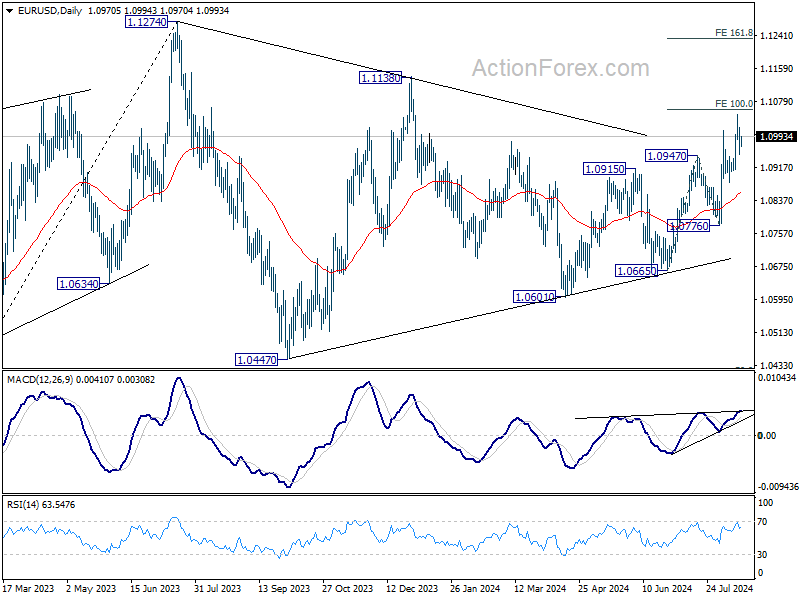
In the bigger picture, price actions from 1.1274 are viewed as a corrective pattern that's could still extend. Break of 1.1138 resistance will be the first signal that rise from 0.9534 (2022 low) is ready to resume through 1.1274 (2023 high). However, break of 1.0776 support will extend the correction with another falling leg back towards 1.0447 support.
USD/CHF Mid-Day Outlook
Daily Pivots: (S1) 0.8666; (P) 0.8707; (R1) 0.8768; More….
Intraday bias in USD/CHF is turned neutral first as it retreated after hitting 0.8747. On the upside, sustained break of 38.2% retracement of 0.9223 to 0.8431 at 0.8734 will extend the rebound from 0.8431 to 61.8% retracement at 0.8920, even as a corrective move. On the downside, break of 0.8616 support will indicate rejection by 0.8734, and turn bias back to the downside for retesting 0.8431 low.

In the bigger picture, price actions from 0.8332 (2023 low) are currently seen as a medium term corrective pattern, with fall from 0.9223 as the second leg. Strong support could be seen from 0.8332 to bring rebound. Yet, overall outlook will continue to stay bearish as long as 0.9243 resistance holds. Firm break of 0.8332, however, will resume larger down trend from 1.0146 (2022 high).

USD/JPY Mid-Day Outlook
Daily Pivots: (S1) 147.76; (P) 148.58; (R1) 150.09; More...
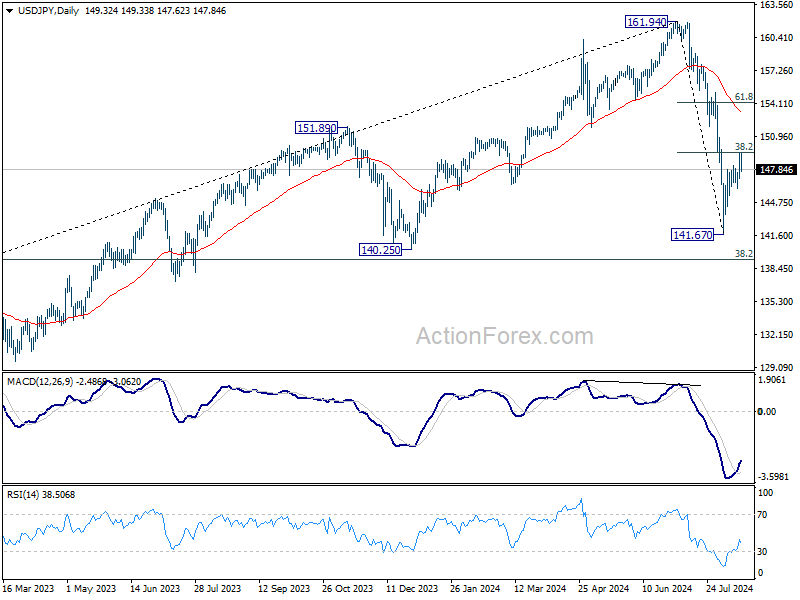
Intraday bias in USD/JPY is turned neutral as it retreated after failing to break through 38.2% retracement of 161.94 to 141.67 at 149.41. On the downside, break of 146.06 minor support will suggest rejection by 149.91, and turn intraday bias back to the downside for retesting 141.67 low instead. On the upside, sustained break of 149.41 will extend the rebound to 61.8% retracement at 154.19, as the second leg of the corrective pattern from 161.94.
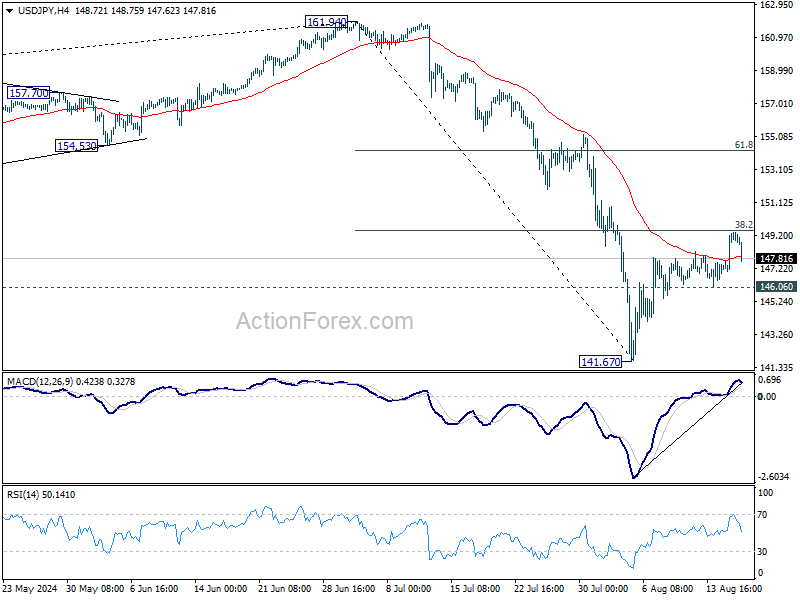
In the bigger picture, fall from 161.94 medium term is seen as correcting whole up trend from 102.58 (2021 low). Deeper decline could be seen to 38.2% retracement of 102.58 to 161.94 at 139.26, which is close to 140.25 support. In any case, risk will stay on the downside as long as 55 W EMA (now at 149.77) holds. Nevertheless, firm break of 55 W EMA will suggest that the range for medium term corrective pattern is already set.
Yen and Swiss Franc Recover as Benchmark Yields Ease
As the US session gets underway, both Yen and Swiss Franc are beginning to recover, aided by the slight pullback in benchmark Treasury yields in the US and Europe. This recovery comes after a tough week for the two safe-haven currencies, which have been the worst performers amid broad risk-on sentiment. Despite today's gains, Yen and Swiss Franc still face an uphill battle to reverse their losses and end the week on a positive note.
British Pound, on the other hand, continues to show strength, particularly against Dollar and Euro. Sterling was supported by data showing rebound in retail sales, even that slightly missed expectations. Overall, this week's slew of data didn't add too much evidence to convince BoE to continue with another rate cut at next meeting. Meanwhile, commodity currencies like the Australian and Canadian Dollars have had a more subdued performance.
The final positions for these currencies as the week closes may be influenced by the upcoming University of Michigan consumer sentiment and inflation expectation data, and their impact of risk sentiment.
In Europe, at the time of writing, FTSE is down -0.62%. DAX is up 0.33%. CAC is flat. UK 10-year yield is down -0.0119 at 3.914. Germany 10-year yield is down -0.036 at 2.229. Earlier in Asia, Nikkei surged 3.64%. Hong Kong HSI rose 1.88%. China Shanghai SSE rose 0.07%. Singapore Strait Times rose 1.12%. Japan 10-year JGB yield rose 0.0372 to 0.875.
Eurozone goods exports fall -6.3% yoy in Jun, goods imports down -8.6% yoy
Eurozone goods exports fell -6.3% yoy to EUR 236.7B in June. Goods imports fall -8.6% yoy to EUR 214.3B. Trade balance showed a EUR 22.3B surplus. Intra-Eurozone trade fell -8.5% yoy to EUR 214.5B.
In seasonally adjusted term, goods exports fell -0.2% mom to EUR 236.2B. Goods imports fell -2.4% mom to EUR 218.7B. Trade surplus widened from EUR 12.4B in the prior month to EUR 17.5B, larger than expectation of EUR 14.5B. Intra-Eurozone trade rose 0.4% mom to EUR 210.7B.
UK retail sales rises 0.5% mom in Jul, vs exp 0.6% mom
UK retail sales volumes rose by 0.5% mom in July, slightly below market expectations of 0.6% increase. On a broader scale, sales volumes in the three months leading up to July saw a 1.1% rise compared to the previous three months ending in April.
Breaking down the data, non-food stores—which include department, clothing, household, and other non-food stores—saw a notable 1.4% increase in sales volumes. Non-store retail sales, which encompass online and other forms of retail not conducted in physical stores, rose by 0.7%, driven primarily by a rebound in retailers other than mail order services. However, the overall growth was tempered by a -1.9% decline in automotive fuel sales volumes.
RBA's Bullock dismisses near-term rate cut expectations
In her remarks to the House of Representatives' economics committee, RBA Governor Michele Bullock emphasized the careful balancing act in managing inflation while minimizing harm to the labor market. Bullock reiterated that the Board believes current monetary policy is "sufficiently restrictive" to bring inflation down over a reasonable timeframe without causing undue damage to employment.
Despite financial markets anticipating a rate cut by the end of the year, Bullock was clear in her message that it is "premature to be thinking about rate cuts" at this stage. She pointed out that inflation remains too high and, in underlying terms, is not expected to fall back within the target range until the end of next year.
While acknowledging that economic circumstances could change, Bullock firmly stated that, based on the current outlook, the Board "does not expect that it will be in a position to cut rates in the near term."
RBNZ confident in inflation outlook, emphasizes measured approach to further rate cuts
In a speech today, RBNZ Governor Adrian Orr expressed a "very strong level of confidence" that forward indicators are pointing to a return to low and stable inflation, within the target range of 1% to 3%. Orr emphasized the importance of keeping inflation expectations and pricing intentions "anchored" as the central bank continues to monitor economic conditions.
Assistant Governor Karen Silk, speaking in a separate interview, noted that RBNZ is observing a continued decline in price and wage-setting behaviors. Silk mentioned that if this adjustment occurs more rapidly than anticipated, it could open the door for the central bank to consider a different, potentially faster path for rate cuts.
Earlier this week, RBNZ lowered the OCR by 25 bps to 5.25% and projected that it would fall below 4% by the end of 2025. Silk reiterated that RBNZ is taking a "measured approach" to policy loosening and remains committed to a data-dependent strategy.
New Zealand BNZ manufacturing rises to 44, 17th month of contraction
New Zealand's manufacturing sector showed a slight improvement in July, with the BusinessNZ Performance of Manufacturing Index rising from 41.2 to 44.0. Despite this rebound, the sector remains deeply entrenched in contraction, marking its 17th consecutive month below the expansion threshold. The current level is still significantly below the long-term average of 52.6.
Breaking down the data, production saw an uptick, increasing from 35.7 to 43.4, while new orders also rose, moving from 39.0 to 42.5. However, employment in the sector continued to decline, slipping from 44.0 to 43.1. Finished stocks decreased from 47.7 to 46.5, and deliveries fell slightly from 44.8 to 44.3.
Despite the relative improvement in activity, the proportion of negative comments from respondents remained high, though it eased slightly to 71.1% in July from 76.3% in June. Businesses cited ongoing issues such as a lack of orders, customers, and sales, which have been persistent concerns in recent months.
BNZ's Senior Economist Doug Steel commented that "manufacturing activity will turn when the broader economy turns." He added that easing monetary conditions, including a lower OCR, could help stimulate a general pick-up in sales, but emphasized that this recovery would take time.
USD/JPY Mid-Day Outlook
Daily Pivots: (S1) 147.76; (P) 148.58; (R1) 150.09; More...
Intraday bias in USD/JPY is turned neutral as it retreated after failing to break through 38.2% retracement of 161.94 to 141.67 at 149.41. On the downside, break of 146.06 minor support will suggest rejection by 149.91, and turn intraday bias back to the downside for retesting 141.67 low instead. On the upside, sustained break of 149.41 will extend the rebound to 61.8% retracement at 154.19, as the second leg of the corrective pattern from 161.94.
In the bigger picture, fall from 161.94 medium term is seen as correcting whole up trend from 102.58 (2021 low). Deeper decline could be seen to 38.2% retracement of 102.58 to 161.94 at 139.26, which is close to 140.25 support. In any case, risk will stay on the downside as long as 55 W EMA (now at 149.77) holds. Nevertheless, firm break of 55 W EMA will suggest that the range for medium term corrective pattern is already set.
Economic Indicators Update
| GMT | Ccy | Events | Actual | Forecast | Previous | Revised |
|---|---|---|---|---|---|---|
| 22:30 | NZD | Business NZ PMI Jul | 44 | 41.1 | 41.2 | |
| 22:45 | NZD | PPI Input Q/Q Q2 | 1.40% | 0.50% | 0.70% | |
| 22:45 | NZD | PPI Output Q/Q Q2 | 1.10% | 0.60% | 0.90% | 0.80% |
| 04:30 | JPY | Tertiary Industry Index M/M Jun | -1.30% | 0.30% | -0.40% | 0.60% |
| 06:00 | GBP | Retail Sales M/M Jul | 0.50% | 0.60% | -1.20% | |
| 09:00 | EUR | Eurozone Trade Balance (EUR) Jun | 17.5B | 14.5B | 12.3B | 12.4B |
| 12:15 | CAD | Housing Starts Jul | 280K | 245K | 242K | |
| 12:30 | CAD | Manufacturing Sales M/M Jun | -2.10% | -2.50% | 0.40% | |
| 12:30 | USD | Building Permits Jul | 1.40M | 1.44M | 1.45M | |
| 12:30 | USD | Housing Starts Jul | 1.24M | 1.34M | 1.35M | |
| 14:00 | USD | Michigan Consumer Sentiment Index Aug P | 67.3 | 66.4 |